


 |
市場調查報告書
商品編碼
2114275
塑性溶膠:市場佔有率分析、產業趨勢與統計、成長預測(2026-2031)Plastisols - Market Share Analysis, Industry Trends & Statistics, Growth Forecasts (2026 - 2031) |
||||||

※ 本網頁內容可能與最新版本有所差異。詳細情況請與我們聯繫。
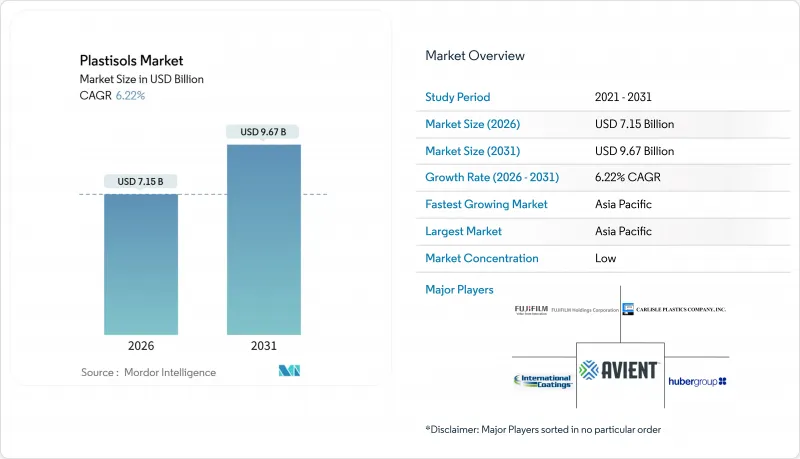
根據 Mordor Intelligence 估計,2026 年塑性溶膠市場價值為 71.5 億美元,預計到 2031 年將達到 96.7 億美元,在預測期(2026-2031 年)內以 6.22% 的複合年成長率成長。
本報告按應用領域(黏合劑和密封劑、油漆和塗料、印刷油墨、模塑產品及其他)、終端用戶行業(建築和施工、交通運輸、紡織、消費電子和機械及其他)以及地區(亞太地區、北美地區、歐洲地區、南美地區以及中東和非洲地區)進行細分。市場預測以美元計價。
全球塑性溶膠市場趨勢及洞察
建築業的蓬勃發展帶動了對油漆和密封劑的需求。
沙烏地阿拉伯的「2030願景」強調使用柔軟性塑性溶膠密封劑,這種密封劑非常適合該地區炎熱的沙漠氣候。在巴西,基礎建設推動了對塑性溶膠屋頂防水卷材和橋樑接縫化合物的需求。阿克蘇諾貝爾收購KANSAI PAINT在東南亞的資產以及佐敦在印尼擴大產能,都促進了東協地區對防護塗料的支出。由於塑性溶膠具有優異的抗衝擊性,即使成本高於聚酯塗料,它們也越來越受到鋼結構屋頂和外牆材料的青睞。然而,阿根廷的大型專案正面臨外匯波動和進口許可證核准延誤的挑戰,這些因素抑制了短期成長前景。
擴大亞太地區的紡織品網版印刷生產能力。
印度的生產連結獎勵計畫計畫(PLI)為紡織製造業注入了大量投資。該計劃與七個總理米特拉(PM MITRA)大型產業園區相結合,旨在擴大國內網版印刷生產。在中國,儘管單價下降,但印染產業的出口在2025年仍實現了成長。這一趨勢顯示中國採取了產能維持策略,進而導致油墨消耗量增加。化學纖維商品及服務稅(GST)的降低顯著降低了投入成本。這項措施鼓勵使用低溫固化塑性溶膠油墨,可能降低每次印刷的能耗。越南和孟加拉的目標是到2030年大幅提高紡織品出口,並有望推動對塑性溶膠油墨的需求。獲得GOTS和RoHS認證的油墨在區域買家中越來越受歡迎,配方生產商也轉向使用高品質、不含鄰苯二甲酸酯的化學成分。
嚴格的聚氯乙烯和鄰苯二甲酸酯法規(REACH、RoHS、CPSIA)
歐洲化學品管理局 (ECHA) 將於 2023 年生效的禁止在玩具和嬰兒產品中使用鄰苯二甲酸二異壬酯 (DINP)、鄰苯二甲酸二異壬酯 (DIDP) 和鄰苯二甲酸二異壬酯 (DnOP) 的禁令,將導致企業需要進行雙重營運資金的需求量。在美國,《有毒物質控制法案》(TSCA) 的報告要求造成了行政負擔,小規模配方生產商將不得不承擔鄰苯二甲酸酯強制性第三方檢測的費用。隨著中國的 GB 6675 標準與歐洲標準接軌,以及印度即將完成其 IS 9873 法規的製定,全球法規的趨同趨勢日益明顯。在合規性日益複雜的背景下,併購活動不斷增加,其中最引人注目的是 Novolex 於 2024 年收購 Pactiv Evergreen。此次收購旨在加強監管合規的投入,並加劇中端市場的競爭。
細分市場分析
預計到2025年,印刷油墨將維持其領先地位,佔據塑性溶膠市場33.24%的銷售佔有率,並持續以7.18%的複合年成長率成長至2031年。印度的生產連結獎勵計畫計劃(PLI)、中國積極的出口策略以及東南亞國協採購多元化,共同推動了服裝裝飾需求的激增。這種成長的需求導致塑性溶膠油墨的持續復購,這類油墨以其在棉和聚酯混紡布料中的高遮蓋力和延展性而聞名。這些油墨不僅在快速固化方面優於水性油墨,而且在顯色方面也更勝一籌。在高階細分市場,不含鄰苯二甲酸酯且獲得GOTS認證的產品顯然更受歡迎,這使得服裝出口商能夠順利通過歐洲化學品管理審計。
網版印刷的穩固地位保證了原料的穩定需求,推動了全球油墨生產商擴大產能。該行業正明顯轉向不含鄰苯二甲酸酯和部分生物基的化學成分。雖然塗料、黏合劑、密封劑和模塑件所佔比例相對較小,但它們的戰略重要性不容忽視。基於塑性溶膠的汽車底盤塗料具有隔音和防腐蝕。同時,浸塑成型的工具手柄和電氣連接器也受益於厚膜性能的提升。在陽光照射強烈的地區,戶外標誌正採用抗紫外線塑性溶膠塗料,從而延長其使用壽命。
區域分析
預計到2025年,亞太地區將佔全球塑性溶膠市場銷售額的51.12%,並在2031年之前以6.33%的複合年成長率成長。印度的生產連結獎勵計畫計畫(PLI)正在推動新的印刷生產線建設,而中國儘管面臨單價下滑,但仍保持著強勁的出口量,這兩項因素均促進了油墨銷售的成長。東南亞國協的建築支出推動了密封劑需求的激增,促使阿克蘇諾貝爾和佐敦擴大在該地區的產能。日本和韓國正在透過加強汽車的防腐蝕層來應對電動車保有量的快速成長。合成纖維商品及服務稅(GST)的降低進一步增強了該地區的成本競爭力。
北美受惠於微型車的穩定生產。隨著電動車比例的增加,每輛車的底盤塗層面積也正在擴大。為響應《消費品安全改進法案》(CPSIA)對鄰苯二甲酸酯的禁令,玩具和嬰兒用品領域明顯轉向使用不含鄰苯二甲酸酯的塑性溶膠,從而提升了通過ISO認證的製造商的市場佔有率。墨西哥的組裝業充分利用了《美墨加協定》(USMCA)下免稅的塗料。同時,加拿大的建築工程需要能夠承受嚴酷凍融循環的專用屋頂塗料。
在歐洲,由於REACH法規的實施,成長速度正在放緩。該法規要求雙重庫存管理,增加了合規成本。更嚴格的二氧化碳排放法規迫使汽車製造商轉向使用更輕的金屬,從而導致對具有更高黏合力的塑性溶膠的需求增加。德國、法國和英國在汽車、建築和紡織等行業的區域應用方面處於領先地位。俄羅斯由於制裁面臨供應限制,而北歐國家正在離岸風力發電設施中使用塑性溶膠,凸顯了對耐疲勞塗層的需求。
其他好處:
- Excel格式的市場預測(ME)表
- 3個月的分析師支持
目錄
第1章:引言
- 研究假設和市場定義
- 調查範圍
第2章:調查方法
第3章執行摘要
第4章 市場狀況
- 市場概覽
- 市場促進因素
- 建築業的蓬勃發展帶動了對油漆和密封劑的需求。
- 擴大亞太地區紡織品網版印刷的生產能力。
- 汽車產業對防腐蝕和減輕重量的需求
- 玩具和兒童護理產品過渡到不含鄰苯二甲酸酯的塑性溶膠。
- 3D列印智慧塑性溶膠。
- 市場限制因素
- 關於聚氯乙烯和鄰苯二甲酸酯的嚴格法規(REACH、RoHS、CPSIA)
- PVC樹脂和塑化劑原料價格的波動
- 與粉末塗料和水性塗料的競爭
- 價值鏈分析
- 波特五力模型
第5章 市場規模與成長預測
- 透過使用
- 黏合劑和密封劑
- 油漆和塗料
- 印刷油墨
- 模製產品
- 其他用途
- 按最終用戶行業分類
- 建築/施工
- 運輸
- 紡織品
- 家用電器/機器
- 其他終端用戶產業
- 按地區
- 亞太地區
- 中國
- 印度
- 日本
- 韓國
- 東南亞國協
- 其他亞太國家
- 北美洲
- 美國
- 加拿大
- 墨西哥
- 歐洲
- 德國
- 英國
- 義大利
- 法國
- 西班牙
- 俄羅斯
- 北歐國家
- 其他歐洲國家
- 南美洲
- 巴西
- 阿根廷
- 其他南美國家
- 中東和非洲
- 沙烏地阿拉伯
- 南非
- 其他中東和非洲國家
- 亞太地區
第6章 競爭情勢
- 市場集中度
- 策略趨勢
- 市佔率和排名分析
- 公司簡介
- Avient Corporation
- Campbell Plastics
- Carlisle Plastics Company
- Chemionics Corporation
- Fujifilm Holdings Corporation
- Huber Group
- International Coatings
- Lancer Group International
- MONARCH COLOR CORPORATION
- PATCHAM
- Polyblend
- PolySol LLC
- Sinclair & Rush, Inc.
- Sushee Coatings
- Uniway Asia Limited
- VITA LIQUID POLYMERS
第7章 市場機會與未來展望
According to Mordor Intelligence, the plastisols market size is estimated at USD 7.15 billion in 2026, and is expected to reach USD 9.67 billion by 2031, at a CAGR of 6.22% during the forecast period (2026-2031).
This report is Segmented by Application (Adhesives and Sealants, Paints and Coatings, Printing Inks, Moldings, and Other Applications), End-User Industry (Building and Construction, Transportation, Textiles, Appliances and Machines, and Other End-User Industries), and Geography (Asia-Pacific, North America, Europe, South America, and Middle-East and Africa). Market Forecasts are Provided in Terms of Value (USD).
Global Plastisols Market Trends and Insights
Construction Boom Driving Coatings and Sealants Demand
Saudi Arabia's Vision 2030 emphasizes the use of flexible plastisol sealants, ideal for the region's high-temperature desert climate. In Brazil, an infrastructure initiative is driving up the demand for plastisol roofing membranes and bridge-joint compounds. ASEAN's spending on protective coatings was bolstered by AkzoNobel's takeover of Kansai Paint's assets in Southeast Asia and Jotun's expansion of capacity in Indonesia. Coated-steel roofing and cladding increasingly prefer plastisol, as its impact resistance justifies the premium over polyester finishes. However, macro-projects in Argentina face challenges due to currency fluctuations and delays in import licenses, curbing short-term growth prospects.
Expansion of Textile Screen-Printing Capacity in Asia-Pacific
India's Production Linked Incentive scheme has infused significant investment into the textile manufacturing sector. This, in conjunction with seven PM MITRA mega-parks, aims to boost the domestic screen-printing output. China's printing-and-dyeing sector saw a rise in export volume in 2025, despite a dip in unit prices. This trend hints at capacity defense strategies, which, in turn, amplify ink consumption. A reduction in GST on man-made fiber has slashed input costs. This move promotes the use of plastisol inks, which cure at lower temperatures, potentially cutting per-run energy consumption. Vietnam and Bangladesh are poised to drive up the demand for plastisol formulations as they target substantial textile exports by 2030. Inks certified under GOTS and RoHS are gaining traction among regional buyers, steering formulators towards premium non-phthalate chemistries.
Stringent PVC and Phthalate Regulations (REACH, RoHS, CPSIA)
Effective 2023, ECHA's bans on DINP, DIDP, and DnOP in toys and childcare goods necessitate dual inventories, inflating working-capital needs. In the U.S., TSCA notifications introduce administrative burdens, with small compounders incurring costs for mandated third-party phthalate testing. China's GB 6675 aligns with European standards, and India is on the verge of finalizing its IS 9873 rules, underscoring a global regulatory convergence. The rising complexity of compliance has fueled mergers and acquisitions activity, highlighted by Novolex's acquisition of Pactiv Evergreen in 2024, aiming to bolster regulatory spending and intensify competition in the mid-tier market.
Other drivers and restraints analyzed in the detailed report include:
- Automotive Corrosion-Protection and Lightweighting Needs
- Shift to Phthalate-Free Plastisols for Toys and Childcare Goods
- Volatile PVC Resin and Plasticizer Feedstock Prices
For complete list of drivers and restraints, kindly check the Table Of Contents.
Segment Analysis
Printing Inks led 2025 revenue with 33.24% plastisol market share and will maintain the top position by expanding at a 7.18% CAGR through 2031. India's PLI incentives, China's aggressive export strategies, and ASEAN's sourcing diversification have fueled a surge in garment-decoration demand. This uptick has led to consistent re-orders for plastisol formulations, known for their opacity and elasticity on cotton and polyester blends. These formulations not only outpace water-based inks in flash-curing speed but also in color saturation. In premium niches, there's a clear preference for phthalate-free, GOTS-approved versions, allowing apparel exporters to seamlessly navigate European chemical-management audits.
The unwavering dominance of screen-printing ensures a steady demand for raw materials, bolstering capacity expansions among global ink manufacturers. The industry's shift towards non-phthalate, partially bio-based chemistries is evident. While Paints and Coatings, Adhesives and Sealants, and Moldings play a smaller role, their strategic importance is undeniable. Automotive underbody coatings, based on plastisol, provide sound-damping and corrosion protection. Meanwhile, dip-molded tool handles and electrical connectors benefit from enhanced thick-film qualities. In high-insolation areas, outdoor signage utilizes UV-resistant plastisol coats, extending its service life.
Complete Report Scope:
- By Application
- Adhesives and Sealants
- Paints and Coatings
- Printing Inks
- Moldings
- Other Applications
- By End-user Industry
- Building and Construction
- Transportation
- Textiles
- Appliances and Machines
- Other End-user Industries
- By Geography
- Asia-Pacific
- China
- India
- Japan
- South Korea
- ASEAN Countries
- Rest of Asia-Pacific
- North America
- United States
- Canada
- Mexico
- Europe
- Germany
- United Kingdom
- Italy
- France
- Spain
- Russia
- NORDIC Countries
- Rest of Europe
- South America
- Brazil
- Argentina
- Rest of South America
- Middle-East and Africa
- Saudi Arabia
- South Africa
- Rest of Middle-East and Africa
- Asia-Pacific
Geography Analysis
Asia-Pacific posted 51.12% of the global plastisol market revenue in 2025 and will climb at a 6.33% CAGR through 2031. India's PLI scheme backs new printing lines, while China, despite facing unit-price erosion, staunchly defends its export volume, collectively bolstering ink sales growth. Construction expenditures in ASEAN fuel a surge in sealant demand, prompting AkzoNobel and Jotun to expand their regional capacities. As Japan and South Korea enhance their automotive corrosion-protection layers, they cater to the burgeoning EV fleets. A reduced GST on synthetic yarn solidifies the region's cost leadership.
North America reaps benefits from a consistent light-vehicle output. With an increasing mix of EVs, each vehicle demands a larger underbody coating area. In response to CPSIA phthalate bans, there's a notable shift towards non-phthalate plastisol in toys and childcare products, bolstering the market share of ISO-certified manufacturers. Mexico's assembly sector capitalizes on tariff-free coatings under the USMCA. Meanwhile, Canadian construction projects require niche roofing applications that must withstand challenging freeze-thaw cycles.
Europe grapples with tempered growth due to REACH restrictions, which necessitate maintaining dual inventories and inflate compliance costs. Stricter CO2 regulations push automakers towards lighter metals, consequently boosting the demand for adhesion-enhanced plastisols. Germany, France, and the UK lead the charge in regional applications spanning automotive, construction, and textile sectors. While Russia faces supply constraints due to sanctions, the Nordics leverage plastisol for offshore wind installations, emphasizing the need for fatigue-resistant coatings.
- Avient Corporation
- Campbell Plastics
- Carlisle Plastics Company
- Chemionics Corporation
- Fujifilm Holdings Corporation
- Huber Group
- International Coatings
- Lancer Group International
- MONARCH COLOR CORPORATION
- PATCHAM
- Polyblend
- PolySol LLC
- Sinclair & Rush, Inc.
- Sushee Coatings
- Uniway Asia Limited
- VITA LIQUID POLYMERS
Additional Benefits:
- The market estimate (ME) sheet in Excel format
- 3 months of analyst support
TABLE OF CONTENTS
1 Introduction
- 1.1 Study Assumptions and Market Definition
- 1.2 Scope of the Study
2 Research Methodology
3 Executive Summary
4 Market Landscape
- 4.1 Market Overview
- 4.2 Market Drivers
- 4.2.1 Construction boom driving coatings and sealants demand
- 4.2.2 Expansion of textile screen-printing capacity in Asia-Pacific
- 4.2.3 Automotive corrosion-protection and lightweighting needs
- 4.2.4 Shift to phthalate-free plastisols for toys and childcare goods
- 4.2.5 Emergence of 3-D-printable and smart-functional plastisols
- 4.3 Market Restraints
- 4.3.1 Stringent PVC and phthalate regulations (REACH, RoHS, CPSIA)
- 4.3.2 Volatile PVC resin and plasticizer feedstock prices
- 4.3.3 Competition from powder and water-borne coatings
- 4.4 Value Chain Analysis
- 4.5 Porter's Five Forces
- 4.5.1 Bargaining Power of Suppliers
- 4.5.2 Bargaining Power of Buyers
- 4.5.3 Threat of New Entrants
- 4.5.4 Threat of Substitutes
- 4.5.5 Degree of Competition
5 Market Size and Growth Forecasts (Value)
- 5.1 By Application
- 5.1.1 Adhesives and Sealants
- 5.1.2 Paints and Coatings
- 5.1.3 Printing Inks
- 5.1.4 Moldings
- 5.1.5 Other Applications
- 5.2 By End-user Industry
- 5.2.1 Building and Construction
- 5.2.2 Transportation
- 5.2.3 Textiles
- 5.2.4 Appliances and Machines
- 5.2.5 Other End-user Industries
- 5.3 By Geography
- 5.3.1 Asia-Pacific
- 5.3.1.1 China
- 5.3.1.2 India
- 5.3.1.3 Japan
- 5.3.1.4 South Korea
- 5.3.1.5 ASEAN Countries
- 5.3.1.6 Rest of Asia-Pacific
- 5.3.2 North America
- 5.3.2.1 United States
- 5.3.2.2 Canada
- 5.3.2.3 Mexico
- 5.3.3 Europe
- 5.3.3.1 Germany
- 5.3.3.2 United Kingdom
- 5.3.3.3 Italy
- 5.3.3.4 France
- 5.3.3.5 Spain
- 5.3.3.6 Russia
- 5.3.3.7 NORDIC Countries
- 5.3.3.8 Rest of Europe
- 5.3.4 South America
- 5.3.4.1 Brazil
- 5.3.4.2 Argentina
- 5.3.4.3 Rest of South America
- 5.3.5 Middle-East and Africa
- 5.3.5.1 Saudi Arabia
- 5.3.5.2 South Africa
- 5.3.5.3 Rest of Middle-East and Africa
- 5.3.1 Asia-Pacific
6 Competitive Landscape
- 6.1 Market Concentration
- 6.2 Strategic Moves
- 6.3 Market Share(%)/Ranking Analysis
- 6.4 Company Profiles (includes Global level Overview, Market level overview, Core Segments, Financials as available, Strategic Information, Products and Services, Recent Developments)
- 6.4.1 Avient Corporation
- 6.4.2 Campbell Plastics
- 6.4.3 Carlisle Plastics Company
- 6.4.4 Chemionics Corporation
- 6.4.5 Fujifilm Holdings Corporation
- 6.4.6 Huber Group
- 6.4.7 International Coatings
- 6.4.8 Lancer Group International
- 6.4.9 MONARCH COLOR CORPORATION
- 6.4.10 PATCHAM
- 6.4.11 Polyblend
- 6.4.12 PolySol LLC
- 6.4.13 Sinclair & Rush, Inc.
- 6.4.14 Sushee Coatings
- 6.4.15 Uniway Asia Limited
- 6.4.16 VITA LIQUID POLYMERS
7 Market Opportunities and Future Outlook
- 7.1 White-space and Unmet-need Assessment


