


 |
市場調查報告書
商品編碼
2114273
歐洲農業微生物:市場佔有率分析、行業趨勢和統計數據、成長預測(2026-2031 年)Europe Agricultural Microbial - Market Share Analysis, Industry Trends & Statistics, Growth Forecasts (2026 - 2031) |
||||||

※ 本網頁內容可能與最新版本有所差異。詳細情況請與我們聯繫。
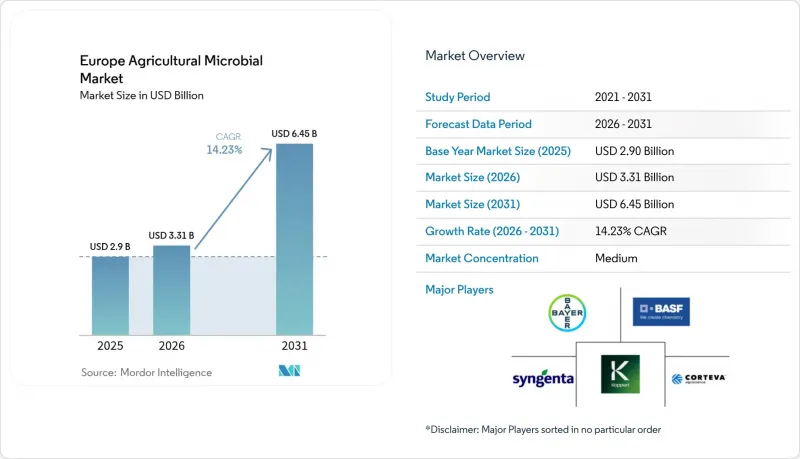
據 Mordor Intelligence 稱,2025 年歐洲農業微生物市場價值 29 億美元,預計到 2031 年將從 2026 年的 33.1 億美元成長至 64.5 億美元,預測期(2026-2031 年)的複合年成長率預計為 14.23%。
本報告按類型(細菌、真菌等)、應用(穀物、豆類/油籽、經濟作物、水果/蔬菜等)、施用方法(土壤處理、葉面噴布等)和地區(德國、英國、法國、西班牙、義大利、荷蘭、俄羅斯等)分類。市場預測以美元計價。
歐洲農業微生物市場趨勢與洞察
擴大有機和再生農業的採用
預計2024年,歐盟有機認證農地面積將達1,590萬公頃,佔農業總面積的10.2%。光是在法國、西班牙和義大利,就有超過700萬公頃的農地總合有機認證標準進行管理。再生農業強調土壤健康指標,而不僅限於有機認證,隨著覆蓋作物、減少耕作和微生物製劑的使用等做法被納入排碳權系統和零售商的永續發展評分卡,再生農業正在迅速發展。這一趨勢在德國和法國尤為顯著,因為兩國的大規模農場擁有將微生物製劑整合到精準播種流程中的農業專業知識和設備。同時,隨著針對高價值園藝作物的客製化應用方案透過合作推廣服務得到更廣泛的應用,西班牙和義大利地中海沿岸的小規模農場也迅速迎頭趕上。
歐盟「從農場到餐桌」戰略下的農藥減量義務
歐盟委員會於2020年通過的「從農場到餐桌」策略,並於2024年透過法律修正案得到強化,該戰略要求到2030年將化學農藥的使用量和風險降低50%,由此產生的監管空白需要透過生物替代方案來填補。成員國正在將這一目標轉化為各自的國家行動計劃。例如,法國承諾在歐盟統一期限之前逐步淘汰Glyphosate和新菸鹼類農藥,而德國則加強了對水體周圍緩衝區的監管,實際上禁止了許多傳統噴灑方式。這些法規正從兩個方面加速微生物的應用。首先,它們正在將化學農藥的競爭對手從市場上淘汰,迫使生產商嘗試使用細菌和真菌進行生物防治,以對抗灰黴病和白粉病等疾病。此外,歐盟《農藥永續使用指令》的相關法規也進一步推動了這項轉變。該指令強制要求制定綜合蟲害管理 (IPM) 計劃,優先採用非化學方法,將微生物製劑納入合規框架,而不是僅將其視為可選的附加措施。
高昂的初始產品成本和分銷成本
微生物製劑的每公頃成本通常比同等化學製劑高出20%至40%。這種價格差異源自於發酵、冷藏保管和保存期限短等經濟因素,這些因素推高了生產和分銷成本。對於南歐和東歐的小規模農戶而言,由於融資限制,他們的平均耕地面積僅為3至8公頃,投入預算也有限,因此這種價格差異成為推廣微生物製劑的主要障礙。利潤微薄的農民往往優先選擇已被證實有效且見效快的投入品,但微生物製劑要證明其對土壤健康的累積效果足以抵消更高的成本,通常需要多個生長季的觀察。分銷基礎設施進一步加劇了這些挑戰。微生物製劑需要冷藏運輸和冷藏保管以維持微生物的活性,這增加了化學肥料經銷商無需承擔的物流成本。在波蘭和羅馬尼亞,由於農村低溫運輸網路仍然不發達,經銷商會將這些成本轉嫁給最終用戶,進一步擴大了價格差距。一些製造商正在透過提供與產量結果掛鉤的績效合約來解決這個問題,但這些合約需要第三方檢驗,並且在西歐市場以外仍然很少見,因為在西歐市場,農業諮詢服務可以監測試驗田並記錄結果。
細分市場分析
至2025年,細菌微生物產品將佔歐洲農業微生物市場的64.70%。這主要得益於芽孢桿菌屬、假單胞菌屬和根瘤菌屬等成熟菌屬,它們在固氮、磷酸鹽溶解和真菌病原體的生物防治方面已展現出顯著功效。隨著細菌微生物領域的日益成熟,產業整合正在進行中,BASF公司和拜耳公司等大型企業正在收購小規模的接種劑生產商,以確保其專有菌株和發酵能力。真菌產品受益於液體製劑的最新技術創新,與傳統的可濕性粉劑相比,這些創新提高了儲存穩定性和田間施用均勻性。歐洲《除生物劑法規》和《植物保護產品法規》的法規結構正在影響核准流程,如果細菌和真菌菌株對哺乳動物毒性低且在環境中持久性低,通常可以享受快速核准。
真菌微生物製劑市場正以15.12%的複合年成長率持續成長,直至2031年。此成長主要受生產者對兼具抑制土傳病害及改善土壤結構及有機質含量雙重功能產品的需求所驅動。病毒微生物製劑,尤其是針對鱗翅目害蟲的桿狀病毒製劑,主要用於高價值作物的特定應用。在這些作物中,可以實現高度特異性的害蟲防治,因此價格較高,且對益蟲的非標靶影響也最小。原生動物微生物製劑仍處於發展初期,主要用於可控環境農業,以控制土傳線蟲和根部病原體。然而,隨著生產成本的下降,田間規模製劑的研究正在加速推進。
其他好處:
- Excel格式的市場預測(ME)表
- 3個月的分析師支持
目錄
第1章:引言
- 研究假設和市場定義
- 調查範圍
第2章:調查方法
第3章執行摘要
第4章 市場狀況
- 市場概覽
- 市場促進因素
- 有機農業和再生農業正變得越來越普及。
- 歐盟有義務減少從農場到餐桌整個生命週期中的農藥使用。
- 消費者對無殘留農產品的需求
- 歐盟的碳權計畫正在擴大,以鼓勵使用生物肥料。
- 人工智慧驅動的微生物組配方正在提高實際應用中的療效。
- 英國脫歐後生技藥品快速註冊途徑
- 市場限制因素
- 產品和分銷的初始成本較高。
- 農民缺乏意識和培訓不足
- 歐盟的兩階段長期微生物報名手續
- 中東歐低溫運輸與物流面臨的挑戰
- 監理情勢
- 波特五力分析
第5章 市場規模與成長預測
- 按類型
- 細菌
- 真菌
- 其他
- 透過使用
- 水果和蔬菜
- 穀物和穀類
- 豆類和油籽
- 經濟作物
- 其他作物類型
- 透過應用方法
- 土壤處理
- 葉面噴布
- 種子處理
- 按地區
- 德國
- 法國
- 英國
- 義大利
- 西班牙
- 土耳其
- 俄羅斯
- 其他歐洲國家
第6章 競爭情勢
- 策略趨勢
- 市佔率分析
- 公司簡介
- BASF SE
- Bayer AG
- Syngenta Group Co. Ltd.
- Corteva Inc.
- Koppert Group BV
- Novonesis A/S
- UPL Limited
- Bioceres Crop Solutions Corp.
- Lallemand Inc.
- FMC Corporation
- Mitsui & Co., Ltd.
- Andermatt Group AG
- Biobest Group NV
- Sumitomo Chemical Co., Ltd.
- AEA Investors LP
第7章 市場機會與未來展望
According to Mordor Intelligence, the Europe agricultural microbial market size was valued at USD 2.90 billion in 2025 and estimated to grow from USD 3.31 billion in 2026 to reach USD 6.45 billion by 2031, at a CAGR of 14.23% during the forecast period (2026-2031).
This report is Segmented by Type (Bacteria, Fungi, and More), by Application (Grains and Cereals, Pulses and Oilseeds, Commercial Crops, Fruits and Vegetables, and More), by Mode of Application (Soil Treatment, Foliar Spray, and More), and by Geography (Germany, United Kingdom, France, Spain, Italy, Netherlands, Russia, and More). The Market Forecasts are Provided in Terms of Value (USD).
Europe Agricultural Microbial Market Trends and Insights
Increasing Adoption of Organic and Regenerative Farming
Certified organic farmland across the European Union reached 15.9 million hectares in 2024, representing 10.2% of the total utilized agricultural area. France, Spain, and Italy collectively manage over 7 million hectares under organic protocols. Regenerative agriculture, which emphasizes soil health metrics beyond organic certification, is expanding even faster as carbon credit programs and retailer sustainability scorecards reward practices such as cover cropping, reduced tillage, and microbial inoculant use. The trend is most pronounced in Germany and France, where large-scale arable farms possess the agronomic expertise and equipment to integrate microbials into precision-seeding workflows, yet smaller Mediterranean holdings in Spain and Italy are catching up as cooperative extension services disseminate application protocols tailored to high-value horticultural crops.
European Union Farm-to-Fork Pesticide-Reduction Mandates
The European Commission's Farm-to-Fork strategy, adopted in 2020 and reinforced through 2024 legislative updates, mandates a 50% reduction in chemical pesticide use and risk by 2030, creating a regulatory void that biological alternatives must fill . Member states are translating this target into national action plans. For instance, France has committed to phasing out glyphosate and neonicotinoids ahead of the Europe Union-wide deadline, while Germany has introduced stricter buffer zones around water bodies that effectively ban many conventional sprays. These restrictions are accelerating the adoption of microbes in two ways. First, they remove chemical competitors from the market, forcing growers to trial bacterial and fungal biocontrols for diseases such as botrytis and powdery mildew. The regulatory influence of the European Union's Sustainable Use of Pesticides Directive further reinforces this shift by requiring integrated pest management plans that prioritize non-chemical methods, embedding microbials into the compliance framework rather than treating them as optional add-ons.
High Upfront Product and Distribution Costs
Microbial products typically cost 20 to 40% more per hectare than chemical equivalents, a price gap driven by fermentation, cold-storage, and shorter shelf-life economics that inflate production and distribution expenses. For smallholder farms in Southern and Eastern Europe, where average holdings range from 3 to 8 hectares, and cash-flow constraints limit input budgets, this premium represents a meaningful barrier to trial adoption. Growers operating on thin margins prioritize inputs with proven, immediate returns, whereas microbials often require multi-season observation to demonstrate cumulative soil-health benefits that justify higher costs. Distribution infrastructure compounds the challenge, as microbial products demand refrigerated transport and storage to maintain viable cell counts, adding logistics expenses that chemical distributors avoid. In Poland and Romania, where rural cold-chain networks remain underdeveloped, distributors pass these costs to end users, further widening the price gap. Some manufacturers are responding by offering pay-for-performance contracts that tie payment to yield outcomes, yet these arrangements require third-party verification and remain rare outside Western European markets, where agronomic advisory services can monitor trial plots and document results.
Other drivers and restraints analyzed in the detailed report include:
- Consumer Demand for Residue-Free Produce
- Expansion of European Union Carbon-Credit Schemes Rewarding Bio-Fertilizer Use
- Limited Farmer Awareness and Training Gaps
For complete list of drivers and restraints, kindly check the Table Of Contents.
Segment Analysis
Bacteria-based microbials captured 64.70% of the Europe agricultural microbial market size in 2025, anchored by established genera such as Bacillus, Pseudomonas, and Rhizobium that deliver proven efficacy in nitrogen fixation, phosphate solubilization, and biocontrol of fungal pathogens. The bacterial segment's maturity is attracting consolidation, with BASF SE and Bayer AG acquiring smaller inoculant firms to secure proprietary strains and fermentation capacity. Fungal products are benefiting from recent innovations in liquid formulations, which improve shelf stability and field application uniformity compared to traditional wettable powders. Regulatory frameworks under the Europe Biocidal Products Regulation and Plant Protection Products Regulation influence approval timelines, with bacterial and fungal strains often qualifying for expedited review when they exhibit low mammalian toxicity and environmental persistence.
Fungi microbials are expanding at a 15.12% CAGR through 2031, driven by grower demand for dual-function products that suppress soil-borne diseases while improving soil structure and organic matter content. Viral microbials, dominated by baculoviruses targeting lepidopteran pests, serve niche applications in high-value crops where highly specific pest control justifies premium pricing and minimizes non-target impacts on beneficial insects. Protozoa remain an emerging segment, primarily applied in controlled-environment agriculture to suppress soil-borne nematodes and root pathogens. However, research into field-scale formulations is accelerating as production costs decline.
Complete Report Scope:
- By Type
- Bacteria
- Fungi
- Others
- By Application
- Fruits and Vegetables
- Grains and Cereals
- Pulses and Oilseeds
- Commercial Crops
- Other Crop Types
- By Mode of Application
- Soil Treatment
- Foliar Spray
- Seed Treatment
- By Geography
- Germany
- France
- United Kingdom
- Italy
- Spain
- Turkey
- Russia
- Rest of Europe
List of Companies Covered in this Report:
- BASF SE
- Bayer AG
- Syngenta Group Co. Ltd.
- Corteva Inc.
- Koppert Group B.V.
- Novonesis A/S
- UPL Limited
- Bioceres Crop Solutions Corp.
- Lallemand Inc.
- FMC Corporation
- Mitsui & Co., Ltd.
- Andermatt Group AG
- Biobest Group NV
- Sumitomo Chemical Co., Ltd.
- AEA Investors LP
Additional Benefits:
- The market estimate (ME) sheet in Excel format
- 3 months of analyst support
TABLE OF CONTENTS
1 INTRODUCTION
- 1.1 Study Assumptions and Market Definition
- 1.2 Scope of the Study
2 RESEARCH METHODOLOGY
3 EXECUTIVE SUMMARY
4 MARKET LANDSCAPE
- 4.1 Market Overview
- 4.2 Market Drivers
- 4.2.1 Increasing adoption of organic and regenerative farming
- 4.2.2 European Union Farm-to-Fork pesticide-reduction mandates
- 4.2.3 Consumer demand for residue-free produce
- 4.2.4 Expansion of European Union carbon-credit schemes rewarding bio-fertilizer use
- 4.2.5 AI-guided microbiome formulations boosting field efficacy
- 4.2.6 Post-Brexit United Kingdom fast-track pathway for biological registrations
- 4.3 Market Restraints
- 4.3.1 High upfront product and distribution costs
- 4.3.2 Limited farmer awareness and training gaps
- 4.3.3 Lengthy two-step European Union microbial registration process
- 4.3.4 Cold-chain and logistics gaps in Central and Eastern Europe
- 4.4 Regulatory Landscape
- 4.5 Porter's Five Forces Analysis
- 4.5.1 Bargaining Power of Suppliers
- 4.5.2 Bargaining Power of Buyers
- 4.5.3 Threat of New Entrants
- 4.5.4 Threat of Substitutes
- 4.5.5 Intensity of Competitive Rivalry
5 MARKET SIZE AND GROWTH FORECASTS (VALUE)
- 5.1 By Type
- 5.1.1 Bacteria
- 5.1.2 Fungi
- 5.1.3 Others
- 5.2 By Application
- 5.2.1 Fruits and Vegetables
- 5.2.2 Grains and Cereals
- 5.2.3 Pulses and Oilseeds
- 5.2.4 Commercial Crops
- 5.2.5 Other Crop Types
- 5.3 By Mode of Application
- 5.3.1 Soil Treatment
- 5.3.2 Foliar Spray
- 5.3.3 Seed Treatment
- 5.4 By Geography
- 5.4.1 Germany
- 5.4.2 France
- 5.4.3 United Kingdom
- 5.4.4 Italy
- 5.4.5 Spain
- 5.4.6 Turkey
- 5.4.7 Russia
- 5.4.8 Rest of Europe
6 COMPETITIVE LANDSCAPE
- 6.1 Strategic Moves
- 6.2 Market Share Analysis
- 6.3 Company Profiles (Includes Global Level Overview, Market Level Overview, Core Segments, Financials as Available, Strategic Information, Market Rank/Share, Products and Services, Recent Developments)
- 6.3.1 BASF SE
- 6.3.2 Bayer AG
- 6.3.3 Syngenta Group Co. Ltd.
- 6.3.4 Corteva Inc.
- 6.3.5 Koppert Group B.V.
- 6.3.6 Novonesis A/S
- 6.3.7 UPL Limited
- 6.3.8 Bioceres Crop Solutions Corp.
- 6.3.9 Lallemand Inc.
- 6.3.10 FMC Corporation
- 6.3.11 Mitsui & Co., Ltd.
- 6.3.12 Andermatt Group AG
- 6.3.13 Biobest Group NV
- 6.3.14 Sumitomo Chemical Co., Ltd.
- 6.3.15 AEA Investors LP
7 MARKET OPPORTUNITIES AND FUTURE OUTLOOK

 全球農業微生物市場(至2031年):按功能(土壤改良/作物保護)、作物類型(穀物、油籽和豆類、水果和蔬菜)、類型(細菌、真菌、病毒、原生動物)、應用和地區分類
 農業微生物市場規模、佔有率和成長分析:按產品類型、功能、微生物製劑形式、配方、應用方法、作物類型、最終用戶和地區分類-2026-2033年產業預測
 農業微生物市場:2026-2032年全球市場預測(依產品類型、微生物類型、劑型、作物類型、包裝類型、應用和通路分類)
 農業微生物製劑市場:依功能、類型、劑型、應用、作物類型、國家及地區分類-全球產業分析、市場規模、市場佔有率及2026年至2033年預測
 2034年農業微生物組市場預測-按微生物類型、應用、製劑形式、作物類型、通路和地區分類的全球分析作物微生物組市場預測至2034年-按產品類型、作物類型、應用方法、應用領域、最終用戶和地區分類的全球分析農業微生物市場預測至2034年—按類型、作物類型、功能、配方、應用和地區分類的全球分析
 農業微生物市場報告:按類型、劑型、應用方法、功能、作物類型和地區分類(2026-2034 年)
 全球農業微生物市場規模、佔有率、趨勢和成長分析報告(2026-2034)
 2026年全球農業微生物市場報告