


 |
市場調查報告書
商品編碼
2114135
智慧照明:市場佔有率分析、產業趨勢與統計、成長預測(2026-2031)Smart Lighting - Market Share Analysis, Industry Trends & Statistics, Growth Forecasts (2026 - 2031) |
||||||

※ 本網頁內容可能與最新版本有所差異。詳細情況請與我們聯繫。
根據 Mordor Intelligence 預測,智慧照明市場規模預計將在 2026 年達到 275.2 億美元,並在 2031 年擴大到 678.3 億美元。
這意味著在整個預測期內,複合年成長率將達到 19.77%,這表明該領域正在從早期採用者的新奇事物轉變為提高建築物性能所必需的主流技術。
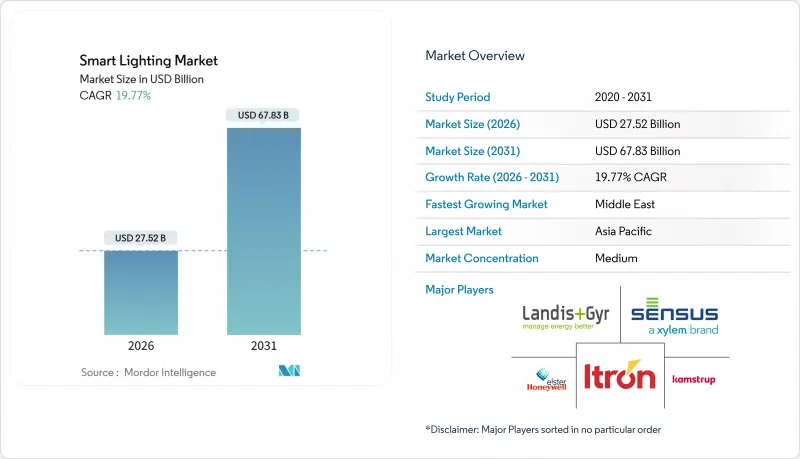
本報告按產品類型(控制系統、智慧燈具和照明設備)、安裝類型(新建、維修)、連接技術(藍牙、Zigbee 等)、最終用戶(住宅、商業、工業等)以及地區(北美、歐洲、亞太、中東和非洲、南美)進行細分。市場預測以美元計價。
全球智慧照明市場趨勢及洞察
擴大智慧家庭生態系統的整合
語音助理平台和 Matter 1.4 認證使得智慧燈泡能夠透過單一韌體鏡像與 Apple HomeKit、Google Home、Amazon Alexa 和 Samsung SmartThings 進行互通,從而消除廠商鎖定並降低支援成本,進而降低購買門檻。 Thread 1.4 的低功耗網狀網路將每個網路的裝置節點上限提升至 250 個,而自癒功能則緩解了 Zigbee 早期部署中存在的可靠性問題。亞洲契約製造製造商擴大生產規模,使得智慧燈泡的平均售價在 2024 年至 2025 年間下降了 22%,從而擴大了智慧燈泡的覆蓋範圍。注重現有燈具改造的經營模式尤其受益,因為消費者無需重新佈線即可更換燈泡。在商業領域,連鎖飯店正擴大部署 Matter 認證的下照燈和人體感應器,透過在客人入住時自動將房間調整至其偏好場景,在提升賓客體驗的同時降低能源成本。
LED成本的快速下降正在提高投資報酬率。
適用於倉庫的高棚照明燈具零售價格已從三年前的 250 至 350 美元降至如今的 120 至 180 美元。同時,其發光效率大幅提升至每瓦 150 流明,幾乎是傳統金屬鹵素燈的兩倍。馬薩諸塞州和康乃狄克州電力公司的獎勵使材料成本降低了 40% 至 50%,投資回收期通常縮短至 12 個月。中國和韓國的晶片代工廠正致力於提高氮化鎵外延的良率,從而每年進一步降低晶圓成本10% 至 15%。城市也在利用這一趨勢。在杜拜,2024 年謝赫拉希德大道 900 個照明燈具的維修實現了 60% 的節能效果,且無需補貼即可在四年內收回成本。成本曲線正變得越來越陡峭,進一步提高了商業、工業和市政領域的價格彈性。
無線協定中的網路安全漏洞
2024年,美國國家標準與技術研究院 (NIST) 發出警告,Zigbee 和藍牙低功耗 (Bluetooth LE) 缺乏強大的身份驗證功能,如果預設憑證保持不變,網路可能容易受到欺騙攻擊。 CVE-2024-41126 漏洞展示了透過惡意配對遠端劫持照明設備,促使關鍵設施營運商要么將照明網路物理空氣間隙,要么恢復使用有線 DALI-2 總線。這些預防措施會增加每個燈具 8-15 美元的額外成本,延長投資回收期,並使與建築自動化的整合更加複雜。 Matter 的設備身份驗證旨在透過使用加密技術檢驗硬體來源來消除這種威脅,但要實現全面保護,需要在多個產品週期內進行現場更換。
細分市場分析
2025年,智慧燈具和照明設備佔智慧照明市場54.67%的佔有率,但預計到2031年,控制系統將以20.19%的複合年成長率(CAGR)實現最高成長。能源服務公司正日益將控制系統定位為需量反應收入、預測性維護和居住者為中心的舒適體驗的關鍵。從以金額為準,燈具和照明設備在2025年仍將主導銷售主導地位,但商品化已將利潤率壓低至25%以下。沃爾沃卡車瑞典工廠實施的Herber「ActiveAhead」系統清晰地展現了以控制為中心的策略。邊緣人工智慧學習了工作單元的佔用情況,預先調暗了通道,並利用了自然光,從而進一步降低了23%的電力消耗。同時,住宅也越來越傾向於選擇無需重新佈線的燈泡。到2025年,Matter認證燈具的平均零售價將降至12美元,使其成為人人都能輕鬆擁有的產品。由於技術堆疊的變革,如今決定供應商差異的不再只是流明數,而是韌體、分析功能和雲端控制面板。
儘管如此,智慧燈具和照明設備仍然至關重要。隨著設施管理人員量化與頻譜相關的生產力提升,晝夜節律調節在辦公室和酒店行業日益受到關注,而裝飾性照明設備則在零售業營造出獨特的品牌氛圍。然而,控制技術也在此扮演核心角色。可調光照明設備標配內建驅動器,可即時接收 Matter 和 DALI-2 指令。隨著部署達到飽和點,軟體升級將帶來持續的收入,使燈具從資本財轉變為數位平台。
至2025年,現有改裝將佔智慧照明市場佔有率的62.91%。這反映出全球建築中仍大量使用螢光和金屬鹵素燈燈。公用事業公司的獎勵可以涵蓋大部分的更換成本,使得投資回報期僅為12至18個月,即使對於財務長而言也是可以接受的。然而,監管趨勢正在改變。隨著能源標準的修訂,新建建築的智慧照明系統正以20.13%的複合年成長率加速發展,這些標準要求在設計階段就採用連網照明。如果照明系統能夠及早確定,承包商就可以預先佈線感測器並為閘道器預留低電壓電源,從而顯著降低未來的人事費用。
現有設施維修的經濟可行性有兩極化。簡單的「燈泡更換」可以實現50-60%的節能,但卻忽略了透過感應人員佔用情況的調光功能所能獲得的額外20-30%的節能效果。目前,建築業主傾向於選擇整合控制系統,以便獎勵電力公司提供的基於績效的激勵措施。地方政府的案例研究也印證了這一點。例如,在杜拜的謝赫拉希德大道2024計畫中,投資在四年內無需補貼便收回了成本,節能效果高達60%,並且立即啟動了二級道路自適應調光試點計畫。
區域分析
L37:到2025年,亞太地區將佔據智慧照明市場37.38%的佔有率。這主要得益於中國龐大的製造業規模、印度的都市化以及日本技術先進的建築業。儘管該地區的成長勢頭強勁,但隨著早期用戶從更換燈具轉向逐步升級控制系統,成長正在放緩。相較之下,中東和非洲地區預計將以20.71%的複合年成長率實現最高成長,這主要得益於智慧城市政策,這些政策已依法規定LED照明的過渡期限為2027年。 2025年10月,卡達公共工程局承諾在全國部署智慧LED路燈,目標是將能耗降低40%至50%。
北美和歐洲仍然是創新中心。加州2025年通過的第24號法規修正案以及馬薩諸塞州慷慨的需求面管理(DSM)補貼計劃,正在縮短投資回收期,並將照明控制系統納入基礎設計階段。歐盟的近零能耗指令要求成員國在2028年前為所有新建建築物安裝連網照明系統。這些政策確保了該地區的財政收入基礎穩固,即使其表面成長率相對較低。
在南美洲和非洲,由於預算限制和電力補貼降低了投資報酬率,LED的普及率仍然很低。雖然巴西和南非的市政層面正在進行試點項目,但財政緊縮限制了其規模。預計到2026年,當LED模組的價格降至每千流明1美元以下時,這些市場將從試點計畫過渡到全面部署。
其他好處:
- Excel格式的市場預測(ME)表
- 3個月的分析師支持
目錄
第1章:引言
- 市場分析與定義的前提條件
- 分析範圍
第2章 分析方法
第3章執行摘要
第4章 市場狀況
- 市場概覽
- 市場促進因素
- 擴大智慧家庭生態系統的整合
- LED成本的快速下降帶來了投資報酬率的提高。
- 由公用事業公司資助的需求面管理(DSM)獎勵
- 各國淨零能耗建築標準(將於2025年至2030年間實施)
- 在倉庫中試行應用Li-Fi相容照明
- 利用邊緣人工智慧的自適應調光演算法
- 市場限制因素
- 無線協定中的網路安全漏洞
- 互通性標準碎片化
- 稀土元素磷光體供應鏈的波動性
- 智慧家庭隱私法規的不確定性
- 產業價值鏈分析
- 監理情勢
- 技術展望
- 波特五力分析
- 宏觀經濟因素對市場的影響
第5章:預測市場規模與成長率
- 依產品類型
- 控制系統
- 智慧燈具和照明設備
- 按安裝類型
- 新建工程
- 維修(改裝)
- 透過連接技術
- Wi-Fi
- Bluetooth
- Zigbee
- 其他連接技術
- 最終用戶
- 住宅
- 商業
- 產業
- 其他最終用戶
- 按地區
- 北美洲
- 美國
- 加拿大
- 墨西哥
- 歐洲
- 德國
- 英國
- 法國
- 俄羅斯
- 其他歐洲國家
- 亞太地區
- 中國
- 日本
- 印度
- 韓國
- 澳洲
- 其他亞太國家
- 中東和非洲
- 中東
- 沙烏地阿拉伯
- 阿拉伯聯合大公國
- 其他中東國家
- 非洲
- 南非
- 埃及
- 其他非洲國家
- 中東
- 南美洲
- 巴西
- 阿根廷
- 其他南美國家
- 北美洲
第6章 競爭情勢
- 市場集中度
- 策略趨勢
- 市佔率分析
- 公司簡介
- Signify NV
- Acuity Brands Inc.
- Hubbell Inc.
- Eaton Corp.
- Lutron Electronics Co. Inc.
- Legrand SA
- Cree Lighting USA, LLC
- Samsung Electronics Co. Ltd.
- Xiaomi Corp.
- Snap One LLC
- Savant Systems Inc.
- Nanoleaf Canada Ltd.
- Sengled Optoelectronics Co.
- Wyze Labs Inc.
- Feit Electric Company, Inc.
- Panasonic Corp.
- Opple Lighting
- EGLO Leuchten GmbH
- Zumtobel Group
第7章 市場機會與未來展望
According to Mordor Intelligence, the smart lighting market size reached USD 27.52 billion in 2026 and is projected to climb to USD 67.83 billion by 2031, translating into a 19.77% CAGR across the forecast horizon, a trajectory that underlines the sector's transition from early-adopter novelty to mainstream building-performance technology.
This report is Segmented by Product Type (Control Systems, and Smart Lamps and Fixtures), Installation Type (New Construction, and Retrofit), Connectivity Technology (Bluetooth, Zigbee, and More), End-User (Residential, Commercial, Industrial, and More), and Geography (North America, Europe, Asia-Pacific, Middle East and Africa, and South America). The Market Forecasts are Provided in Terms of Value (USD).
Global Smart Lighting Market Trends and Insights
Expanding Smart-Home Ecosystem Integration
Voice-assistant platforms and Matter 1.4 certification have reduced purchase friction by enabling a single firmware image to interoperate with Apple HomeKit, Google Home, Amazon Alexa, and Samsung SmartThings, removing vendor lock-in and lowering support costs. Thread 1.4's low-power mesh has raised the device limit to 250 nodes per network, while self-healing routes alleviate reliability complaints that dogged early Zigbee rollouts. Smart-bulb average selling prices fell 22% between 2024 and 2025 as Asian contract manufacturers scaled production, expanding the addressable household base. Retrofit-oriented business models benefit disproportionately because consumers can swap bulbs without rewiring. Commercially, hospitality chains now bundle Matter-certified downlights with occupancy sensors so guestrooms automatically adjust to preferred scenes at check-in, improving the guest experience while shaving energy bills.
Rapid LED Cost Reductions Improve ROI
High-bay fixtures suitable for warehouses now retail at USD 120-180, down from USD 250-350 just three years earlier, while efficacy leapt to 150 lumens per watt, nearly double that of metal-halide incumbents. Utility incentives in Massachusetts and Connecticut shave 40-50% off material costs, routinely compressing payback to 12 months. Chinese and South Korean chip foundries are pushing gallium nitride epitaxy yields higher, cutting die costs by a further 10-15% each year. Cities are capitalizing: Dubai retrofitted 900 luminaires on Sheikh Rashid Street in 2024, netting 60% energy savings and a 4-year payback, even without subsidies. The cost curve keeps steepening, reinforcing price elasticity across commercial, industrial, and municipal segments.
Cyber-Security Vulnerabilities in Wireless Protocols
The National Institute of Standards and Technology warned in 2024 that Zigbee and Bluetooth LE lack robust authentication, exposing networks to spoofing when default credentials persist. CVE-2024-41126 demonstrated remote takeover of luminaires via unauthorized pairing, spurring critical-facility operators to air-gap lighting networks or revert to wired DALI-2 buses. Such precautions add USD 8-15 per fixture, lengthening payback and complicating building-automation integration. Matter's device-attestation aims to neutralize the threat by cryptographically verifying hardware provenance, but full mitigation requires field replacements over several product cycles.
Other drivers and restraints analyzed in the detailed report include:
- Utility-Funded Demand-Side-Management Incentives
- National Net-Zero Building Codes
- Fragmented Inter-Operability Standards
For complete list of drivers and restraints, kindly check the Table Of Contents.
Segment Analysis
Smart lamps and fixtures captured 54.67% of the smart lighting market share in 2025, while control systems are set to register the fastest 20.19% CAGR through 2031. Energy-service companies increasingly position controls as the gateway to demand-response revenue, predictive maintenance, and occupant-centric comfort. In value terms, lamps and fixtures still dominated 2025 sales, but commoditization is squeezing margins below 25%. Helvar's ActiveAhead deployment at Volvo Trucks' Swedish plant illustrates the control-centric thesis: edge AI learned work-cell occupancy, pre-dimmed aisles, and harvested daylight to trim an additional 23% of power. Residential buyers, meanwhile, gravitate toward bulbs that require no wiring changes; average retail pricing for a Matter-certified lamp fell to USD 12 in 2025, democratizing access. The shifting stack means firmware, analytics, and cloud dashboards, not raw lumens, determine vendor differentiation.
Smart lamps and fixtures, nonetheless, remain indispensable. Circadian-tuning is gaining traction in offices and hospitality as facility managers quantify productivity gains tied to light spectra, while decorative luminaires support branded ambience in retail. Yet even here, controls are subsuming the narrative: tunable fixtures ship with embedded drivers that listen for Matter or DALI-2 commands out of the box. As the installed base saturates, software upgrades will extract recurring revenue, transforming lamps from capital goods into digital platforms.
Retrofits accounted for 62.91% of the smart lighting market share in 2025, reflecting the significant inventory of fluorescent and metal-halide luminaires still in use in global building stock. Utility incentives underwrite much of the swap-out cost, translating into 12- to 18-month paybacks that meet even CFO-level hurdle rates. Yet the compliance tide is turning: new construction is accelerating at a 20.13% CAGR because updated energy codes make networked lighting mandatory at the blueprint stage. When lighting is specified early, contractors prewire for sensors and provide low-voltage power for gateways, slashing future labor costs.
Retrofit economics bifurcate. Simple lamp-for-lamp replacements yield 50-60% energy cuts but miss the incremental 20-30% available from occupancy-aware dimming. Building owners now select integrated control packages to unlock utility performance-based incentives. Municipal case studies reinforce the point: Dubai's 2024 Sheikh Rashid Street project realized 60% savings on a four-year unsubsidized payback and immediately initiated trials on secondary roads for adaptive dimming.
Complete Report Scope:
- By Product Type
- Control Systems
- Smart Lamps and Fixtures
- By Installation Type
- New Construction
- Retrofit
- By Connectivity Technology
- Wi-Fi
- Bluetooth
- Zigbee
- Other Connectivity Technologies
- By End-User
- Residential
- Commercial
- Industrial
- Other End-Users
- By Geography
- North America
- United States
- Canada
- Mexico
- Europe
- Germany
- United Kingdom
- France
- Russia
- Rest of Europe
- Asia-Pacific
- China
- Japan
- India
- South Korea
- Australia
- Rest of Asia-Pacific
- Middle East and Africa
- Middle East
- Saudi Arabia
- United Arab Emirates
- Rest of Middle East
- Africa
- South Africa
- Egypt
- Rest of Africa
- Middle East
- South America
- Brazil
- Argentina
- Rest of South America
- North America
Geography Analysis
L37: Asia-Pacific commanded 37.38% of the smart lighting market share in 2025, anchored by China's manufacturing scale, India's urbanization, and Japan's tech-savvy construction sector. The region's growth is steady but moderating as early adopters transition from fixture swaps to incremental control-system upgrades. Middle East and Africa, conversely, will post the quickest 20.71% CAGR because sovereign smart-city mandates hard-code LED conversion deadlines as early as 2027. Qatar's Public Works Authority committed to nationwide smart LED streetlighting in October 2025, aiming for 40-50% energy savings.
North America and Europe remain crucibles of innovation. California's 2025 Title 24 revision and Massachusetts' generous DSM rebates shorten payback cycles, embedding lighting controls during schematic design. The European Union's near-zero-energy directive requires member states to incorporate networked lighting in all new buildings by 2028. These policies keep the regions' aggregate revenue base resilient despite lower headline growth.
South America and Africa still lag in penetration due to budget constraints and electricity tariff subsidies that dilute ROI. Brazil and South Africa are piloting municipal conversions, but fiscal austerity limits scale. As LED module pricing falls below USD 1 per kilolumen in 2026, these markets will gradually migrate from pilot to portfolio execution.
- Signify N.V.
- Acuity Brands Inc.
- Hubbell Inc.
- Eaton Corp.
- Lutron Electronics Co. Inc.
- Legrand SA
- Cree Lighting USA, LLC
- Samsung Electronics Co. Ltd.
- Xiaomi Corp.
- Snap One LLC
- Savant Systems Inc.
- Nanoleaf Canada Ltd.
- Sengled Optoelectronics Co.
- Wyze Labs Inc.
- Feit Electric Company, Inc.
- Panasonic Corp.
- Opple Lighting
- EGLO Leuchten GmbH
- Zumtobel Group
Additional Benefits:
- The market estimate (ME) sheet in Excel format
- 3 months of analyst support
TABLE OF CONTENTS
1 INTRODUCTION
- 1.1 Study Assumptions and Market Definition
- 1.2 Scope of the Study
2 RESEARCH METHODOLOGY
3 EXECUTIVE SUMMARY
4 MARKET LANDSCAPE
- 4.1 Market Overview
- 4.2 Market Drivers
- 4.2.1 Expanding Smart-Home Ecosystem Integration
- 4.2.2 Rapid LED Cost Reductions Improve ROI
- 4.2.3 Utility-Funded Demand-Side-Management Incentives
- 4.2.4 National Net-Zero Building Codes (2025-2030 Roll-outs)
- 4.2.5 Li-Fi-Enabled Lighting Pilots in Warehouses
- 4.2.6 Edge-AI-Powered Adaptive Dimming Algorithms
- 4.3 Market Restraints
- 4.3.1 Cyber-Security Vulnerabilities in Wireless Protocols
- 4.3.2 Fragmented Inter-Operability Standards
- 4.3.3 Supply Chain Volatility in Rare-Earth Phosphors
- 4.3.4 Smart-Home Privacy Regulation Uncertainty
- 4.4 Industry Value Chain Analysis
- 4.5 Regulatory Landscape
- 4.6 Technological Outlook
- 4.7 Porter's Five Forces Analysis
- 4.7.1 Bargaining Power of Suppliers
- 4.7.2 Bargaining Power of Buyers
- 4.7.3 Threat of New Entrants
- 4.7.4 Threat of Substitutes
- 4.7.5 Degree of Competition
- 4.8 Impact of Macroeconomic Factors on the Market
5 MARKET SIZE AND GROWTH FORECASTS (VALUE)
- 5.1 By Product Type
- 5.1.1 Control Systems
- 5.1.2 Smart Lamps and Fixtures
- 5.2 By Installation Type
- 5.2.1 New Construction
- 5.2.2 Retrofit
- 5.3 By Connectivity Technology
- 5.3.1 Wi-Fi
- 5.3.2 Bluetooth
- 5.3.3 Zigbee
- 5.3.4 Other Connectivity Technologies
- 5.4 By End-User
- 5.4.1 Residential
- 5.4.2 Commercial
- 5.4.3 Industrial
- 5.4.4 Other End-Users
- 5.5 By Geography
- 5.5.1 North America
- 5.5.1.1 United States
- 5.5.1.2 Canada
- 5.5.1.3 Mexico
- 5.5.2 Europe
- 5.5.2.1 Germany
- 5.5.2.2 United Kingdom
- 5.5.2.3 France
- 5.5.2.4 Russia
- 5.5.2.5 Rest of Europe
- 5.5.3 Asia-Pacific
- 5.5.3.1 China
- 5.5.3.2 Japan
- 5.5.3.3 India
- 5.5.3.4 South Korea
- 5.5.3.5 Australia
- 5.5.3.6 Rest of Asia-Pacific
- 5.5.4 Middle East and Africa
- 5.5.4.1 Middle East
- 5.5.4.1.1 Saudi Arabia
- 5.5.4.1.2 United Arab Emirates
- 5.5.4.1.3 Rest of Middle East
- 5.5.4.2 Africa
- 5.5.4.2.1 South Africa
- 5.5.4.2.2 Egypt
- 5.5.4.2.3 Rest of Africa
- 5.5.4.1 Middle East
- 5.5.5 South America
- 5.5.5.1 Brazil
- 5.5.5.2 Argentina
- 5.5.5.3 Rest of South America
- 5.5.1 North America
6 COMPETITIVE LANDSCAPE
- 6.1 Market Concentration
- 6.2 Strategic Moves
- 6.3 Market Share Analysis
- 6.4 Company Profiles (includes Global Level Overview, Market Level Overview, Core Segments, Financials as Available, Strategic Information, Market Rank/Share for Key Companies, Products and Services, and Recent Developments)
- 6.4.1 Signify N.V.
- 6.4.2 Acuity Brands Inc.
- 6.4.3 Hubbell Inc.
- 6.4.4 Eaton Corp.
- 6.4.5 Lutron Electronics Co. Inc.
- 6.4.6 Legrand SA
- 6.4.7 Cree Lighting USA, LLC
- 6.4.8 Samsung Electronics Co. Ltd.
- 6.4.9 Xiaomi Corp.
- 6.4.10 Snap One LLC
- 6.4.11 Savant Systems Inc.
- 6.4.12 Nanoleaf Canada Ltd.
- 6.4.13 Sengled Optoelectronics Co.
- 6.4.14 Wyze Labs Inc.
- 6.4.15 Feit Electric Company, Inc.
- 6.4.16 Panasonic Corp.
- 6.4.17 Opple Lighting
- 6.4.18 EGLO Leuchten GmbH
- 6.4.19 Zumtobel Group
7 MARKET OPPORTUNITIES AND FUTURE OUTLOOK
- 7.1 White-Space and Unmet-Need Assessment

 家用LED照明市場:全球市場預測,2026-2032年
 智慧照明市場預測至2034年-按產品類型、連接技術、安裝類型、應用和地區分類的分析智慧照明解決方案市場預測至2034年—全球產品、通訊技術、安裝類型、控制方法、應用、最終用戶和區域分析
 智慧照明市場報告:趨勢、預測和競爭分析(至2035年)無線智慧照明控制系統市場:依產品、通訊技術、安裝方式、照明類型、最終用途及銷售管道分類-2026-2032年全球市場預測
 全球智慧照明市場規模、佔有率、趨勢和成長分析報告(2026-2034)智慧照明與控制系統市場:2026-2032年全球市場預測(依產品類型、照明技術、安裝類型、應用、最終用戶和銷售管道)智慧照明自動化市場預測至2034年—按組件、連接技術、安裝類型、應用、最終用戶和地區分類的全球分析智慧互聯照明系統市場預測至2034年:按組件、類型、連接方式、應用和區域分類的全球分析智慧自我調整照明系統市場預測至2034年-按產品類型、組件、技術、應用、最終用戶和地區分類的全球分析