


 |
市場調查報告書
商品編碼
2114134
渦輪控制系統:市場佔有率分析、行業趨勢和統計數據、成長預測(2026-2031 年)Turbine Control System - Market Share Analysis, Industry Trends & Statistics, Growth Forecasts (2026 - 2031) |
||||||

※ 本網頁內容可能與最新版本有所差異。詳細情況請與我們聯繫。
據 Mordor Intelligence 稱,2025 年渦輪控制系統市值為 219.8 億美元,預計到 2031 年將達到 300.2 億美元,而 2026 年為 231.6 億美元,預測期(2026-2031 年)的複合年成長率為 5.36%。
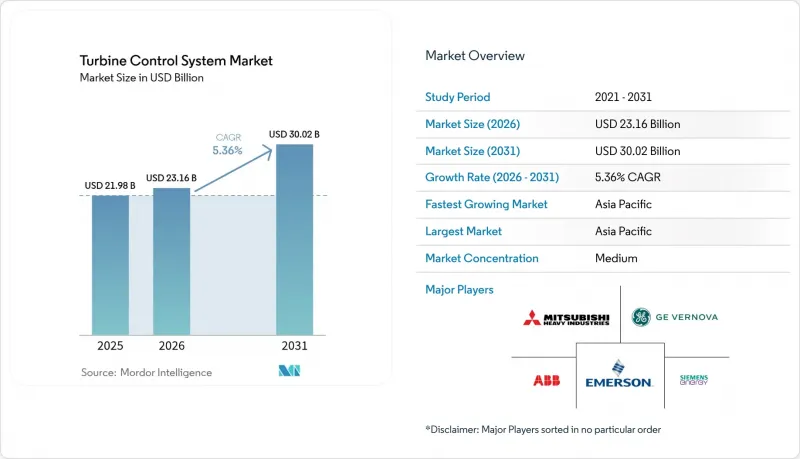
本報告按類型(燃氣渦輪機控制系統、風力發電機控制系統等)、功能(速度控制、負載控制、溫度控制、壓力控制等功能)、組件(控制器/PLC、服務等)、最終用戶(發電廠、獨立服務供應商等)和地區(北美、歐洲、亞太地區等)進行分類。
全球渦輪控制系統市場趨勢與洞察
隨著風力發電容量的擴大,對先進的俯仰和偏航控制技術的需求日益成長。
最新的15兆瓦級離岸風力發電機運作的轉子直徑超過240米,導致空氣動力負荷和結構疲勞加劇。因此,其控制軟體需要在20毫秒的周期內整合槳距、偏航和扭矩指令,以平衡功率輸出和葉片應變。歐洲和中國的併網法規要求風電場必須具備頻率支援功能,這迫使控制設備暫時降低有功功率以模擬旋轉慣性。浮體式裝置的要求更高,因為機艙必須與船舶系纜的動態行為即時協調。擁有高精度氣動彈性模型和邊緣運算處理器的供應商正在這個快速成長的風力發電機控制系統市場中擴大市場佔有率。
提高全球燃氣渦輪機設備的可靠性
隨著聯合循環發電系統從基本負載向尖峰負載過渡,高溫部件面臨溫度循環加劇和潛在的火焰不穩定性。三菱重工的A-CPFM平台將機器學習技術整合到燃燒迴路中,使控制設備能夠微調燃料混合比並消除振動引起的跳閘。目前,這項功能正在密西西比州的600兆瓦傑克遜電廠進行展示。氫氣的加入進一步增加了複雜性,因為其火焰速度和熱值與純甲烷不同。因此,控制邏輯必須追蹤這些變數以防止自燃。特別是中東地區的電廠業主,他們依賴汽電共生機組進行海水淡化,因此優先考慮軟體維修,以確保運轉率超過99%。
隨著可再生能源的擴張,與石化燃料相關的資本投資將會減少。
歐洲電力公司,例如Vattenfall,正在出售或暫停營運煤炭和天然氣資產,以確保離岸風力發電和電池儲能專案的資金。這些資產出售導致新型渦輪控制系統的市場規模縮小。剩餘的石化燃料業者將預算重點放在最必要的維修上,例如為符合排放法規和實現靈活運作而維修,而不是對控制室進行徹底的翻新。因此,市場重心正從新硬體安裝轉向現有設施的最佳化合約。儘管渦輪控制系統產業對軟體授權和現場服務的專業知識需求不斷成長,但整體收入成長卻在放緩。
細分市場分析
2025年,燃氣發電平台佔據了渦輪控制系統市場43.40%的佔有率。這主要得益於其兩方面的優勢:一是作為基本負載電力供應的基石,二是作為可再生能源發電量下降時的快速響應單元。如今,融合機器學習技術的燃燒控制系統可將啟動燃料消耗降低高達10%,這項節能優勢正受到受現貨價格波動影響的公司電廠營運商的青睞。同時,預計2026年至2031年間,風電解決方案將以7.16%的複合年成長率成長。這主要得益於全球每年新增20吉瓦離岸風力發電,這些風電場需要多軸控制系統來應對尾流交互作用和電網支援運作。蒸氣和水力發電產業已趨於成熟,投資仍在穩步成長,尤其是在抽水蓄能電站改造為長期儲能設施的領域。
支撐天然氣主導地位的第二個因素是氫氣相容系統的發展。當混合比超過30%時,原始設備製造商(OEM)提供的軟體更新會調整燃燒溫度圖和稀釋氣體流量曲線。因此,使用GE 7F和西門子SGT-800系統的營運商選擇分階段升級控制平台,而不是徹底更換硬體。相較之下,風電產業採用直接安裝在機艙上的分散式邊緣處理器,即使在海上頻寬有限的情況下,也能保持小於5毫秒的回授迴路。這些架構變革正吸引著專注於IT領域的新參與企業進入渦輪機控制系統市場。
預計到2025年,速度控制將佔總收入的31.95%,這反映了其在蒸氣、排放氣體預計也將實現6.05%的複合年成長率。排放氣體控制模組正從簡單的查找表發展到自適應神經網路控制器,後者能夠即時平衡氮氧化物目標值、上升速率和燃料混合比例。壓力控制邏輯在單程蒸汽產生器中至關重要,目前也在進行升級,新的演算法可以調節變速給水泵,從而抑制汽包水位波動。所有功能的通用趨勢是「融合」。以前需要多個獨立控制器的多種高級應用現在整合到單一高可用性PLC中,簡化了安裝空間和維護工作。
隨著電網規範的修訂提高了對慣性、頻率穿越和黑啟動的要求,預計到 2031 年,由這些新功能驅動的汽輪機控制系統市場規模將超過 61.8 億美元。對於發電廠管理人員而言,將高級功能整合到單一許可證中可以簡化合規性審計,從而進一步加快採用速度。
區域分析
預計到2025年,亞太地區將佔全球銷售額的38.05%,並將以每年5.78%的速度持續成長至2031年。中國離岸風力發電競標現已要求具備併網能力,開發商從競標階段就開始指定採用多功能控制器。印度一項約44吉瓦亞臨界燃煤電廠的維修和現代化項目也為渦輪控制系統市場帶來了新的訂單。繼5300兆瓦邦巴功聯合循環燃氣渦輪機計畫取得突破性成功後,東南亞國家,特別是泰國,正在採購高效的J級燃氣渦輪機,其控制系統能夠將8台機組同步連接到同一500千伏母線上。
北美仍然是第二大區域,這得益於德克薩斯州、維吉尼亞和亞伯達資料中心的集中分佈。當地電力公司正與渦輪機原始設備製造商 (OEM) 合作,共同開發一種名為「黑園」的模式,該模式允許源自航空的渦輪機組在電網故障期間獨立運行,以支援敏感的 IT 負載。這項功能正在為渦輪機控制系統產業帶來顯著的服務溢價。環保部門強調從甲烷轉向氫氣,這進一步加速了控制軟體方面的支出,因為現有渦輪機需要實現能夠處理沃泊指數波動燃料的邏輯。
在歐洲,靈活運作和網路彈性備受重視。德國電網營運商目前對頻率響應時間小於兩秒的高速系統給予獎勵,並鼓勵在維修的蒸氣動力裝置中實施過火邏輯和先進的調速閥序列。同時,歐盟的NIS2法規使網路安全義務具有法律約束力,並鼓勵電廠業主部署受監控的防火牆和異常檢測分析系統。這些因素確保了軟體和服務收入的持續性,即使新建石化燃料電廠的數量很少。
在中東和非洲,海水淡化和天然氣中游作業的共同循環和機械驅動計畫仍在積極進行。由於環境溫度高且粉塵多,需要控制演算法來預測壓縮機突波裕度並自動控制進氣洩放冷卻程序,以防止喘突波。南美洲的成長核心是巴西的抽水蓄能水力發電廠,這些電站採用四象限水輪機,可在發電和驅動之間交替運行,這需要先進的過渡控制,而這種控制只能透過現代控制器進行調節。
其他好處:
- Excel格式的市場預測(ME)表
- 3個月的分析師支持
目錄
第1章:引言
- 市場分析與定義的前提條件
- 分析範圍
第2章 分析方法
第3章執行摘要
第4章 市場狀況
- 市場概覽
- 市場促進因素
- 老舊火力發電設施的現代化改造
- 由於風力發電設施的擴張,對先進的俯仰和偏航控制的需求日益成長。
- 全球範圍內提高燃氣渦輪機設備可靠性的努力
- 由於人工智慧資料中心的高峰需求激增,快速爬坡控制正在加速進行。
- 利用數位孿生進行預測性維護
- 市場限制因素
- 隨著可再生能源的擴張,對石化燃料產業的資本投資正在減少。
- 現有設施維修中網路安全和整合問題的複雜性。
- 電網連接規則中更嚴格的慣性限制正在限制斜坡演算法。
- 供應鏈分析
- 監理情勢
- 技術展望
- 波特五力分析
第5章:預測市場規模與成長率
- 按類型
- 蒸氣渦輪控制系統
- 燃氣渦輪機控制系統
- 風力發電機控制系統
- 水輪機控制系統
- 按功能
- 速度控制
- 負載控制
- 溫度控制
- 壓力控制
- 其他功能
- 按組件
- 控制器/PLC
- 感應器換能器
- 人機介面/監控與資料擷取軟體
- 執行器閥
- 服務(安裝、維修、網路安全)
- 最終用戶
- 發電公司
- 石油和天然氣(上游工程、中游製程、下游製程)
- 製程工業(化工、造紙、金屬加工)
- 船/飛機
- 獨立服務提供者
- 按地區
- 北美洲
- 美國
- 加拿大
- 墨西哥
- 歐洲
- 德國
- 英國
- 法國
- 義大利
- 北歐國家
- 俄羅斯
- 其他歐洲國家
- 亞太地區
- 中國
- 印度
- 日本
- 韓國
- 東南亞國協
- 其他亞太國家
- 南美洲
- 巴西
- 阿根廷
- 智利
- 其他南美國家
- 中東和非洲
- 沙烏地阿拉伯
- 阿拉伯聯合大公國
- 南非
- 奈及利亞
- 其他中東和非洲國家
- 北美洲
第6章 競爭情勢
- 市場集中度
- 策略趨勢(企業合併、聯盟、購電協議)
- 市場佔有率分析(主要公司的市場排名和市場佔有率)
- 公司簡介
- ABB Ltd
- Emerson Electric Co.
- General Electric(GE Vernova)
- Siemens Energy AG
- Honeywell International Inc.
- Rockwell Automation Inc.
- Mitsubishi Heavy Industries Ltd
- Rolls-Royce plc
- Schneider Electric SE
- Woodward Inc.
- Yokogawa Electric Corp.
- Baker Hughes Co.
- Mita-Teknik A/S
- Innoway-Sea Group
- Turbine Controls Ltd
- Eaton Corporation
- Hitachi Energy Ltd
- CCC(Compressor Controls Corp.)
- Voith Turbo GmbH
- Bosch Rexroth AG
第7章 市場機會與未來展望
According to Mordor Intelligence, the turbine control system market size was valued at USD 21.98 billion in 2025 and estimated to grow from USD 23.16 billion in 2026 to reach USD 30.02 billion by 2031, at a CAGR of 5.36% during the forecast period (2026-2031).
This report is Segmented by Type (Gas Turbine Control Systems, Wind Turbine Control Systems, and More), Function (Speed Control, Load Control, Temperature Control, Pressure Control, and Other Functions), Component (Controllers and PLCs, Services, and More), End-User (Power Generation Utilities, Independent Service Providers, and More), and Geography (North America, Europe, Asia-Pacific, and More).
Global Turbine Control System Market Trends and Insights
Expansion of Wind Capacity Requiring Advanced Pitch & Yaw Controls
Modern 15-MW offshore turbines operate with rotor diameters exceeding 240 m, magnifying aerodynamic loads and structural fatigue. Their control software, therefore, blends pitch, yaw, and torque commands in 20-millisecond cycles to balance power extraction against blade strain. Grid codes in Europe and China add another layer by compelling wind farms to contribute frequency support, forcing controllers to momentarily reduce active power to emulate spinning inertia. Floating installations raise the bar again, as the nacelle must coordinate with mooring-line dynamics in real-time. Suppliers armed with high-fidelity aeroelastic models and edge-computing processors are capturing share in this fast-growing slice of the turbine control systems market.
Reliability Push in Global Gas-Turbine Fleet
As combined-cycle blocks transition from baseload to peaker duty, hot-section parts experience increased temperature cycling and potential flame instability. Mitsubishi Heavy Industries' A-CPFM platform integrates machine learning into the combustion loop, enabling the controller to fine-tune fuel splits and eliminate vibration-driven trips -a feature now validated at the 600 MW Jackson facility in Mississippi. Hydrogen blending introduces further complexity because the flame speed and calorific value differ from those of pure methane; therefore, control logic must track these variables to prevent auto-ignition events. Plant owners, especially in the Middle East, where water desalination relies on cogeneration units, are prioritizing software retrofits that ensure greater than 99% availability.
Declining Fossil CAPEX as Renewables Scale
European utilities such as Vattenfall have sold or mothballed coal and gas assets to unlock capital for offshore wind and battery projects. These divestments lower the addressable base for new turbine control installations. Remaining fossil operators funnel budgets into only the most necessary upgrades-chiefly emissions-compliance and flexible-operation retrofits-rather than full control-room overhauls. The net effect is a shift from green-field hardware awards to brown-field optimization contracts, which tempers overall revenue expansion even as it boosts demand for software licensing and field-service expertise within the turbine control systems industry.
Other drivers and restraints analyzed in the detailed report include:
- AI Data-Center Peak-Demand Surges Driving Fast-Ramp Controls
- Digital-Twin-Enabled Predictive Maintenance
- Cyber-Security & Integration Complexity in Brown-Field Retrofits
For complete list of drivers and restraints, kindly check the Table Of Contents.
Segment Analysis
Gas platforms supplied 43.40% of the turbine control systems market in 2025, a lead built on their dual role as baseload anchors and rapid-response units when renewable output sags. Machine-learning-infused combustion control now trims start-up fuel consumption by up to 10%, a saving eagerly adopted by merchant-plant operators exposed to volatile spot prices. Conversely, wind solutions are projected to climb a 7.16% CAGR slope between 2026 and 2031, driven by 20 GW per year of global offshore additions that require multi-axis control to handle wake interactions and grid-support duties. The steam and hydro categories, while mature, continue to experience moderate spending, particularly where pumped-storage hydropower is repurposed for long-duration energy storage.
A second factor sustaining gas leadership is hydrogen readiness. OEMs are shipping software updates that adjust firing-temperature maps and diluent-flow curves if blend ratios exceed 30%. Owners of GE 7F and Siemens SGT-800 fleets are therefore opting for incremental control-platform upgrades rather than full hardware swaps. Wind, by contrast, is embracing distributed-edge processors mounted directly in the nacelle so that feedback loops stay below 5 ms despite limited offshore bandwidth. Those architecture shifts are drawing IT-oriented entrants into the turbine control systems market.
Speed control represented 31.95% of 2025 revenues, reflecting its universality across steam, gas, hydro, and wind machines. Even so, auxiliary packages such as vibration suppression, combustion emissions, and cyber-intrusion monitoring will together post a 6.05% CAGR. Emissions modules are trending from simple lookup tables toward adaptive neural-network regulators that balance NOx targets, ramp rates, and fuel blends in real-time. Pressure-control logic, critical in once-through steam generators, is also being upgraded, with new algorithms coordinating variable-speed feed-water pumps to dampen drum-level oscillations. Across all functions, the guiding pattern is convergence: a single high-availability PLC now hosts multiple advanced applications that once required separate controllers, streamlining footprint and maintenance.
The turbine control systems market size attributed to these emerging functions is poised to surpass USD 6.18 billion by 2031 as grid-code revisions tighten inertia, frequency-ride-through, and black-start requirements. For fleet managers, bundling advanced functions into a single license simplifies compliance audits, thereby further boosting adoption.
Complete Report Scope:
- By Type
- Steam Turbine Control Systems
- Gas Turbine Control Systems
- Wind Turbine Control Systems
- Hydro Turbine Control Systems
- By Function
- Speed Control
- Load Control
- Temperature Control
- Pressure Control
- Other Functions
- By Component
- Controllers and PLCs
- Sensors and Transducers
- HMI and SCADA Software
- Actuators and Valves
- Services (Installation, Retrofit, Cyber-security)
- By End-user
- Power Generation Utilities
- Oil and Gas (Upstream, Midstream, Downstream)
- Process Industries (Chemicals, Paper, Metals)
- Marine and Aviation
- Independent Service Providers
- By Geography
- North America
- United States
- Canada
- Mexico
- Europe
- Germany
- United Kingdom
- France
- Italy
- NORDIC Countries
- Russia
- Rest of Europe
- Asia-Pacific
- China
- India
- Japan
- South Korea
- ASEAN Countries
- Rest of Asia-Pacific
- South America
- Brazil
- Argentina
- Chile
- Rest of South America
- Middle East and Africa
- Saudi Arabia
- United Arab Emirates
- South Africa
- Nigeria
- Rest of Middle East and Africa
- North America
Geography Analysis
The Asia-Pacific region commanded 38.05% of 2025 revenue and is projected to expand at a 5.78% annual rate through 2031. Chinese offshore wind auctions now stipulate grid-forming capability, prompting developers to specify multi-function controllers right at the bidding stage. India's renovation and modernization program for ~44 GW of subcritical coal units also generates new orders for the turbine control systems market. Southeast Asian countries, particularly Thailand, following its 5,300 MW Bang Pakong CCGT milestone, procure high-efficiency J-class gas turbines whose control suites synchronize eight units across a single 500 kV bus.
North America remains the second-largest region, buoyed by data-center clustering in Texas, Virginia, and Alberta. Local utilities collaborate with turbine OEMs to co-develop "black-park" modes so that aeroderivative units can island sensitive IT loads during grid faults, a capability that commands sizeable service premiums in the turbine control systems industry. Environmental agencies' emphasis on the methane-to-hydrogen transition further accelerates control-software spending, as existing turbines must receive logic capable of handling variable Wobbe-index fuels.
Europe places a strong emphasis on flexible operations and cyber-resilience. Germany's grid operator now rewards fast frequency response of less than 2 seconds, encouraging retrofitted steam units to implement over-fire logic plus advanced governor-valve sequencing. Simultaneously, the EU NIS2 regulation adds legal teeth to cybersecurity obligations, prompting plant owners to adopt monitored firewalls and anomaly-detection analytics. These factors sustain software and services revenue even though green-field fossil builds are rare.
In the Middle East and Africa, combined-cycle and mechanical-drive projects for desalination and midstream gas continue to be active. High ambient temperatures and dust necessitate control algorithms that anticipate compressor surge margins and automate inlet-bleed cooling sequences to prevent compressor surge. South American growth centers on Brazil's pumped-storage assets, which now engage four-quadrant turbines that alternate between generation and motoring, requiring sophisticated transitions that only the latest controllers can coordinate.
- ABB Ltd
- Emerson Electric Co.
- General Electric (GE Vernova)
- Siemens Energy AG
- Honeywell International Inc.
- Rockwell Automation Inc.
- Mitsubishi Heavy Industries Ltd
- Rolls-Royce plc
- Schneider Electric SE
- Woodward Inc.
- Yokogawa Electric Corp.
- Baker Hughes Co.
- Mita-Teknik A/S
- Innoway-Sea Group
- Turbine Controls Ltd
- Eaton Corporation
- Hitachi Energy Ltd
- CCC (Compressor Controls Corp.)
- Voith Turbo GmbH
- Bosch Rexroth AG
Additional Benefits:
- The market estimate (ME) sheet in Excel format
- 3 months of analyst support
TABLE OF CONTENTS
1 Introduction
- 1.1 Study Assumptions & Market Definition
- 1.2 Scope of the Study
2 Research Methodology
3 Executive Summary
4 Market Landscape
- 4.1 Market Overview
- 4.2 Market Drivers
- 4.2.1 Modernization of ageing thermal fleets
- 4.2.2 Expansion of wind capacity requiring advanced pitch & yaw controls
- 4.2.3 Reliability push in global gas-turbine fleet
- 4.2.4 AI-data-center peak-demand surges driving fast-ramp controls
- 4.2.5 Digital-twin-enabled predictive maintenance
- 4.3 Market Restraints
- 4.3.1 Declining fossil CAPEX as renewables scale
- 4.3.2 Cyber-security & integration complexity in brown-field retrofits
- 4.3.3 Stricter grid-code inertia limits constraining ramp algorithms
- 4.4 Supply-Chain Analysis
- 4.5 Regulatory Landscape
- 4.6 Technological Outlook
- 4.7 Porter's Five Forces
- 4.7.1 Bargaining Power of Suppliers
- 4.7.2 Bargaining Power of Buyers
- 4.7.3 Threat of New Entrants
- 4.7.4 Threat of Substitutes
- 4.7.5 Intensity of Competitive Rivalry
5 Market Size & Growth Forecasts
- 5.1 By Type
- 5.1.1 Steam Turbine Control Systems
- 5.1.2 Gas Turbine Control Systems
- 5.1.3 Wind Turbine Control Systems
- 5.1.4 Hydro Turbine Control Systems
- 5.2 By Function
- 5.2.1 Speed Control
- 5.2.2 Load Control
- 5.2.3 Temperature Control
- 5.2.4 Pressure Control
- 5.2.5 Other Functions
- 5.3 By Component
- 5.3.1 Controllers and PLCs
- 5.3.2 Sensors and Transducers
- 5.3.3 HMI and SCADA Software
- 5.3.4 Actuators and Valves
- 5.3.5 Services (Installation, Retrofit, Cyber-security)
- 5.4 By End-user
- 5.4.1 Power Generation Utilities
- 5.4.2 Oil and Gas (Upstream, Midstream, Downstream)
- 5.4.3 Process Industries (Chemicals, Paper, Metals)
- 5.4.4 Marine and Aviation
- 5.4.5 Independent Service Providers
- 5.5 By Geography
- 5.5.1 North America
- 5.5.1.1 United States
- 5.5.1.2 Canada
- 5.5.1.3 Mexico
- 5.5.2 Europe
- 5.5.2.1 Germany
- 5.5.2.2 United Kingdom
- 5.5.2.3 France
- 5.5.2.4 Italy
- 5.5.2.5 NORDIC Countries
- 5.5.2.6 Russia
- 5.5.2.7 Rest of Europe
- 5.5.3 Asia-Pacific
- 5.5.3.1 China
- 5.5.3.2 India
- 5.5.3.3 Japan
- 5.5.3.4 South Korea
- 5.5.3.5 ASEAN Countries
- 5.5.3.6 Rest of Asia-Pacific
- 5.5.4 South America
- 5.5.4.1 Brazil
- 5.5.4.2 Argentina
- 5.5.4.3 Chile
- 5.5.4.4 Rest of South America
- 5.5.5 Middle East and Africa
- 5.5.5.1 Saudi Arabia
- 5.5.5.2 United Arab Emirates
- 5.5.5.3 South Africa
- 5.5.5.4 Nigeria
- 5.5.5.5 Rest of Middle East and Africa
- 5.5.1 North America
6 Competitive Landscape
- 6.1 Market Concentration
- 6.2 Strategic Moves (M&A, Partnerships, PPAs)
- 6.3 Market Share Analysis (Market Rank/Share for key companies)
- 6.4 Company Profiles (includes Global level Overview, Market level overview, Core Segments, Financials as available, Strategic Information, Products & Services, and Recent Developments)
- 6.4.1 ABB Ltd
- 6.4.2 Emerson Electric Co.
- 6.4.3 General Electric (GE Vernova)
- 6.4.4 Siemens Energy AG
- 6.4.5 Honeywell International Inc.
- 6.4.6 Rockwell Automation Inc.
- 6.4.7 Mitsubishi Heavy Industries Ltd
- 6.4.8 Rolls-Royce plc
- 6.4.9 Schneider Electric SE
- 6.4.10 Woodward Inc.
- 6.4.11 Yokogawa Electric Corp.
- 6.4.12 Baker Hughes Co.
- 6.4.13 Mita-Teknik A/S
- 6.4.14 Innoway-Sea Group
- 6.4.15 Turbine Controls Ltd
- 6.4.16 Eaton Corporation
- 6.4.17 Hitachi Energy Ltd
- 6.4.18 CCC (Compressor Controls Corp.)
- 6.4.19 Voith Turbo GmbH
- 6.4.20 Bosch Rexroth AG
7 Market Opportunities & Future Outlook
- 7.1 White-space & Unmet-Need Assessment

 渦輪控制系統市場-2026-2032年全球市場預測
 渦輪控制系統市場商機、成長要素、產業趨勢分析及2026-2035年預測。
 2026年全球渦輪控制系統市場報告進水裝置市場按類型、分銷管道、應用和最終用戶分類,全球預測(2026-2032年)
 渦輪控制系統市場 - 全球產業規模、佔有率、趨勢、機會及預測(按技術、組件、應用、最終用戶、地區和競爭格局分類),2021-2031年
 渦輪控制系統市場規模、佔有率和成長分析(按組件、類型、功能和地區)- 產業預測 2025-2032
 渦輪機控制系統市場:全球產業分析,規模,佔有率,成長,趨勢,2024~2031年預測