


 |
市場調查報告書
商品編碼
2114105
陸上鑽井鑽機:市場佔有率分析、產業趨勢與統計、成長預測(2026-2031 年)Land Drilling Rig - Market Share Analysis, Industry Trends & Statistics, Growth Forecasts (2026 - 2031) |
||||||

※ 本網頁內容可能與最新版本有所差異。詳細情況請與我們聯繫。
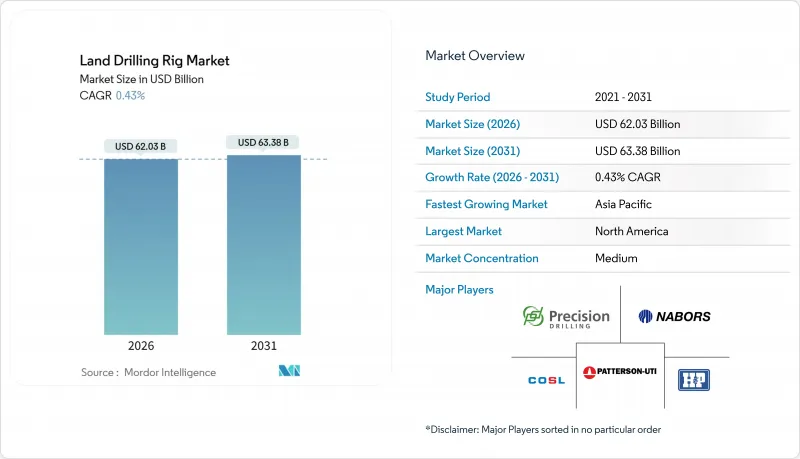
根據 Mordor Intelligence 估計,2026 年陸上鑽井鑽機市場價值為 620.3 億美元,預計在預測期(2026-2031 年)內將以 0.43% 的複合年成長率成長,到 2031 年達到 633.8 億美元。
本報告按鑽機類型(常規型、移動式/輪式、步行式超規格型)、驅動系統(機械式、電動式、混合動力/組合式)、額定馬力(1000 馬力以下、1000-1499 馬力、1500 匹馬力以上)、應用(常規石油、地熱能、新興地區和歐洲市場分類能和美國地區進行亞特熱分類能、
全球陸上鑽井鑽機市場趨勢及洞察
採用“超級規格”,功率超過1500馬力
功率超過1500馬力的超高性能鑽井平台如今已成為複雜非常傳統型油田的主流選擇,能夠鑽探深度超過15000英尺的水平井,與傳統鑽井平台相比,總鑽井時間最多可縮短30%。 FlexRig公司在美國的鑽井鑽機預計在2025年將實現日均收益28500美元,由於其配備7500磅/平方英寸的泵和750噸的頂驅,因此售價可高出3000美元。美國約60%的此類鑽井平台部署在二疊紀盆地,該盆地鑽探更深的沃爾夫坎普地層需要更高的扭矩。阿布達比國家石油公司鑽井部門也緊追在後,為高壓的賈夫拉氣田增購了12台超高性能鑽機。高昂的初始資本支出(CAPEX),通常每台鑽井平台超過2500萬美元,仍然限制著只有財力雄厚的運營商才能擁有此類鑽井平台。
頁岩和其他傳統型蘊藏量
傳統型鑽探正從評估階段邁向大規模生產,推動陸上鑽機市場的基本需求。在阿根廷瓦卡穆埃爾塔,YPF及其合作夥伴正使用1200至1500馬力的鑽機鑽探更深、富含液體的地層,預計到2025年底,日產量將達到50萬桶,兩年內成長56%。美國仍佔全球傳統型活動的40%,受惠於其強大的運輸能力和完善的鑽井基礎設施。澳洲正崛起為緻密氣新興產區,桑托斯公司在庫柏盆地引入自動化鑽機以降低勞動力風險。阿根廷的RIGI稅收穩定計畫等監管激勵措施正在加速外國公司的進入,而美國聯邦政府授予的油氣租賃權則面臨法律上的阻力。
全球向可再生能源轉型
2024年,可再生能源領域的投資額達6,230億美元,連續第三年超過上游油氣產業的投資額。國際能源總署(IEA)的「淨零排放」情境預測,石油需求將在2025年達到峰值,到2035年下降25%,這意味著鑽探計畫將面臨結構性壓力。道達爾能源公司目前將40%的資本支出分配給電力和可再生能源,並已退出北海未確定油田的探勘。 2024年,投資者的積極行動進一步活性化,貝萊德和先鋒集團因氣候風險而投票反對鑽探擴張計畫。儘管中東的國有石油公司受到的影響相對較小,但北美的獨立石油公司正在將其鑽井鑽機轉向地熱發電,而地熱發電距離商業化規模仍需數年時間。
細分市場分析
步行式超高性能鑽機的出現,推動了陸上鑽井鑽機高科技平台市場佔有率的成長,年複合成長率達0.8%,儘管移動式和輪式鑽機在2025年仍將佔據40.8%的收入佔有率。步行式鑽孔機可將作業時間縮短3至8小時,每次作業可節省高達20萬美元的成本,同時提高井場鑽井的經濟效益。這些優勢對二疊紀盆地的營運商尤其具有吸引力,因為他們每個井場通常鑽探6至12口井。然而,由於每台設備的資本密集度超過2800萬美元,新興地區的採用受到限制,因為這些地區的資金籌措成本必須透過每日租金溢價來抵銷。
同時,阿根廷、哥倫比亞和非洲部分地區仍在使用傳統的車載式鑽機。在這些地區,由於油井分散、鑽井目標淺且安全標準較低,因此盡量減少資本投資是首選。加州新的Tier 4引擎排放法規實際上禁止在新計畫中使用純柴油機械鑽機,加速了聖華金盆地鑽機的退役。 「步行式」鑽孔機的概念正在中東地區推廣。阿布達比國家石油公司(ADNOC)於2024年向賈夫拉油田交付了四台鑽孔機,顯示北美以外的國際市場對此類鑽孔機的需求。隨著超高規格鑽機的供應日益緊張,擁有混合型鑽機車隊的承包商在傳統鑽井作業中仍然保持著定價權。
預計到2025年,陸上鑽井鑽機市場中,機械鑽機將佔51.5%的佔有率,但由於監管和節油壓力,電動SCR和交流驅動鑽機佔有率正以每年0.7%的速度成長。電動平台每鑽一英尺可減少約15%的柴油消耗,以目前油價計算,每天可節省2000至3000美元。此外,電動平台還可在起下鑽過程中進行再生煞車,進一步降低營運成本。
不同地區的普及率各不相同。在加拿大,嚴寒的冬季和短暫的鑽井季節意味著電動鑽孔機的普及速度較慢。 Precision Drilling公司擁有的181台鑽機中,只有55%是電動的。在中國,70%的鑽機仍是機械鑽機,但中海油正在塔里木盆地開展示範項目,以滿足中國石油的甲烷排放目標。根據SPE(石油工程師協會)2024年的一項研究,從全生命週期成本的角度來看,全電動鑽機具有優勢,因為更少的活動部件可以降低18%至22%的維護成本。在電網和現場天然氣供應不穩定的地區,柴電混合動力鑽機可以彌補電力缺口。
區域分析
到2025年,北美將佔全球市場價值的49.9%,預計2031年將維持0.4%的適度複合年成長率。儘管在2025年底鑽機數量減少至588台,但由於水平鑽井段的延伸和週期時間的縮短,產量仍增加了3%。埃克森美孚斥資600億美元收購先鋒公司,獲得了更大、更連續的鑽井平台,提高了資本效率。加拿大鑽機數量在季節性高峰期達到181台,但由於每年春季解凍期間設施仍會運作長達兩個月,因此運轉率波動被控制在最低限度。堪薩斯州和科羅拉多的天然氫氣鑽探以及內華達州的地熱井鑽探帶來了新的多元化發展,但與石油相比,產量仍然小規模。
中東和非洲地區的前景最為穩定,複合年成長率為0.6%,這得益於政府資金的支持以及低於30美元的盈虧平衡點。阿布達比國家石油公司(ADNOC)鑽井業務已將鑽機數量增至118台,並根據基於績效的定價機制,與科威特和沙烏地阿拉伯簽訂了多年合約。沙烏地阿美公司投資70億美元的陸上天然氣開採項目旨在從傑夫拉氣田開採200兆鑽機天然氣,這需要高扭矩鑽機來處理壓力高達10000磅/平方英寸的地層。利比亞計畫部署20台陸上鑽機,將日產量恢復至150萬桶,但進展將取決於政治穩定。阿爾及利亞計劃在2026年開採120口井,顯示在經歷了多年的投資不足之後,撒哈拉沙漠的天然氣開採活動即將恢復。
亞太地區是成長最快的地區,年複合成長率達1.3%,但其成長主要來自小規模計畫。印度已宣佈在坎貝盆地和戈達瓦里盆地開發13個地熱區塊,這些盆地的溫度超過攝氏200度C。在澳大利亞,庫柏盆地的一個緻密氣計畫正在引入自動化鑽機,以緩解人手不足。印尼的前沿探勘在獲得許可方面面臨延誤,而中國海工集團正在塔里木盆地試點使用電動鑽機,以履行其甲烷減排目標。南美洲的年複合成長率為0.5%,主要得益於瓦卡穆爾塔油田,該油田日產量達50萬桶,儘管巴西專注於海上開發,但其產量仍提振了區域需求。歐洲仍受到水力壓裂禁令的限制,但土耳其和羅馬尼亞仍在成熟的陸上油田進行小規模鑽探。
其他好處:
- Excel格式的市場預測(ME)表
- 3個月的分析師支持
目錄
第1章:引言
- 研究假設和市場定義
- 調查範圍
第2章:調查方法
第3章執行摘要
第4章 市場狀況
- 市場概覽
- 市場促進因素
- 擴大使用馬力超過1500匹的超高性能鑽機。
- 頁岩和其他傳統型蘊藏量的利用
- 中東和北非地區陸上探勘與生產(E&P)的復甦;資本支出(CAPEX)計畫儲備
- 引進低排放氣體/LNG動力鑽井鑽機引擎。
- 引入利用人工智慧的全自動「數位鑽機」。
- 地熱和天然氫井開發專案的興起
- 市場限制因素
- 全球向可再生能源轉型正在加速。
- 原油價格波動及資本紀律要求
- 降低與環境、社會及公司治理 (ESG) 相關的資金籌措和保險門檻。
- 擴大脆弱流域的「禁鑽」緩衝區
- 供應鏈分析
- 監理情勢
- 技術展望
- 波特五力模型
第5章 市場規模與成長預測
- 按鑽機類型
- 傳統的
- 移動式/輪式
- 行走的超級規格
- 透過驅動系統
- 機械的
- 電動(SCR 和 AC)
- 混合/複合
- 按額定馬力
- 1000馬力或以下
- 1,000~1,499 HP
- 1500馬力或以上
- 透過使用
- 傳統型石油
- 傳統型/緻密油氣和頁岩油氣
- 地熱
- 新興天然氫
- 按地區
- 北美洲
- 美國
- 加拿大
- 墨西哥
- 歐洲
- 土耳其
- 羅馬尼亞
- 烏克蘭
- 法國
- 西班牙
- 其他歐洲國家
- 亞太地區
- 印度
- 澳洲
- 東南亞國協
- 其他亞太國家
- 南美洲
- 巴西
- 阿根廷
- 哥倫比亞
- 其他南美國家
- 中東和非洲
- 沙烏地阿拉伯
- 阿拉伯聯合大公國
- 阿曼
- 科威特
- 伊拉克
- 阿爾及利亞
- 利比亞
- 奈及利亞
- 其他中東和非洲國家
- 北美洲
第6章 競爭情勢
- 市場集中度
- 策略趨勢(併購、聯盟、購電協議)
- 市場佔有率分析(主要公司的市場排名和佔有率)
- 公司簡介
- Nabors Industries Ltd
- Helmerich & Payne Inc
- Patterson-UTI Energy Inc
- Precision Drilling Corp
- Schlumberger Ltd
- Weatherford International PLC
- Ensign Energy Services Inc
- KCA Deutag
- ADNOC Drilling
- China Oilfield Services Ltd(COSL)
- Sinopec Zhongyuan Petroleum Eng.
- Borr Drilling Ltd
- Saipem SpA
- Kuwait Drilling Company
- Valaris Ltd
- ADES Holding
- Independence Contract Drilling
- Cactus Drilling
- Honghua Group Ltd
- Nabors Saudi Arabia
第7章 市場機會與未來展望
According to Mordor Intelligence, the land drilling rig market size is estimated at USD 62.03 billion in 2026, and is expected to reach USD 63.38 billion by 2031, at a CAGR of 0.43% during the forecast period (2026-2031).
This report is Segmented by Rig Type (Conventional, Mobile/Wheel-Mounted, and Walking Super-Spec), Drive System (Mechanical, Electric, and Hybrid/Compound), Horsepower Rating (Up To 1, 000 HP, 1, 000 To 1, 499 HP, and Above 1, 500 HP), Application (Conventional Oil, Geothermal, Emerging Natural-Hydrogen, and More), and Geography (North America, Europe, Asia-Pacific, South America, and Middle East and Africa).
Global Land Drilling Rig Market Trends and Insights
>=1,500 HP super-spec adoption
Super-spec platforms above 1,500 HP now dominate complex unconventionals, enabling laterals beyond 15,000 feet and trimming total-depth times by up to 30% versus legacy units. FlexRig fleets in the United States logged average day rates of USD 28,500 in 2025, a USD 3,000 premium justified by 7,500-psi pumps and 750-ton top drives. About 60% of U.S. deployments went to the Permian Basin, where deeper Wolfcamp zones require higher torque. ADNOC Drilling mirrored the trend, adding 12 super-spec rigs for the high-pressure Jafurah gas play. High upfront capex, often above USD 25 million per rig, continues to limit ownership to well-capitalized operators.
Shale and other unconventional reserves
Unconventional drilling has switched from appraisal to factory mode, reinforcing baseline demand for the land drilling rigs market. Argentina's Vaca Muerta delivered 500,000 barrels per day by late 2025, up 56% in two years, as YPF and partners drilled deeper liquids-rich sections using 1,200-1,500 HP rigs. The United States still accounted for 40% of global unconventional activity, benefiting from takeaway capacity and pro-drilling infrastructure. Australia is emerging as a tight-gas frontier, where Santos is deploying automated rigs in the Cooper Basin to curb labor exposure. Regulatory incentives such as Argentina's RIGI tax-stability regime are accelerating foreign participation, whereas U.S. federal lease issuance faces legal headwinds.
Global shift to renewables
Renewables attracted USD 623 billion in investment during 2024, overtaking upstream hydrocarbon spend for a third straight year. The IEA's Net-Zero scenario sees oil demand peaking in 2025 and sliding 25% by 2035, implying structural pressure on drilling programs. TotalEnergies now directs 40% of its capex toward power and renewables, retreating from North Sea wildcats. Investor activism deepened in 2024 as BlackRock and Vanguard voted against drilling expansions, citing climate risk. Middle Eastern NOCs remain insulated, but North American independents are repurposing rigs toward geothermal, where commercial scale is still years away.
Other drivers and restraints analyzed in the detailed report include:
- Revival of MENA onshore CAPEX
- Low-emission gas/LNG-powered rig engines
- Oil-price volatility & capital discipline
For complete list of drivers and restraints, kindly check the Table Of Contents.
Segment Analysis
Walking super-spec rigs lifted the land drilling rigs market share for high-tech platforms by adding 0.8% CAGR, even though mobile and wheel-mounted units still generated 40.8% of 2025 revenue. Walking systems cut move times from three days to eight hours, saving up to USD 200,000 per relocation and boosting pad-drilling economics. These benefits appeal most to Permian operators completing 6-12 wells per pad. Capital intensity above USD 28 million per unit limits their spread in emerging regions, where dayrate premiums must offset financing costs.
At the other end, conventional truck-mounted fleets persist in Argentina, Colombia, and parts of Africa, where dispersed wells, shallow targets, and lower safety standards favor minimal capex. California's new Tier 4 engine rules effectively ban diesel-only mechanical rigs for new programs, accelerating retirements in the San Joaquin Basin. The Middle East is importing the walking concept; ADNOC moved four units into Jafurah in 2024, validating international demand beyond North America. As super-spec supply tightens, contractors with mixed fleets retain pricing power in conventional work.
Mechanical rigs represented 51.5% of the 2025 land drilling rigs market size, but electric SCR and AC drives are expanding at a 0.7% clip under regulatory and fuel-savings pressure. Electric platforms cut diesel usage by roughly 15% per foot drilled, translating to USD 2,000-3,000 in daily savings at current fuel prices. They also enable regenerative braking during tripping, lowering operating costs further.
Adoption patterns vary by geography. Canada, with challenging winters and shorter drilling windows, is converting slowly; only 55% of Precision Drilling's 181-rig fleet is electric. China still runs 70% mechanical rigs, though COSL has pilots underway in the Tarim Basin to meet PetroChina methane goals. Lifecycle economics favor full electrification because maintenance expenses fall 18-22% thanks to fewer moving parts, according to an SPE 2024 study. Hybrid diesel-electric setups are bridging the gap where grid or field gas is patchy.
Complete Report Scope:
- By Rig Type
- Conventional
- Mobile/Wheel-Mounted
- Walking Super-Spec
- By Drive System
- Mechanical
- Electric (SCR and AC)
- Hybrid/Compound
- By Horsepower Rating
- Up to 1,000 HP
- 1,000 to 1,499 HP
- Above 1,500 HP
- By Application
- Conventional Oil
- Unconventional/Tight and Shale
- Geothermal
- Emerging Natural-Hydrogen
- By Geography
- North America
- United States
- Canada
- Mexico
- Europe
- Turkey
- Romania
- Ukraine
- France
- Spain
- Rest of Europe
- Asia-Pacific
- India
- Australia
- ASEAN Countries
- Rest of Asia-Pacific
- South America
- Brazil
- Argentina
- Colombia
- Rest of South America
- Middle East and Africa
- Saudi Arabia
- United Arab Emirates
- Oman
- Kuwait
- Iraq
- Algeria
- Libya
- Nigeria
- Rest of Middle East and Africa
- North America
Geography Analysis
North America produced 49.9% of the 2025 value and is forecast at a modest 0.4% CAGR to 2031. Rig counts eased to 588 in late 2025, but output still climbed 3% thanks to longer laterals and faster cycle times. ExxonMobil's USD 60 billion Pioneer acquisition unlocked larger contiguous pads, enhancing capital efficiency. Canada's seasonal fleet reached 181 rigs, yet spring breakup still sidelines equipment for up to two months each year, tempering utilization swings. Natural-hydrogen spuds in Kansas and Colorado, plus geothermal wells in Nevada, provide emerging diversification, though volumes remain modest relative to oil.
The Middle East and Africa posted the steadiest outlook with a 0.6% CAGR, aided by state funding and sub-USD 30 breakevens. ADNOC Drilling scaled to 118 rigs, entering Kuwait and Saudi Arabia under multiyear contracts backed by performance tariffs. Saudi Aramco's USD 7 billion onshore program targets 200 TCF of Jafurah gas, requiring high-torque rigs tailored for 10,000-psi formations. Libya plans 20 land rigs to restore 1.5 million barrels per day, although progress depends on political stability. Algeria's 120-well plan for 2026 signals renewed Saharan gas drilling after years of underinvestment.
Asia-Pacific is the fastest-growing region at 1.3% CAGR, yet from a smaller base. India issued 13 geothermal blocks targeting the Cambay and Godavari basins with temperatures above 200 °C. Australia's Cooper Basin tight-gas projects employ automated rigs to mitigate labor scarcity. Indonesia's frontier exploration faces permitting delays, while China's COSL trials electric rigs in the Tarim Basin as part of methane-cutting goals. South America's 0.5% CAGR hinges on Vaca Muerta, whose 500,000 barrels per day output lifted regional demand despite Brazil focusing offshore. Europe remains constrained by fracturing bans, though Turkey and Romania sustain modest drilling in mature onshore licenses.
- Nabors Industries Ltd
- Helmerich & Payne Inc
- Patterson-UTI Energy Inc
- Precision Drilling Corp
- Schlumberger Ltd
- Weatherford International PLC
- Ensign Energy Services Inc
- KCA Deutag
- ADNOC Drilling
- China Oilfield Services Ltd (COSL)
- Sinopec Zhongyuan Petroleum Eng.
- Borr Drilling Ltd
- Saipem SpA
- Kuwait Drilling Company
- Valaris Ltd
- ADES Holding
- Independence Contract Drilling
- Cactus Drilling
- Honghua Group Ltd
- Nabors Saudi Arabia
Additional Benefits:
- The market estimate (ME) sheet in Excel format
- 3 months of analyst support
TABLE OF CONTENTS
1 Introduction
- 1.1 Study Assumptions & Market Definition
- 1.2 Scope of the Study
2 Research Methodology
3 Executive Summary
4 Market Landscape
- 4.1 Market Overview
- 4.2 Market Drivers
- 4.2.1 Increasing use of >=1,500 HP super-spec rigs
- 4.2.2 Exploiting shale & other unconventional reserves
- 4.2.3 Revival of MENA onshore E&P CAPEX pipelines
- 4.2.4 Adoption of low-emission gas/LNG-powered rig engines
- 4.2.5 Deployment of fully automated, AI-driven "digital rigs"
- 4.2.6 Rise of geothermal & natural-hydrogen well programs
- 4.3 Market Restraints
- 4.3.1 Accelerating global shift to renewables
- 4.3.2 Oil-price volatility & capital-discipline mandates
- 4.3.3 Tightening ESG financing & insurance hurdles
- 4.3.4 Expanding no-drill buffer zones in sensitive basins
- 4.4 Supply-Chain Analysis
- 4.5 Regulatory Landscape
- 4.6 Technological Outlook
- 4.7 Porter's Five Forces
- 4.7.1 Bargaining Power of Suppliers
- 4.7.2 Bargaining Power of Buyers
- 4.7.3 Threat of New Entrants
- 4.7.4 Threat of Substitutes
- 4.7.5 Intensity of Competitive Rivalry
5 Market Size & Growth Forecasts
- 5.1 By Rig Type
- 5.1.1 Conventional
- 5.1.2 Mobile/Wheel-Mounted
- 5.1.3 Walking Super-Spec
- 5.2 By Drive System
- 5.2.1 Mechanical
- 5.2.2 Electric (SCR and AC)
- 5.2.3 Hybrid/Compound
- 5.3 By Horsepower Rating
- 5.3.1 Up to 1,000 HP
- 5.3.2 1,000 to 1,499 HP
- 5.3.3 Above 1,500 HP
- 5.4 By Application
- 5.4.1 Conventional Oil
- 5.4.2 Unconventional/Tight and Shale
- 5.4.3 Geothermal
- 5.4.4 Emerging Natural-Hydrogen
- 5.5 By Geography
- 5.5.1 North America
- 5.5.1.1 United States
- 5.5.1.2 Canada
- 5.5.1.3 Mexico
- 5.5.2 Europe
- 5.5.2.1 Turkey
- 5.5.2.2 Romania
- 5.5.2.3 Ukraine
- 5.5.2.4 France
- 5.5.2.5 Spain
- 5.5.2.6 Rest of Europe
- 5.5.3 Asia-Pacific
- 5.5.3.1 India
- 5.5.3.2 Australia
- 5.5.3.3 ASEAN Countries
- 5.5.3.4 Rest of Asia-Pacific
- 5.5.4 South America
- 5.5.4.1 Brazil
- 5.5.4.2 Argentina
- 5.5.4.3 Colombia
- 5.5.4.4 Rest of South America
- 5.5.5 Middle East and Africa
- 5.5.5.1 Saudi Arabia
- 5.5.5.2 United Arab Emirates
- 5.5.5.3 Oman
- 5.5.5.4 Kuwait
- 5.5.5.5 Iraq
- 5.5.5.6 Algeria
- 5.5.5.7 Libya
- 5.5.5.8 Nigeria
- 5.5.5.9 Rest of Middle East and Africa
- 5.5.1 North America
6 Competitive Landscape
- 6.1 Market Concentration
- 6.2 Strategic Moves (M&A, Partnerships, PPAs)
- 6.3 Market Share Analysis (Market Rank/Share for key companies)
- 6.4 Company Profiles (includes Global level Overview, Market level overview, Core Segments, Financials as available, Strategic Information, Products & Services, and Recent Developments)
- 6.4.1 Nabors Industries Ltd
- 6.4.2 Helmerich & Payne Inc
- 6.4.3 Patterson-UTI Energy Inc
- 6.4.4 Precision Drilling Corp
- 6.4.5 Schlumberger Ltd
- 6.4.6 Weatherford International PLC
- 6.4.7 Ensign Energy Services Inc
- 6.4.8 KCA Deutag
- 6.4.9 ADNOC Drilling
- 6.4.10 China Oilfield Services Ltd (COSL)
- 6.4.11 Sinopec Zhongyuan Petroleum Eng.
- 6.4.12 Borr Drilling Ltd
- 6.4.13 Saipem SpA
- 6.4.14 Kuwait Drilling Company
- 6.4.15 Valaris Ltd
- 6.4.16 ADES Holding
- 6.4.17 Independence Contract Drilling
- 6.4.18 Cactus Drilling
- 6.4.19 Honghua Group Ltd
- 6.4.20 Nabors Saudi Arabia
7 Market Opportunities & Future Outlook
- 7.1 White-Space & Unmet-Need Assessment

 電動潛孔鎚鑽機市場:全球市場預測,2026-2032年露天鑽機市場:全球市場預測,2026-2032年鑽機市場:全球市場預測,2026-2032年陸上鑽井鑽機市場-2026-2032年全球市場預測礦用鑽機市場-2026-2032年全球市場預測
 鑽機市場-全球產業規模、佔有率、趨勢、機會和預測:按安裝地點、類型、鑽井方法、作業深度、地區和競爭格局分類,2021-2031年
 鑽機市場規模、佔有率和成長分析:按鑽機類型、鑽井深度、最終用途產業和地區分類-2026-2033年產業預測履帶地熱鑽機市場:按額定功率、深度、組件、應用、最終用戶和銷售管道,全球預測,2026-2032年
 旋轉爆破鑽孔鑽機市場報告:按類型、動力源、應用和地區分類(2026-2034 年)極地鑽機市場按鑽機類型、水深、移動性、動力來源、應用和最終用途產業分類-全球預測,2026-2032年