


 |
市場調查報告書
商品編碼
2114101
建築一體化光伏(BIPV):市場佔有率分析、產業趨勢與統計及成長預測(2026-2031)Building Integrated Photovoltaic (BIPV) - Market Share Analysis, Industry Trends & Statistics, Growth Forecasts (2026 - 2031) |
||||||

※ 本網頁內容可能與最新版本有所差異。詳細情況請與我們聯繫。
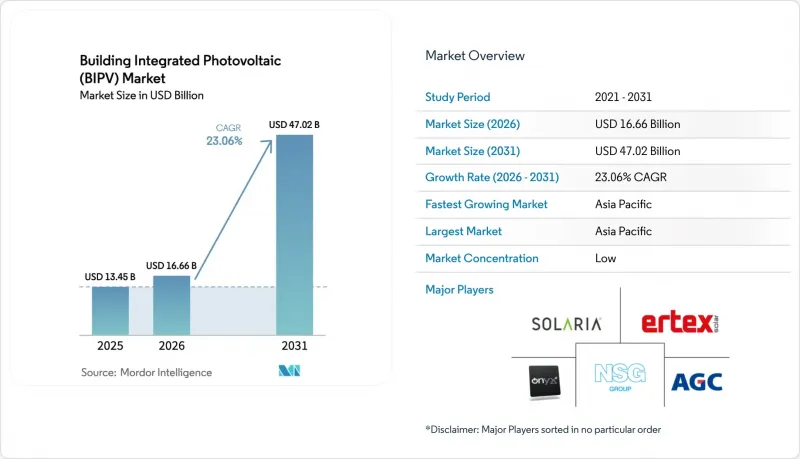
根據 Mordor Intelligence 預測,建築一體化光伏 (BIPV) 市場規模預計將在 2025 年達到 134.5 億美元,2026 年達到 166.6 億美元,到 2031 年達到 470.2 億美元,2026 年至 2031 年的複合年成長率為 23.06%。
本報告按技術(晶體矽、薄膜和新興技術)、最終用戶(住宅、商業、工業和公共/機構)以及地區(北美、歐洲、亞太、南美以及中東和非洲)進行細分。市場規模和預測均以美元計價。
建築一體化光伏(BIPV)市場的全球趨勢與洞察
支持性政策獎勵與強制性零碳建築
歐盟關於建築能源效率的2024/1275號指令規定,到2030年,所有新建建築的屋頂都必須適合安裝太陽能發電系統;面積超過250平方公尺的公共建築的維修則從2027年開始分階段實施。德國復興信貸銀行(KfW)的442計畫已累計5億歐元,用於補貼10%至30%的安裝成本;法國也擴大了其MaPrimeRenov計畫對整合式外立面的津貼,最高補貼額度為1.1萬歐元。在中國,一項覆蓋676個縣的「全國太陽能發電強制令」將於2025年底前實施,屆時新建工業建築將被要求在其屋頂安裝發電設備或購買可再生能源證書。這些措施有效地保障了建築一體化光伏(BIPV)市場的需求。這些法規簡化了授權流程,促進了專業承包商的發展,並將BIPV從可選維修轉變為建築規範的強制性要求。隨著越來越多的地區採用類似的指南,開發商現在在基本設計階段早期就加入了太陽能發電容量,以避免在核准過程中後期進行代價高昂的設計變更。
降低太陽能發電和系統平衡 (BOS) 的成本
到2025年中期,單晶PERC組件的價格將降至每瓦0.12美元,逆變器供應商之間的競爭壓力也使電子元件的價格比去年同期下降了18%。 AGC和NSG/Pilkinton推出的標準化幕牆套件透過在工廠整合接線盒和密封條,減少了25%的現場人工成本。雖然透明光伏玻璃的價格仍然比Low-E低輻射鍍膜玻璃高出20%至40%,但開發高租金物業的開發人員正透過增加收入和減少屋頂設備的擁塞來彌補成本差異。在沿岸地區,到2025年,建築一體化光伏(BIPV)發電的平準化電力成本將低於零售電費,這意味著在年太陽輻射量超過2200千瓦時/平方米的地區,無需補貼即可安裝BIPV系統。隨著 BOS(建築內光伏)製造商擴大規模,建築內光伏(BIPV)市場價格彈性增大,為中型商業項目打開了大門,此前由於成本考慮,這些項目很難引入整合式太陽能幕牆。
初始設定和設計非常複雜。
建築獨立式光伏(BIPV)需要結構、電氣和幕牆團隊之間的緊密協作,但很少有總承包商能夠提供如此一體化的工作流程。在紐約和加州,結構荷載、電網連接和疏散路線都需要單獨的核准,這使得軟成本比屋頂光伏陣列高出12%至18%,工期延長至多六個月。將光電系統整合到客製化幕牆中,每平方公尺的成本將增加550至850歐元,這促使注重成本的開發商轉向更經濟的停車棚。保險公司在保費上增加5%至15%,直到檢驗員確認符合UL 1703和IEC 61730標準,這反映出他們對光伏系統防洪和快速停止功能的可靠性存在擔憂。熟練人員的短缺進一步加劇了這些風險。北美地區只有不到2,000名認證安裝人員,迫使開發商從歐洲引進工人,每天的成本高達800美元,這將對專案的獲利能力造成壓力,直到現場培訓全面實施為止。
細分市場分析
到2025年,晶體矽將佔光伏組件出貨量的87.5%,在建築光伏一體化(BIPV)市場佔最大佔有率。但預計到2031年,鈣鈦礦矽串聯組件的複合年成長率將達到27.5%,縮小其領先優勢。隆基的「Hi-MO 9」組件實現了24.92%的轉換效率,進一步鞏固了矽在高功率的優勢。同時,First Solar的「Series 7」CdTe組件即使在高溫倉庫環境下也能保持穩定的輸出。儘管如此,轉換效率高達29.1%的實驗室級串聯電池正在推動歐洲各地的幕牆實驗性安裝,這表明市電平價指日可待。 Heliatek的有機薄膜組件的早期現場數據顯示,其使用壽命可達25年,顛覆了人們對軟性組件壽命短、易耗的固有印象。目前,建築光伏一體化(BIPV)市場為建築師提供了豐富的選擇,從剛性高密度面板到輕質有機卷材,企劃團隊可以根據專案需求選擇合適的基材、重量和外觀。供應鏈中的細微差別也至關重要。低鐵玻璃的短缺可能會阻礙晶體矽項目,而採用聚合物基板的串聯組件則可以規避此限制。如果鈣鈦礦組件在2027年獲得IEC 61215認證,資金籌措障礙或將消除,晶體矽製造商的市場佔有率可能會迅速下降。
第二代薄膜太陽能電池處於中間位置。碲化鎘(CdTe)、銅銦鎵硒(CIGS)和非晶質具有低溫度係數,即使在沙漠氣候下也能保持發電效率,但它們的能量密度仍然落後於頂級單晶PERC太陽能電池。隨著組件價格的下降,薄膜太陽能電池正將重心從直接的功率競爭轉向曲面天窗、歷史建築外觀和超輕量張拉屋頂等細分應用領域。原始設備製造商(OEM)正在投資混合生產線,將鈣鈦礦塗層層壓到晶體矽晶圓上,以在不進行根本性工廠升級的情況下提高效率。最終結果將決定矽能否保持其現有地位,還是會在建築整合光伏(BIPV)市場中將高階建築項目拱手讓給具有新型化學成分的材料。
區域分析
預計到2025年,亞太地區將佔全球光伏組件出貨量的40.7%,並預計在2031年之前以23.8%的年均成長率持續成長,繼續保持主導地位。在中國,已有676個縣強制要求安裝光電模組,確保了市場需求的持續成長。同時,在日本,上網電價補貼(FIT)政策的調整鼓勵了自用,提高了屋頂光電的獲利能力。在深圳,建築面積超過5000平方公尺的商業建築必須安裝BIPV組件,這使得隆基、天合光能和日昇等國內大型企業獲得了大量訂單。印度已設定目標,到2030年實現300吉瓦的光伏裝置容量,並為政府設施制定了單獨的BIPV目標,但各邦法規的差異以及幕牆工程師的短缺阻礙了目標的實施。在新加坡登加區主導的東協試點計畫中,42,000戶住宅被要求安裝太陽能屋頂,這表明如果政策明確,太陽能發電是擴充性的。
歐洲則位居第二,主要得益於《建築能源性能指令》。在德國、法國和西班牙,公共資金承擔了30%至50%的專案成本;而在瑞典,每噸二氧化碳(tCO2)超過100歐元的碳排放稅正從生命週期成本的角度推動太陽能發電的整合。英國的《未來住宅標準》強制要求住宅光伏一體化(BIPV)技術,但脫歐後的勞動力短缺導致安裝人員的薪資從2024年起上漲了12%至15%。在北歐國家,由於日照時數的波動,年發電量不穩定,但人們對高效串聯式光伏板的興趣日益濃厚,以彌補季節性發電量的下降。整體而言,各項扶持性獎勵支撐著穩定的專案儲備,跨國公司正利用這些專案在BIPV市場試行跨國籌資策略。
北美地區的擴張主要集中在加州、紐約州和加拿大部分地區,修訂後的淨計量法規和30%的聯邦投資稅額扣抵(ITC)將投資回收期縮短至8-10年。加州第24號法規將強制性太陽能發電需求擴展至面積超過10,000平方英尺的商業建築,從而刺激了老舊建築外觀的維修。紐約州的《氣候法案》規定,到2030年,地方政府物業管理公司必須從可再生能源中獲得70%的電力,這鼓勵在州政府合約中採用建築一體化光伏(BIPV)外觀。中東和非洲地區雖然仍在發展中,但潛力巨大。 NEOM和Masdar城已將太陽能外觀納入其總體規劃,目標是實現100%可再生能源供電。該地區太陽輻射量高達每年2,200千瓦時/平方米,即使沒有補貼,投資回收期也可能不到六年,這使其成為下一個建築一體化光伏(BIPV)市場的成長中心。
其他好處:
- Excel格式的市場預測(ME)表
- 3個月的分析師支持
目錄
第1章:引言
- 研究假設和市場定義
- 調查範圍
第2章:調查方法
第3章執行摘要
第4章 市場狀況
- 市場概覽
- 市場促進因素
- 支持性政策獎勵與強制性零碳建築
- 降低太陽能發電成本和系統平衡
- 對淨零排放/智慧城市發展的需求日益成長
- 帷幕牆一體成型透明光伏玻璃的成長
- 企業面臨獲得ESG和綠建築認證的壓力。
- 5G相容屋頂基礎設施的綜效
- 市場限制因素
- 前期實施成本高,設計複雜。
- 結構因素/因消防安全標準造成的障礙
- 熟練承包商短缺,帷幕牆工程缺乏專業知識。
- 特種光伏玻璃的供應鏈限制
- 供應鏈分析
- 監理情勢
- 技術展望
- 波特五力模型
- 投資與資金籌措分析
第5章 市場規模與成長預測
- 透過技術
- 晶體矽(單晶、多晶)
- 薄膜(CdTe、CIGS、a-Si)
- 新興技術(鈣鈦礦、有機太陽能電池、串聯電池)
- 最終用戶
- 住宅
- 商業
- 產業
- 公共和機構建築
- 按成分(定性分析)
- 屋頂
- 帷幕牆/立面
- 窗戶和透明玻璃
- 天窗和中庭
- 遮陽裝置(百葉窗、陽台)
- 按地區
- 北美洲
- 美國
- 加拿大
- 墨西哥
- 歐洲
- 德國
- 法國
- 英國
- 西班牙
- 義大利
- 北歐國家
- 俄羅斯
- 其他歐洲國家
- 亞太地區
- 中國
- 日本
- 印度
- 韓國
- 東南亞國協
- 澳洲和紐西蘭
- 其他亞太國家
- 南美洲
- 巴西
- 阿根廷
- 哥倫比亞
- 其他南美國家
- 中東和非洲
- 沙烏地阿拉伯
- 阿拉伯聯合大公國
- 南非
- 奈及利亞
- 埃及
- 其他中東和非洲國家
- 北美洲
第6章 競爭情勢
- 市場集中度分析
- 策略趨勢(併購、聯盟、購電協議)
- 市場佔有率分析(主要公司的市場排名和佔有率)
- 公司簡介
- Onyx Solar Energy SL
- AGC Inc.
- Nippon Sheet Glass(Pilkington)
- Ertex Solartechnik GmbH
- Solaria Corporation
- Sunovation GmbH
- Mitrex Inc.
- Changzhou Almaden Co. Ltd.
- NanoPV Solar Inc.
- Tesla Inc.
- First Solar Inc.
- Sharp Corporation
- Hanwha Q-Cells
- Canadian Solar Inc.
- LONGi Green Energy
- Trina Solar Ltd.
- Risen Energy Co. Ltd.
- Waaree Energies Ltd.
- Heliatek GmbH
- Ascent Solar Technologies
第7章 市場機會與未來展望
According to Mordor Intelligence, the building integrated photovoltaic market size is projected to be USD 13.45 billion in 2025, USD 16.66 billion in 2026, and reach USD 47.02 billion by 2031, growing at a CAGR of 23.06% from 2026 to 2031.
This report is Segmented by Technology (Crystalline Silicon, Thin-Film, and Emerging), End-User (Residential, Commercial, Industrial, and Institutional and Public Buildings), and Geography (North America, Europe, Asia-Pacific, South America, and Middle East and Africa). The Market Sizes and Forecasts are Provided in Terms of Value (USD).
Global Building Integrated Photovoltaic (BIPV) Market Trends and Insights
Supportive Policy Incentives & Zero-Carbon Building Mandates
Europe's Energy Performance of Buildings Directive 2024/1275 requires solar-ready roofs on all new structures by 2030, and phased retrofits for public buildings above 250 square meters now begin in 2027. Germany's KfW 442 program earmarked EUR 500 million in 2025 to subsidize 10-30% of installed costs, while France extended MaPrimeRenov grants up to EUR 11,000 for integrated facades. China's whole-county solar mandate, covering 676 counties by late 2025, obliges new industrial rooftops to host on-site generation or purchase renewable certificates, effectively guaranteeing a pipeline for the Building Integrated Photovoltaic (BIPV) market. These rules shorten permitting cycles, train specialist installers, and shift BIPV from a discretionary upgrade to a code requirement. As more jurisdictions transpose similar directives, developers front-load solar envelopes into schematic designs to avoid costly redesigns later in the approval process.
Declining PV & Balance-of-System Costs
Monocrystalline PERC modules dropped to USD 0.12 per watt in mid-2025, and competitive pressure among inverter suppliers trimmed electronics pricing by 18% year-on-year. Standardized curtain-wall kits released by AGC and NSG/Pilkington cut on-site labor by 25% by integrating junction boxes and weather seals at the factory. Transparent PV glass still costs 20-40% more than low-E glazing, but high-rent developers recoup premiums by monetizing electricity and reducing mechanical-penthouse congestion. In the Gulf, the levelized cost of BIPV electricity fell below retail tariffs in 2025, enabling subsidy-free adoption where irradiance tops 2,200 kWh/m2/yr. As BOS manufacturers scale, the Building Integrated Photovoltaic (BIPV) market enjoys price elasticity that opens mid-tier commercial projects previously priced out of integrated solar facades.
High Initial Installation & Design Complexity
BIPV requires tight coordination among structural, electrical, and facade teams, yet few general contractors offer that integrated workflow. New York and California demand separate approvals for structural load, interconnection, and fire egress, pushing soft costs 12-18% above rooftop arrays and stretching timelines by up to six months. Custom curtain-wall integration can add EUR 550-850/m2 to budgets, nudging cost-conscious developers toward cheaper carports. Insurers levy 5-15% premiums until inspectors confirm UL 1703 and IEC 61730 compliance, reflecting caution over water ingress and rapid-shutdown reliability. A talent bottleneck compounds risks: fewer than 2,000 certified installers operate in North America, leading developers to import European crews at USD 800/day, which erodes project margins until local training accelerates.
Other drivers and restraints analyzed in the detailed report include:
- Rising Demand for Net-Zero / Smart-City Developments
- Growth of Facade-Integrated Transparent PV Glass
- Structural / Fire-Safety Code Barriers
For complete list of drivers and restraints, kindly check the Table Of Contents.
Segment Analysis
Crystalline silicon commanded 87.5% of 2025 volume, equating to the largest Building Integrated Photovoltaic (BIPV) market share, yet perovskite-silicon tandems are set to erode that lead with a 27.5% CAGR to 2031. LONGi's Hi-MO 9 hit 24.92% efficiency, reinforcing silicon's high-wattage advantage, while First Solar's Series 7 CdTe maintained output in high-temperature warehouses. Still, laboratory tandem cells at 29.1% efficiency have spurred pilot facades across Europe, indicating looming parity. Early field data from Heliatek's organic films suggest 25-year durability is attainable, undermining the perception that flexible modules are short-life novelties. The Building Integrated Photovoltaic (BIPV) market now offers architects a spectrum from rigid, high-density panels to light organic rolls, allowing project teams to match substrate, weight, and aesthetics. Supply-chain nuances matter: low-iron glass shortages can stall crystalline projects, whereas polymer-substrate tandems bypass that constraint. Once IEC 61215 certification reaches perovskite modules in 2027, financing barriers will fall, and crystalline players may confront accelerated share loss.
Second-generation thin films occupy a middle ground. CdTe, CIGS, and amorphous silicon demonstrate lower temperature coefficients, which protects yield in desert climates, yet their energy density still trails top-tier mono-PERC. As module prices slide, thin films pivot to niche value, curved skylights, heritage facades, and ultra-light tensile roofs, rather than head-to-head wattage battles. OEMs are investing in hybrid lines that laminate perovskite coatings onto crystalline wafers, chasing efficiency gains without radical factory retools. The outcome will decide whether silicon defends incumbency or concedes premium architectural projects to newer chemistries within the Building Integrated Photovoltaic (BIPV) market.
Complete Report Scope:
- By Technology
- Crystalline Silicon (Monocrystalline, Polycrystalline)
- Thin-Film (CdTe, CIGS, a-Si)
- Emerging (Perovskite, Organic PV, Tandem)
- By End-User
- Residential
- Commercial
- Industrial
- Institutional and Public Buildings
- By Building Element (Qualitative Analysis)
- Roofs
- Facades/Curtain Walls
- Windows and Transparent Glazing
- Skylights and Atriums
- Shading Devices (Louvers, Balconies)
- By Geography
- North America
- United States
- Canada
- Mexico
- Europe
- Germany
- France
- United Kingdom
- Spain
- Italy
- NORDIC Countries
- Russia
- Rest of Europe
- Asia-Pacific
- China
- Japan
- India
- South Korea
- ASEAN Countries
- Australia and New Zealand
- Rest of Asia-Pacific
- South America
- Brazil
- Argentina
- Colombia
- Rest of South America
- Middle East and Africa
- Saudi Arabia
- United Arab Emirates
- South Africa
- Nigeria
- Egypt
- Rest of Middle East and Africa
- North America
Geography Analysis
Asia-Pacific controlled 40.7% of global volume in 2025 and is forecast to grow 23.8% annually through 2031, protecting its leadership in the Building Integrated Photovoltaic (BIPV) market. China's 676-county solar mandate guarantees continuous demand, while Japan's feed-in tariff revision rewards self-consumption, lifting rooftop economics. Shenzhen obliges commercial buildings above 5,000 m2 to install BIPV skins, funneling orders to domestic giants LONGi, Trina, and Risen. India sets 300 GW solar by 2030 with a carved-out BIPV target for government facilities, but heterogeneous state codes and a shortage of facade engineers slow roll-out. ASEAN pilots, led by Singapore's Tengah district, mandate solar-ready roofs on 42,000 homes, showing scalability once policy clarity arrives.
Europe ranks second, propelled by the Energy Performance of Buildings Directive. Germany, France, and Spain underwrite 30-50% of project costs, while Sweden's carbon tax above EUR 100/tCO2 steers lifecycle economics toward integrated solar. The United Kingdom's Future Homes Standard pushes residential developers to adopt BIPV from 2025, though post-Brexit labor shortages inflated installer wages 12-15% after 2024. Nordic daylight fluctuations complicate annual yield but spur interest in high-efficiency tandem panels that offset seasonal lows. Altogether, supportive incentives anchor a predictable pipeline that multinationals use to trial cross-border procurement strategies within the Building Integrated Photovoltaic (BIPV) market.
North America's expansion clusters in California, New York, and parts of Canada, where updated net-metering and 30% federal ITC compress payback to 8-10 years. California's Title 24 extends solar mandates to commercial buildings over 10,000 ft2, triggering facade retrofits on older stock. New York's Climate Act compels municipal property managers to offset 70% of electricity with renewables by 2030, driving state contracts toward BIPV facades. The Middle East and Africa remain nascent yet promising, with NEOM and Masdar City embedding solar skins in master plans that target 100% renewable supply. High irradiance above 2,200 kWh/m2/yr offers sub-6-year payback even without subsidies, positioning the region as the next growth pole for the Building Integrated Photovoltaic (BIPV) market.
- Onyx Solar Energy SL
- AGC Inc.
- Nippon Sheet Glass (Pilkington)
- Ertex Solartechnik GmbH
- Solaria Corporation
- Sunovation GmbH
- Mitrex Inc.
- Changzhou Almaden Co. Ltd.
- NanoPV Solar Inc.
- Tesla Inc.
- First Solar Inc.
- Sharp Corporation
- Hanwha Q-Cells
- Canadian Solar Inc.
- LONGi Green Energy
- Trina Solar Ltd.
- Risen Energy Co. Ltd.
- Waaree Energies Ltd.
- Heliatek GmbH
- Ascent Solar Technologies
Additional Benefits:
- The market estimate (ME) sheet in Excel format
- 3 months of analyst support
TABLE OF CONTENTS
1 Introduction
- 1.1 Study Assumptions & Market Definition
- 1.2 Scope of the Study
2 Research Methodology
3 Executive Summary
4 Market Landscape
- 4.1 Market Overview
- 4.2 Market Drivers
- 4.2.1 Supportive policy incentives & zero-carbon building mandates
- 4.2.2 Declining PV & balance-of-system costs
- 4.2.3 Rising demand for net-zero/smart-city developments
- 4.2.4 Growth of facade-integrated transparent PV glass
- 4.2.5 Corporate ESG & green-building certification pressures
- 4.2.6 5G-ready rooftop infrastructure synergy
- 4.3 Market Restraints
- 4.3.1 High initial installation & design complexity
- 4.3.2 Structural / fire-safety code barriers
- 4.3.3 Limited skilled installers & facade-engineering know-how
- 4.3.4 Supply-chain constraints for specialty BIPV glass
- 4.4 Supply-Chain Analysis
- 4.5 Regulatory Landscape
- 4.6 Technological Outlook
- 4.7 Porter's Five Forces
- 4.7.1 Bargaining Power of Suppliers
- 4.7.2 Bargaining Power of Buyers
- 4.7.3 Threat of New Entrants
- 4.7.4 Threat of Substitutes
- 4.7.5 Intensity of Competitive Rivalry
- 4.8 Investment & Funding Analysis
5 Market Size & Growth Forecasts
- 5.1 By Technology
- 5.1.1 Crystalline Silicon (Monocrystalline, Polycrystalline)
- 5.1.2 Thin-Film (CdTe, CIGS, a-Si)
- 5.1.3 Emerging (Perovskite, Organic PV, Tandem)
- 5.2 By End-User
- 5.2.1 Residential
- 5.2.2 Commercial
- 5.2.3 Industrial
- 5.2.4 Institutional and Public Buildings
- 5.3 By Building Element (Qualitative Analysis)
- 5.3.1 Roofs
- 5.3.2 Facades/Curtain Walls
- 5.3.3 Windows and Transparent Glazing
- 5.3.4 Skylights and Atriums
- 5.3.5 Shading Devices (Louvers, Balconies)
- 5.4 By Geography
- 5.4.1 North America
- 5.4.1.1 United States
- 5.4.1.2 Canada
- 5.4.1.3 Mexico
- 5.4.2 Europe
- 5.4.2.1 Germany
- 5.4.2.2 France
- 5.4.2.3 United Kingdom
- 5.4.2.4 Spain
- 5.4.2.5 Italy
- 5.4.2.6 NORDIC Countries
- 5.4.2.7 Russia
- 5.4.2.8 Rest of Europe
- 5.4.3 Asia-Pacific
- 5.4.3.1 China
- 5.4.3.2 Japan
- 5.4.3.3 India
- 5.4.3.4 South Korea
- 5.4.3.5 ASEAN Countries
- 5.4.3.6 Australia and New Zealand
- 5.4.3.7 Rest of Asia-Pacific
- 5.4.4 South America
- 5.4.4.1 Brazil
- 5.4.4.2 Argentina
- 5.4.4.3 Colombia
- 5.4.4.4 Rest of South America
- 5.4.5 Middle East and Africa
- 5.4.5.1 Saudi Arabia
- 5.4.5.2 United Arab Emirates
- 5.4.5.3 South Africa
- 5.4.5.4 Nigeria
- 5.4.5.5 Egypt
- 5.4.5.6 Rest of Middle East and Africa
- 5.4.1 North America
6 Competitive Landscape
- 6.1 Market Concentration Analysis
- 6.2 Strategic Moves (M&A, Partnerships, PPAs)
- 6.3 Market Share Analysis (Market Rank/Share for key companies)
- 6.4 Company Profiles (includes Global level Overview, Market level overview, Core Segments, Financials as available, Strategic Information, Products & Services, and Recent Developments)
- 6.4.1 Onyx Solar Energy SL
- 6.4.2 AGC Inc.
- 6.4.3 Nippon Sheet Glass (Pilkington)
- 6.4.4 Ertex Solartechnik GmbH
- 6.4.5 Solaria Corporation
- 6.4.6 Sunovation GmbH
- 6.4.7 Mitrex Inc.
- 6.4.8 Changzhou Almaden Co. Ltd.
- 6.4.9 NanoPV Solar Inc.
- 6.4.10 Tesla Inc.
- 6.4.11 First Solar Inc.
- 6.4.12 Sharp Corporation
- 6.4.13 Hanwha Q-Cells
- 6.4.14 Canadian Solar Inc.
- 6.4.15 LONGi Green Energy
- 6.4.16 Trina Solar Ltd.
- 6.4.17 Risen Energy Co. Ltd.
- 6.4.18 Waaree Energies Ltd.
- 6.4.19 Heliatek GmbH
- 6.4.20 Ascent Solar Technologies
7 Market Opportunities & Future Outlook
- 7.1 White-Space & Unmet-Need Assessment

 全球建築一體化光伏(BIPV)市場規模、佔有率、趨勢和成長分析報告(2026-2034)
 光伏建築整合(BIPV)太陽能車棚市場分析與預測(至2035年):類型、產品、服務、技術、組件、應用、材料類型、最終用戶、功能、安裝類型
 建築一體化光伏(BIPV)市場:全球市場預測(2026-2032)
 整合式太陽能發電市場:依產品類型、應用、技術、國家及地區分類-全球產業分析、市場規模、市場佔有率及2026年至2033年預測建築一體成型光伏(BIPV)帷幕牆市場:按組件、技術類型、材料類型、設計、安裝方法和最終用戶分類-2026-2032年全球市場預測
 建築整合太陽能發電市場規模、佔有率、趨勢和預測:按產品類型、應用、最終用途和地區分類,2026-2034年
 建築一體化太陽能市場:按技術、應用和地區分類
 太陽能草坪和鋪路陣列市場預測至2034年—按產品類型、系統整合、安裝類型、技術、應用、最終用戶和地區分類的全球分析建築一體化光伏(BIPV)市場預測至2034年-按電池類型、系統整合、安裝配置、應用、最終用戶和地區分類的全球分析太陽能陽光日光室系統市場分析及預測(至2035年):按類型、產品、服務、技術、組件、應用、材料類型、最終用戶和安裝類型分類