


 |
市場調查報告書
商品編碼
2114091
微型行動資料中心:市場佔有率分析、產業趨勢與統計資料、成長預測(2026-2031 年)Micro Mobile Data Center - Market Share Analysis, Industry Trends & Statistics, Growth Forecasts (2026 - 2031) |
||||||

※ 本網頁內容可能與最新版本有所差異。詳細情況請與我們聯繫。
據 Mordor Intelligence 稱,微型行動資料中心的市場規模預計在 2026 年達到 122.5 億美元,高於 2025 年的 104.6 億美元,預計到 2031 年將達到 269.9 億美元。
預計從 2026 年到 2031 年,其複合年成長率將達到 17.14%。
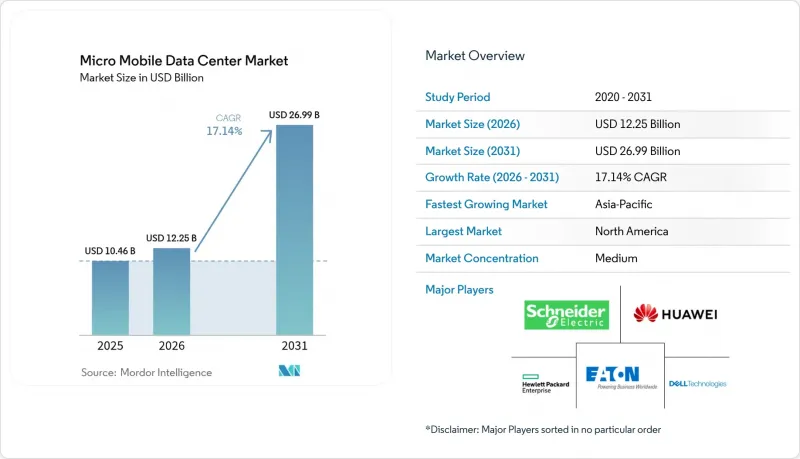
本報告按框架單位尺寸(25RU 或以下,以及 25RU 以上)、外形規格(集裝箱式模組及其他)、應用領域(即時計算節點、邊緣計算節點及其他)、組織規模(中小企業及其他)、最終用戶行業(IT 和電信、銀行、金融服務和保險及其他)以及地區(北美、歐洲及其他)進行細分。市場預測以美元計價。
全球微型移動資料中心市場趨勢與洞察
透過 5G 部署推動邊緣運算
第五代網路將吞吐量提升至 10 Gbps,並將延遲降低至 1 毫秒以下,使得集中式處理對於身臨其境型現實、自動駕駛和工業自動化等應用而言不再實用。因此,營運商正在行動通訊基地台邊緣部署微型行動資料中心節點,以託管網路功能虛擬化 (NFV) 和多重存取邊緣運算 (MAEC) 協定堆疊。即時影像分析、零售店內支援擴增實境的試衣間以及協同式車輛導航等功能如今已在本地運行,從而降低了傳輸成本並保證了確定性的性能。在營運商尋求 5G 容量商業化的推動下,邊緣基礎設施支出預計在 2024 年將成長 15.4%,達到 2,320 億美元。
物聯網資料在終端機呈現爆炸性成長
工廠、醫院和街道上安裝的數十億個智慧感測器會產生大量的遙測數據,但不可能透過廣域網路 (WAN) 傳輸所有數據。安裝在生產線旁或智慧照明燈桿內的緊湊而堅固的機殼,可讓演算法對原始數據進行推理、過濾和壓縮,並根據需要將其與雲端同步。本地處理也能滿足高度監管產業中關於資料主權和隱私的監管要求。 FS.com 指出,邊緣微型站點透過將敏感有效載荷保留在本地,直到滿足策略查核點,從而增強了安全性。
邊緣運算設施營運人員短缺
營運數百個分散式機殼需要具備資訊技術、電機工程和機械工程等專業知識的人員。Schneider Electric的開放式課程平台擁有超過一百萬名註冊學員,旨在滿足預計到2025年對230萬個資料中心人員的需求。然而,人才招募進度滯後,減緩了新興市場的擴張速度。
細分市場分析
25-40RU 規格的產品佔據微型行動資料中心市場 39.45% 的佔有率,預計將以 18.6% 的複合年成長率成長。企業青睞這種尺寸的產品,因為它將計算、電源和冷卻功能整合在一個機櫃中,既足夠緊湊,可以安裝在分支機構,又能為未來的工作負載擴展提供足夠的空間。Delta的緊湊型 UPS 系統內建鋰離子電池組,在提高密度的同時,還能減少面積。
25RU 以下的小型機櫃非常適合空間有限的場所,例如高速公路收費站和海上石油鑽井平台,但它們通常存在通風不良和備用容量不足的問題。超過 40RU 的配置則用於需要 GPU叢集進行 AI 推理的聚合層以及電信業者的中心機房。供應商預計,採用兩台 30RU 機櫃成對運作以平衡容錯性和擴充性的混合設計將成為微型行動資料中心市場的主流。
機架式儲存模組佔總銷售額的 50.55%,憑藉其標準化的深度和寬度,與現有伺服器基礎架構完美契合,預計將繼續保持主導地位。客戶可以逐一擴展儲存模組,根據應用需求調整投資,從而減少閒置容量。 Supermicro 的機架級架構甚至允許營運商拆卸 NVMe 儲存設備,並動態重新配置資源,以最佳化資源利用率。
貨櫃式模組為活動場地和遠端挖礦提供快速、大容量的儲存。它們通常在工廠密封,並配備開放式節熱器。壁掛式節點非常適合占地面積受限的便利商店連鎖和快餐店。供應商現在正在添加衝擊感測器、防塵過濾器和防篡改開關,以應對惡劣的現場環境,從而擴展其在更廣泛的微型和移動資料中心市場中的工作負載處理能力。
區域分析
預計到2025年,北美將佔總收入的34.65%,這主要得益於5G的密集部署、超大規模資料中心業者運營商對邊緣接入點的投資,以及支持醫療保健和金融領域數據主權的立法。美國引領市場,對園區邊緣節點的強勁需求與北維吉尼亞、矽谷和德克薩斯州的大規模基礎設施建設相輔相成。聯邦政府主導的舉措,例如微型反應器試點項目,凸顯了為戰略性工作負載構建離網電力戰略的努力。
預計到2031年,亞太地區將以18.1%的複合年成長率實現最高成長,這主要得益於中國、印度、日本和韓國加速推進智慧製造和互聯旅遊專案。政府津貼和頻段分配鼓勵電信業者和雲端服務供應商建構近距離運算環境,以支援即時物聯網分析。 Vantage位於賽城(Cyberjaya)的第二園區和NTT DATA位於雅加達的設施表明,該地區正在轉變為符合當地資料居住法律的去中心化模式。
在歐洲,以德國、英國和法國為首的市場持續穩定擴張。由於《一般資料保護規則》 (GDPR) 的嚴格要求,強制規定資料必須在本地處理,工廠、醫院和金融科技公司紛紛投資建設區域叢集,而非跨境傳輸資料。 Equinix 在法蘭克福、倫敦和巴黎的 IBX 網路將區域樞紐與雲端連接點連接起來,同時支援低於 5 毫秒的邊緣工作負載。中東、非洲和南美洲的部署雖然起步規模小規模,但受到智慧城市預算和 5G 走廊計畫的推動,為微型行動資料中心市場的供應商開闢了新的市場。
其他好處:
- Excel格式的市場預測(ME)表
- 3個月的分析師支持
目錄
第1章:引言
- 研究假設和市場定義
- 調查範圍
第2章:調查方法
第3章執行摘要
第4章 市場狀況
- 市場概覽
- 市場促進因素
- 透過 5G 部署推動邊緣運算
- 終端物聯網資料激增
- 零售業全通路的快速數位化
- 超大規模資料中心業者服務中斷後,對容錯能力的需求日益成長。
- 軍方對強大的離網運算能力的需求
- 以ESG主導的可再生能源微電網合作
- 市場限制因素
- 邊緣運算設施營運人員短缺
- 模組化資料中心相關法規的碎片化
- 鋰離子電池熱失控的擔憂
- 銅和稀土元素供應鏈的波動性
- 產業價值鏈分析
- 監理情勢
- 技術展望
- 波特五力分析
- 宏觀經濟因素對市場的影響
第5章 市場規模與成長預測
- 按尺寸分類的框架單位
- 25 RU 或更少
- 25~40 RU
- 40 RU 或以上
- 按外形規格
- 容器型模組
- 機架式艙體
- 壁掛式/微邊緣節點
- 透過使用
- 即時/改裝資料中心
- 邊緣運算節點
- 高密度網路
- 遠端辦公室和分店
- 移動和戰術計算
- 災害復原和備份
- 按組織規模
- 小型企業
- 大公司
- 按最終用戶行業分類
- 資訊科技/通訊
- BFSI
- 零售與電子商務
- 醫療保健和生命科學
- 政府/國防
- 能源公用事業
- 製造業和工業
- 教育
- 按地區
- 北美洲
- 美國
- 加拿大
- 墨西哥
- 歐洲
- 英國
- 德國
- 法國
- 義大利
- 西班牙
- 荷蘭
- 其他歐洲國家
- 亞太地區
- 中國
- 日本
- 印度
- 韓國
- 新加坡
- 澳洲
- 馬來西亞
- 其他亞太國家
- 南美洲
- 巴西
- 阿根廷
- 其他南美國家
- 中東和非洲
- 中東
- UAE
- 沙烏地阿拉伯
- 土耳其
- 以色列
- 其他中東國家
- 非洲
- 南非
- 奈及利亞
- 埃及
- 其他非洲國家
- 中東
- 北美洲
第6章 競爭情勢
- 市場集中度
- 策略趨勢
- 市佔率分析
- 公司簡介
- Schneider Electric SE
- Dell Technologies Inc.
- Huawei Technologies Co. Ltd.
- Hewlett Packard Enterprise Development LP
- Eaton Corporation plc
- Vertiv Holdings Co.
- IBM Corporation
- Panduit Corp.
- Zella DC(formerly Zellabox)
- Hitachi Ltd.
- Instant Data Centers LLC
- Dataracks
- Rittal GmbH and Co. KG
- Canovate Group
- Cisco Systems Inc.
- EdgeMicro Inc.
- Vapor IO Inc.
- Cannon Technologies Ltd.
- nLighten(Iliad Group)
- DC Blox Inc.
第7章 市場機會與未來展望
According to Mordor Intelligence, micro mobile data center market size in 2026 is estimated at USD 12.25 billion, growing from 2025 value of USD 10.46 billion with 2031 projections showing USD 26.99 billion, growing at 17.14% CAGR over 2026-2031.
This report is Segmented by Rack Unit Size (Up To 25 RU, and More), Form Factor (Containerized Modules, and More), Application (Instant, Edge-Computing Nodes, and More), Organization Size(Small and Medium Enterprises, and More) End-User Industry(IT and Telecom, BFSI, and More) and Geography (North America, Europe, and More). The Market Forecasts are Provided in Terms of Value (USD).
Global Micro Mobile Data Center Market Trends and Insights
Edge-Computing Push from 5G Roll-Outs
Fifth-generation networks are raising throughput to 10 Gbps and pushing latency below 1 ms, making centralized processing impractical for immersive realities, autonomous mobility, and industrial automation. Carriers are therefore co-locating micro mobile data center market nodes at cell-site edges to host network-function virtualization and multi-access edge computing stacks. Real-time video analytics, AR retail fitting rooms, and cooperative vehicle guidance now execute locally, trimming transport costs and guaranteeing deterministic performance. Spending on edge infrastructure jumped 15.4% to USD 232 billion in 2024, spearheaded by telecom operators eager to monetize 5G capacity.
Exponential IoT Data at Endpoints
Billions of smart sensors in factories, hospitals, and city streets churn out torrents of telemetry that cannot all traverse the WAN. Compact, ruggedized enclosures installed beside manufacturing lines or inside smart-lighting poles let algorithms infer, filter, and compress raw feeds before optionally syncing with the cloud. Localized processing also satisfies data-sovereignty and privacy codes in regulated industries. FS.com observes that edge micro sites improve security by retaining sensitive payloads on premises until policy checkpoints are met.
Talent Scarcity in Edge-Qualified Facility Operations
Running hundreds of distributed enclosures demands personnel who grasp IT, electrical, and mechanical disciplines. Schneider Electric's open courseware has enrolled more than 1 million learners to bridge the projected need for 2.3 million data-center staff by 2025. Yet recruitment lags, slowing roll-outs in emerging markets.
Other drivers and restraints analyzed in the detailed report include:
- Rapid Retail Omni-Channel Digitization
- Heightened Resilience Needs After Hyperscaler Outages
- Lithium-Ion Thermal-Runaway Concerns
For complete list of drivers and restraints, kindly check the Table Of Contents.
Segment Analysis
The 25-40 RU accounted for 39.45% of the micro mobile data center market and is forecast to advance at 18.6% CAGR. Enterprises favor this footprint because it bundles compute, power, and cooling in a cabinet that is both compact enough for branch sites and spacious enough to accommodate future workload expansion. Compact UPS systems with integrated lithium-ion packs from Delta boost density while trimming floor-space requirements.
Smaller sub-25 RU enclosures excel in areas where real estate is scarce, such as highway toll booths or offshore rigs, but often struggle with airflow and limited spare capacity. Configurations above 40 RU serve aggregation layers or telecom central offices demanding GPU clusters for AI inference. Suppliers expect hybrid designs, where two 30 RU frames travel as a pair to balance resilience and scalability in the micro mobile data center market.
Rack-mounted pods accounted for 50.55% of revenue and will maintain lead status thanks to standardized depth and width that align with existing server infrastructure. Customers scale one pod at a time, synchronizing cash spend with application demand and shrinking stranded capacity. Supermicro's rack-scale architecture even lets operators disaggregate NVMe storage and recombine resources on the fly to optimize utilization.
Containerized modules deliver rapid bulk capacity for event venues or remote mining, often arriving factory-sealed with outside-air economizers. Wall-mount nodes satisfy convenience-store chains and quick-service restaurants, where floor space is premium. Vendors now add shock sensors, dust filters, and tamper switches to withstand harsh field conditions, expanding addressable workloads across the broader micro mobile data center market.
Complete Report Scope:
- By Rack Unit Size
- Up to 25 RU
- 25 - 40 RU
- Above 40 RU
- By Form Factor
- Containerized Modules
- Rack-Mounted Pods
- Wall-Mounted / Micro-Edge Nodes
- By Application
- Instant / Retrofit Data Center
- Edge-Computing Nodes
- High-Density Networks
- Remote Office and Branch Office
- Mobile and Tactical Computing
- Disaster Recovery and Backup
- By Organization Size
- Small and Medium Enterprises
- Large Enterprises
- By End-user Vertical
- IT and Telecommunication
- BFSI
- Retail and E-commerce
- Healthcare and Life Sciences
- Government and Defense
- Energy and Utilities
- Manufacturing and Industrial
- Education
- By Geography
- North America
- United States
- Canada
- Mexico
- Europe
- United Kingdom
- Germany
- France
- Italy
- Spain
- Netherlands
- Rest of Europe
- Asia-Pacific
- China
- Japan
- India
- South Korea
- Singapore
- Australia
- Malaysia
- Rest of Asia-Pacific
- South America
- Brazil
- Argentina
- Rest of South America
- Middle East and Africa
- Middle East
- UAE
- Saudi Arabia
- Turkey
- Israel
- Rest of Middle East
- Africa
- South Africa
- Nigeria
- Egypt
- Rest of Africa
- Middle East
- North America
Geography Analysis
North America held 34.65% of total revenue in 2025 thanks to dense 5G roll-outs, hyperscaler investment in edge POPs, and supportive data-sovereignty statutes for healthcare and finance. The United States dominates, with Northern Virginia, Silicon Valley, and Texas generating heavy demand for campus-adjacent edge nodes that complement megascale builds. Federal initiatives such as microreactor pilots underscore commitment to off-grid power strategies for strategic workloads.
Asia-Pacific will post the highest 18.1% CAGR to 2031 as China, India, Japan, and South Korea accelerate smart-manufacturing and connected-mobility programs. State grants and spectrum allocations encourage telcos and cloud providers to host proximate compute for real-time IoT analytics. Vantage's second Cyberjaya campus and NTT DATA's Jakarta build illustrate a regional shift toward distributed models capable of respecting local data-residency laws.
Europe continues steady expansion led by Germany, the United Kingdom, and France. Strict GDPR rules require localized processing, so factories, hospitals, and fintechs invest in zone-specific clusters instead of shipping data across borders. Equinix's IBX network in Frankfurt, London, and Paris bridges regional hubs to cloud on-ramps while hosting sub-5 ms edge workloads. Emerging adoption in the Middle East, Africa, and South America starts from smaller bases but is buoyed by smart-city budgets and 5G corridor projects, opening fresh terrain for micro mobile data center market suppliers.
- Schneider Electric SE
- Dell Technologies Inc.
- Huawei Technologies Co. Ltd.
- Hewlett Packard Enterprise Development LP
- Eaton Corporation plc
- Vertiv Holdings Co.
- IBM Corporation
- Panduit Corp.
- Zella DC (formerly Zellabox)
- Hitachi Ltd.
- Instant Data Centers LLC
- Dataracks
- Rittal GmbH and Co. KG
- Canovate Group
- Cisco Systems Inc.
- EdgeMicro Inc.
- Vapor IO Inc.
- Cannon Technologies Ltd.
- nLighten (Iliad Group)
- DC Blox Inc.
Additional Benefits:
- The market estimate (ME) sheet in Excel format
- 3 months of analyst support
TABLE OF CONTENTS
1 INTRODUCTION
- 1.1 Study Assumptions and Market Definition
- 1.2 Scope of the Study
2 RESEARCH METHODOLOGY
3 EXECUTIVE SUMMARY
4 MARKET LANDSCAPE
- 4.1 Market Overview
- 4.2 Market Drivers
- 4.2.1 Edge-computing push from 5G roll-outs
- 4.2.2 Exponential IoT data at endpoints
- 4.2.3 Rapid retail omni-channel digitization
- 4.2.4 Heightened resilience needs after hyperscaler outages
- 4.2.5 Military demand for rugged off-grid compute
- 4.2.6 ESG-driven micro-grid pairing for renewables
- 4.3 Market Restraints
- 4.3.1 Talent scarcity in edge-qualified facility ops
- 4.3.2 Fragmented regulatory codes for modular DCs
- 4.3.3 Lithium-ion thermal-runaway concerns
- 4.3.4 Copper and rare-earth supply-chain volatility
- 4.4 Industry Value Chain Analysis
- 4.5 Regulatory Landscape
- 4.6 Technological Outlook
- 4.7 Porter's Five Forces Analysis
- 4.7.1 Threat of New Entrants
- 4.7.2 Bargaining Power of Buyers
- 4.7.3 Bargaining Power of Suppliers
- 4.7.4 Threat of Substitutes
- 4.7.5 Intensity of Competitive Rivalry
- 4.8 Impact of Macroeconomic Factors on the Market
5 MARKET SIZE AND GROWTH FORECASTS (VALUE)
- 5.1 By Rack Unit Size
- 5.1.1 Up to 25 RU
- 5.1.2 25 - 40 RU
- 5.1.3 Above 40 RU
- 5.2 By Form Factor
- 5.2.1 Containerized Modules
- 5.2.2 Rack-Mounted Pods
- 5.2.3 Wall-Mounted / Micro-Edge Nodes
- 5.3 By Application
- 5.3.1 Instant / Retrofit Data Center
- 5.3.2 Edge-Computing Nodes
- 5.3.3 High-Density Networks
- 5.3.4 Remote Office and Branch Office
- 5.3.5 Mobile and Tactical Computing
- 5.3.6 Disaster Recovery and Backup
- 5.4 By Organization Size
- 5.4.1 Small and Medium Enterprises
- 5.4.2 Large Enterprises
- 5.5 By End-user Vertical
- 5.5.1 IT and Telecommunication
- 5.5.2 BFSI
- 5.5.3 Retail and E-commerce
- 5.5.4 Healthcare and Life Sciences
- 5.5.5 Government and Defense
- 5.5.6 Energy and Utilities
- 5.5.7 Manufacturing and Industrial
- 5.5.8 Education
- 5.6 By Geography
- 5.6.1 North America
- 5.6.1.1 United States
- 5.6.1.2 Canada
- 5.6.1.3 Mexico
- 5.6.2 Europe
- 5.6.2.1 United Kingdom
- 5.6.2.2 Germany
- 5.6.2.3 France
- 5.6.2.4 Italy
- 5.6.2.5 Spain
- 5.6.2.6 Netherlands
- 5.6.2.7 Rest of Europe
- 5.6.3 Asia-Pacific
- 5.6.3.1 China
- 5.6.3.2 Japan
- 5.6.3.3 India
- 5.6.3.4 South Korea
- 5.6.3.5 Singapore
- 5.6.3.6 Australia
- 5.6.3.7 Malaysia
- 5.6.3.8 Rest of Asia-Pacific
- 5.6.4 South America
- 5.6.4.1 Brazil
- 5.6.4.2 Argentina
- 5.6.4.3 Rest of South America
- 5.6.5 Middle East and Africa
- 5.6.5.1 Middle East
- 5.6.5.1.1 UAE
- 5.6.5.1.2 Saudi Arabia
- 5.6.5.1.3 Turkey
- 5.6.5.1.4 Israel
- 5.6.5.1.5 Rest of Middle East
- 5.6.5.2 Africa
- 5.6.5.2.1 South Africa
- 5.6.5.2.2 Nigeria
- 5.6.5.2.3 Egypt
- 5.6.5.2.4 Rest of Africa
- 5.6.5.1 Middle East
- 5.6.1 North America
6 COMPETITIVE LANDSCAPE
- 6.1 Market Concentration
- 6.2 Strategic Moves
- 6.3 Market Share Analysis
- 6.4 Company Profiles (includes Global level Overview, Market level overview, Core Segments, Financials as available, Strategic Information, Market Rank/Share for key companies, Products and Services, and Recent Developments)
- 6.4.1 Schneider Electric SE
- 6.4.2 Dell Technologies Inc.
- 6.4.3 Huawei Technologies Co. Ltd.
- 6.4.4 Hewlett Packard Enterprise Development LP
- 6.4.5 Eaton Corporation plc
- 6.4.6 Vertiv Holdings Co.
- 6.4.7 IBM Corporation
- 6.4.8 Panduit Corp.
- 6.4.9 Zella DC (formerly Zellabox)
- 6.4.10 Hitachi Ltd.
- 6.4.11 Instant Data Centers LLC
- 6.4.12 Dataracks
- 6.4.13 Rittal GmbH and Co. KG
- 6.4.14 Canovate Group
- 6.4.15 Cisco Systems Inc.
- 6.4.16 EdgeMicro Inc.
- 6.4.17 Vapor IO Inc.
- 6.4.18 Cannon Technologies Ltd.
- 6.4.19 nLighten (Iliad Group)
- 6.4.20 DC Blox Inc.
7 MARKET OPPORTUNITIES AND FUTURE OUTLOOK
- 7.1 White-space and Unmet-Need Assessment

 全球微型資料中心市場規模、佔有率、趨勢和成長分析報告(2026-2034年)
 微型移動資料中心市場:依產品、最終用戶、應用、框架單位、組織規模、外形規格、國家及地區分類-全球產業分析、市場規模、市場佔有率及2026年至2033年預測
 微型移動資料中心市場-2026-2032年全球市場預測
 2026年全球微型資料中心市場報告2026年全球微型移動資料中心市場報告
 微型移動資料中心市場分析及預測(至2035年):按類型、產品類型、服務、技術、組件、應用、部署類型、最終用戶、功能和安裝類型分類
 微型行動資料中心市場 - 全球產業規模、佔有率、趨勢、機會、預測:按類型、企業類型、最終用戶、地區和競爭對手分類,2021-2031 年
 微型移動資料中心市場規模、佔有率和成長分析(按組件、類型、框架單位、外形規格、組織規模、應用、垂直行業和地區分類)—2026-2033年行業預測
 微型資料中心市場 - 成長、未來展望、競爭分析,2025 年至 2033 年
 微型資料中心市場規模、佔有率和成長分析(按組件、應用、框架單位、組織規模、外形規格、類型、垂直和地區)- 產業預測 2025-2032