


 |
市場調查報告書
商品編碼
2114089
生物識別服務:市場佔有率分析、產業趨勢與統計、成長預測(2026-2031)Biometrics-as-a-Service - Market Share Analysis, Industry Trends & Statistics, Growth Forecasts (2026 - 2031) |
||||||

※ 本網頁內容可能與最新版本有所差異。詳細情況請與我們聯繫。
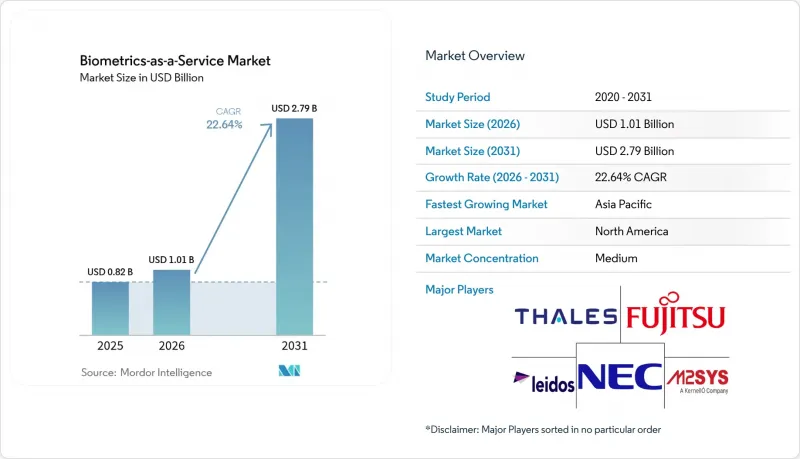
據 Mordor Intelligence 稱,生物識別即服務市場在 2025 年的價值為 8.2 億美元,預計到 2031 年將從 2026 年的 10.1 億美元成長到 27.9 億美元,在預測期(2026-2031 年)內的複合年成長率為 22.64%。
本報告按應用領域(例如,設施門禁控制、考勤管理)、生物識別方法(例如,指紋認證、多指紋融合)、部署模式(例如,公共雲端)、終端用戶行業(例如,政府/公共部門、銀行、金融服務和保險業)以及地區進行細分。市場預測以美元計價,並基於現有數據。
生物識別生物辨識即服務市場趨勢與洞察
在線交易的數量和價值均有所增加
預計到2024年,數位支付交易量將達到1.86兆筆,這將使密碼驗證系統不堪重負,並推動對基於雲端的生物識別的需求激增。已從本地部署生物識別系統遷移到SaaS模式的銀行,其認證延遲降低了67%,並實現了即時詐欺分析。生物識別服務市場透過在交易量激增時自動調配運算資源來滿足這些可擴展性需求。延遲的降低也改善了用戶體驗,並提高了高頻行動支付的轉換率。隨著跨境電子商務的擴張,商家擴大採用整合API來簡化跨司法管轄區的KYC(了解你的客戶)流程,從而進一步推動了市場對該技術的接受度。
針對深度造假的強制性措施激增
歐盟人工智慧立法要求金融機構在2025年12月前實施合成媒體的技術防禦措施。深度造假工具能夠僅憑單張圖像生成逼真的面部影片,對單因素身份驗證構成挑戰。生物識別服務(BaaS)市場供應商目前正在打包提供生物辨識偵測功能,這些功能可以追蹤難以偽造的細微臉部表情、瞳孔反應和聲音諧波。在視訊通話和遠端註冊過程中持續進行身份驗證可以防止合成身份詐騙。合規期限的臨近正在加速採購流程,而保險公司也越來越要求在其網路風險保險單中納入深度造假防護,這進一步加速了相關技術的普及應用。
對第三方雲端資料主權的擔憂
歐洲資料保護委員會強制規定敏感生物識別資料必須保留在核准的司法管轄區內,這使得跨區域SaaS部署變得複雜。企業往往被迫依賴特定區域的雲端平台或邊緣設備,進一步增加了部署的複雜性。一些政府完全禁止傳輸到其管轄範圍之外,限制了聯合身份項目的發展。供應商透過提供特定國家/地區的資料分片和客戶管理的加密金鑰來應對這項挑戰,但這些管控措施增加了成本,並抑制了在主權法規嚴格的地區生物識別服務市場的成長。
細分市場分析
到2025年,行動身分驗證將佔生物識別服務市場28.21%的佔有率,智慧型手機感測器和WebAuthn技術使設備能夠充當安全符記。企業報告稱,將設備原生生物識別功能整合到其行動裝置管理(MDM)工作流程後,登入時間縮短,密碼重設次數減少了73%。同樣,消費者也開始接受在金融科技和電子商務中使用指紋和臉部認證解鎖,推動了每日交易量的成長。由於服務供應商可以透過單一雲端點管理異質感測器組合、韌體更新和生物識別檢測(活體檢測),生物識別服務市場正從中受益。
邊境和移民管制是成長最快的細分領域,預計到2031年將以22.96%的複合年成長率成長,這主要得益於世界各國政府出入境系統的自動化。雲端協作簡化了機場的擴展能力,使其能夠應對季節性客流高峰,而邊緣快取則確保資料處理在主權域內進行。供應商現在提供多模態自助通關終端和SaaS後端捆綁式解決方案,縮短了採購週期。安全需求與提升旅客體驗目標之間的相互作用推動了持續的支出,尤其是在亞太地區的智慧機場計畫中,成長勢頭強勁。
指紋認證技術在感測器成熟度、ISO模板標準和使用者熟悉度的推動下,預計到2025年將佔據生物識別服務(BaaS)市場31.12%的佔有率。其在行動裝置和ATM機上的大規模部署,降低了購置成本,並確保了持續使用。然而,使用合成指紋和矽模型進行身份冒用的風險日益增加。因此,服務提供者正在將指紋認證與被動式臉部認證或語音辨識相結合,以提高可靠性,同時又不顯著降低便利性。
隨著企業對抵禦深度造假的需求日益成長,多模態系統市場預計將以22.97%的複合年成長率成長。 SaaS平台整合了臉部、語音和行為訊號的風險評分,從而實現自適應多因素身份驗證(MFA)。機器學習整合模型會根據上下文對每個模態進行加權,提高低風險事件的處理速度,並在偵測到異常情況時加強審查。這種安全性和使用者體驗(UX)之間的平衡正在推動多模態技術在銀行、金融和保險(BFSI)、醫療保健和遠距辦公等應用情境中的普及,進一步擴大了生物識別服務即服務(BaaS)市場。
區域分析
北美地區憑藉著成熟的雲端運算技術、創業投資資金和清晰的生物識別隱私立法,預計到2025年將以38.29%的市佔率引領生物識別服務市場。美國聯邦項目,例如美國的生物識別移民和邊境控制系統,每年處理超過4億次身份驗證,相當於對SaaS可擴展性的壓力測試。在加拿大,互通性試點計畫正在將各省的服務通用到全國性的數位錢包;而在墨西哥,普惠金融的推廣正在幫助以前沒有銀行帳戶的人開設生物識別帳戶。這些趨勢共同確保了強勁的合約續約和提升銷售。
亞太地區是成長最快的地區,預計到2031年複合年成長率將達到23.06%。從印度的“Aadhaar”到新加坡的“Singpass”,各國數位身分方案的推廣使生物識別登入更加普及,並促進了跨產業的應用。在日本,「我的號碼卡」(My Number card)在醫療和社會安全領域的應用,增加了每日身份驗證的數量;而在中國,行動支付生態系統正在推動行為生物識別技術的創新。東協為協調信任架構所做的努力,有望實現跨國身分驗證,並擴大生物識別即服務(BaaS)的潛在市場。
在歐洲,人工智慧產業正經歷著穩定但高度監管的成長。 GDPR 和即將訂定的人工智慧相關法律法規要求演算法透明化,這使得那些在減少偏見方面擁有良好記錄的供應商更具優勢。汽車製造商正在採用車載臉部辨識和虹膜辨識來實現個人化服務。工業企業正在部署掌紋認證終端用於現場門禁,理由是戴手套時更加衛生便捷。同時,在中東和非洲,數位銀行和邊境管制領域的早期試點計畫正在進行中。資料居住需求通常需要本地託管合作夥伴,這影響企業的打入市場策略。
其他好處:
- Excel格式的市場預測(ME)表
- 3個月的分析師支持
目錄
第1章:引言
- 研究假設和市場定義
- 調查範圍
第2章:調查方法
第3章執行摘要
第4章 市場狀況
- 市場概覽
- 市場促進因素
- 線上交易量和交易額成長
- 針對深度造假的強制性措施激增
- 具有整合生物識別功能的雲端原生身分與存取管理 (IAM) 套件
- 後量子密碼學的互補性
- 全國實施數位身分(G2P 和 G2C)
- 基於 WebAuthn 的無密碼工作區
- 市場限制因素
- 對第三方雲端的資料主權問題的擔憂
- 偏見和人口統計表現差距
- 認證和問責制度分散
- 合成身分詐騙的軍備競賽
- 產業價值鏈分析
- 監理情勢
- 技術展望
- 語音和語音人工智慧領域的突破性進展
- 行動生物識別和臉部認證的日益普及。
- 持續認證和行為認證
- 利用穿戴式裝置進行生命徵生物識別
- 波特五力分析
- 宏觀經濟因素的影響
- 投資和資金籌措分析
第5章 市場規模與成長預測
- 透過使用
- 網站存取控制
- 考勤管理
- 行動身份驗證
- 網頁和職場登入
- 電子支付和交易認證
- 邊境和移民管制
- 執法和監控
- 其他用途
- 通過生物識別方法
- 指紋認證
- 多指紋融合
- 臉部認證
- 虹膜辨識
- 掌紋和靜脈鑑定
- 語音辨識
- 行為生物特徵學
- 多模態生物識別
- 其他方式
- 按部署模式
- 公共雲端
- 私有雲端
- 混合雲端
- 按最終用戶行業分類
- 政府/公共部門
- BFSI
- 衛生保健
- 零售與電子商務
- 資訊科技/通訊
- 旅遊與飯店
- 教育
- 其他終端用戶產業
- 按地區
- 北美洲
- 美國
- 加拿大
- 墨西哥
- 南美洲
- 巴西
- 阿根廷
- 其他南美國家
- 歐洲
- 英國
- 德國
- 法國
- 義大利
- 西班牙
- 荷蘭
- 其他歐洲國家
- 亞太地區
- 中國
- 日本
- 韓國
- 印度
- ASEAN
- 其他亞太國家
- 中東和非洲
- 中東
- 沙烏地阿拉伯
- 阿拉伯聯合大公國
- 土耳其
- 其他中東國家
- 非洲
- 南非
- 奈及利亞
- 肯亞
- 其他非洲國家
- 中東
- 北美洲
第6章 競爭情勢
- 市場集中度
- 策略趨勢
- 市佔率分析
- 公司簡介
- Thales Group
- IDEMIA France SAS
- NEC Corporation
- Fujitsu Limited
- Leidos Holdings Inc.
- Aware Inc.
- ImageWare Systems Inc.
- BIO-key International Inc.
- M2SYS Technology(Kernel LLC)
- Mobbeel Solutions SLL
- BioEnable Technologies Pvt Ltd.
- Clearview AI Inc.
- HID Global Corporation
- Suprema Inc.
- Veridium IP Ltd.
- Cognitec Systems GmbH
- Precise Biometrics AB
- Daon Inc.
- Microsoft Corporation
- Amazon Web Services Inc.
- Google LLC(Google Cloud)
- Ping Identity Holding Corp.
- LexisNexis Risk Solutions Inc.
第7章 市場機會與未來展望
According to Mordor Intelligence, the biometrics-as-a-Service market size was valued at USD 0.82 billion in 2025 and estimated to grow from USD 1.01 billion in 2026 to reach USD 2.79 billion by 2031, at a CAGR of 22.64% during the forecast period (2026-2031).
This report is Segmented by Application (Site Access Control, Time and Attendance Recording, and More), Biometric Modality (Fingerprint Recognition, Multi-Fingerprint Fusion, and More), Deployment Model (Public Cloud, and More), End-User Industry (Government and Public Sector, BFSI, and More), and Geography. The Market Forecasts are Provided in Terms of Value (USD), Based On Availability.
Global Biometrics-as-a-Service Market Trends and Insights
Rising Volume and Value of Online Transactions
Digital payment volumes hit 1.86 trillion transactions in 2024, overwhelming password systems and elevating demand for cloud-scale biometric verification. Banks moving from on-premises biometrics to SaaS models report 67% lower authentication latency, enabling real-time fraud analytics. The Biometrics-as-a-Service market answers these scalability needs by auto-provisioning compute during transaction spikes. Lower latency also improves user experience, which lifts conversion rates for high-frequency mobile payments. As cross-border e-commerce expands, merchants prefer unified APIs that streamline KYC across jurisdictions, reinforcing market uptake.
Explosion of Deep-fake Mitigation Mandates
The EU AI Act compels financial institutions to deploy technical defenses against synthetic media by December 2025. Deepfake tools can create convincing facial videos from single images, challenging single-factor checks. Biometrics-as-a-Service market providers now bundle liveness detection that tracks micro-expressions, pupillary response, and voice harmonics harder to spoof. Continuous authentication during video calls or remote onboarding deters synthetic identity fraud. Compliance deadlines accelerate procurement cycles, while insurers increasingly require deepfake safeguards in cyber-risk policies, further stimulating adoption.
Third-party Cloud Data-sovereignty Concerns
The European Data Protection Board requires sensitive biometrics to stay within approved jurisdictions, complicating multi-region SaaS rollouts. Organizations often resort to regional clouds or edge appliances, inflating deployment complexity. Some governments ban outbound template transfers entirely, restricting federated identity projects. Vendors respond by offering country-specific shards and customer-managed encryption keys, but such controls raise cost, trimming Biometrics-as-a-Service market growth where sovereignty rules are strict.
Other drivers and restraints analyzed in the detailed report include:
- Cloud-native IAM Suites Embedding Biometrics
- Post-quantum Cryptography Complementarity
- Bias and Demographic Performance Gaps
For complete list of drivers and restraints, kindly check the Table Of Contents.
Segment Analysis
Mobile authentication accounted for 28.21% of the Biometrics-as-a-Service market in 2025 as smartphone sensors and WebAuthn turn devices into security tokens. Enterprises cite shorter login times and 73% fewer password resets after embedding device-native biometrics in MDM workflows. Consumers likewise accept fingerprint or facial unlock for fintech and e-commerce, translating into high daily transaction volumes. The Biometrics-as-a-Service market benefits because service providers manage sensor heterogeneity, firmware updates, and liveness checks through a single cloud endpoint.
Border and immigration control is the fastest-rising subsegment, set for a 22.96% CAGR through 2031 as governments automate entry/exit systems. Cloud orchestration simplifies scalability for airports handling seasonal passenger peaks, while edge caching keeps processing within sovereign zones. Vendors now bundle multimodal capture kiosks with SaaS back-ends, reducing procurement cycles. The interplay of security mandates and traveler experience goals ensures sustained spending, with growth particularly strong in Asia-Pacific smart-airport projects.
Fingerprint technology held a 31.12% Biometrics-as-a-Service market share in 2025 thanks to mature sensors, ISO template standards, and entrenched user familiarity. Large installed bases in mobile devices and ATMs keep capture costs low, ensuring ongoing volume. Yet synthetic fingerprints and silicone molds raise spoofing risk. Providers therefore pair fingerprints with passive facial or voice checks, increasing assurance without noticeable friction.
Multimodal systems will expand at a 22.97% CAGR as enterprises seek defense-in-depth against deepfakes. SaaS platforms unify risk scoring across face, voice, and behavioral signals, enabling adaptive MFA. Machine-learning ensembles weigh modalities based on context, improving throughput for low-risk events and stepping up scrutiny where anomalies surface. This balance of security and UX is propelling multimodal adoption across BFSI, healthcare, and remote-work use cases, further enlarging the Biometrics-as-a-Service market.
Complete Report Scope:
- By Application
- Site Access Control
- Time and Attendance Recording
- Mobile Authentication
- Web and Workplace Login
- e-Payments and Transaction Authentication
- Border and Immigration Control
- Law-Enforcement and Surveillance
- Other Applications
- By Biometric Modality
- Fingerprint Recognition
- Multi-fingerprint Fusion
- Facial Recognition
- Iris Recognition
- Palm and Vein Recognition
- Voice Recognition
- Behavioural Biometrics
- Multimodal Biometrics
- Other Modalities
- By Deployment Model
- Public Cloud
- Private Cloud
- Hybrid Cloud
- By End-user Industry
- Government and Public Sector
- BFSI
- Healthcare
- Retail and E-commerce
- IT and Telecom
- Travel and Hospitality
- Education
- Other End-user Industries
- By Geography
- North America
- United States
- Canada
- Mexico
- South America
- Brazil
- Argentina
- Rest of South America
- Europe
- United Kingdom
- Germany
- France
- Italy
- Spain
- Netherlands
- Rest of Europe
- Asia-Pacific
- China
- Japan
- South Korea
- India
- ASEAN
- Rest of Asia-Pacific
- Middle East and Africa
- Middle East
- Saudi Arabia
- United Arab Emirates
- Turkey
- Rest of Middle East
- Africa
- South Africa
- Nigeria
- Kenya
- Rest of Africa
- Middle East
- North America
Geography Analysis
North America dominated the Biometrics-as-a-Service market with a 38.29% share in 2025, underpinned by cloud maturity, venture funding, and clear biometric privacy statutes. Federal programs such as the U.S. biometric entry-exit system handle over 400 million annual verifications, stress-testing SaaS scalability. Canadian interoperability pilots link provincial services to a national wallet, while Mexican financial inclusion drives biometric onboarding of the previously unbanked. Together these dynamics ensure robust contract renewals and upsells.
Asia-Pacific is the fastest-advancing region, forecast at a 23.06% CAGR to 2031. National digital-ID schemes from India's Aadhaar extensions to Singapore's Singpass normalize biometric logins, stimulating cross-sector adoption. Japan's My Number card expansion into healthcare and social security increases daily verification volume, while China's mobile-payment ecosystem fuels behavioral biometrics innovation. ASEAN's effort to harmonize trust-frameworks could unlock cross-border verification, enlarging the addressable Biometrics-as-a-Service market.
Europe shows steady but regulation-heavy growth. GDPR and the forthcoming AI Act impose algorithmic transparency, favoring providers with bias-mitigation credentials. Automotive OEMs employ in-cabin facial and iris recognition for personalization. Industrial firms deploy palm-vein stations for shop-floor access, citing hygiene and gloves compatibility. Meanwhile, the Middle East and Africa see early-stage pilots in digital banking and border management. Data-residency clauses often necessitate local hosting partners, shaping go-to-market strategies.
- Thales Group
- IDEMIA France SAS
- NEC Corporation
- Fujitsu Limited
- Leidos Holdings Inc.
- Aware Inc.
- ImageWare Systems Inc.
- BIO-key International Inc.
- M2SYS Technology (Kernel LLC)
- Mobbeel Solutions S.L.L.
- BioEnable Technologies Pvt Ltd.
- Clearview AI Inc.
- HID Global Corporation
- Suprema Inc.
- Veridium IP Ltd.
- Cognitec Systems GmbH
- Precise Biometrics AB
- Daon Inc.
- Microsoft Corporation
- Amazon Web Services Inc.
- Google LLC (Google Cloud)
- Ping Identity Holding Corp.
- LexisNexis Risk Solutions Inc.
Additional Benefits:
- The market estimate (ME) sheet in Excel format
- 3 months of analyst support
TABLE OF CONTENTS
1 INTRODUCTION
- 1.1 Study Assumptions and Market Definition
- 1.2 Scope of the Study
2 RESEARCH METHODOLOGY
3 EXECUTIVE SUMMARY
4 MARKET LANDSCAPE
- 4.1 Market Overview
- 4.2 Market Drivers
- 4.2.1 Rising volume and value of on-line transactions
- 4.2.2 Explosion of deep-fake mitigation mandates
- 4.2.3 Cloud-native IAM suites embedding biometrics
- 4.2.4 Post-quantum cryptography complementarity
- 4.2.5 National digital-ID roll-outs (G2P and G2C)
- 4.2.6 WebAuthn-based password-less workspaces
- 4.3 Market Restraints
- 4.3.1 Third-party cloud data-sovereignty concerns
- 4.3.2 Bias and demographic performance gaps
- 4.3.3 Fragmented certification and liability regimes
- 4.3.4 Synthetic identity fraud arms-race
- 4.4 Industry Value Chain Analysis
- 4.5 Regulatory Landscape
- 4.6 Technological Outlook
- 4.6.1 Voice and speech AI breakthroughs
- 4.6.2 Ubiquitous mobile biometrics and facial Liveness
- 4.6.3 Continuous and behavioural authentication
- 4.6.4 Vital-signal biometrics via wearables
- 4.7 Porter's Five Forces Analysis
- 4.7.1 Bargaining Power of Suppliers
- 4.7.2 Bargaining Power of Buyers
- 4.7.3 Threat of New Entrants
- 4.7.4 Threat of Substitutes
- 4.7.5 Competitive Rivalry
- 4.8 Impact of Macroeconomic Factors
- 4.9 Investment and Funding Analysis
5 MARKET SIZE AND GROWTH FORECASTS (VALUE)
- 5.1 By Application
- 5.1.1 Site Access Control
- 5.1.2 Time and Attendance Recording
- 5.1.3 Mobile Authentication
- 5.1.4 Web and Workplace Login
- 5.1.5 e-Payments and Transaction Authentication
- 5.1.6 Border and Immigration Control
- 5.1.7 Law-Enforcement and Surveillance
- 5.1.8 Other Applications
- 5.2 By Biometric Modality
- 5.2.1 Fingerprint Recognition
- 5.2.2 Multi-fingerprint Fusion
- 5.2.3 Facial Recognition
- 5.2.4 Iris Recognition
- 5.2.5 Palm and Vein Recognition
- 5.2.6 Voice Recognition
- 5.2.7 Behavioural Biometrics
- 5.2.8 Multimodal Biometrics
- 5.2.9 Other Modalities
- 5.3 By Deployment Model
- 5.3.1 Public Cloud
- 5.3.2 Private Cloud
- 5.3.3 Hybrid Cloud
- 5.4 By End-user Industry
- 5.4.1 Government and Public Sector
- 5.4.2 BFSI
- 5.4.3 Healthcare
- 5.4.4 Retail and E-commerce
- 5.4.5 IT and Telecom
- 5.4.6 Travel and Hospitality
- 5.4.7 Education
- 5.4.8 Other End-user Industries
- 5.5 By Geography
- 5.5.1 North America
- 5.5.1.1 United States
- 5.5.1.2 Canada
- 5.5.1.3 Mexico
- 5.5.2 South America
- 5.5.2.1 Brazil
- 5.5.2.2 Argentina
- 5.5.2.3 Rest of South America
- 5.5.3 Europe
- 5.5.3.1 United Kingdom
- 5.5.3.2 Germany
- 5.5.3.3 France
- 5.5.3.4 Italy
- 5.5.3.5 Spain
- 5.5.3.6 Netherlands
- 5.5.3.7 Rest of Europe
- 5.5.4 Asia-Pacific
- 5.5.4.1 China
- 5.5.4.2 Japan
- 5.5.4.3 South Korea
- 5.5.4.4 India
- 5.5.4.5 ASEAN
- 5.5.4.6 Rest of Asia-Pacific
- 5.5.5 Middle East and Africa
- 5.5.5.1 Middle East
- 5.5.5.1.1 Saudi Arabia
- 5.5.5.1.2 United Arab Emirates
- 5.5.5.1.3 Turkey
- 5.5.5.1.4 Rest of Middle East
- 5.5.5.2 Africa
- 5.5.5.2.1 South Africa
- 5.5.5.2.2 Nigeria
- 5.5.5.2.3 Kenya
- 5.5.5.2.4 Rest of Africa
- 5.5.5.1 Middle East
- 5.5.1 North America
6 COMPETITIVE LANDSCAPE
- 6.1 Market Concentration
- 6.2 Strategic Moves
- 6.3 Market Share Analysis
- 6.4 Company Profiles (includes Global level Overview, Market level overview, Core Segments, Financials as available, Strategic Information, Market Rank/Share, Products and Services, Recent Developments)
- 6.4.1 Thales Group
- 6.4.2 IDEMIA France SAS
- 6.4.3 NEC Corporation
- 6.4.4 Fujitsu Limited
- 6.4.5 Leidos Holdings Inc.
- 6.4.6 Aware Inc.
- 6.4.7 ImageWare Systems Inc.
- 6.4.8 BIO-key International Inc.
- 6.4.9 M2SYS Technology (Kernel LLC)
- 6.4.10 Mobbeel Solutions S.L.L.
- 6.4.11 BioEnable Technologies Pvt Ltd.
- 6.4.12 Clearview AI Inc.
- 6.4.13 HID Global Corporation
- 6.4.14 Suprema Inc.
- 6.4.15 Veridium IP Ltd.
- 6.4.16 Cognitec Systems GmbH
- 6.4.17 Precise Biometrics AB
- 6.4.18 Daon Inc.
- 6.4.19 Microsoft Corporation
- 6.4.20 Amazon Web Services Inc.
- 6.4.21 Google LLC (Google Cloud)
- 6.4.22 Ping Identity Holding Corp.
- 6.4.23 LexisNexis Risk Solutions Inc.
7 MARKET OPPORTUNITIES AND FUTURE OUTLOOK
- 7.1 White-space and Unmet-Need Assessment

 生物辨識即服務市場:2026-2032年全球市場預測(依服務類型、生物識別方法、認證模式、應用、最終用戶、部署類型和企業規模分類)
 生物辨識即服務市場規模、佔有率和趨勢分析報告:按認證、解決方案、類型、模式、最終用途、地區和細分市場預測(2026-2033 年)
 生物辨識即服務市場報告:按組件、解決方案類型、特性、模式、框架單位、部署模式、組織規模、應用、最終用戶和地區分類(2026-2034 年)
 2026年全球生物辨識即服務市場報告
 生物識別即服務市場規模、佔有率和成長分析(按交付類型、生物識別方法、應用、組織規模、產業垂直領域、部署模式和地區分類)-2026-2033年產業預測
 生物辨識即服務市場-全球產業規模、佔有率、趨勢、機會與預測(按組件、按部署、按應用、按地區、按競爭)2020-2030F
 全球生物辨識即服務 (BaaS) 市場規模(按部署、模式類型、應用、區域範圍和預測)