


 |
市場調查報告書
商品編碼
2114079
巨量資料安全:市場佔有率分析、產業趨勢與統計、成長預測(2026-2031)Big Data Security - Market Share Analysis, Industry Trends & Statistics, Growth Forecasts (2026 - 2031) |
||||||

※ 本網頁內容可能與最新版本有所差異。詳細情況請與我們聯繫。
根據 Mordor Intelligence 預測,巨量資料安全市場規模將從 2025 年的 276.3 億美元成長到 2026 年的 280.5 億美元,然後在 2031 年達到 302.5 億美元,2026 年至 2031 年的複合年成長率為 1.52%。
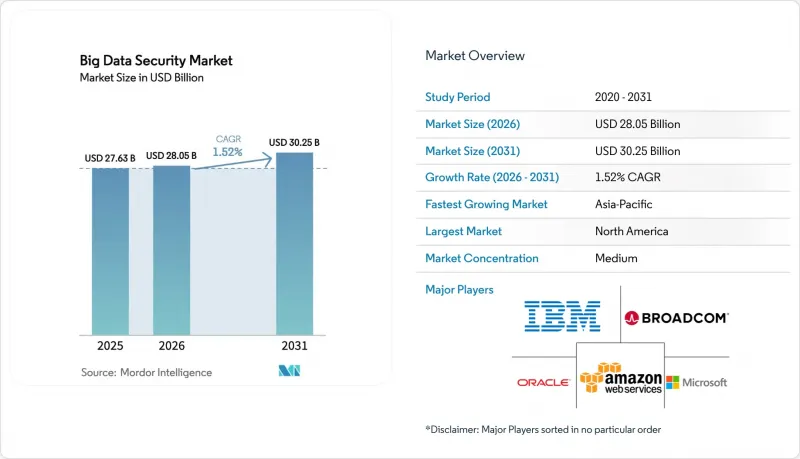
本報告按組件(解決方案和服務)、公司規模(中小企業和大型企業)、最終用戶行業(銀行、金融服務和保險 [BFSI]、IT 和電信、製造業、醫療保健和生命科學、航太和國防等)、部署模式(本地部署和雲端部署)以及地區進行分類。
全球巨量資料安全市場趨勢與洞察
人工智慧驅動的攻擊正迫使企業重新分配安全預算。
勒索軟體集團目前正利用生成式人工智慧(AI)發動快速憑證竊取和社交工程攻擊,繞過傳統防禦措施。大規模安全事件導致製造業停機損失超過每分鐘 22,000 美元,促使企業董事會大幅增加安全預算,遠超過以往撥款。預計到 2024 年,各行業資料外洩造成的損失將達到 556 萬美元,超過整體 IT 支出成長速度,並推動對即時分析以偵測橫向移動的需求。金融機構承認其資金不足,僅有 13% 的 IT 支出用於安全防禦,專家呼籲將這一比例提高到 20%,以應對攻擊者的自動化攻擊。在關鍵基礎設施領域,人工智慧驅動的安全營運中心報告稱,透過以機器學習為基礎的相關性分析取代人工分類,事件解決速度提高了 30%。因此,隨著企業重新評估其資金優先事項,巨量資料安全市場預計將持續成長。
GDPR和各國資料保護法都要求建立Petabyte級合規基礎設施。
歐洲的GDPR、加州的CCPA以及亞太地區的類似法規都要求對日益龐大的資料集進行加密、脫敏和審計追蹤。中國強化後的「2025規劃」增加了對金融和保險公司的即時合規審查,並加強了對控制系統缺陷的處罰。根據NIS2指令,歐洲各組織已將資訊安全預算提高到IT總支出的9%,但到2025年,資料外洩的區域平均成本仍將達到440萬歐元。在美國,衛生與公眾服務部在其2026財政年度計畫中提案撥款1億美元用於全行業的網路安全協調。隨著合規性從政策層面轉向技術實施層面,對可擴展加密、令牌化和不可篡改日誌記錄的需求日益成長,而這些正是巨量資料安全市場的主要收入來源。
網路安全人才短缺限制了市場成長。
32%的歐盟企業無法滿足網路安全崗位的基本要求,導致其對託管安全服務提供者的依賴性日益增強。日本電信業者已與Cloudflare合作,提供承包零信任服務,以解決中小企業的人才短缺問題。微軟的「安全未來計畫」已部署34,000名工程師參與人工智慧驅動的自動化工作,將事件回應速度提升了30%,顯示超大規模資料中心業者大規模企業正在努力彌補專業知識的不足。雖然自動化可以減輕工作量,但長期存在的人才短缺問題正在延緩自動化技術的普及,並限制巨量資料安全市場的短期成長。
細分市場分析
受加密、令牌化和 SIEM 套件強勁需求的推動,解決方案板塊預計到 2025 年將佔總收入的 62.35%。同時,隨著企業擴大將全天候監控和合規性整合外包,服務板塊預計將以 18.72% 的複合年成長率成長。人才短缺和平台複雜性正促使企業轉向託管檢測與回應 (MDR)、諮詢和整合合約。供應商正將這些服務與雲端訂閱捆綁在一起,以實現可預測的營運成本 (OpEx) 和快速引進週期。因此,在整個預測期內,巨量資料安全市場將繼續體現以服務主導的價值創造。
託管安全服務發展勢頭最為強勁,隨著企業在雲端基礎設施上重建資料湖,諮詢和整合專案也蓬勃發展。在解決方案領域,受監管要求的推動,資料加密和令牌化軟體持續推動銷售量。 SIEM 平台正透過人工智慧推理功能不斷演進,以減少警報疲勞,而 IAM 升級則為零信任架構的採用奠定了基礎。平台功能的整合表明,隨著企業尋求端到端的控制點,巨量資料安全市場正在持續整合。
到2025年,大型企業將主導市場,佔據68.75%的收入佔有率,企業發展和嚴格的合規要求。然而,中小企業預計將實現19.55%的複合年成長率,凸顯了降低准入門檻的雲端訂閱模式的重要性。超大規模資料中心業者現在已將企業級加密、金鑰管理和行為分析等功能整合到其基礎套餐中,使資源受限的公司也能使用以往只有財富500強企業才能享受到的功能。這種轉變正在擴大基本客群,巨量資料安全市場也持續保持兩位數的成長。
對於大型企業而言,投資主要集中在高階分析、同構加密試點部署以及能夠分析Petabyte級日誌的AI驅動型安全營運中心(SOC)。有些組織擁有超過1000名安全專家的團隊,凸顯了其內部專業知識的深度。相較之下,中小企業則更傾向於選擇能夠代表其處理複雜任務的承包託管服務。隨著巨量資料安全產業的日益成熟,那些能夠最佳化定價和自動化功能以適應這一細分市場的供應商有望獲得顯著的市場佔有率。
區域分析
北美受惠於零信任架構的早期應用、強大的供應商生態系統以及成熟的資料外洩通知法律,預計到2025年將佔全球收入的40.95%。隨著大型企業完成初步的雲端遷移,成長速度有所放緩,但持續進行的AI安全試點部署維持了支出動能。歐洲在GDPR和NIS2指令實施的推動下,成長速度僅次於北美,資訊安全目前佔IT總預算的9%。儘管經濟逆風對可自由支配的IT項目造成了沉重打擊,但監管的明朗化仍在推動需求成長。
預計到2031年,亞太地區的年複合成長率(CAGR)將達到20.15%,這反映了對自主雲的投資以及對本土技術的強制性採用。 AWS承諾在2027年投資2.26兆日圓(約153億美元)擴展其日本區域,清楚展現了該公司對超大規模雲端服務的堅定承諾。同時, Oracle計劃額外投資80億美元建造本地資料中心,以滿足經濟安全準則的要求。在政府機構優先採用本地工具的推動下,中國的資訊安全市場規模到2027年可望達到37兆元。該地區各國政府正在鼓勵本地資料處理,以促進安全產品的採用,從而擴大新興經濟體巨量資料安全市場的規模。
儘管中東、非洲和拉丁美洲的市場規模較小,但隨著雲端運算普及率的提高和金融業現代化政策的推進,這些地區的市場規模正在擴大。海灣合作理事會(GCC)成員國正在製定與「2030願景」相關的網路安全新法規,而巴西的《個人資料保護法》(LGPD)也促使鄰國效仿。雖然基礎設施的不平衡阻礙了市場成長,但數位銀行的快速普及創造了潛在需求,隨著網路連接的改善,巨量資料安全市場將能夠滿足這一需求。
其他好處:
- Excel格式的市場預測(ME)表
- 3個月的分析師支持
目錄
第1章:引言
- 研究假設和市場定義
- 調查範圍
第2章:調查方法
第3章執行摘要
第4章 市場狀況
- 市場概覽
- 市場促進因素
- 物聯網、行動和雲端日誌的快速成長使傳統的控制能力不堪重負,促使人們採用下一代以資料為中心的安全技術。
- 人工智慧驅動的安全漏洞、雙重勒索軟體和供應鏈攻擊,使得巨量資料安全分析的預算亟需增加。
- GDPR、CCPA、PDPA 和數十項新的國家法律要求進行Petabyte級加密、遮罩和審計追蹤。
- 資料湖向公共雲端的遷移正在加速對雲端原生安全、零信任和責任共享工具的需求。
- 各公司正爭相保護用於訓練 LLM 的龐大專有資料集,以防止模型外洩和智慧財產權損失。
- 零售媒體、醫療保健和廣告科技公司需要對他們用於共用見解的資料進行加密,同時避免洩露原始資料。
- 市場限制因素
- 資料安全工程師和資料科學家的短缺導致專案工作量增加,MSSP成本上升。
- 在混合環境中整合加密、SIEM、IAM 和資料管治工具,會對資本支出 (CapEx) 和營運成本 (OpEx) 預算造成負擔。
- 居住地法律的差異(例如中國的《中土法律》、俄羅斯的《FZ-242》)阻礙了統一的全球安全架構的建立。
- 聯邦學習和同態密碼技術減少了對集中式資料儲存的需求,並降低了對傳統巨量資料安全堆疊的支出。
- 價值供應鏈分析
- 監理情勢
- 技術展望
- 波特五力分析
- 新冠疫情與地緣政治事件的影響
第5章 市場規模與成長預測
- 按組件
- 解決方案
- 資料加密和令牌化
- 安全智慧/SIEM
- IAM 和 PAM
- 入侵偵測/防禦
- 資料遮罩和混淆
- 服務
- 諮詢與整合
- 託管安全服務
- 培訓和支持
- 解決方案
- 按組織規模
- 小型企業
- 大公司
- 按最終用戶行業分類
- 銀行、金融服務和保險(BFSI)
- 資訊科技/通訊
- 製造業
- 醫療保健和生命科學
- 航太/國防
- 政府/公共部門
- 零售與電子商務
- 部署模式
- 現場
- 雲
- 按地區
- 北美洲
- 美國
- 加拿大
- 南美洲
- 巴西
- 墨西哥
- 其他南美國家
- 歐洲
- 英國
- 德國
- 法國
- 俄羅斯
- 其他歐洲國家
- 亞太地區
- 中國
- 印度
- 日本
- 其他亞太國家
- 中東
- 沙烏地阿拉伯
- 阿拉伯聯合大公國
- 土耳其
- 其他中東國家
- 非洲
- 南非
- 奈及利亞
- 其他非洲國家
- 北美洲
第6章 競爭情勢
- 市場集中度
- 策略趨勢
- 市佔率分析
- 公司簡介
- Amazon Web Services
- Broadcom(Symantec)
- Check Point Software Technologies
- Cisco Systems
- Cloudera
- CrowdStrike
- Dell Technologies
- Elastic NV
- Fortinet
- Google Cloud(Alphabet)
- Hewlett Packard Enterprise
- IBM Corporation
- Imperva
- McAfee
- Microsoft Corporation
- Oracle Corporation
- Palo Alto Networks
- RSA Security
- Snowflake Inc.
- Splunk Inc.
- Talend SA
- Thales Group
第7章 市場機會與未來展望
According to Mordor Intelligence, the big data security market size market is expected to grow from USD 27.63 billion in 2025 to USD 28.05 billion in 2026 and is forecast to reach USD 30.25 billion by 2031 at 1.52% CAGR over 2026-2031.
This report is Segmented by Component (Solutions and Services), Organization Size (Small and Medium Enterprises and Large Enterprises), End-User Industry (Banking, Financial Services, and Insurance [BFSI], IT and Telecommunication, Manufacturing, Healthcare and Life Sciences, Aerospace and Defense, and More), Deployment Mode (On-Premise and Cloud), and Geography.
Global Big Data Security Market Trends and Insights
AI-enabled breaches drive enterprise security budget reallocations
Ransomware groups now weaponize generative AI for rapid credential theft and social-engineering campaigns that bypass legacy defenses. Manufacturing downtime has surpassed USD 22,000 per minute during major incidents, prompting boards to lift security budgets well above prior allocations. Data-breach costs in industrial domains climbed to USD 5.56 million in 2024, eclipsing general IT-spending growth and fueling demand for real-time analytics that detect lateral movement. Financial institutions concede that current allocations of only 13% of IT spend underfund defenses, with experts urging a shift toward 20% to keep pace with attacker automation. Across critical infrastructure, AI-powered security operations centers report 30% faster incident resolution once machine-learning correlation replaces manual triage. The result is sustained top-line expansion for the big data security market as enterprises reprioritize funding.
GDPR and national data laws mandate petabyte-scale compliance infrastructure
Europe's GDPR, California's CCPA, and similar statutes in Asia Pacific now obligate encryption, masking, and audit trails across ever-larger datasets. China's 2025 enhancements add real-time compliance audits for finance and insurance firms, tightening penalties for lax controls. European organizations have raised information-security budgets to 9% of total IT outlays under the NIS2 Directive, while average regional breach costs reached EUR 4.4 million in 2025. In the United States, the Department of Health and Human Services proposed USD 100 million for sector-wide cybersecurity coordination in its FY 2026 plan. As compliance moves from policy to technical enforcement, demand increases for scalable encryption, tokenization, and immutable logging key revenue streams within the big data security market.
Cybersecurity talent shortage constrains market growth
Thirty-two percent of EU organizations cannot fill essential cybersecurity roles, driving reliance on managed security service providers. Japan's operators collaborate with Cloudflare to supply turnkey zero-trust services that offset staffing gaps for SMEs. Microsoft's Secure Future Initiative applies 34,000 engineers to AI-driven automation, improving incident response by 30% and showcasing how hyperscalers compensate for scarce expertise. Although automation eases workloads, chronic shortages slow deployment and limit the near-term scale-up of the big data security market.
Other drivers and restraints analyzed in the detailed report include:
- Cloud data lakes accelerate zero-trust architecture adoption
- LLM training in data protection becomes a strategic imperative
- Tool-orchestration complexity strains enterprise budgets
For complete list of drivers and restraints, kindly check the Table Of Contents.
Segment Analysis
Solutions held 62.35% of 2025 revenue, driven by robust demand for encryption, tokenization, and SIEM suites. At the same time, Services is set to grow at 18.72% CAGR as organizations outsource 24/7 monitoring and compliance integration. Talent scarcity and platform complexity push enterprises toward managed detection and response, consulting, and integration contracts. Vendors bundle these offerings with cloud subscriptions, enabling predictable OpEx and faster implementation cycles. As a result, the big data security market will continue to reflect service-led value creation throughout the forecast period.
Managed Security Services show the highest traction, while Advisory and Integration engagements surge as firms re-architect data lakes on cloud foundations. Data encryption and tokenization software remains the volume driver within Solutions, propelled by regulatory mandates. SIEM platforms evolve with AI inference that reduces alert fatigue, and IAM upgrades underpin zero-trust rollouts. The convergence of platform features signals ongoing consolidation in the big data security market as players chase end-to-end control points.
Large Enterprises dominated in 2025 with 68.75% revenue, reflecting multi-region operations and stringent compliance obligations. Yet SMEs are forecast to post a 19.55% CAGR, highlighting cloud subscription models that lower entry barriers. Hyperscalers now embed enterprise-grade encryption, key management, and behavior analytics into baseline plans, letting resource-constrained firms access capabilities once exclusive to Fortune 500 peers. This shift broadens the customer base, sustaining double-digit expansion in the big data security market.
For large organizations, investments focus on advanced analytics, homomorphic encryption pilots, and AI-powered SOCs that mine petabyte-scale logs. Some institutions maintain teams exceeding 1,000 security specialists, underscoring the depth of in-house expertise. SMEs, by contrast, emphasize turnkey managed services that offload complexity. Vendors tailoring price points and automation to this segment stand to capture an outsized share as the big data security industry matures.
Complete Report Scope:
- By Component
- Solutions
- Data Encryption and Tokenization
- Security Intelligence/SIEM
- IAM and PAM
- Intrusion Detection/Prevention
- Data Masking and Obfuscation
- Services
- Consulting and Integration
- Managed Security Services
- Training and Support
- Solutions
- By Organization Size
- Small and Medium Enterprises
- Large Enterprises
- By End-user Industry
- Banking, Financial Services and Insurance (BFSI)
- IT and Telecommunication
- Manufacturing
- Healthcare and Life Sciences
- Aerospace and Defense
- Government and Public Sector
- Retail and E-commerce
- By Deployment Mode
- On-premise
- Cloud
- By Geography
- North America
- United States
- Canada
- South America
- Brazil
- Mexico
- Rest of South America
- Europe
- United Kingdom
- Germany
- France
- Russia
- Rest of Europe
- Asia-Pacific
- China
- India
- Japan
- Rest of Asia-Pacific
- Middle East
- Saudi Arabia
- United Arab Emirates
- Turkey
- Rest of Middle East
- Africa
- South Africa
- Nigeria
- Rest of Africa
- North America
Geography Analysis
North America held 40.95% of 2025 revenue, benefiting from early zero-trust adoption, a dense vendor ecosystem, and mature breach-notification laws. Growth moderates as large enterprises complete initial cloud migrations, yet ongoing AI-security pilots maintain spending momentum. Europe follows, propelled by GDPR enforcement and the NIS2 Directive, with information-security allocations now 9% of total IT budgets. Regulatory certainty fuels demand even as economic headwinds weigh on discretionary IT projects.
Asia Pacific is forecast for a 20.15% CAGR through 2031, reflecting sovereign-cloud investments and domestic-technology mandates. AWS's pledge of 2.26 trillion yen (USD 15.3 billion) to expand Japanese regions by 2027 exemplifies its hyperscale commitment. Oracle separately plans USD 8 billion in local data centers to meet economic-security guidelines. China's information-security market could hit 37 trillion yuan by 2027 as state bodies prioritize indigenous tooling. Governments across the region encourage local data processing to spur security product adoption, enlarging the big data security market size in emerging economies.
The Middle East, Africa, and Latin America represent smaller bases but show rising adoption as cloud coverage widens and financial-sector modernization policies advance. Gulf Cooperation Council states issue new cyber regulations tied to Vision 2030 agendas, while Brazil's LGPD inspires neighbouring countries to legislate. Although infrastructure gaps temper growth, rising digital-banking penetration creates latent demand that the big data security market can tap as connectivity improves.
- Amazon Web Services
- Broadcom (Symantec)
- Check Point Software Technologies
- Cisco Systems
- Cloudera
- CrowdStrike
- Dell Technologies
- Elastic NV
- Fortinet
- Google Cloud (Alphabet)
- Hewlett Packard Enterprise
- IBM Corporation
- Imperva
- McAfee
- Microsoft Corporation
- Oracle Corporation
- Palo Alto Networks
- RSA Security
- Snowflake Inc.
- Splunk Inc.
- Talend SA
- Thales Group
Additional Benefits:
- The market estimate (ME) sheet in Excel format
- 3 months of analyst support
TABLE OF CONTENTS
1 Introduction
- 1.1 Study Assumptions and Market Definition
- 1.2 Scope of the Study
2 RESEARCH METHODOLOGY
3 EXECUTIVE SUMMARY
4 MARKET LANDSCAPE
- 4.1 Market Overview
- 4.2 Market Drivers
- 4.2.1 Surging IoT, mobile and cloud logs overwhelm legacy controls, driving next-gen data-centric security adoption
- 4.2.2 AI-enabled breaches, double-extortion ransomware and supply-chain attacks force bigger budgets for big-data security analytics
- 4.2.3 GDPR, CCPA, PDPA and dozens of new national laws mandate encryption, masking and audit trails at petabyte scale
- 4.2.4 Shift of data lakes to public cloud accelerates demand for cloud-native security, zero-trust and shared-responsibility tooling
- 4.2.5 Enterprises scramble to secure massive proprietary datasets used for LLM training to avoid model leakage and IP loss
- 4.2.6 Retail-media, healthcare and ad-tech firms require encryption-in-use to share insights without exposing raw data
- 4.3 Market Restraints
- 4.3.1 Scarcity of data-security engineers and data scientists inflates project timelines and MSSP costs
- 4.3.2 Orchestrating encryption, SIEM, IAM and data-governance tools across hybrid estates strains CapEx/OpEx budgets
- 4.3.3 Divergent residency laws (e.g., China CSL, Russia FZ-242) block unified global security architectures
- 4.3.4 Federated learning and homomorphic encryption reduce need for centralized data stores, tempering spend on classic big-data security stacks
- 4.4 Value/Supply-Chain Analysis
- 4.5 Regulatory Landscape
- 4.6 Technological Outlook
- 4.7 Porter's Five Forces Analysis
- 4.7.1 Bargaining Power of Buyers
- 4.7.2 Bargaining Power of Suppliers
- 4.7.3 Threat of New Entrants
- 4.7.4 Threat of Substitutes
- 4.7.5 Intensity of Competitive Rivalry
- 4.8 Impact of COVID-19 and Geopolitical Events
5 Market Size and Growth Forecasts (Value)
- 5.1 By Component
- 5.1.1 Solutions
- 5.1.1.1 Data Encryption and Tokenization
- 5.1.1.2 Security Intelligence/SIEM
- 5.1.1.3 IAM and PAM
- 5.1.1.4 Intrusion Detection/Prevention
- 5.1.1.5 Data Masking and Obfuscation
- 5.1.2 Services
- 5.1.2.1 Consulting and Integration
- 5.1.2.2 Managed Security Services
- 5.1.2.3 Training and Support
- 5.1.1 Solutions
- 5.2 By Organization Size
- 5.2.1 Small and Medium Enterprises
- 5.2.2 Large Enterprises
- 5.3 By End-user Industry
- 5.3.1 Banking, Financial Services and Insurance (BFSI)
- 5.3.2 IT and Telecommunication
- 5.3.3 Manufacturing
- 5.3.4 Healthcare and Life Sciences
- 5.3.5 Aerospace and Defense
- 5.3.6 Government and Public Sector
- 5.3.7 Retail and E-commerce
- 5.4 By Deployment Mode
- 5.4.1 On-premise
- 5.4.2 Cloud
- 5.5 By Geography
- 5.5.1 North America
- 5.5.1.1 United States
- 5.5.1.2 Canada
- 5.5.2 South America
- 5.5.2.1 Brazil
- 5.5.2.2 Mexico
- 5.5.2.3 Rest of South America
- 5.5.3 Europe
- 5.5.3.1 United Kingdom
- 5.5.3.2 Germany
- 5.5.3.3 France
- 5.5.3.4 Russia
- 5.5.3.5 Rest of Europe
- 5.5.4 Asia-Pacific
- 5.5.4.1 China
- 5.5.4.2 India
- 5.5.4.3 Japan
- 5.5.4.4 Rest of Asia-Pacific
- 5.5.5 Middle East
- 5.5.5.1 Saudi Arabia
- 5.5.5.2 United Arab Emirates
- 5.5.5.3 Turkey
- 5.5.5.4 Rest of Middle East
- 5.5.6 Africa
- 5.5.6.1 South Africa
- 5.5.6.2 Nigeria
- 5.5.6.3 Rest of Africa
- 5.5.1 North America
6 COMPETITIVE LANDSCAPE
- 6.1 Market Concentration
- 6.2 Strategic Moves
- 6.3 Market Share Analysis
- 6.4 Company Profiles (includes Global level Overview, Market level overview, Core Segments, Financials as available, Strategic Information, Market Rank/Share, Products and Services, Recent Developments)
- 6.4.1 Amazon Web Services
- 6.4.2 Broadcom (Symantec)
- 6.4.3 Check Point Software Technologies
- 6.4.4 Cisco Systems
- 6.4.5 Cloudera
- 6.4.6 CrowdStrike
- 6.4.7 Dell Technologies
- 6.4.8 Elastic NV
- 6.4.9 Fortinet
- 6.4.10 Google Cloud (Alphabet)
- 6.4.11 Hewlett Packard Enterprise
- 6.4.12 IBM Corporation
- 6.4.13 Imperva
- 6.4.14 McAfee
- 6.4.15 Microsoft Corporation
- 6.4.16 Oracle Corporation
- 6.4.17 Palo Alto Networks
- 6.4.18 RSA Security
- 6.4.19 Snowflake Inc.
- 6.4.20 Splunk Inc.
- 6.4.21 Talend SA
- 6.4.22 Thales Group
7 MARKET OPPORTUNITIES AND FUTURE OUTLOOK
- 7.1 White-space and Unmet-need Assessment

 巨量資料安全市場:全球市場預測,2026-2032年
 2026-2030年全球巨量資料安全市場
 巨量資料安全市場分析及預測(至2035年):類型、產品類型、服務、技術、組件、應用、部署模式、最終用戶、解決方案
 2026年巨量資料安全全球市場報告
 巨量資料安全市場規模、佔有率、趨勢和預測:按組件、部署模式、組織規模、技術、最終用戶行業和地區分類,2026-2034 年
 巨量資料安全市場規模、佔有率、成長及全球產業分析:按類型、應用和地區分類的洞察,2026-2034 年預測
 巨量資料安全市場預測至2032年:按組件、安全類型、組織規模、部署類型、最終用戶和地區分類的全球分析日本巨量資料安全市場報告:按組件、部署類型、組織規模、技術、最終用戶產業和地區分類,2026-2034年
 巨量資料安全市場規模、佔有率和成長分析(按組件、軟體、部署類型、組織規模、垂直產業和地區分類)-2026-2033年產業預測
 巨量資料安全市場-全球產業規模、佔有率、趨勢、機會和預測(按組件、安全類型、最終用戶產業、地區和競爭細分,2020-2030 年預測)