


 |
市場調查報告書
商品編碼
2114077
行動裝置管理:市場佔有率分析、產業趨勢與統計、成長預測(2026-2031)Mobile Device Management - Market Share Analysis, Industry Trends & Statistics, Growth Forecasts (2026 - 2031) |
||||||

※ 本網頁內容可能與最新版本有所差異。詳細情況請與我們聯繫。
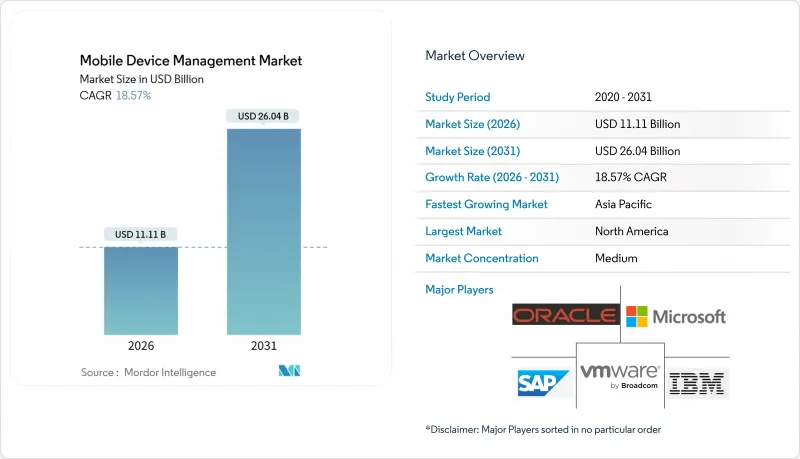
根據 Mordor Intelligence 預測,行動裝置管理市場規模預計將在 2026 年達到 111.1 億美元,到 2031 年達到 260.4 億美元,在此期間的複合年成長率為 18.57%。
本報告按部署模式(本地部署和雲端部署)、設備類型(智慧型手機和平板電腦、筆記型電腦和桌上型電腦、其他)、最終用戶產業(IT和電信、銀行、金融服務和保險、其他)、所有權模式(企業自有設備、自帶設備辦公 (BYOD)、公司自有設備辦公 (COPE)、選擇設備辦公室 (CYOD))以及地區(CYOD))以及地區(CY)。市場預測以美元 (USD) 為單位。
全球行動裝置管理市場趨勢與洞察
企業自備設備辦公 (BYOD) 政策的爆炸性成長
隨著混合辦公模式的興起,預計到2025年,82%的企業將允許員工在公司網路上使用個人智慧型手機和平板電腦,高於2023年的67%。設備數量的增加導致作業系統、個人雲端應用和非託管資料路徑的組合數量增加一倍,因此需要容器化和遠端擦拭巾控制。保險公司越來越拒絕承保或對存在非託管終端的設備收取額外費用,這使得行動裝置管理 (MDM) 的實施成為風險轉移的先決條件。雖然取消公司提供的設備可以節省成本,這對財務部門來說很有吸引力,但根據《一般資料保護規範》(GDPR) 和《加州消費者隱私權法案》(CCPR) 因資料外洩而產生的罰款可能會抵消這些節省。因此,高階主管將行動裝置管理市場視為一種直接的對沖監管罰款和不斷上漲的保險費的有效手段,而不僅僅是提高效率的可選工具。
向雲端原生 UEM 套件的遷移正在加速。
企業正在逐步淘汰本地主機,遷移到雲端平台,這些平台將智慧型手機、筆記型電腦、穿戴式裝置和物聯網設備整合到單一策略結構中。 Microsoft Intune 與 Azure Active Directory 整合,就是一個很好的例子,它能夠即時評估裝置狀態、使用者身分和應用程式上下文,從而做出條件存取決策。彈性容量消除了伺服器採購週期,而自動更新則確保持續符合新制定的零信任準則。中期收益包括基於機器學習的配置偏差修正和硬體故障預測警報,預計將終端管理工作量減少高達 40%。延遲遷移會增加技術債的風險,因為 FIDO2 和後量子演算法等新標準的發布速度超過了本地軟體的發布週期。
與傳統 IAM/ITSM 系統整合相關的初始成本
依賴過時的身份管理和技術支援工具的公司在實施現代行動裝置管理 (MDM) 時,必須投資於客製化 API、目錄同步和工作流程編配。諮詢費用通常超過 50 萬美元,專案週期可能長達一年,這對中型企業的預算造成了巨大壓力。混合式身分驗證協定會造成單點故障,從而延誤事件回應。此外,金融和醫療保健產業嚴格的變更管理委員會也會延長測試週期。這些成本方面的阻礙暫時減緩了高度監管的成熟企業採用行動裝置管理的速度。
細分市場分析
預計到2025年,雲端託管平台將佔總營收的65.13%,凸顯其在行動裝置管理市場的主導地位。預計到2031年,雲端託管平台的複合年成長率將達到19.12%,這反映了其彈性擴展、自動化功能更新以及付費使用制,該模式將資本支出轉化為營運成本。微軟和VMware等供應商正在提供可與SIEM、IAM和EDR工具整合的REST API,從而縮短整合時間。即使是曾經拒絕公共雲端的國防機構和金融機構,現在也開始採用混合解決方案,在不同國家的資料中心之間同步災害復原策略,進一步擴大了雲端的普及範圍。
自主端點管理正在加速這項轉型,機器學習引擎能夠分析遙測資料、預測組件故障並自我修正偏差。 Gartner 預測,到 2029 年,隨著自主功能的成熟,人事費用將下降 40%,這也凸顯了雲端交付在行動裝置管理 (MDM) 市場日益普及的原因。零接觸配置允許設備直接出貨給最終用戶,並透過QR碼實現自動註冊,這種做法在疫情封鎖期間逐漸普及。然而,其價值提案取決於硬體認證和安全的供應鏈,因為韌體漏洞可能會在設備連接之前就停用遠端管理安全措施。
儘管智慧型手機和平板電腦在2025年佔據了48.28%的收入佔有率,但隨著工廠將蜂窩模組整合到機器人中、車隊部署堅固耐用的手持終端機以及公共產業安裝智慧電錶,工業物聯網終端預計將以20.34%的複合年成長率成長。到2030年,蜂巢式物聯網工業IoT預計將達到56億,每個連接都需要憑證更新、修補程式更新和網路存取控制。筆記型電腦對於程式碼開發和財務建模仍然至關重要,但由於基於瀏覽器的應用程式的興起,其成長曲線正在趨於平緩。
在建築、採礦和醫療保健等嚴苛環境以及感染控制法規限制使用消費級硬體的領域,堅固耐用的穿戴式裝置正蓬勃發展。 OMA-DM 和 LwM2M 等輕量級協定可減少代理佔用空間,並節省電池和 CPU 功耗。 5G 網路切片為遙測提供專用頻寬,確保自動駕駛汽車和遠端手術的可靠吞吐量。這些趨勢正在推動行動裝置管理 (MDM) 市場對面向物聯網的功能進行投資,包括電力消耗策略輪詢和邊緣快取更新。
區域分析
預計到2025年,北美將佔據38.71%的市場。這主要得益於自帶設備辦公室(BYOD)的早期普及、嚴格的網路保險要求以及強大的供應商生態系統。美國網路安全和基礎設施安全局(CISA)已將終端管理定位為保護關鍵基礎設施的核心手段,從而加速了其在公共部門的普及應用。加拿大和墨西哥的資料保護法正在推動該地區雲端實例的成長,而《美墨加協定》(USMCA)則促進了跨境資料流動。儘管隨著大型企業市場接近飽和,市場成長趨於穩定,但沒有專職IT人員的中小型企業仍是行動裝置管理市場的重要成長動力。
歐洲的趨勢主要受GDPR(一般資料保護規則)和ESG(環境、社會和管治)指令的約束。德國、英國和法國是需求的主要驅動力,但《企業永續性實質審查指示》更傾向於那些揭露碳足跡並支持維修權的供應商。對俄羅斯的製裁限制了歐洲和美國的雲端服務,促使本土替代服務的發展。工人代表委員會定期就GDPR第88條規定的設備追蹤限制進行談判,比對許可證銷售的影響更大,但對功能採用率的影響更大。
亞太地區是成長最快的地區,複合年成長率達10.23%,這主要得益於印度的「數位印度」計畫、中國的智慧製造計畫以及日本的「社會5.0」基礎設施願景。在韓國,5G環境的成熟正推動低延遲MDM功能在自主系統中早期應用。在澳洲和紐西蘭,透過「基本八項」標準加強網路安全,使得MDM的角色更加關鍵。在中東,阿拉伯聯合大公國和沙烏地阿拉伯的發展勢頭強勁;而在非洲,MDM的應用仍處於起步階段,尤其是在奈及利亞和肯亞的金融科技生態系統中。這些努力共同推動了行動裝置管理(MDM)市場的擴張,但仍需實現功能在地化和國內資料託管。
其他好處:
- Excel格式的市場預測(ME)表
- 3個月的分析師支持
目錄
第1章:引言
- 研究假設和市場定義
- 調查範圍
第2章:調查方法
第3章執行摘要
第4章 市場狀況
- 市場概覽
- 市場促進因素
- 企業自備設備辦公 (BYOD) 政策的爆炸性成長
- 向雲端原生 UEM 套件的遷移正在加速。
- 強制性終端安全網路保險正在迅速增加。
- 利用 5G 技術擴展現場服務人員隊伍
- 為後量子時代安全做好準備,就是強化設備的信任體系。
- ESG掛鉤的採購方式為安全設備供應商帶來優勢。
- 市場限制因素
- 與傳統 IAM/ITSM 系統整合相關的初始成本
- 主權監管資料和規則碎片化
- 越來越多的人開始關注保護員工隱私免受設備追蹤的問題。
- 堅固耐用的物聯網終端設備電池容量和 CPU 效能餘裕不足
- 產業價值鏈分析
- 監理情勢
- 技術展望
- 波特五力分析
- 對關鍵相關人員的影響評估
- 主要用例和案例研究
- 宏觀經濟因素對市場的影響
第5章 市場規模與成長預測
- 部署模式
- 現場
- 雲
- 依設備類型
- 智慧型手機和平板電腦
- 筆記型電腦和桌上型電腦
- 堅固耐用的穿戴式設備
- 物聯網/工業物聯網端點
- 按最終用戶行業分類
- 資訊科技/通訊
- BFSI
- 醫療保健和生命科學
- 零售與電子商務
- 政府/公共部門
- 製造業
- 教育
- 運輸/物流
- 自有車型
- 本公司自有設備
- BYOD(Bring Your Own Device)
- COPE(公司所有,個人使用)
- CYOD(Choose-Your-Own-Device)
- 按地區
- 北美洲
- 美國
- 加拿大
- 墨西哥
- 南美洲
- 巴西
- 阿根廷
- 其他南美國家
- 歐洲
- 德國
- 英國
- 法國
- 義大利
- 西班牙
- 俄羅斯
- 其他歐洲國家
- 亞太地區
- 中國
- 日本
- 韓國
- 印度
- 澳洲
- 紐西蘭
- 其他亞太國家
- 中東
- 阿拉伯聯合大公國
- 沙烏地阿拉伯
- 土耳其
- 其他中東國家
- 非洲
- 南非
- 奈及利亞
- 肯亞
- 其他非洲國家
- 北美洲
第6章 競爭情勢
- 市場集中度
- 策略趨勢
- 市佔率分析
- 公司簡介
- VMware Inc.
- Microsoft Corporation(Intune)
- IBM Corporation
- Citrix Systems Inc.
- SAP SE
- Broadcom Inc.(Symantec)
- Cisco Systems Inc.
- Ivanti Software Inc.
- JAMF Software LLC
- SOTI Inc.
- ManageEngine(Zoho Corporation)
- Hexnode(UEM)
- 42Gears Mobility Systems
- Scalefusion
- Baramundi Software AG
- Addigy
- Miradore Ltd.
- Kaspersky Lab
- Sophos Group plc
- MobileIron Inc.
- BlackBerry Limited
- Check Point Software Technologies Ltd.
- Google LLC(Android Enterprise)
- Lookout Inc.
第7章 市場機會與未來展望
According to Mordor Intelligence, the mobile device management market size stands at USD 11.11 billion in 2026 and is projected to reach USD 26.04 billion by 2031, reflecting an 18.57% CAGR over the period.
This report is Segmented by Deployment Mode (On-Premise, and Cloud), Device Type (Smartphones and Tablets, Laptops and Desktops, and More), End-User Industry (IT and Telecom, BFSI, and More), Ownership Model (Corporate-Owned Devices, BYOD, COPE, CYOD), and Geography (North America, South America, Europe, Asia Pacific, Middle East, Africa). The Market Forecasts are Provided in Terms of Value (USD).
Global Mobile Device Management Market Trends and Insights
Explosion of Enterprise BYOD Policies
Hybrid work has pushed 82% of organizations to allow employee-owned phones and tablets on corporate networks in 2025, up from 67% in 2023. This expanded fleet multiplies operating-system permutations, personal cloud apps, and unmanaged data paths, demanding containerization and remote-wipe controls. Insurers are increasingly denying or surcharging coverage when unmanaged endpoints exist, making MDM adoption a prerequisite for risk transfer. Cost savings from eliminating corporate device stipends can entice finance teams; however, breach-related penalties under the GDPR or the California Consumer Privacy Rights Act may offset those savings. As a result, executives view the Mobile Device Management market as a direct hedge against regulatory fines and premium hikes rather than an optional efficiency tool.
Accelerating Shift to Cloud-Native UEM Suites
Organizations are abandoning on-premise consoles for cloud platforms that consolidate phones, laptops, wearables, and IoT devices behind a single policy fabric. Microsoft Intune, integrated with Azure Active Directory, exemplifies how conditional access decisions now assess real-time device health, user identity, and app context. Elastic capacity removes server procurement cycles, while automatic updates ensure continuous compliance with emerging zero-trust guidelines. Medium-term gains include machine-learning remediation of configuration drift and predictive hardware failure alerts, cutting endpoint management labor by as much as 40%. Delayed migrations risk technical debt as emerging standards such as FIDO2 and post-quantum algorithms outpace on-premise software release cycles.
Up-Front Integration Cost with Legacy IAM/ITSM Stacks
Enterprises relying on outdated identity managers and help-desk tools must fund custom APIs, directory sync, and workflow orchestration when deploying modern MDM. Consulting fees often exceed USD 500,000, and projects can last a year, straining budgets for mid-sized firms. Mixed authentication protocols create single points of failure and incident-response delays, while strict change-control boards in finance and healthcare prolong testing cycles. This cost friction temporarily slows the uptake of Mobile Device Management among heavily regulated incumbents.
Other drivers and restraints analyzed in the detailed report include:
- Surge in Cyber-Insurance Mandates for Endpoint Control
- 5G-Enabled Field-Service Workforce Expansion
- Fragmented Regulatory Data-Sovereignty Rules
For complete list of drivers and restraints, kindly check the Table Of Contents.
Segment Analysis
Cloud-hosted platforms controlled 65.13% of 2025 revenue, confirming their dominance in the Mobile Device Management market. The model's 19.12% CAGR to 2031 reflects elastic scaling, automatic feature updates, and pay-as-you-go pricing that converts capital outlays into operating expenses. Vendors such as Microsoft and VMware expose REST APIs that integrate with SIEM, IAM, and EDR tools, trimming integration timelines. Even defense and financial institutions that once rejected public cloud now adopt hybrid blueprints that mirror policies across sovereign data centers for disaster recovery, further enlarging the cloud's footprint.
Autonomous endpoint management accelerates the shift, as machine-learning engines analyze telemetry, predict component failures, and self-correct drift. Gartner estimates a 40% cut in labor costs by 2029 when autonomous capabilities mature, underscoring why the Mobile Device Management market favors cloud delivery. Zero-touch provisioning enables devices to ship directly to end users and self-enroll through QR codes, a practice that was cemented during pandemic lockdowns. The value proposition, however, hinges on hardware attestation and a secure supply chain, because compromised firmware can defeat remote-management safeguards before devices even connect.
Smartphones and tablets owned 48.28% of 2025 revenue, but industrial IoT endpoints will grow at 20.34% CAGR as factories embed cellular modules in robots, fleets deploy rugged handhelds, and utilities install smart meters. Cellular IoT connections are projected to reach 5.6 billion by 2030, each requiring certificate rotation, patching, and network-access controls. Laptops remain vital for code development and financial modeling, yet browser-based apps flatten their growth curve.
Rugged and wearable devices thrive in construction, mining, and clinical settings where harsh environments or infection-control rules preclude consumer hardware. Lightweight protocols such as OMA-DM and LwM2M shrink agent footprints, conserving battery and CPU. 5G network slicing offers dedicated bandwidth for telemetry, ensuring reliable throughput for autonomous vehicles or remote surgery. These dynamics channel investment toward IoT-oriented functionality within the Mobile Device Management market, including power-aware policy polling and edge-cached updates.
Complete Report Scope:
- By Deployment Mode
- On-Premise
- Cloud
- By Device Type
- Smartphones and Tablets
- Laptops and Desktops
- Rugged and Wearable Devices
- IoT/IIoT Endpoints
- By End-User Industry
- IT and Telecom
- BFSI
- Healthcare and Life Sciences
- Retail and E-Commerce
- Government and Public Sector
- Manufacturing
- Education
- Transportation and Logistics
- By Ownership Model
- Corporate-Owned Devices
- BYOD
- COPE (Corporate-Owned, Personally Enabled)
- CYOD (Choose-Your-Own-Device)
- By Geography
- North America
- United States
- Canada
- Mexico
- South America
- Brazil
- Argentina
- Rest of South America
- Europe
- Germany
- United Kingdom
- France
- Italy
- Spain
- Russia
- Rest of Europe
- Asia Pacific
- China
- Japan
- South Korea
- India
- Australia
- New Zealand
- Rest of Asia Pacific
- Middle East
- United Arab Emirates
- Saudi Arabia
- Turkey
- Rest of Middle East
- Africa
- South Africa
- Nigeria
- Kenya
- Rest of Africa
- North America
Geography Analysis
North America held a 38.71% share in 2025, buoyed by early BYOD uptake, rigorous cyber-insurance clauses, and a dense vendor ecosystem. The United States Cybersecurity and Infrastructure Security Agency classifies endpoint management as a core safeguard for critical infrastructure, accelerating public-sector rollouts. Canadian and Mexican data-protection laws are driving the growth of regionally hosted cloud instances, yet the United States-Mexico-Canada Agreement facilitates cross-border data flow. Market growth steadies as large enterprises near saturation, but small firms without dedicated IT staff remain a significant expansion vector for the Mobile Device Management market.
Europe's trajectory depends on GDPR compliance and ESG directives. Germany, the United Kingdom, and France anchor demand, while the Corporate Sustainability Due Diligence Directive rewards vendors that disclose their carbon footprints and support the right to repair. Russian sanctions restrict Western cloud services, prompting the development of domestic alternatives. Works councils routinely negotiate device-tracking limitations under GDPR Article 88, affecting feature uptake more than license volumes.
Asia Pacific is the fastest-growing region at 10.23% CAGR, underpinned by India's Digital India scheme, China's smart manufacturing push, and Japan's Society 5.0 infrastructure vision. South Korea's mature 5G landscape encourages early adoption of low-latency MDM features for autonomous systems. Australia and New Zealand strengthen cybersecurity baselines through the Essential Eight, reinforcing MDM's role. The Middle East sees momentum in the United Arab Emirates and Saudi Arabia, while Africa's nascent uptake concentrates in Nigeria and Kenya's fintech ecosystems. Collectively, these initiatives broaden the Mobile Device Management market but demand feature localization and sovereign data hosting.
- VMware Inc.
- Microsoft Corporation (Intune)
- IBM Corporation
- Citrix Systems Inc.
- SAP SE
- Broadcom Inc. (Symantec)
- Cisco Systems Inc.
- Ivanti Software Inc.
- JAMF Software LLC
- SOTI Inc.
- ManageEngine (Zoho Corporation)
- Hexnode (UEM)
- 42Gears Mobility Systems
- Scalefusion
- Baramundi Software AG
- Addigy
- Miradore Ltd.
- Kaspersky Lab
- Sophos Group plc
- MobileIron Inc.
- BlackBerry Limited
- Check Point Software Technologies Ltd.
- Google LLC (Android Enterprise)
- Lookout Inc.
Additional Benefits:
- The market estimate (ME) sheet in Excel format
- 3 months of analyst support
TABLE OF CONTENTS
1 INTRODUCTION
- 1.1 Study Assumptions and Market Definition
- 1.2 Scope of the Study
2 RESEARCH METHODOLOGY
3 EXECUTIVE SUMMARY
4 MARKET LANDSCAPE
- 4.1 Market Overview
- 4.2 Market Drivers
- 4.2.1 Explosion of Enterprise BYOD Policies
- 4.2.2 Accelerating Shift to Cloud-Native UEM Suites
- 4.2.3 Surge in Cyber-Insurance Mandates for Endpoint Control
- 4.2.4 5G-Enabled Field-Service Workforce Expansion
- 4.2.5 Post-Quantum Security Preparations Elevating Device Trust Stacks
- 4.2.6 ESG-Linked Procurement Favouring Secure-Device Vendors
- 4.3 Market Restraints
- 4.3.1 Up-Front Integration Cost with Legacy IAM/ITSM Stacks
- 4.3.2 Fragmented Regulatory Data-Sovereignty Rules
- 4.3.3 Growing Employee Privacy Push-Back on Device Tracking
- 4.3.4 Limited Battery/CPU Headroom on Rugged IoT Endpoints
- 4.4 Industry Value Chain Analysis
- 4.5 Regulatory Landscape
- 4.6 Technological Outlook
- 4.7 Porter's Five Forces Analysis
- 4.7.1 Bargaining Power of Suppliers
- 4.7.2 Bargaining Power of Buyers
- 4.7.3 Threat of New Entrants
- 4.7.4 Threat of Substitutes
- 4.7.5 Intensity of Competitive Rivalry
- 4.8 Impact Assessment of Key Stakeholders
- 4.9 Key Use Cases and Case Studies
- 4.10 Impact of Macroeconomic Factors on the Market
5 MARKET SIZE AND GROWTH FORECASTS (VALUE)
- 5.1 By Deployment Mode
- 5.1.1 On-Premise
- 5.1.2 Cloud
- 5.2 By Device Type
- 5.2.1 Smartphones and Tablets
- 5.2.2 Laptops and Desktops
- 5.2.3 Rugged and Wearable Devices
- 5.2.4 IoT/IIoT Endpoints
- 5.3 By End-User Industry
- 5.3.1 IT and Telecom
- 5.3.2 BFSI
- 5.3.3 Healthcare and Life Sciences
- 5.3.4 Retail and E-Commerce
- 5.3.5 Government and Public Sector
- 5.3.6 Manufacturing
- 5.3.7 Education
- 5.3.8 Transportation and Logistics
- 5.4 By Ownership Model
- 5.4.1 Corporate-Owned Devices
- 5.4.2 BYOD
- 5.4.3 COPE (Corporate-Owned, Personally Enabled)
- 5.4.4 CYOD (Choose-Your-Own-Device)
- 5.5 By Geography
- 5.5.1 North America
- 5.5.1.1 United States
- 5.5.1.2 Canada
- 5.5.1.3 Mexico
- 5.5.2 South America
- 5.5.2.1 Brazil
- 5.5.2.2 Argentina
- 5.5.2.3 Rest of South America
- 5.5.3 Europe
- 5.5.3.1 Germany
- 5.5.3.2 United Kingdom
- 5.5.3.3 France
- 5.5.3.4 Italy
- 5.5.3.5 Spain
- 5.5.3.6 Russia
- 5.5.3.7 Rest of Europe
- 5.5.4 Asia Pacific
- 5.5.4.1 China
- 5.5.4.2 Japan
- 5.5.4.3 South Korea
- 5.5.4.4 India
- 5.5.4.5 Australia
- 5.5.4.6 New Zealand
- 5.5.4.7 Rest of Asia Pacific
- 5.5.5 Middle East
- 5.5.5.1 United Arab Emirates
- 5.5.5.2 Saudi Arabia
- 5.5.5.3 Turkey
- 5.5.5.4 Rest of Middle East
- 5.5.6 Africa
- 5.5.6.1 South Africa
- 5.5.6.2 Nigeria
- 5.5.6.3 Kenya
- 5.5.6.4 Rest of Africa
- 5.5.1 North America
6 COMPETITIVE LANDSCAPE
- 6.1 Market Concentration
- 6.2 Strategic Moves
- 6.3 Market Share Analysis
- 6.4 Company Profiles
- 6.4.1 VMware Inc.
- 6.4.2 Microsoft Corporation (Intune)
- 6.4.3 IBM Corporation
- 6.4.4 Citrix Systems Inc.
- 6.4.5 SAP SE
- 6.4.6 Broadcom Inc. (Symantec)
- 6.4.7 Cisco Systems Inc.
- 6.4.8 Ivanti Software Inc.
- 6.4.9 JAMF Software LLC
- 6.4.10 SOTI Inc.
- 6.4.11 ManageEngine (Zoho Corporation)
- 6.4.12 Hexnode (UEM)
- 6.4.13 42Gears Mobility Systems
- 6.4.14 Scalefusion
- 6.4.15 Baramundi Software AG
- 6.4.16 Addigy
- 6.4.17 Miradore Ltd.
- 6.4.18 Kaspersky Lab
- 6.4.19 Sophos Group plc
- 6.4.20 MobileIron Inc.
- 6.4.21 BlackBerry Limited
- 6.4.22 Check Point Software Technologies Ltd.
- 6.4.23 Google LLC (Android Enterprise)
- 6.4.24 Lookout Inc.
7 MARKET OPPORTUNITIES AND FUTURE OUTLOOK
- 7.1 White-Space and Unmet-Need Assessment

 全球行動裝置管理市場規模、佔有率、趨勢和成長分析報告(2026-2034年)行動裝置管理 (MDM) 市場規模、佔有率、成長、全球產業分析、區域趨勢及 2026 年至 2034 年預測美國一級行動裝置和數據產業的成長機會
 行動裝置管理市場:按元件、裝置類型、功能、平台類型、應用、產業、部署類型和企業規模分類-2026-2032年全球市場預測
 量子容錯行動裝置管理市場規模、佔有率和成長分析:按服務產品、部署模式、組織規模、裝置類型、最終用戶產業、應用和地區分類-2026-2033年產業預測
 行動裝置生命週期管理市場預測至2034年-按組件、部署模式、裝置類型、應用、最終用戶和地區分類的全球分析
 行動裝置管理市場報告:按類型、部署模式、組織規模、產業和地區分類(2026-2034 年)
 2026年全球抗量子攻擊行動裝置管理市場報告2026年全球行動裝置管理市場報告
 行動裝置管理市場分析及預測(至2035年):依類型、產品類型、服務、技術、元件、應用、設備、部署類型及最終用戶分類