


 |
市場調查報告書
商品編碼
2114059
粉末冶金:市場佔有率分析、產業趨勢與統計、成長預測(2026-2031)Powder Metallurgy - Market Share Analysis, Industry Trends & Statistics, Growth Forecasts (2026 - 2031) |
||||||

※ 本網頁內容可能與最新版本有所差異。詳細情況請與我們聯繫。
據 Mordor Intelligence 稱,2026 年粉末冶金市場規模估計為 263.8 億美元,預計在預測期(2026-2031 年)內將以 4.56% 的複合年成長率成長,到 2031 年達到 329.7 億美元。
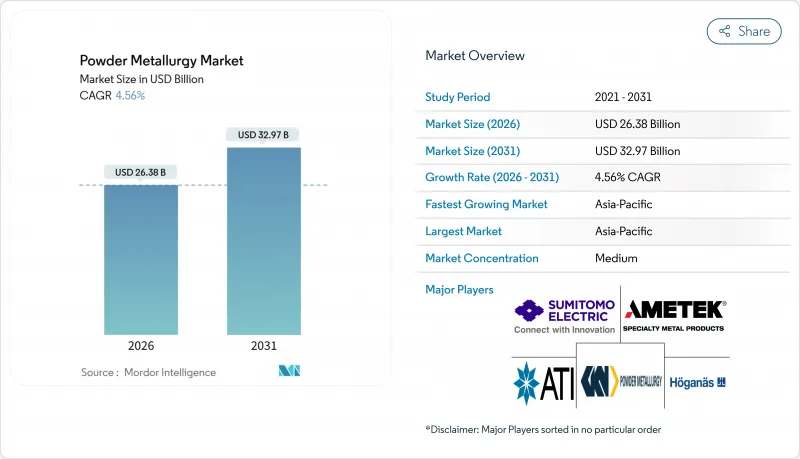
本報告按材料類型(鐵基和有色金屬)、製造程序(沖壓、燒結、金屬射出成型成型等)、應用領域(汽車、工業機械、電氣電子及其他應用)和地區(亞太地區、北美地區、歐洲地區、南美地區以及中東和非洲地區)進行細分。市場預測以美元計價。
全球粉末冶金市場趨勢與洞察
北美地區輕量化電動動力傳動系統零件中粉末冶金(PM)技術的應用日益廣泛
美國電動車 (EV) 的發展提升了粉末冶金技術的重要性。這是因為軟磁性複合材料在 10 kHz 頻率下可實現超過 500 的相對磁導率,從而在不損失扭矩的情況下,將馬達定子鐵芯的尺寸縮小 15-20%。 2024 年,通用汽車 (GM) 和福特汽車與國內燒結供應商簽署了多年期契約,每年採購總量達 12 萬噸,用於其 Ultium 和 BlueCruise 平台。這些合約優先考慮符合《通膨控制法案》國內採購要求的北美噴塗成型能力。為達到 20 萬公里的零件使用壽命目標,要求零件在 180°C 下的尺寸穩定性達到 ±0.02 毫米以內,而鋁壓鑄製程無法滿足此要求。
歐洲對近淨成形金屬積層製造零件的需求正在激增。
2025年,粉末床熔融技術實現量產,空中巴士公司在每架A320neo飛機上整合了14個鈦合金支架,使每架飛機的重量減輕了180公斤。材料採購效率從15%提高到95%,減少了加工廢料並縮短了週期時間。 2024年至2025年間,山特維克和吉凱恩等供應商投資4.55億美元,用於擴建氣體霧化生產線,以供應粒徑15至45微米的球形粉末。歐洲航空安全局(EASA)第21部分和北美防空認證計畫(NADCAP)的修訂將認證週期從48個月縮短至28個月,並加快了設計凍結進程。
由於重要礦物供應風險,高純度粉末的價格出現波動。
2024年1月至2025年12月期間,倫敦金屬交易所(LME)鎳價波動幅度高達33%,導致原物料成本上漲,而固定價格合約無法消化這些成本。印尼禁止礦石出口迫使霧化器製造商轉向價格更高的加拿大和澳洲鎳礦,導致鎳粉價格每噸上漲2100至2800美元。儘管目前仍有60%的鈷來自剛果民主共和國(DRC),但該國的管治挑戰使得主要航太產業製造商進行衝突礦產審計工作變得更加複雜。由於中國電力限制加劇了海綿鈦的短缺,導致新型粉末的認證延遲長達九個月。
細分市場分析
預計到2025年,鐵基材料將佔粉末冶金市場79.24%的佔有率,並將以4.66%的年均成長率持續成長至2031年,凸顯其在汽車傳動齒輪、同步器輪轂和軸承領域的市場主導地位。儘管電氣化導致引擎使用量整體下降,但鐵基材料相對較低的價格優勢(每公斤1.80美元至2.40美元,而鈦的價格為每公斤8.50美元至12美元)確保了主導地位。在該領域,軟磁複合材料正逐漸被應用,其在20 kHz頻率下可實現1.8特斯拉的磁通密度,這是傳統疊片材料在無渦流損耗的情況下無法達到的水平。例如,Hoganas等供應商於2024年推出了磷塗層“Somaloy 3P”,可將鐵芯損耗降低18%,並已在2027款歐洲電動汽車電機設計中得到應用。
至2025年,非鐵金屬粉末將佔粉末冶金市場佔有率的20.76%,屆時鈦、鋁和鎳基高溫合金粉末將在航太、醫療和儲能等領域實現量產。回收材料的使用有助於緩解原物料價格的波動。 Chimera公司的「RecycTi」粉末已於2024年獲得美國聯邦航空管理局(FAA)的批准,成本降低了30%,目前佔該公司鈦出貨量的12%。針對特定應用的合金化正在拓寬性能範圍;鐵基供應商透過添加矽和鋁來改善磁性能,而有色金屬供應商則透過混入回收金屬屑來規避大宗商品價格風險。這種轉變凸顯了策略上的差異:在大規模生產的鐵基領域,競爭主要由單件成本(以美分計)驅動;而在鈦和鎳等小批量生產的細分市場,競爭則主要由認證速度驅動。
區域分析
到2025年,亞太地區將佔全球銷售額的40.44%。這主要得益於中國140萬噸的年產能以及印度政策主導的醫療設備在地化生產。中國生產商中石油粉體有限公司經營八家水噴砂製造廠,並以比歐洲平均價格低20-25%的價格向國內OEM廠商供貨。日本透過住友電工和Resonaq的經銷網路向東南亞出口精密齒輪和軟磁複合材料。印度的優惠政策將促成2024年至2025年間新建六家MIM工廠,而泰國等東南亞國協已為燒結零件工廠吸引了8,700萬美元的外國直接投資(FDI)。
在北美,對製造業回流和電動車橋的投資正在加速。 GKN以14.4億美元收購了American Axle的工廠,在密西根州和北卡羅來納州新增了7.8萬噸的產能,並獲得了Ultium齒輪的訂單。 Phoenix Sintered Metals於2024年在田納西州投資4,200萬美元,建造了一條熱壓生產線,以滿足國內對連桿的需求。
在歐洲,隨著德國、英國和法國將積層製造技術優先應用於航太領域,市場正在不斷擴張。山特維克公司位於尼斯的工廠擴建使其鈦粉和鎳粉產量提高了40%,為空中巴士和羅爾斯·羅伊斯等公司的專案提供了支持。南美市場佔有率的成長主要得益於巴西的軟性燃料引擎,這些引擎目前仍依賴燒結齒輪。中東和非洲市場的成長則得益於沙烏地阿拉伯的國防相關合約以及南非礦業機械的維修。
其他好處:
- Excel格式的市場預測(ME)表
- 3個月的分析師支持
目錄
第1章:引言
- 研究假設和市場定義
- 調查範圍
第2章:調查方法
第3章執行摘要
第4章 市場狀況
- 市場概覽
- 市場促進因素
- 在北美,PM(聚合物)在輕量化電動動力傳動系統總成零件中的應用正在不斷擴大。
- 歐洲對近淨成形金屬積層製造零件的需求正在激增。
- 亞太地區精密醫療植入製造的在地化
- 中東國防領域的現代化正在推動耐火金屬粉末的需求。
- 碳邊境調節機制將重塑歐盟鐵粉貿易
- 市場限制因素
- 由於重要礦物供應風險,高純度粉末的價格出現波動。
- 航太零件認證標準的局限性
- 先進鑄造技術對複雜鋁零件構成競爭威脅
- 價值鏈分析
- 波特五力模型
第5章 市場規模與成長預測
- 材料類型
- 鐵基
- 非鐵金屬
- 透過製造技術
- 壓制和燒結
- 金屬射出成型(MIM)
- 積層製造/粉末層熔融
- 等靜壓模塑
- 透過使用
- 車
- 工業機械
- 電氣和電子設備
- 航太
- 其他用途
- 按地區
- 亞太地區
- 中國
- 日本
- 印度
- 韓國
- 東南亞國協
- 其他亞太國家
- 北美洲
- 美國
- 加拿大
- 墨西哥
- 歐洲
- 德國
- 英國
- 法國
- 義大利
- 西班牙
- 其他歐洲國家
- 南美洲
- 巴西
- 阿根廷
- 其他南美國家
- 中東和非洲
- 沙烏地阿拉伯
- 南非
- 埃及
- 其他中東和非洲國家
- 亞太地區
第6章 競爭情勢
- 市場集中度
- 策略趨勢
- 市佔率/排名分析
- 公司簡介
- AMETEK Inc.
- ATI
- CNPC Powder
- CRS Holdings, LLC
- Elementum
- Elmet Technologies
- ERASTEEL
- Fine Sinter Co., Ltd.
- GKN Powder Metallurgy
- Granges
- Hoganas AB
- Kymera International
- LIBERTY Steel Group
- Metalysis
- Miba AG
- Phoenix Sintered Metals, LLC
- Plansee Group
- POSCO
- Powder Alloy Corporation(PAC)
- Resonac Holdings Corporation
- Rio Tinto
- Runaya
- Sandvik AB
- Sumitomo Electric Industries, Ltd.
第7章 市場機會與未來展望
According to Mordor Intelligence, the powder metallurgy market size is estimated at USD 26.38 billion in 2026, and is expected to reach USD 32.97 billion by 2031, at a CAGR of 4.56% during the forecast period (2026-2031).
This report is Segmented by Material Type (Ferrous and Non-Ferrous), Manufacturing Technology (Press and Sinter, Metal Injection Molding, and More), Application (Automotive, Industrial Machinery, Electrical and Electronics, and Other Applications), and Geography (Asia-Pacific, North America, Europe, South America, and Middle East and Africa). The Market Forecasts are Provided in Terms of Value (USD).
Global Powder Metallurgy Market Trends and Insights
Increasing Preference for PM in Lightweight E-Powertrain Components In North America
Electric-vehicle programs in the United States elevated powder metallurgy because soft-magnetic composites achieve relative permeabilities above 500 at 10 kHz, allowing motor-stator cores to shrink 15-20% without torque loss. General Motors and Ford locked multi-year agreements totaling 120,000 tons annually with domestic sintering suppliers for Ultium and BlueCruise platforms in 2024. These contracts favor North American atomization capacity that complies with the Inflation Reduction Act content rules. Component life targets of 200,000 km require dimensional stability within +-0.02 mm at 180 °C, conditions that die-cast aluminum cannot meet.
Surge in Demand for Net-Shape Additive Metal Components Across Europe
Powder bed fusion reached serial production when Airbus integrated 14 titanium brackets per A320neo in 2025, trimming 180 kg from each airframe. Material-buy efficiency rose from 15% to 95%, saving machining scrap and cycle time. Suppliers such as Sandvik and GKN invested USD 455 million between 2024-25 to expand gas-atomization lines that deliver 15-45 µm spherical powders. EASA Part 21 and NADCAP changes cut certification loops from 48 to 28 months, accelerating design freezes.
Volatile High-Purity Powder Prices Amid Critical-Mineral Supply Risk
London Metal Exchange nickel prices swung 33% between January 2024 and December 2025, raising feedstock costs that fixed-price contracts cannot absorb. Indonesia's ore export ban compelled atomizers to pivot to higher-cost Canadian and Australian supply, adding USD 2,100-2,800 per ton to nickel powder. Cobalt remains 60% sourced from the DRC, where governance challenges complicate conflict-minerals audits for aerospace primes. Titanium sponge shortages amplified by Chinese power curbs delayed new powder qualifications by up to nine months.
Other drivers and restraints analyzed in the detailed report include:
- Localization of Precision Medical-Implant Manufacturing in Asia-Pacific
- Defense Modernization Boosting Refractory Metal Powders In Middle East
- Limited Aerospace Part Qualification Standards
For complete list of drivers and restraints, kindly check the Table Of Contents.
Segment Analysis
Ferrous accounted for 79.24% of powder metallurgy market share in 2025 and is forecast to compound at a 4.66% rate to 2031, underscoring the material's volume leverage in automotive drivetrain gears, synchronizer hubs, and bearings. Relative affordability-USD 1.80-2.40 per kg versus USD 8.50-12.00 for titanium-sustains ferrous leadership even as electrification trims total engine content. The segment is pivoting toward soft-magnetic composites that achieve 1.8 Tesla flux density at 20 kHz, a level conventional laminations cannot reach without eddy-current penalties. Suppliers such as Hoganas launched phosphorus-coated Somaloy 3P in 2024, cutting core losses 18% and earning three European EV-motor design wins for the 2027 model year.
Non-ferrous grades held 20.76% of powder metallurgy market share in 2025 as titanium, aluminum, and nickel-superalloy powders reach serial production in aerospace, medical, and energy storage programs. Recycled feedstocks soften raw-material volatility: Kymera's RecycTi powder, approved by the FAA in 2024, offers 30% cost savings and now represents 12% of the firm's titanium shipments. Application-specific alloying is widening the performance envelope, with ferrous suppliers adding silicon and aluminum for magnetics, while non-ferrous counterparts blend reclaimed chips to hedge commodity risk. The shift underscores a strategic divide: high-volume ferrous segments compete on cents per part, whereas low-volume titanium and nickel niches compete on certification speed.
Complete Report Scope:
- By Material Type
- Ferrous
- Non-Ferrous
- By Manufacturing Technology
- Press and Sinter
- Metal Injection Molding (MIM)
- Additive Manufacturing / Powder Bed Fusion
- Isostatic Pressing
- By Application
- Automotive
- Industrial Machinery
- Electrical and Electronics
- Aerospace
- Other Applications
- By Geography
- Asia-Pacific
- China
- Japan
- India
- South Korea
- ASEAN Countries
- Rest of Asia-Pacific
- North America
- United States
- Canada
- Mexico
- Europe
- Germany
- United Kingdom
- France
- Italy
- Spain
- Rest of Europe
- South America
- Brazil
- Argentina
- Rest of South America
- Middle East and Africa
- Saudi Arabia
- South Africa
- Egypt
- Rest of Middle East and Africa
- Asia-Pacific
Geography Analysis
Asia-Pacific contributed 40.44% of global revenue in 2025, anchored by China's 1.4 million-ton annual production capacity and India's policy-driven medical-device localization. Chinese producer CNPC Powder operates eight water-atomization plants supplying domestic OEMs at prices 20-25% below European averages. Japan is exporting precision gears and soft-magnetic composites across Southeast Asia through Sumitomo Electric and Resonac distribution networks. India's incentives triggered six new MIM plants between 2024-25, and ASEAN nations such as Thailand secured USD 87 million in FDI for sintered-component factories.
North America's reshoring and e-axle investments are accelerating. GKN's USD 1.44 billion buyout of American Axle's facilities added 78,000 tons of capacity across Michigan and North Carolina, locking in contracts for Ultium gears. Phoenix Sintered Metals deployed a USD 42 million warm-compaction line in Tennessee in 2024 to meet domestic connecting-rod demand.
Europe is advancing as Germany, the United Kingdom, and France prioritize additive manufacturing for aerospace. Sandvik's Neath expansion raised titanium and nickel-powder output by 40%, underpinning Airbus and Rolls-Royce programs. South America's share is driven by Brazil's flex-fuel engines that still rely on sintered gears. The Middle East and Africa's growth is supported by Saudi defense contracts and South African mining-equipment refurbishment.
- AMETEK Inc.
- ATI
- CNPC Powder
- CRS Holdings, LLC
- Elementum
- Elmet Technologies
- ERASTEEL
- Fine Sinter Co., Ltd.
- GKN Powder Metallurgy
- Granges
- Hoganas AB
- Kymera International
- LIBERTY Steel Group
- Metalysis
- Miba AG
- Phoenix Sintered Metals, LLC
- Plansee Group
- POSCO
- Powder Alloy Corporation (PAC)
- Resonac Holdings Corporation
- Rio Tinto
- Runaya
- Sandvik AB
- Sumitomo Electric Industries, Ltd.
Additional Benefits:
- The market estimate (ME) sheet in Excel format
- 3 months of analyst support
TABLE OF CONTENTS
1 Introduction
- 1.1 Study Assumptions and Market Definition
- 1.2 Scope of the Study
2 Research Methodology
3 Executive Summary
4 Market Landscape
- 4.1 Market Overview
- 4.2 Market Drivers
- 4.2.1 Increasing Preference for PM in Lightweight E-Powertrain Components in North America
- 4.2.2 Surge in Demand for Net-Shape Additive Metal Components Across Europe
- 4.2.3 Localization Of Precision Medical-Implant Manufacturing in Asia-Pacific
- 4.2.4 Defense Modernization Boosting Refractory Metal Powders in Middle East
- 4.2.5 Carbon-Border Adjustment Mechanism Reshaping EU Ferrous Powder Trade
- 4.3 Market Restraints
- 4.3.1 Volatile High-Purity Powder Prices Amid Critical-Mineral Supply Risk
- 4.3.2 Limited Aerospace Part Qualification Standards
- 4.3.3 Competitive Threat from Advanced Casting of Complex Al Components
- 4.4 Value Chain Analysis
- 4.5 Porter's Five Forces
- 4.5.1 Bargaining Power of Suppliers
- 4.5.2 Bargaining Power of Buyers
- 4.5.3 Threat of New Entrants
- 4.5.4 Threat of Substitute Products
- 4.5.5 Intensity of Competitive Rivalry
5 Market Size and Growth Forecasts (Value)
- 5.1 By Material Type
- 5.1.1 Ferrous
- 5.1.2 Non-Ferrous
- 5.2 By Manufacturing Technology
- 5.2.1 Press and Sinter
- 5.2.2 Metal Injection Molding (MIM)
- 5.2.3 Additive Manufacturing / Powder Bed Fusion
- 5.2.4 Isostatic Pressing
- 5.3 By Application
- 5.3.1 Automotive
- 5.3.2 Industrial Machinery
- 5.3.3 Electrical and Electronics
- 5.3.4 Aerospace
- 5.3.5 Other Applications
- 5.4 By Geography
- 5.4.1 Asia-Pacific
- 5.4.1.1 China
- 5.4.1.2 Japan
- 5.4.1.3 India
- 5.4.1.4 South Korea
- 5.4.1.5 ASEAN Countries
- 5.4.1.6 Rest of Asia-Pacific
- 5.4.2 North America
- 5.4.2.1 United States
- 5.4.2.2 Canada
- 5.4.2.3 Mexico
- 5.4.3 Europe
- 5.4.3.1 Germany
- 5.4.3.2 United Kingdom
- 5.4.3.3 France
- 5.4.3.4 Italy
- 5.4.3.5 Spain
- 5.4.3.6 Rest of Europe
- 5.4.4 South America
- 5.4.4.1 Brazil
- 5.4.4.2 Argentina
- 5.4.4.3 Rest of South America
- 5.4.5 Middle East and Africa
- 5.4.5.1 Saudi Arabia
- 5.4.5.2 South Africa
- 5.4.5.3 Egypt
- 5.4.5.4 Rest of Middle East and Africa
- 5.4.1 Asia-Pacific
6 Competitive Landscape
- 6.1 Market Concentration
- 6.2 Strategic Moves
- 6.3 Market Share / Ranking Analysis
- 6.4 Company Profiles (includes Global-level Overview, Market-level Overview, Core Segments, Financials as available, Strategic Information, Market Rank/Share, Products and Services, Recent Developments)
- 6.4.1 AMETEK Inc.
- 6.4.2 ATI
- 6.4.3 CNPC Powder
- 6.4.4 CRS Holdings, LLC
- 6.4.5 Elementum
- 6.4.6 Elmet Technologies
- 6.4.7 ERASTEEL
- 6.4.8 Fine Sinter Co., Ltd.
- 6.4.9 GKN Powder Metallurgy
- 6.4.10 Granges
- 6.4.11 Hoganas AB
- 6.4.12 Kymera International
- 6.4.13 LIBERTY Steel Group
- 6.4.14 Metalysis
- 6.4.15 Miba AG
- 6.4.16 Phoenix Sintered Metals, LLC
- 6.4.17 Plansee Group
- 6.4.18 POSCO
- 6.4.19 Powder Alloy Corporation (PAC)
- 6.4.20 Resonac Holdings Corporation
- 6.4.21 Rio Tinto
- 6.4.22 Runaya
- 6.4.23 Sandvik AB
- 6.4.24 Sumitomo Electric Industries, Ltd.
7 Market Opportunities and Future Outlook
- 7.1 White-Space and Unmet-Need Assessment

 2026-2030年全球粉末冶金市場
 粉末冶金和燒結市場預測至2034年:按產品形式、材料類型、工藝、最終用戶和地區分類的全球分析
 粉末冶金市場-2026-2032年全球市場預測
 金屬射出成型成型粉末市場:依粉末類型、應用、終端用戶產業及地區分類
 粉末冶金市場規模、佔有率、趨勢和預測:按類型、材料、製造程序、應用和地區分類,2026-2034年
 金屬射出成型(MIM):全球市場佔有率和排名、總收入和需求預測(2026-2032年)
 粉末冶金,粉末射出成型(PIM),層積造型(AM),及相關的全球市場(2025年)- 終端用戶,用途:分析與預測(2024年~2030年)燒結金屬零件市場:依技術、材料、粉末、終端用戶產業和應用分類-2026-2032年全球預測
 全球粉末冶金零件市場規模、佔有率、趨勢和成長分析報告(2026-2034年)日本粉末冶金市場規模、佔有率、趨勢和預測:按類型、材料、製造程序、應用和地區分類,2026-2034年