


 |
市場調查報告書
商品編碼
2114027
區塊鏈即服務:市場佔有率分析、產業趨勢與統計及成長預測(2026-2031)Blockchain-as-a-Service - Market Share Analysis, Industry Trends & Statistics, Growth Forecasts (2026 - 2031) |
||||||

※ 本網頁內容可能與最新版本有所差異。詳細情況請與我們聯繫。
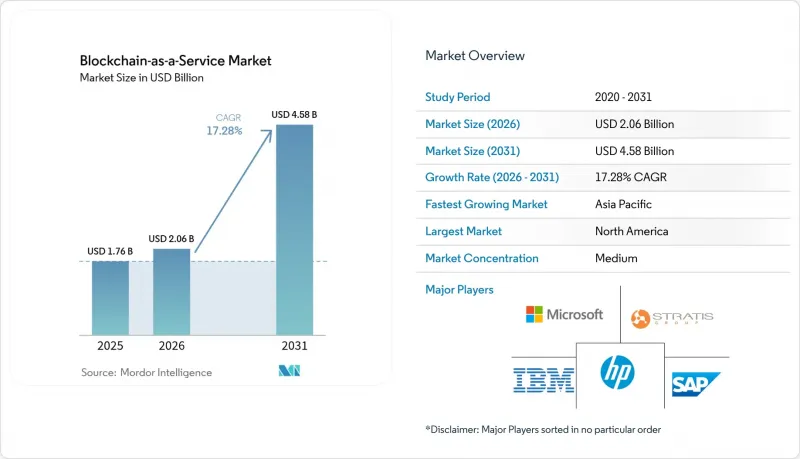
根據 Mordor Intelligence 預測,區塊鏈即服務 (BaaS) 市場規模將從 2025 年的 17.6 億美元成長到 2026 年的 20.6 億美元,然後在 2031 年達到 45.8 億美元,2026 年至 2031 年的複合成長率為 17.28%。
本報告按組件(平台即服務 (PaaS)、基礎設施即服務 (IaaS) 等)、部署模式(公共雲端、私有雲端等)、組織規模(大型企業和中小企業)、應用(智慧合約、支付和結算等)、最終用戶業(IT 和電信、製造業等)和地區進行分類。
全球區塊鏈即服務 (BaaS) 市場趨勢與洞察
受監管行業對防篡改資料完整性的需求日益成長。
醫療保健、金融和製藥業正日益採用區塊鏈技術來滿足嚴格的審計追蹤和溯源交易要求。 Change Healthcare 的 Hyperledger Fabric 部署方案每天已處理約 5,000 萬筆交易,同時維護防篡改日誌。歐洲關於追蹤藥品來源的法規也在推動類似的應用。金融機構透過將監管數據記錄在監管機構根據 MiCA 認定為可信的區塊鏈上,減輕了合規營運的負擔。這些行業監管要求,尤其是審計人員對不可篡改記錄而非傳統資料庫的偏好,正在鞏固區塊鏈即服務 (BaaS) 市場作為實現合規的一種手段的地位。因此,隨著已開發國家推出新的資料完整性政策,市場需求也不斷成長。
雲端超大規模資料中心業者正在將 BaaS 整合到更廣泛的「X 即服務」堆疊中。
微軟正在Azure上整合區塊鏈、人工智慧和物聯網,使用戶能夠透過熟悉的入口網站和現有合約啟動帳本。亞馬遜雲端服務和Google雲端也紛紛效仿,Kaleido與Azure的合作提供了500多個預先建置的API,可以無縫整合到企業工具中。這種捆綁式服務縮短了採購週期,尤其對缺乏高級加密能力的中型企業而言,並使其營運成本保持可變性而非資本密集。這種打包策略使所有管理雲端工作負載的客戶都能了解區塊鏈即服務市場,並且其採用被視為一個分階段的決策,而非一次變革性的轉變。
標準碎片化和協定互通性差距
儘管IEEE和ISO仍在不斷開發相關框架,但目前尚無通用的即插即用標準,這迫使企業自行建造跨鏈連接器(iso.org)。 《感測器》期刊的一項研究表明,此類架構會增加複雜性並帶來新的攻擊面。因此,跨國公司不願擴大跨境試點項目,減緩了區塊鏈即服務(BaaS)市場累積數量的成長。在主流互通性協定成熟之前,供應商必須將藍圖資源投入到專有橋接器的開發中,這會增加成本並延長部署時間。
細分市場分析
至2025年,平台即服務(PaaS)將佔總收入的37.30%。這主要得益於其整合的開發環境和柔軟性的配置,吸引了許多大型企業。另一方面,託管服務以19.25%的複合年成長率快速成長,因為企業需要承包營運、安全修補程式和全天候運作運行,而無需自行維運節點。大規模跨國公司的財務團隊正在實際節省成本。例如,西門子在遷移到用於跨境流動性管理的託管休閒後,銀行帳戶數量減少了一半,並實現了每年2000萬美元的成本節約。在金融和醫療保健行業,諮詢和實施工作對於與傳統ERP系統整合以及遵守特定產業法規仍然至關重要。
此外,即使企業希望採用雲端收費,同時需要對共識機制進行精細控制,他們仍會選擇基礎設施即服務 (IaaS)。同時,軟體即服務 (SaaS) 工具包提供的 API 可以抽象化智慧合約的編譯過程,從而降低小規模開發者的入門門檻。合規性相關的日益繁重的工作量使得不可篡改的審計追蹤成為必需,因此即使是風險規避型的董事會現在也開始批准訂閱。這種持續的需求正在支撐區塊鏈即服務 (BaaS) 市場的發展,無論是在待開發區還是棕地部署方面。
到 2025 年,由於超大規模資料中心業者提供高彈性和高服務等級協定 (SLA),公共雲端將佔據區塊鏈即服務 (BaaS) 市場 62.20% 的佔有率。儘管如此,混合雲端仍有望以 21.35% 的複合年成長率成長,因為金融機構和製藥公司為了滿足 MiCA 及類似政策下的資料居住要求,仍然選擇將敏感資料保留在本地。混合拓撲結構透過將生產環境置於防火牆之後,同時利用公共雲端作為開發沙箱,從而加速迭代開發。
在資料主權和高度敏感工作負載等因素的限制下,禁止使用外部基礎設施的場景下,私有雲端仍然被廣泛應用。歐盟新的業務永續營運法規進一步推動了緊急時應對計畫的製定,提升了混合雲編配的吸引力。因此,區塊鏈即服務(BaaS)市場架構的多樣性日益顯著。隨著企業為因應成本審計和新的合規性指南而在不同環境間遷移工作負載,對編排工具的需求也持續成長。
區域分析
2025年,北美繼續保持主導地位,佔據區塊鏈即服務(BaaS)市場40.40%的佔有率。這得歸功於大規模創業融資,其中包括高盛和Citadel主導的Digital Assets公司1.35億美元的資金籌措。美國超大規模超大規模資料中心業者正在將帳本管理工具整合到主流雲端服務中,從而幫助現有客戶快速部署。多個州實施的監管沙箱正在加速營運試點,但全國範圍內的政策不一致仍然造成合規的不確定性,減緩了跨州部署的進程。
亞太地區正經歷最快成長,預計到2031年年複合成長率(CAGR)將達到18.20%。新加坡和香港政府主導的央行數位貨幣(CBDC)和代幣化計畫正在取得實際成功,吸引銀行和金融科技公司進入商業平台。日本、韓國和中國的製造地正利用亞洲內部的貿易走廊,將區塊鏈技術應用於供應鏈和永續發展報告等領域。大學區塊鏈研究實驗室的建立,正在不斷壯大亞太地區的人才儲備,有助於彌補其他地區面臨的開發者短缺問題。
在歐洲,將於2024年12月全面生效的MiCA統一規則正在推動區塊鏈技術的發展。汽車、奢侈品和食品公司正在實施源頭交易解決方案以滿足監管和消費者的需求,雷諾的「XCEED」供應鏈系統就是一個典型的例子。歐洲中央銀行(ECB)推動數位資產市場整合,鼓勵銀行利用分散式帳本基礎設施後勤部門進行現代化改造,這將有助於維持短期合約的流通。在中東和非洲等新興市場,區塊鏈在普惠金融和碳權登記計畫的試點計畫正在進行中,但由於技術能力有限,其整體應用仍處於早期階段。
其他好處:
- Excel格式的市場預測(ME)表
- 3個月的分析師支持
目錄
第1章:引言
- 研究假設和市場定義
- 調查範圍
第2章:調查方法
第3章執行摘要
第4章 市場狀況
- 市場概覽
- 市場促進因素
- 在所有受監管的行業中,對防篡改資料完整性的需求日益成長。
- 雲端超大規模資料中心業者正在將 BaaS 整合到更廣泛的「X 即服務」堆疊中。
- 有關代幣化和穩定幣的監管規定正逐漸明朗。
- 利用 BaaS 後端技術的央行沙箱計劃
- 新冠疫情後企業區塊鏈試播部署激增
- 利用基於區塊鏈的永續發展帳本對範圍 3 排放進行審計(這項技術尚未受到太多關注)
- 市場限制因素
- 標準碎片化和協定互通性差距
- 分散式帳本工程領域人才短缺
- 關於智慧合約可執行性的判例法不確定性
- 對雲端支出的審查力度加大,導致概念驗證預算受到限制(儘管這一點並未被公開強調)。
- 價值鏈分析
- 監理情勢
- 技術展望
- 波特五力分析
第5章 市場規模與成長預測
- 按組件
- Platform-as-a-Service(PaaS)
- Infrastructure-as-a-Service(IaaS)
- 軟體即服務 (SaaS) SDK 和 API
- 諮詢及實施服務
- 託管/營運服務
- 按部署模式
- 公共雲端
- 私有雲端
- 混合雲端
- 按組織規模
- 大公司
- 小型企業
- 透過使用
- 智慧合約
- 供應鏈可追溯性
- 數位身分和KYC
- 付款和結算
- 管治、風險和合規
- 其他
- 按最終用戶行業分類
- 銀行、金融服務和保險(BFSI)
- 醫療保健和生命科學
- 資訊科技/通訊
- 零售與電子商務
- 製造業
- 能源公用事業
- 政府/公共部門
- 其他
- 按地區
- 北美洲
- 美國
- 加拿大
- 墨西哥
- 南美洲
- 巴西
- 阿根廷
- 智利
- 其他南美國家
- 歐洲
- 德國
- 英國
- 法國
- 義大利
- 西班牙
- 荷蘭
- 俄羅斯
- 其他歐洲國家
- 亞太地區
- 中國
- 印度
- 日本
- 韓國
- ASEAN
- 其他亞太國家
- 中東和非洲
- 中東
- 海灣合作理事會(沙烏地阿拉伯、阿拉伯聯合大公國、卡達等)
- 土耳其
- 其他中東國家
- 非洲
- 南非
- 奈及利亞
- 肯亞
- 其他非洲國家
- 中東
- 北美洲
第6章 競爭情勢
- 市場集中度
- 策略趨勢
- 市佔率分析
- 公司簡介
- IBM Corporation
- Microsoft Corporation
- Amazon Web Services(AWS)
- Oracle Corporation
- SAP SE
- Hewlett-Packard Enterprise
- Huawei Technologies Co. Ltd.
- Alibaba Cloud
- Tencent Cloud
- R3
- ConsenSys
- Blockstream Inc.
- Stratis Group Ltd.
- PayStand Inc.
- Kaleido
- Guardtime
- Dragonchain Inc.
- Bitfury Group
- LeewayHertz
- Wipro Limited
- Accenture plc
- Infosys Limited
- NTT DATA
- LG CNS
- Tech Mahindra
第7章 市場機會與未來展望
According to Mordor Intelligence, the blockchain-as-a-Service market size is expected to grow from USD 1.76 billion in 2025 to USD 2.06 billion in 2026 and is forecast to reach USD 4.58 billion by 2031 at 17.28% CAGR over 2026-2031.
This report is Segmented by Component (Platform-As-A-Service (PaaS), Infrastructure-As-A-Service (IaaS), and More), Deployment Model (Public Cloud, Private Cloud, and More), Organization Size (Large Enterprises and Small and Medium Enterprises), Application (Smart Contracts, Payments and Settlement, and More), End-User Vertical (IT and Telecom, Manufacturing, and More), and Geography.
Global Blockchain-as-a-Service Market Trends and Insights
Rising demand for tamper-proof data integrity across regulated industries
Health, finance, and pharmaceuticals increasingly adopt blockchain to meet stringent audit-trail and provenance mandates. Change Healthcare's Hyperledger Fabric deployment already processes about 50 million daily transactions while preserving immutable logs. European pharmaceutical rules that track medicine provenance drive similar uptake. Financial institutions cut compliance workloads by recording regulatory data on chains that regulators deem trustworthy under MiCA. These sector mandates position the Blockchain-as-a-Service market as a compliance enabler, particularly as auditors begin to prefer immutable records over traditional databases. Demand, therefore, scales with every new data-integrity policy in advanced economies.
Cloud hyperscalers bundling BaaS into broader X-as-a-Service stacks
Microsoft integrates blockchain, AI, and IoT on Azure, letting clients activate ledgers through familiar portals and existing contracts. Amazon Web Services and Google Cloud follow, while Kaleido's Azure tie-up offers more than 500 pre-built APIs that snap into enterprise tools. Bundling cuts procurement cycles, especially for mid-market firms without deep cryptography skills, and keeps operating costs variable instead of capital-intensive. This packaging strategy keeps the Blockchain-as-a-Service market visible to every customer managing cloud workloads, making adoption an incremental, rather than transformative, decision.
Fragmented standards and protocol interoperability gaps
IEEE and ISO continue to draft frameworks, yet no universal plug-and-play standard exists, forcing enterprises to custom-build cross-chain connectors iso.org. Sensors-journal research shows such architectures add complexity and new attack surfaces. Multinationals therefore hesitate to scale pilots across borders, which slows cumulative contract flow into the Blockchain-as-a-Service market. Until dominant interoperability protocols mature, vendors must allocate road-map resources to proprietary bridges that elevate costs and lengthen implementation timelines.
Other drivers and restraints analyzed in the detailed report include:
- Gradual regulatory clarity on tokenization and stablecoins
- Central-bank sandbox programs sourcing BaaS back-ends
- Talent shortage in distributed-ledger engineering
For complete list of drivers and restraints, kindly check the Table Of Contents.
Segment Analysis
Platform-as-a-Service contributed 37.30% revenue in 2025, underpinned by integrated development environments and configurability that attract large corporations. Managed Services, however, grows fastest at 19.25% CAGR as organizations seek turnkey operations, security patching and 24/7 uptime without running nodes themselves. Large multinational treasury teams cite tangible savings; Siemens cut bank accounts by half and saved USD 20 million each year after migrating to managed ledgers for cross-border liquidity. Consulting and implementation work remains essential to bridge legacy ERP systems and to meet sector-specific regulations in finance and healthcare.
Enterprises also adopt Infrastructure-as-a-Service when they need granular control over consensus settings yet still prefer cloud billing. Meanwhile, software-as-a-service toolkits expose APIs that abstract smart-contract compilation, lowering entry barriers for small developers. Rising compliance workloads make immutable audit trails a default requirement, so even risk-averse boards now approve subscriptions. This persistent demand anchors the Blockchain-as-a-Service market across both greenfield and brownfield deployments.
Public Cloud captured 62.20% of the Blockchain-as-a-Service market share in 2025 because hyperscalers provide elasticity and high service-level agreements. Still, Hybrid Cloud is on track for a 21.35% CAGR as financial institutions and pharmaceutical firms hold sensitive data on-premises to satisfy residency laws under MiCA and similar policies. Hybrid topologies keep production chains behind firewalls while using public cloud for development sandboxes, which speeds iteration.
Private Cloud persists where data sovereignty or classified workloads prohibit any external infrastructure. The European Union's new operational-resilience rules further motivate contingency planning, making hybrid designs attractive. As a result, the Blockchain-as-a-Service market sees consistent architectural diversity: enterprises swap workloads between environments in response to cost audits or new compliance directives, ensuring long-run demand for orchestration tools.
Complete Report Scope:
- By Component
- Platform-as-a-Service (PaaS)
- Infrastructure-as-a-Service (IaaS)
- Software-as-a-Service (SaaS) SDKs and APIs
- Consulting and Implementation Services
- Managed/Operations Services
- By Deployment Model
- Public Cloud
- Private Cloud
- Hybrid Cloud
- By Organization Size
- Large Enterprises
- Small and Medium Enterprises
- By Application
- Smart Contracts
- Supply-Chain Traceability
- Digital Identity and KYC
- Payments and Settlement
- Governance, Risk and Compliance
- Others
- By End-User Vertical
- Banking, Financial Services and Insurance (BFSI)
- Healthcare and Life Sciences
- IT and Telecom
- Retail and E-commerce
- Manufacturing
- Energy and Utilities
- Government and Public Sector
- Others
- By Geography
- North America
- United States
- Canada
- Mexico
- South America
- Brazil
- Argentina
- Chile
- Rest of South America
- Europe
- Germany
- United Kingdom
- France
- Italy
- Spain
- Netherlands
- Russia
- Rest of Europe
- Asia Pacific
- China
- India
- Japan
- South Korea
- ASEAN
- Rest of Asia Pacific
- Middle East and Africa
- Middle East
- GCC (Saudi Arabia, UAE, Qatar, etc.)
- Turkey
- Rest of Middle East
- Africa
- South Africa
- Nigeria
- Kenya
- Rest of Africa
- Middle East
- North America
Geography Analysis
North America continued to dominate in 2025 with a 40.40% Blockchain-as-a-Service market share, buoyed by deep venture funding such as Digital Asset's USD 135 million round led by Goldman Sachs and Citadel. US-based hyperscalers integrate ledger tools into mainstream cloud menus, allowing quick uptakes among existing clients. Regulatory sandboxes in several states accelerate production pilots, though nationwide policy fragmentation still injects compliance uncertainty that slows multi-state rollouts.
Asia Pacific records the steepest growth at an 18.20% CAGR through 2031. Government-backed CBDC and tokenization projects in Singapore and Hong Kong create visible proof points, drawing banks and fintechs onto commercial platforms. Manufacturing hubs across Japan, South Korea and China deploy blockchains for supply-chain and sustainability reporting use cases, leveraging intra-Asia trade corridors. Regional talent pools expand through university blockchain labs, helping offset developer shortages seen elsewhere.
Europe benefits from MiCA's uniform rules that became fully effective in December 2024. Automotive, luxury and food companies implement provenance solutions to satisfy regulators and consumers, exemplified by Renault's XCEED supply-chain systeM. The European Central Bank's advocacy for digital-assets market integration encourages banks to modernize back offices with distributed-ledger infrastructure, sustaining near-term contract flow. Emerging markets in the Middle East and Africa experiment with blockchain for financial inclusion and carbon credit registries, yet overall adoption remains nascent due to limited technical capacity.
- IBM Corporation
- Microsoft Corporation
- Amazon Web Services (AWS)
- Oracle Corporation
- SAP SE
- Hewlett-Packard Enterprise
- Huawei Technologies Co. Ltd.
- Alibaba Cloud
- Tencent Cloud
- R3
- ConsenSys
- Blockstream Inc.
- Stratis Group Ltd.
- PayStand Inc.
- Kaleido
- Guardtime
- Dragonchain Inc.
- Bitfury Group
- LeewayHertz
- Wipro Limited
- Accenture plc
- Infosys Limited
- NTT DATA
- LG CNS
- Tech Mahindra
Additional Benefits:
- The market estimate (ME) sheet in Excel format
- 3 months of analyst support
TABLE OF CONTENTS
1 INTRODUCTION
- 1.1 Study Assumptions and Market Definition
- 1.2 Scope of the Study
2 RESEARCH METHODOLOGY
3 EXECUTIVE SUMMARY
4 MARKET LANDSCAPE
- 4.1 Market Overview
- 4.2 Market Drivers
- 4.2.1 Rising demand for tamper-proof data integrity across regulated industries
- 4.2.2 Cloud hyperscalers bundling BaaS into broader X-as-a-Service stacks
- 4.2.3 Gradual regulatory clarity on tokenization and stablecoins
- 4.2.4 Central-bank sandbox programs sourcing BaaS back-ends
- 4.2.5 Explosion of enterprise-grade blockchain pilots post-COVID-19
- 4.2.6 Scope-3 emissions auditing via blockchain sustainability ledgers (under-radar)
- 4.3 Market Restraints
- 4.3.1 Fragmented standards and protocol interoperability gaps
- 4.3.2 Talent shortage in distributed-ledger engineering
- 4.3.3 Uncertain jurisprudence on smart-contract enforceability
- 4.3.4 Rising cloud spend scrutiny dampening POC budgets (under-radar)
- 4.4 Value Chain Analysis
- 4.5 Regulatory Landscape
- 4.6 Technological Outlook
- 4.7 Porter's Five Forces Analysis
- 4.7.1 Threat of New Entrants
- 4.7.2 Bargaining Power of Buyers
- 4.7.3 Bargaining Power of Suppliers
- 4.7.4 Threat of Substitutes
- 4.7.5 Intensity of Competitive Rivalry
5 MARKET SIZE AND GROWTH FORECASTS (VALUE)
- 5.1 By Component
- 5.1.1 Platform-as-a-Service (PaaS)
- 5.1.2 Infrastructure-as-a-Service (IaaS)
- 5.1.3 Software-as-a-Service (SaaS) SDKs and APIs
- 5.1.4 Consulting and Implementation Services
- 5.1.5 Managed/Operations Services
- 5.2 By Deployment Model
- 5.2.1 Public Cloud
- 5.2.2 Private Cloud
- 5.2.3 Hybrid Cloud
- 5.3 By Organization Size
- 5.3.1 Large Enterprises
- 5.3.2 Small and Medium Enterprises
- 5.4 By Application
- 5.4.1 Smart Contracts
- 5.4.2 Supply-Chain Traceability
- 5.4.3 Digital Identity and KYC
- 5.4.4 Payments and Settlement
- 5.4.5 Governance, Risk and Compliance
- 5.4.6 Others
- 5.5 By End-User Vertical
- 5.5.1 Banking, Financial Services and Insurance (BFSI)
- 5.5.2 Healthcare and Life Sciences
- 5.5.3 IT and Telecom
- 5.5.4 Retail and E-commerce
- 5.5.5 Manufacturing
- 5.5.6 Energy and Utilities
- 5.5.7 Government and Public Sector
- 5.5.8 Others
- 5.6 By Geography
- 5.6.1 North America
- 5.6.1.1 United States
- 5.6.1.2 Canada
- 5.6.1.3 Mexico
- 5.6.2 South America
- 5.6.2.1 Brazil
- 5.6.2.2 Argentina
- 5.6.2.3 Chile
- 5.6.2.4 Rest of South America
- 5.6.3 Europe
- 5.6.3.1 Germany
- 5.6.3.2 United Kingdom
- 5.6.3.3 France
- 5.6.3.4 Italy
- 5.6.3.5 Spain
- 5.6.3.6 Netherlands
- 5.6.3.7 Russia
- 5.6.3.8 Rest of Europe
- 5.6.4 Asia Pacific
- 5.6.4.1 China
- 5.6.4.2 India
- 5.6.4.3 Japan
- 5.6.4.4 South Korea
- 5.6.4.5 ASEAN
- 5.6.4.6 Rest of Asia Pacific
- 5.6.5 Middle East and Africa
- 5.6.5.1 Middle East
- 5.6.5.1.1 GCC (Saudi Arabia, UAE, Qatar, etc.)
- 5.6.5.1.2 Turkey
- 5.6.5.1.3 Rest of Middle East
- 5.6.5.2 Africa
- 5.6.5.2.1 South Africa
- 5.6.5.2.2 Nigeria
- 5.6.5.2.3 Kenya
- 5.6.5.2.4 Rest of Africa
- 5.6.5.1 Middle East
- 5.6.1 North America
6 COMPETITIVE LANDSCAPE
- 6.1 Market Concentration
- 6.2 Strategic Moves
- 6.3 Market Share Analysis
- 6.4 Company Profiles (includes Global level Overview, Market level overview, Core Segments, Financials as available, Strategic Information, Market Rank/Share for key companies, Products and Services, and Recent Developments)
- 6.4.1 IBM Corporation
- 6.4.2 Microsoft Corporation
- 6.4.3 Amazon Web Services (AWS)
- 6.4.4 Oracle Corporation
- 6.4.5 SAP SE
- 6.4.6 Hewlett-Packard Enterprise
- 6.4.7 Huawei Technologies Co. Ltd.
- 6.4.8 Alibaba Cloud
- 6.4.9 Tencent Cloud
- 6.4.10 R3
- 6.4.11 ConsenSys
- 6.4.12 Blockstream Inc.
- 6.4.13 Stratis Group Ltd.
- 6.4.14 PayStand Inc.
- 6.4.15 Kaleido
- 6.4.16 Guardtime
- 6.4.17 Dragonchain Inc.
- 6.4.18 Bitfury Group
- 6.4.19 LeewayHertz
- 6.4.20 Wipro Limited
- 6.4.21 Accenture plc
- 6.4.22 Infosys Limited
- 6.4.23 NTT DATA
- 6.4.24 LG CNS
- 6.4.25 Tech Mahindra
7 MARKET OPPORTUNITIES AND FUTURE OUTLOOK
- 7.1 White-space and Unmet-need Assessment

 區塊鏈即服務 (BaaS) 全球市場規模、佔有率、趨勢和成長分析報告(2026-2034 年)
 區塊鏈即服務 (BaaS) 市場:按組件、組織規模、部署模式、應用和最終用戶產業分類-2026-2032 年全球市場預測
 2026年全球區塊鏈服務市場報告2026年全球區塊鏈即服務市場報告
 2026-2030年全球區塊鏈即服務市場
 區塊鏈即服務市場-全球產業規模、佔有率、趨勢、機會及預測(按組件、最終用戶垂直產業、地區和競爭格局分類,2020-2030 年預測)
 2032 年區塊鏈即服務(BaaS) 市場預測:按組件、部署模型、應用、最終用戶和地區進行的全球分析
 區塊鏈即服務市場規模、佔有率及成長分析(按產品、組織規模、應用、垂直領域和地區)-2025 年至 2032 年產業預測