


 |
市場調查報告書
商品編碼
2114019
鑽井同步測量(MWD):市場佔有率分析、行業趨勢和統計數據、成長預測(2026-2031)Measurement While Drilling (MWD) - Market Share Analysis, Industry Trends & Statistics, Growth Forecasts (2026 - 2031) |
||||||

※ 本網頁內容可能與最新版本有所差異。詳細情況請與我們聯繫。
根據 Mordor Intelligence 預測,同步鑽井測量 (MWD) 市場規模將從 2025 年的 37.7 億美元成長到 2026 年的 40.7 億美元,然後在 2031 年達到 59.4 億美元,2026 年至 2031 年的複合年成長率為 7.88%。
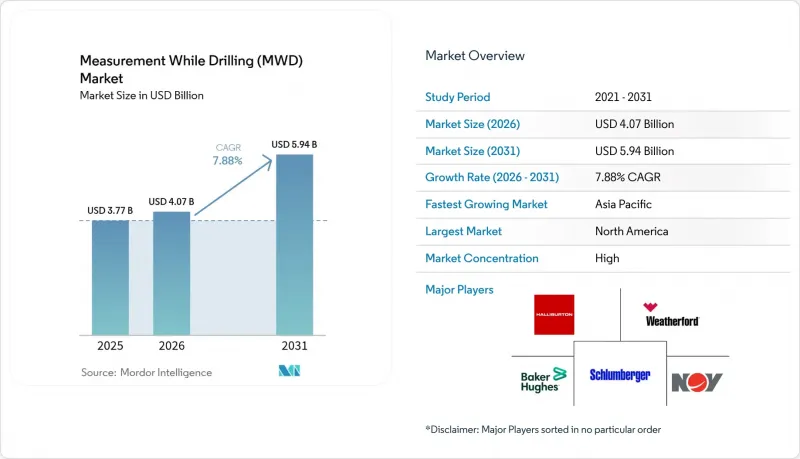
本報告按組件(泥漿脈衝隨鑽測量工具、電磁隨鑽測量工具、有線鑽桿系統、鑽內陀螺儀系統、RSS整合式隨鑽測量模組和水下遙測感測器)、安裝位置(陸上和海上)以及地區(北美、歐洲、亞太地區、南美以及中東和非洲)進行分類。
全球同步鑽井(MWD)市場趨勢與洞察
傳統型頁岩油氣鑽探的擴張
二疊紀盆地頁岩水平井的長度持續增加,預計到2026年,該盆地的年產量將增加30萬桶/日,達到690萬桶/日。這些超長水平井複雜的地質導向要求,推動了對高精度隨鑽測量(MWD)系統的需求,這些系統能夠維持井筒穩定性並最佳化著陸區。阿根廷的瓦卡穆爾塔(Vaca Muerta)計畫正在擴大類似的努力,利用即時壓力監測和地質測繪來高效開發緻密儲存。先進的MWD技術實現的連續定向控制,最大限度地減少了井眼彎曲度,降低了套管磨損,並在10000英尺(約3000米)的水平井全長範圍內保持了與儲存的接觸。營運商也正在部署與MWD感測器整合的旋轉導向系統,以減少滑移時間並提高平均鑽井速度,從而提高每英尺鑽井的經濟效益。透過策略性地專注於以較低的損益平衡價格最大化資源回收率,我們正在加強對整個非傳統資源組合中可靠的地下遙測技術的投資。
透過即時數據提高非生產時間效率和降低油井成本的需求日益成長
意外事件佔總鑽井時間的15%至20%,這加大了作業者透過持續的地下回饋來減少非生產時間的壓力。 BP公司對有線鑽桿的現場測試平均縮短了10%的鑽井時間,顯示亞秒級資料能夠改善鑽頭負載管理並降低鑽桿卡死的風險。即時方位伽馬射線和電阻率測量進一步提高了地質導向的精度,將最佳定位與更高的初始產量直接聯繫起來。雙向指令支援的同步鑽井測量(MWD)市場技術無需起鑽即可快速更改參數,從而避免了代價高昂的流體損失事故。增加儲存暴露最終提高了預計最終採收率(EUR),支持在價格波動環境下影響預算分配的資本紀律策略。因此,即使在成熟油田,數位化鑽井的投資也能帶來複利回報。
原油價格波動對探勘與生產預算的影響
歷史數據顯示,原油價格每下跌1美元,全球平均就有64座運作鑽機停工,凸顯了該產業對價格波動的敏感度。美國探勘與生產(E&P)公司已將2024年的資本支出削減至617億美元至654億美元,反映出其對可自由支配的鑽井預算採取謹慎態度。由於緻密油專案的損益平衡點約為每桶50美元,獲利能力低的專案在市場低迷時期會變得無利可圖,從而延緩了鑽井同步測量(MWD)系統的應用。此外,採收率的不對稱性進一步削弱了服務定價的決定性作用,迫使提供服務業者延長付款期限並管理備用工具庫存。此外,由於營運商優先考慮分階段升級而非全面部署有線鑽桿,金融市場的不確定性也延緩了大規模遙測升級,直到價格恢復穩定。
細分市場分析
MudPulse 方法憑藉其在標準壓力和溫度條件下鑽機現場的可靠性和廣泛應用,依然具有重要價值,預計到 2025 年將佔據隨鑽測量 (MWD) 市場 42.15% 的佔有率。然而,有線鑽桿測量方法正日益成為該領域的競爭焦點。隨著作業者將更高的頻寬與更快的決策週期連結起來,預計到 2031 年,該方法的複合年成長率將達到 9.73%。電磁隨鑽測量工具的市場規模在空氣鑽井和使用低電導率流體的鑽井作業中持續擴大,為 MudPulse 遙測靈敏度顯著降低的情況提供了替代方案。旋轉導向系統模組在鑽井過程中擴大整合陀螺儀感測器和地下振動感測器,將測量和驅動功能整合到單一平台中,以支援自主導航。
隨著即時分析能夠即時管理鑽柱健康狀況,對可測量動態壓力、衝擊和轉速的水下遙測感測器的需求日益成長。 SLB 的 NeoLink 展示了向整合硬體和雲端原生軟體的轉變,縮短了從鑽頭到鑽機控制系統的學習週期。同步鑽井測量 (MWD) 市場的未來成長取決於模組化工具設計,這種設計能夠在不增加鑽柱長度的情況下快速重新配置,從而滿足地熱、碳捕獲或遠距離井的需求。隨著鑽井作業向對熱工和機械要求更高的礦區轉移,投資於固態電子裝置、先進減振技術和可回收電池組的供應商將能夠提供更高的日租金。
區域分析
北美地區在二疊紀盆地頁岩油氣開發和墨西哥灣深海探勘持續活性化的推動下,預計到2025年將佔隨鑽測量(MWD)市場收入的38.12%。該地區成熟的供應鏈、豐富的鑽機基礎設施和數據驅動的營運文化正在推動自動化技術的快速普及,從而提高鑽井速度並最大限度地減少側鑽。加拿大油砂中的蒸氣輔助重力洩油(SAGD)井和新興的地熱開發項目正在推動對能夠應對蒸氣輔助環境的高溫MWD工具的需求。在墨西哥,Trion超深海油田的開發仍在繼續,已簽訂的多年合約規定提供人工智慧驅動的服務,以縮短井週期並提高安全性。監管機構(例如安全與環境執法局)對遠端即時監控的日益重視,進一步凸顯了海上油井對可靠的高頻寬遙測技術的迫切需求。
亞太地區正經歷最快成長,預計到2031年年複合成長率(CAGR)將達到8.56%。這主要歸功於各國石油公司擴大鑽井規模以滿足需求並加強能源安全。中國南海計畫採用鑽井過程中地震探勘(SWD)技術進行即時地質成像,從而能夠在高溫高壓(HPHT)區域實現精準的套管下放。印度的運作中鑽機數量預計將從2024年的111台增加到2028年的142台,這反映出國內產量目標的上調,並帶動了鑽井過程中同步測量(MWD)市場的強勁訂單。同樣,澳洲的近海天然氣田和地熱先導計畫也需要高溫感測器和自主導向技術來控制裂縫性花崗岩地層的井眼偏轉。東南亞(如印尼和馬來西亞)的營運商正致力於開發經濟高效的隨鑽測量 (MWD) 方案,以平衡成本績效地質評估和有限的鑽井預算,這凸顯了該地區對成本效益的敏感性。
歐洲市場主要受北海現有油田的再開發以及符合脫碳政策目標的地熱鑽探的推動。挪威正在推進鑽井自動化,將哈里伯頓公司的LOGIX軟體與Sekar AS公司的演算法結合,以實現大規模自主定向鑽井。隨著德國和荷蘭鼓勵開發用於區域供熱的深層地熱井,地熱領域的隨鑽測量(MWD)市場正在擴張,這需要能夠在高達200 度C的腐蝕性鹽水中運行的工具。在中東,受國營石油公司對傳統型儲存(例如沙烏地阿美公司的傑夫拉頁岩)的投資推動,市場持續穩定成長。在非洲,西非深水區的新發現正在加速發展;在南美洲,巴西鹽層下下層和阿根廷頁岩層的開發刺激了對能夠在狹窄孔隙水壓力範圍內運行的高規格MWD服務的需求。
其他好處:
- Excel格式的市場預測(ME)表
- 3個月的分析師支持
目錄
第1章:引言
- 研究假設和市場定義
- 調查範圍
第2章:調查方法
第3章執行摘要
第4章 市場狀況
- 市場概覽
- 市場促進因素
- 傳統型頁岩油氣鑽探的擴張
- 利用即時數據減少非生產時間 (NPT) 和降低油井成本的需求日益成長。
- 深海和超深海領域的資本投資復甦
- 使用有線鑽桿可以實現高頻寬遙測。
- 地熱鑽探助力能源轉型
- 市場限制因素
- 原油價格波動正在影響探勘與生產預算。
- 與高壓高溫井中隨鑽測量工具的可靠性相關的挑戰。
- 對資料所有權和網路安全的擔憂
- 熟練的隨鑽測量現場工程師短缺
- 供應鏈分析
- 監理情勢
- 技術展望
- 波特五力模型
- 主要上游項目
第5章 市場規模與成長預測
- 按組件
- 泥脈衝式隨鑽測量工具
- 電磁隨鑽測量工具
- 有線鑽管系統
- 鑽井過程中的陀螺儀系統
- RSS整合式隨鑽測量模組
- 地下遙測感測器
- 按部署位置
- 陸上
- 離岸
- 按地區
- 北美洲
- 美國
- 加拿大
- 墨西哥
- 歐洲
- 德國
- 英國
- 挪威
- 荷蘭
- 義大利
- 俄羅斯
- 其他歐洲國家
- 亞太地區
- 中國
- 印度
- 日本
- 韓國
- 東南亞國協
- 澳洲
- 其他亞太國家
- 南美洲
- 巴西
- 阿根廷
- 哥倫比亞
- 其他南美國家
- 中東和非洲
- 沙烏地阿拉伯
- 阿拉伯聯合大公國
- 卡達
- 奈及利亞
- 南非
- 埃及
- 其他中東和非洲國家
- 北美洲
第6章 競爭情勢
- 市場集中度
- 策略趨勢(併購、聯盟、購電協議)
- 市場佔有率分析(主要公司的市場排名和佔有率)
- 公司簡介
- Schlumberger(SLB)
- Halliburton Company
- Baker Hughes Co.
- Weatherford International
- Nabors Industries Ltd
- National Oilwell Varco(NOV)
- Scientific Drilling International
- Gyrodata Inc.
- China Oilfield Services Ltd(COSL)
- APS Technology Inc.
- Emerson(Roxar Downhole)
- Tenaris(iRun Casing)
- Erdos Miller
- M/D Totco(NOV)
- PetroServices GmbH
- Cougar Drilling Solutions
- Sinopec Oilfield Service Corp
- GyroVision AS
- Bench Tree Group
第7章 市場機會與未來展望
According to Mordor Intelligence, the measurement while drilling market size is expected to grow from USD 3.77 billion in 2025 to USD 4.07 billion in 2026 and is forecast to reach USD 5.94 billion by 2031 at 7.88% CAGR over 2026-2031.
This report is Segmented by Component (Mud-Pulse MWD Tools, Electromagnetic MWD Tools, Wired Drill-Pipe Systems, Gyro-While-Drilling Systems, RSS-Integrated MWD Modules, and Downhole Telemetry Sensors), Location of Deployment (Onshore and Offshore), and Geography (North America, Europe, Asia-Pacific, South America, and Middle East and Africa).
Global Measurement While Drilling (MWD) Market Trends and Insights
Growth in Unconventional Shale Drilling
Horizontal shale wells in the Permian Basin continue to increase in length, with annual basin output expected to rise by 300,000 barrels per day, reaching 6.9 million barrels per day by 2026. Complex geosteering requirements in these extended laterals elevate demand for high-precision MWD systems that maintain borehole stability and optimize landing zones. Argentina's Vaca Muerta program is scaling similar practices, using real-time pressure monitoring and formation mapping to unlock tight reservoirs efficiently. Continuous directional control enabled by advanced measurement while drilling market technology minimizes dogleg severity, lowers casing wear, and sustains reservoir contact across 10,000-foot laterals. Operators also deploy rotary steerable systems integrated with MWD sensors to decrease slide time and increase the average rate of penetration, thereby amplifying the economic benefit of each incremental foot drilled. Strategic focus on maximizing resource recovery at low break-even prices reinforces investment in robust downhole telemetry across unconventional portfolios.
Rising Need to Reduce NPT & Well-Costs via Real-Time Data
Unplanned events account for 15-20% of total drilling time, intensifying operator pressure to curtail non-productive time through continuous downhole feedback. Wired drill-pipe field trials by BP achieved average drilling time savings of 10%, proving that sub-second data improves weight-on-bit management and mitigates stuck-pipe risk. Real-time azimuthal gamma and resistivity measurements further sharpen geosteering accuracy, directly linking better placement to higher initial production rates. Measurement while drilling market technology capable of bidirectional command enables prompt parameter changes without tripping tools, eliminating costly lost circulation incidents. Enhanced reservoir exposure ultimately lifts estimated ultimate recovery, supporting capital-discipline strategies that dominate budget allocations in a volatile pricing world. The result is a compounding return on digital drilling investments even in mature fields.
Oil-Price Volatility Impacting E&P Budgets
Historical data show that every USD 1 decline in crude price is associated with an average disengagement of 64 drilling rigs worldwide, underscoring the sector's sensitivity to price swings. US exploration and production companies trimmed 2024 capital spending to USD 61.7-65.4 billion, echoing a cautious stance toward discretionary drilling budgets. Tight-oil projects require breakeven levels near USD 50 per barrel, so marginal campaigns become uneconomic during downturns, delaying measurement while drilling market deployments. The asymmetric recovery pattern further depresses service pricing power, compelling providers to stretch payment terms and manage spare tool inventory. Financial uncertainty also slows large-scale telemetry upgrades as operators favor incremental enhancements over full wired drill-pipe conversions until price stability returns.
Other drivers and restraints analyzed in the detailed report include:
- Deep- & Ultra-Deep-Water CAPEX Rebound
- Wired Drill-Pipe Adoption Enabling High-Bandwidth Telemetry
- Reliability Challenges of MWD Tools in HPHT Wells
For complete list of drivers and restraints, kindly check the Table Of Contents.
Segment Analysis
Mud-Pulse systems dominated 2025 revenue with a 42.15% of measurement-while-drilling market share, as their reliability and rig-floor familiarity remain valuable in standard pressure and temperature conditions. However, the segment confronts mounting competition from Wired Drill-Pipe systems, projected to grow at a 9.73% CAGR through 2031, as operators equate higher bandwidth with faster decision-making cycles. The measurement while drilling market size tied to Electromagnetic MWD tools continues to rise in air-drilling and low-conductivity fluid operations, providing an alternate option where mud-pulse telemetry attenuates severely. Rotary steerable system modules are increasingly equipped with gyro-while-drilling and downhole vibration sensors, blending measurement and actuation within a single platform that supports autonomous navigation.
Demand for downhole telemetry sensors that capture dynamic pressure, shock, and rotational speed increases as real-time analytics enable immediate drill-string health management. SLB's NeoLink demonstrates the migration toward integrated hardware and cloud-native software that shortens learning loops from the bit to the rig control system. Future growth in the measurement while drilling market hinges on modular tool designs that allow for rapid reconfiguration for geothermal, carbon capture, or extended-reach wells without inflating the string length. Providers investing in solid-state electronics, advanced vibration damping, and retrievable battery packs are likely to command premium day rates once drilling activity shifts toward more thermally and mechanically demanding plays.
Complete Report Scope:
- By Component
- Mud-Pulse MWD Tools
- Electromagnetic MWD Tools
- Wired Drill-Pipe Systems
- Gyro-While-Drilling Systems
- RSS-Integrated MWD Modules
- Downhole Telemetry Sensors
- By Location of Deployment
- Onshore
- Offshore
- By Geography
- North America
- United States
- Canada
- Mexico
- Europe
- Germany
- United Kingdom
- Norway
- Netherlands
- Italy
- Russia
- Rest of Europe
- Asia-Pacific
- China
- India
- Japan
- South Korea
- ASEAN Countries
- Australia
- Rest of Asia-Pacific
- South America
- Brazil
- Argentina
- Colombia
- Rest of South America
- Middle East and Africa
- Saudi Arabia
- United Arab Emirates
- Qatar
- Nigeria
- South Africa
- Egypt
- Rest of Middle East and Africa
- North America
Geography Analysis
North America retained 38.12% of 2025 revenue in the measurement while drilling market, supported by sustained shale activity in the Permian Basin and deep-water exploration in the Gulf of Mexico. The region's mature supply chain, abundant rig fleet, and data-driven operating culture drive the rapid adoption of automation, increasing the rate of penetration and minimizing sidetrack drilling. Canada's oil-sands SAGD wells and emerging geothermal initiatives are driving demand for high-temperature MWD tools that can handle steam-assisted environments. Mexico continues to advance the Trion ultra-deepwater development, awarding multi-year contracts that specify AI-enabled service delivery to reduce well cycle time and enhance safety. The regulatory emphasis on remote real-time monitoring by agencies such as the Bureau of Safety and Environmental Enforcement further underscores the need for reliable, high-bandwidth telemetry in offshore wells.
The Asia-Pacific region is the fastest-growing, with an 8.56% CAGR expected through 2031, as national oil companies ramp up drilling to meet demand and improve energy security. China's South China Sea projects deploy seismic-while-drilling for real-time formation imaging, enabling precise casing points in HPHT zones. India's active rig count is projected to rise from 111 in 2024 to 142 by 2028, reflecting higher domestic production goals that translate into robust measurement while drilling market orders. Australia's offshore gas fields and geothermal pilots similarly require high-temperature sensors and autonomous steering to control wellbore deviation in fractured granites. Southeast Asian operators in Indonesia and Malaysia focus on cost-effective MWD packages that balance real-time formation evaluation with lean rig budgets, highlighting the region's price-performance sensitivity.
Europe's market revolves around North Sea brownfield redevelopment and geothermal drilling aligned with decarbonization policy targets. Norway champions drilling automation, pairing Halliburton LOGIX software with Sekal AS algorithms to deliver autonomous directional drilling at scale. The measurement while drilling (MWD) market size in geothermal applications is expanding as Germany and the Netherlands incentivize the development of deep geothermal wells for district heating, necessitating tools that operate in corrosive brines at temperatures of up to 200 °C. The Middle East continues to experience steady growth, spurred by national oil company investments in unconventional reservoirs, such as Saudi Aramco's Jafurah shale. Africa sees momentum in West Africa's deep-water discoveries, while South America leverages Brazil's pre-salt and Argentina's shale developments to stimulate demand for high-spec MWD services capable of navigating tight pore-pressure margins.
- Schlumberger (SLB)
- Halliburton Company
- Baker Hughes Co.
- Weatherford International
- Nabors Industries Ltd
- National Oilwell Varco (NOV)
- Scientific Drilling International
- Gyrodata Inc.
- China Oilfield Services Ltd (COSL)
- APS Technology Inc.
- Emerson (Roxar Downhole)
- Tenaris (iRun Casing)
- Erdos Miller
- M/D Totco (NOV)
- PetroServices GmbH
- Cougar Drilling Solutions
- Sinopec Oilfield Service Corp
- GyroVision AS
- Bench Tree Group
Additional Benefits:
- The market estimate (ME) sheet in Excel format
- 3 months of analyst support
TABLE OF CONTENTS
1 Introduction
- 1.1 Study Assumptions & Market Definition
- 1.2 Scope of the Study
2 Research Methodology
3 Executive Summary
4 Market Landscape
- 4.1 Market Overview
- 4.2 Market Drivers
- 4.2.1 Growth in unconventional shale drilling
- 4.2.2 Rising need to reduce NPT & well-costs via real-time data
- 4.2.3 Deep- & ultra-deep-water CAPEX rebound
- 4.2.4 Wired drill-pipe adoption enabling high-bandwidth telemetry
- 4.2.5 Geothermal drilling for energy transition
- 4.3 Market Restraints
- 4.3.1 Oil-price volatility impacting E&P budgets
- 4.3.2 Reliability challenges of MWD tools in HPHT wells
- 4.3.3 Data-ownership & cyber-security concerns
- 4.3.4 Shortage of skilled MWD field engineers
- 4.4 Supply-Chain Analysis
- 4.5 Regulatory Landscape
- 4.6 Technological Outlook
- 4.7 Porter's Five Forces
- 4.7.1 Bargaining Power of Suppliers
- 4.7.2 Bargaining Power of Consumers
- 4.7.3 Threat of New Entrants
- 4.7.4 Threat of Substitutes
- 4.7.5 Intensity of Competitive Rivalry
- 4.8 Key Upstream Projects
5 Market Size & Growth Forecasts
- 5.1 By Component
- 5.1.1 Mud-Pulse MWD Tools
- 5.1.2 Electromagnetic MWD Tools
- 5.1.3 Wired Drill-Pipe Systems
- 5.1.4 Gyro-While-Drilling Systems
- 5.1.5 RSS-Integrated MWD Modules
- 5.1.6 Downhole Telemetry Sensors
- 5.2 By Location of Deployment
- 5.2.1 Onshore
- 5.2.2 Offshore
- 5.3 By Geography
- 5.3.1 North America
- 5.3.1.1 United States
- 5.3.1.2 Canada
- 5.3.1.3 Mexico
- 5.3.2 Europe
- 5.3.2.1 Germany
- 5.3.2.2 United Kingdom
- 5.3.2.3 Norway
- 5.3.2.4 Netherlands
- 5.3.2.5 Italy
- 5.3.2.6 Russia
- 5.3.2.7 Rest of Europe
- 5.3.3 Asia-Pacific
- 5.3.3.1 China
- 5.3.3.2 India
- 5.3.3.3 Japan
- 5.3.3.4 South Korea
- 5.3.3.5 ASEAN Countries
- 5.3.3.6 Australia
- 5.3.3.7 Rest of Asia-Pacific
- 5.3.4 South America
- 5.3.4.1 Brazil
- 5.3.4.2 Argentina
- 5.3.4.3 Colombia
- 5.3.4.4 Rest of South America
- 5.3.5 Middle East and Africa
- 5.3.5.1 Saudi Arabia
- 5.3.5.2 United Arab Emirates
- 5.3.5.3 Qatar
- 5.3.5.4 Nigeria
- 5.3.5.5 South Africa
- 5.3.5.6 Egypt
- 5.3.5.7 Rest of Middle East and Africa
- 5.3.1 North America
6 Competitive Landscape
- 6.1 Market Concentration
- 6.2 Strategic Moves (M&A, Partnerships, PPAs)
- 6.3 Market Share Analysis (Market Rank/Share for key companies)
- 6.4 Company Profiles (includes Global level Overview, Market level overview, Core Segments, Financials as available, Strategic Information, Products & Services, and Recent Developments)
- 6.4.1 Schlumberger (SLB)
- 6.4.2 Halliburton Company
- 6.4.3 Baker Hughes Co.
- 6.4.4 Weatherford International
- 6.4.5 Nabors Industries Ltd
- 6.4.6 National Oilwell Varco (NOV)
- 6.4.7 Scientific Drilling International
- 6.4.8 Gyrodata Inc.
- 6.4.9 China Oilfield Services Ltd (COSL)
- 6.4.10 APS Technology Inc.
- 6.4.11 Emerson (Roxar Downhole)
- 6.4.12 Tenaris (iRun Casing)
- 6.4.13 Erdos Miller
- 6.4.14 M/D Totco (NOV)
- 6.4.15 PetroServices GmbH
- 6.4.16 Cougar Drilling Solutions
- 6.4.17 Sinopec Oilfield Service Corp
- 6.4.18 GyroVision AS
- 6.4.19 Bench Tree Group
7 Market Opportunities & Future Outlook
- 7.1 White-space & Unmet-Need Assessment


