


 |
市場調查報告書
商品編碼
2114018
電動機:市場佔有率分析、產業趨勢與統計、成長預測(2026-2031)Electric Motor - Market Share Analysis, Industry Trends & Statistics, Growth Forecasts (2026 - 2031) |
||||||

※ 本網頁內容可能與最新版本有所差異。詳細情況請與我們聯繫。
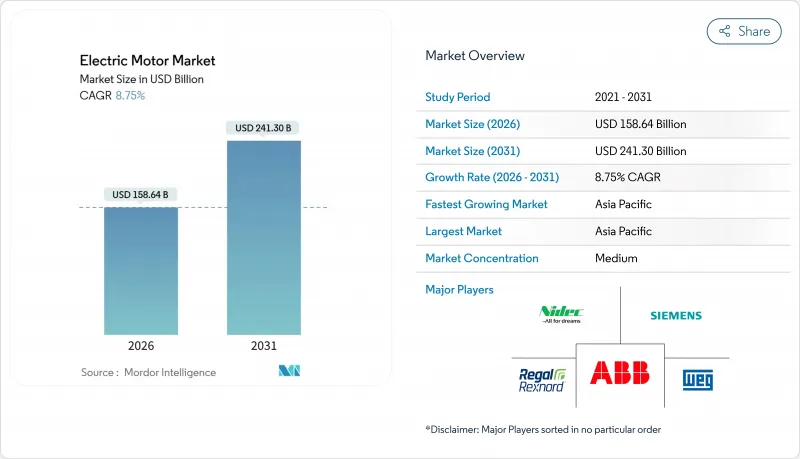
根據 Mordor Intelligence 估計,2026 年電動馬達市值為 1,586.4 億美元,預計到 2031 年將達到 2,413 億美元,在預測期(2026-2031 年)內複合年成長率為 8.75%。
本報告按馬達(DC馬達、AC馬達、其他)、額定功率(分數馬力等)、電壓(低壓、中壓、高壓)、應用(工業機械、暖通空調和製冷、其他)、最終用途行業(住宅、商業、工業)和地區(北美、歐洲、亞太、南美、中東和非洲)進行分類。
全球馬達市場趨勢與洞察
亞洲離散產業製造自動化快速電氣化
在中國、日本、韓國和東協地區密集的機器人組裝線上,新型機器人單元整合了4到7個伺服軸。根據國際機器人聯合會(IFR)預測,到2024年,全球機器人部署量將達到54.2萬台,其中超過70%將部署在亞太地區。每個關節都需要一個緊湊型高精度電機,這推高了每個機器人電機的平均成本,並增加了對內置反饋的無刷直流馬達和永磁同步馬達的需求。印度的電子產品生產獎勵計畫(PLI)已撥款15億美元補貼,以促進本地馬達在地採購,從而享有關稅減免。原始設備製造商(OEM)現在將耐負載循環繞組和耐熱絕緣作為一項要求,採購標準也從單價轉向了全生命週期吞吐量。
美國聯邦能源標準正在推動住宅維修中暖通空調系統的普及。
美國能源局最終確定的2024年SEER2法規修訂版實際上強制要求在風扇組件中使用電子整流馬達(ECM),導致數百萬住宅的更換需求激增。與永久分壓電容馬達相比,變速ECM可降低高達30%的能耗,加州和德克薩斯州的電力公司正透過需量反應獎勵將此優勢轉化為收益。電機供應商正在銷售捆綁診斷功能和雲端保固服務的電機,將其定位為不僅是一次性零件銷售,更是業務收益的切入點。安裝人員最初對40-60%的溢價持懷疑態度,但隨著聯邦稅額扣抵將投資回收期縮短至僅兩個供暖季,他們的態度也發生了轉變。
釹的價格波動給永磁馬達的獲利能力帶來了壓力。
2024年,中國供應配額的調整導致氧化釹價格飆升15%,給與汽車業簽訂固定價格合約的製造商帶來了壓力。由於磁鐵佔牽引馬達零件成本的30%之多,價格波動進一步擠壓了本已微薄的利潤空間。庫存增加佔用營運資金並造成價值貶值風險,一些供應商開始探索替代方案,例如感應馬達和開關式磁阻電動機,這些電機可以避免對稀土元素的依賴,但效率會略低一些。
細分市場分析
預計到2025年,交流馬達將佔馬達總銷量的74%,年成長率達9.45%,這主要得益於其在泵浦、壓縮機和暖通空調鼓風機等領域的成熟應用。雖然感應馬達在定速應用中佔據主導地位,但同步馬達在變頻驅動(VFD)能夠提高精度和能源效率的領域正逐漸獲得市場佔有率。歐洲對IE4和IE5級馬達的採用正在加速同步馬達的普及,尤其是在0.75千瓦及以上功率等級的馬達中。直流馬達在汽車、電動工具和小家電領域佔據了穩固的地位,其高扭矩密度和電池相容性彌補了其較高的初始成本。目前,幾乎所有高階吸塵器都配備了無刷直流馬達,每次充電後的運作時間最多可延長40%。
新興的混合型馬達結合了感應馬達的穩健性和永磁轉子的優勢,在實現IE4級能效的同時,也能直接啟動。這項特性在逆變器基礎設施尚未普及的新興市場尤其重要。諸如全封閉式電機、步進電機和軸流電機等特殊類型的電機,儘管規模較小,但仍佔據著盈利的細分市場,主要與製冷、3D列印和移動出行領域的初創企業相關。隨著性能範圍的重疊,採購決策越來越依賴噪音特性、熱裕度或每公斤扭力等應用特定指標,而非馬達分類。
到2025年,功率低於1馬力的馬達將佔出貨量的51.4%,這反映出它們在冷藏庫、洗衣機和支付終端等設備的廣泛應用。價格彈性在該細分市場佔據主導地位;僅僅3美元的成本差異就可能導致供應商的更換,但能源之星基準值要求逐年提高能源效率。功率在1至500馬力之間的整合功率(IP)馬達用於輸送機、壓縮機和工具機,這些設備的停機成本遠高於設備本身的價格。隨著工廠升級到IE4型號,節能高達5%,這種中型馬達的市場規模持續擴大。
儘管500馬力以上的高功率機組產量較小,但預計到2031年將以每年7.8%的速度成長,這主要得益於採礦和石化行業老舊設備的更新換代。業者正在權衡新生產的IE4型機組(以目前電價計算,預計投資回收期為3-4年)與只能恢復原IE1或IE2型機組效率的重繞服務之間的利弊。一些原始設備製造商(OEM)現在提供模組化的定子和轉子組件,可以現場升級現有機組,為完全更換和維修之間提供了折衷方案。
區域分析
預計到2025年,亞太地區將維持43.8%的電動馬達市場佔有率,並在2031年之前以10.7%的複合年成長率成長。中國汽車製造商預計到2025年11月將交付1,478萬輛新能源汽車,隨著轎車轉向雙馬達佈局,牽引馬達的需求將翻倍。 2024年,該地區部署的機器人數量將超過全球整體的70%。每個單元最多需要7個精密馬達。印度的生產連結獎勵計畫計畫(PLI)正在推動15億美元的資金流入電子和馬達生產領域。同時,越南和泰國正在吸引家電組裝線,以實現在地化採購並縮短前置作業時間。
北美地區的這股發展動能主要得益於美國能源局(DOE) 的 SEER2 標準,該標準強制要求冷暖氣空調空調 (HVAC) 系統維修,並在工業領域推廣預測性維護。 2024 年的一項調查顯示,38% 的更換是由感測器警報觸發,而非基於時間的計劃,這表明資產管理領域正在建立一種數據驅動的模式。在加拿大,採礦業正在升級到符合 IE4 標準的高功率電機,以降低偏遠地區每千瓦時超過 0.12 美元的電力成本。在墨西哥,汽車和家電製造業近岸外包的興起正在收緊區域供應鏈,並加速新生產設施中採用中電壓馬達。
歐洲的能源格局受政策主導。生態設計法規目前強制要求符合IE4標準,預計IE5標準將於2027年推出。 2024年新增的16.4吉瓦離岸風力發電將推動對兆瓦級發電機的需求。同時,德國的製程工業正在採用變頻驅動器,降低20%至40%的能耗。英國熱泵的日益普及以及北歐國家對水力發電的依賴,都促進了對即使在負載波動下也能高效運作的馬達的需求。東歐的工廠正受益於歐盟團結基金的設備現代化津貼,加速了高效率標準的普及。
南美洲的市場情勢受大宗商品主導。在巴西,農產品需要能夠承受高溫和粉塵的灌溉和糧食加工馬達;而在阿根廷,鋰礦企業正在安裝符合IE4標準的高功率破碎機,以滿足投資者對永續性的要求。在中東,石油和天然氣公司要求使用具備ATEX和IECEx認證的防爆設備,雖然這增加了認證的難度,延長了交貨週期,但也確保了產品能夠以溢價銷售。海灣國家正在投資區域供冷系統和海水淡化系統,這推動了中壓泵的採購。
其他好處:
- Excel格式的市場預測(ME)表
- 3個月的分析師支持
目錄
第1章:引言
- 研究假設和市場定義
- 調查範圍
第2章:調查方法
第3章執行摘要
第4章 市場狀況
- 市場概覽
- 近期趨勢與發展
- 市場促進因素
- 亞洲離散產業製造自動化快速電氣化
- 受聯邦能源標準的推動,美國住宅維修中暖通空調系統的採用正在加速。
- 歐洲離岸風力發電發電廠裝置裝置的快速成長,推高了對高功率永磁馬達的需求。
- 中國電池式電動車(BEV)動力傳動系統生產的擴張正在推動對高效牽引馬達的需求。
- 利用工業IoT進行預測性維護正在推動北美老舊馬達的更換。
- 政府關於最低排放標準 (MEPS) 的法規正在推動 IE4 和 IE5 馬達的全球銷售成長。
- 市場限制因素
- 釹的價格波動給永磁馬達的獲利能力帶來了壓力。
- IGBT模組的供應限制限制了高壓馬達的生產。
- 中東石油和天然氣產業防爆馬達認證週期長
- 整合伺服驅動器的日益普及正在減少獨立馬達的商機。
- 供應鏈分析
- 監理展望
- 技術展望
- 波特五力模型
第5章 市場規模與成長預測
- 依馬達類型
- AC馬達(感應式(非同步)、同步式)
- DC馬達(有刷、無刷(BLDC))
- 其他(密封馬達、步進馬達)
- 按類型分類的額定輸出
- 分數馬力(小於 1 馬力)
- 整數馬力(1-500 馬力)
- 高功率(500馬力或以上)
- 透過電壓
- 低電壓(低於1千伏特)
- 中壓(1-6千伏特)
- 高壓(6千伏特或更高)
- 透過使用
- 工業機械
- 暖通空調和製冷
- 汽車和運輸業
- 住宅
- 公共產業和能源
- 其他(農業、石油天然氣、採礦)
- 按最終用途行業分類
- 住宅
- 商業
- 產業
- 按地區
- 北美洲
- 美國
- 加拿大
- 墨西哥
- 歐洲
- 英國
- 德國
- 法國
- 西班牙
- 北歐國家
- 俄羅斯
- 其他歐洲國家
- 亞太地區
- 中國
- 印度
- 日本
- 韓國
- 馬來西亞
- 泰國
- 印尼
- 越南
- 澳洲
- 其他亞太國家
- 南美洲
- 巴西
- 阿根廷
- 哥倫比亞
- 其他南美國家
- 中東和非洲
- 阿拉伯聯合大公國
- 沙烏地阿拉伯
- 南非
- 埃及
- 其他中東和非洲國家
- 北美洲
第6章 競爭情勢
- 市場集中度
- 策略趨勢(併購、聯盟、購電協議)
- 市場佔有率分析(主要公司的市場排名和佔有率)
- 公司簡介
- ABB Ltd.
- Siemens AG
- Nidec Corporation
- Regal Rexnord Corporation
- WEG SA
- Toshiba Corporation
- Hitachi Ltd.
- Rockwell Automation, Inc.
- AMETEK, Inc.
- Johnson Electric Holdings Ltd.
- TECO Electric & Machinery Co., Ltd.
- Mitsubishi Electric Corporation
- Baldor Electric Company
- Brook Crompton Holdings Ltd.
- Anhui Wannan Electric Machine Co., Ltd.
- Kirloskar Electric Company Ltd.
- Hyosung Heavy Industries
- Danaher Motion(Kollmorgen)
- Yaskawa Electric Corporation
- Fuji Electric Co., Ltd.
- Robert Bosch GmbH
- Schneider Electric SE
- SEW-Eurodrive GmbH & Co. KG
- Emerson Electric Co.
第7章 市場機會與未來展望
According to Mordor Intelligence, the electric motor market size is estimated at USD 158.64 billion in 2026, and is expected to reach USD 241.30 billion by 2031, at a CAGR of 8.75% during the forecast period (2026-2031).
This report is Segmented by Motor Type (DC Motor, AC Motor, and Others), Output Power Rating (Fractional Horsepower, and More), Voltage (Low Voltage, Medium Voltage, and High Voltage), Application (Industrial Machinery, HVAC and Refrigeration, and More), End-Use Industry (Residential, Commercial, and Industrial), and Geography (North America, Europe, Asia-Pacific, South America, and Middle East and Africa).
Global Electric Motor Market Trends and Insights
Rapid Electrification of Manufacturing Automation in Asia's Discrete Industries
Robot-dense assembly lines across China, Japan, South Korea, and the ASEAN region are embedding four to seven servo axes in each new unit. The International Federation of Robotics counted 542,000 installations worldwide in 2024, more than 70% of which landed in Asia-Pacific. Every joint needs a compact, high-precision motor, raising average motor value per robot and pulling demand toward brushless DC and permanent-magnet synchronous designs with integrated feedback. India's electronics Production-Linked Incentive scheme has allocated USD 1.5 billion in subsidies, spurring local sourcing of motors to qualify for tariff relief. Original-equipment manufacturers now specify duty-cycle-resilient windings and temperature-resistant insulation, shifting procurement criteria from unit price to lifetime throughput.
Accelerating HVAC Adoption in US Residential Retrofits Driven by Federal Energy Standards
The U.S. Department of Energy's updated SEER2 rules, finalized in 2024, effectively require electronically commutated motors in blower assemblies, setting off a replacement surge across millions of homes. Variable-speed ECMs cut electricity use by up to 30% relative to permanent split-capacitor motors, a benefit that utilities in California and Texas monetize through demand-response incentives. Motor vendors are bundling diagnostics and cloud-based warranties, framing the motor as a gateway to service revenue rather than a one-time component sale. Installers initially wary of 40-60% price premiums have shifted stance as federal tax credits shorten payback periods to two heating seasons.
Volatile Neodymium Prices Pressuring Permanent-Magnet Motor Economics
Neodymium oxide prices spiked 15% during 2024 as Chinese supply faced quota adjustments, squeezing manufacturers that commit to fixed-price automotive contracts. Magnets represent up to 30% of a traction motor's bill of materials, so pricing swings erode already-thin margins. Stockpiling inventory locks working capital and risks devaluation, pushing some vendors to investigate induction or switched-reluctance alternatives that sidestep rare-earth dependence at modest efficiency penalties.
Other drivers and restraints analyzed in the detailed report include:
- Surging Offshore Wind Turbine Installations Requiring High-Power Permanent-Magnet Motors in Europe
- Battery Electric Vehicle Powertrain Ramp-Up in China Catalyzing High-Efficiency Traction Motors Demand
- Supply Constraints of IGBT Modules Limiting High-Voltage Motor Production
For complete list of drivers and restraints, kindly check the Table Of Contents.
Segment Analysis
AC machines accounted for 74% of the Electric Motors market revenue in 2025 and are set to grow 9.45% yearly, underpinned by entrenched use in pumps, compressors, and HVAC blowers. Induction models dominate fixed-speed duties, but synchronous variants are picking up share wherever variable-frequency drives unlock precision and energy gains. Adoption of IE4 and IE5 classes in Europe has accelerated synchronous uptake, particularly in frame sizes above 0.75 kilowatts. DC architectures hold ground in automotive, power tools, and small appliances, where torque density and battery compatibility outweigh higher upfront cost. Brushless DC motors now ship inside nearly every premium vacuum cleaner, extending run time per charge by up to 40%.
A rising hybrid class blends induction robustness with permanent-magnet rotors, delivering IE4 efficiency while starting direct-on-line, a feature valued in developing markets that lack ubiquitous inverter infrastructure. Specialty formats, hermetic, stepper, and axial-flux, remain small yet profitable niches tied to refrigeration, 3-D printing, and mobility startups. As performance envelopes overlap, purchasing decisions hinge less on taxonomy and more on application-specific metrics such as acoustic signature, thermal headroom, or torque-per-kilogram.
Motors below 1 horsepower held 51.4% of 2025 shipments, reflecting ubiquity across refrigerators, washing machines, and payment terminals. Price elasticity rules this tranche: a USD 3 cost delta can flip sourcing decisions, yet ENERGY STAR thresholds force incremental efficiency gains year after year. Integral-horsepower machines between 1 and 500 horsepower serve conveyors, compressors, and machine tools where downtime costs dwarf equipment prices. The Electric Motors market size for this middle band continues to expand as factories retrofit IE4 models to capture up to 5% energy savings.
High-power units above 500 horsepower, though smaller in volume, are forecast to grow 7.8% annually to 2031 on the replacement of aging assets in mining and petrochemicals. Operators weigh rewind services that recover only original IE1 or IE2 efficiency against new-build IE4 alternatives with 3- to 4-year paybacks at current energy tariffs. Some OEMs now offer modular stator-rotor cartridges that upgrade legacy frames in situ, bridging the gap between full replacement and refurbishment.
Complete Report Scope:
- By Motor Type
- AC Motor (Induction (Asynchronous), Synchronous)
- DC Motor (Brushed, Brushless (BLDC))
- Others (Hermetic Motor, Stepper Motor)
- By Output Power Rating
- Fractional Horsepower (Below 1 HP)
- Integral Horsepower (1 to 500 HP)
- High-Power (Above 500 HP)
- By Voltage
- Low Voltage (Below 1 kV)
- Medium Voltage (1 to 6 kV)
- High Voltage (Above 6 kV)
- By Application
- Industrial Machinery
- HVAC and Refrigeration
- Automotive and Transportation
- Residential Appliances
- Utilities and Energy
- Others (Agriculture, Oil and Gas, Mining)
- By End-Use Industry
- Residential
- Commercial
- Industrial
- By Geography
- North America
- United States
- Canada
- Mexico
- Europe
- United Kingdom
- Germany
- France
- Spain
- NORDIC Countries
- Russia
- Rest of Europe
- Asia-Pacific
- China
- India
- Japan
- South Korea
- Malaysia
- Thailand
- Indonesia
- Vietnam
- Australia
- Rest of Asia-Pacific
- South America
- Brazil
- Argentina
- Colombia
- Rest of South America
- Middle East and Africa
- United Arab Emirates
- Saudi Arabia
- South Africa
- Egypt
- Rest of Middle East and Africa
- North America
Geography Analysis
Asia-Pacific retained a 43.8% Electric Motors market share in 2025 and is tracking a 10.7% CAGR to 2031. Chinese automakers delivered 14.78 million new-energy vehicles through November 2025, a vector that multiplies traction-motor demand as sedans transition to dual-motor layouts. Robotics installations across the region surpassed 70% of the global 542,000 units in 2024, each cell requiring up to seven precision motors. India's Production-Linked Incentive subsidies channel USD 1.5 billion into electronics and motor production, while Vietnam and Thailand attract appliance assembly lines that localize sourcing and compress lead times.
North American momentum stems from HVAC retrofits mandated by DOE SEER2 standards and industrial predictive-maintenance rollouts. A 2024 survey recorded 38% of replacements triggered by sensor alerts rather than time-based schedules, indicating a data-driven paradigm in asset management. Canada's mining sector is moving to IE4 high-horsepower upgrades to mitigate electricity costs above USD 0.12 per kilowatt-hour in remote zones. Mexico's near-shoring influx for automotive and white goods manufacturing tightens regional supply chains and boosts medium-voltage motor uptake in new production halls.
Europe's landscape is policy-led. Ecodesign regulations require IE4 compliance today and foreshadow IE5 thresholds by 2027. Offshore wind additions of 16.4 gigawatts in 2024 underpin multi-megawatt generator demand, while Germany's process industries adopt variable-frequency drives that shave 20-40% energy use. The United Kingdom's heat-pump push and Nordic reliance on hydropower converge on motors that operate efficiently under variable loads. Eastern European factories benefit from EU cohesion-fund grants to modernize equipment, nudging adoption of premium-efficiency ratings.
South America's mix is commodity-driven: Brazil's agribusiness relies on irrigation and grain-handling motors that survive high heat and dust, whereas Argentina's lithium mines deploy high-horsepower crushers under IE4 specifications to meet investor sustainability covenants. In the Middle East, oil and gas operators demand explosion-proof units with ATEX and IECEx tags, a certification hurdle that stretches supply timelines but locks in premium pricing. Gulf states invest in district-cooling and desalination systems, fueling medium-voltage pump procurement.
- ABB Ltd.
- Siemens AG
- Nidec Corporation
- Regal Rexnord Corporation
- WEG S.A.
- Toshiba Corporation
- Hitachi Ltd.
- Rockwell Automation, Inc.
- AMETEK, Inc.
- Johnson Electric Holdings Ltd.
- TECO Electric & Machinery Co., Ltd.
- Mitsubishi Electric Corporation
- Baldor Electric Company
- Brook Crompton Holdings Ltd.
- Anhui Wannan Electric Machine Co., Ltd.
- Kirloskar Electric Company Ltd.
- Hyosung Heavy Industries
- Danaher Motion (Kollmorgen)
- Yaskawa Electric Corporation
- Fuji Electric Co., Ltd.
- Robert Bosch GmbH
- Schneider Electric SE
- SEW-Eurodrive GmbH & Co. KG
- Emerson Electric Co.
Additional Benefits:
- The market estimate (ME) sheet in Excel format
- 3 months of analyst support
TABLE OF CONTENTS
1 Introduction
- 1.1 Study Assumptions & Market Definition
- 1.2 Scope of the Study
2 Research Methodology
3 Executive Summary
4 Market Landscape
- 4.1 Market Overview
- 4.2 Recent Trends & Developments
- 4.3 Market Drivers
- 4.3.1 Rapid Electrification of Manufacturing Automation in Asia's Discrete Industries
- 4.3.2 Accelerating HVAC Adoption in US Residential Retrofits Driven by Federal Energy Standards
- 4.3.3 Surging Offshore Wind Turbine Installations Requiring High-Power Permanent-Magnet Motors in Europe
- 4.3.4 Battery Electric Vehicle Powertrain Ramp-Up in China Catalyzing High-Efficiency Traction Motors Demand
- 4.3.5 Industrial IoT-Enabled Predictive Maintenance Boosting Replacement of Aging Motors in North America
- 4.3.6 Government Mandates on MEPS Propelling IE4 & IE5 Motor Sales Globally
- 4.4 Market Restraints
- 4.4.1 Volatile Neodymium Prices Pressuring Permanent-Magnet Motor Economics
- 4.4.2 Supply Constraints of IGBT Modules Limiting High-Voltage Motor Production
- 4.4.3 Lengthy Certification Cycles for Explosion-Proof Motors in Middle-East Oil & Gas
- 4.4.4 Growing Adoption of Integrated Servo Drives Reducing Stand-Alone Motor Revenue Opportunities
- 4.5 Supply-Chain Analysis
- 4.6 Regulatory Outlook
- 4.7 Technological Outlook
- 4.8 Porter's Five Forces
- 4.8.1 Bargaining Power of Suppliers
- 4.8.2 Bargaining Power of Buyers
- 4.8.3 Threat of New Entrants
- 4.8.4 Threat of Substitute Products
- 4.8.5 Intensity of Competitive Rivalry
5 Market Size & Growth Forecasts
- 5.1 By Motor Type
- 5.1.1 AC Motor (Induction (Asynchronous), Synchronous)
- 5.1.2 DC Motor (Brushed, Brushless (BLDC))
- 5.1.3 Others (Hermetic Motor, Stepper Motor)
- 5.2 By Output Power Rating
- 5.2.1 Fractional Horsepower (Below 1 HP)
- 5.2.2 Integral Horsepower (1 to 500 HP)
- 5.2.3 High-Power (Above 500 HP)
- 5.3 By Voltage
- 5.3.1 Low Voltage (Below 1 kV)
- 5.3.2 Medium Voltage (1 to 6 kV)
- 5.3.3 High Voltage (Above 6 kV)
- 5.4 By Application
- 5.4.1 Industrial Machinery
- 5.4.2 HVAC and Refrigeration
- 5.4.3 Automotive and Transportation
- 5.4.4 Residential Appliances
- 5.4.5 Utilities and Energy
- 5.4.6 Others (Agriculture, Oil and Gas, Mining)
- 5.5 By End-Use Industry
- 5.5.1 Residential
- 5.5.2 Commercial
- 5.5.3 Industrial
- 5.6 By Geography
- 5.6.1 North America
- 5.6.1.1 United States
- 5.6.1.2 Canada
- 5.6.1.3 Mexico
- 5.6.2 Europe
- 5.6.2.1 United Kingdom
- 5.6.2.2 Germany
- 5.6.2.3 France
- 5.6.2.4 Spain
- 5.6.2.5 NORDIC Countries
- 5.6.2.6 Russia
- 5.6.2.7 Rest of Europe
- 5.6.3 Asia-Pacific
- 5.6.3.1 China
- 5.6.3.2 India
- 5.6.3.3 Japan
- 5.6.3.4 South Korea
- 5.6.3.5 Malaysia
- 5.6.3.6 Thailand
- 5.6.3.7 Indonesia
- 5.6.3.8 Vietnam
- 5.6.3.9 Australia
- 5.6.3.10 Rest of Asia-Pacific
- 5.6.4 South America
- 5.6.4.1 Brazil
- 5.6.4.2 Argentina
- 5.6.4.3 Colombia
- 5.6.4.4 Rest of South America
- 5.6.5 Middle East and Africa
- 5.6.5.1 United Arab Emirates
- 5.6.5.2 Saudi Arabia
- 5.6.5.3 South Africa
- 5.6.5.4 Egypt
- 5.6.5.5 Rest of Middle East and Africa
- 5.6.1 North America
6 Competitive Landscape
- 6.1 Market Concentration
- 6.2 Strategic Moves (M&A, Partnerships, PPAs)
- 6.3 Market Share Analysis (Market Rank/Share for key companies)
- 6.4 Company Profiles (includes Global level Overview, Market level overview, Core Segments, Financials as available, Strategic Information, Products & Services, and Recent Developments)
- 6.4.1 ABB Ltd.
- 6.4.2 Siemens AG
- 6.4.3 Nidec Corporation
- 6.4.4 Regal Rexnord Corporation
- 6.4.5 WEG S.A.
- 6.4.6 Toshiba Corporation
- 6.4.7 Hitachi Ltd.
- 6.4.8 Rockwell Automation, Inc.
- 6.4.9 AMETEK, Inc.
- 6.4.10 Johnson Electric Holdings Ltd.
- 6.4.11 TECO Electric & Machinery Co., Ltd.
- 6.4.12 Mitsubishi Electric Corporation
- 6.4.13 Baldor Electric Company
- 6.4.14 Brook Crompton Holdings Ltd.
- 6.4.15 Anhui Wannan Electric Machine Co., Ltd.
- 6.4.16 Kirloskar Electric Company Ltd.
- 6.4.17 Hyosung Heavy Industries
- 6.4.18 Danaher Motion (Kollmorgen)
- 6.4.19 Yaskawa Electric Corporation
- 6.4.20 Fuji Electric Co., Ltd.
- 6.4.21 Robert Bosch GmbH
- 6.4.22 Schneider Electric SE
- 6.4.23 SEW-Eurodrive GmbH & Co. KG
- 6.4.24 Emerson Electric Co.
7 Market Opportunities & Future Outlook
- 7.1 White-Space & Unmet-Need Assessment

 非晶質驅動馬達市場:全球市場預測,2026-2032年
 全球馬達市場汽車驅動馬達鐵心市場:全球市場預測,2026-2032年
 振動馬達市場報告:趨勢、預測和競爭分析(至2035年)
 2026年全球電機競爭情報-主要參與者、技術趨勢、製造、創新與競爭格局的策略分析2026年全球馬達專利情報-專利趨勢、應用趨勢、主要專利持有人策略分析、永磁同步馬達和無刷直流馬達領域、軸流馬達和稀土元素磁鐵閒置頻段、未來智慧財產權展望
 葉片幫浦市場:策略性洞察與預測(2026-2031年)家用電子電器用馬達市場:依馬達類型、電壓、應用、銷售管道、國家及地區分類-全球產業分析、市場規模及佔有率、未來預測(2026-2033)
 馬達市場分析:按馬達類型、電壓、額定功率、磁鐵類型、重量、轉速、應用和地區分類(2026-2034 年)
 電機鐵芯市場:按材料、電機類型、終端應用產業及地區分類