


 |
市場調查報告書
商品編碼
2114013
改質瀝青:市場佔有率分析、產業趨勢與統計、成長預測(2026-2031)Modified Bitumen - Market Share Analysis, Industry Trends & Statistics, Growth Forecasts (2026 - 2031) |
||||||

※ 本網頁內容可能與最新版本有所差異。詳細情況請與我們聯繫。
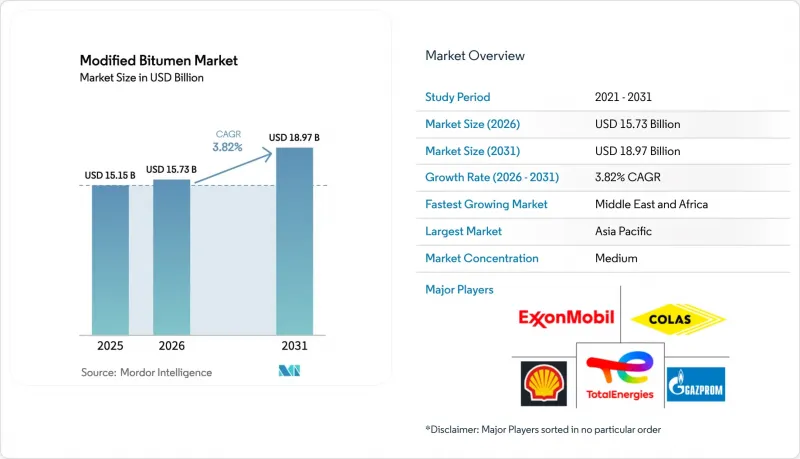
根據 Mordor Intelligence 預測,改質瀝青市場規模預計將在 2025 年達到 151.5 億美元,2026 年達到 157.3 億美元,到 2031 年達到 189.7 億美元,2026 年至 2031 年的複合年成長率為 3.82%。
本報告按改質劑類型(SBS、APP、蛤殼橡膠、天然橡膠及其他)、施工方法(熱瀝青、冷瀝青、噴燈施工)、應用領域(道路建設和鋪路、屋頂和管道及其他)以及地區(亞太地區、北美地區、歐洲地區、南美地區、中東和非洲)進行細分。市場預測以美元計價。
全球改質瀝青市場趨勢及洞察
美國國際基礎建設發展署(IIJA)、歐盟第二輪資本充足率基金(CEF-2)和印度總理加蒂沙克蒂計畫(PM-Gatishakti)等道路建設獎勵策略
多年期合約和充足的資金支持正在推動聚合物改性瀝青的消費。美國《基礎建設投資與就業法案》(IIJA)為公路建設撥出了大量資金。雖然其中大部分資金已獲授權,但截至2025年9月,實際支出僅佔一小部分,這表明未來幾年採購量將達到高峰。在印度,PM-Gatishakti走廊和PMGSY-IV農村道路舉措旨在利用廢棄塑膠和冷拌技術來建設廣泛的道路網路。預計這將加速SBS的採用,尤其是在新興國家。同時,歐洲的CEF-2計劃,其預算的很大一部分與氣候目標掛鉤,正在其專案中推廣使用再生橡膠和生物聚合物黏合劑。擁有區域性混合終端、同時供應SBS和APP並維護預先已通過核准產品清單的供應商,正受益於訂購機構縮短的競標週期。因此,儘管不同地區的供應情況有所不同,但供應量已顯著增加,這很可能在可預見的未來推動改性瀝青市場的發展。
中國更嚴格的瀝青性能標準:JTGF40-2021 和 Austroads 混合 PMB 標準
中國的JTGF40-2021標準為高流量高速公路設定了新的抗車轍性能基準值,實際上強制要求使用含有大量SBS的混合料。該標準於2024年在廣東和浙江兩省開始實施,導致對SBS的需求增加。澳洲道路協會(Austroads)的混合黏合劑指南建議將SBS與蛤殼橡膠混合,以平衡高溫穩定性和低溫柔柔軟性。這種方法可以在滿足疲勞性能標準的同時降低聚合物用量。這些不斷發展的標準不僅縮短了聚合物拌合站的投資回收期,還將競爭限制在預認證供應商範圍內。此外,它們還加速了該技術向採用澳洲和紐西蘭標準的東南亞國協的推廣。未能改進配方的承包商將面臨保固失效或專案延期的風險。這種情況凸顯了改質瀝青市場對聚合物改質瀝青規範日益成長的需求。
原油價格波動給改質劑的獲利能力帶來了壓力。
2025年,布蘭特原油價格維持穩定。然而,在亞洲,丁二烯供應緊張導致SBS現貨價格飆升,降低了調和商的利潤率。歐佩克+的減產措施也推高了期貨價格。聚合物生產商暗示,由於原料成本上漲,價格可能會上漲。在印度和東南亞等地政府委託的道路建設合約中,價格差異給調和商帶來了特別沉重的負擔,因為這些合約很少包含價格上漲條款。雖然擁有自有聚合物資產的大型石油公司受這些波動的影響較小,但獨立調和商卻面臨困境,這種壓力可能導致改性瀝青市場重組,並降低供應商的多樣性。
細分市場分析
2025年,SBS憑藉其低溫柔柔軟性,佔據了改質瀝青市場39.75%的佔有率。在加拿大和北歐的高速公路上,由於熱裂紋嚴重影響養護週期,SBS的需求尤其旺盛。隨著中國、美國和歐洲的道路管理部門開始將SBS的性能需求納入設計手冊,預計到2031年,SBS改質瀝青的市場規模將穩定成長。相較之下,APP的複合年成長率預計將達到4.29%,這主要得益於中東和北非地區屋頂施工法規的推動,這些法規要求在環境溫度超過70 度C的地區使用高反射率防水卷材。
改質瀝青的需求因當地氣候和監管標準而異。例如,在寒冷地區,如日本的高速公路維修工程,道路重鋪工程首選SBS改質瀝青;而在炎熱乾燥地區,尤其是安裝太陽能板的倉庫屋頂,APP改質劑瀝青則佔據主導地位。蛤殼橡膠和SBS的混合改質瀝青符合歐盟的再生材料含量標準,但由於品管方面的挑戰,目前仍屬於小眾市場。同時,目前被歸類為「其他」的早期生物聚合物改質劑正處於市場擴張的邊緣,尤其是在碳定價導致成本差異縮小的情況下。能夠巧妙平衡SBS和APP產能的供應商,既可以應對區域性市場波動,又能掌握改質瀝青市場不斷變化的趨勢。
區域分析
預計到2025年,亞太地區將佔全球銷售額的44.36%,主要得益於中國新建高速公路和印度主要道路的擴建。然而,隨著中國東部公路網接近飽和,該地區的成長速度正在放緩。同時,印度面臨土地徵用延誤的問題,導致競標到最終成交的周期延長。在日本,每年都有大量投資,重點是將SBS聚合物應用於高速公路加鋪層建設,旨在減少老化路面的疲勞。同時,在東協地區,受亞洲開發銀行(亞銀)資助的產業走廊計畫的推動,市場需求激增,但外匯風險和政治局勢變化等挑戰仍然是主要問題。
預計中東和非洲地區將以5.98%的複合年成長率達到最高成長率。這一成長主要得益於對交通運輸管道、新行政首都道路以及高速公路維修的大規模投資。此外,海灣合作理事會(GCC)建築規範強制要求使用符合SRI標準的APP膜材,以及南非推廣使用再生橡膠,預計也將推動需求成長。然而,該地區面臨與原油價格相關的資金籌措波動以及普遍存在的安全問題。
預計北美和歐洲的成長速度將放緩。隨著這些成熟的基礎設施網路從擴建轉向維護,挑戰也隨之而來。美國國家橋樑清單(NBI)顯示,許多橋樑需要鋪設橋面防水膜。然而,未來充滿不確定性,預計2026年後的《基礎設施投資與就業法案》(IIJA)預算撥款將減少,且由於電動車的普及,汽油稅收入也在下降。在大西洋彼岸的歐洲,分配給公路的《歐洲互聯互通基金第二階段》(CEF-2)預算比例有限,成長僅限於必要的道路重鋪和都市區維修專案。南美洲雖然規模較小,且更容易受到經濟波動的影響,但卻帶來了一線希望。巴西2024年至2025年的收費公路特許經營正在刺激需求,但宏觀經濟的不穩定性給前景蒙上了一層陰影。
其他好處:
- Excel格式的市場預測(ME)表
- 3個月的分析師支持
目錄
第1章:引言
- 研究假設和市場定義
- 調查範圍
第2章:調查方法
第3章執行摘要
第4章 市場狀況
- 市場概覽
- 市場促進因素
- 美國國際基礎建設獎勵策略。
- 中國 JTGF40-2021 標準和 Austroads 混合 PMB 標準對瀝青性能提出了更嚴格的要求。
- 改用自黏式和室溫施工防水卷材將減少建築工地的火災。
- 歐盟綠色交易中用於道路建設的再生橡膠(橡膠顆粒/PMB)分配。
- 由生物聚合物(木質素、藻類)改性的黏合劑已達到商業規模。
- 市場限制因素
- 原油價格波動對該修飾符的獲利能力帶來了壓力。
- 北美和歐洲熟練焊炬操作人員短缺
- 加州、德國和韓國對熱瀝青中揮發性有機化合物和多環芳烴的含量上限規定
- 價值鏈分析
- 波特五力模型
第5章 市場規模與成長預測
- 按修飾符類型
- 苯乙烯-丁二烯-苯乙烯(SBS)
- 無規聚丙烯(APP)
- 蛤殼橡膠
- 天然橡膠
- 其他
- 透過應用方法
- 熱瀝青
- 冷瀝青
- 火炬應用
- 透過使用
- 道路建設和鋪路
- 屋頂材料和管道
- 其他
- 按地區
- 亞太地區
- 中國
- 印度
- 日本
- 韓國
- 東南亞國協
- 其他亞太國家
- 北美洲
- 美國
- 加拿大
- 墨西哥
- 歐洲
- 德國
- 英國
- 法國
- 義大利
- 西班牙
- 俄羅斯
- 其他歐洲國家
- 南美洲
- 巴西
- 阿根廷
- 其他南美國家
- 中東和非洲
- 沙烏地阿拉伯
- 南非
- 其他中東和非洲國家
- 亞太地區
第6章 競爭情勢
- 市場集中度
- 策略趨勢
- 市佔率和排名分析
- 公司簡介
- Breedon Group plc
- COLAS
- Dow
- Exxon Mobil Corporation
- Firestone Building Products Company, LLC
- Fosroc International Limited
- GAF
- Gazprom Neft PJSC
- Hincol
- Nynas AB
- ORLEN Asfalt Sp. z oo
- Repsol
- Rosneft Deutschland GmbH
- Saint-Gobain Weber
- Shell plc
- Sika AG
- SOPREMA SAS
- Texsa Systems SLU
- TotalEnergies
第7章 市場機會與未來展望
According to Mordor Intelligence, the modified bitumen market size is projected to be USD 15.15 billion in 2025, USD 15.73 billion in 2026, and reach USD 18.97 billion by 2031, growing at a CAGR of 3.82% from 2026 to 2031.
This report is Segmented by Modifier Type (SBS, APP, Crumb Rubber, Natural Rubber, and Others), Application Method (Hot Asphalt, Cold Asphalt, and Torch-Applied), Application (Road Construction and Paving, Roofing and Piping, and Others), and Geography (Asia-Pacific, North America, Europe, South America, and Middle East and Africa). Market Forecasts are Provided in Terms of Value (USD).
Global Modified Bitumen Market Trends and Insights
Road-Building Stimulus in the US IIJA, EU CEF-2, and India PM-Gatishakti
Multi-year lettings, fueled by substantial funding allocations, are driving up the consumption of polymer-modified asphalt. The US Infrastructure Investment and Jobs Act has earmarked significant funds for highways. While a large portion of this amount is obligated, only a fraction has been spent as of September 2025, hinting at a purchasing peak in the coming years. In India, the PM-Gatishakti corridors and the PMGSY-IV rural-road initiative are set to cover extensive kilometers, utilizing waste plastic and cold-mix technologies. This move is set to accelerate the adoption of SBS, especially in emerging states. Meanwhile, Europe's CEF-2 program has tied a significant portion of its budget to climate objectives, pushing projects towards using recycled rubber and bio-polymer binders. Suppliers boasting regional blending terminals, sourcing both SBS and APP, and maintaining pre-approved product lists are reaping the benefits as agencies shorten bid timelines. The cumulative result is a notable surge in volumes, albeit unevenly distributed across regions, bolstering the modified bitumen market for the foreseeable future.
Tightening Asphalt-Performance Specs in China JTGF40-2021 and Austroads Hybrid-PMB Standards
China's JTGF40-2021 has set new rutting-resistance thresholds for expressways with high daily traffic, effectively mandating the use of SBS-rich mixes. Enforcement began in 2024 in Guangdong and Zhejiang, leading to an increase in SBS demand. Austroads' guidelines for hybrid binders advocate a blend of SBS and crumb rubber, achieving a balance between high-temperature stability and low-temperature flexibility. This approach allows a reduction in polymer dosage while still meeting fatigue criteria. These evolving standards not only shorten payback periods for polymer-blending plants but also narrow competition to pre-qualified suppliers. Furthermore, they expedite the diffusion of technology to ASEAN nations that are adopting codes from Australasia. Contractors who neglect to upgrade their formulations face the risk of warranty voids and project delays. This scenario underscores the growing entrenchment of polymer-modified asphalt specifications within the modified bitumen market.
Crude-Oil Price Volatility Squeezing Modifier Economics
In 2025, Brent crude prices remained steady. However, in Asia, SBS spot prices surged due to tight butadiene supplies, leading to a reduction in blender margins. OPEC+ production curbs have kept forward prices elevated. In response to rising feedstock costs, polymer manufacturers are signaling price increases. Notably, government road contracts in India and Southeast Asia seldom incorporate price-escalation clauses, compelling blenders to shoulder the financial spread. While integrated oil majors with their own polymer assets remain shielded from these fluctuations, independent blenders are feeling the squeeze, facing pressures that could lead to consolidation and a diminished supplier diversity in the modified bitumen market.
Other drivers and restraints analyzed in the detailed report include:
- Shift to Self-Adhered and Cold-Applied Membranes Cutting Labor-Site Fires
- Recycled-Rubber Quotas in EU Green Deal Roads
- Skilled Torch-Applicator Shortages in North America and Europe
For complete list of drivers and restraints, kindly check the Table Of Contents.
Segment Analysis
SBS accounted for 39.75% of the modified bitumen market share in 2025 on the strength of its low-temperature flexibility, especially for Canadian and northern European highways where thermal cracking dictates maintenance cycles. As road agencies in China, the United States, and Europe begin to incorporate SBS performance into their design manuals, the market size for SBS-linked modified bitumen is projected to grow steadily through 2031. APP, by contrast, is forecast to grow at a 4.29% CAGR, propelled by Middle Eastern and North African roofing mandates that require high solar-reflectance membranes under ambient temperatures exceeding 70 °C.
Demand for modified bitumen adjusts according to regional climates and regulatory codes. For instance, while SBS is favored in cold-climate resurfacing initiatives-such as Japan's expressway rehabilitation-APP is the go-to choice for hot, arid regions, especially for warehouse roofs equipped with photovoltaic arrays. Hybrid blends of crumb-rubber and SBS meet the EU's recycled-content standards but remain a niche segment due to challenges in quality control. Meanwhile, early-stage bio-polymer modifiers, currently categorized under "Others," are on the brink of expansion, especially if carbon pricing helps narrow their cost disparity. Suppliers adept at balancing their capacities between SBS and APP can navigate regional fluctuations and tap into the changing dynamics of the modified bitumen market.
Complete Report Scope:
- By Modifier Type
- Styrene-Butadiene-Styrene (SBS)
- Atactic Polypropylene (APP)
- Crumb Rubber
- Natural Rubber
- Others
- By Application Method
- Hot Asphalt
- Cold Asphalt
- Torch-Applied
- By Application
- Road Construction and Paving
- Roofing and Piping
- Others
- By Geography
- Asia-Pacific
- China
- India
- Japan
- South Korea
- ASEAN Countries
- Rest of Asia-Pacific
- North America
- United States
- Canada
- Mexico
- Europe
- Germany
- United Kingdom
- France
- Italy
- Spain
- Russia
- Rest of Europe
- South America
- Brazil
- Argentina
- Rest of South America
- Middle-East and Africa
- Saudi Arabia
- South Africa
- Rest of Middle-East and Africa
- Asia-Pacific
Geography Analysis
Asia-Pacific generated 44.36% of 2025 revenue, driven by China's addition of expressways and India's expansion of highways. Yet, as eastern provinces of China approach network saturation, growth has moderated. Concurrently, India grapples with land-acquisition delays, extending its tender-to-award cycles. Japan, investing heavily annually, emphasizes SBS polymers for expressway overlays, aiming to mitigate fatigue on its aging pavements. Meanwhile, ASEAN's demand surges, buoyed by ADB-financed industrial corridor projects, though challenges like currency risks and political shifts loom large.
The Middle East and Africa region is poised for the fastest 5.98% CAGR. Major investments in transport pipelines, roads for new administrative capitals, and freeway rehabilitation spur this growth. Additionally, the GCC's building codes mandate SRI-compliant APP membranes, while South Africa pushes for recycled-rubber, both bolstering volume prospects. However, the region grapples with funding volatility tied to oil prices and overarching security concerns.
North America and Europe are set to grow at a more tempered pace. As these mature networks pivot from expansion to maintenance, challenges arise. The U.S. National Bridge Inventory flags numerous structures in need of deck membranes. Yet, with IIJA allocations set to wane post-2026 and gas-tax revenues dipping due to rising EV adoption, the future looks uncertain. Across the Atlantic, Europe's CEF-2 dedicates a limited portion of its budget to highways, confining growth to essential resurfacing and urban retrofits. South America, though small and cyclical, sees a glimmer of hope: Brazil's toll concessions for 2024-2025 spark demand, yet macroeconomic instability casts a shadow on the outlook.
- Breedon Group plc
- COLAS
- Dow
- Exxon Mobil Corporation
- Firestone Building Products Company, LLC
- Fosroc International Limited
- GAF
- Gazprom Neft PJSC
- Hincol
- Nynas AB
- ORLEN Asfalt Sp. z o.o.
- Repsol
- Rosneft Deutschland GmbH
- Saint-Gobain Weber
- Shell plc
- Sika AG
- SOPREMA S.A.S
- Texsa Systems SLU
- TotalEnergies
Additional Benefits:
- The market estimate (ME) sheet in Excel format
- 3 months of analyst support
TABLE OF CONTENTS
1 Introduction
- 1.1 Study Assumptions and Market Definition
- 1.2 Scope of the Study
2 Research Methodology
3 Executive Summary
4 Market Landscape
- 4.1 Market Overview
- 4.2 Market Drivers
- 4.2.1 Road-building stimulus in the US IIJA, EU CEF-2 and India PM-Gatishakti
- 4.2.2 Tightening asphalt-performance specs in China's JTGF40-2021 and Austroads hybrid-PMB standards
- 4.2.3 Shift to self-adhered and cold-applied membranes cutting labour-site fires
- 4.2.4 Recycled-rubber (crumb-rubber-PMB) quotas in EU Green Deal roads
- 4.2.5 Bio-polymer (lignin, algae) modified binders hitting commercial scale
- 4.3 Market Restraints
- 4.3.1 Crude-oil price volatility squeezing modifier economics
- 4.3.2 Skilled-torch-applicator shortages in North America and Europe
- 4.3.3 VOC and PAH caps on hot asphalt in California, Germany, Korea
- 4.4 Value Chain Analysis
- 4.5 Porter's Five Forces
- 4.5.1 Bargaining Power of Suppliers
- 4.5.2 Bargaining Power of Buyers
- 4.5.3 Threat of New Entrants
- 4.5.4 Threat of Substitutes
- 4.5.5 Competitive Rivalry
5 Market Size and Growth Forecasts (Value)
- 5.1 By Modifier Type
- 5.1.1 Styrene-Butadiene-Styrene (SBS)
- 5.1.2 Atactic Polypropylene (APP)
- 5.1.3 Crumb Rubber
- 5.1.4 Natural Rubber
- 5.1.5 Others
- 5.2 By Application Method
- 5.2.1 Hot Asphalt
- 5.2.2 Cold Asphalt
- 5.2.3 Torch-Applied
- 5.3 By Application
- 5.3.1 Road Construction and Paving
- 5.3.2 Roofing and Piping
- 5.3.3 Others
- 5.4 By Geography
- 5.4.1 Asia-Pacific
- 5.4.1.1 China
- 5.4.1.2 India
- 5.4.1.3 Japan
- 5.4.1.4 South Korea
- 5.4.1.5 ASEAN Countries
- 5.4.1.6 Rest of Asia-Pacific
- 5.4.2 North America
- 5.4.2.1 United States
- 5.4.2.2 Canada
- 5.4.2.3 Mexico
- 5.4.3 Europe
- 5.4.3.1 Germany
- 5.4.3.2 United Kingdom
- 5.4.3.3 France
- 5.4.3.4 Italy
- 5.4.3.5 Spain
- 5.4.3.6 Russia
- 5.4.3.7 Rest of Europe
- 5.4.4 South America
- 5.4.4.1 Brazil
- 5.4.4.2 Argentina
- 5.4.4.3 Rest of South America
- 5.4.5 Middle-East and Africa
- 5.4.5.1 Saudi Arabia
- 5.4.5.2 South Africa
- 5.4.5.3 Rest of Middle-East and Africa
- 5.4.1 Asia-Pacific
6 Competitive Landscape
- 6.1 Market Concentration
- 6.2 Strategic Moves
- 6.3 Market Share/Ranking Analysis
- 6.4 Company Profiles (includes Global level Overview, Market level overview, Core Segments, Financials as available, Strategic Information, Market Rank/Share, Products and Services, Recent Developments)
- 6.4.1 Breedon Group plc
- 6.4.2 COLAS
- 6.4.3 Dow
- 6.4.4 Exxon Mobil Corporation
- 6.4.5 Firestone Building Products Company, LLC
- 6.4.6 Fosroc International Limited
- 6.4.7 GAF
- 6.4.8 Gazprom Neft PJSC
- 6.4.9 Hincol
- 6.4.10 Nynas AB
- 6.4.11 ORLEN Asfalt Sp. z o.o.
- 6.4.12 Repsol
- 6.4.13 Rosneft Deutschland GmbH
- 6.4.14 Saint-Gobain Weber
- 6.4.15 Shell plc
- 6.4.16 Sika AG
- 6.4.17 SOPREMA S.A.S
- 6.4.18 Texsa Systems SLU
- 6.4.19 TotalEnergies
7 Market Opportunities and Future Outlook
- 7.1 White-space andandUnmet-need Assessment


