


 |
市場調查報告書
商品編碼
2113994
Humed Silica:市場佔有率分析、產業趨勢與統計、成長預測(2026-2031)Fumed Silica - Market Share Analysis, Industry Trends & Statistics, Growth Forecasts (2026 - 2031) |
||||||

※ 本網頁內容可能與最新版本有所差異。詳細情況請與我們聯繫。
據 Mordor Intelligence 稱,2026 年氣相二氧化矽市場規模估計為 322.14 千噸,預計到 2031 年將達到 410.36 千噸,在預測期(2026-2031 年)內以 4.96% 的複合年成長率成長。
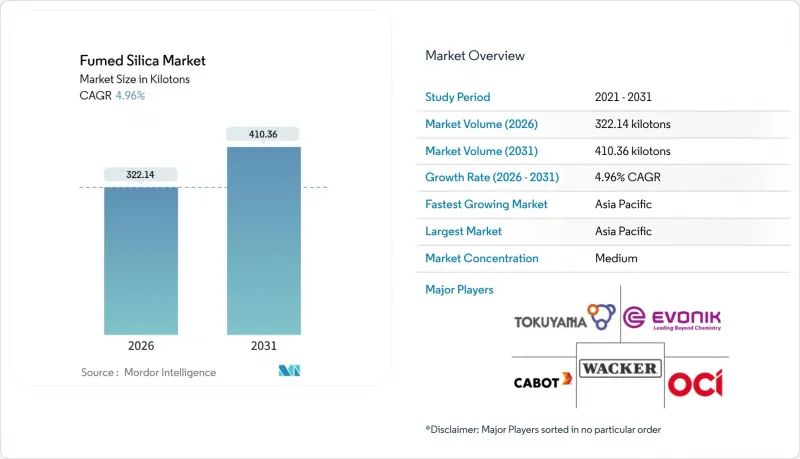
本報告按類型(親水性和疏水性)、製造程序(火焰水解和等離子/電弧氣相氧化)、功能(流變控制、防止沉降、增強)、應用(矽橡膠、黏合劑和密封劑等)以及地區(亞太地區、北美地區、歐洲地區、南美地區、中東和非洲)進行細分。市場預測以銷售量(噸)為單位。
全球氣相二氧化矽市場趨勢及洞察
矽橡膠在家用電子電器的應用蓬勃發展
隨著智慧型手機、穿戴式裝置和車載資訊娛樂模組的尺寸不斷縮小,對矽酮封裝的需求激增,尤其是那些添加了氣相二氧化矽以增強觸變性和增強性能的材料。在亞洲,疏水性熱熔膠填料已被應用於電動兩輪和三輪車的組裝上,有效防止了固化過程中的相分離。 2023年,艾爾化學宣布計劃在上海運作一條生產線,以實現電子產品用矽酮黏合劑的在地化供應。韓國軟性OLED的興起推動了對超低黏度矽凝膠的需求。這些凝膠需要奈米二氧化矽來保持其在反覆彎曲後的光學透明度。每個鉸鏈組件都需要精確的流變學調節,而沉澱二氧化矽無法滿足這項要求,因此氣相二氧化矽在消費性電子產品中的應用日益廣泛。
油漆和塗料配方改變導致需求激增
建築和工業化合物製造商正轉向水性體系,這些體係依靠氣相二氧化矽來維持適用性,而無需使用高揮發性有機化合物(VOC)溶劑。南海岸空氣品質管理區(AQMD)第1113號規則的實施加速了這項轉變。贏創的「AEROSIL E2D」級氣相二氧化矽將於2024年6月投產,將提高水性塗料的混合速度。歐盟生態標章草案標準於2025年2月發布,強調低粉塵原料,間接顯示熱解製備的二氧化矽優於粗粒沉澱法製備的二氧化矽。中國和印度的汽車原始設備製造商(OEM)正在轉向使用高固態含量聚氨酯塗料,並用疏水性二氧化矽增強,以防止垂直面板出現下垂現象。預計這些累積性變化將在整個預測期內推動氣相二氧化矽市場持續成長。
四氯化矽原料價格波動
由於四氯化矽的供應依賴多晶矽的利用週期,當太陽能需求放緩,特定產品氯矽烷的產量下降時,氣相二氧化矽生產商的利潤率將面臨壓力,現貨價格也會上漲。為了降低風險,生產商正擴大探索實施回收循環,將廢棄物轉化為四氯化矽。由於缺乏透明的基準,長期供應合約難以簽訂,迫使許多黏合劑生產商每季調整價格,影響了價格的可預測性。
細分市場分析
到2025年,親水性矽橡膠的需求量將佔總需求量的75.45%,這一佔有率與2031年之前5.45%的強勁複合年成長率(CAGR)相符。這是因為製藥和營養保健品生產商更傾向於使用符合FDA 21 CFR 172.480和EFSA E 551法規的未改質表面。雖然矽烷處理的疏水性矽橡膠適用於對濕度敏感的矽橡膠和非極性塗層,但由於其增強材料單位成本較高,因此成長速度較慢。
在印度,對親水性產品的需求日益成長,尤其明顯。印度的片劑生產商指定使用細級二氧化矽來穩定出口的活性成分。同時,在風力發電機葉片黏合劑和3D列印樹脂領域,隨著德山化學於2024年在浙江省擴建產能,疏水性產品的應用也迅速成長。贏創的高分散性親水性E2D系列產品可使水性塗料混合配商將混合時間縮短五分之一,進而提高製程經濟性。在矽橡膠用二氧化矽市場,由於沉澱法製備的替代品無法達到8 MPa以上的拉伸強度目標,疏水性二氧化矽的價格仍居高不下。
到2025年,火焰水解法將佔總產量的72.36%,並繼續保持其在流變控制領域的領先地位。然而,由於航太氣凝膠和化學機械拋光(CMP)漿料需要不含金屬雜質的超高純度顆粒,預計等離子體和電弧蒸氣氧化法將以5.92%的複合年成長率超越火焰水解法。等離子設備能夠滿足韓國和台灣半導體製造廠對雜質閾值低於10 ppm的要求,從而增強其在特定領域的競爭優勢。
儘管初始投資較高,但等離子模組在即將到來的歐洲碳氫化合物(CBAM)關稅政策下具有吸引力,因為它們可以與可再生能源結合使用,並減少碳排放。德國的火焰式設備營運商正在進行綠色氫氣燃燒器的試驗,但他們面臨電解槽供應有限的挑戰。電弧蒸氣氧化法的處理能力僅為火焰式方法的約三分之一,因此其商業性應用僅限於高附加價值國防複合材料。因此,儘管等離子級氣相二氧化矽市場具有重要的戰略意義,但其絕對噸位可能仍小規模。
區域分析
預計到2025年,亞太地區將佔全球產量的48.15%,並在2031年之前以5.18%的年均複合成長率成長。這一成長主要得益於中國對用於邏輯織物和電池封裝材料的CMP漿料的需求增加,以及印度對營養補充劑生產的需求成長。德山化學工業株式會社浙江工廠負責為韓國汽車塗料提供表面處理級產品,而OCI株式會社群山工廠則為韓國的密封劑和二次電池生產線供應產品。在日本,用於火焰水解的綠色氫氣示範實驗正在進行中,但目前面臨規模限制。
在北美,NASA的氣凝膠計畫和建築塗料領域更嚴格的VOC(揮發性有機化合物)法規推動了成長。瓦克位於田納西州查爾斯頓的工廠供應矽橡膠化合物,而贏創在南卡羅來納州新建的沉澱二氧化矽生產線表明,低價位市場面臨替代壓力。加拿大和墨西哥的成長相對滯後,但與汽車組裝相關的成長率也接近5%。
能源成本和即將實施的CBAM碳關稅正在抑制歐洲的經濟成長。贏創位於萊茵費爾登的E2D工廠提供了一種水性塗料相容型產品,可將混合能耗降低五分之一。由於歐盟生態標章標準的提案以及荷蘭可能將產品歸類為STOT RE 1級,塗料製造商的遵循成本不斷增加,但由於CORDIS對航太氣凝膠的資助,特種應用領域的需求仍然強勁。
其他好處:
- Excel格式的市場預測(ME)表
- 3個月的分析師支持
目錄
第1章:引言
- 研究假設和市場定義
- 調查範圍
第2章:調查方法
第3章執行摘要
第4章 市場狀況
- 市場概覽
- 市場促進因素
- 矽橡膠的繁榮是由消費性電子產品(亞洲)所推動的。
- 由於油漆和塗料配方改變,需求激增
- 藥品和個人保健產品產業快速成長
- 光固化樹脂在3D列印領域的市場滲透率
- 航太級氣凝膠複合材料需要超高純度的二氧化矽。
- 市場限制因素
- 四氯化矽原料價格波動
- 提高低成本沉澱二氧化矽的產能
- 火焰水解反應器與等離子反應器能量強度的比較。
- 價值鏈分析
- 波特五力模型
第5章 市場規模與成長預測
- 按類型
- 親水性
- 疏水性
- 透過製造程序
- 火焰水解
- 等離子體/電弧蒸氣氧化
- 按功能
- 流變控制/增稠
- 防止沉澱/防止結塊
- 增強材料/填料
- 透過使用
- 矽橡膠
- 黏合劑和密封劑
- 油漆、塗料、油墨
- 塑膠和複合材料(UPR)
- 食品/飲料
- 其他用途(藥品和個人護理用品等)
- 按地區
- 亞太地區
- 中國
- 印度
- 日本
- 韓國
- 其他亞太國家
- 北美洲
- 美國
- 加拿大
- 墨西哥
- 歐洲
- 德國
- 英國
- 法國
- 義大利
- 其他歐洲國家
- 南美洲
- 巴西
- 阿根廷
- 其他南美國家
- 中東和非洲
- 沙烏地阿拉伯
- 南非
- 其他中東和非洲國家
- 亞太地區
第6章 競爭情勢
- 市場集中度
- 策略趨勢
- 市佔率和排名分析
- 公司簡介
- AMS Applied Material Solutions
- Cabot Corporation
- China-Henan Huamei Chemical Co., Ltd.
- DONGYUE GROUP
- Evonik Industries AG
- Gelest Inc.
- Henan Xunyu Chemical Co., Ltd.
- Heraeus Group
- HPQ Silicon Inc.
- Kemipex
- Kemitura
- Ningbo Ruifeng Sealing Materials Co., Ltd.
- OCI Ltd.
- Orisil
- Redox
- Tokai Carbon Co., Ltd.
- Tokuyama Corporation
- Wacker Chemie AG
- Yichang CSG Polysilicon Co., Ltd.
- Zhejiang FuShiTe Group Co., Ltd.
第7章 市場機會與未來展望
According to Mordor Intelligence, the fumed silica market size is estimated at 322.14 kilotons in 2026, and is expected to reach 410.36 kilotons by 2031, at a CAGR of 4.96% during the forecast period (2026-2031).
This report is Segmented by Type (Hydrophilic and Hydrophobic), Production Process (Flame Hydrolysis and Plasma/Arc Vapor Oxidation), Function (Rheology Control, Anti-Settling, and Reinforcement), Application (Silicone Rubber, Adhesives and Sealants, and More), and Geography (Asia-Pacific, North America, Europe, South America, Middle-East and Africa). Market Forecasts are Provided in Terms of Volume (Tons).
Global Fumed Silica Market Trends and Insights
Consumer Electronics Boom in Silicone Elastomers
As smartphones, wearables, and automotive infotainment modules shrink in size, the demand for silicone encapsulants, specifically those with fumed silica loading for enhanced thixotropy and reinforcement, has surged. In Asia, assembly lines for electric two- and three-wheelers are now utilizing hydrophobic-grade thermal gap fillers, effectively preventing phase separation during the curing process. In 2023, Elkem activated a production line in Shanghai, aiming to localize the supply of electronics-grade silicone adhesives. The rise of flexible OLEDs in South Korea is propelling the demand for ultra-low-viscosity silicone gels, which require nano-silica to maintain optical clarity during repetitive bending. Each hinge assembly demands precise rheology tuning, a feat that precipitated silica falls short of, leading to a deeper penetration of fumed silica in consumer devices.
Demand Surge from Paint and Coating Reformulations
Architectural and industrial formulators are pivoting to waterborne systems that depend on fumed silica to retain brushability without high-VOC solvents, a switch hastened by South Coast AQMD Rule 1113 limits. Evonik's AEROSIL E2D grades, commissioned in June 2024, enable faster mixing in waterborne coatings. Draft EU Ecolabel criteria released in February 2025 emphasize low-dust raw materials, indirectly favoring pyrogenic silica over coarse precipitated grades. Automotive OEM coatings in China and India are migrating to high-solids polyurethane systems reinforced with hydrophobic silica to prevent sag on vertical panels. The cumulative shift sustains growth in the fumed silica market through the forecast period.
Price Volatility of SiCl4 Feedstock
SiCl4 supply hinges on polysilicon utilization cycles, so fumed silica producers endure margin pressure when solar demand softens, and chlorosilane by-product output falls, lifting spot prices. Producers increasingly explore recycling loops that convert waste streams back into SiCl4 to curb exposure. The absence of transparent benchmarks complicates long-term supply contracts, forcing many adhesive formulators onto quarterly adjustments that erode predictability.
Other drivers and restraints analyzed in the detailed report include:
- Rapid Growth in Pharmaceuticals and Personal-Care Formulations
- Penetration of 3D-Printed Photopolymer Resins
- Low-Cost Precipitated Silica Capacity Additions
For complete list of drivers and restraints, kindly check the Table Of Contents.
Segment Analysis
Hydrophilic grades captured 75.45% of 2025 demand, and this share aligns with a robust 5.45% CAGR to 2031 as pharmaceutical and nutraceutical makers favor unmodified surfaces governed by FDA 21 CFR 172.480 and EFSA E 551 rules. Hydrophobic variants, treated with silanes, address moisture-sensitive silicone rubber and non-polar coatings but grow at a slower clip due to a higher cost per reinforcement unit.
Hydrophilic expansion is evident in India, where tablet makers specify fine-grade silica to stabilize active ingredients during export transit. Hydrophobic adoption surges in wind-turbine blade adhesives and 3D-printing resins, aided by Tokuyama's 2024 capacity boost in Zhejiang. Evonik's easier-dispersing hydrophilic E2D line lets waterborne paint formulators cut mixing time by one-fifth, tightening process economics. The fumed silica market size for hydrophobic grades in silicone rubber still commands premiums because precipitated substitutes cannot match tensile strength targets above 8 MPa.
Flame hydrolysis generated 72.36% of the 2025 output, keeping it dominant in rheology control. Plasma and arc vapor oxidation will, however, outpace at 5.92% CAGR as aerospace aerogels and CMP slurries demand ultra-pure particles free of metallic contaminants. Plasma units meet sub-10 ppm impurity thresholds required by semiconductor fabs in South Korea and Taiwan, reinforcing a specialty moat.
Despite higher capex, plasma modules integrate with renewable power and lower carbon footprints, attributes attractive under Europe's impending CBAM tariff. Flame operators in Germany trial green hydrogen burners but face limited electrolyzer supply. Arc vapor oxidation throughput lags by roughly threefold versus flame, so its commercial deployment remains confined to high-value defense composites. The fumed silica market size for plasma grades should therefore remain small in absolute tonnage, though strategically important.
Complete Report Scope:
- By Type
- Hydrophilic
- Hydrophobic
- By Production Process
- Flame Hydrolysis
- Plasma/Arc Vapor Oxidation
- By Function
- Rheology Control/Thickening
- Anti-settling/Anti-caking
- Reinforcement/Filler
- By Application
- Silicone Rubber
- Adhesives and Sealants
- Paints, Coatings, and Inks
- Plastics and Composites (UPR)
- Food and Beverages
- Other Applications (Pharmaceuticals and Personal Care, etc.)
- By Geography
- Asia-Pacific
- China
- India
- Japan
- South Korea
- Rest of Asia-Pacific
- North America
- United States
- Canada
- Mexico
- Europe
- Germany
- United Kingdom
- France
- Italy
- Rest of Europe
- South America
- Brazil
- Argentina
- Rest of South America
- Middle-East and Africa
- Saudi Arabia
- South Africa
- Rest of Middle-East and Africa
- Asia-Pacific
Geography Analysis
Asia-Pacific owned 48.15% of the 2025 volume and grew at 5.18% through 2031, driven by CMP slurry demand for logic fabs, battery encapsulants in China, and rising nutraceutical production in India. Tokuyama's Zhejiang plant powers localized supply of surface-treated grades for automotive coatings, while OCI's Gunsan unit feeds South Korean sealant and secondary battery lines. Japan experiments with green hydrogen for flame hydrolysis, yet faces scale constraints.
North America carried growth on the back of NASA aerogel projects and stricter VOC caps in architectural paints. Wacker's Charleston, Tennessee, plant supplies silicone rubber compounds, and Evonik's new precipitated silica line in South Carolina hints at substitution pressure in low-tier segments. Canada and Mexico trail but log near 5% growth linked to automotive assembly.
Energy costs and looming CBAM carbon tariffs limit Europe's growth. Evonik's Rheinfelden E2D facility offers waterborne-friendly grades that cut mixing energy by one-fifth. Draft EU Ecolabel criteria and potential STOT RE 1 classification in the Netherlands raise compliance expenses for paint makers, yet aerospace aerogel funding under CORDIS keeps specialty demand resilient.
- AMS Applied Material Solutions
- Cabot Corporation
- China-Henan Huamei Chemical Co., Ltd.
- DONGYUE GROUP
- Evonik Industries AG
- Gelest Inc.
- Henan Xunyu Chemical Co., Ltd.
- Heraeus Group
- HPQ Silicon Inc.
- Kemipex
- Kemitura
- Ningbo Ruifeng Sealing Materials Co., Ltd.
- OCI Ltd.
- Orisil
- Redox
- Tokai Carbon Co., Ltd.
- Tokuyama Corporation
- Wacker Chemie AG
- Yichang CSG Polysilicon Co., Ltd.
- Zhejiang FuShiTe Group Co., Ltd.
Additional Benefits:
- The market estimate (ME) sheet in Excel format
- 3 months of analyst support
TABLE OF CONTENTS
1 Introduction
- 1.1 Study Assumptions and Market Definition
- 1.2 Scope of the Study
2 Research Methodology
3 Executive Summary
4 Market Landscape
- 4.1 Market Overview
- 4.2 Market Drivers
- 4.2.1 Consumer-electronics-led boom in silicone elastomers (Asia)
- 4.2.2 Demand surge from paints and coatings reformulations
- 4.2.3 Rapid growth in pharmaceuticals and personal-care formulations
- 4.2.4 Penetration of 3-D-printed photopolymer resins
- 4.2.5 Aerospace-grade aerogel composites require ultra-pure silica
- 4.3 Market Restraints
- 4.3.1 Price volatility of SiCl4 feedstock
- 4.3.2 Low-cost precipitated silica capacity additions
- 4.3.3 High energy intensity of flame hydrolysis vs plasma reactors
- 4.4 Value Chain Analysis
- 4.5 Porter's Five Forces
- 4.5.1 Bargaining Power of Suppliers
- 4.5.2 Bargaining Power of Buyers
- 4.5.3 Threat of New Entrants
- 4.5.4 Threat of Substitutes
- 4.5.5 Degree of Competition
5 Market Size and Growth Forecasts (Volume)
- 5.1 By Type
- 5.1.1 Hydrophilic
- 5.1.2 Hydrophobic
- 5.2 By Production Process
- 5.2.1 Flame Hydrolysis
- 5.2.2 Plasma/Arc Vapor Oxidation
- 5.3 By Function
- 5.3.1 Rheology Control/Thickening
- 5.3.2 Anti-settling/Anti-caking
- 5.3.3 Reinforcement/Filler
- 5.4 By Application
- 5.4.1 Silicone Rubber
- 5.4.2 Adhesives and Sealants
- 5.4.3 Paints, Coatings, and Inks
- 5.4.4 Plastics and Composites (UPR)
- 5.4.5 Food and Beverages
- 5.4.6 Other Applications (Pharmaceuticals and Personal Care, etc.)
- 5.5 By Geography
- 5.5.1 Asia-Pacific
- 5.5.1.1 China
- 5.5.1.2 India
- 5.5.1.3 Japan
- 5.5.1.4 South Korea
- 5.5.1.5 Rest of Asia-Pacific
- 5.5.2 North America
- 5.5.2.1 United States
- 5.5.2.2 Canada
- 5.5.2.3 Mexico
- 5.5.3 Europe
- 5.5.3.1 Germany
- 5.5.3.2 United Kingdom
- 5.5.3.3 France
- 5.5.3.4 Italy
- 5.5.3.5 Rest of Europe
- 5.5.4 South America
- 5.5.4.1 Brazil
- 5.5.4.2 Argentina
- 5.5.4.3 Rest of South America
- 5.5.5 Middle-East and Africa
- 5.5.5.1 Saudi Arabia
- 5.5.5.2 South Africa
- 5.5.5.3 Rest of Middle-East and Africa
- 5.5.1 Asia-Pacific
6 Competitive Landscape
- 6.1 Market Concentration
- 6.2 Strategic Moves
- 6.3 Market Share(%)/Ranking Analysis
- 6.4 Company Profiles (includes Global-level Overview, Market-level Overview, Core Segments, Financials as available, Strategic Information, Products and Services, and Recent Developments)
- 6.4.1 AMS Applied Material Solutions
- 6.4.2 Cabot Corporation
- 6.4.3 China-Henan Huamei Chemical Co., Ltd.
- 6.4.4 DONGYUE GROUP
- 6.4.5 Evonik Industries AG
- 6.4.6 Gelest Inc.
- 6.4.7 Henan Xunyu Chemical Co., Ltd.
- 6.4.8 Heraeus Group
- 6.4.9 HPQ Silicon Inc.
- 6.4.10 Kemipex
- 6.4.11 Kemitura
- 6.4.12 Ningbo Ruifeng Sealing Materials Co., Ltd.
- 6.4.13 OCI Ltd.
- 6.4.14 Orisil
- 6.4.15 Redox
- 6.4.16 Tokai Carbon Co., Ltd.
- 6.4.17 Tokuyama Corporation
- 6.4.18 Wacker Chemie AG
- 6.4.19 Yichang CSG Polysilicon Co., Ltd.
- 6.4.20 Zhejiang FuShiTe Group Co., Ltd.
7 Market Opportunities and Future Outlook
- 7.1 White-space and Unmet-Need Assessment

 氣相二氧化矽市場報告:至2035年的趨勢、預測及競爭分析
 氣相二氧化矽市場-2026-2032年全球市場預測
 全球氣相二氧化矽市場:按類型、應用、終端用戶產業和地區分類-預測至2030年
 2026年全球氣相二氧化矽市場報告
 氣相二氧化矽市場規模、佔有率及成長分析(按類型、應用、最終用戶和地區分類)-2026-2033年產業預測
 氣相二氧化矽市場機會、成長促進因素、產業趨勢分析及預測(2026-2035年)
 氣相二氧化矽市場:預測(2025-2030)
 氣相二氧化矽的全球市場分析:廠房生產能力,生產量,運用效率,需求與供給,終端用戶產業,銷售管道,各地區需求,企業佔有率(2015年~2035年)