


 |
市場調查報告書
商品編碼
2113846
蒸餾穀物(DDGS)飼料:市場佔有率分析、行業趨勢和統計數據、成長預測(2026-2031)Distiller's Dried Grains With Solubles (DDGS) Feed - Market Share Analysis, Industry Trends & Statistics, Growth Forecasts (2026 - 2031) |
||||||

※ 本網頁內容可能與最新版本有所差異。詳細情況請與我們聯繫。
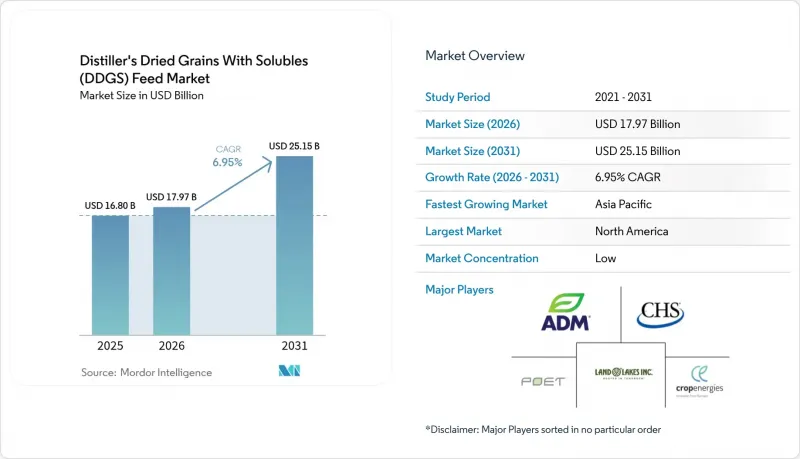
據 Mordor Intelligence 稱,2026 年蒸餾穀物 (DDGS)飼料的市場規模估計為 179.7 億美元,高於 2025 年的 168 億美元,預計到 2031 年將達到 251.5 億美元。
預計 2026 年至 2031 年的複合年成長率為 6.95%。
本報告按作物類型(玉米、小麥、米、混合穀物及其他)、動物類型(乳牛、肉牛、豬、家禽及其他)和地區(北美、歐洲、亞太、南美、中東和非洲)進行細分。市場預測以美元計價。
全球蒸餾蟲(DDGS)飼料市場趨勢及洞察
高蛋白、成本績效動物飼料。
全球肉類消費量的成長推動了對高蛋白飼料原料的需求持續成長,這些原料既能提供經濟價值,又能維持牲畜的生產力。根據經濟合作暨發展組織(OECD)預測,全球禽肉消費量將從2023年的139,334,200噸增加到2024年的141,274,700噸。 DDGS的粗蛋白含量約為27-30%,成本通常比同等量的豆粕低10-15%,對於面臨利潤壓力的飼料負責人而言,具有極具吸引力的經濟優勢。內布拉斯加大學的一項研究表明,在育肥牛飼料中添加高達25%的DDGS不會顯著影響其生產力,這使得營養師能夠根據原料供應情況和價格趨勢柔軟性最佳化配方。這項研究挑戰了傳統的保守配方限制,並表明DDGS在所有牲畜品種中具有更廣泛的適用性。
全球乙醇和生質燃料產業的擴張
擴大乙醇產能將直接影響DDGS的供應,因為每生產一加侖乙醇,就會產生約17至18磅DDGS作為副產品。 2025年1月,GreenPlains公司在美國的「高草」(Tall Grass)碳捕集計畫透過低碳溢價提高了乙醇的經濟效益。該計畫將碳強度從51降低至約19,從而獲得了45Z無污染燃料生產積分,並得以參與各州的低碳燃料市場。即使在加工利潤率下降的情況下,這些環境溢價也能為乙醇生產提供經濟獎勵。
由於糧食價格波動,DDGS的價格優勢有所下降。
由於酒糟(DDGS)與玉米源自同一供應鏈,其價格走勢與玉米價格密切相關。玉米價格飆升時,酒糟價格往往也會在幾天內隨之上漲,縮小了通常支撐需求的10-15%的價格差距。 2025年1月,酒糟現貨平均競標為每噸155美元,但由於水路運輸緊張,從新奧爾良(NOLA)到岸價(CIF)的出口價格達到了每噸216美元。如果酒糟價格超過經濟閾值,飼料生產商可以柔軟性轉向其他蛋白質來源,這種需求的韌性限制了供應緊張時期的定價權。
細分市場分析
玉米衍生的DDGS(蒸餾穀粕)繼續佔據市場主導地位,預計到2025年將佔據約59.20%的市場佔有率。這反映了北美玉米乙醇基礎設施的優勢以及確保品質穩定和供應穩定的成熟供應鏈。該領域的成熟轉化為價格穩定和技術專長,從而支持可靠的飼料配方。小麥衍生的DDGS正在搶佔小規模的區域市場,尤其是在歐洲和加拿大,這些地區以小麥為基礎的乙醇生產形成了地域性有限的供應路線。米衍生的DDGS目前仍屬於小眾產品,但在亞洲市場展現出發展潛力,因為亞洲的米加工基礎設施能夠支持其特殊應用。
同時,添加胺基酸的DDGS正成為成長最快的細分市場,預計到2031年將以9.25%的複合年成長率成長,其目標市場是高階應用領域,在這些領域,更優的營養成分能夠支撐更高的價格。如果添加特定的酵素來提高纈氨酸和離胺酸的含量,添加氨基酸的DDGS的價格還會更高。然而,玉米仍然是定價的基石,確保了那些優先考慮營養成分一致性的買家的穩定流動性。
區域分析
預計到2025年,北美將維持44.30%的市佔率。這主要得益於美國龐大的玉米乙醇生產基礎設施,其主要生產商如Archer Daniels Midland (ADM)、POET和Green Plains等,每年生產超過4000萬噸DDGS。加拿大透過小麥乙醇生產為市場做出貢獻,而墨西哥作為主要出口目的地,吸收了大規模的美國DDGS,但鐵路運輸偶爾中斷會影響交付的可靠性。鐵路運輸對墨西哥的出口穩定有保障,但貨車經常短缺會增加運輸成本,促使沿海飼料生產商尋求供應來源多元化。
預計亞太地區將成為成長最快的地區,到2031年複合年成長率將達到7.22%。該地區的供應池正在擴大,這得益於中國玉米乙醇產業的成長和印度穀物釀酒廠產量的增加,同時蓬勃發展的家禽和水產養殖業也推動了消費。越南、泰國和印尼總合2024年的進口量將超過400萬噸,供應商採用類似SecureFeed的黃麴毒素檢測方案,正在加快品質認證產品的清關速度。
受巴西玉米乙醇產量年增24.5%的推動,南美洲DDGS(蒸餾薄荷膠)飼料市場正在擴張。巴西國內牲畜飼料廠的DDGS需求量增加,預計剩餘產量將供應安地斯山脈和加勒比海地區市場。在阿根廷,以小麥為原料的乙醇生產設施正在生產適用於智利和烏拉圭酪農的各種DDGS。
其他好處
- Excel格式的市場預測(ME)表
- 3個月的分析師支持
目錄
第1章:引言
- 研究假設和市場定義
- 調查範圍
第2章:調查方法
第3章執行摘要
第4章 市場狀況
- 市場概覽
- 市場促進因素
- 高蛋白、成本績效動物飼料。
- 全球乙醇和生質燃料產業的擴張
- 由於分餾技術的改進,纖維含量降低
- 亞洲家禽和豬飼料中DDGS含量不斷上升
- 水產養殖飼料的廣泛應用是由於其價格與魚粉相當。
- 經認證的綠色DDGS可享有低碳燃料標準溢價。
- 市場限制因素
- 由於糧食價格波動,DDGS的價格優勢有所下降。
- 與大豆、菜籽和其他蛋白質殘渣的競爭。
- 主要出口市場收緊黴菌毒素和硫磺基準值。
- 由於鐵路車輛。
- 技術展望
- 監理情勢
- 波特五力分析
第5章 市場規模與成長預測
- 按類型
- 玉米
- 小麥
- 米
- 胺基酸
- 混合穀物
- 其他
- 依動物類型
- 乳牛
- 肉牛
- 豬
- 家禽
- 水產養殖
- 其他動物類型
- 按地區
- 北美洲
- 美國
- 加拿大
- 墨西哥
- 其他北美國家
- 歐洲
- 德國
- 英國
- 法國
- 義大利
- 西班牙
- 俄羅斯
- 其他歐洲國家
- 亞太地區
- 中國
- 日本
- 印度
- 泰國
- 其他亞太國家
- 南美洲
- 巴西
- 阿根廷
- 其他南美國家
- 中東
- 沙烏地阿拉伯
- 土耳其
- 其他中東國家
- 非洲
- 南非
- 其他非洲地區
- 北美洲
第6章 競爭情勢
- 市場集中度
- 策略趨勢
- 市佔率分析
- 公司簡介
- Archer Daniels Midland Company
- CHS Inc.
- POET LLC
- CropEnergies AG
- Land O'Lakes, Inc.
- Cargill Incorporated
- Green Plains Inc.
- Valero Energy Corporation
- The Andersons, Inc.
- Vertex Bioenergy SL
- Globus Spirits Limited
- Nugen Feeds and Foods Private Limited
- The Andersons Inc.
- Kent Corporation
- The Scoular Company
第7章 市場機會與未來展望
According to Mordor Intelligence, distiller's dried grains with solubles (DDGS) feed market size in 2026 is estimated at USD 17.97 billion, growing from 2025 value of USD 16.80 billion with 2031 projections showing USD 25.15 billion, growing at 6.95% CAGR over 2026-2031.
This report is Segmented by Type (Corn, Wheat, Rice, Blended Grains, and Other Types), Animal Type (Dairy Cattle, Beef Cattle, Swine, Poultry, and Other Animal Types), and by Geography (North America, Europe, Asia-Pacific, South America, and Middle East and Africa). The Market Forecasts are Provided in Terms of Value (USD).
Global Distiller's Dried Grains With Solubles (DDGS) Feed Market Trends and Insights
Rising Demand for High-Protein Cost-Effective Animal Feed
The global expansion in meat consumption drives continuous demand for protein-rich feed ingredients that provide economic value while maintaining animal performance. According to the Organization for Economic Co-operation and Development (OECD), global poultry meat consumption reached 141,274.7 thousand metric tons in 2024, increasing from 139,334.2 thousand metric tons in 2023 . DDGS provides approximately 27-30% crude protein content at costs typically 10-15% below soybean meal equivalent, creating compelling economics for feed formulators managing margin pressure. University of Nebraska research demonstrates that variable DDGS inclusion rates up to 25% in finishing cattle rations produce no significant performance differences, providing nutritionists flexibility to optimize formulations based on ingredient availability and pricing dynamics. This research challenges traditional conservative inclusion limits and suggests broader application potential across livestock species.
Expansion of the Global Ethanol/Biofuel Industry
Ethanol capacity expansion creates a direct multiplier effect on DDGS supply, with each gallon of ethanol generating approximately 17-18 pounds of DDGS co-product. In January 2025, Green Plains' Tallgrass carbon capture project in the United States demonstrates the improvement of ethanol economics through low-carbon premiums. The project reduced carbon intensity from 51 to approximately 19, allowing participation in 45Z Clean Fuel Production Credits and state low-carbon fuel markets. These environmental premiums provide economic incentives for ethanol production during periods of reduced processing margins.
Volatile Grain Prices Eroding DDGS Price Advantage
DDGS prices mirror corn because both stem from the same supply chain. When corn spikes, distillers' grains often follow within days, narrowing the normal 10-15% discount that underpins demand. January 2025 spot bids averaged USD 155 per ton while CIF NOLA export values reached USD 216 as river logistics tightened.Feed formulators maintain flexibility to substitute alternative protein sources when DDGS pricing exceeds economic thresholds, creating demand elasticity that limits pricing power during supply-constrained periods.
Other drivers and restraints analyzed in the detailed report include:
- Improved Fractionation Technologies Lowering Fiber Content
- Rising DDGS Inclusion in Poultry and Swine Rations in Asia
- Competition From Soybean, Canola, and Other Protein Meals
For complete list of drivers and restraints, kindly check the Table Of Contents.
Segment Analysis
Corn Distiller's Dried Grains With Solubles (DDGS) maintains commanding market leadership with approximately 59.20% share in 2025, reflecting North America's corn ethanol infrastructure dominance and established supply chains that deliver consistent quality and availability. This segment's maturity provides price stability and technical expertise that support reliable feed formulation. Wheat DDGS captures smaller regional markets, particularly in Europe and Canada, where wheat-based ethanol production creates localized supply streams. Rice DDGS remains niche but shows promise in Asian markets where rice processing infrastructure supports specialized applications.
While amino acid-enriched DDGS variants emerge as the fastest-growing subsegment at 9.25% CAGR through 2031, targeting premium applications where enhanced nutritional profiles justify higher pricing. Amino acid-enriched forms command further premiums when valine or lysine levels are raised through targeted enzyme additions. Even so, corn continues to anchor price discovery, ensuring steady liquidity for buyers who value consistent nutrient specs.
Complete Report Scope:
- By Type
- Corn
- Wheat
- Rice
- Amino Acids
- Blended Grains
- Other Types
- By Animal Type
- Dairy Cattle
- Beef Cattle
- Swine
- Poultry
- Aquaculture
- Other Animal Types
- By Geography
- North America
- United States
- Canada
- Mexico
- Rest of North America
- Europe
- Germany
- United Kingdom
- France
- Italy
- Spain
- Russia
- Rest of Europe
- Asia-Pacific
- China
- Japan
- India
- Thailand
- Rest of Asia-Pacific
- South America
- Brazil
- Argentina
- Rest of South America
- Middle East
- Saudi Arabia
- Turkey
- Rest of Middle East
- Africa
- South Africa
- Rest of Africa
- North America
Geography Analysis
North America retained 44.30% of the 2025 market share in 2025, driven by the United States' massive corn ethanol infrastructure that generates over 40 million metric tons of DDGS annually through facilities operated by major producers, including Archer Daniels Midland, POET, and Green Plains. Canada contributes through wheat-based ethanol production, while Mexico represents a major export destination that absorbs significant United States DDGS volumes despite occasional rail service disruptions that impact delivery reliability. Rail service into Mexico underpins steady exports, though periodic car shortages lift delivered cost and encourage seaboard feeders to diversify supply.
Asia-Pacific delivers the fastest uptick at 7.22% CAGR through 2031. China's corn ethanol expansion and India's grain-based distillery ramp-ups enlarge the regional supply pool, while booming poultry and aquaculture sectors lift consumption. Vietnam, Thailand, and Indonesia collectively imported more than 4 million metric tons in 2024, and quality-certified products are clearing customs faster as suppliers adopt aflatoxin detection protocols similar to SecureFeed.
The South American Distiller's Dried Grains With Solubles (DDGS) feed market is expanding, driven by Brazil's corn ethanol production growth of 24.5% year-on-year. Domestic livestock feed mills consume increasing volumes, with excess production targeted for Andean and Caribbean markets. Argentina's wheat-based ethanol facilities produce DDGS variants suitable for dairy operations in Chile and Uruguay.
- Archer Daniels Midland Company
- CHS Inc.
- POET LLC
- CropEnergies AG
- Land O' Lakes, Inc.
- Cargill Incorporated
- Green Plains Inc.
- Valero Energy Corporation
- The Andersons, Inc.
- Vertex Bioenergy S.L
- Globus Spirits Limited
- Nugen Feeds and Foods Private Limited
- The Andersons Inc.
- Kent Corporation
- The Scoular Company
Additional Benefits:
- The market estimate (ME) sheet in Excel format
- 3 months of analyst support
TABLE OF CONTENTS
1 Introduction
- 1.1 Study Assumptions and Market Definition
- 1.2 Scope of the Study
2 Research Methodology
3 Executive Summary
4 Market Landscape
- 4.1 Market Overview
- 4.2 Market Drivers
- 4.2.1 Rising demand for high-protein cost-effective animal feed
- 4.2.2 Expansion of the global ethanol/biofuel industry
- 4.2.3 Improved fractionation technologies lowering fiber content
- 4.2.4 Rising DDGS inclusion in poultry and swine rations in Asia
- 4.2.5 Aquaculture feed adoption driven by cost parity with fishmeal
- 4.2.6 Low-carbon fuel-standard premiums for certified green DDGS
- 4.3 Market Restraints
- 4.3.1 Volatile grain prices eroding DDGS price advantage
- 4.3.2 Competition from soybean, canola and other protein meals
- 4.3.3 Tightened mycotoxin/sulfur limits in key export markets
- 4.3.4 Rail-car shortages inflating delivered costs from inland plants
- 4.4 Technological Outlook
- 4.5 Regulatory Landscape
- 4.6 Porter's Five Forces Analysis
- 4.6.1 Bargaining Power of Suppliers
- 4.6.2 Bargaining Power of Buyers
- 4.6.3 Threat of New Entrants
- 4.6.4 Threat of Substitutes
- 4.6.5 Competitive Rivalry
5 Market Size and Growth Forecasts (Value)
- 5.1 By Type
- 5.1.1 Corn
- 5.1.2 Wheat
- 5.1.3 Rice
- 5.1.4 Amino Acids
- 5.1.5 Blended Grains
- 5.1.6 Other Types
- 5.2 By Animal Type
- 5.2.1 Dairy Cattle
- 5.2.2 Beef Cattle
- 5.2.3 Swine
- 5.2.4 Poultry
- 5.2.5 Aquaculture
- 5.2.6 Other Animal Types
- 5.3 By Geography
- 5.3.1 North America
- 5.3.1.1 United States
- 5.3.1.2 Canada
- 5.3.1.3 Mexico
- 5.3.1.4 Rest of North America
- 5.3.2 Europe
- 5.3.2.1 Germany
- 5.3.2.2 United Kingdom
- 5.3.2.3 France
- 5.3.2.4 Italy
- 5.3.2.5 Spain
- 5.3.2.6 Russia
- 5.3.2.7 Rest of Europe
- 5.3.3 Asia-Pacific
- 5.3.3.1 China
- 5.3.3.2 Japan
- 5.3.3.3 India
- 5.3.3.4 Thailand
- 5.3.3.5 Rest of Asia-Pacific
- 5.3.4 South America
- 5.3.4.1 Brazil
- 5.3.4.2 Argentina
- 5.3.4.3 Rest of South America
- 5.3.5 Middle East
- 5.3.5.1 Saudi Arabia
- 5.3.5.2 Turkey
- 5.3.5.3 Rest of Middle East
- 5.3.6 Africa
- 5.3.6.1 South Africa
- 5.3.6.2 Rest of Africa
- 5.3.1 North America
6 Competitive Landscape
- 6.1 Market Concentration
- 6.2 Strategic Moves
- 6.3 Market Share Analysis
- 6.4 Company Profiles (Includes Global Level Overview, Market Level Overview, Core Segments, Financials as Available, Strategic Information, Market Rank/Share for Key Companies, Products and Services, Recent Developments)
- 6.4.1 Archer Daniels Midland Company
- 6.4.2 CHS Inc.
- 6.4.3 POET LLC
- 6.4.4 CropEnergies AG
- 6.4.5 Land O' Lakes, Inc.
- 6.4.6 Cargill Incorporated
- 6.4.7 Green Plains Inc.
- 6.4.8 Valero Energy Corporation
- 6.4.9 The Andersons, Inc.
- 6.4.10 Vertex Bioenergy S.L
- 6.4.11 Globus Spirits Limited
- 6.4.12 Nugen Feeds and Foods Private Limited
- 6.4.13 The Andersons Inc.
- 6.4.14 Kent Corporation
- 6.4.15 The Scoular Company

