


 |
市場調查報告書
商品編碼
2113795
催化劑再生:市場佔有率分析、產業趨勢與統計、成長預測(2026-2031)Catalyst Regeneration - Market Share Analysis, Industry Trends & Statistics, Growth Forecasts (2026 - 2031) |
||||||

※ 本網頁內容可能與最新版本有所差異。詳細情況請與我們聯繫。
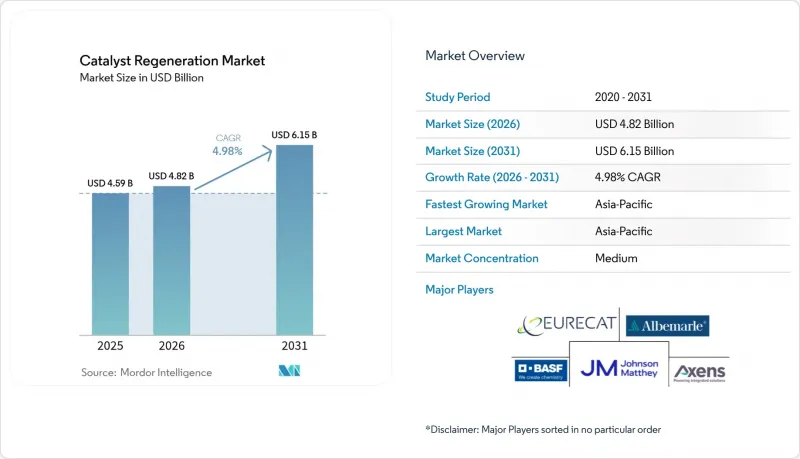
據 Mordor Intelligence 稱,催化劑再生市場在 2025 年的價值為 45.9 億美元,預計到 2031 年將達到 61.5 億美元,而 2026 年為 48.2 億美元,預測期(2026-2031 年)的複合年成長率為 4.98%。
本報告按方法(非原位和原位)、應用領域(煉油廠和石化聯合企業、環境、能源電力及其他應用)和地區(亞太地區、北美地區、歐洲地區、南美地區以及中東和非洲地區)進行細分。市場預測以美元計價。
全球催化劑回收市場趨勢及洞察
對煉油廠和石化廠排放物實施嚴格的環境法規
各國和地區的監管機構正在收緊排放限值,這正在改變催化劑再利用的經濟可行性。美國環保署 (EPA) 修訂的有害空氣污染物標準預計每年可減少 2,200 短噸有毒物質排放,從而帶來超過 1 億美元的健康效益。加州低碳燃料標準 (LCFS) 要求在 2030 年將燃料循環的碳強度降低 30%,到 2045 年降低 90%,這增加了對再生催化劑的需求,以符合生命週期核算規則。歐盟的工業排放指令將催化劑再生納入廢棄物管理的「最佳利用技術 (BAT)」框架,進一步強化了從合規角度優先考慮回收利用而非掩埋處置的趨勢。亞洲各地正在製定類似的監管提案,預計這一趨勢的影響將迅速蔓延。
新型催化劑面臨越來越大的成本壓力
鈀、鉑和銠的價格波動使得採購新催化劑成為一項高風險的預算項目。學術評估表明,再生輕度污染的加氫催化劑可以恢復超過80%的基準活性,而成本不到新催化劑的一半。在海灣化學冶金公司營運的金屬回收設施中,99%的廢催化劑被轉化為可穩定銷售的鉬和鎳,這清楚地展現了循環經濟對精煉廠的益處。在亞太地區,由於其龐大的加工量,成本節省加倍,促使設施管理人員簽訂多年再生協議。
金屬污染催化劑的回收率降低
重質原油中的釩、鎳和鐵會不可逆地與活性位點結合,降低再生率。實驗室研究表明,當釩含量超過5 wt.%時,由於孔隙堵塞和相變,氫脫硫活性會降低一半以上。雖然改良的脫金屬處理可以去除高達89.2%的鎳,但通常會損害骨架結構的穩定性,限制其重複使用。因此,以殘渣為原料的業者會權衡部分回收的成本與購買新催化劑的成本,在某些情況下,他們會選擇丟棄殘渣。
細分市場分析
到2025年,異地設施將佔據催化劑再生市場72.60%的佔有率,這得益於其強大的熱處理和化學處理生產線,能夠恢復80%至90%的催化劑活性。領先的服務供應商在金屬提取前,利用多級窯爐去除碳氫化合物、碳和硫,然後將再生後的催化劑裝入道路運輸桶中,這些運輸桶可以無縫整合到精煉裝置中,之後再運回現場。
隨著臭氧氧化技術的日趨成熟,直接在製程裝置內進行的原位再生技術正以5.72%的複合年成長率快速發展。連續催化重整裝置的運作人員認知到,低溫氧化能夠降低反應器上的金屬應力,從而延長反應器壽命並顯著減少停機時間。早期採用者報告稱,與將物料送至異地相比,週轉時間縮短了10天,催化劑再生成本也降低了近15%。
區域分析
由於其強大的煉油能力、與石化產業的緊密聯繫以及先進的回收法規,預計到2025年,亞太地區將佔全球催化劑需求的42.10%。預計到2031年,亞太地區催化劑回收市場將保持強勁成長,年複合成長率將達5.45%,尤其是在亞太地區。日本的回收企業經營綜合性設施,可以將受污染的催化劑、廢棄電池和電子廢料轉化為高純度的鈀和釩,從而確保國內原料的穩定供應。在印度,待開發區的綜合煉油廠正在加大對廠內回收生產線的投資,以避免跨國廢棄物運輸。
北美受益於監管的確定性和在數位化領域的領先地位。美國墨西哥灣沿岸的煉油廠將運作資料傳送到雲端演算法,這些演算法會提案最佳燃燒時間。同時,加拿大一家加氫裂解裝置根據閉合迴路合約獲得回收的鈷鉬(Co-Mo)系統,該合約保證了金屬的回購價格。碳排放稅抵免是另一個收入來源,它鼓勵中北美地區的獨立煉油廠在合規結算截止日期前安排再生。
在歐洲,嚴格的環境法規與製程技術出口之間力求平衡。法國和德國的持牌公司提供供應和再生服務包,使中東客戶能夠透過歐洲樞紐獲得「從搖籃到搖籃」的全生命週期服務。歐盟對綠色氫能和電子燃料的資助進一步刺激了該地區的需求,因為專用反應器正在轉向使用客製化的催化劑,而這些催化劑需要精確的再生循環才能保持選擇性。
其他好處:
- Excel格式的市場預測(ME)表
- 3個月的分析師支持
目錄
第1章:引言
- 研究假設和市場定義
- 調查範圍
第2章:調查方法
第3章執行摘要
第4章 市場狀況
- 市場概覽
- 市場促進因素
- 對煉油廠和石化廠的排放氣體實施嚴格的環境法規。
- 新型催化劑面臨越來越大的成本壓力
- 碳強度法規支持再生催化劑
- 現場臭氧氧化技術的突破性進步減少了停機時間。
- 透過預測分析實現基於狀態的再生
- 市場限制因素
- 金屬污染催化劑的回收率降低
- 實驗室檢測方法缺乏全球標準
- 一次性奈米催化劑在特定製程的興起
- 價值鏈分析
- 波特五力模型
第5章 市場規模與成長預測
- 透過方法
- Ex-Situ
- In-Situ
- 透過使用
- 煉油廠和石化聯合企業
- 環境
- 能源與電力
- 其他應用(塑膠熱解、特殊應用)
- 按地區
- 亞太地區
- 中國
- 日本
- 印度
- 韓國
- 東南亞國協
- 其他亞太國家
- 北美洲
- 美國
- 加拿大
- 墨西哥
- 歐洲
- 德國
- 英國
- 法國
- 義大利
- 西班牙
- 俄羅斯
- 北歐國家
- 其他歐洲國家
- 南美洲
- 巴西
- 阿根廷
- 其他南美國家
- 中東和非洲
- 沙烏地阿拉伯
- 南非
- 其他中東和非洲國家
- 亞太地區
第6章 競爭情勢
- 市場集中度
- 策略趨勢
- 市佔率和排名分析
- 公司簡介
- Advanced Catalyst Systems
- Albemarle Corporation
- AMETEK Inc.
- Axens
- BASF
- CORMETECH
- EBINGER Katalysatorservice GmbH & Co. KG
- Eurecat
- EvoNik Industries AG
- Honeywell International Inc.
- Johnson Matthey
- NIPPON KETJEN Co. Ltd.
- Topsoe A/S
- WR Grace and Co.
- Yokogawa Cororation. of America
第7章 市場機會與未來展望
According to Mordor Intelligence, the catalyst regeneration market size was valued at USD 4.59 billion in 2025 and estimated to grow from USD 4.82 billion in 2026 to reach USD 6.15 billion by 2031, at a CAGR of 4.98% during the forecast period (2026-2031).
This report is Segmented by Method (Ex-Situ and In-Situ), Application (Refineries and Petrochemical Complexes, Environmental, Energy and Power, and Other Applications), and Geography (Asia-Pacific, North America, Europe, South America, and Middle-East and Africa). The Market Forecasts are Provided in Terms of Value (USD).
Global Catalyst Regeneration Market Trends and Insights
Strict Environmental Regulations on Refinery and Petrochemical Emissions
National and regional regulators are tightening allowable emission limits, changing the economics of catalyst reuse. The U.S. Environmental Protection Agency's updated hazardous-air-pollutant standards will cut toxic releases by 2,200 short tons a year and deliver monetized health benefits exceeding USD 100 million annually. California's Low Carbon Fuel Standard requires a 30% reduction in fuel-cycle carbon intensity by 2030 and 90% by 2045, elevating demand for regenerated catalysts to comply with lifecycle accounting rules. The EU's Industrial Emissions Directive embeds catalyst regeneration in Best Available Techniques for waste treatment, reinforcing a compliance-driven preference for regeneration over landfill. Across Asia, similar limits are being drafted, ensuring the driver's influence spreads rapidly.
Rising Cost Pressure of Fresh Catalysts
Volatile prices for palladium, platinum, and rhodium have turned fresh catalyst procurement into a high-risk budget item. Academic assessments show that regenerating lightly fouled hydroprocessing catalysts recovers more than 80% of baseline activity at less than half the cost of a new supply. Metal-recovery facilities operated by Gulf Chemical and Metallurgical Corporation routinely convert 99% of spent catalyst into sellable molybdenum and nickel streams, illustrating the circular-value upside for refiners. In volume-heavy APAC hubs, the savings multiply, prompting facility managers to lock in multi-year regeneration contracts.
Lower Recovery on Metal-Poisoned Catalysts
Vanadium, nickel, and iron from heavy crudes bind irreversibly to active sites, curtailing regeneration yields. Laboratory work shows vanadium loads above 5 wt.% slash hydrodesulfurization activity by more than half because of pore blockage and phase changes. Although modified demetallization treatments strip up to 89.2% of nickel, they often damage framework stability, limiting reuse cycles. Operators running resid feeds therefore weigh the cost of partial recovery against fresh catalyst outlay, sometimes opting for disposal.
Other drivers and restraints analyzed in the detailed report include:
- Carbon-Intensity Mandates Favouring Regenerated Catalysts
- On-Site Ozone-Oxidation Breakthroughs Cut Downtime
- Lack of Global Lab Test-Method Standards
For complete list of drivers and restraints, kindly check the Table Of Contents.
Segment Analysis
Ex-situ facilities captured 72.60% of the catalyst regeneration market share in 2025 on the strength of robust thermal and chemical treatment trains capable of restoring 80-90% of fresh activity. Leading service providers remove hydrocarbons, carbon, and sulfur in staged kilns before metal extraction, delivering regenerated volumes back to the site in road-approved drums that slot seamlessly into refining units.
In-situ regeneration, applied directly inside process equipment, is gaining 5.72% CAGR momentum as ozone-oxidation technology matures. Continuous catalytic reformer operators appreciate that low-temperature oxidation curbs metallurgical stress on reactors, extending vessel life while slashing downtime. Early adopters report 10-day turnaround savings compared with sending material off-site and cutting the catalyst regeneration market cost per tonne by nearly 15%.
Complete Report Scope:
- By Method
- Ex-Situ
- In-Situ
- By Application
- Refineries and Petrochemical Complexes
- Environmental
- Energy and Power
- Other Application (Plastics Pyrolysis, Speciality)
- By Geography
- Asia-Pacific
- China
- Japan
- India
- South Korea
- ASEAN Countries
- Rest of Asia-Pacific
- North America
- United States
- Canada
- Mexico
- Europe
- Germany
- United Kingdom
- France
- Italy
- Spain
- Russia
- NORDIC Countries
- Rest of Europe
- South America
- Brazil
- Argentina
- Rest of South America
- Middle-East and Africa
- Saudi Arabia
- South Africa
- Rest of Middle-East and Africa
- Asia-Pacific
Geography Analysis
Asia-Pacific carried 42.10% of global demand in 2025 thanks to high refining capacity, deep petrochemical integration, and progressive recycling regulations. Regional growth of 5.45% CAGR through 2031 keeps the catalyst regeneration market firmly centered on APAC. Japanese recyclers run integrated facilities that convert fouled catalyst, spent batteries, and electronic scrap into high-purity palladium and vanadium, ensuring secure domestic raw-material flows. In India, greenfield integrated refineries earmark capex for on-site regeneration trains to avoid cross-border waste shipments.
North America benefits from regulatory certainty and digital leadership. Refineries on the U.S. Gulf Coast stream operating-data feeds to cloud-based algorithms that recommend optimal burn times, while Canadian hydrocrackers receive recycled Co-Mo systems delivered under closed-loop contracts that guarantee metals buy-back pricing. Carbon-tax credits add a second revenue line, nudging mid-continental independent refiners to schedule regeneration just before compliance reconciliation dates.
Europe balances stringent environmental oversight with process-technology exports. French and German licensors bundle supply-and-regeneration packages, allowing clients in the Middle East to receive cradle-to-cradle service routed through European hubs. EU funding for green hydrogen and e-fuels further boosts regional demand as specialty reactors switch to tailored catalyst grades that require precise regeneration cycles to maintain selectivity.
- Advanced Catalyst Systems
- Albemarle Corporation
- AMETEK Inc.
- Axens
- BASF
- CORMETECH
- EBINGER Katalysatorservice GmbH & Co. KG
- Eurecat
- EvoNik Industries AG
- Honeywell International Inc.
- Johnson Matthey
- NIPPON KETJEN Co. Ltd.
- Topsoe A/S
- W.R. Grace and Co.
- Yokogawa Cororation. of America
Additional Benefits:
- The market estimate (ME) sheet in Excel format
- 3 months of analyst support
TABLE OF CONTENTS
1 Introduction
- 1.1 Study Assumptions and Market Definition
- 1.2 Scope of the Study
2 Research Methodology
3 Executive Summary
4 Market Landscape
- 4.1 Market Overview
- 4.2 Market Drivers
- 4.2.1 Strict Environmental Regulations on Refinery And Petrochemical Emissions
- 4.2.2 Rising Cost-Pressure of Fresh Catalysts
- 4.2.3 Carbon-Intensity Mandates Favouring Regenerated Catalysts
- 4.2.4 On-Site Ozone-Oxidation Breakthroughs Cut Downtime
- 4.2.5 Predictive Analytics Enabling Condition-Based Regeneration
- 4.3 Market Restraints
- 4.3.1 Lower Recovery on Metal-Poisoned Catalysts
- 4.3.2 Lack of Global Lab Test-Method Standards
- 4.3.3 Rise of Single-Use Nano-Catalysts in Select Processes
- 4.4 Value Chain Analysis
- 4.5 Porter's Five Forces
- 4.5.1 Bargaining Power of Suppliers
- 4.5.2 Bargaining Power of Buyers
- 4.5.3 Threat of New Entrants
- 4.5.4 Threat of Substitutes
- 4.5.5 Degree of Competition
5 Market Size and Growth Forecasts (Value)
- 5.1 By Method
- 5.1.1 Ex-Situ
- 5.1.2 In-Situ
- 5.2 By Application
- 5.2.1 Refineries and Petrochemical Complexes
- 5.2.2 Environmental
- 5.2.3 Energy and Power
- 5.2.4 Other Application (Plastics Pyrolysis, Speciality)
- 5.3 By Geography
- 5.3.1 Asia-Pacific
- 5.3.1.1 China
- 5.3.1.2 Japan
- 5.3.1.3 India
- 5.3.1.4 South Korea
- 5.3.1.5 ASEAN Countries
- 5.3.1.6 Rest of Asia-Pacific
- 5.3.2 North America
- 5.3.2.1 United States
- 5.3.2.2 Canada
- 5.3.2.3 Mexico
- 5.3.3 Europe
- 5.3.3.1 Germany
- 5.3.3.2 United Kingdom
- 5.3.3.3 France
- 5.3.3.4 Italy
- 5.3.3.5 Spain
- 5.3.3.6 Russia
- 5.3.3.7 NORDIC Countries
- 5.3.3.8 Rest of Europe
- 5.3.4 South America
- 5.3.4.1 Brazil
- 5.3.4.2 Argentina
- 5.3.4.3 Rest of South America
- 5.3.5 Middle-East and Africa
- 5.3.5.1 Saudi Arabia
- 5.3.5.2 South Africa
- 5.3.5.3 Rest of Middle-East and Africa
- 5.3.1 Asia-Pacific
6 Competitive Landscape
- 6.1 Market Concentration
- 6.2 Strategic Moves
- 6.3 Market Share(%)/Ranking Analysis
- 6.4 Company Profiles {(includes Global level Overview, Market level overview, Core Segments, Financials as available, Strategic Information, Market Rank/Share for key companies, Products and Services, and Recent Developments)}
- 6.4.1 Advanced Catalyst Systems
- 6.4.2 Albemarle Corporation
- 6.4.3 AMETEK Inc.
- 6.4.4 Axens
- 6.4.5 BASF
- 6.4.6 CORMETECH
- 6.4.7 EBINGER Katalysatorservice GmbH & Co. KG
- 6.4.8 Eurecat
- 6.4.9 EvoNik Industries AG
- 6.4.10 Honeywell International Inc.
- 6.4.11 Johnson Matthey
- 6.4.12 NIPPON KETJEN Co. Ltd.
- 6.4.13 Topsoe A/S
- 6.4.14 W.R. Grace and Co.
- 6.4.15 Yokogawa Cororation. of America
7 Market Opportunities and Future Outlook
- 7.1 White-space and Unmet-Need Assessment


