


 |
市場調查報告書
商品編碼
2113766
無晶片RFID:市場佔有率分析、產業趨勢與統計、成長預測(2026-2031年)Chipless RFID - Market Share Analysis, Industry Trends & Statistics, Growth Forecasts (2026 - 2031) |
||||||

※ 本網頁內容可能與最新版本有所差異。詳細情況請與我們聯繫。
據 Mordor Intelligence 稱,2025 年無晶片 RFID 市值為 17.3 億美元,預計到 2031 年將從 2026 年的 21.6 億美元成長至 64.9 億美元,預測期(2026-2031 年)的複合年成長率為 24.68%。
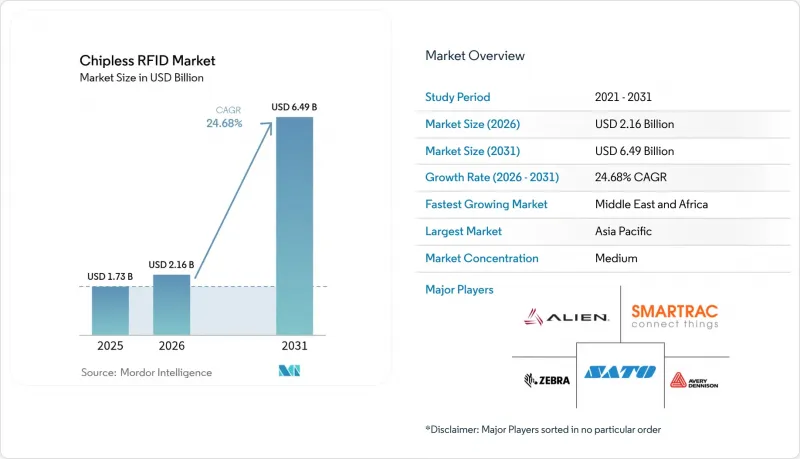
本報告按產品類型(標籤、讀卡器、中間件)、列印技術(噴墨、網版印刷等)、運作頻率(低頻 125–134 kHz 等)、材料(銀奈米墨水、銅基墨水等)、應用(智慧卡、智慧票等)、終端用戶產業(零售/電子商務、醫療保健等)和地區進行細分。市場預測以美元(USD)為單位。
全球無晶片RFID市場趨勢與洞察
亞洲快速消費品包裝中無積體電路標籤的低成本大規模生產
中國和東南亞的製造商正透過將軟式電路板與銀奈米漿料結合,推動無晶片RFID技術在多包裝消費品中的大規模應用,製造出每個成本低於5美分的標籤。代工印刷商正在以每分鐘超過120公尺的速度運作多條柔版印刷生產線,使每家工廠每年能夠生產超過20億個標籤。設備維修的快速投資回報以及與包裝製造商的地理位置接近性,正在加速這項技術的普及。供應商正在試行使用可回收的纖維素基材,以符合品牌的永續發展目標。隨著成本的降低,一次性標籤的應用範圍正在擴展到一次性電子設備和單劑量藥品包裝。
政府對消費稅/印花稅的強制性規定
歐盟因仿冒品造成的損失估計高達160億歐元(173億美元),促使歐盟頒布了2024/1640號指令。該指令建議採用帶有唯一射頻簽章的防篡改識別碼。目前,義大利、西班牙和沙烏地阿拉伯的財政部已指定無晶片格式用於酒類和菸草印花,使印刷商能夠在一次印刷過程中整合安全功能。長期合約正在加速端到端追溯平台的部署,並延長高解析度閱讀器的更新週期。東協正在考慮類似的法規,預計到2028年將出現第二波需求。
讀取範圍限制及與配備晶片的超高頻系統的比較
無晶片標籤的讀取範圍通常在空曠環境下最大僅為3米,而帶有晶片的UHF標籤的讀取範圍則超過10米。這導致倉庫中需要更高的讀寫器密度,基礎設施預算可能因此翻倍。目前處於原型階段的多層超材料天線可以將讀取範圍擴展40%,但由於金屬貨架和液體的存在,訊號衰減仍然存在。系統整合商正在透過基於區域的門戶和混合部署方案來解決這個問題,將無晶片標籤的使用範圍限制在包裝層級的商品上,並繼續在托盤上使用帶有晶片的嵌體。
細分市場分析
預計到2025年,標籤銷售額將佔總收入的70.42%,凸顯了標籤在無晶片RFID市場所有部署場景中的關鍵作用。亞洲的合約印刷商正利用規模經濟降低單位成本,而歐洲的安全印刷商則專注於高價值的認證解決方案。中介軟體收入目前小規模,但隨著企業需要雲端連接器、資料清洗和分析功能將原始射頻回波轉換為可操作的儀表板,預計將以26.05%的複合年成長率快速成長。
中介軟體的加速成長正在改變市場格局,軟體供應商如今能夠影響硬體設計藍圖並推動開放API的普及。因此,標籤製造商正在增加對資訊服務團隊的投入以維持市場佔有率。這一趨勢鞏固了中間件作為未來功能(例如預測性維護和基於人工智慧的簽章匹配)「安全隔離網閘」的地位。
預計到2025年,網版印刷將佔據37.35%的市場佔有率,尤其是在食品飲料包裝領域,這得益於其長期穩定的生產效率和成熟的供應鏈。在無晶片RFID市場,噴墨印刷製程目前正以27.15%的複合年成長率快速成長。這是因為按需噴墨列印頭可以形成精細的天線,適用於高密度特徵編碼。
噴墨技術的應用也支援現場客製化。品牌擁有者可以在產品發布前幾天列印限量版防偽標識,從而降低產品過時的風險。對於產量極高的SKU,網版印刷生產線仍具有優勢,因為模具攤銷成本遠高於換模成本。以網版印刷製作接地層、噴墨印刷製作微型天線的混合生產線正變得越來越普遍,但這反映的是過渡階段,而非完全取代。
區域分析
到2025年,亞太地區將引領無晶片RFID市場,佔39.30%的銷售額。中國加工商正在運作整合網版印刷和柔版印刷的生產線,為國內外市場的快速消費品品牌提供服務。同時,日本鐵路營運商正將RFID票務系統推廣至區域線路。澳洲郵政部門正在試行在跨境小包裹上使用無晶片標籤,以減少申報詐騙。地方政府正根據其零塑膠指南,共同資助可生物分解基材的研究。
北美緊隨其後,這得益於其強大的智慧財產權組合以及醫療和航太領域的早期採用者。大學正與新創公司合作,將石墨烯墨水商業化;聯邦政府津貼支持生技藥品和關鍵零件的安全供應鏈。超級市場連鎖店正在採用無晶片標籤,以減少生鮮食品浪費,並將商品層面的數據納入ESG報告。
歐洲排名第三,但在防偽法規的推動下,正呈現穩定成長態勢。義大利和波蘭的稅票計畫強制要求採用無晶片射頻安全層。北歐包裝公司正在整合紙質嵌體以實現循環經濟目標,德國機械製造商則向亞洲原始設備製造商 (OEM) 供應模組化噴墨列印頭。中東和非洲地區雖然目前規模較小,但成長速度最快。海灣合作理事會 (GCC) 中央銀行正在將射頻認證標準化應用於紙幣,南非海關也正在為高價值出口商品引入無晶片封條。
其他好處:
- Excel格式的市場預測(ME)表
- 3個月的分析師支持
目錄
第1章:引言
- 調查結果
- 研究的先決條件
- 調查範圍
第2章:調查方法
第3章執行摘要
第4章 市場狀況
- 市場概覽
- 市場促進因素
- 亞洲快速消費品包裝中無積體電路標籤的低成本大規模生產
- 強制性政府稅收和稅務印花(歐盟的防偽)
- 北美標籤加工產業導電油墨印刷技術的進步
- 低溫運輸醫療物流中被動感測器的引入
- 對紙幣和安全文件真偽驗證的需求(中東)
- 市場限制因素
- 有限讀取範圍系統與晶片整合式超高頻系統的比較。
- 缺乏統一的 ISO/IEC 編碼標準
- 維修領導基礎設施的成本
- 印刷天線易受潮和磨損
- 價值供應鏈分析
- 技術展望
- 印刷技術
- 噴墨
- 螢幕
- 柔版印刷
- 凹版印刷
- 印刷技術
- 監理展望
- 波特五力模型
- 投資分析
第5章 市場規模與成長預測
- 依產品類型
- 標籤
- 領導者
- 中介軟體
- 按運作頻率
- LF(125~134 kHz)
- HF(13.56 MHz)
- UHF(860~960 MHz)
- 材料
- 銀奈米墨水
- 銅基油墨
- 石墨烯/碳墨
- 透過使用
- 智慧卡
- 智慧票
- 品牌和文件的真偽驗證
- 資產追蹤
- 按最終用戶行業分類
- 零售與電子商務
- 醫療和藥品
- 物流/運輸
- 銀行、金融服務和保險(BFSI)
- 政府/公共部門
- 按地區
- 北美洲
- 美國
- 加拿大
- 墨西哥
- 南美洲
- 巴西
- 阿根廷
- 其他南美國家
- 歐洲
- 英國
- 德國
- 法國
- 義大利
- 西班牙
- 俄羅斯
- 其他歐洲國家
- 亞太地區
- 中國
- 日本
- 韓國
- 印度
- 澳洲
- 其他亞太國家
- 中東和非洲
- GCC
- 南非
- 其他中東和非洲國家
- 北美洲
第6章 競爭情勢
- 市場集中度
- 策略趨勢
- 市佔率分析
- 公司簡介
- Alien Technology
- Avery Dennison
- Zebra Technologies
- SATO Holdings
- Smartrac Technology
- NXP Semiconductors
- Thinfilm Electronics ASA
- PragmatIC Semiconductor
- Impinj Inc.
- Stora Enso
- Spectra Systems Corp.
- Linxens
- TagSense
- Tageos SA
- Variuscard GmbH
- IDTRONIC GmbH
- SML Group
- Toppan Printing Co.
第7章 市場機會與未來展望
According to Mordor Intelligence, the chipless RFID market size was valued at USD 1.73 billion in 2025 and estimated to grow from USD 2.16 billion in 2026 to reach USD 6.49 billion by 2031, at a CAGR of 24.68% during the forecast period (2026-2031).
This report is Segmented by Product Type (Tag, Reader, Middleware), Printing Technology (Ink-Jet, Screen, and More), Operating Frequency (LF 125-134 KHz, and More), Material (Silver-Nano Ink, Copper-Based Ink, and More), Application (Smart Cards, Smart Tickets, and More), End-User Industry (Retail and E-Commerce, Healthcare and More), and by Geography. The Market Forecasts are Provided in Terms of Value (USD).
Global Chipless RFID Market Trends and Insights
Lower-cost Mass Production of IC-less Tags in Asian FMCG Packaging
Manufacturers in China and Southeast Asia have combined flexible substrates with silver-nano paste to reach sub-5-cent tags, positioning the chipless RFID market for high-volume adoption in consumer-goods multipacks. Contract printers are running multi-lane flexographic lines at speeds above 120 m/min, allowing over 2 billion units per plant annually. Fast payback on retrofits and geographic proximity to packaging converters accelerate uptake. Suppliers are piloting recyclable cellulose substrates to align with brand sustainability targets. As costs fall, single-use tags are extending into disposable electronics and unit-dose pharmaceutical packs.
Government Excise / Tax-stamp Mandates
EU loss estimates of EUR 16 billion (USD 17.3 billion) in counterfeited goods prompted Directive 2024/1640, which endorses tamper-evident identifiers with unique RF signatures. Ministries of finance in Italy, Spain, and Saudi Arabia now specify chipless formats for alcohol and tobacco stamps so printers can embed security in a single press pass. Long-run contracts incentivise end-to-end traceability platforms and open replacement cycles for high-resolution readers. Similar legislation is under review in ASEAN, suggesting a second wave of demand by 2028.
Limited Read Range versus Chipped UHF Systems
Chipless tags typically peak at 3 m in free air, compared with over 10 m for chipped UHF tags, forcing warehouses to increase reader density, which can double infrastructure budgets. Multi-layer metamaterial antennas now in prototype add 40% range, yet metallic racks and liquid contents still attenuate signals. Integrators respond with zone-based portals and hybrid deployments, reserving chipless tags for package-level items while pallets continue to carry chipped inlays.
Other drivers and restraints analyzed in the detailed report include:
- Printable Conductive-Ink Advances in North American Label Converting
- Passive Sensor Adoption for Cold-chain Healthcare Logistics
- Absence of Harmonised ISO / IEC Encoding Standards
For complete list of drivers and restraints, kindly check the Table Of Contents.
Segment Analysis
Tag sales generated 70.42% of 2025 revenue, underscoring their indispensability across every deployment scenario in the chipless RFID market. Asian contract printers leverage scale to drive unit costs down, while European security printers focus on high-value authenticators. Middleware revenues, although smaller today, are set to climb faster at a 26.05% CAGR because enterprises require cloud connectors, data cleansing, and analytics to turn raw RF echoes into actionable dashboards.
Accelerated middleware growth alters bargaining power; software vendors now influence hardware design road maps and push for open APIs. As a result, tag manufacturers invest in data-services teams to defend share. The trend positions middleware as a gatekeeper for future functionality such as predictive maintenance and AI-based signature matching.
Screen printing held a 37.35% share in 2025 thanks to long-run productivity and mature supply chains, especially within food and beverage packaging. The chipless RFID market now sees ink-jet processes expanding at 27.15% CAGR because droplet-on-demand heads create fine-line antennas suitable for high-density signature encoding.
Ink-jet adoption also supports on-site customisation. Brand owners can print limited-edition authenticity marks days before product launch, cutting obsolescence risk. Screen lines keep their advantage in very high-volume SKUs where tooling amortisation offsets changeover costs. Hybrid lines that start with screen for ground planes and finish with ink-jet for micro-antennas are gaining traction, reflecting a transition phase rather than outright displacement.
Complete Report Scope:
- By Product Type
- Tag
- Reader
- Middleware
- By Operating Frequency
- LF (125-134 kHz)
- HF (13.56 MHz)
- UHF (860-960 MHz)
- By Material
- Silver-nano Ink
- Copper-based Ink
- Graphene/Carbon Ink
- By Application
- Smart Cards
- Smart Tickets
- Brand and Document Authentication
- Asset Tracking
- By End-user Industry
- Retail and E-commerce
- Healthcare and Pharmaceuticals
- Logistics and Transportation
- Banking, Financial Services and Insurance (BFSI)
- Government and Public Sector
- By Geography
- North America
- United States
- Canada
- Mexico
- South America
- Brazil
- Argentina
- Rest of South America
- Europe
- United Kingdom
- Germany
- France
- Italy
- Spain
- Russia
- Rest of Europe
- Asia Pacific
- China
- Japan
- South Korea
- India
- Australia
- Rest of Asia Pacific
- Middle East and Africa
- GCC
- South Africa
- Rest of Middle East and Africa
- North America
Geography Analysis
Asia Pacific led the chipless RFID market with 39.30% revenue in 2025. China's converters run integrated screen and flexographic lines, serving domestic and export FMCG brands, while Japanese rail operators extend RFID-enabled fare systems to rural routes. Australia's postal service is trialling chipless tags on cross-border parcels to cut declaration fraud. Regional governments co-fund research into biodegradable substrates, aligning with zero-plastic directives.
North America follows with strong intellectual-property portfolios and an early-adopter customer base in healthcare and aerospace. Universities collaborate with start-ups to commercialise graphene inks, and federal grants support secure supply chains for biologics and critical spare parts. Supermarket chains deploy chipless tags to reduce perishables wastage and tie item-level data into ESG reporting.
Europe ranks third yet posts steady gains driven by anti-counterfeiting mandates. Tax-stamp programs in Italy and Poland stipulate chipless RF security layers. Nordic packaging firms integrate paper inlays to meet circular-economy targets, and German machine builders ship modular ink-jet heads to Asian OEMs. The Middle East & Africa region, while smaller today, is the fastest growing; GCC central banks standardise banknote RF authentication and South African customs rolls out chipless seals on high-value exports.
- Alien Technology
- Avery Dennison
- Zebra Technologies
- SATO Holdings
- Smartrac Technology
- NXP Semiconductors
- Thinfilm Electronics ASA
- PragmatIC Semiconductor
- Impinj Inc.
- Stora Enso
- Spectra Systems Corp.
- Linxens
- TagSense
- Tageos SA
- Variuscard GmbH
- IDTRONIC GmbH
- SML Group
- Toppan Printing Co.
Additional Benefits:
- The market estimate (ME) sheet in Excel format
- 3 months of analyst support
TABLE OF CONTENTS
1 INTRODUCTION
- 1.1 Study Deliverables
- 1.2 Study Assumptions
- 1.3 Scope of the Study
2 RESEARCH METHODOLOGY
3 EXECUTIVE SUMMARY
4 MARKET LANDSCAPE
- 4.1 Market Overview
- 4.2 Market Drivers
- 4.2.1 Lower-cost Mass-production of IC-less Tags in Asian FMCG Packaging
- 4.2.2 Government Excise/Tax-stamp Mandates (EU Counter-feiting)
- 4.2.3 Printable Conductive-Ink Advances in North American Label Converting
- 4.2.4 Passive Sensor Adoption for Cold-chain Healthcare Logistics
- 4.2.5 Banknote and Secure-Document Authentication Demand (Middle East)
- 4.3 Market Restraints
- 4.3.1 Limited Read Range vs. Chipped UHF Systems
- 4.3.2 Absence of Harmonised ISO/IEC Encoding Standards
- 4.3.3 Retrofit Cost of Reader Infrastructure
- 4.3.4 Moisture and Abrasion Vulnerability of Printed Antennas
- 4.4 Value / Supply-Chain Analysis
- 4.5 Technological Outlook
- 4.5.1 Printing Technologies
- 4.5.1.1 Ink-jet
- 4.5.1.2 Screen
- 4.5.1.3 Flexographic
- 4.5.1.4 Gravure
- 4.5.1 Printing Technologies
- 4.6 Regulatory Outlook
- 4.7 Porter's Five Forces
- 4.7.1 Threat of New Entrants
- 4.7.2 Bargaining Power of Buyers
- 4.7.3 Bargaining Power of Suppliers
- 4.7.4 Threat of Substitutes
- 4.7.5 Competitive Rivalry
- 4.8 Investment Analysis
5 MARKET SIZE AND GROWTH FORECASTS (VALUE)
- 5.1 By Product Type
- 5.1.1 Tag
- 5.1.2 Reader
- 5.1.3 Middleware
- 5.2 By Operating Frequency
- 5.2.1 LF (125-134 kHz)
- 5.2.2 HF (13.56 MHz)
- 5.2.3 UHF (860-960 MHz)
- 5.3 By Material
- 5.3.1 Silver-nano Ink
- 5.3.2 Copper-based Ink
- 5.3.3 Graphene/Carbon Ink
- 5.4 By Application
- 5.4.1 Smart Cards
- 5.4.2 Smart Tickets
- 5.4.3 Brand and Document Authentication
- 5.4.4 Asset Tracking
- 5.5 By End-user Industry
- 5.5.1 Retail and E-commerce
- 5.5.2 Healthcare and Pharmaceuticals
- 5.5.3 Logistics and Transportation
- 5.5.4 Banking, Financial Services and Insurance (BFSI)
- 5.5.5 Government and Public Sector
- 5.6 By Geography
- 5.6.1 North America
- 5.6.1.1 United States
- 5.6.1.2 Canada
- 5.6.1.3 Mexico
- 5.6.2 South America
- 5.6.2.1 Brazil
- 5.6.2.2 Argentina
- 5.6.2.3 Rest of South America
- 5.6.3 Europe
- 5.6.3.1 United Kingdom
- 5.6.3.2 Germany
- 5.6.3.3 France
- 5.6.3.4 Italy
- 5.6.3.5 Spain
- 5.6.3.6 Russia
- 5.6.3.7 Rest of Europe
- 5.6.4 Asia Pacific
- 5.6.4.1 China
- 5.6.4.2 Japan
- 5.6.4.3 South Korea
- 5.6.4.4 India
- 5.6.4.5 Australia
- 5.6.4.6 Rest of Asia Pacific
- 5.6.5 Middle East and Africa
- 5.6.5.1 GCC
- 5.6.5.2 South Africa
- 5.6.5.3 Rest of Middle East and Africa
- 5.6.1 North America
6 COMPETITIVE LANDSCAPE
- 6.1 Market Concentration
- 6.2 Strategic Moves
- 6.3 Market Share Analysis
- 6.4 Company Profiles (includes Global level Overview, Market level overview, Core Segments, Financials as available, Strategic Information, Market Rank/Share, Products and Services, Recent Developments)
- 6.4.1 Alien Technology
- 6.4.2 Avery Dennison
- 6.4.3 Zebra Technologies
- 6.4.4 SATO Holdings
- 6.4.5 Smartrac Technology
- 6.4.6 NXP Semiconductors
- 6.4.7 Thinfilm Electronics ASA
- 6.4.8 PragmatIC Semiconductor
- 6.4.9 Impinj Inc.
- 6.4.10 Stora Enso
- 6.4.11 Spectra Systems Corp.
- 6.4.12 Linxens
- 6.4.13 TagSense
- 6.4.14 Tageos SA
- 6.4.15 Variuscard GmbH
- 6.4.16 IDTRONIC GmbH
- 6.4.17 SML Group
- 6.4.18 Toppan Printing Co.
7 MARKET OPPORTUNITIES AND FUTURE OUTLOOK
- 7.1 White-space and Unmet-need Assessment

 2026年全球即時偵測領導者市場報告
 醫療智慧卡讀卡機市場規模、佔有率和成長分析:按產品類型、技術、最終用戶和地區分類-2026-2033年產業預測
 無晶片RFID市場分析及預測(至2035年):依類型、產品類型、技術、組件、應用、材料類型、最終用戶、功能、安裝類型及解決方案分類2026年全球醫療保健智慧卡讀卡機市場報告
 全球醫療智慧卡讀卡機市場規模、佔有率、趨勢和成長分析報告(2026-2034年)2026年全球印刷式和無晶片無線射頻識別(RFID)市場報告
 無晶片RFID市場-全球產業規模、佔有率、趨勢、機會和預測:按產品類型、組件類型、頻率範圍、應用、最終用戶、地區和競爭格局分類,2021-2031年
 無晶片 RFID 市場(按組件類型、行業垂直和地區分類)
 無晶片 RFID 市場規模、佔有率和成長分析(按產品類型、頻段、應用、最終用戶和地區)- 產業預測 2025-2032
 全球醫療保健智慧卡讀卡機市場