


 |
市場調查報告書
商品編碼
2113739
飼料偏好增強劑:市場佔有率分析、產業趨勢與統計、成長預測(2026-2031)Feed Palatability Enhancers - Market Share Analysis, Industry Trends & Statistics, Growth Forecasts (2026 - 2031) |
||||||

※ 本網頁內容可能與最新版本有所差異。詳細情況請與我們聯繫。
根據 Mordor Intelligence 預測,飼料偏好增強劑的市場規模預計將從 2025 年的 34.1 億美元成長到 2026 年的 36.5 億美元,到 2031 年將達到 51.2 億美元,2026 年至 2031 年的複合年成長率為 7.01%。
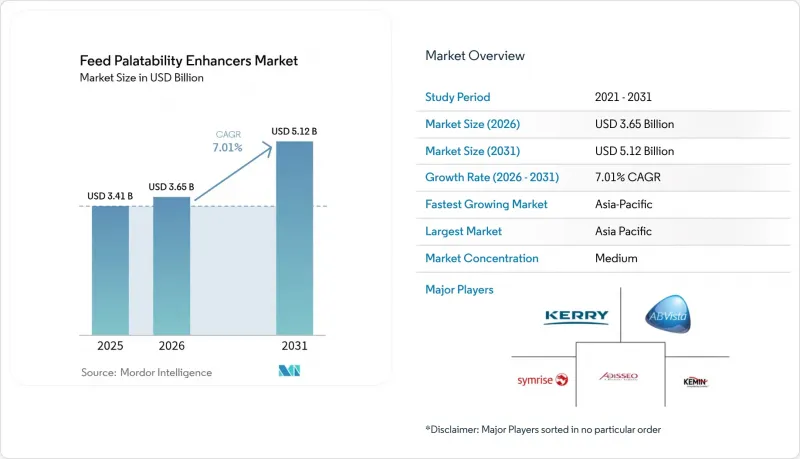
本報告按類型(香料、甜味劑等)、動物種類(反芻動物、家禽、豬、水產養殖等)和地區(北美、歐洲、亞太、南美等)分類。市場預測以美元計價。
全球飼料偏好增強劑市場趨勢及洞察
對不使用抗生素的畜牧業的需求日益成長
監管機構對抗生素生長促進劑的禁令為偏好增強劑的推廣創造了有利條件,迫使生產者透過感官吸引力而非藥物刺激食慾來維持飼料攝取量。美國食品藥物管理局(FDA)於2017年頒布並於2023年加強的《獸用飼料指令》(VFD)限制了飼料中具有重要醫療價值的抗生素的使用,促使綜合性畜牧企業轉向以風味為基礎的解決方案,以維持每日增重。根據泰國畜牧發展部的報告顯示,2023年至2024年間,泰國合約肉雞生產商對偏好增強劑的使用率增加了22%。這與該國逐步淘汰粘菌素和桿菌肽鋅的政策相吻合。這項監管措施目前正在印度蔓延。印度食品安全標準局 (FSSAI)提案在 2024 年底限制家禽和水產養殖複合飼料中的抗生素使用。這可能會為每年 8.5 億隻家禽打開一個市場。
寵物食品的優質化與人性化
寵物飼主越來越將寵物視為家庭成員,他們要求寵物食品的成分透明,並追求符合人類飲食趨勢的美味口感。根據尼爾森2024年的數據,美國超高階寵物食品的銷量年增14%,其中濕糧的價格比乾糧高出32%。這主要是因為肉汁和肉湯中添加了偏好增強劑。凱利集團的「口味與營養」部門於2025年初推出了一系列源自發酵魚蛋白的偏好增強劑。此系列產品專門針對濕貓糧市場,並指出消費者願意為標有「不含人工香料」的產品支付每85克多0.4美元。這種「人性化」趨勢也延伸到了零食領域。凱敏工業公司於2024年中期推出了一種偏好增強系統,該系統能夠模擬陳年乳酪的鮮味,以滿足訓練獎勵和潔齒棒的優質化。
植物來源原料和蛋白質水解物的價格波動
受天氣和出口限制影響,作物減產導致關鍵偏好成分成本上升,利潤空間受到擠壓。因此,供應商被迫修改配方或將價格上漲轉嫁給消費者,導致需求放緩。 2024年1月至9月,酵母萃取物物價格上漲了22%。這是由於巴西甘蔗短缺,導致糖蜜供應減少,而糖蜜是發酵型偏好增強劑的關鍵成分。此外,西班牙安達盧西亞的乾旱導致作物減產40%,使得2024年初迷迭香萃取物價格飆升31%,並擾亂了天然寵物食品偏好增強劑的供應鏈。原料採購垂直整合不足的中小型偏好增強劑生產商面臨嚴峻壓力,東南亞多家區域供應商在未能獲得酵母和水解物的長期供應合約後,於2024年退出市場。
細分市場分析
截至2025年,調味劑將佔飼料偏好增強劑市場規模的37.45%,預計2031年將以7.16%的複合年成長率成長。調味劑因其適用於不同物種和飼料形式而成為主要類別。調味系統可以掩蓋高蛋白飼料固有的苦味,並刺激不同物種的嗅覺受體。凱利集團2024年的產品平臺包括12種針對家禽特定生命階段的新型調味料系統。例如,一種專為促進從雛雞幼畜飼料過渡到育成雞飼料而設計的幼畜飼料調味劑,旨在解決採食量下降導致長期生產力下降的問題。
在許多情況下,親水膠體或改性澱粉基增稠劑與香精結合使用,既能提高顆粒的耐久性,又能掩蓋高濃度替代蛋白(例如昆蟲粉或單細胞蛋白)產生的異味,從而創造出偏好極佳的產品。BASF於2024年推出的寵物零食香精增稠劑組合,解決了偏好和咀嚼性的雙重難題,在功能性和感官吸引力必須兼顧的細分市場中贏得了市場佔有率。將合成基礎成分與天然香料相結合的混合配方正逐漸成為一種切實可行的折衷方案,既經濟高效,又能透過對法規的謹慎解讀滿足「不含人工香料」的標籤要求。
區域分析
亞太地區正引領飼料偏好增強劑市場的發展,預計2025年將佔33.60%的市場佔有率,並在2031年之前維持8.34%的年複合成長率(CAGR)。這主要得益於中國畜牧業的現代化、越南擴大蝦類出口的雄心壯志以及印度家禽業的擴張。預計到2024年,中國複合飼料產量將達2.8億噸。隨著綜合性畜牧企業採用取代禁用抗生素的營養策略,商業飼料中偏好增強劑的滲透率將從2020年的42%上升至2024年的約58%。全球最大的飼料生產商泰國正大食品公司於2024年中期宣布,將在其亞洲各地的家禽養殖業務中規範化使用偏好增強劑的配方。這項決定將影響每年超過 2000 萬噸的飼料生產,顯示偏好增強劑正在成為主流。
北美和歐洲市場正在擴張,成長並非集中在傳統的家禽和生豬養殖領域,而是集中在寵物食品和有機畜牧業。根據美國農業部報告,預計到2024年,有機肉雞產量將增加11%,而有機認證的偏好增強劑對於維持國家有機計畫(NOP)標準的認證至關重要。在法國,動物福利法規正推動家禽業轉向生長速度較慢的品種,與傳統的35-42天飼養週期相比,這些品種需要持續56-70天的飼料週期,從而增加了對偏好增強劑的需求。
中東和非洲地區正處於快速成長期,這主要得益於沙烏地阿拉伯、埃及和南非家禽業的擴張,以及肯亞和奈及利亞水產養殖業的早期發展。沙烏地阿拉伯的「2030願景」農業多元化策略包含一項目標,即雞肉自給率達70%。在沙漠氣候下,熱應激會降低採食量,因此,飼料添加劑被視為提高飼料轉換率、增強偏好的有效手段。埃及家禽業正從2023年的禽流感疫情中恢復,2024年,隨著養殖戶尋求透過改善幼畜飼料的性能來加快雞群重組,偏好增強劑的使用量增加。
其他好處:
- Excel格式的市場預測(ME)表
- 3個月的分析師支持
目錄
第1章:引言
- 研究假設和市場定義
- 調查範圍
第2章:調查方法
第3章執行摘要
第4章 市場狀況
- 市場概覽
- 市場促進因素
- 對無抗生素畜牧養殖的需求日益成長
- 寵物食品的優質化與人性化
- 擴大家禽和豬的精準飼餵平台
- 亞太地區水產養殖的快速集約化
- 用於顆粒飼料的耐熱天然風味技術
- 基於區塊鏈的原料可追溯性正在提升潔淨標示的說法。
- 市場限制因素
- 植物來源原料和蛋白質水解物的價格波動
- 人工甜味劑的嚴格區域核准標準
- 特種胺基酸供應鏈中斷
- 消費者對高檔寵物食品中的化學香精持懷疑態度。
- 監理情勢
- 技術展望
- 波特五力分析
第5章 市場規模與成長預測
- 按類型
- 味道
- 甜味劑
- 香氣增強劑
- 依動物類型
- 家禽
- 豬
- 反芻動物
- 水產養殖
- 其他動物類型
- 按地區
- 北美洲
- 美國
- 加拿大
- 墨西哥
- 其他北美國家
- 南美洲
- 巴西
- 阿根廷
- 其他南美國家
- 歐洲
- 德國
- 英國
- 法國
- 西班牙
- 義大利
- 俄羅斯
- 其他歐洲國家
- 亞太地區
- 中國
- 日本
- 印度
- 澳洲
- 其他亞太國家
- 中東
- 沙烏地阿拉伯
- 阿拉伯聯合大公國
- 其他中東國家
- 非洲
- 南非
- 埃及
- 其他非洲國家
- 北美洲
第6章 競爭情勢
- 策略趨勢
- 市佔率分析
- 公司簡介
- Kerry Group plc
- Associated British Foods plc
- Symrise AG
- Bluestar Adisseo Co. Ltd
- Kemin Industries Inc.
- DSM-Firmenich AG
- BASF SE
- Cargill Incorporated
- ADM
- Nutreco NV
- Novus International Inc.
- Alltech Inc.
- Evonik Industries AG
- CJ CheilJedang Corporation
- DuPont de Nemours Inc.
第7章 市場機會與未來展望
According to Mordor Intelligence, the feed palatability enhancers market size is expected to grow from USD 3.41 billion in 2025 to USD 3.65 billion in 2026 and is forecast to reach USD 5.12 billion by 2031 at 7.01% CAGR over 2026-2031.
This report is Segmented by Type (Flavors, Sweeteners, and More), by Animal Type (Ruminant, Poultry, Swine, Aquaculture, and More), and by Geography (North America, Europe, Asia-Pacific, South America, and More). The Market Forecasts are Provided in Terms of Value (USD).
Global Feed Palatability Enhancers Market Trends and Insights
Rising Demand for Antibiotic-Free Livestock Production
Regulatory bans on antibiotic growth promoters have created a structural tailwind for palatability enhancers by forcing producers to maintain feed intake through sensory appeal rather than pharmaceutical appetite stimulation. The United States Food and Drug Administration's Veterinary Feed Directive, implemented in 2017 and tightened in 2023, restricts medically important antibiotics in feed, pushing integrators toward flavor-based solutions that preserve daily weight gain . In Thailand, the Department of Livestock Development reported a 22% increase in palatant adoption among contract broiler growers between 2023 and 2024, correlating with the country's phase-out of colistin and zinc bacitracin. This regulatory momentum is now extending to India, where the Food Safety and Standards Authority of India proposed antibiotic restrictions in compound feeds for poultry and aquaculture in late 2024, potentially unlocking a market serving 850 million birds annually.
Premiumization and Humanization of Pet Nutrition
Pet owners increasingly treat companion animals as family members, demanding ingredient transparency and gourmet flavor profiles that mirror human food trends. Nielsen data for 2024 indicate that super-premium pet food sales in the United States grew 14% year-over-year, with wet diets commanding a 32% price premium over dry kibble, driven largely by palatant-enhanced gravies and broths. Kerry Group's Taste and Nutrition division launched a range of fermented fish-protein palatants in early 2025, specifically targeting the feline wet-food segment, citing consumer willingness to pay USD 0.40 more per 85-gram pouch for products labeled no artificial flavors. This humanization extends to treats, where Kemin Industries introduced a palatable system in mid-2024 that replicates the umami profile of aged cheeses, addressing the premiumization of training rewards and dental chews.
Volatile Prices of Botanical and Protein-Hydrolysate Inputs
Weather-driven crop failures and export restrictions are inflating costs for key palatable raw materials, compressing margins, and forcing suppliers to reformulate or pass through price increases that dampen demand. Yeast-extract prices rose 22% between January and September 2024, driven by Brazilian sugarcane shortages that reduced molasses availability, a primary feedstock for fermentation-based palatants. Rosemary-extract quotations surged 31% in early 2024 after drought in Spain's Andalusia region cut harvest volumes by 40%, disrupting supply chains for natural pet food palatants. Smaller palatant producers lacking vertical integration into raw-material sourcing face acute pressure, with several regional suppliers in Southeast Asia exiting the market in 2024 after failing to secure long-term contracts for yeast and hydrolysate supplies.
Other drivers and restraints analyzed in the detailed report include:
- Expansion of Precision-Feeding Platforms in Poultry and Swine
- Rapid Aquaculture Intensification in Asia-Pacific
- Stringent Regional Approvals for Synthetic Sweeteners
For complete list of drivers and restraints, kindly check the Table Of Contents.
Segment Analysis
The flavors category accounted for 37.45% of the feed palatability enhancers market size in 2025 and is projected to grow at a 7.16% CAGR through 2031. Flavors remain the dominant category due to their versatility across species and feed formats. Flavor systems mask bitter notes from high-protein diets and stimulate olfactory receptors across species. Kerry Group's 2024 product pipeline included 12 new flavor systems targeting specific life stages in poultry, such as a starter-diet flavor designed to ease the transition from pre-starter to grower rations, addressing a pain point where intake dips often trigger long-term performance penalties .
Texturants, often based on hydrocolloids or modified starches, are being co-formulated with flavors to create palatable systems that improve pellet durability while masking off-notes from high-inclusion alternative proteins such as insect meal or single-cell proteins. BASF's 2024 launch of a combined flavor-texturant for pet treats addressed the dual challenge of palatability and dental-chew hardness, capturing share in a segment where functionality and sensory appeal must coexist. Blended formulations, which combine synthetic backbones with natural top-notes, are emerging as a pragmatic middle ground, offering cost efficiency while meeting no artificial flavors claims through careful regulatory interpretation.
Complete Report Scope:
- By Type
- Flavors
- Sweeteners
- Aroma Enhancers
- By Animal Type
- Poultry
- Swine
- Ruminant
- Aquaculture
- Other Animal Types
- By Geography
- North America
- United States
- Canada
- Mexico
- Rest of North America
- South America
- Brazil
- Argentina
- Rest of South America
- Europe
- Germany
- United Kingdom
- France
- Spain
- Italy
- Russia
- Rest of Europe
- Asia-Pacific
- China
- Japan
- India
- Australia
- Rest of Asia-Pacific
- Middle East
- Saudi Arabia
- United Arab Emirates
- Rest of Middle East
- Africa
- South Africa
- Egypt
- Rest of Africa
- North America
Geography Analysis
The Asia-Pacific region led the feed palatability enhancers market, holding a 33.60% share in 2025, with a projected CAGR of 8.34% through 2031, driven by China's livestock modernization, Vietnam's ambitions in shrimp exports, and India's expansion in the poultry sector. China's compound feed production reached 280 million metric tons in 2024, with palatable penetration rates in commercial feeds rising from 42% in 2020 to an estimated 58% in 2024 as integrators adopt nutritional strategies to replace banned antibiotics. Thailand's Charoen Pokphand Foods, the world's largest animal-feed producer, announced in mid-2024 that it would standardize palatable inclusion across its Asian poultry operations, a decision that affects over 20 million metric tons of annual feed output and signals mainstream acceptance of palatability enhancement.
North America and Europe are expanding, with growth concentrated in the pet food and organic livestock segments, rather than in conventional poultry and swine. The United States Department of Agriculture reported that organic broiler production grew 11% in 2024, with organic-certified palatants becoming a prerequisite for maintaining certification under National Organic Program standards. In France, the poultry sector's shift toward slower-growing breeds, driven by animal welfare regulations, is increasing palatable demand as longer grow-out periods require sustained feed intake over 56-70 day cycles, versus conventional 35-42 day programs.
The Middle East and Africa are growing regions, driven by poultry-sector expansion in Saudi Arabia, Egypt, and South Africa, alongside nascent aquaculture development in Kenya and Nigeria. Saudi Arabia's Vision 2030 agricultural diversification strategy includes targets for 70% self-sufficiency in poultry meat, with palatants identified as a tool to improve feed efficiency in desert climates where heat stress depresses intake. Egypt's poultry sector, recovering from avian influenza outbreaks in 2023, experienced increased palatable adoption in 2024 as producers sought to accelerate flock rebuilding through improved starter diet performance.
List of Companies Covered in this Report:
- Kerry Group plc
- Associated British Foods plc
- Symrise AG
- Bluestar Adisseo Co. Ltd
- Kemin Industries Inc.
- DSM-Firmenich AG
- BASF SE
- Cargill Incorporated
- ADM
- Nutreco N.V.
- Novus International Inc.
- Alltech Inc.
- Evonik Industries AG
- CJ CheilJedang Corporation
- DuPont de Nemours Inc.
Additional Benefits:
- The market estimate (ME) sheet in Excel format
- 3 months of analyst support
TABLE OF CONTENTS
1 INTRODUCTION
- 1.1 Study Assumptions and Market Definition
- 1.2 Scope of the Study
2 RESEARCH METHODOLOGY
3 EXECUTIVE SUMMARY
4 MARKET LANDSCAPE
- 4.1 Market Overview
- 4.2 Market Drivers
- 4.2.1 Rising demand for antibiotic-free livestock production
- 4.2.2 Premiumization and humanization of pet nutrition
- 4.2.3 Expansion of precision-feeding platforms in poultry and swine
- 4.2.4 Rapid aquaculture intensification in Asia-Pacific
- 4.2.5 Heat-stable natural flavor technologies for pelleted feeds
- 4.2.6 Blockchain-enabled raw-material traceability boosting clean-label claims
- 4.3 Market Restraints
- 4.3.1 Volatile prices of botanical and protein-hydrolysate inputs
- 4.3.2 Stringent regional approvals for synthetic sweeteners
- 4.3.3 Supply-chain disruptions for specialty amino acids
- 4.3.4 Consumer skepticism toward chemical aromas in premium pet food
- 4.4 Regulatory Landscape
- 4.5 Technological Outlook
- 4.6 Porter's Five Forces Analysis
- 4.6.1 Bargaining Power of Suppliers
- 4.6.2 Bargaining Power of Buyers
- 4.6.3 Threat of New Entrants
- 4.6.4 Threat of Substitutes
- 4.6.5 Intensity of Competitive Rivalry
5 MARKET SIZE AND GROWTH FORECASTS (VALUE)
- 5.1 By Type
- 5.1.1 Flavors
- 5.1.2 Sweeteners
- 5.1.3 Aroma Enhancers
- 5.2 By Animal Type
- 5.2.1 Poultry
- 5.2.2 Swine
- 5.2.3 Ruminant
- 5.2.4 Aquaculture
- 5.2.5 Other Animal Types
- 5.3 By Geography
- 5.3.1 North America
- 5.3.1.1 United States
- 5.3.1.2 Canada
- 5.3.1.3 Mexico
- 5.3.1.4 Rest of North America
- 5.3.2 South America
- 5.3.2.1 Brazil
- 5.3.2.2 Argentina
- 5.3.2.3 Rest of South America
- 5.3.3 Europe
- 5.3.3.1 Germany
- 5.3.3.2 United Kingdom
- 5.3.3.3 France
- 5.3.3.4 Spain
- 5.3.3.5 Italy
- 5.3.3.6 Russia
- 5.3.3.7 Rest of Europe
- 5.3.4 Asia-Pacific
- 5.3.4.1 China
- 5.3.4.2 Japan
- 5.3.4.3 India
- 5.3.4.4 Australia
- 5.3.4.5 Rest of Asia-Pacific
- 5.3.5 Middle East
- 5.3.5.1 Saudi Arabia
- 5.3.5.2 United Arab Emirates
- 5.3.5.3 Rest of Middle East
- 5.3.6 Africa
- 5.3.6.1 South Africa
- 5.3.6.2 Egypt
- 5.3.6.3 Rest of Africa
- 5.3.1 North America
6 COMPETITIVE LANDSCAPE
- 6.1 Strategic Moves
- 6.2 Market Share Analysis
- 6.3 Company Profiles (Includes Global Level Overview, Market Level Overview, Core Segments, Financials as Available, Strategic Information, Market Rank/Share, Products and Services, Recent Developments)
- 6.3.1 Kerry Group plc
- 6.3.2 Associated British Foods plc
- 6.3.3 Symrise AG
- 6.3.4 Bluestar Adisseo Co. Ltd
- 6.3.5 Kemin Industries Inc.
- 6.3.6 DSM-Firmenich AG
- 6.3.7 BASF SE
- 6.3.8 Cargill Incorporated
- 6.3.9 ADM
- 6.3.10 Nutreco N.V.
- 6.3.11 Novus International Inc.
- 6.3.12 Alltech Inc.
- 6.3.13 Evonik Industries AG
- 6.3.14 CJ CheilJedang Corporation
- 6.3.15 DuPont de Nemours Inc.


