


 |
市場調查報告書
商品編碼
2113713
餘熱回收鍋爐:市場佔有率分析、產業趨勢與統計、成長預測(2026-2031)Heat Recovery Steam Generator - Market Share Analysis, Industry Trends & Statistics, Growth Forecasts (2026 - 2031) |
||||||

※ 本網頁內容可能與最新版本有所差異。詳細情況請與我們聯繫。
預計廢熱回收鍋爐的市場規模將從 2025 年的 15.1 億美元成長到 2026 年的 15.9 億美元,然後從 2026 年到 2031 年以 5.01% 的複合年成長率成長,到 2031 年達到 20.2 億美元。
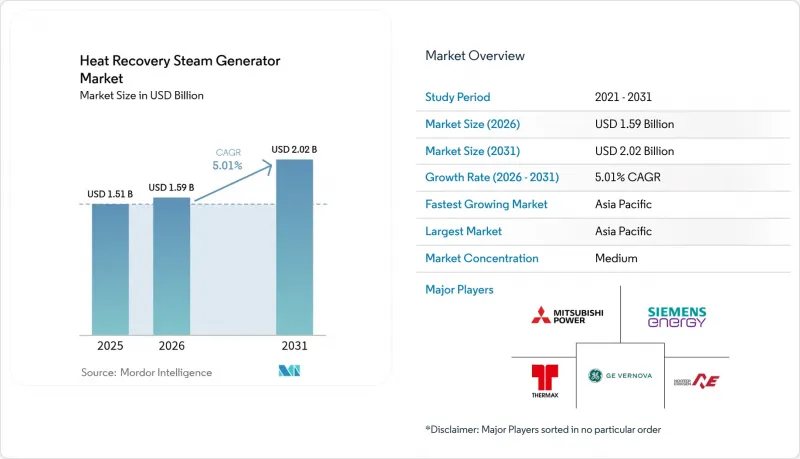
本報告按設計類型(臥式滾筒餘熱鍋爐、立式滾筒餘熱鍋爐和單程餘熱鍋爐)、最終用戶(發電廠、石油和天然氣設施、化工和化肥廠、金屬和礦業、紙漿和造紙等)以及地區(北美、歐洲、亞太、南美以及中東和非洲)進行細分。市場規模和預測均以美元計價。
全球餘熱回收鍋爐市場趨勢及洞察
計畫擴大燃氣複合循環設備產能
全球開發商預計,到2028年,美國將新增超過18.7吉瓦的聯合循環發電裝置容量,沙烏地阿拉伯、卡達和中國也有數吉瓦的計畫正在同步運作中。專案發起人正在指定使用能夠處理氫燃料汽輪機更寬廢氣溫度範圍的餘熱鍋爐(HRSG),並整合廢氣再循環(EGR)技術,以降低6%的碳捕整合本。由於汽輪機訂單已持續到2029年,電力公司正在提前訂購設備,這使得擁有內部模組製造能力的供應商獲得了競爭優勢。充足的專案儲備為餘熱鍋爐市場提供了數年的收入前景,但進度風險仍取決於汽輪機的供應和資金籌措進展。隨著業主對快速運作、部分負荷下的效率以及在高氫含量燃燒氣體下材料的耐久性提出更高的要求,設計複雜性也在增加。
工業部門減排法規
美國環保署 (EPA) 目前強制要求長期運作中的燃煤發電廠和新建的基本負載燃氣電廠在 2032 年前將二氧化碳排放量減少 90%,這促使工業園區內對以餘熱鍋爐 (HRSG) 技術為核心的汽電共生電廠維修和建設。歐洲化學製造商的案例,例如BASF在德國建造的 160 兆瓦熱泵-蒸氣聯合循環裝置,清楚地展示了這些法規如何將環境合規轉化為對能源效率的投資。追求淨零排放的工廠正在採用三壓餘熱鍋爐,為製程蒸氣和溶劑回收裝置提供蒸汽。化學和化學肥料製造商正在探索能夠處理胺再生負荷的配置方案,從而在不影響加工能力的前提下滿足法規要求。那些早期開展授權和技術整合的先行者,正受益於整個生命週期內合規成本的降低以及碳權額度帶來的潛在收益增加。
與其它方案相比,前期投入成本高,投資回收期長。
配備三壓餘熱鍋爐的典型燃氣複合循環機組(CCGT)每兆瓦成本比開式循環燃氣渦輪機電廠高出25萬美元,且在低容量電網中運轉率長達8-12年。東南亞和非洲的開發商面臨更高的資金籌措,因此擴大選擇成本更低、效率更低的開式循環燃氣渦輪機組。因此,餘熱回收鍋爐市場的成長往往由那些提供容量支付方案和能源效率提升獎勵的地區所推動。多邊金融機構正試圖透過綠色債券框架來彌補資金籌措缺口,但資金轉移時間的延遲可能導致訂單的延誤。
細分市場分析
儘管目前單程式餘熱回收鍋爐(HRSG)仍佔少數,但預計到2031年將以6.46%的複合年成長率成長。同時,2025年汽包式系統佔總銷售量的58.12%。臥式汽包機組因其穩定的蒸氣純度和久經考驗的耐久性,在基本負載機組(CCGT)中仍佔據主導地位。立式汽包機組則特別適用於空間受限的維修項目,例如煉油廠。單程序餘熱回收鍋爐的市場規模預計將從2026年的4.9億美元成長到2031年的6.7億美元,促使供應商更加重視快速啟動設計。不到30分鐘的啟動時間使電廠業者能夠準確掌握尖峰時段價格區間,而汽包式系統平均仍需60至90分鐘。使用氫燃料的初步試驗表明,單程管式迴路中氯化物引起的應力腐蝕有所降低,這種設計被視為應對未來燃料轉型的有效策略。儘管如此,水質要求依然嚴格,電廠業主正在投資冷凝水淨化撬裝設備來保護渦輪葉片。
在超過 800 兆瓦的大型聯合循環燃氣渦輪機 (CCGT) 專案中,熟悉的佈局和規模經濟往往是優先考慮的因素,因此水平汽包式餘熱鍋爐 (HRSG) 預計將繼續主導餘熱鍋爐市場。原始設備製造商 (OEM) 正在透過將三級壓力系統與再熱系統相結合,將聯合循環淨效率最大化至 64% 以上,正如泰國 5300 兆瓦的 M701JAC叢集所展示的那樣。諸如 3D 列印的低壓節熱器翅片和先進的 T91 鋼製集管等改進措施可減少循環疲勞,從而延長檢查週期。在整個預測期內,智慧吹灰和紅外線管監測等分階段升級將延長汽包式機組的使用壽命,即使直流式機組在中型電廠中越來越普遍。
區域分析
亞太地區在市場佔有率和成長率方面繼續保持主導地位。預計到2025年,該地區將佔全球銷售額的42.55%,到2031年,其收入將成長2.2億美元,複合年成長率(CAGR)為5.73%。這主要得益於中國、印度、越南和泰國的多吉瓦級燃氣複合循環發電(CCGT)擴建計畫。中國惠州一座採用先進翅片管合金的直流式餘熱鍋爐(HRSG)的氫能汽電共生,便是開發商確保其資產能夠適應未來50%氫氣燃燒的典型案例。印度的國家氫能計畫正在推動古吉拉突邦和奧裡薩邦雙燃料燃氣渦輪機汽電共生設施的運作維修。在日本,緊湊型立式棕地餘熱鍋爐因其在電網改造項目中的適用性而備受青睞,部分原因是在地採購獎勵。
在北美,需求正透過設備更新周期和排放標準來維持。美國環保署 (EPA) 90% 的二氧化碳減排規定正在加速燃煤發電廠的改造,這些電廠採用配備溶劑再生式熱交換器備用墊片的 CCGT-HRSG 機組。美國墨西哥灣沿岸的煉油廠正在使用源自飛機的燃氣渦輪機中的直接作用式 HRSG,以對沖液化天然氣價格波動和擬議的碳定價。加拿大亞伯達的一個工業碳捕集中心正在透過與 HRSG 供應商簽訂契約,為整合燃燒後捕集技術的垃圾焚化發電發電廠拓展非電力應用場景。
在歐洲,高效率的氫氣注入式餘熱回收蒸汽發生器(HRSG)正推動著脫碳進程。隨著德國逐步淘汰不受控制的燃煤電廠,電力公司現在訂購的是具有廢氣再循環功能的三壓再熱系統,以實現餘熱回收。在荷蘭,溫室園藝產業正在大力升級熱電聯產(CHP)系統,這為緊湊型雙壓HRSG與小型汽輪機的組合開闢了新的市場。然而,由於高度依賴亞洲壓力零件製造商的供應鏈,歐洲專案面臨物流延誤的風險,因此人們對本地模組組裝的興趣日益濃厚。
在中東,隨著「2030願景」和產業多元化的推進,訂單正在加速成長。在沙烏地阿拉伯7.2吉瓦的燃氣聯合循環發電(CCGT)專案中,指定使用碳捕集型餘熱鍋爐(HRSG),處理46巴低壓蒸氣,以滿足溶劑再生需求,這表明其設計比傳統的蒸發器組更為複雜。在卡達的諾斯菲爾德液化天然氣(LNG)擴建計畫中,緊湊型餘熱鍋爐被用於源自航空的渦輪機中,以最大限度地提高模組化整合度。阿拉伯聯合大公國的電力公司優先簽訂能夠保證98%運轉率的服務契約,這為原始設備製造商(OEM)帶來了售後服務收入。
南美洲和非洲仍在發展中,但未來潛力巨大。在巴西,燃氣發電計畫正在進行競標,以補充太陽能和風能發電,其中包括巴伊亞州的一座電廠,該電廠安裝了本地製造的立式滾筒餘熱鍋爐,以滿足在地採購規定。在奈及利亞和莫三比克,小型聯合循環燃氣渦輪機(CCGT)計畫正在為工業園區進行評估,但資金籌措挑戰依然存在。儘管如此,隨著該地區天然氣蘊藏量的發現和基礎設施的建設,這兩個大洲有望成為長期成長的重點區域。
其他好處:
- Excel格式的市場預測(ME)表
- 3個月的分析師支持
目錄
第1章:引言
- 研究假設和市場定義
- 調查範圍
第2章:調查方法
第3章執行摘要
第4章 市場狀況
- 市場概覽
- 市場促進因素
- 聯合循環燃氣渦輪裝置產能擴建計劃
- 產業部門的減排義務
- 石油、天然氣和化學工業的營運成本壓力
- 二氧化碳捕獲與儲存(CCS)技術的整合正在擴大對低壓蒸氣的需求。
- 採用緊湊型 HRSG(硬體減排儲能)系統的模組化 LNG 工廠。
- 在資料中心實施汽電共生
- 市場限制因素
- 與其他方案相比,它需要更高的資本投入和更長的投資回收期。
- 天然氣價格波動正在減緩燃氣複合循環發電專案的最終投資決策(FID)。
- 高濃度氫氣渦輪機廢氣對材料的腐蝕。
- HRSG缺乏熟練的製造能力
- 供應鏈分析
- 監理情勢
- 技術展望
- 波特五力模型
第5章 市場規模與成長預測
- 有意為之
- 水平式滾筒式餘熱鍋爐
- 立式滾筒餘熱鍋爐
- 直通式餘熱鍋爐
- 最終用戶
- 發電廠
- 石油和天然氣設施
- 化工和化肥廠
- 金屬和採礦
- 紙漿和造紙
- 其他工業用戶
- 按地區
- 北美洲
- 美國
- 加拿大
- 墨西哥
- 歐洲
- 德國
- 英國
- 法國
- 義大利
- 北歐國家
- 俄羅斯
- 其他歐洲國家
- 亞太地區
- 中國
- 印度
- 日本
- 韓國
- 東南亞國協
- 其他亞太國家
- 南美洲
- 巴西
- 阿根廷
- 其他南美國家
- 中東和非洲
- 沙烏地阿拉伯
- 阿拉伯聯合大公國
- 南非
- 其他中東和非洲國家
- 北美洲
第6章 競爭情勢
- 市場集中度
- 策略趨勢(併購、聯盟、購電協議)
- 市場佔有率分析(主要公司的市場排名和佔有率)
- 公司簡介
- General Electric(GE Vernova)
- Siemens Energy AG
- Mitsubishi Power(MHI Group)
- Thermax Ltd.
- Nooter/Eriksen
- Doosan Enerbility
- CMI Energy
- Babcock & Wilcox Enterprises
- NEM Energy(John Cockerill)
- Harbin Boiler Co.
- BHI Co., Ltd.
- Kelvion Holding GmbH
- Alfa Laval AB
- AC BOILERS SpA
- Sofinter SpA
- Vogt Power International
- Struthers Energy & Power
- CMU Energy Solutions
- Mersen SA
- HTC Technologies
第7章 市場機會與未來展望
According to Mordor Intelligence, the heat recovery steam generator market size is expected to grow from USD 1.51 billion in 2025 to USD 1.59 billion in 2026 and is forecast to reach USD 2.02 billion by 2031 at 5.01% CAGR over 2026-2031.
This report is Segmented by Design (Horizontal Drum HRSG, Vertical Drum HRSG, and Once-Through HRSG), End User (Power Plants, Oil and Gas Facilities, Chemical and Fertilizer Plants, Metal and Mining, Pulp and Paper, and More), and Geography (North America, Europe, Asia-Pacific, South America, and Middle East and Africa). The Market Sizes and Forecasts are Provided in Terms of Value (USD).
Global Heat Recovery Steam Generator Market Trends and Insights
Expansion of CCGT Capacity Pipeline
Global developers anticipate commissioning more than 18.7 GW of new combined-cycle capacity in the United States by 2028, with parallel multigigawatt programs also advancing in Saudi Arabia, Qatar, and China. Project sponsors are specifying HRSGs that tolerate wider exhaust-gas temperatures from hydrogen-capable turbines and integrate exhaust-gas recirculation to cut carbon-capture costs by 6%. As turbine backlogs extend to 2029, utilities are placing early equipment orders, shifting the competitive advantage toward vendors with captive module fabrication capabilities. The robust pipeline provides multi-year revenue visibility for the heat recovery steam generator market, although schedule risk remains tied to turbine availability and financing milestones. Design complexity is trending upward because owners demand rapid starts, part-load efficiency, and materials resilience under high-hydrogen combustion gases.
Industrial Emission-Reduction Mandates
The US Environmental Protection Agency now requires 90% CO2 abatement for long-run coal and new baseload gas plants by 2032, prompting industrial campuses to retrofit or build cogeneration plants centered on HRSG technology. European chemical producers, exemplified by BASF's 160 MW heat-pump-steam complex in Germany, illustrate how mandates convert environmental compliance into energy-efficiency investments. Facilities pursuing net-zero pathways incorporate triple-pressure HRSGs that feed both process steam and solvent-based capture units. Chemical and fertilizer operators seek configurations compatible with amine regeneration loads, enabling them to comply without jeopardizing throughput. Early movers who master permitting and technology integration benefit from lower lifetime compliance costs and potential carbon credit upside.
High CAPEX & Long Pay-Back vs Alternatives
The typical CCGT equipped with a triple-pressure HRSG costs USD 0.25 million per MW more than an open-cycle plant, extending payback periods to 8-12 years in low-capacity-factor grids. Developers in Southeast Asia and Africa face higher financing spreads, tilting procurement toward less efficient but cheaper OCGT sets. Growth in the heat recovery steam generator market, therefore, tends to favor jurisdictions that offer capacity payments or energy-efficiency incentives. Multilateral lenders attempt to bridge the gap with green-bond frameworks, yet disbursement timelines can delay order intake.
Other drivers and restraints analyzed in the detailed report include:
- Operational-Cost Pressure in O&G & Chemicals
- CO2-Capture Integration Boosting Low-Pressure Steam Demand
- Gas-Price Volatility Dampening CCGT FIDs
For complete list of drivers and restraints, kindly check the Table Of Contents.
Segment Analysis
Once-through HRSGs, although still a minority, are projected to grow at a 6.46% CAGR through 2031, while drum-type systems accounted for 58.12% of the 2025 revenue. Horizontal drum units retain dominance in base-load CCGT blocks because they provide consistent steam purity and proven durability. Vertical drums serve space-constrained retrofit sites, particularly inside refineries. The heat recovery steam generator market size for once-through units is projected to rise from USD 0.49 billion in 2026 to USD 0.67 billion by 2031, reinforcing supplier focus on quick-start architectures. Startup curves of under 30 minutes enable plant operators to chase peak pricing windows, whereas drum systems still average 60 to 90 minutes. Hydrogen-blend pilots indicate lower chloride-induced stress corrosion on once-through tube circuitry, positioning the design as a hedge against future fuel shifts. That said, water-quality demands remain stringent; owners are investing in condensate polishing skids to safeguard turbine blades.
Horizontal drum HRSGs will continue to dominate the larger slice of the heat recovery steam generator market, as mega-scale CCGT projects exceeding 800 MW tend to opt for familiar layouts and economies of scale. OEMs package triple-pressure with reheat trains to maximize combined-cycle output beyond 64% net efficiency, as validated by Thailand's 5,300 MW M701JAC cluster. Enhancements, such as 3D-printed low-pressure economizer fins and advanced T91 steel headers, mitigate fatigue from cycling, thereby extending service intervals. Over the forecast horizon, incremental upgrades ask smart soot-blowing and infrared tube monitoring will prolong the competitive life of drum configurations, even as once-through units proliferate in mid-merit plants.
Complete Report Scope:
- By Design
- Horizontal Drum HRSG
- Vertical Drum HRSG
- Once-Through HRSG
- By End User
- Power Plants
- Oil and Gas Facilities
- Chemical and Fertilizer Plants
- Metal and Mining
- Pulp and Paper
- Other Industrial Users
- By Geography
- North America
- United States
- Canada
- Mexico
- Europe
- Germany
- United Kingdom
- France
- Italy
- NORDIC Countries
- Russia
- Rest of Europe
- Asia-Pacific
- China
- India
- Japan
- South Korea
- ASEAN Countries
- Rest of Asia-Pacific
- South America
- Brazil
- Argentina
- Rest of South America
- Middle East and Africa
- Saudi Arabia
- United Arab Emirates
- South Africa
- Rest of Middle East and Africa
- North America
Geography Analysis
Asia-Pacific continues to headline both market share and growth velocity. The region generated 42.55% of global 2025 revenue, and its 5.73% CAGR promises an incremental USD 0.22 billion by 2031, supported by multi-gigawatt CCGT expansions in China, India, Vietnam, and Thailand. China's Huizhou hydrogen-ready CHP block exemplifies how developers future-proof assets for 50% H2 firing, embedding once-through HRSGs with advanced fin-tube alloys. India's national hydrogen mission is spurring the commissioning of cogeneration retrofits with dual-fuel turbines in Gujarat and Odisha. Japan's fleet-renewal projects favor compact vertical-drum HRSGs for brownfield grid-balancing plants, aided by local content incentives.
North America leverages replacement cycles and emissions standards to sustain demand. The Environmental Protection Agency's 90% CO2 rule accelerates repowering of coal sites with CCGT-HRSG blocks that include spare pads for solvent regeneration exchangers. US Gulf Coast refineries embrace once-through HRSGs on aeroderivative turbines to hedge against LNG price volatility and carbon pricing proposals. Canada's Alberta industrial carbon-capture hub contracts HRSG suppliers for waste-to-energy plants integrating post-combustion capture, expanding non-utility use cases.
Europe pursues decarbonization through high-efficiency, hydrogen-blend-capable HRSGs. Germany's phase-out of unabated coal drives utilities to order triple-pressure, reheat systems with exhaust-gas recirculation for capture readiness. The Netherlands incentivizes combined heat-and-power upgrades in greenhouse horticulture, opening a niche segment for compact two-pressure HRSGs paired with small frame turbines. Supply-chain reliance on Asian pressure-part fabricators, however, exposes European projects to logistics delays, propelling interest in localized module assembly.
The Middle East records accelerating orders linked to Vision 2030 and industrial diversification. Saudi Arabia's 7.2 GW CCGT pipeline specifies carbon-capture-ready HRSGs rated for 46 bar low-pressure steam to accommodate solvent regeneration, signaling design upgrades beyond conventional evaporator banks. Qatar's North Field LNG expansion opts for compact HRSGs on aeroderivative turbines to maximize modular integration. United Arab Emirates utilities emphasize service contracts that guarantee 98% availability, funneling after-sales revenues to OEMs.
South America and Africa remain nascent but promising. Brazil tenders gas-fired thermal capacity to back solar and wind, including Bahia plants fitted with locally fabricated vertical-drum HRSGs to satisfy content rules. Nigeria and Mozambique evaluate small CCGT packages for industrial parks, but financing hurdles persist. Nonetheless, regional gas discoveries position both continents as long-term growth candidates once infrastructure matures.
- General Electric (GE Vernova)
- Siemens Energy AG
- Mitsubishi Power (MHI Group)
- Thermax Ltd.
- Nooter/Eriksen
- Doosan Enerbility
- CMI Energy
- Babcock & Wilcox Enterprises
- NEM Energy (John Cockerill)
- Harbin Boiler Co.
- BHI Co., Ltd.
- Kelvion Holding GmbH
- Alfa Laval AB
- AC BOILERS S.p.A.
- Sofinter S.p.A.
- Vogt Power International
- Struthers Energy & Power
- CMU Energy Solutions
- Mersen S.A.
- HTC Technologies
Additional Benefits:
- The market estimate (ME) sheet in Excel format
- 3 months of analyst support
TABLE OF CONTENTS
1 Introduction
- 1.1 Study Assumptions & Market Definition
- 1.2 Scope of the Study
2 Research Methodology
3 Executive Summary
4 Market Landscape
- 4.1 Market Overview
- 4.2 Market Drivers
- 4.2.1 Expansion of CCGT capacity pipeline
- 4.2.2 Industrial emission-reduction mandates
- 4.2.3 Operational-cost pressure in O&G & chemicals
- 4.2.4 CO?-capture integration boosting low-pressure steam demand
- 4.2.5 Modular LNG plants adopting compact HRSGs
- 4.2.6 Data-center micro-cogeneration deployment
- 4.3 Market Restraints
- 4.3.1 High CAPEX & long pay-back vs alternatives
- 4.3.2 Gas-price volatility dampening CCGT FIDs
- 4.3.3 Materials corrosion under high-H2 turbine exhaust
- 4.3.4 Limited skilled HRSG fabrication capacity
- 4.4 Supply-Chain Analysis
- 4.5 Regulatory Landscape
- 4.6 Technological Outlook
- 4.7 Porter's Five Forces
- 4.7.1 Bargaining Power of Suppliers
- 4.7.2 Bargaining Power of Buyers
- 4.7.3 Threat of New Entrants
- 4.7.4 Threat of Substitutes
- 4.7.5 Competitive Rivalry
5 Market Size & Growth Forecasts
- 5.1 By Design
- 5.1.1 Horizontal Drum HRSG
- 5.1.2 Vertical Drum HRSG
- 5.1.3 Once-Through HRSG
- 5.2 By End User
- 5.2.1 Power Plants
- 5.2.2 Oil and Gas Facilities
- 5.2.3 Chemical and Fertilizer Plants
- 5.2.4 Metal and Mining
- 5.2.5 Pulp and Paper
- 5.2.6 Other Industrial Users
- 5.3 By Geography
- 5.3.1 North America
- 5.3.1.1 United States
- 5.3.1.2 Canada
- 5.3.1.3 Mexico
- 5.3.2 Europe
- 5.3.2.1 Germany
- 5.3.2.2 United Kingdom
- 5.3.2.3 France
- 5.3.2.4 Italy
- 5.3.2.5 NORDIC Countries
- 5.3.2.6 Russia
- 5.3.2.7 Rest of Europe
- 5.3.3 Asia-Pacific
- 5.3.3.1 China
- 5.3.3.2 India
- 5.3.3.3 Japan
- 5.3.3.4 South Korea
- 5.3.3.5 ASEAN Countries
- 5.3.3.6 Rest of Asia-Pacific
- 5.3.4 South America
- 5.3.4.1 Brazil
- 5.3.4.2 Argentina
- 5.3.4.3 Rest of South America
- 5.3.5 Middle East and Africa
- 5.3.5.1 Saudi Arabia
- 5.3.5.2 United Arab Emirates
- 5.3.5.3 South Africa
- 5.3.5.4 Rest of Middle East and Africa
- 5.3.1 North America
6 Competitive Landscape
- 6.1 Market Concentration
- 6.2 Strategic Moves (M&A, Partnerships, PPAs)
- 6.3 Market Share Analysis (Market Rank/Share for key companies)
- 6.4 Company Profiles (includes Global level Overview, Market level overview, Core Segments, Financials as available, Strategic Information, Products & Services, and Recent Developments)
- 6.4.1 General Electric (GE Vernova)
- 6.4.2 Siemens Energy AG
- 6.4.3 Mitsubishi Power (MHI Group)
- 6.4.4 Thermax Ltd.
- 6.4.5 Nooter/Eriksen
- 6.4.6 Doosan Enerbility
- 6.4.7 CMI Energy
- 6.4.8 Babcock & Wilcox Enterprises
- 6.4.9 NEM Energy (John Cockerill)
- 6.4.10 Harbin Boiler Co.
- 6.4.11 BHI Co., Ltd.
- 6.4.12 Kelvion Holding GmbH
- 6.4.13 Alfa Laval AB
- 6.4.14 AC BOILERS S.p.A.
- 6.4.15 Sofinter S.p.A.
- 6.4.16 Vogt Power International
- 6.4.17 Struthers Energy & Power
- 6.4.18 CMU Energy Solutions
- 6.4.19 Mersen S.A.
- 6.4.20 HTC Technologies
7 Market Opportunities & Future Outlook
- 7.1 White-space & Unmet-Need Assessment

 餘熱回收鍋爐(HRSG)的全球市場
 蒸汽產生器市場:2026-2032年全球市場預測(依燃料類型、技術、容量、安裝類型和應用分類)
 全球餘熱回收鍋爐市場:機會與策略展望(至2035年)
 餘熱回收蒸汽產生器市場-全球產業規模、佔有率、趨勢、機會、預測:按設計、應用、產量、最終用戶、地區和競爭格局分類,2021-2031年2026年全球餘熱回收蒸汽產生器(HRSG)狀態監測市場報告2026年全球餘熱回收蒸汽產生器(HRSG)衰減器升級市場報告
 全球餘熱回收蒸汽產生器市場規模、佔有率、趨勢和成長分析報告(2026-2034年)
 餘熱回收蒸汽產生器市場報告:按設計、功率輸出、應用、最終用戶和地區分類(2026-2034 年)低壓蒸汽產生器市場(按燃料類型、技術、應用和最終用戶產業分類),全球預測(2026-2032)
 廢熱回收蒸汽產生器市場規模、佔有率和成長分析(按設計、額定功率、運作模式、最終用戶和地區分類)-2026-2033年產業預測