


 |
市場調查報告書
商品編碼
2113711
鑽井和完井流體:市場佔有率分析、行業趨勢和統計數據、成長預測(2026-2031 年)Drilling And Completion Fluids - Market Share Analysis, Industry Trends & Statistics, Growth Forecasts (2026 - 2031) |
||||||

※ 本網頁內容可能與最新版本有所差異。詳細情況請與我們聯繫。
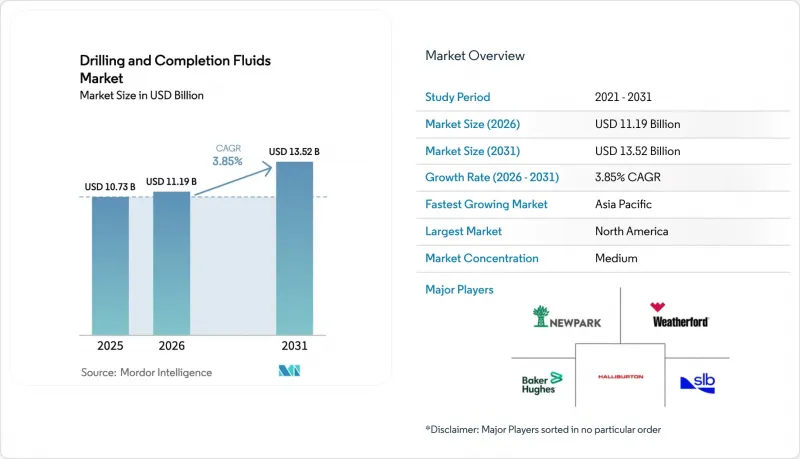
預計鑽井和完井流體市場將從 2025 年的 107.3 億美元成長到 2026 年的 111.9 億美元,到 2031 年將達到 135.2 億美元,2026 年至 2031 年的複合年成長率為 3.85%。
本報告按流體類型(水基、油基、合成、空氣基等)、鑽井階段(鑽井液、完井/維修液)、井類型(常規井和非常規井)、應用(陸上和海上)以及地區(北美、歐洲、亞太地區、南美以及中東和非洲)進行分類。
全球鑽井及完井流體市場趨勢及洞察
深海和超深海鑽井專案重新定義了流體規格。
深水井每口消耗3000至5000桶流體,並承受高壓高溫(HPHT)條件。因此,要達到超過18磅/加侖的等效循環密度(ECD),例如巴西石油公司(Petrobras)的鹽層下項目(儲存壓力高達15000磅/平方英寸),就需要將合成泥漿與甲酸銫鹽水混合。在柴油基泥漿被禁用的情況下,Equinor公司的Johan Kastberg北極計畫透過採用合成系統,將停產時間減少了18%。 Total Energy公司在其Mero 4專案中採用了內部研發的烯烴基合成流體,以滿足巴西的泥漿污染法規,同時維持頁岩氣治理效果。這些高規格油井提高了單井流體價值,使得需求集中在數量較少但盈利較高的海上項目。由於鑽機迅速轉移到奈米比亞和蘇利南,預計這一趨勢將在預測期內加劇。
傳統型儲存的擴張推動了對減磨劑和黏土穩定劑的需求。
在二疊紀盆地超過12000英尺的超長井眼中,聚丙烯醯胺減磨劑用於降低幫浦的壓力和扭矩。在阿根廷瓦卡穆埃爾塔,與膨潤土基系統相比,含有包覆聚合物的氯化鉀基漿液將井眼失穩事故減少了22%。中國石油天然氣集團公司(中石油)在鄂爾多斯緻密砂層鑽井時,透過添加奈米二氧化矽基密封劑,將流體損失降低至5毫升/30分鐘以下,從而提高了鑽井速度15%。這些化學技術的改進也體現在全井液中,其中黏度降低劑和表面活性劑提高了丙烷的輸送效率和採收率。
原油價格波動對上游產業的資本配置帶來了壓力。
預計2025年布蘭特原油均價為每桶78美元,低於2024年的每桶84美元。因此,正如康科石油公司在其2025年第三季財報電話會議上所指出的,二疊紀盆地的幾家獨立石油公司已關閉了9%的鑽機,並將完井作業推遲到油價超過每桶80美元之後。上游資本支出仍比2019年的實質水準低15%,其中非強制性鑽井工程受到的削減幅度最大。在西非,由於安哥拉和奈及利亞的鑽井計畫因財務壓力而推遲,運作中鑽機數量下降了11%,直接影響了鑽井液的訂單。由於鑽井液僅佔油井成本的4%至7%,因此當業者削減成本時,鑽井液往往是首當其沖被削減或取消的項目之一。
細分市場分析
合成鑽井液在海上市場的佔有率正在擴大,預計到2031年將以5.8%的複合年成長率成長,超過整體鑽井和完井流體市場的成長速度。水基產品在2025年佔銷售額的57.1%,由於其成本比合成產品低40-50%,因此在陸上頁岩地層中更受歡迎。隨著監管機構收緊對切削碎屑的監管,含油漿料的市場佔有率正在下降,而氣動鑽井液的使用率仍低於3%,處於小眾市場。貝克休斯公司的「SYN-TEQ」等內嵌烯烴系統能夠在2025年承受墨西哥灣下第三系地層井底350°F(約177°C)的高溫。斯倫貝謝公司的「RHELIANT」等新興奈米配方使中東長水平井的潤滑性能提高了24%。這些進展表明,規格主導的需求正在將價值集中在高階流體類別中。
水基技術也在不斷發展。哈里伯頓公司的「Baracarb」混合液在北美18%的陸上鑽井段實現了與油性漿液相當的頁岩抑制性能,同時降低了處置成本。成本最佳化的聚合物包裝使陸上作業者能夠在不犧牲鑽速(ROP)的情況下降低稀釋率,從而鞏固了他們在活躍盆地中的持續優勢。整體而言,隨著海上高溫高壓(HPHT)專案的增加,水基系統正成為銷售的基礎,並展現出符合監管機構要求的永續性優勢,而合成鑽井液無疑仍將是鑽井液和完井流體市場成長的主要動力。
儘管鑽井液在2025年仍佔總需求的70.5%,但隨著儲存接觸品質對業者而言比單純的鑽井速度更為重要,完井液和維修液的複合年成長率預計將達到4.9%。西方石油公司在沃爾夫坎普井完井作業中使用的霍爾酸鹽鹽水使初始產量提高了11%,因此每桶價格上漲了30-40%。隨著多級水力壓裂對密度控制的要求日益嚴格,高品質的鹽水和纖維增強系統對於控制壓裂幾何形狀至關重要。威德福公司的Frac-Pac壓裂液將在2025年實現230口井的即時壓裂測繪,進而進一步推動壓裂液和壓裂工作流程整合的發展趨勢。
儘管如此,鑽井液領域的創新仍在持續。 Newpark公司的「Evolution」可生物分解聚合物系統在墨西哥灣沿岸的頁岩油井中將稀釋率降低了19%,從而在添加劑成本不斷上漲的情況下降低了總流體成本。隨著鑽井和完井工作流程之間的界限日益模糊,將兩種流體相捆綁在一起的長期單一供應商合約變得越來越普遍,而貫穿整個油井生命週期的綜合流體工程的價值也日益凸顯。
區域分析
北美市場的主導地位主要源自於二疊紀盆地,但加拿大和阿拉斯加等新興緻密油生產也在採用數位化流體系統來降低鑽井成本和排放。亞太地區在地化進程的加速顯示供應鏈正在朝著更短的方向發展,迫使西方服務公司在建造工廠和放棄市場佔有率之間做出選擇。歐洲的流體需求正日益轉向合成流體,到2025年,挪威89%的油井將在更嚴格的排放法規下使用水性或合成配方。南美洲鹽層下油井的單井流體成本位居世界前列,促使供應商持續投資巴西的混合設施。在中東,高壓、高硫化氫含量的精製鹽水對於維持碳酸鹽儲存的完整性至關重要,其價格仍居高不下。非洲的前景取決於金融改革能否重新運作安哥拉和奈及利亞擱置的探勘活動。如果沒有這些改革,與其他前沿盆地相比,非洲的流體需求可能會停滯不前。
其他好處:
- Excel格式的市場預測(ME)表
- 3個月的分析師支持
目錄
第1章:引言
- 研究假設和市場定義
- 調查範圍
第2章:調查方法
第3章執行摘要
第4章 市場狀況
- 市場概覽
- 全球陸上和海洋中運作中的鑽井鑽機數量
- 上游資本支出(CAPEX)的歷史表現與預測-陸上和海上作業對比
- 未來計畫開展的主要上游項目
- 市場促進因素
- 深海和超深海鑽探作業增加。
- 傳統型(頁岩和緻密)儲存的擴張
- 朝向低毒性、水基和合成液體方向發展的環境進步。
- 基於數位技術的鑽井液最佳化和即時流變控制。
- 循環經濟模式用於回收再處理廢污泥
- 國有石油公司(NOC)的本地化計劃正在推動區域流體製造。
- 市場限制因素
- 原油價格的波動週期正在延緩鑽井預算的製定。
- 嚴格的排放法規,禁止從含油泥水中排放切割產生的碎屑。
- 特種聚合物和重晶石添加劑的供應鏈緊張。
- 減少流體消耗的「控制壓力鑽井」技術正在得到更廣泛的應用。
- 供應鏈分析
- 技術展望
- 監理情勢
- 波特五力模型
第5章 市場規模與成長預測
- 流體力學
- 水溶液
- 油基
- 合成系統
- 氣動式(空氣、霧化、泡沫)
- 其他底物(酯類、乙二醇、奈米流體)
- 開挖階段
- 鑽井液
- 用於竣工和維修的液體
- 按井類型
- 傳統的
- 傳統型
- 透過使用
- 陸上
- 離岸
- 按地區
- 北美洲
- 美國
- 加拿大
- 墨西哥
- 歐洲
- 英國
- 挪威
- 俄羅斯
- 烏克蘭
- 其他歐洲國家
- 亞太地區
- 中國
- 印度
- 東南亞國協
- 澳洲
- 其他亞太國家
- 南美洲
- 巴西
- 阿根廷
- 哥倫比亞
- 其他南美國家
- 中東和非洲
- 沙烏地阿拉伯
- 阿拉伯聯合大公國
- 卡達
- 奈及利亞
- 阿爾及利亞
- 其他中東和非洲國家
- 北美洲
第6章 競爭情勢
- 市場集中度
- 策略趨勢(併購、聯盟、購電協議)
- 市場佔有率分析(主要公司的市場排名和佔有率)
- 公司簡介
- Baker Hughes Company
- Schlumberger Limited
- Halliburton Company
- Weatherford International plc
- Newpark Resources Inc.
- TETRA Technologies Inc.
- National Oilwell Varco Inc.
- CES Energy Solutions Corp.
- Chevron Phillips Chemical Co. LLC
- MI SWACO(SLB)
- Scomi Energy Services Bhd
- AES Drilling Fluids LLC
- Anchor Drilling Fluids USA
- Flotek Industries Inc.
- Gumpro Drilling Fluids Pvt Ltd
- Oilfield Chemical Co. Baker Petrolite
- Petrochem Performance Chemicals Ltd
- Q'Max Solutions Inc.
- IMDEX Limited(AMC Drilling Fluids)
- Valence Drilling Fluids LLC
第7章 市場機會與未來展望
According to Mordor Intelligence, the drilling and completion fluids market size is expected to grow from USD 10.73 billion in 2025 to USD 11.19 billion in 2026 and is forecast to reach USD 13.52 billion by 2031 at 3.85% CAGR over 2026-2031.
This report is Segmented by Fluid Base (Water-Based, Oil-Based, Synthetic-Based, Pneumatic, and Other Bases), Drilling Stage (Drilling Fluids and Completion and Work-Over Fluids), Well Type (Conventional and Unconventional), Application (Onshore and Offshore), and Geography (North America, Europe, Asia-Pacific, South America, and Middle East and Africa).
Global Drilling And Completion Fluids Market Trends and Insights
Deep-Water And Ultra-Deep-Water Campaigns Reshape Fluid Specifications
Deep-water wells consume 3,000-5,000 barrels of fluid each and impose HPHT conditions that demand synthetic muds blended with cesium formate brines to achieve ECDs above 18 lb/gal, as seen in Petrobras' pre-salt programs, where reservoir pressure reaches 15,000 psi. Equinor's Johan Castberg Arctic project showed synthetic systems trimmed non-productive time by 18% under discharge bans on diesel-based mud. TotalEnergies adopted internal-olefin synthetic fluids on Mero 4 to satisfy Brazilian cuttings rules while maintaining shale inhibition. These high-spec wells elevate per-well fluid value and concentrate demand in fewer, but more lucrative, offshore campaigns. Rapid rig mobilization to Namibia and Suriname is expected to reinforce this pattern through the forecast period.
Unconventional Reservoir Expansion Drives Friction-Reducer And Clay-Stabilizer Demand
Extended-reach laterals exceeding 12,000 ft in the Permian Basin rely on polyacrylamide friction reducers to cut pump pressure and torque. Argentina's Vaca Muerta uses potassium-chloride muds with encapsulating polymers that lowered wellbore-instability incidents by 22% versus bentonite systems. CNPC achieved 15% faster footage in Ordos tight sand by adding nano-silica sealants that kept fluid loss below 5 mL/30 min. These chemistry upgrades also appear in completion fluids, where viscosity breakers and surfactants improve proppant transport and recovery factors.
Oil Price Volatility Compresses Upstream Capital Allocation
Brent averaged USD 78/bbl in 2025, down from USD 84/bbl in 2024, prompting several Permian independents to park 9% of rigs and defer completions until prices exceed USD 80/bbl, as noted by ConocoPhillips in its Q3 2025 call. The IEA reported upstream capex remaining 15% below 2019 real-terms levels, with discretionary drilling projects bearing the sharpest cuts. West Africa's active rig count slipped 11% after Angolan and Nigerian programs were postponed under fiscal stress, directly trimming fluid orders. Because fluids make up only 4%-7% of well cost, they are among the first line items downgraded or canceled when operators retrench.
Other drivers and restraints analyzed in the detailed report include:
- Environmental Regulations Accelerate Synthetic And Water-Based Fluid Adoption
- Digital Optimization Platforms Enable Real-Time Fluid Adjustments
- Discharge Regulations Force Costly Fluid Substitutions
For complete list of drivers and restraints, kindly check the Table Of Contents.
Segment Analysis
Synthetic-based fluids captured a growing offshore share and are projected to register a 5.8% CAGR to 2031, outpacing the overall drilling and completion fluids market. Water-based products held 57.1% of 2025 revenue, favored in onshore shale where they undercut synthetic prices by 40%-50%. Oil-based muds are retreating as regulators tighten cuttings rules, while pneumatic fluids stay niche at <3% volume. Internal-olefin systems, such as Baker Hughes' SYN-TEQ, handled 350 °F bottom-hole temperatures in Gulf of Mexico lower tertiary wells during 2025. Emerging nano-formulations like Schlumberger's RHELIANT improved lubricity by 24% on Middle East extended-reach wells. These advances underscore how specification-driven demand is concentrating value in premium fluid categories.
Water-based technology also evolves: Halliburton's Baracarb blend attained shale inhibition parity with oil-based muds across 18% of North America's land footage while eliminating disposal fees. Cost-optimized polymer packages allow land operators to trim dilution rates without sacrificing ROP, supporting continued dominance in high-activity basins. Overall, escalating offshore HPHT projects ensure synthetic fluids remain the growth engine of the drilling and completion fluids market, even as water-based systems anchor volume and offer a sustainability narrative that resonates with regulators.
Drilling fluids retained 70.5% of 2025 demand, yet completion and work-over fluids are positioned for a faster 4.9% CAGR as reservoir contact quality eclipses pure drilling speed in operator priorities. Formate-based brines used by Occidental in Wolfcamp completions lifted initial production 11%, justifying 30%-40% higher barrel pricing. Multi-stage hydraulic fracturing intensifies density-control requirements, making premium brines and fiber-laden systems indispensable for fracture geometry management. Weatherford's Frac-Pac fluids enabled real-time fracture mapping on 230 wells in 2025, reinforcing the trend toward integrated fluid-frac workflows.
Drilling fluid innovation nevertheless continues: Newpark's Evolution biodegradable polymer system cut dilution 19% on Gulf Coast shale wells, lowering total fluid cost despite higher additive unit prices. Blurring lines between drilling and completion workflows encourages long-term, single-provider contracts that bundle both fluid phases, reinforcing the value of holistic fluid engineering throughout the well life cycle.
Complete Report Scope:
- By Fluid Base
- Water-based
- Oil-based
- Synthetic-based
- Pneumatic (air, mist, foam)
- Other Bases (ester, glycol, nano-fluids)
- By Drilling Stage
- Drilling Fluids
- Completion and Work-over Fluids
- By Well Type
- Conventional
- Unconventional
- By Application
- Onshore
- Offshore
- By Geography
- North America
- United States
- Canada
- Mexico
- Europe
- United Kingdom
- Norway
- Russia
- Ukraine
- Rest of Europe
- Asia-Pacific
- China
- India
- ASEAN Countries
- Australia
- Rest of Asia-Pacific
- South America
- Brazil
- Argentina
- Colombia
- Rest of South America
- Middle East and Africa
- Saudi Arabia
- United Arab Emirates
- Qatar
- Nigeria
- Algeria
- Rest of Middle East and Africa
- North America
Geography Analysis
North America's market size advantage is anchored in the Permian Basin, but emerging tight-oil plays in Canada and Alaska also deploy digital fluid systems to cut well costs and emissions. Asia-Pacific's localization surge signals a shift toward shorter supply chains, compelling Western service companies either to build plants or cede share. Europe's fluid demand is increasingly synthetic; 89% of 2025 Norwegian wells used water-based or synthetic formulations under stricter discharge rules. South America's pre-salt wells carry some of the highest fluid spend per hole worldwide, explaining sustained vendor investment in Brazilian blending hubs. The Middle East continues to pay premiums for HP high-H2S completion brines that preserve carbonate reservoir integrity. Africa's outlook will hinge on fiscal reforms that can reignite shelved exploration in Angola and Nigeria; without them, fluid demand risks under-performance relative to other frontier basins.
- Baker Hughes Company
- Schlumberger Limited
- Halliburton Company
- Weatherford International plc
- Newpark Resources Inc.
- TETRA Technologies Inc.
- National Oilwell Varco Inc.
- CES Energy Solutions Corp.
- Chevron Phillips Chemical Co. LLC
- M-I SWACO (SLB)
- Scomi Energy Services Bhd
- AES Drilling Fluids LLC
- Anchor Drilling Fluids USA
- Flotek Industries Inc.
- Gumpro Drilling Fluids Pvt Ltd
- Oilfield Chemical Co. Baker Petrolite
- Petrochem Performance Chemicals Ltd
- Q'Max Solutions Inc.
- IMDEX Limited (AMC Drilling Fluids)
- Valence Drilling Fluids LLC
Additional Benefits:
- The market estimate (ME) sheet in Excel format
- 3 months of analyst support
TABLE OF CONTENTS
1 Introduction
- 1.1 Study Assumptions & Market Definition
- 1.2 Scope of the Study
2 Research Methodology
3 Executive Summary
4 Market Landscape
- 4.1 Market Overview
- 4.2 Global Onshore & Offshore Active Rig Count
- 4.3 Historic & Forecast Upstream CAPEX - Onshore vs Offshore
- 4.4 Major Upcoming Upstream Projects
- 4.5 Market Drivers
- 4.5.1 Rising deep-water and ultra-deep-water drilling campaigns
- 4.5.2 Expansion of unconventional (shale & tight) reservoirs
- 4.5.3 Environmental push toward low-toxicity, water-based and synthetic fluids
- 4.5.4 Digitally enabled drilling fluid optimization & real-time rheology control
- 4.5.5 Circular-economy models for recycling and re-conditioning spent mud
- 4.5.6 National oil company (NOC) localization programs driving regional fluid manufacturing
- 4.6 Market Restraints
- 4.6.1 Volatile crude-oil price cycles delaying drilling budgets
- 4.6.2 Stringent discharge regulations on oil-based mud cuttings
- 4.6.3 Supply chain tightness of specialty polymer & barite additives
- 4.6.4 Rising adoption of managed-pressure drilling that lowers fluid volumes
- 4.7 Supply-Chain Analysis
- 4.8 Technological Outlook
- 4.9 Regulatory Landscape
- 4.10 Porter's Five Forces
- 4.10.1 Bargaining Power of Suppliers
- 4.10.2 Bargaining Power of Buyers
- 4.10.3 Threat of New Entrants
- 4.10.4 Threat of Substitutes
- 4.10.5 Competitive Rivalry
5 Market Size & Growth Forecasts
- 5.1 By Fluid Base
- 5.1.1 Water-based
- 5.1.2 Oil-based
- 5.1.3 Synthetic-based
- 5.1.4 Pneumatic (air, mist, foam)
- 5.1.5 Other Bases (ester, glycol, nano-fluids)
- 5.2 By Drilling Stage
- 5.2.1 Drilling Fluids
- 5.2.2 Completion and Work-over Fluids
- 5.3 By Well Type
- 5.3.1 Conventional
- 5.3.2 Unconventional
- 5.4 By Application
- 5.4.1 Onshore
- 5.4.2 Offshore
- 5.5 By Geography
- 5.5.1 North America
- 5.5.1.1 United States
- 5.5.1.2 Canada
- 5.5.1.3 Mexico
- 5.5.2 Europe
- 5.5.2.1 United Kingdom
- 5.5.2.2 Norway
- 5.5.2.3 Russia
- 5.5.2.4 Ukraine
- 5.5.2.5 Rest of Europe
- 5.5.3 Asia-Pacific
- 5.5.3.1 China
- 5.5.3.2 India
- 5.5.3.3 ASEAN Countries
- 5.5.3.4 Australia
- 5.5.3.5 Rest of Asia-Pacific
- 5.5.4 South America
- 5.5.4.1 Brazil
- 5.5.4.2 Argentina
- 5.5.4.3 Colombia
- 5.5.4.4 Rest of South America
- 5.5.5 Middle East and Africa
- 5.5.5.1 Saudi Arabia
- 5.5.5.2 United Arab Emirates
- 5.5.5.3 Qatar
- 5.5.5.4 Nigeria
- 5.5.5.5 Algeria
- 5.5.5.6 Rest of Middle East and Africa
- 5.5.1 North America
6 Competitive Landscape
- 6.1 Market Concentration
- 6.2 Strategic Moves (M&A, Partnerships, PPAs)
- 6.3 Market Share Analysis (Market Rank/Share for key companies)
- 6.4 Company Profiles (includes Global level Overview, Market level overview, Core Segments, Financials as available, Strategic Information, Products & Services, and Recent Developments)
- 6.4.1 Baker Hughes Company
- 6.4.2 Schlumberger Limited
- 6.4.3 Halliburton Company
- 6.4.4 Weatherford International plc
- 6.4.5 Newpark Resources Inc.
- 6.4.6 TETRA Technologies Inc.
- 6.4.7 National Oilwell Varco Inc.
- 6.4.8 CES Energy Solutions Corp.
- 6.4.9 Chevron Phillips Chemical Co. LLC
- 6.4.10 M-I SWACO (SLB)
- 6.4.11 Scomi Energy Services Bhd
- 6.4.12 AES Drilling Fluids LLC
- 6.4.13 Anchor Drilling Fluids USA
- 6.4.14 Flotek Industries Inc.
- 6.4.15 Gumpro Drilling Fluids Pvt Ltd
- 6.4.16 Oilfield Chemical Co. Baker Petrolite
- 6.4.17 Petrochem Performance Chemicals Ltd
- 6.4.18 Q'Max Solutions Inc.
- 6.4.19 IMDEX Limited (AMC Drilling Fluids)
- 6.4.20 Valence Drilling Fluids LLC
7 Market Opportunities & Future Outlook
- 7.1 White-space & Unmet-Need Assessment

 鑽井和完井液市場報告:按系統類型、井類型、應用和地區分類(2026-2034 年)
 鑽井和完井液市場:依流體類型、井下環境、添加劑類型和應用分類-2026-2032年全球預測褐煤基鑽井分散劑市場(依流體類別、井類型、應用和最終用途產業分類)-全球預測,2026-2032年鑽井定位液市場(依流體類型、應用、井類型和最終用戶產業分類),全球預測(2026-2032年)
 全球研磨液市場
 鑽井完井液市場-全球產業規模、佔有率、趨勢、機會和預測(按類型、應用、地區和競爭細分,2020-2030 年)
 鑽井完井液市場規模、佔有率和成長分析(按流體系統、應用、井類型和地區)- 2025-2032 年產業預測
 非洲鑽井和完井液:市場佔有率分析、產業趨勢和成長預測(2025-2030)