


 |
市場調查報告書
商品編碼
2113677
多因素身份驗證 (MFA):市場佔有率分析、行業趨勢和統計數據以及成長預測 (2026-2031)Multifactor Authentication (MFA) - Market Share Analysis, Industry Trends & Statistics, Growth Forecasts (2026 - 2031) |
||||||

※ 本網頁內容可能與最新版本有所差異。詳細情況請與我們聯繫。
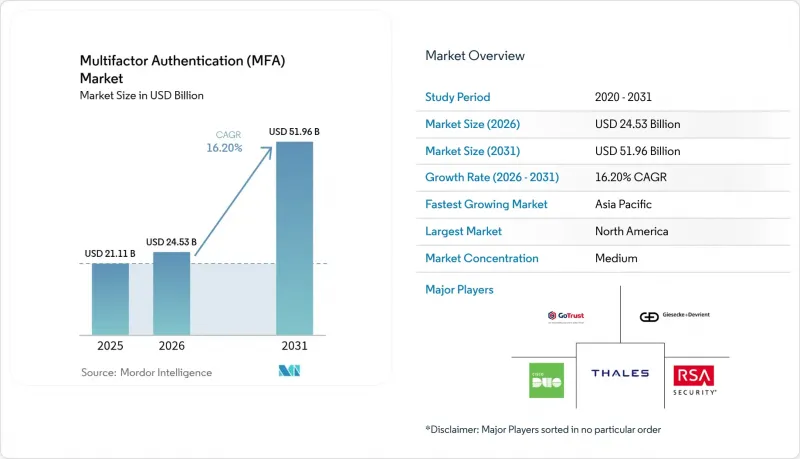
據 Mordor Intelligence 稱,多因素身份驗證市場在 2025 年的價值為 211.1 億美元,預計到 2031 年將達到 519.6 億美元,而 2026 年為 245.3 億美元,預測期(2026-2031 年)的複合年成長率為 16.20%。
本報告按交付方式(硬體、軟體、服務)、身份驗證模型(雙重認證、多因素身份驗證等)、部署方式(本地部署、雲端部署、混合部署)、企業規模(中小企業、大型企業)、存取管道(VPN 和遠端登入等)、最終用戶產業(銀行和金融機構等)以及地區進行細分。市場預測以美元計價。
全球多因素身份驗證 (MFA) 市場趨勢與洞察
受監管產業向零信任安全架構的快速轉變
在零信任架構中,每次會話都需要持續的身份驗證,而多因素身份驗證(MFA)正從可選的附加功能演變為核心控制機制。根據加拿大金融機構監理辦公室(OSFI)B-13號指令,加拿大銀行必須逐步淘汰簡訊驗證碼(SMS OTP),這將促使硬體符記和生物識別因素融入日常營運。包括Capital One在內的美國領先金融機構已承諾在2025年底前取消員工密碼,並以與設備憑證關聯的金鑰取而代之,以降低撞庫人員編制的風險。為此,供應商正在建立平台基礎設施,整合員工、客戶和機器身份的身份驗證,從而擴展多因素身份驗證市場的生態系統。
勒索軟體即服務 (RaaS) 攻擊的激增導致保費上漲。
網路保險公司現在將能夠抵禦網路釣魚攻擊的多因素身份驗證 (MFA) 視為一項基本安全措施。投資 MFA 已成為對沖保險成本的直接途徑,因為仍依賴電子郵件或簡訊動態密碼(OTP) 的公司可能會面臨拒保或保費上漲的風險。隨著中間人攻擊工具包的日益普及,企業董事會正將關注點從邊界防火牆轉向身份驗證,這推動了此前不願進行現代化改造的中型企業對多因素身份驗證的需求。
傳統 SCADA/ICS 環境中 MFA互通性的局限性
工業網路依賴於確定性的延遲和持續的運作。由於增加登入流程會帶來停機風險,工廠營運商選擇將營運技術(OT)和資訊技術(IT)分離,而不是全面實施多因素身份驗證(MFA),這導致重工業多因素身份驗證市場的收入成長停滯不前。
細分市場分析
到2025年,軟體解決方案將佔總收入的47.90%,佔據多因素身分驗證市場的最大佔有率。基於訂閱的授權模式、API工具包和雲端主機簡化了混合辦公環境中的部署。隨著企業從邊界控制轉向整合合規性報告和自適應風險指標的身份架構,該細分市場的價值提案將進一步提升。主導的無密碼平台正以18.85%的複合年成長率成長,反映出買家傾向於選擇無需憑證資料庫且能從根本上防止網路釣魚的身份驗證方法。對於必須使用隔離安全元件進行儲存的受監管工作負載而言,硬體仍然至關重要,但晶片短缺導致令牌成本上升,促使預算轉向軟體。
隨著對實施專業知識的需求不斷成長,託管服務已成為一個極具吸引力的細分市場。服務合作夥伴負責設計註冊宣傳活動、維修傳統應用程式並監控多因素身份驗證 (MFA) 控制面板,從而將一次性產品部署轉化為持續的諮詢收入。因此,領先的整合商透過將部署服務納入更廣泛的零信任專案中,提高了平均合約價值,推動了多因素身分驗證市場轉向以平台為中心的採購模式。
到2025年,雙重認證仍將佔總收入的45.95%,這主要得益於身分驗證應用程式和簡訊驗證碼能夠快速降低風險。然而,隨著瀏覽器和行動作業系統供應商將FIDO2整合到其原生工作流程中,防釣魚金鑰正以18.05%的複合年成長率快速成長。微軟決定預設將新個人帳戶設定為無密碼帳戶,這項措施已成為強而有力的參考模型。雖然在某些政府和金融領域,需要三個或更多身份驗證因素的多因素身份驗證框架仍然至關重要,但在更廣泛的商業領域,人們的興趣正轉向基於風險的動態編配,以增強身份驗證因素的強度。
區域分析
預計到2025年,北美將佔全球銷售額的37.35%,並將在2031年之前維持13.95%的複合年成長率。儘管美國總統關於關鍵基礎設施網路安全的行政命令和加拿大OSFI的B-13法規正在推動多因素身份驗證(MFA)的製度化,但總部位於該地區的身份識別SaaS供應商生態系統仍在保持活躍的創新週期。因此,隨著零信任安全策略的普及進入穩定階段,供應商不斷提升銷售自適應分析功能,北美多因素身份驗證市場的規模正在穩步擴大。
得益於政府主導的身份識別項目,亞太地區可望實現16.35%的複合年成長率。在日本,「我的號碼」系統的智慧型手機認證已成為超過650家企業的登入基礎設施;在新加坡,FIDO令牌正在被引入銀行,以取代簡訊驗證碼,並逐漸被主流企業採用。在澳大利亞,數位身分框架為聯邦政府服務引入了通行密鑰,類似的舉措也在私營部門迅速湧現。東南亞和印度等新興經濟體正透過跳過傳統密碼,直接採用行動生物識別,從而擴大市場成長潛力。
在歐洲,2024/1183 號規則在 27 個國家實現了錢包登入的標準化,並展現出強勁的兩位數成長。公共部門的需求正在推動供應商擴張,而私人線上服務供應商如果不能確保互通性,則面臨客戶流失的風險。中東和非洲雖然用戶基數較小,但在雲端遷移和網路安全韌性建設的推動下,其採用率也在不斷提高,為全球多因素身份驗證市場帶來了多元化的收入來源。
其他好處:
- Excel格式的市場預測(ME)表
- 3個月的分析師支持
目錄
第1章:引言
- 研究假設和市場定義
- 調查範圍
第2章:調查方法
第3章執行摘要
第4章 市場狀況
- 市場概覽
- 市場促進因素
- 受監管產業正迅速向零信任安全架構轉型
- 勒索軟體即服務 (RaaS) 的激增導致保險費上漲。
- 歐盟強制要求電子政府入口網站採用基於FIDO的強式身分驗證。
- 基於推播通知的網路釣魚工具包的興起,增加了對具有網路釣魚防護功能的多因素身份驗證 (MFA) 的需求。
- 人工智慧驅動的深度造假攻擊促使人們採用更先進的生物識別技術。
- 曼達洛人式公私威脅情報共用模式(美國與五眼聯盟)
- 市場限制因素
- 傳統 SCADA/ICS 環境的 MFA互通性有限。
- A2P費用的上漲增加了OTP簡訊的成本。
- 行動身分驗證應用程式使用者體驗 (UX) 的不一致性阻礙了員工的採用。
- 硬體符記晶片供不應求和安全元件供應風險
- 供應鏈分析
- 監管和技術展望
- 波特五力模型
第5章 市場規模與成長預測
- 按服務類型
- 硬體
- 令牌(USB、智慧卡、智慧鑰匙)
- 生物識別設備(指紋、手掌、臉部辨識)
- 其他設備(穿戴式裝置、支援NFC功能的智慧卡)
- 軟體
- 身份驗證解決方案(TOTP、推送、U2F)
- 行動應用(原生應用程式、SDK)
- 服務
- 託管服務和專業服務
- 硬體
- 通過認證模型
- 雙因素認證(2FA)
- 多因素認證(3F 和 4F)
- 自適應/基於風險的多因素分析
- 無密碼(WebAuthn、密碼)
- 部署模式
- 現場
- 雲
- 民眾
- 私人的
- 混合
- 按公司規模
- 中小企業
- 大公司
- 透過存取頻道存取頻道
- VPN和遠端登入
- Web 和 SaaS 應用
- 行動工作者
- 按最終用戶行業分類
- 銀行和金融機構
- 加密貨幣和 Web3 交易所
- 技術(SaaS、IT 服務、DevOps)
- 政府(聯邦政府、州政府、地方政府、系統整合商)
- 醫療和藥品
- 零售與電子商務
- 能源、公共產業、製造業
- 教育、移民、公共服務
- 按地區
- 北美洲
- 美國
- 加拿大
- 南美洲
- 巴西
- 其他南美國家
- 歐洲
- 英國
- 德國
- 法國
- 其他歐洲國家
- 亞太地區
- 中國
- 日本
- 印度
- 韓國
- 其他亞太國家
- 中東和非洲
- 中東
- GCC
- 土耳其
- 以色列
- 其他中東國家
- 非洲
- 南非
- 奈及利亞
- 埃及
- 其他非洲國家
- 中東
- 北美洲
第6章 競爭情勢
- 市場集中度
- 策略性舉措(資金籌措、合作)
- 市佔率分析
- 公司簡介
- Giesecke+Devrient GmbH
- Thetis
- GoTrustID Inc.
- Thales Group
- Duo Security(Cisco Systems Inc.)
- RSA Security LLC
- Okta Inc.
- Google LLC(Alphabet Inc.)
- Ping Identity Corp.
- ManageEngine(Zoho Corp.)
- Microsoft Corp.
- TeleSign Corp.(Proximus Group)
- HID Global Corp.
- OneSpan Inc.
- CyberArk Software Ltd.
- ForgeRock Inc.
- Entrust Corp.
- SecureAuth Corp.
- Symantec Corp.(Broadcom Inc.)
- Keyless Technologies
- Secret Double Octopus
- Trusona Inc.
第7章 市場機會與未來展望
According to Mordor Intelligence, the multifactor authentication market size was valued at USD 21.11 billion in 2025 and estimated to grow from USD 24.53 billion in 2026 to reach USD 51.96 billion by 2031, at a CAGR of 16.20% during the forecast period (2026-2031).
This report is Segmented by Offering Type (Hardware, Software, Services), Authentication Model (Two-Factor, Multifactor, and More), Deployment Mode (On-Premises, Cloud, Hybrid), Enterprise Size (SMEs, Large Enterprises), Access Channel (VPN and Remote Login, and More), End-User Industry (Banking and Financial Institutions, and More), and by Geography. The Market Forecasts are Provided in Terms of Value (USD).
Global Multifactor Authentication (MFA) Market Trends and Insights
Rapid Migration to Zero-Trust Security Architectures Across Regulated Industries
Zero-trust blueprints now require continuous identity checks on every session, elevating MFA from an optional add-on to core control. Canadian banks must abandon SMS OTP under OSFI B-13, pushing hardware tokens and biometric factors into routine operations. U.S. financial majors, including Capital One have pledged to remove employee passwords by end-2025, substituting device-certificate-anchored passkeys that cut credential-stuffing risk. Vendors respond by building platform fabrics that unify authentication across workforce, customer, and machine identities, strengthening the multifactor authentication market's ecosystem breadth.
Surge in Ransomware-as-a-Service Driving Insurance Premium Hikes
Cyber insurers now treat phishing-resistant MFA as baseline hygiene. Policies are refused or repriced upward where email-only or SMS-OTP remains in place, making MFA investment a direct insurance-cost hedge. As adversary-in-the-middle kits commoditize, boards shift funding from perimeter firewalls to identity assurance, propelling multifactor authentication market demand among mid-size enterprises previously slow to modernize.
Legacy SCADA/ICS Environments' Limited MFA Interoperability
Industrial networks depend on deterministic latency and continuous uptime. Injecting extra login steps risks downtime, so plant operators isolate OT from IT rather than retrofit full MFA, capping reachable multifactor authentication market revenue in heavy industry.
Other drivers and restraints analyzed in the detailed report include:
- Mandated FIDO-Based Strong Authentication for EU e-Government Portals
- Push-Notification Phishing Kits Raising Demand for Phishing-Resistant MFA
- Rising OTP SMS Costs Amid A2P Fee Inflation
For complete list of drivers and restraints, kindly check the Table Of Contents.
Segment Analysis
Software solutions generated 47.90% of 2025 revenue and anchor the largest slice of the multifactor authentication market. Subscription licensing, API toolkits, and cloud consoles streamline rollouts across hybrid workforces. The segment's value proposition scales further as enterprises migrate perimeter controls into identity fabrics that integrate compliance reporting and adaptive risk metrics. Passwordless platforms-led by WebAuthn toolchains and SDKs-are clocking 18.85% CAGR, reflecting buyer preference for factors that erase credential databases and defeat phishing at the root. Hardware remains indispensable for regulated workloads that stipulate isolated secure-element storage, yet chip shortages inflate token costs and nudge budgets toward software.
Demand for implementation expertise turns managed services into an attractive niche. Service partners design enrollment campaigns, retrofit legacy apps, and monitor MFA dashboards, turning one-off product placement into recurring advisory revenue. As a result, large integrators bundle rollouts with broader zero-trust projects, lifting average contract values and reinforcing the multifactor authentication market's shift to platform-centric procurement.
Two-factor login still underpins 45.95% of 2025 revenue, primarily through authenticator apps and SMS codes that deliver quick risk reduction. However, phishing-resistant passkeys are expanding at 18.05% CAGR as browser and mobile-OS vendors bake FIDO2 into native workflows. Microsoft's decision to make new consumer accounts passwordless by default supplies a powerful reference model. Multifactor frameworks requiring three or more factors remain compulsory in select government and financial segments, but the broader commercial appetite pivots toward risk-based orchestration that elevates factor strength dynamically.
Complete Report Scope:
- By Offering Type
- Hardware
- Tokens (USB, Smart-card, Smartkey)
- Biometric Devices (Fingerprint, Palm-vein, Facial)
- Other Devices (Wearables, Smartcards-NFC)
- Software
- Authenticator Solutions (TOTP, Push, U2F)
- Mobile Apps (Native, SDK)
- Services
- Managed and Professional Services
- Hardware
- By Authentication Model
- Two-Factor (2FA)
- Multifactor (3F and 4F)
- Adaptive / Risk-Based MFA
- Password-less (WebAuthn, Passkeys)
- By Deployment Mode
- On-premises
- Cloud
- Public
- Private
- Hybrid
- By Enterprise Size
- Small and Medium-sized Enterprises (SMEs)
- Large Enterprises
- By Access Channel
- VPN and Remote Login
- Web and SaaS Applications
- Mobile Workforce
- By End-user Industry
- Banking and Financial Institutions
- Cryptocurrency and Web3 Exchanges
- Technology (SaaS, IT Services, DevOps)
- Government (Federal, State, Local, Integrators)
- Healthcare and Pharmaceutical
- Retail and E-commerce
- Energy, Utilities and Manufacturing
- Education, Immigration and Public Services
- By Geography
- North America
- United States
- Canada
- South America
- Brazil
- Rest of South America
- Europe
- United Kingdom
- Germany
- France
- Rest of Europe
- Asia-Pacific
- China
- Japan
- India
- South Korea
- Rest of Asia-Pacific
- Middle East and Africa
- Middle East
- GCC
- Turkey
- Israel
- Rest of Middle East
- Africa
- South Africa
- Nigeria
- Egypt
- Rest of Africa
- Middle East
- North America
Geography Analysis
North America retained 37.35% revenue in 2025 and should log 13.95% CAGR to 2031. U.S. executive orders on critical-infrastructure cybersecurity and Canadian OSFI B-13 collectively institutionalize MFA, while the ecosystem of identity SaaS vendors headquartered in the region keeps innovation cycles brisk. The multifactor authentication market size for North America thus scales steadily as zero-trust procurement enters the maintenance phase and vendors upsell adaptive analytics.
Asia-Pacific is on a 16.35% CAGR trajectory thanks to government identity programs. Japan's My Number smartphone credential now underpins login for over 650 firms, and Singapore's banks have replaced SMS with FIDO tokens, broadening mainstream adoption. Australia's Digital ID framework rolls out passkeys for federal services, spurring private-sector copycats. Emerging economies across Southeast Asia and India extend market runway by leapfrogging legacy passwords straight into mobile biometrics.
Europe advances at solid double digits as Regulation 2024/1183 standardizes wallet login across 27 nations. Public-sector volume guarantees vendor scale, and private online-service providers must interoperate or risk customer churn. The Middle East and Africa, though starting from a smaller base, record increasing deployments aligned with cloud migration and cyber-resilience bids, adding diversified revenue streams to the global multifactor authentication market.
- Giesecke+Devrient GmbH
- Thetis
- GoTrustID Inc.
- Thales Group
- Duo Security (Cisco Systems Inc.)
- RSA Security LLC
- Okta Inc.
- Google LLC (Alphabet Inc.)
- Ping Identity Corp.
- ManageEngine (Zoho Corp.)
- Microsoft Corp.
- TeleSign Corp. (Proximus Group)
- HID Global Corp.
- OneSpan Inc.
- CyberArk Software Ltd.
- ForgeRock Inc.
- Entrust Corp.
- SecureAuth Corp.
- Symantec Corp. (Broadcom Inc.)
- Keyless Technologies
- Secret Double Octopus
- Trusona Inc.
Additional Benefits:
- The market estimate (ME) sheet in Excel format
- 3 months of analyst support
TABLE OF CONTENTS
1 INTRODUCTION
- 1.1 Study Assumptions and Market Definition
- 1.2 Scope of the Study
2 RESEARCH METHODOLOGY
3 EXECUTIVE SUMMARY
4 MARKET LANDSCAPE
- 4.1 Market Overview
- 4.2 Market Drivers
- 4.2.1 Rapid migration to Zero-Trust security architectures across regulated industries
- 4.2.2 Surge in ransomware-as-a-service driving insurance premium hikes
- 4.2.3 Mandated FIDO-based strong authentication for e-Government portals in EU
- 4.2.4 Push-notification phishing kits raising demand for phishing-resistant MFA
- 4.2.5 AI-powered deep-fake attacks forcing higher-factor biometrics
- 4.2.6 Mandalorian Class Public-Private threat-intel sharing models (US and Five-Eyes)
- 4.3 Market Restraints
- 4.3.1 Legacy SCADA/ICS environments limited MFA interoperability
- 4.3.2 Rising OTP SMS costs amid A2P fee inflation
- 4.3.3 Fragmented mobile authenticator UX hurting workforce adoption
- 4.3.4 Hardware token chip shortages and secure-element supply risk
- 4.4 Supply-Chain Analysis
- 4.5 Regulatory and Technological Outlook
- 4.6 Porter's Five Forces
- 4.6.1 Threat of New Entrants
- 4.6.2 Bargaining Power of Suppliers
- 4.6.3 Bargaining Power of Buyers
- 4.6.4 Threat of Substitutes
- 4.6.5 Competitive Rivalry
5 MARKET SIZE AND GROWTH FORECASTS (VALUE)
- 5.1 By Offering Type
- 5.1.1 Hardware
- 5.1.1.1 Tokens (USB, Smart-card, Smartkey)
- 5.1.1.2 Biometric Devices (Fingerprint, Palm-vein, Facial)
- 5.1.1.3 Other Devices (Wearables, Smartcards-NFC)
- 5.1.2 Software
- 5.1.2.1 Authenticator Solutions (TOTP, Push, U2F)
- 5.1.2.2 Mobile Apps (Native, SDK)
- 5.1.3 Services
- 5.1.3.1 Managed and Professional Services
- 5.1.1 Hardware
- 5.2 By Authentication Model
- 5.2.1 Two-Factor (2FA)
- 5.2.2 Multifactor (3F and 4F)
- 5.2.3 Adaptive / Risk-Based MFA
- 5.2.4 Password-less (WebAuthn, Passkeys)
- 5.3 By Deployment Mode
- 5.3.1 On-premises
- 5.3.2 Cloud
- 5.3.2.1 Public
- 5.3.2.2 Private
- 5.3.3 Hybrid
- 5.4 By Enterprise Size
- 5.4.1 Small and Medium-sized Enterprises (SMEs)
- 5.4.2 Large Enterprises
- 5.5 By Access Channel
- 5.5.1 VPN and Remote Login
- 5.5.2 Web and SaaS Applications
- 5.5.3 Mobile Workforce
- 5.6 By End-user Industry
- 5.6.1 Banking and Financial Institutions
- 5.6.2 Cryptocurrency and Web3 Exchanges
- 5.6.3 Technology (SaaS, IT Services, DevOps)
- 5.6.4 Government (Federal, State, Local, Integrators)
- 5.6.5 Healthcare and Pharmaceutical
- 5.6.6 Retail and E-commerce
- 5.6.7 Energy, Utilities and Manufacturing
- 5.6.8 Education, Immigration and Public Services
- 5.7 By Geography
- 5.7.1 North America
- 5.7.1.1 United States
- 5.7.1.2 Canada
- 5.7.2 South America
- 5.7.2.1 Brazil
- 5.7.2.2 Rest of South America
- 5.7.3 Europe
- 5.7.3.1 United Kingdom
- 5.7.3.2 Germany
- 5.7.3.3 France
- 5.7.3.4 Rest of Europe
- 5.7.4 Asia-Pacific
- 5.7.4.1 China
- 5.7.4.2 Japan
- 5.7.4.3 India
- 5.7.4.4 South Korea
- 5.7.4.5 Rest of Asia-Pacific
- 5.7.5 Middle East and Africa
- 5.7.5.1 Middle East
- 5.7.5.1.1 GCC
- 5.7.5.1.2 Turkey
- 5.7.5.1.3 Israel
- 5.7.5.1.4 Rest of Middle East
- 5.7.5.2 Africa
- 5.7.5.2.1 South Africa
- 5.7.5.2.2 Nigeria
- 5.7.5.2.3 Egypt
- 5.7.5.2.4 Rest of Africa
- 5.7.5.1 Middle East
- 5.7.1 North America
6 COMPETITIVE LANDSCAPE
- 6.1 Market Concentration
- 6.2 Strategic Moves (Funding, Partnerships)
- 6.3 Market Share Analysis
- 6.4 Company Profiles (includes Global Level Overview, Market Level Overview, Core Segments, Financials as available, Strategic Information, Market Rank/Share, Products and Services, Recent Developments)
- 6.4.1 Giesecke+Devrient GmbH
- 6.4.2 Thetis
- 6.4.3 GoTrustID Inc.
- 6.4.4 Thales Group
- 6.4.5 Duo Security (Cisco Systems Inc.)
- 6.4.6 RSA Security LLC
- 6.4.7 Okta Inc.
- 6.4.8 Google LLC (Alphabet Inc.)
- 6.4.9 Ping Identity Corp.
- 6.4.10 ManageEngine (Zoho Corp.)
- 6.4.11 Microsoft Corp.
- 6.4.12 TeleSign Corp. (Proximus Group)
- 6.4.13 HID Global Corp.
- 6.4.14 OneSpan Inc.
- 6.4.15 CyberArk Software Ltd.
- 6.4.16 ForgeRock Inc.
- 6.4.17 Entrust Corp.
- 6.4.18 SecureAuth Corp.
- 6.4.19 Symantec Corp. (Broadcom Inc.)
- 6.4.20 Keyless Technologies
- 6.4.21 Secret Double Octopus
- 6.4.22 Trusona Inc.
7 MARKET OPPORTUNITIES AND FUTURE OUTLOOK
- 7.1 White-space and Unmet-Need Assessment

 多因素身份驗證市場:按組件、模型、身份驗證方法、部署類型、組織規模和行業分類-2026-2032年全球市場預測
 多因素身份驗證市場規模、佔有率、趨勢和預測:按模型、部署、應用、行業和地區分類,2026-2034 年
 全球多因素身份驗證市場規模、佔有率、趨勢和成長分析報告(2026-2034年)
 2026年量子安全多因素認證全球市場報告2026年全球多因素身份驗證市場報告
 多因素身份驗證市場分析及預測(至 2035 年):按類型、產品、服務、技術、組件、應用、部署、最終用戶和解決方案分類多因素身份驗證工具市場,依身分驗證因素類型、部署模式、最終用戶產業和組織規模分類,全球預測,2026-2032年
 多因素身份驗證市場規模、佔有率和成長分析(按身份驗證類型、模型類型、組件、公司規模、最終用戶行業和地區分類)—2026-2033年行業預測
 多因素認證市場-全球產業規模、佔有率、趨勢、機會及預測(按解決方案、認證類型、最終用戶、地區和競爭格局分類,2020-2030 年預測)
 全球多因素身份驗證 (MFA) 市場 - 市場佔有率和排名、總收入和需求預測 (2025-2031)