


 |
市場調查報告書
商品編碼
2113667
汽車電子穩定控制系統:市場佔有率分析、產業趨勢與統計、成長預測(2026-2031)Automotive Electronic Stability Control Systems - Market Share Analysis, Industry Trends & Statistics, Growth Forecasts (2026 - 2031) |
||||||

※ 本網頁內容可能與最新版本有所差異。詳細情況請與我們聯繫。
據 Mordor Intelligence 稱,2025 年汽車電子穩定控制 (ESC) 市場價值為 77.6 億美元,預計到 2031 年將達到 118.6 億美元,而 2026 年為 83.3 億美元,預測期(2026-2031 年)的複合成長率為 7.31%。
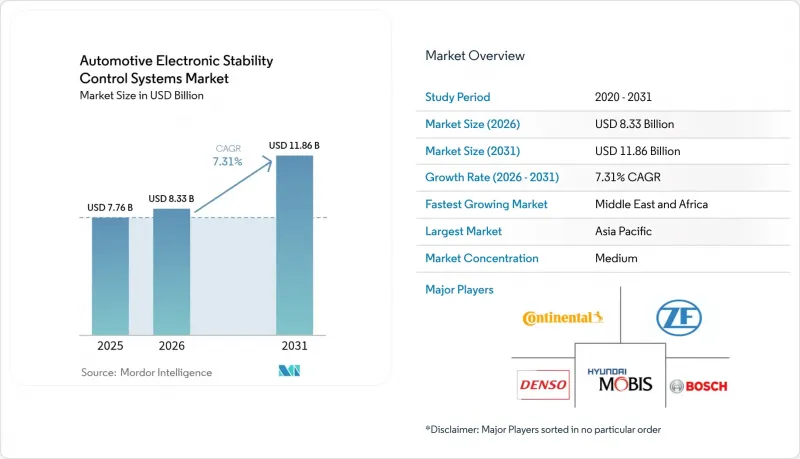
本報告按車輛類型(乘用車等)、零件(感知器等)、技術(液壓式電子穩定控制系統和電液/電子機械控制系統)、動力系統(內燃機車輛等)、銷售管道(原廠配套和售後改裝)以及地區進行細分。市場預測以美元計價。
全球汽車電子穩定控制系統市場趨勢及洞察
Kei car類強制要求配備ESC(電子穩定控制系統)
隨著全球法規的不斷發展,汽車電子穩定控制系統(ESC)市場正從選用技術躍升為強制車輛子系統。歐盟《通用安全法規II》(General Safety Regulation II)將於2024年7月起適用於所有新車型,該法規強制要求所有乘用車和輕型商用車必須配備ESC以及其他主動安全功能。美國也制定了類似的法規,即FMVSS 126。統一的法規期限促使汽車製造商(OEM)從平台定義階段就開始整合ESC,推動了大規模供應合約的簽訂,降低了單通路成本。這種規模經濟效應在緊湊型車領域尤為顯著,因為該領域先前的ESC普及率較低。因此,零件製造商需要協調三大洲的檢驗、型式認證和軟體發布計劃,以縮短開發週期,並提升模組化架構的價值,從而實現針對特定品牌的踏板腳感調整,並透過快閃記憶體更新來實現。
ADAS和自動駕駛技術的快速普及
車道維持輔助、自動緊急煞車和主動式車距維持定速系統在進行感測器融合時都依賴車輛姿態的穩定。因此,電子穩定控制系統(ESC)是網域控制器的核心,其作用正從被動式側滑校正轉向預測式軌跡控制。集中式運算平台將橫擺角速度、橫向加速度和轉向角資料輸入機器學習模型,以預測摩擦極限並預先調整煞車壓力。其結果是更平順的介入、更高的駕乘舒適性和更少的保固索賠。此外,處理器吞吐量的提高使得供應商能夠提供空中下載(OTA)更新,無需服務人員上門即可微調演算法參數,從而在汽車電子穩定控制系統市場創造持續的收入來源。
ESC模組的初始成本和生命週期成本都很高。
單一設備的成本在 300 至 800 美元之間,如果與雷達組合使用,成本則接近 2000 美元,這可能佔入門級交易價格的兩位數百分比。預計到 2030 年,半導體價格上漲將使電子產品的單一支出加倍,這促使原始設備製造商 (OEM) 尋求批量折扣和在地採購。從車主的角度來看,如果在碰撞後維修過程中需要校準設備,維修成本可能會增加 50% 至 100%。因此,車隊營運商往往更重視總營運成本而非零售價格本身,減緩了非正式共乘市場和老舊車隊對這項服務的接受度。
細分市場分析
2025年,乘用車在汽車電子穩定控制系統(ESC)市場銷售量中佔比63.92%,這主要得益於相關法令的完善和消費者安全意識的提升。輕型商用車的需求也顯著成長,這主要得益於電子商務的蓬勃發展以及防側翻功能帶來的都市區配送交通量增加。預計在預測期內,乘用車細分市場將保持最高的成長率,複合年成長率(CAGR)預計達到7.62%。這主要歸功於純電動車(BEV)的普及,這類車需要扭力向量控制邏輯來確保高瞬時扭力的動力系統始終保持正確的行駛軌跡。
在豪華轎車中,ESC演算法與主動懸吊減震器協同工作,控制車輛在突然變換車道時的重量轉移;這項功能目前已成為歐洲C級車的標準配備。貨車車隊營運商正在利用遠端資訊處理平台,將ESC啟動事件反映在駕駛員培訓儀錶板上,從而減少保險索賠。這些應用案例表明,軟體分析正在拓展汽車電子穩定控制系統市場的價值來源,使其不再局限於硬體利潤。
到2025年,感測器組件將佔總支出的44.25%,這反映了陀螺儀、加速計和輪速感測器等用於採集車輛動態數據的需求。然而,隨著原始設備製造商(OEM)向集中式運算區域轉型,軟體和演算法堆疊正以17.65%的複合年成長率(CAGR)快速擴張。電控系統(ECU)仍然是核心部件,需要在資料匯流排頻寬和即時作業系統的確定性之間取得平衡。
演算法供應商正利用空中下載 (OTA) 管道延長功能壽命,並支援基於訂閱的性能模式,從而在賽道駕駛期間提供更激進的扭力分配。隨著車輛向Gigabit網路骨幹網路過渡,感測器融合技術的應用範圍正在擴展,涵蓋雷射雷達和攝影機影像數據,進一步推動汽車電子穩定控制 (ESC) 市場從機械差異化向數位化差異化轉型。
區域分析
到2025年,亞太地區將佔全球銷量的48.12%,中東和非洲預計將成為成長最快的地區,到2031年複合年成長率將達到10.66%。中國汽車製造商正在將其生產基地擴展到東南亞國協,預計到2030年代中期,該地區輕型汽車產量將從420萬輛增加到近600萬輛。政府對新能源汽車的獎勵正在加速軟體驅動煞車系統的應用,而本地半導體製造工廠正在縮短供應鏈。印度的產業政策目標是到2035年實現汽車產業銷售額1兆美元,這將為電子穩定控制系統(ESC)市場創造進一步的成長空間。日本和韓國正在透過提供執行器和ECU方面的專業知識來鞏固其技術領先地位。
北美市場呈現成熟且穩健的成長態勢。自2012年車型以來,新車滲透率已趨於飽和,成長動力正轉向車輛更換需求和功能升級,例如與L3級高速公路自動駕駛系統相容的預測性橫擺控制模組。加拿大的組裝廠符合美國法規,並已具備涵蓋整個北美大陸的經濟規模。陽光地帶各省的自動駕駛班車示範計畫為客製化的電子機械煞車系統開闢了新的銷售管道,提升了供應商的生命週期價值。
在歐洲,儘管汽車銷售趨於平穩,但該地區仍保持著適度的複合年成長率,這主要得益於歐洲新車安全評鑑協會(Euro NCAP)日益嚴格的安全標準。 2024年安全法規將高階線控刹車模組的試點測試,而南歐製造商則專注於為A級城市汽車開發成本最佳化的液壓模組。東歐的代工組裝正從亞洲進口感測器模組,這不僅加強了跨區域的供應鏈網路,也有助於中東和非洲地區的穩定。該地區的複合年成長率高達10.66%,位居整個區域之首,這主要得益於基礎設施的擴張以及與聯合國歐洲經濟委員會(UNECE)安全標準的政策接軌。海灣合作理事會(GCC)成員國的車輛對用於沙漠公路的高重心SUV提出了更高的側翻預防功能要求,這推動了相關技術的早期應用。南美洲緊隨其後,複合年成長率達7.98%,這主要得益於巴西在2023年新增的400,018台註冊設備,從而加速了在地採購率的成長。關稅措施正在促進電子模組的在地化生產,並降低跨國供應商面臨的外匯風險。
其他好處:
- Excel格式的市場預測(ME)表
- 3個月的分析師支持
目錄
第1章:引言
- 研究假設和市場定義
- 調查範圍
第2章:調查方法
第3章執行摘要
第4章 市場狀況
- 市場概覽
- 市場促進因素
- 關於微型車類別強制實施ESC的法規。
- ADAS和自動駕駛技術的快速普及
- 電動車再生煞車過程中穩定性需求
- 過渡到線控刹車系統
- 消費者對五星級NCAP評級的興趣日益濃厚
- 新興國家微型車產量增加
- 市場限制因素
- ESC模組的初始成本和生命週期成本都很高
- 成熟市場平台飽和
- 聯網電子穩定控制器ECU中的網路安全風險
- 懸吊/輪胎改裝後的校準問題
- 價值供應鏈分析
- 監理情勢
- 技術展望
- 波特五力模型
第5章 市場規模與成長預測
- 車輛類型
- 搭乘用車
- 輕型商用車
- 中型和重型商用車輛
- 按組件
- 感應器
- 電控系統(ECU)
- 執行器/液壓單元
- 軟體和演算法
- 其他規則
- 透過技術
- 液壓電子調速器
- 電液/電子機械調速器
- 依推進類型
- 內燃機車
- 混合動力汽車和插電式混合動力汽車
- 電池式電動車
- 按銷售管道
- 原廠正品零件
- 改裝
- 按地區
- 北美洲
- 美國
- 加拿大
- 其他北美國家
- 南美洲
- 巴西
- 阿根廷
- 其他南美國家
- 歐洲
- 德國
- 英國
- 法國
- 義大利
- 西班牙
- 俄羅斯
- 其他歐洲國家
- 亞太地區
- 中國
- 日本
- 印度
- 韓國
- 澳洲和紐西蘭
- 其他亞太國家
- 中東和非洲
- 沙烏地阿拉伯
- 阿拉伯聯合大公國
- 土耳其
- 南非
- 埃及
- 其他中東和非洲國家
- 北美洲
第6章 競爭情勢
- 市場集中度
- 策略趨勢
- 市佔率分析
- 公司簡介
- Robert Bosch GmbH
- Continental AG
- ZF Friedrichshafen AG
- Denso Corporation
- Hyundai Mobis Co., Ltd.
- Mando Corporation
- Aisin Seiki Co., Ltd.
- Knorr-Bremse AG
- Hitachi Astemo Ltd.
- Autoliv Inc.
- Aptiv PLC
- Veoneer Inc.
第7章 市場機會與未來展望
According to Mordor Intelligence, the automotive electronic stability control market size was valued at USD 7.76 billion in 2025 and estimated to grow from USD 8.33 billion in 2026 to reach USD 11.86 billion by 2031, at a CAGR of 7.31% during the forecast period (2026-2031).
This report is Segmented by Vehicle Type (Passenger Cars and More), Component (Sensors and More), Technology (Hydraulic ESC and Electro-Hydraulic / Electro-Mechanical ESC), Propulsion Type (Internal-Combustion Engine Vehicles and More), Sales Channel (OEM-Fitted and Aftermarket Retrofit), and Geography. The Market Forecasts are Provided in Terms of Value (USD).
Global Automotive Electronic Stability Control Systems Market Trends and Insights
Mandatory ESC Legislation in Light-Vehicle Categories
Global rulemaking elevates the automotive electronic stability control market from an optional technology to a compulsory vehicle sub-system. The European Union's General Safety Regulation II, in force for new models from July 2024, obliges every passenger vehicle and light commercial vehicle to incorporate ESC along with other active-safety functions. Comparable standards apply in the United States under FMVSS 126. Harmonised deadlines motivate OEMs to integrate ESC at the platform-definition stage, fuelling bulk supply agreements that lower the cost per channel. This scale benefit is especially pronounced in compact-car segments, where prior option-take rates were modest. Component makers must therefore synchronize validation, homologation, and software-release calendars across three continents, shortening development loops and raising the value of modular architectures that can be flashed for brand-specific pedal-feel tuning.
Rapid ADAS and Automated-Driving Adoption
Lane-keeping, automatic emergency braking, and adaptive cruise control rely on a stable chassis attitude during sensor-fusion events. ESC thus becomes the backbone of the domain controller, shifting its role from reactive skid correction to predictive trajectory governance. Centralized compute platforms feed yaw-rate, lateral-acceleration, and steering-angle data into machine-learning models that forecast friction limits and pre-condition brake pressure. The outcome is smoother intervention, which improves passenger comfort and reduces warranty claims. Higher processor throughput also enables suppliers to push over-the-air updates that refine algorithm parameters without workshop visits, creating annuity revenue streams inside the automotive electronic stability control market.
High Upfront and Lifecycle Cost of ESC Modules
At USD 300 to 800 per vehicle in stand-alone form and escalating toward USD 2,000 when bundled with radar, the bill can absorb a double-digit share of entry-segment transaction prices. Semiconductor inflation doubles the per-vehicle electronics spend by 2030, prompting OEMs to demand volume discounts and local sourcing. On the ownership side, post-collision repairs cost 50-100% more when calibration rigs are required. Fleets therefore evaluate total-cost-of-operation rather than headline retail prices, slowing penetration in informal ride-sharing markets and ageing car parks.
Other drivers and restraints analyzed in the detailed report include:
- EV-Specific Regenerative-Braking Stability Needs
- Transition Toward Brake-by-Wire Architectures
- Platform Saturation in Mature Markets
For complete list of drivers and restraints, kindly check the Table Of Contents.
Segment Analysis
Passenger cars generated 63.92% of 2025 revenue in the automotive electronic stability control market, supported by legal mandates and consumer safety awareness. Light commercial vehicles contribute a sizeable demand as e-commerce accelerates urban delivery traffic that benefits from rollover mitigation. The passenger cars segment is anticipated to witness the fastest growth rate during the forecast period, marking a CAGR of 7.62%, primarily due to battery electric cars, requiring torque-vectoring logic that keeps high-instant-torque drivetrains on course.
In premium sedans, ESC algorithms coordinate with active-suspension dampers to manage weight transfer during rapid lane changes, a feature now standard in Europe's C-segment. Fleet operators of delivery vans employ telematics portals that feed ESC-trigger events into driver-coaching dashboards, cutting insurance claims. These usage cases illustrate how software analytics enlarge the value pool inside the Automotive electronic stability control market beyond hardware margins.
Sensor assemblies held 44.25% of 2025 spend, reflecting the need for gyroscopes, accelerometers, and wheel-speed pick-ups that capture vehicle-dynamics data. Software and algorithm stacks, however, advance at 17.65% CAGR as OEMs migrate to centralized compute zones. Electronic control units remain the nerve centre, balancing data bus bandwidth and real-time operating-system determinism.
Algorithm suppliers exploit over-the-air pipelines to extend feature life, enabling subscription-based performance modes that unlock more aggressive torque allocation on track days. As vehicles transition to gigabit Ethernet backbones, sensor fusion broadens to include lidar and camera feeds, further pushing the automotive electronic stability control market toward digital rather than mechanical differentiation.
Complete Report Scope:
- By Vehicle Type
- Passenger Cars
- Light Commercial Vehicles
- Medium and Heavy Commercial Vehicles
- By Component
- Sensors
- Electronic Control Unit (ECU)
- Actuator / Hydraulic Unit
- Software and Algorithms
- Other Components
- By Technology
- Hydraulic ESC
- Electro-Hydraulic / Electro-Mechanical ESC
- By Propulsion Type
- Internal-Combustion Engine Vehicles
- Hybrid and Plug-in Hybrid Vehicles
- Battery-Electric Vehicles
- By Sales Channel
- OEM-Fitted
- Aftermarket Retrofit
- By Geography
- North America
- United States
- Canada
- Rest of North America
- South America
- Brazil
- Argentina
- Rest of South America
- Europe
- Germany
- United Kingdom
- France
- Italy
- Spain
- Russia
- Rest of Europe
- Asia-Pacific
- China
- Japan
- India
- South Korea
- Australia and New Zealand
- Rest of Asia-Pacific
- Middle East and Africa
- Saudi Arabia
- United Arab Emirates
- Turkey
- South Africa
- Egypt
- Rest of Middle East and Africa
- North America
Geography Analysis
Asia-Pacific contributed 48.12% of global revenue in 2025, while the Middle East and Africa are expected to be the fastest-growing regions with a 10.66% CAGR through 2031. China's automakers extended production into ASEAN, lifting regional light-vehicle output projections from 4.2 million to nearly 6 million units by the mid-2030s. Government incentives for new-energy vehicles accelerate software-centric braking adoption, while local semiconductor fabs shorten supply chains. India's industrial policy seeks a USD 1 trillion automotive turnover by 2035, carving further runway for the electronic stability control market expansion. Japan and South Korea supply actuator and ECU expertise, anchoring technology leadership.
North America exhibits a mature yet stable trajectory. Mandated fitment since model-year 2012 saturates new-car penetration, shifting growth to replacement units and feature upgrades such as predictive-yaw modules that integrate with L3 highway pilots. Canadian assembly plants harmonize with United States regulations, ensuring continental-scale economies. Autonomous-shuttle pilots in Sun Belt states offer a fresh outlet for bespoke electro-mechanical brake systems, extending lifecycle value for suppliers.
Europe posts a moderate CAGR under a backdrop of plateauing vehicle sales yet stringent Euro-NCAP targets. The 2024 safety regulation bundle turned advanced ESC into a baseline specification, driving focus toward software updates that refine intervention smoothness. German tier-1s pilot brake-by-wire modules tied to energy recuperation analytics, while Southern European manufacturers focus on cost-optimized hydraulic blocks for A-segment city cars. Eastern-European contract assemblers import sensor modules from Asia, reinforcing cross-regional supply networks that stabilize the Middle East & Africa, unlock the fastest regional CAGR at 10.66%, propelled by infrastructure expansion and policy alignment with UNECE safety codes. Gulf Cooperation Council fleets demand rollover mitigation in high-centre-of-gravity SUVs used on desert highways, stimulating early adoption. South America follows with 7.98% CAGR, led by Brazil's 400,018 vehicle registrations in 2023, which heighten local content mandates. Tariffs incentivize in-region production of electronic modules, which tempers currency volatility for multinational suppliers.
- Robert Bosch GmbH
- Continental AG
- ZF Friedrichshafen AG
- Denso Corporation
- Hyundai Mobis Co., Ltd.
- Mando Corporation
- Aisin Seiki Co., Ltd.
- Knorr-Bremse AG
- Hitachi Astemo Ltd.
- Autoliv Inc.
- Aptiv PLC
- Veoneer Inc.
Additional Benefits:
- The market estimate (ME) sheet in Excel format
- 3 months of analyst support
TABLE OF CONTENTS
1 Introduction
- 1.1 Study Assumptions and Market Definition
- 1.2 Scope of the Study
2 Research Methodology
3 Executive Summary
4 Market Landscape
- 4.1 Market Overview
- 4.2 Market Drivers
- 4.2.1 Mandatory ESC legislation in light-vehicle categories
- 4.2.2 Rapid ADAS and automated-driving adoption
- 4.2.3 EV-specific regenerative-braking stability needs
- 4.2.4 Transition toward brake-by-wire architectures
- 4.2.5 Growing consumer focus on 5-star NCAP ratings
- 4.2.6 Rising light-vehicle output in emerging economies
- 4.3 Market Restraints
- 4.3.1 High upfront and lifecycle cost of ESC modules
- 4.3.2 Platform saturation in mature markets
- 4.3.3 Cyber-security risks in networked ESC ECUs
- 4.3.4 Calibration issues after suspension / tyre retrofits
- 4.4 Value / Supply-Chain Analysis
- 4.5 Regulatory Landscape
- 4.6 Technological Outlook
- 4.7 Porter's Five Forces
- 4.7.1 Bargaining Power of Suppliers
- 4.7.2 Bargaining Power of Buyers
- 4.7.3 Threat of New Entrants
- 4.7.4 Threat of Substitutes
- 4.7.5 Intensity of Competitive Rivalry
5 Market Size and Growth Forecasts (Value (USD))
- 5.1 By Vehicle Type
- 5.1.1 Passenger Cars
- 5.1.2 Light Commercial Vehicles
- 5.1.3 Medium and Heavy Commercial Vehicles
- 5.2 By Component
- 5.2.1 Sensors
- 5.2.2 Electronic Control Unit (ECU)
- 5.2.3 Actuator / Hydraulic Unit
- 5.2.4 Software and Algorithms
- 5.2.5 Other Components
- 5.3 By Technology
- 5.3.1 Hydraulic ESC
- 5.3.2 Electro-Hydraulic / Electro-Mechanical ESC
- 5.4 By Propulsion Type
- 5.4.1 Internal-Combustion Engine Vehicles
- 5.4.2 Hybrid and Plug-in Hybrid Vehicles
- 5.4.3 Battery-Electric Vehicles
- 5.5 By Sales Channel
- 5.5.1 OEM-Fitted
- 5.5.2 Aftermarket Retrofit
- 5.6 By Geography
- 5.6.1 North America
- 5.6.1.1 United States
- 5.6.1.2 Canada
- 5.6.1.3 Rest of North America
- 5.6.2 South America
- 5.6.2.1 Brazil
- 5.6.2.2 Argentina
- 5.6.2.3 Rest of South America
- 5.6.3 Europe
- 5.6.3.1 Germany
- 5.6.3.2 United Kingdom
- 5.6.3.3 France
- 5.6.3.4 Italy
- 5.6.3.5 Spain
- 5.6.3.6 Russia
- 5.6.3.7 Rest of Europe
- 5.6.4 Asia-Pacific
- 5.6.4.1 China
- 5.6.4.2 Japan
- 5.6.4.3 India
- 5.6.4.4 South Korea
- 5.6.4.5 Australia and New Zealand
- 5.6.4.6 Rest of Asia-Pacific
- 5.6.5 Middle East and Africa
- 5.6.5.1 Saudi Arabia
- 5.6.5.2 United Arab Emirates
- 5.6.5.3 Turkey
- 5.6.5.4 South Africa
- 5.6.5.5 Egypt
- 5.6.5.6 Rest of Middle East and Africa
- 5.6.1 North America
6 Competitive Landscape
- 6.1 Market Concentration
- 6.2 Strategic Moves
- 6.3 Market Share Analysis
- 6.4 Company Profiles (includes Global Level Overview, Market Level Overview, Core Segments, Financials as Available, Strategic Information, Market Rank/Share for Key Companies, Products and Services, SWOT Analysis, and Recent Developments)
- 6.4.1 Robert Bosch GmbH
- 6.4.2 Continental AG
- 6.4.3 ZF Friedrichshafen AG
- 6.4.4 Denso Corporation
- 6.4.5 Hyundai Mobis Co., Ltd.
- 6.4.6 Mando Corporation
- 6.4.7 Aisin Seiki Co., Ltd.
- 6.4.8 Knorr-Bremse AG
- 6.4.9 Hitachi Astemo Ltd.
- 6.4.10 Autoliv Inc.
- 6.4.11 Aptiv PLC
- 6.4.12 Veoneer Inc.
7 Market Opportunities and Future Outlook
- 7.1 White-space & Unmet-Need Assessment

 電子穩定控制系統(ESC)市場:全球市場預測,2026-2032年
 2026年全球獸用口腔液穩定系統市場報告
 電子穩定控制系統 (ESC) 市場分析及至 2035 年預測:類型、產品類型、技術、組件、應用、部署狀態、最終用戶、功能、安裝配置、解決方案
 電子穩定控制系統(ESC)市場:按組件、功能、車輛類型、驅動系統、技術、國家和地區分類-全球產業分析、市場規模、市場佔有率及2026年至2033年預測
 全球電子穩定控制系統(ESC)市場
 2026年全球汽車動態地面投影市場研究報告
 電子穩定控制系統(ESC)市場規模、佔有率和成長分析:按系統類型、車輛類型、銷售管道和地區分類-2026-2033年產業預測
 2026-2034年全球電子穩定控制系統(ESC)市場規模、佔有率、趨勢和成長分析報告2026年全球電子穩定控制系統(ESC)市場報告汽車動態感測器市場:2026-2032年全球市場預測(按感測器類型、車輛類型、技術、應用和分銷管道分類)