


 |
市場調查報告書
商品編碼
2113646
飼料用類胡蘿蔔素:市場佔有率分析、行業趨勢和統計數據以及成長預測(2026-2031 年)Feed Carotenoids - Market Share Analysis, Industry Trends & Statistics, Growth Forecasts (2026 - 2031) |
||||||

※ 本網頁內容可能與最新版本有所差異。詳細情況請與我們聯繫。
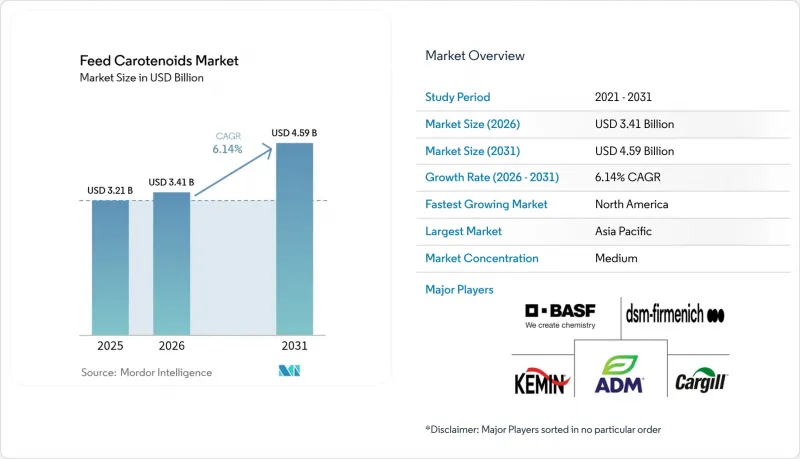
據 Mordor Intelligence 稱,飼料胡蘿蔔素的市場規模預計在 2026 年達到 34.1 億美元,高於 2025 年的 32.1 億美元,預計到 2031 年將達到 45.9 億美元。
預計從 2026 年到 2031 年,其複合年成長率將達到 6.14%。
本報告按產品類型(BETA-胡蘿蔔素、茄紅素、葉黃素、蝦青素、角黃素及其他)、形態(顆粒、粉末及其他)、動物種類(反芻動物、家禽、豬、水產養殖及其他)和地區(北美、歐洲、亞太、南美及其他)進行分類。市場預測以美元計價。
全球飼料胡蘿蔔素市場趨勢及洞察
對鮭科魚類彩色飼料的需求日益成長。
鮭科魚類養殖戶普遍認為,魚肉鮮豔的顏色直接影響消費者支付溢價的意願。挪威生產商報告稱,體色最佳的魚價格可上漲15%至20%。歐洲食品安全局(EFSA)於2024年重申觀賞魚中蝦蝦青素的安全基準值為100毫克/公斤,此舉明確了監管規定,並促進了蝦紅素在商業水產養殖中的應用。由於類胡蘿蔔素在偏遠地區需要溫控運輸,其運輸成本可能高達原料價值的12%,迫使養殖場租用附近的倉庫並在現場進行穩定性測試。
新興經濟體的工業化規模家禽生產
亞太地區家禽產業的整合推動了對標準化著色解決方案的集中需求,這些解決方案能夠在大規模生產中保持蛋黃顏色和肉雞皮膚外觀的一致性。從傳統的小規模養殖系統向一體化營運的轉變,為能夠提供技術支援和品質保證方案的優質類胡蘿蔔素供應商創造了機會。隨著巴西家禽出口的成長,遵守國際顏色標準變得至關重要,這加速了標準化類胡蘿蔔素添加方案的普及,以確保不同遺傳品系和生產環境下產品外觀的一致性。
富含類胡蘿蔔素的生質能供應波動
由於氣候變遷和土地利用競爭壓力影響原料的供應和價格,從萬壽菊花瓣、辣椒粉和其他植物性原料中提取類胡蘿蔔素的農業生產正變得日益不穩定。主要產區的天氣變化甚至會導致同一季節內的價格波動,迫使飼料生產商維持更大的庫存緩衝,從而增加營運資金需求。提取設施集中在特定地理區域,導致供應鏈脆弱性增加,近期同時影響多個原料類別的供應中斷證明了這一點。替代籌資策略需要經過嚴格的檢驗和法規核准,這可能需要18到24個月才能完成,限制了企業在短期內應對供應中斷的柔軟性。
細分市場分析
到2025年,蝦青素將佔飼料胡蘿蔔素市場31.95%的佔有率,主要得益於鮭魚著色劑的溢價。隨著零售商推廣非合成魚貝類標籤,蝦蝦青素正以7.36%的複合年成長率推動市場成長。 BETA-胡蘿蔔素作為維生素A的雙重成分,在禽類和豬類養殖領域仍佔據重要的飼料胡蘿蔔素市場。雖然在飼料蛋生產項目中保留葉黃素有助於實現帶殼雞蛋SKU(庫存管理單元)的差異化,但角黃素的使用仍受到劑量上限的限制。
蝦青素的市場主導地位形成了一個價格保護傘,使得像玉米黃質這樣的利基類胡蘿蔔素能夠以特有的溢價出售。鮭魚加工商將獎金與魚片顏色指標掛鉤,確保即使在飼料成本上漲時期,市場需求仍然穩定。監管條件賦予了蝦青素和BETA-胡蘿蔔素替代品競爭優勢,因為它們在提供類似著色效果的同時,也不存在安全隱患。其他類胡蘿蔔素,包括玉米黃質和辣椒紅素,則針對特定的應用領域,在這些領域,特定的顏色特性或功能優勢使其價格高於主流替代品。
區域分析
至2025年,亞太地區將佔全球飼料胡蘿蔔素市場的29.55%。中國在全球水產養殖產量中佔有較大佔有率,隨著大規模養殖場整合的推進,營養標準化進程也正在加速。在印度和越南,人們正在採用歐洲肉雞基因,這需要更高的類胡蘿蔔素濃度來增強出口水產品的表皮顏色。各地區政府都在補貼循環水養殖系統,從而提高了每噸魚產品中蝦蝦青素的使用量。
預計北美地區在2026年至2031年間將以7.55%的複合年成長率達到最高成長。北美地區預計將保持穩定成長,這得益於其大規模家禽養殖綜合體以及兼顧創新速度與安全性的法規環境。美國食品藥物管理局(FDA)對發酵衍生原料的核准流程比歐盟更快,這吸引了創業投資人,並加速了美國製造地的建立。加拿大的大西洋鮭魚養殖場已與BASF SE)和帝斯曼公司(DSM)簽署了供應契約,其中包括降低營運中斷風險的措施。在南美洲,標準化著色方案的引入正在推進,這得歸功於巴西家禽出口的激增。同時,非洲新興的吳郭魚養殖場正在探索低成本的珠粒技術,以提高魚肉的產量和價值。
在歐洲,挪威的鮭魚價值鏈和德國的預混合料生產設施是重要的需求中心。由於歐洲食品安全局(EFSA)嚴格的審查程序,配方正傾向於使用天然來源的成分,而德國則為推進微珠包埋生產線提供了技術基礎。斯堪的納維亞半島的水產飼料廠正在微調蝦蝦青素的用量,以達到每公斤魚片25毫克的目標,並最大限度地減少殘留損失。
其他好處:
- Excel格式的市場預測(ME)表
- 3個月的分析師支持
目錄
第1章:引言
- 研究假設和市場定義
- 調查範圍
第2章:調查方法
第3章執行摘要
第4章 市場狀況
- 市場概覽
- 市場促進因素
- 鮭科魚類飼料。
- 新興國家的工業化家禽生產
- 從合成類胡蘿蔔素過渡到天然類胡蘿蔔素
- 微藻類和微發酵在成本方面取得突破性進展。
- 關稅促使類胡蘿蔔素供應鏈回歸國內
- 透過人工智慧驅動的色素最佳化來實現物種特異性結果。
- 市場限制因素
- 富含類胡蘿蔔素的生質能供應的波動性
- 新型發酵菌株監管方面的不確定性
- 熱帶地區飼料物流過程中因光分解造成的損失
- 劑量超過營養攝取量時有無症狀性毒性的風險。
- 監理情勢
- 技術展望
- 波特五力分析
第5章 市場規模與成長預測
- 依產品類型
- BETA-胡蘿蔔素
- 茄紅素
- 葉黃素
- 蝦青素
- 角黃素
- 其他類型
- 按形式
- 珠
- 粉末
- 油懸浮液
- 乳液
- 依動物類型
- 反芻動物
- 家禽
- 豬
- 水產養殖
- 其他動物類型
- 按地區
- 北美洲
- 美國
- 加拿大
- 墨西哥
- 其他北美國家
- 歐洲
- 德國
- 英國
- 法國
- 西班牙
- 義大利
- 俄羅斯
- 其他歐洲國家
- 亞太地區
- 中國
- 印度
- 日本
- 澳洲
- 其他亞太國家
- 南美洲
- 巴西
- 阿根廷
- 其他南美國家
- 中東
- 沙烏地阿拉伯
- 土耳其
- 其他中東國家
- 非洲
- 南非
- 埃及
- 其他非洲國家
- 北美洲
第6章 競爭情勢
- 市場集中度
- 策略趨勢
- 市佔率分析
- 公司簡介
- BASF SE
- DSM-Firmenich AG
- Kemin Industries, Inc.
- Synthite Industries Ltd.
- Nutrex NV
- Divi's Laboratories Limited
- Archer-Daniels-Midland Company
- Cargill Inc.
- Zhejiang NHU Co., Ltd.(NHU Holding Group Co.,Ltd)
- Givaudan SA
- Allied Biotech Corporation
- Impextraco NV
- EW Nutrition GmbH
- Novus International, Inc.(Mitsui & Co., Ltd. and Nippon Soda Co., Ltd)
第7章 市場機會與未來展望
According to Mordor Intelligence, feed carotenoids market size in 2026 is estimated at USD 3.41 billion, growing from 2025 value of USD 3.21 billion with 2031 projections showing USD 4.59 billion, growing at 6.14% CAGR over 2026-2031.
This report is Segmented by Product Type (Beta-Carotene, Lycopene, Lutein, Astaxanthin, Canthaxanthin, and Other Types), by Form (Beadlet, Powder, and More), by Animal Type (Ruminant, Poultry, Swine, Aquaculture, and Other Animal Types), and by Geography (North America, Europe, Asia-Pacific, South America, and More). The Market Forecasts are Provided in Terms of Value (USD).
Global Feed Carotenoids Market Trends and Insights
Rising Demand for Salmonid Aquafeed Pigmentation
Salmon farmers link flesh coloration directly with consumer premium willingness, and Norwegian producers report a 15 - 20% price uplift for optimally pigmented fish. The European Food Safety Authority's 2024 reaffirmation of astaxanthin safety limits at 100 mg/kg for ornamental fish provides regulatory clarity that supports expanded usage in commercial aquaculture. Freight cost for temperature-controlled carotenoids reaches 12% of ingredient value in remote sites, pushing farms to secure nearby warehousing and on-farm stability testing.
Industrial-Scale Poultry Production in Emerging Economies
Poultry sector consolidation in Asia-Pacific markets creates concentrated demand for standardized pigmentation solutions that ensure consistent egg yolk coloration and broiler skin appearance across large production volumes. The shift from traditional smallholder systems to integrated operations creates opportunities for premium carotenoid suppliers who can provide technical support and quality assurance programs. Brazil's poultry export growth necessitates compliance with international color standards, driving the adoption of standardized carotenoid supplementation protocols that ensure consistent product appearance across diverse genetic lines and production environments.
Volatility in Carotenoid-Rich Biomass Supplies
Agricultural extraction of carotenoids from marigold petals, paprika, and other plant sources faces increasing volatility due to climate variability and competing land use pressures that affect raw material availability and pricing. Weather disruptions in major growing regions can create price swings within single seasons, forcing feed manufacturers to maintain larger inventory buffers that increase working capital requirements. The concentration of extraction facilities in specific geographic regions creates supply chain vulnerabilities, as demonstrated by recent disruptions that affected multiple ingredient categories simultaneously. Alternative sourcing strategies require extensive validation and regulatory approvals that can take 18-24 months to complete, limiting short-term flexibility in responding to supply disruptions.
Other drivers and restraints analyzed in the detailed report include:
- Shift from Synthetic to Natural Carotenoids
- Microalgae and Precision-Fermentation Cost Breakthroughs
- Regulatory Uncertainty Around Novel Fermentation Strains
For complete list of drivers and restraints, kindly check the Table Of Contents.
Segment Analysis
Astaxanthin held 31.95% feed carotenoids market share in 2025, driven by salmon pigmentation premiums. It leads growth at a 7.36% CAGR as retailers promote non-synthetic seafood labels. The feed carotenoids market size attributable to beta-carotene remains sizable in poultry and swine due to its dual Vitamin A role. Lutein retention in table-egg programs supports differentiated shell-egg Stock keeping units (SKU), while canthaxanthin usage stays constrained by dosage ceilings.
The dominance of astaxanthin creates a price umbrella enabling niche carotenoids such as zeaxanthin to float at specialty premiums. Salmon processors tie bonus payments to fillet hue metrics, cementing steady demand even during feed cost inflation cycles. The regulatory landscape creates competitive advantages for astaxanthin and beta-carotene alternatives that offer similar pigmentation benefits without associated safety concerns. Other carotenoid types, including zeaxanthin and capsanthin, target niche applications where specific color profiles or functional benefits justify premium pricing compared to mainstream alternatives.
Complete Report Scope:
- By Product Type
- Beta-Carotene
- Lycopene
- Lutein
- Astaxanthin
- Canthaxanthin
- Other Types
- By Form
- Beadlet
- Powder
- Oil Suspension
- Emulsion
- By Animal Type
- Ruminant
- Poultry
- Swine
- Aquaculture
- Other Animal Types
- By Geography
- North America
- United States
- Canada
- Mexico
- Rest of North America
- Europe
- Germany
- United Kingdom
- France
- Spain
- Italy
- Russia
- Rest of Europe
- Asia-Pacific
- China
- India
- Japan
- Australia
- Rest of Asia-Pacific
- South America
- Brazil
- Argentina
- Rest of South America
- Middle East
- Saudi Arabia
- Turkey
- Rest of Middle East
- Africa
- South Africa
- Egypt
- Rest of Africa
- North America
Geography Analysis
Asia-Pacific contributed 29.55% of the feed carotenoids market in 2025. China accounts for a significant share of the world's aquaculture harvest, and the consolidation of mega-farms accelerates the standardization of nutrients. India and Vietnam adopt European-style broiler genetics, demanding higher carotenoid density for export-grade skin coloration. Regional governments subsidize recirculating aquaculture systems, magnifying astaxanthin uptake per metric ton of fish produced.
North America is projected to register the fastest CAGR of 7.55% from 2026 to 2031. North America posts steady gains backed by large poultry complexes and a regulatory environment that balances innovation speed with safety. FDA approvals for fermentation-derived inputs move faster than EU processes, enticing venture investors to build United States manufacturing. Canada's Atlantic salmon farms secure supply contracts that include delivery contingencies tied to BASF SE and DSM outage risk mitigation. South America leverages Brazil's poultry export surge to integrate standardized pigmentation protocols, whereas Africa's emerging tilapia farms explore low-cost beadlets to raise harvest value.
Europe, with Norway's salmon value chain and Germany's premix hubs acting as anchor demand centers. EFSA's stringent review procedures tilt formulations toward natural inputs, and Germany offers technical hubs that refine beadlet encapsulation lines. Nordic aquafeed factories fine-tune astaxanthin dosage to comply with 25 mg/kg fillet targets and minimize residual loss.
- BASF SE
- DSM-Firmenich AG
- Kemin Industries, Inc.
- Synthite Industries Ltd.
- Nutrex NV
- Divi's Laboratories Limited
- Archer-Daniels-Midland Company
- Cargill Inc.
- Zhejiang NHU Co., Ltd. (NHU Holding Group Co.,Ltd)
- Givaudan SA
- Allied Biotech Corporation
- Impextraco NV
- EW Nutrition GmbH
- Novus International, Inc. (Mitsui & Co., Ltd. and Nippon Soda Co., Ltd)
Additional Benefits:
- The market estimate (ME) sheet in Excel format
- 3 months of analyst support
TABLE OF CONTENTS
1 Introduction
- 1.1 Study Assumptions and Market Definition
- 1.2 Scope of the Study
2 Research Methodology
3 Executive Summary
4 Market Landscape
- 4.1 Market Overview
- 4.2 Market Drivers
- 4.2.1 Rising demand for salmonid aquafeed pigmentation
- 4.2.2 Industrial-scale poultry production in emerging economies
- 4.2.3 Shift from synthetic to natural carotenoids
- 4.2.4 Microalgae and precision-fermentation cost breakthroughs
- 4.2.5 Tariff-driven reshoring of carotenoid supply chains
- 4.2.6 AI-enabled pigment optimization for species-specific outcomes
- 4.3 Market Restraints
- 4.3.1 Volatility in carotenoid-rich biomass supplies
- 4.3.2 Regulatory uncertainty around novel fermentation strains
- 4.3.3 Photodegradation losses during tropical feed logistics
- 4.3.4 Sub-clinical toxicity risks at supra-nutritional doses
- 4.4 Regulatory Landscape
- 4.5 Technological Outlook
- 4.6 Porter's Five Forces Analysis
- 4.6.1 Bargaining Power of Suppliers
- 4.6.2 Bargaining Power of Buyers
- 4.6.3 Threat of New Entrants
- 4.6.4 Threat of Substitutes
- 4.6.5 Intensity of Competitive Rivalry
5 Market Size and Growth Forecasts (Value)
- 5.1 By Product Type
- 5.1.1 Beta-Carotene
- 5.1.2 Lycopene
- 5.1.3 Lutein
- 5.1.4 Astaxanthin
- 5.1.5 Canthaxanthin
- 5.1.6 Other Types
- 5.2 By Form
- 5.2.1 Beadlet
- 5.2.2 Powder
- 5.2.3 Oil Suspension
- 5.2.4 Emulsion
- 5.3 By Animal Type
- 5.3.1 Ruminant
- 5.3.2 Poultry
- 5.3.3 Swine
- 5.3.4 Aquaculture
- 5.3.5 Other Animal Types
- 5.4 By Geography
- 5.4.1 North America
- 5.4.1.1 United States
- 5.4.1.2 Canada
- 5.4.1.3 Mexico
- 5.4.1.4 Rest of North America
- 5.4.2 Europe
- 5.4.2.1 Germany
- 5.4.2.2 United Kingdom
- 5.4.2.3 France
- 5.4.2.4 Spain
- 5.4.2.5 Italy
- 5.4.2.6 Russia
- 5.4.2.7 Rest of Europe
- 5.4.3 Asia-Pacific
- 5.4.3.1 China
- 5.4.3.2 India
- 5.4.3.3 Japan
- 5.4.3.4 Australia
- 5.4.3.5 Rest of Asia-Pacific
- 5.4.4 South America
- 5.4.4.1 Brazil
- 5.4.4.2 Argentina
- 5.4.4.3 Rest of South America
- 5.4.5 Middle East
- 5.4.5.1 Saudi Arabia
- 5.4.5.2 Turkey
- 5.4.5.3 Rest of Middle East
- 5.4.6 Africa
- 5.4.6.1 South Africa
- 5.4.6.2 Egypt
- 5.4.6.3 Rest of Africa
- 5.4.1 North America
6 Competitive Landscape
- 6.1 Market Concentration
- 6.2 Strategic Moves
- 6.3 Market Share Analysis
- 6.4 Company Profiles (Includes Global Level Overview, Market Level Overview, Core Segments, Financials as Available, Strategic Information, Market Rank/Share, Products and Services, Recent Developments)
- 6.4.1 BASF SE
- 6.4.2 DSM-Firmenich AG
- 6.4.3 Kemin Industries, Inc.
- 6.4.4 Synthite Industries Ltd.
- 6.4.5 Nutrex NV
- 6.4.6 Divi's Laboratories Limited
- 6.4.7 Archer-Daniels-Midland Company
- 6.4.8 Cargill Inc.
- 6.4.9 Zhejiang NHU Co., Ltd. (NHU Holding Group Co.,Ltd)
- 6.4.10 Givaudan SA
- 6.4.11 Allied Biotech Corporation
- 6.4.12 Impextraco NV
- 6.4.13 EW Nutrition GmbH
- 6.4.14 Novus International, Inc. (Mitsui & Co., Ltd. and Nippon Soda Co., Ltd)


