


 |
市場調查報告書
商品編碼
2113570
智慧布料:市場佔有率分析、產業趨勢與統計、成長預測(2026-2031)Smart Fabrics - Market Share Analysis, Industry Trends & Statistics, Growth Forecasts (2026 - 2031) |
||||||

※ 本網頁內容可能與最新版本有所差異。詳細情況請與我們聯繫。
據 Mordor Intelligence 稱,2025 年智慧布料市場價值為 775 萬件,預計到 2031 年將從 2026 年的 858 萬件成長至 1,425 萬件,預測期(2026-2031 年)複合年成長率為 10.68%。
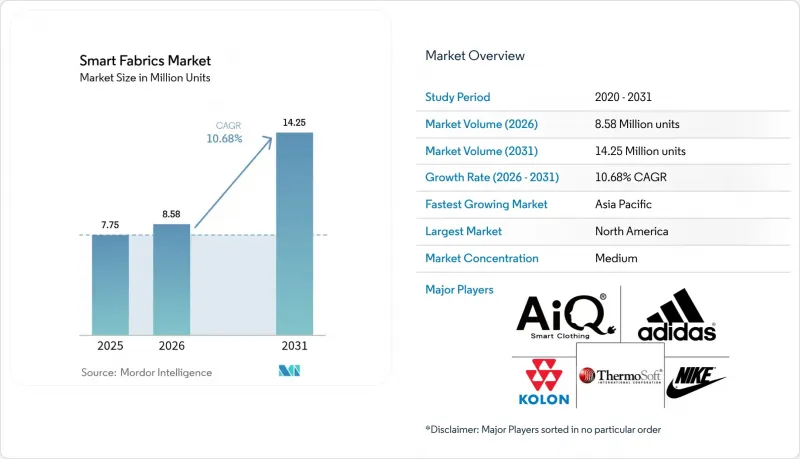
本報告按類型(被動式智慧布料、主動式智慧布料、超智慧布料)、功能(感測、溫度調節等)、材質(棉基、聚酯纖維/尼龍基、高性能材料)、應用(時尚/娛樂、運動/健身等)和地區細分。市場預測以銷售量(單位)為單位。
全球智慧布料市場趨勢及洞察
穿戴式電子產品生態系統的發展
隨著穿戴式裝置的日益普及,智慧服飾的需求也隨之激增。滑鐵盧大學的研究人員展示了一種能夠收集太陽能和體熱能的布料,無需外接電池。康乃爾大學的「SeamFit」襯衫則利用縫入普通T恤的導電線,以93.4%的準確率辨識運動類型。醫療領域的智慧服裝原型也正在快速發展,加州理工學院研發的智慧繃帶能夠以專家級的準確度預測創傷治療時間。 《衛報》報導了一種基於紡織品的電子設備,它可以吸收環境電磁能,並利用人體作為電路的一部分,為嵌入服裝中的超低功耗感測器供電。這些技術的進步正在模糊服裝和電子產品之間的界限,智慧布料市場也正向生活方式、醫療和工業領域不斷擴張。
軟性積體電路的快速小型化和整合
電子設備融入布料舒適度的閾值已經改變了。麻省理工學院的工程師們開發出一種可拉伸纖維電腦,它整合了微型裝置、感測器和藍牙模組,並且可以機洗。這使得穿戴式裝置能夠應用於北極任務,在不增加衣物體積的情況下監測生命徵象。此外,研究表明,刺繡摩擦奈米發電機每次滑動循環可產生307.5微焦耳的能量,證明了透過衣物的正常運動即可實現能源回收的實用性。香港大學開發的有機電化學電晶體可在織物上進行本地數據處理,從而降低通訊負載並增強隱私性。這些突破性技術使得在保持織物懸垂性和柔軟性的同時,將先進的處理能力融入紡織品成為可能,從而提高了消費者的接受度。
高昂的製造成本和網路安全風險
這些生產線需要專用設備來嵌入導體、感測器和微控制器,導致單位成本高於普通紡織品。 2024年的通貨膨脹和供應鏈中斷進一步擠壓了美國紡織品製造商的利潤空間,迫使許多製造商削減自動化升級的投資。資料安全也是一個值得關注的問題,因為服裝會收集受健康資料法規約束的生物識別資訊。加密會增加組件成本,而產品生命週期內強制性的軟體更新也會增加總擁有成本。小規模品牌難以獲得受監管設計的資金,這阻礙了它們打入低收入市場。
細分市場分析
隨著預測分析和自適應技術從實驗室走向大規模生產,預計到2031年,超智慧布料的複合年成長率將達到11.06%,成為市場主導領域。被動式布料由於其在基礎感測任務中久經考驗的耐用性,目前仍佔據智慧布料市場44.62%的佔有率。能夠根據刺激改變透氣性等特性的主動式布料填補了這一市場空白,但必須克服功耗與耐用性之間的權衡難題。採用壓電纖維的智慧聲學布料可以將彎曲和觸覺感受轉化為精確的電訊號,即使全天穿著也能保持透氣性和熱穩定性。研發流程中融入了嵌入紡織品的神經網路,這些神經網路能夠學習穿著者的穿著模式並預測異常情況,從而實現主動健康預警。這些功能為超智慧布料創造了明顯的價值溢價,推動其在高性能運動服、國防和慢性病監測等領域的智慧布料市場佔有率不斷成長。
智慧聲學技術正惠及被動式和主動式產品。最佳化的分層方案提高了訊號雜訊比,從而提升了入門級平衡監測帶和低成本姿勢矯正設備的性能。被動式產品製造商可以利用現有織布機,比新參與企業超智慧領域的企業更快擴大規模。隨著生產線整合度的提高,織布機製造商和晶片供應商之間的專利共用將提高產量,並使各層級產品實現均衡成長。
能源採集功能預計將以13.28%的複合年成長率實現最高成長,但到2025年,感測功能仍將佔據智慧布料市場55.42%的佔有率。利用相變油墨和微流體通道實現加熱和冷卻的恆溫毛衣滿足了特定性能需求,而發光布料則將提升時尚鞋類和活動服裝的檔次。編織到臂帶中的高效摩擦驅動奈米發電機,如今可在劇烈運動期間提供超過3 mW cm⁻²的功率,使藍牙信標無需外部電源即永續運作(arxiv.org)。將這些超級電容與水能源來源結合使用,可使其保持數天的電量,無需每日充電。此類電源系統將使救援人員的自主式野戰夾克和即使在病人無法移動的情況下也能追蹤生命徵象的醫院罩衣得以實用化。
感測技術透過整合到訓練T卹中的心率和體溫測量模組,繼續保持主導地位。基於纖維的感應線圈透過測量肌肉氧飽和度,拓展了運動器材在預防運動傷害方面的作用。隨著製造商將多功能紗線融入產品,產品線正在將感測功能與微能量電池融合,這些類別不再相互排斥,而是相輔相成。
區域分析
北美擁有雄厚的國防預算、蓬勃發展的健康科技生態系統以及消費者對創新運動服裝的熱情,預計到2025年將以28.12%的市場佔有率引領全球。美國國防部正在資助纖維電腦和氣候適應型製服的研發,從而確保國內對高規格布料的需求。麻省理工學院、滑鐵盧大學和加州理工學院透過孵化新創公司並授權其紡織平台,不斷豐富該地區的創新管道。多家紡紗廠已將生產轉移到近岸地區,以緩解供應衝擊,並利用政府旨在重組區域製造業的激勵措施。
亞太地區是成長的主要驅動力,預計2031年將維持12.05%的複合年成長率。中國的產業用紡織品產業已佔全國紡織業總量的20%以上,其中醫療、過濾及防護類產品年增率達9%至13%。北京矩陣科技的「Y-Warm」隔熱材料具有優異的保暖性和抗菌性能,預計將出口到寒冷氣候地區的運動服飾品牌。日本供應商正在研發超細導電長絲,而韓國多家公司正在將可水洗的OLED紗線圖案商業化,用於互動服裝。在印度,一家新創公司正在接受扶持,致力於為當地診所生產價格極具競爭力的智慧繃帶,展現了智慧繃帶在該地區廣泛的應用前景。歐洲正處於永續性法規與先進工程技術的交匯點。歐盟先進的PFAS法規正在推動對替代塗層的研究,這些塗層既能保持導電性,又能降低毒性風險。蘭精集團對TreeToTextile的少數股權投資正在加速開發可減少水和能源消耗的纖維素纖維。儘管德國、法國和西班牙正在發展紡織品回收產業叢集,但消費者調查顯示,他們對基於永續性的價格溢價非常敏感。大學正與汽車零件製造商合作開發能夠檢測駕駛員疲勞的座椅布料,這將擴大工業應用範圍,並鞏固歐洲作為智慧布料市場創新中心的地位。
其他好處:
- Excel格式的市場預測(ME)表
- 3個月的分析師支持
目錄
第1章:引言
- 研究假設和市場定義
- 調查範圍
第2章:調查方法
第3章執行摘要
第4章 市場狀況
- 市場概覽
- 市場促進因素
- 穿戴式電子產品生態系統的成長
- 軟性積體電路的快速小型化和整合
- 與導電線相關的專利申請數量將激增(自2025年起)
- 整合到纖維中的能源採集型超級電容
- 認知負荷監測設備的軍事要求
- 來自循環紡織品牌的永續性溢價
- 市場限制因素
- 高昂的製造成本和網路安全風險
- 電子紡織品互通性缺乏全球標準
- 奈米塗層毒性新規
- 電子紡織品廢棄物處理階段的複雜性。
- 供應鏈分析
- 監理情勢
- 技術展望
- 波特五力分析
- 對影響市場的宏觀經濟因素進行評估
第5章 市場規模與成長預測
- 按類型
- 被動式智慧織物
- 主動式智慧布料
- 超智慧布料
- 功能性別
- 感測
- 體溫調節
- 能源採集
- 發光與美學
- 材料
- 棉質
- 聚酯纖維和尼龍
- 高性能材料(克維拉、Dyneema等)
- 透過使用
- 時尚與娛樂
- 運動與健身
- 醫療保健
- 交通運輸-汽車和航太
- 軍事/國防
- 工業與安全
- 按地區
- 北美洲
- 美國
- 加拿大
- 墨西哥
- 南美洲
- 巴西
- 阿根廷
- 其他南美國家
- 歐洲
- 德國
- 英國
- 法國
- 義大利
- 西班牙
- 荷蘭
- 其他歐洲國家
- 亞太地區
- 中國
- 日本
- 韓國
- 印度
- 其他亞太國家
- 中東和非洲
- 中東
- 沙烏地阿拉伯
- 阿拉伯聯合大公國
- 其他中東國家
- 非洲
- 南非
- 奈及利亞
- 其他非洲國家
- 中東
- 北美洲
第6章 競爭情勢
- 市場集中度
- 策略趨勢
- 市佔率分析
- 公司簡介
- Adidas AG
- NIKE Inc.
- AIQ Smart Clothing Inc.
- DuPont de Nemours Inc.
- Kolon Industries Inc.
- Sensoria Inc.
- ThermoSoft International Corp.
- Interactive Wear AG
- Ohmatex ApS
- Schoeller Textil AG
- Toray Industries Inc.
- Hexoskin/Carre Technologies Inc.
- Gentherm Inc.
- VF Corporation(The North Face)
- Under Armour Inc.
- Laird PLC(Advanced Thermal)
- Jabil Inc.(BlueSky e-textile)
- Google LLC(Jacquard by Levi's)
- Textronics Inc.
- Wearable X
- VT Garment Co.(Gravitech)
第7章 市場機會與未來展望
According to Mordor Intelligence, the smart fabrics market size was valued at 7.75 million units in 2025 and estimated to grow from 8.58 million units in 2026 to reach 14.25 million units by 2031, at a CAGR of 10.68% during the forecast period (2026-2031).
This report is Segmented by Type (Passive Smart Fabrics, Active Smart Fabrics, Ultra-Smart Fabrics), Functionality (Sensing, Thermoregulation, and More), Material (Cotton-Based, Polyester and Nylon, High-Performance), Application (Fashion and Entertainment, Sports and Fitness, and More), and Geography. The Market Forecasts are Provided in Terms of Volume (Units).
Global Smart Fabrics Market Trends and Insights
Growth in Wearable-Electronics Ecosystem
Demand for smart garments has surged in tandem with the wider wearable device boom. Researchers at the University of Waterloo demonstrated fabrics that harvest solar and body-heat energy, removing the need for external batteries. Cornell University's SeamFit shirts classified exercises with 93.4% accuracy using conductive threads stitched into everyday tees. Healthcare prototypes are progressing quickly, including smart bandages from the California Institute of Technology that predict wound-healing timelines at expert-level precision. The Guardian reported fiber-based electronics that draw ambient electromagnetic energy, turning the human body into part of the circuit and fueling ultra-low-power sensors embedded inside clothing. Collectively, these advances blur the line between attire and electronics, expanding the smart fabrics market into lifestyle, medical, and industrial realms.
Rapid Miniaturization and Flexible-IC Integration
The threshold at which integrated electronics compromise fabric comfort has shifted. MIT engineers produced elastic fiber computers containing micro-devices, sensors, and Bluetooth modules that survive machine washes, enabling Arctic mission wearables that monitor vital signs without bulk.Embroidered triboelectric nanogenerators yielded 307.5 µJ per sliding cycle, showcasing viable energy capture through regular garment motion. Organic electrochemical transistors developed at the University of Hong Kong now process data locally on the fabric, lowering transmission loads and boosting privacy. These breakthroughs place sophisticated processing power inside textiles while preserving drape and flexibility, enhancing consumer acceptance.
High Fabrication Cost and Cybersecurity Risks
Production lines require specialized equipment for embedding conductors, sensors, and microcontrollers, pushing unit costs above those of regular textiles. Inflation and supply chain disruptions in 2024 further squeezed margins for U.S. textile mills, many of which diverted capex away from automation upgrades. Data security remains a parallel concern because garments collect biometrics that fall under health-data regulations. Encryption adds component expense and mandates software updates throughout a product's life, increasing total cost of ownership. Smaller brands face hurdles securing capital for compliant design, slowing penetration in low-income markets.
Other drivers and restraints analyzed in the detailed report include:
- Textile-Embedded Energy-Harvesting Supercapacitors
- Military Mandates for Cognitive-Load Monitoring Gear
- Absence of Global E-Textile Interoperability Standards
For complete list of drivers and restraints, kindly check the Table Of Contents.
Segment Analysis
Ultra-smart variants are forecast to post the segment-leading 11.06% CAGR to 2031 as predictive analytics and automated adaptation move from labs into volume production. Passive formats still command 44.62% of the smart fabrics market due to proven durability across basic sensing tasks. Active fabrics, which modify properties like breathability in response to stimuli, bridge the gap but must overcome power and durability trade-offs. Smart acoustic cloth using piezoelectric threads translates bending and touch into precise electrical signals, maintaining airflow and thermal stability for day-long wear. R&D pipelines are embedding on-textile neural networks that learn wearer patterns and predict anomalies, unlocking proactive wellness alerts. These capabilities give Ultra-smart fabrics a clear value premium, propelling their share of the smart fabrics market in high-performance sportswear, defense, and chronic-care monitoring.
Smart acoustics also benefit Passive and Active categories. Tailored layering schemes now boost signal-to-noise ratios, enhancing entry-level balance monitoring belts and low-cost posture trainers. Builders of Passive goods leverage established looms, so they scale faster than Ultra-smart newcomers. As manufacturing lines converge, patent sharing between loom makers and chip vendors will compress yields, balancing growth across tiers.
Energy Harvesting functions show the highest forecast CAGR of 13.28%, though Sensing retained a 55.42% share of the smart fabrics market in 2025. Thermoregulation sweaters that heat or cool through phase-change inks and microfluidic channels fulfill niche performance needs, while luminescent fabrics enrich aesthetic footwear and event costumes. Efficient triboelectric nanogenerators woven into arm bands now deliver over 3 mW cm-2 during intense motion, enabling continuous Bluetooth beacons without external power arxiv.org. Moisture-enabled supercapacitors pair with those generators to retain charge for days, removing the daily charging chore. These power systems make autonomous field jackets viable for rescue crews and enable hospital gowns that track vitals even when patients lack mobility.
Sensing retains leadership through ubiquitous heart-rate and temperature modules in workout tees. Textile-based inductive coils measure muscle oxygenation, expanding the role of sports gear in injury prevention. As manufacturers integrate multi-functional yarns, product families combine sensing with micro-energy cells, making the categories mutually reinforcing rather than mutually exclusive.
Complete Report Scope:
- By Type
- Passive Smart Fabrics
- Active Smart Fabrics
- Ultra-smart Fabrics
- By Functionality
- Sensing
- Thermoregulation
- Energy Harvesting
- Luminescent and Aesthetic
- By Material
- Cotton-based
- Polyester and Nylon
- High-performance (Kevlar, Dyneema, etc.)
- By Application
- Fashion and Entertainment
- Sports and Fitness
- Medical and Healthcare
- Transportation - Automotive and Aerospace
- Military and Defense
- Industrial and Safety
- By Geography
- North America
- United States
- Canada
- Mexico
- South America
- Brazil
- Argentina
- Rest of South America
- Europe
- Germany
- United Kingdom
- France
- Italy
- Spain
- Netherlands
- Rest of Europe
- Asia-Pacific
- China
- Japan
- South Korea
- India
- Rest of Asia-Pacific
- Middle East and Africa
- Middle East
- Saudi Arabia
- United Arab Emirates
- Rest of Middle East
- Africa
- South Africa
- Nigeria
- Rest of Africa
- Middle East
- North America
Geography Analysis
North America led with 28.12% market share in 2025 on the back of strong defense budgets, vibrant health-tech ecosystems, and consumer enthusiasm for innovative sportswear. The Department of Defense funds fiber computers and climate-adaptive uniforms, ensuring domestic demand for high-spec fabrics. MIT, University of Waterloo, and Caltech spin out start-ups that license their textile platforms, keeping regional innovation pipelines full. Several mills moved to near-shore production to mitigate supply shocks, unlocking government incentives aimed at rebuilding local manufacturing.
Asia Pacific is the growth engine, projected at a 12.05% CAGR through 2031. China's technical textile segment already forms over 20% of its broader textile industry, posting 9-13% annual growth in medical, filtration, and protective categories. Beijing MatrixTech's Y-Warm insulation delivers superior thermal retention and antimicrobial properties, offering export potential to cold-weather sportswear brands. Japanese suppliers refine ultrafine conductive filaments, while Korean groups commercialize washable OLED thread patterns for interactive apparel. India nurtures start-ups that craft price-competitive smart bandages for rural clinics, demonstrating the region's wide application spread. Europe sits at the convergence of sustainability mandates and advanced engineering. The bloc's progressive PFAS restrictions drive research into alternative coatings that cut toxic risk yet retain conductivity. Lenzing's minority stake in TreeToTextile fast-tracks cellulose fibers that lower water and energy footprints. Germany, France, and Spain foster textile recycling clusters, but consumer surveys reveal price sensitivity to sustainability premiums. Universities collaborate with automotive suppliers on seat fabrics that detect driver fatigue, broadening industrial uptake and reinforcing Europe's role as an innovation hub in the smart fabrics market.
- Adidas AG
- NIKE Inc.
- AIQ Smart Clothing Inc.
- DuPont de Nemours Inc.
- Kolon Industries Inc.
- Sensoria Inc.
- ThermoSoft International Corp.
- Interactive Wear AG
- Ohmatex ApS
- Schoeller Textil AG
- Toray Industries Inc.
- Hexoskin / Carre Technologies Inc.
- Gentherm Inc.
- VF Corporation (The North Face)
- Under Armour Inc.
- Laird PLC (Advanced Thermal)
- Jabil Inc. (BlueSky e-textile)
- Google LLC (Jacquard by Levi's)
- Textronics Inc.
- Wearable X
- VT Garment Co. (Gravitech)
Additional Benefits:
- The market estimate (ME) sheet in Excel format
- 3 months of analyst support
TABLE OF CONTENTS
1 INTRODUCTION
- 1.1 Study Assumptions and Market Definition
- 1.2 Scope of the Study
2 RESEARCH METHODOLOGY
3 EXECUTIVE SUMMARY
4 MARKET LANDSCAPE
- 4.1 Market Overview
- 4.2 Market Drivers
- 4.2.1 Growth in wearable-electronics ecosystem
- 4.2.2 Rapid miniaturization and flexible-IC integration
- 4.2.3 Surge in conductive-yarn patent filings (post-2025)
- 4.2.4 Textile-embedded energy-harvesting supercapacitors
- 4.2.5 Military mandates for cognitive-load monitoring gear
- 4.2.6 Sustainability premiums from circular-textile brands
- 4.3 Market Restraints
- 4.3.1 High fabrication cost and cybersecurity risks
- 4.3.2 Absence of global e-textile interoperability standards
- 4.3.3 Emerging toxicity rules on nano-coatings
- 4.3.4 End-of-life recycling complexity of e-textile waste
- 4.4 Supply-Chain Analysis
- 4.5 Regulatory Landscape
- 4.6 Technological Outlook
- 4.7 Porter's Five Forces Analysis
- 4.7.1 Threat of New Entrants
- 4.7.2 Bargaining Power of Suppliers
- 4.7.3 Bargaining Power of Buyers
- 4.7.4 Threat of Substitutes
- 4.7.5 Competitive Rivalry
- 4.8 Assesment of Macroeconomic Factors on the Market
5 MARKET SIZE AND GROWTH FORECASTS (UNITS)
- 5.1 By Type
- 5.1.1 Passive Smart Fabrics
- 5.1.2 Active Smart Fabrics
- 5.1.3 Ultra-smart Fabrics
- 5.2 By Functionality
- 5.2.1 Sensing
- 5.2.2 Thermoregulation
- 5.2.3 Energy Harvesting
- 5.2.4 Luminescent and Aesthetic
- 5.3 By Material
- 5.3.1 Cotton-based
- 5.3.2 Polyester and Nylon
- 5.3.3 High-performance (Kevlar, Dyneema, etc.)
- 5.4 By Application
- 5.4.1 Fashion and Entertainment
- 5.4.2 Sports and Fitness
- 5.4.3 Medical and Healthcare
- 5.4.4 Transportation - Automotive and Aerospace
- 5.4.5 Military and Defense
- 5.4.6 Industrial and Safety
- 5.5 By Geography
- 5.5.1 North America
- 5.5.1.1 United States
- 5.5.1.2 Canada
- 5.5.1.3 Mexico
- 5.5.2 South America
- 5.5.2.1 Brazil
- 5.5.2.2 Argentina
- 5.5.2.3 Rest of South America
- 5.5.3 Europe
- 5.5.3.1 Germany
- 5.5.3.2 United Kingdom
- 5.5.3.3 France
- 5.5.3.4 Italy
- 5.5.3.5 Spain
- 5.5.3.6 Netherlands
- 5.5.3.7 Rest of Europe
- 5.5.4 Asia-Pacific
- 5.5.4.1 China
- 5.5.4.2 Japan
- 5.5.4.3 South Korea
- 5.5.4.4 India
- 5.5.4.5 Rest of Asia-Pacific
- 5.5.5 Middle East and Africa
- 5.5.5.1 Middle East
- 5.5.5.1.1 Saudi Arabia
- 5.5.5.1.2 United Arab Emirates
- 5.5.5.1.3 Rest of Middle East
- 5.5.5.2 Africa
- 5.5.5.2.1 South Africa
- 5.5.5.2.2 Nigeria
- 5.5.5.2.3 Rest of Africa
- 5.5.5.1 Middle East
- 5.5.1 North America
6 COMPETITIVE LANDSCAPE
- 6.1 Market Concentration
- 6.2 Strategic Moves
- 6.3 Market Share Analysis
- 6.4 Company Profiles (includes Global level Overview, Market level overview, Core Segments, Financials as available, Strategic Information, Market Rank/Share for key companies, Products and Services, and Recent Developments)
- 6.4.1 Adidas AG
- 6.4.2 NIKE Inc.
- 6.4.3 AIQ Smart Clothing Inc.
- 6.4.4 DuPont de Nemours Inc.
- 6.4.5 Kolon Industries Inc.
- 6.4.6 Sensoria Inc.
- 6.4.7 ThermoSoft International Corp.
- 6.4.8 Interactive Wear AG
- 6.4.9 Ohmatex ApS
- 6.4.10 Schoeller Textil AG
- 6.4.11 Toray Industries Inc.
- 6.4.12 Hexoskin / Carre Technologies Inc.
- 6.4.13 Gentherm Inc.
- 6.4.14 VF Corporation (The North Face)
- 6.4.15 Under Armour Inc.
- 6.4.16 Laird PLC (Advanced Thermal)
- 6.4.17 Jabil Inc. (BlueSky e-textile)
- 6.4.18 Google LLC (Jacquard by Levi's)
- 6.4.19 Textronics Inc.
- 6.4.20 Wearable X
- 6.4.21 VT Garment Co. (Gravitech)
7 MARKET OPPORTUNITIES AND FUTURE OUTLOOK
- 7.1 White-space and Unmet-need Assessment

 智慧溫控纖維市場:依原料、應用、最終用戶、國家及地區分類-全球產業分析、市場規模、市場佔有率及2026年至2033年預測
 智慧交通運輸布料市場-2026-2032年全球市場預測
 智慧布料和紡織品:全球市場佔有率和排名、總收入和需求預測(2025-2031年)
 2032 年污染感測織物市場預測:按產品類型、材料類型、分銷管道、技術、應用、最終用戶和地區進行的全球分析2032 年智慧布料市場預測:按類型、功能、材料、應用、最終用戶和地區進行的全球分析
 交通運輸智慧織物市場規模、佔有率、成長分析(按組件、材料、應用、最終用戶產業和地區)- 產業預測,2025 年至 2032 年
 交通智慧織物:市場佔有率分析、產業趨勢/統計、成長預測(2025-2030)用於時尚和娛樂的智慧布料:市場佔有率分析、行業趨勢、統計和成長預測(2025-2030)用於運動和健身的智慧布料:市場佔有率分析、行業趨勢和成長預測(2025-2030)