


 |
市場調查報告書
商品編碼
2113522
魚蝦飼料添加劑:市場佔有率分析、產業趨勢與統計及成長預測(2026-2031)Fish And Shrimp Feed Additives - Market Share Analysis, Industry Trends & Statistics, Growth Forecasts (2026 - 2031) |
||||||

※ 本網頁內容可能與最新版本有所差異。詳細情況請與我們聯繫。
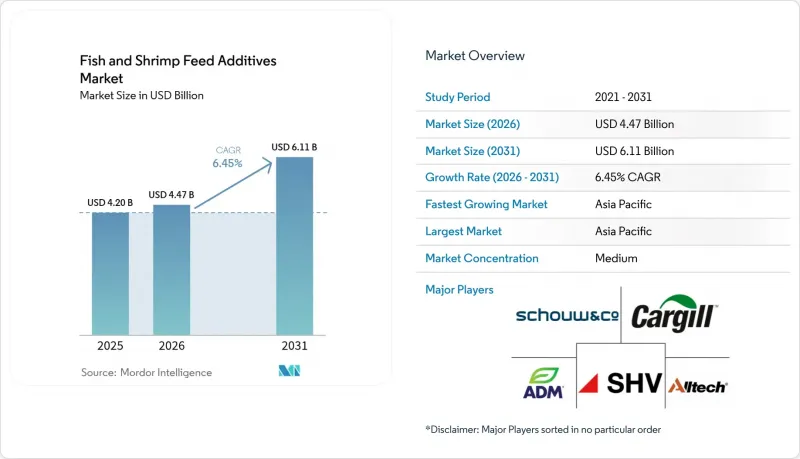
據 Mordor Intelligence 稱,2026 年魚蝦飼料添加劑的市場規模估計為 44.7 億美元,高於 2025 年的 42 億美元,預計到 2031 年將達到 61.1 億美元。
預計從 2026 年到 2031 年,其複合年成長率將達到 6.45%。
本報告按目標動物(魚蝦)、添加劑類型(胺基酸、抗生素、維生素、抗氧化劑、飼料酵素、益生菌、有機酸、精油和植物萃取物等)、劑型(乾粉、液體、膠囊劑)和地區(北美、南美、歐洲、亞太等)進行細分。市場預測以美元計價。
全球魚蝦飼料添加劑市場趨勢及洞察
全球水產品消費量不斷成長
在對高品質、可追溯水產品需求不斷成長的推動下,生產商正透過使用添加劑來提高飼料轉換率並減少對環境的影響,從而改善飼料品質。高價值進口商將無抗生素認證作為市場准入的必要條件,這使得增強免疫力的化合物從可選項轉變為必需成分。能夠改善魚片品質、色澤和omega-3脂肪酸含量的特殊成分在零售通路中價格更高。像DSM-Firmenich的「Sustell」這樣的數位化永續性平台正在幫助水產養殖戶量化添加劑帶來的碳減排量,並將其傳達給買家。由於野生漁業的供應量落後於消費量,水產養殖業的擴張正在推動對添加劑的長期需求。
擴大出口型水產養殖
厄瓜多爾的蝦農們展現了出口認證如何促進益生菌和酵素的使用,這些添加劑能夠抑制抗生素殘留,同時在長途運輸到歐洲和北美的過程中維持蝦子的存活率。越南和印尼也出現了類似的趨勢,高品質的添加劑抵消了進口商要求的三階段檢驗體系的成本。 BioMar公司揭露的碳足跡數據,例如“每公斤蝦排放5.2公斤二氧化碳當量”,凸顯了低環境影響配方簡化認證程序的價值。出口溢價證明了提高蝦子存活率和生長率的投資是合理的,即使在價格敏感的市場,也促進了添加劑的使用。
全球禁用抗生素導致配方奶粉價格上漲。
美國食品藥物管理局(FDA) 的產業指南 293 和歐洲食品安全局 (EFSA) 的更新規定,對替代成分提出了額外的測試、文件編制和檢驗程序要求。在不含抗生素的飼料中重新引入抗生素需要測試、分析和監測基礎設施,這會導致在實現利潤之前成本增加。小規模飼料生產商缺乏專門的研發團隊,迫使他們依賴跨國公司昂貴的承包解決方案。進口市場的不同法規進一步增加了產品開發的複雜性,加重了監管合規團隊的負擔,並延長了新添加劑實現盈利所需的時間。
細分市場分析
至2025年,魚類將佔魚蝦飼料添加劑市場規模的70.45%。鮭魚、鱒魚和鱸魚養殖利用更大的生物量和穩定的物流,將添加劑成本分攤到整個生產過程中,從而增強了規模經濟效益。酵素複合物提高了飼料轉換率,增加了盈利,也為推出價格更高的組合藥物提供了合理性。儘管蝦類養殖產量較低,但在東南亞和南美洲的集約化水產養殖系統中,蝦類養殖的複合年成長率仍達到7.38%,這些地區需要增強免疫力的混合飼料來防止大規模死亡。
養殖品種的多樣化正在創造利基市場機會。澳洲肺魚、鯰魚以及新興的陸基養殖海水魚類都需要客製化的微量營養素配方。精準投餵設備能夠針對每種魚類達到最佳劑量,進而提高益生菌膠囊和精油混合物的功效。帝斯曼-菲美尼奇公司針對鱸魚和鯛魚開發的「Sustell」模組清晰地展現了客製化永續性分析的發展趨勢。隨著越來越多的生產商採用循環水產養殖系統,能夠最大限度減少養分滲漏的水質穩定劑的市場佔有率將會擴大,從而推動魚類和蝦類產品線的價值成長超過銷量成長。
區域分析
預計亞太地區將在2025年佔據銷售領先地位,佔總銷售額的36.58%,並預計在2031年之前以6.92%的複合年成長率持續成長,鞏固其作為魚蝦飼料添加劑市場基石的地位。中國循環水養殖系統的轉型正在推動對高精度、水穩定性添加劑的需求。越南和印尼的蝦類出口商正依靠益生菌和有機酸來滿足歐盟和美國買家對無抗生素認證的要求。印度沿海養殖業的擴張以及印尼澳洲肺魚養殖業的發展,在Skretting和NewSeas等夥伴關係的支持下,正在推動新的產量成長。
與亞洲一樣,南美洲也正經歷蓬勃發展。厄瓜多爾的蝦類出口量在2023年將達到120萬噸,價值72億美元,這主要得益於與提高蝦類存活率和碳標籤相關的添加劑的銷售。智利的鮭魚養殖戶正努力控制疾病,並增加對酸化劑和增強疫苗效力的營養物質的投入。巴西的吳郭魚養殖場正在投資酵素混合物,以便利用當地廉價的飼料來維持具有競爭力的單位成本。政府旨在促進永續生產和可追溯性的補貼進一步推動了功能性添加劑在全部區域的應用。
歐洲和北美是成熟且極具影響力的市場,它們對監管標準的製定起著決定性作用。挪威一家領先的鮭魚生產商正在尋求使用包封蝦青素和藻類提取油來保持魚肉色澤和ω-3脂肪酸含量。在加拿大,快速發展的陸基水產養殖業正在試驗人工智慧驅動的投餵技術,以最佳化添加劑配方。嚴格的核准制度有利於資質齊全的供應商,限制新進者,並鞏固現有品牌的地位。
中東和非洲雖然仍處於發展階段,但正經歷快速成長。埃及吳郭魚養殖業的蓬勃發展以及沙烏地阿拉伯對糧食安全的投入,推動了對技術援助的需求,而這種需求往往伴隨著添加劑的供應。在奈及利亞和南非,鯰魚和海水養殖業正在擴張,因此人們更傾向於選擇經濟高效的酸化劑,以延長飼料在高溫氣候下的保存期限。帝斯曼-菲美尼奇在埃及的年產1萬噸工廠,清楚地展現了向本地化生產的轉變,從而縮短了前置作業時間並降低了進口關稅。
其他好處:
- Excel格式的市場預測(ME)表
- 3個月的分析師支持
目錄
第1章:引言
- 研究假設和市場定義
- 調查範圍
第2章:調查方法
第3章執行摘要
第4章 市場狀況
- 市場概覽
- 市場促進因素
- 全球水產品消費量增加
- 擴大出口型水產養殖
- 政府對永續水產養殖的獎勵措施和補貼
- 用於免疫調節的功能性飼料添加劑
- 使用昆蟲和藻類衍生的添加劑
- 高精度供料平台正在推動添加劑的日益普及。
- 市場限制因素
- 原物料價格波動
- 水產養殖中反覆發生的疾病爆發
- 全球禁用抗生素增加了藥物配方變更的成本。
- 報告合成添加劑碳足跡的壓力
- 監理情勢
- 技術展望
- 波特五力分析
第5章 市場規模與成長預測
- 依動物類型
- 魚
- 蝦
- 按添加劑類型
- 胺基酸
- 抗生素
- 維他命
- 抗氧化劑
- 飼料酵素
- 益生菌
- 有機酸
- 精油和植物萃取物
- 礦物
- 益生元
- 按形式
- 乾粉(粉末/顆粒)
- 液體
- 封裝/塗層
- 按地區
- 北美洲
- 美國
- 加拿大
- 墨西哥
- 其他北美國家
- 南美洲
- 巴西
- 厄瓜多
- 智利
- 其他南美國家
- 歐洲
- 德國
- 英國
- 法國
- 西班牙
- 挪威
- 俄羅斯
- 其他歐洲國家
- 亞太地區
- 中國
- 印度
- 日本
- 越南
- 印尼
- 其他亞太國家
- 中東
- 沙烏地阿拉伯
- 阿拉伯聯合大公國
- 其他中東國家
- 非洲
- 埃及
- 奈及利亞
- 其他非洲國家
- 北美洲
第6章 競爭情勢
- 市場集中度
- 策略趨勢
- 市佔率分析
- 公司簡介
- Cargill Incorporated
- Nutreco(SHV Holdings NV)
- Alltech Inc
- ADM(Archer Daniels Midland Company)
- Biomar Group(Schouw & Co.)
- DSM-Firmenich
- Evonik Industries AG
- Ridley Corporation
- Adisseo(BlueStar Group)
- BASF SE
- Kemin Industries Inc
- Aker Biomarine
- Calanus AS
- Charoen Pokphand Foods(CP Group)
- Grobest
第7章 市場機會與未來展望
According to Mordor Intelligence, the fish and shrimp feed additives market size in 2026 is estimated at USD 4.47 billion, growing from 2025 value of USD 4.20 billion with 2031 projections showing USD 6.11 billion, growing at 6.45% CAGR over 2026-2031.
This report is Segmented by Animal Type (Fish and Shrimp), Additive Type (Amino Acids, Antibiotics, Vitamins, Antioxidants, Feed Enzymes, Probiotics, Organic Acids, Essential Oils and Plant Extracts, and More), Form (Dry, Liquid, and Encapsulated), and Geography (North America, South America, Europe, Asia-Pacific, and More). The Market Forecasts are Provided in Terms of Value (USD).
Global Fish And Shrimp Feed Additives Market Trends and Insights
Growing global seafood consumption
Escalating demand for premium, traceable seafood encourages producers to upgrade rations with additives that boost feed conversion rates and minimize environmental footprints. High-value importers tie antibiotic-free certification to market access, turning immune-supporting compounds from optional extras into essential inputs. Specialized ingredients that enhance fillet quality, color, and omega-3 profiles secure price premiums in retail channels. Digital sustainability platforms, such as DSM-Firmenich's Sustell, help farmers quantify additive-linked carbon reductions and communicate them to buyers. As consumption outpaces supply from capture fisheries, aquaculture expansion reinforces long-term additive demand.
Expansion of export-oriented aquaculture
Ecuadorian shrimp operators exemplify how export accreditation drives the adoption of probiotics and enzymes that curb antibiotic residues while preserving survival during lengthy logistics to Europe and North America. Similar patterns hold in Vietnam and Indonesia, where premium additives offset the costs of triple testing regimes required by importers. Carbon footprint disclosures, such as BioMar's 5.2 kg CO2-equivalent per kg shrimp benchmark, underline the value of low-impact formulations that simplify certification. Export premiums justify investments that raise survival and growth, reinforcing additive spend even in price-sensitive markets.
Global antibiotic bans raising reformulation costs
FDA (Food and Drug Administration) Guidance for Industry 293 and EFSA updates impose extra testing, documentation, and validation steps for alternative ingredients. Reformulating feeds without antibiotics demands trials, analytics, and monitoring infrastructure that raise costs before returns materialize. Smaller mills lack dedicated R&D teams, pushing them toward turnkey solutions from multinationals at premium pricing. Divergent rules across import markets further complicate rollouts, stretching regulatory teams thin and extending time to revenue for new additives.
Other drivers and restraints analyzed in the detailed report include:
- Government incentives and subsidies for sustainable aquaculture
- Precision feeding platforms boosting additive utilization
- Carbon-footprint reporting pressure on synthetic additives
For complete list of drivers and restraints, kindly check the Table Of Contents.
Segment Analysis
The fish occupied 70.45% of the fish and shrimp feed additives market size in 2025. Salmon, trout, and sea bass farms leverage higher biomass volumes and stable logistics to spread additive costs across output, reinforcing economies of scale. Improved feed conversion from enzyme complexes raises profitability, justifying premium formulations. Shrimp operations, while smaller in volume, post a 7.38% CAGR because intensive systems in Southeast Asia and South America need immune-supporting blends to prevent mass mortality events.
Species diversification introduces niche opportunities. Barramundi, catfish, and emerging land-based marine species require tailored micronutrient profiles. Precision-feeding hardware allows species-specific dosing, boosting the efficacy of encapsulated probiotics and essential oil blends. DSM-Firmenich's Sustell module for sea bass and sea bream illustrates the trend toward bespoke sustainability analytics. As more producers adopt recirculating aquaculture systems, water-stable additives that minimize leaching will claim higher shares, lifting value growth above volume gains in both fish and shrimp lines.
Complete Report Scope:
- By Animal Type
- Fish
- Shrimp
- By Additive Type
- Amino Acids
- Antibiotics
- Vitamins
- Antioxidants
- Feed Enzymes
- Probiotics
- Organic Acids
- Essential Oils and Plant Extracts
- Minerals
- Prebiotics
- By Form
- Dry (Powder/Granules)
- Liquid
- Encapsulated/Coated
- By Geography
- North America
- United States
- Canada
- Mexico
- Rest of North America
- South America
- Brazil
- Ecuador
- Chile
- Rest of South America
- Europe
- Germany
- United Kingdom
- France
- Spain
- Norway
- Russia
- Rest of Europe
- Asia-Pacific
- China
- India
- Japan
- Vietnam
- Indonesia
- Rest of Asia-Pacific
- Middle East
- Saudi Arabia
- United Arab Emirates
- Rest of Middle East
- Africa
- Egypt
- Nigeria
- Rest of Africa
- North America
Geography Analysis
Asia-Pacific led with 36.58% of 2025 revenue and is projected to compound at 6.92% through 2031, cementing its status as the anchor of the fish and shrimp feed additives market. China's transition toward recirculating aquaculture systems intensifies demand for precise, water-stable additives. Vietnamese and Indonesian shrimp exporters rely on probiotics and organic acids to satisfy antibiotic-free certifications required by European Union and United States buyers. India's coastal expansion and Indonesia's barramundi initiatives are adding fresh volume, supported by partnerships such as Skretting and NewSeas.
South America mirrors Asia's intensity, with Ecuador's shrimp exports in 2023 topping USD 7.2 billion from 1.2 million metric tons, anchoring additive sales tied to survival improvement and carbon labeling. Chilean salmon producers struggle with disease control, channeling spending toward acidifiers and vaccine-supportive nutrients. Brazilian tilapia farms invest in enzyme blends that unlock cheaper local feedstuffs, keeping unit costs competitive. Government subsidies aimed at sustainable output and traceability further encourage functional additive uptake across the region.
Europe and North America represent mature yet influential destinations that shape regulatory norms. Norway's salmon giants demand encapsulated astaxanthin and algae oil to sustain flesh color and omega-3 levels. Canada's growing land-based sector experiments with AI-based feeding that optimizes additive inclusion. Stringent approval regimes favor suppliers with robust dossiers, limiting new entrants and strengthening established brands.
Middle East and Africa are nascent but fast-growing. Egypt's tilapia boom and Saudi Arabia's food-security investments create appetite for technical support bundled with additive supply. Nigeria and South Africa expand catfish and marine operations, favoring cost-effective acidifiers that extend feed shelf life in hot climates. DSM-Firmenich's 10,000 metric tons plant in Egypt underscores the move toward local production that trims lead times and import duties
- Cargill Incorporated
- Nutreco (SHV Holdings N.V.)
- Alltech Inc
- ADM (Archer Daniels Midland Company)
- Biomar Group (Schouw & Co.)
- DSM-Firmenich
- Evonik Industries AG
- Ridley Corporation
- Adisseo (BlueStar Group)
- BASF SE
- Kemin Industries Inc
- Aker Biomarine
- Calanus AS
- Charoen Pokphand Foods (CP Group)
- Grobest
Additional Benefits:
- The market estimate (ME) sheet in Excel format
- 3 months of analyst support
TABLE OF CONTENTS
1 Introduction
- 1.1 Study Assumptions and Market Definition
- 1.2 Scope of the Study
2 Research Methodology
3 Executive Summary
4 Market Landscape
- 4.1 Market Overview
- 4.2 Market Drivers
- 4.2.1 Growing global seafood consumption
- 4.2.2 Expansion of export-oriented aquaculture
- 4.2.3 Government incentives and subsidies for sustainable aquaculture
- 4.2.4 Functional feed additives for immune modulation
- 4.2.5 Adoption of insect- and algae-based additive ingredients
- 4.2.6 Precision feeding platforms boosting additive utilization
- 4.3 Market Restraints
- 4.3.1 Raw-material price volatility
- 4.3.2 Recurring disease outbreaks in aquaculture
- 4.3.3 Global antibiotic bans raising reformulation costs
- 4.3.4 Carbon-footprint reporting pressure on synthetic additives
- 4.4 Regulatory Landscape
- 4.5 Technological Outlook
- 4.6 Porter's Five Forces Analysis
- 4.6.1 Bargaining Power of Suppliers
- 4.6.2 Bargaining Power of Buyers
- 4.6.3 Threat of New Entrants
- 4.6.4 Threat of Substitutes
- 4.6.5 Intensity of Competitive Rivalry
5 Market Size and Growth Forecasts (Value)
- 5.1 By Animal Type
- 5.1.1 Fish
- 5.1.2 Shrimp
- 5.2 By Additive Type
- 5.2.1 Amino Acids
- 5.2.2 Antibiotics
- 5.2.3 Vitamins
- 5.2.4 Antioxidants
- 5.2.5 Feed Enzymes
- 5.2.6 Probiotics
- 5.2.7 Organic Acids
- 5.2.8 Essential Oils and Plant Extracts
- 5.2.9 Minerals
- 5.2.10 Prebiotics
- 5.3 By Form
- 5.3.1 Dry (Powder/Granules)
- 5.3.2 Liquid
- 5.3.3 Encapsulated/Coated
- 5.4 By Geography
- 5.4.1 North America
- 5.4.1.1 United States
- 5.4.1.2 Canada
- 5.4.1.3 Mexico
- 5.4.1.4 Rest of North America
- 5.4.2 South America
- 5.4.2.1 Brazil
- 5.4.2.2 Ecuador
- 5.4.2.3 Chile
- 5.4.2.4 Rest of South America
- 5.4.3 Europe
- 5.4.3.1 Germany
- 5.4.3.2 United Kingdom
- 5.4.3.3 France
- 5.4.3.4 Spain
- 5.4.3.5 Norway
- 5.4.3.6 Russia
- 5.4.3.7 Rest of Europe
- 5.4.4 Asia-Pacific
- 5.4.4.1 China
- 5.4.4.2 India
- 5.4.4.3 Japan
- 5.4.4.4 Vietnam
- 5.4.4.5 Indonesia
- 5.4.4.6 Rest of Asia-Pacific
- 5.4.5 Middle East
- 5.4.5.1 Saudi Arabia
- 5.4.5.2 United Arab Emirates
- 5.4.5.3 Rest of Middle East
- 5.4.6 Africa
- 5.4.6.1 Egypt
- 5.4.6.2 Nigeria
- 5.4.6.3 Rest of Africa
- 5.4.1 North America
6 Competitive Landscape
- 6.1 Market Concentration
- 6.2 Strategic Moves
- 6.3 Market Share Analysis
- 6.4 Company Profiles (Includes Global Level Overview, Market Level Overview, Core Segments, Financials as Available, Strategic Information, Market Rank/Share, Products and Services, and Recent Developments)
- 6.4.1 Cargill Incorporated
- 6.4.2 Nutreco (SHV Holdings N.V.)
- 6.4.3 Alltech Inc
- 6.4.4 ADM (Archer Daniels Midland Company)
- 6.4.5 Biomar Group (Schouw & Co.)
- 6.4.6 DSM-Firmenich
- 6.4.7 Evonik Industries AG
- 6.4.8 Ridley Corporation
- 6.4.9 Adisseo (BlueStar Group)
- 6.4.10 BASF SE
- 6.4.11 Kemin Industries Inc
- 6.4.12 Aker Biomarine
- 6.4.13 Calanus AS
- 6.4.14 Charoen Pokphand Foods (CP Group)
- 6.4.15 Grobest


