

 |
市場調查報告書
商品編碼
2113517
汽車轉向系統:市場佔有率分析、產業趨勢與統計、成長預測(2026-2031)Automotive Steering System - Market Share Analysis, Industry Trends & Statistics, Growth Forecasts (2026 - 2031) |
||||||

※ 本網頁內容可能與最新版本有所差異。詳細情況請與我們聯繫。
根據 Mordor Intelligence 估計,2025 年汽車轉向系統市值為 349.8 億美元,2026 年將擴大到 368.5 億美元,預計到 2031 年將達到 477.7 億美元。
預計從 2026 年到 2031 年,其複合年成長率將達到 5.33%。
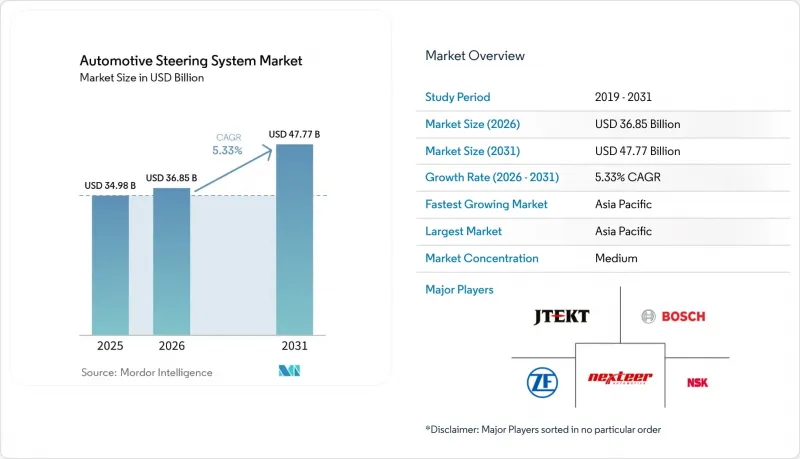
本報告按組件(液壓泵、電動馬達等)、車輛類型(乘用車、商用車)、機構(電動方向盤系統 (EPS)、液壓動力方向盤(HPS) 等)、銷售管道(OEM 和售後市場)以及地區(北美、南美等)進行細分。市場預測以美元計價。
全球汽車轉向系統市場趨勢及洞察
EPS在內燃機(ICE)和新能源汽車(XEV)平台上的快速普及
儘管EPS(電動輔助轉向系統)常被描述為電動車主導的技術,但汽車轉向系統市場最大的產量仍來自內燃機(ICE)和混合動力汽車。由於取消液壓泵可以降低引擎的運轉負荷,並將燃油效率提高3-5%,因此即使在內燃機平台仍佔據汽車產量主導地位的領域,EPS仍然至關重要。此外,由於EPS是一種用於車道維持、自動停車和轉向修正的可控執行器,隨著越來越多的車輛整合駕駛輔助功能,其作用預計將進一步擴大。雖然低成本的柱式輔助系統在量產車型中仍然很重要,但較重的SUV和大型電動車需要比標準C-EPS通常提供的扭力更大的扭力。 2025年4月,Nextair宣布推出一款“高功率柱式輔助EPS”,其助力能力擴展至110牛頓米,適用於跨界車和入門級電動車項目,超過了標準C-EPS的範圍。因此,汽車轉向系統市場正在保持一種發展路徑,即供應商不再依賴一次性推出 EPS,而是逐步向更大的車輛等級和高功率的變體過渡。
從2025年起,高階電動車將引進線控轉向技術。
線控轉向系統在2025年至2026年間從技術潛力階段過渡到量產階段,為汽車轉向系統市場開闢了一個新的高階成長領域。採埃孚(ZF)於2025年2月開始為蔚來汽車的ET9車型量產線控轉向系統,而梅賽德斯-奔馳則於2026年4月在歐洲推出了採用採埃孚硬體的改款EQS車型,實現了線控轉向系統的量產。耐世特(Nexteer)也於2026年4月開始為中國新能源汽車製造商生產符合ASIL-D認證標準的線控轉向系統,這標誌著該公司首個針對該架構的全面量產項目。隨著GB17675-2025標準於2026年7月1日生效,該標準取消了對機械轉向連桿的要求,並為線控轉向系統的商業化應用提供了明確的法律依據,中國仍然是該技術最重要的驅動力。蔚來汽車、小鵬汽車、比亞迪和理想汽車等廠商的參與表明,這項技術的應用範圍已從超豪華市場擴展到更廣泛的電動車價格區間。 ZF在張家港計畫的線控轉向系統年產能為38萬套,這也顯示供應商目前正在進行資本投資,他們假設汽車轉向系統市場將吸收大量的產量,而不僅僅是試點規模的生產。
稀土元素磁鐵價格波動推高了EPS的零件成本。
由於釹鐵硼磁鐵對電動輔助轉向系統(EPS)馬達的性能至關重要,因此對稀土元素的依賴仍然是汽車轉向系統市場最明顯的供應風險之一。中國佔全球整體稀土元素精煉量的91%和燒結釹鐵硼磁鐵產量的94%,其政策變化會迅速改變整個供應鏈的成本曲線。 2025年4月,中國商務部對七種中重稀土元素實施出口許可措施,進一步收緊了供應前景,因為鏑和鋱對於方向盤馬達所需的高溫性能至關重要。 2026年初至年末,氧化釹镨價格飆升後趨於穩定。這顯著增加了EPS專案物料清單(BOM)的壓力,尤其是在對價格最敏感的車型類別中。為此,供應商正與中國以外的供應商簽訂採購協議,並專注於設計針對低需求應用最佳化的鐵氧體馬達。同時,萊納斯等生產商正在中國境外擴大釹镨樹脂的產能。儘管採取了這些措施,汽車轉向系統市場仍面臨著成本負擔不平衡的問題;與高階線控轉向產品相比,主流電動輔助轉向系統(EPS)組件的價格受到的限制更大。
細分市場分析
到2025年,轉向柱和齒條將佔汽車轉向系統市場佔有率的38.74%,成為所有轉向系統架構中最大的零件類別。這一主導地位反映出,儘管電子元件和軟體的附加價值不斷增加,但轉向柱、齒條、軸、接頭和齒輪機構在EPS、EHPS和其他液壓系統中仍然至關重要。此細分市場強勁的銷售表現源自於所有車輛(無論輔助功能如何實現)對將轉向輸入轉換為車輪角度的機械路徑的持續需求。在汽車轉向系統市場,這意味著轉向柱和齒條組件扮演著基礎零件的角色,而電子元件正日益成為產品差異化的決定性因素。隨著新型乘用車平台不斷從液壓轉向轉向電動輔助轉向,液壓幫浦細分市場目前正面臨持續的壓力。
這種轉變並不意味著對零件的需求會消失;相反,價值正在轉移到馬達、ECU 和感測元件上。 ECU 的銷量正在成長,因為 EPS 控制器不再只是處理輔助邏輯,而是要管理扭力疊加、感測器融合輸入以及日益軟體化的轉向行為。此外,ADAS 系統需要進行多項扭矩、角度和位置測量以滿足診斷範圍要求,這導致感測器層數增加,進而增加了每個組件的零件數量。隨著高功率EPS 和故障運行設計在更多車型中廣泛應用,預計從 2026 年到 2031 年,馬達的複合年成長率將達到 8.53%,使其成為汽車轉向系統市場中成長最快的零件。雙繞組無刷直流馬達正成為 L2+ 應用的標準配置,因為即使發生單繞組故障,每個繞組也必須保持部分轉向控制能力。轉向線控技術透過增加每個系統中的馬達數量進一步擴大了需求,因為齒條執行器馬達和方向盤回授模擬器馬達是獨立的。從Nextair 2025年的訂單組成來看,純電動和電動車-內燃機混合動力平台佔了很大比例,這種組成變化已在訂單表現中得到明顯體現。因此,汽車轉向系統產業正在穩步將價值重心轉移到電子整合馬達組件上,同時又不影響機械轉向硬體的基本重要性。
到2025年,乘用車將佔據汽車轉向系統市場佔有率的62.65%,這不僅反映了乘用車產量的成長,也反映了新型乘用車幾乎全面採用電動輔助轉向系統(EPS)。 SUV仍然是該車型組中最重要的車身類型,因為其重量和較大的輪胎接地面積對能夠承受更大橫向扭矩的齒輪齒條式和雙小齒輪EPS解決方案提出了更高的要求。掀背車在歐洲和南亞仍然佔據重要地位,這些地區的都市區駕駛習慣仍然偏愛緊湊型車身;而轎車則憑藉在中國本土的生產保持著穩定的市場地位。多用途汽車(MPV)雖然在絕對數量上仍然較小,但在東南亞地區仍然保持著重要的地位,因為以家庭為導向的車身類型仍然很受歡迎。就整個乘用車市場而言,汽車轉向系統市場受到歐洲和日本已建立的EPS標準的限制。同時,中國新能源汽車平台正日益興起將EPS與早期線控轉向科技結合的趨勢。
預計2026年至2031年間,商用車市場將以7.28%的複合年成長率成長,成為汽車轉向系統市場中成長最快的車輛類別。短期成長的主要驅動力將是都市區配送區域輕型商用車的電氣化,電動驅動系統正在被引入,改變了以往以液壓動力方向盤為標準的傳統佈局。對於中型和重型商用車而言,前軸的高負載仍使其高度依賴液壓或電液轉向系統。然而,隨著高速公路自動駕駛功能對車道居中控制精度要求的提高,這一趨勢正在轉變。這種需求促使卡車製造商評估未來平台的冗餘EPS設計,尤其是在其產品藍圖中包含高速公路自動駕駛和編隊行駛功能的情況下。一項美國專利申請重點在於商用車模式切換期間的安全控制器切換,這反映了當前對高速故障時接管車輛的功能安全性的關注。商用車產業為供應商提供了極具吸引力的商機。這是因為電動輔助轉向的過渡將從相對較低的基礎水平開始,從而為轉型提供了更大的空間。此外,將高扭矩轉向部件融入先前主要應用於乘用車的電氣化項目中,將使汽車轉向系統市場的收入來源多元化。因此,汽車轉向系統產業不僅依賴電動車的成長,還依賴大型車輛應用中對電動轉向系統日益成長的需求,因為在這些應用中,控制精度具有戰略價值。
區域分析
到2025年,亞太地區將佔據全球汽車轉向系統市場規模的48.25%,預計到2031年將以6.52%的複合年成長率成長。這將使該地區同時擁有最大的市場規模和最快的成長速度。中國憑藉其全球最大的汽車生產規模和短期內最強勁的線控轉向部署計劃,仍然是汽車轉向系統市場最重要的國家。預計到2025年,中國新能源車產量將顯著成長,反映出對電動輔助轉向系統(EPS)和新型線控轉向平台日益成長的需求。線控轉向商業化部署的法律體制(計劃於2026年根據GB17675-2025生效)的製定意義重大,因為中國主要汽車製造商已經批准了該領域的項目。同時,印度正透過對電動車的大力政策支持和對國內製造群的投資,推動全部區域的成長動能。另一方面,日本已經展現了其在提供精密轉向和開發高級線控系統方面的能力,例如Lexus 550e F SPORT 將於 2026 年引入線控轉向系統。
到2025年,歐洲仍將是汽車轉向系統第二大市場,並持續成長,這得益於嚴格的安全和排放氣體法規以及強大的Tier 1供應商基礎。德國是該區域線控轉向系統應用的中心,採埃孚和博世均已開始量產,梅賽德斯-奔馳計劃於2026年在歐洲首次大規模量產EQS車型。該地區的監管趨勢正在推動對電動輔助轉向系統(EPS)的強勁需求,因為即使在以前可以使用傳統液壓解決方案的情況下,對用於車道維持輔助和安全功能的電子控制轉向輸出的需求也在不斷成長。博世已預測線控系統將帶來可觀的長期利潤,顯示供應商對此轉型高度重視。東歐的生產基地,例如捷克、斯洛伐克和匈牙利,透過作為西歐OEM計畫的組裝中心,繼續滿足EPS的需求。同時,由於制裁和供應鏈的孤立,俄羅斯的轉型步伐較為緩慢,這限制了其獲得先進半導體和頂級轉向系統的途徑。
北美仍然是汽車轉向系統市場的重要區域。這是因為該地區的產品組合包括大型皮卡和全尺寸SUV,這些車型歷來比其他地區更早採用液壓和電液轉向系統。如今,隨著駕駛輔助功能在大型車輛中日益普及,同樣的車型組合也為高功率輔助轉向系統(EPS)和未來的線控轉向系統創造了巨大的市場機會。南美洲繼續與巴西和阿根廷的組裝週期緊密相連,巴西是主要的生產和分銷中心,隨著現有車輛老化,EPS的替換市場也不斷擴大。在中東和非洲,市場穩步成長,儘管成長較慢,這得益於沙烏地阿拉伯和阿拉伯聯合大公國汽車銷量的成長,以及土耳其面向出口、需要滿足歐洲轉向標準的生產設施。
其他好處:
- Excel格式的市場預測(ME)表
- 3個月的分析師支持
目錄
第1章:引言
- 研究假設和市場定義
- 調查範圍
第2章:調查方法
第3章執行摘要
第4章 市場狀況
- 市場概覽
- 市場促進因素
- EPS 在 ICE 和 XEV 平台中的快速普及
- 從2025年起,高階電動車將引進線控轉向技術
- OEM廠商對具備ADAS功能的「故障運作」架構的需求
- 聯合國歐洲經濟委員會R155號指令強制要求市場上的電子控制單元具備網路安全意識
- 符合歐盟7/CAFE排放標準的輕量化轉向柱
- OTA扭力疊加軟體的銷售
- 市場限制因素
- 稀土元素磁鐵價格波動推高了每股盈餘的物料清單成本。
- 供不應求將持續到2026年
- 人們對轉向手感的擔憂減緩了線控轉向技術的普及。
- 一級供應商的整合將限制整車製造商的議價能力。
- 價值供應鏈分析
- 技術展望
- 監理情勢
- 波特五力模型
第5章 市場規模與成長預測
- 按組件
- 液壓泵浦
- 電動機
- 轉向柱/齒條
- 感測器(扭矩、角度、位置)
- 電控系統(ECU)
- 其他規則
- 車輛類型
- 搭乘用車
- 掀背車
- 轎車
- 運動型多用途車
- 多用途車輛
- 商用車輛
- 輕型商用車
- 中型和重型商用車輛
- 搭乘用車
- 透過機制
- 電動方向盤(EPS)
- 液壓動力方向盤(HPS)
- 電液動力方向盤(EHPS)
- 線控樓梯
- 按銷售管道
- 目的地設備製造商 (OEM)
- 售後市場
- 按地區
- 北美洲
- 美國
- 加拿大
- 其他北美國家
- 南美洲
- 巴西
- 阿根廷
- 其他南美國家
- 歐洲
- 德國
- 英國
- 法國
- 義大利
- 俄羅斯
- 其他歐洲國家
- 亞太地區
- 中國
- 日本
- 印度
- 韓國
- 其他亞太國家
- 中東和非洲
- 土耳其
- 沙烏地阿拉伯
- 阿拉伯聯合大公國
- 南非
- 其他中東和非洲國家
- 北美洲
第6章 競爭情勢
- 市場集中度
- 策略趨勢
- 市佔率分析
- 公司簡介
- JTEKT Corporation
- Robert Bosch GmbH
- ZF Friedrichshafen AG
- Nexteer Automotive Corporation
- NSK Ltd.
- HL Mando Corporation
- Astemo Ltd.
- Hyundai Mobis
- thyssenkrupp Presta AG
- Schaeffler Group
- Denso Corporation
- Knorr-Bremse AG
- China Automotive Systems, Inc.
第7章 市場機會與未來展望
According to Mordor Intelligence, the automotive steering system market size was valued at USD 34.98 billion in 2025, is estimated to grow to USD 36.85 billion in 2026, and is projected to reach USD 47.77 billion by 2031, growing at a 5.33% CAGR over 2026-2031.
This report is Segmented by Component (Hydraulic Pump, Electric Motor, and More), Vehicle Type (Passenger Cars, Commercial Vehicles), Mechanism (Electronic Power Steering (EPS), Hydraulic Power Steering (HPS), and More), Sales Channel (OEM and Aftermarket), and Geography (North America, South America, and More). The Market Forecasts are Provided in Terms of Value (USD).
Global Automotive Steering System Market Trends and Insights
Rapid EPS Penetration in ICE and XEV Platforms
EPS is often described as an EV-led technology, but the bigger volume engine in the automotive steering system market still comes from ICE and hybrid vehicle production. Removing the hydraulic pump reduces parasitic engine load and improves fuel economy by 3-5%, keeping EPS relevant even where combustion platforms still account for most vehicle output. EPS is also the controllable actuator used for lane keeping, automated parking, and steering correction, so its role is expected to grow as more vehicles add assisted driving features. The lower-cost column-assist format still matters for high-volume programs, yet heavier SUVs and larger electrified vehicles need more torque than standard C-EPS can usually deliver. Nexteer responded in April 2025 with a High-Output Column-Assist EPS that extends assist capacity to 110 Nm for crossover and entry EV programs, which sit above the normal C-EPS range . This keeps the automotive steering system market on a stepwise migration path, where suppliers move through larger vehicle classes and higher-output variants rather than relying on a single wave of EPS adoption.
Steer-By-Wire Deployment in Premium EVs From 2025
Steer-by-wire moved from technical promise to serial production during 2025 and 2026, adding a new premium growth layer to the automotive steering system market. ZF began series production for NIO's ET9 in February 2025, and Mercedes-Benz brought steer-by-wire into European series production in April 2026 on the refreshed EQS using ZF hardware. Nexteer also began ASIL-D-certified steer-by-wire production in April 2026 for a Chinese NEV manufacturer, marking its first full-scale production program in this architecture. China remains the most important catalyst because GB17675-2025, effective July 1, 2026, removes the mandatory mechanical steering link and gives commercial deployment a clear legal basis. The presence of programs from NIO, XPeng, BYD, and Li Auto shows that adoption is already moving below the ultra-luxury tier and into broader EV price bands. ZF's planned capacity of 380,000 steer-by-wire sets a year in Zhangjiagang also shows that suppliers are now committing capital on the assumption that the automotive steering system market will absorb meaningful production volume rather than pilot-scale output .
Rare-Earth Magnet Price Volatility Inflates EPS BOM
Rare-earth exposure remains one of the clearest supply risks in the automotive steering system market because NdFeB magnets are central to EPS motor performance. China accounts for 91% of globally refined rare earth output and 94% of sintered NdFeB magnet manufacturing, so policy changes there move cost curves quickly across the rest of the supply chain. MOFCOM's April 2025 export licensing action on seven medium and heavy rare earth elements tightened the outlook further because dysprosium and terbium are important for the high-temperature performance needed in steering motors. From the start of 2026 to later that year, NdPr oxide prices experienced a significant surge before easing. This substantially increased bill-of-materials pressures for EPS programs, particularly in the most price-sensitive vehicle categories. In response, suppliers are forging non-Chinese sourcing agreements and delving deeper into ferrite-based motor designs tailored for applications with lower demand. Concurrently, producers like Lynas are ramping up NdPr capacity beyond China's borders. Despite these measures, the automotive steering system market grapples with a lopsided cost burden: mainstream EPS assemblies have tighter pricing constraints compared to their premium steer-by-wire counterparts.
Other drivers and restraints analyzed in the detailed report include:
- OEM Demand For ADAS-Ready "Fail-Operational" Architectures
- Cyber-Secure ECU Mandates in UNECE R155 Markets
- Automotive MCU Shortage Through 2026
For complete list of drivers and restraints, kindly check the Table Of Contents.
Segment Analysis
Steering Column/Rack accounted for 38.74% of the automotive steering system market in 2025, making it the largest component group across all steering architectures. That lead reflects the fact that columns, racks, shafts, joints, and gear mechanisms remain present in EPS, EHPS, and the remaining hydraulic programs, even as more value moves into electronics and software. Revenue in this area stays resilient because every vehicle still needs the mechanical path that translates commanded steering input into wheel angle, regardless of how the assist function is delivered. Within the automotive steering system market, this makes the column-and-rack set the anchor content layer, while electronics increasingly determine product differentiation. The hydraulic pump sub-segment is now under sustained pressure because new passenger car platforms continue to move away from hydraulic steering in favor of electric assist.
That shift is shifting value toward electric motors, ECUs, and sensing elements rather than eliminating demand for components. ECU revenue is rising because EPS controllers now manage torque overlay, sensor fusion inputs, and increasingly software-defined steering behavior, rather than handling only assist logic. The sensors layer is also deepening because ADAS-ready systems require multiple torque, angle, and position measurements to meet diagnostic coverage expectations, thereby increasing content per assembly. Electric Motor is projected to grow at 8.53% CAGR from 2026 to 2031, making it the fastest-growing component in the automotive steering system market as higher-output EPS and fail-operational designs spread across more vehicle classes. Dual-winding brushless DC motors are becoming a more common baseline for L2+ applications because each winding must maintain partial steering authority after a single fault. The steer-by-wire transition adds another layer of demand because the rack actuator motor is separate from the steering-wheel feedback simulator motor, which increases motor content per system. Nexteer's 2025 booking mix, with a significant share tied to fully EV and split EV-and-ICE platforms, shows that this content shift is already evident in active business awards. As a result, the automotive steering system industry is seeing the value center steadily shift toward electronically integrated motor assemblies without diminishing the fundamental importance of mechanical steering hardware.
Passenger Cars held 62.65% of the automotive steering system market share in 2025, reflecting both higher unit production and near-complete penetration of EPS in new passenger models. SUVs remain the most important body style within this vehicle group because their weight and wider tire footprints support demand for rack-assist and dual-pinion EPS solutions with stronger lateral torque handling. Hatchbacks still matter in Europe and South Asia, where urban driving patterns continue to support compact formats, and sedans keep a stable role through domestic Chinese production. Multi-purpose vehicles remain smaller in absolute terms, yet they retain relevance in Southeast Asia, where family-oriented vehicle formats continue to have enduring appeal. Across passenger cars, the automotive steering system market is already shaped by an established EPS baseline in Europe and Japan. At the same time, Chinese NEV platforms increasingly pair EPS with early steer-by-wire preparation.
Commercial Vehicles are projected to grow at a 7.28% CAGR from 2026 to 2031, making them the fastest-growing vehicle category in the automotive steering system market. The near-term lift comes from light commercial vehicle electrification in urban delivery fleets, where electric drivetrains remove the natural fit that hydraulic power steering once had in conventional layouts. Medium and heavy commercial vehicles still rely heavily on hydraulic or electro-hydraulic steering because front axle loads remain very high. Still, the direction of travel is changing as automated highway functions require more precise lane-centering control. That need is prompting truck manufacturers to evaluate redundant EPS designs for future platforms, especially where highway automation or platooning is part of the product roadmap. A U.S. patent application highlighted safe controller switching during commercial vehicle mode transitions, which reflects the functional safety attention now being placed on fault handover at highway speeds. For suppliers, the commercial vehicle opportunity is attractive because the shift starts from a lower electric-assist base, offering more room for conversion. It also broadens the revenue mix of the automotive steering system market by bringing higher-torque steering content into electrification programs that were previously dominated by passenger cars. The automotive steering system industry will therefore depend not only on more EVs, but also on the growing need to electrify steering in heavy-duty applications where control precision has strategic value.
Complete Report Scope:
- By Component
- Hydraulic Pump
- Electric Motor
- Steering Column / Rack
- Sensors (Torque, Angle, Position)
- Electronic Control Unit (ECU)
- Other Components
- By Vehicle Type
- Passenger Cars
- Hatchback
- Sedan
- Sport Utility Vehicle
- Multi-Purpose Vehicle
- Commercial Vehicles
- Light Commercial Vehicles
- Medium and Heavy Commercial Vehicles
- Passenger Cars
- By Mechanism
- Electronic Power Steering (EPS)
- Hydraulic Power Steering (HPS)
- Electro-hydraulic Power Steering (EHPS)
- Steer-by-Wire
- By Sales Channel
- Original Equipment Manufacturer (OEM)
- Aftermarket
- By Geography
- North America
- United States
- Canada
- Rest of North America
- South America
- Brazil
- Argentina
- Rest of South America
- Europe
- Germany
- United Kingdom
- France
- Italy
- Russia
- Rest of Europe
- Asia-Pacific
- China
- Japan
- India
- South Korea
- Rest of Asia-Pacific
- Middle East and Africa
- Turkey
- Saudi Arabia
- United Arab Emirates
- South Africa
- Rest of Middle East and Africa
- North America
Geography Analysis
Asia-Pacific accounted for 48.25% of the automotive steering system market size in 2025 and is expected to expand at a 6.52% CAGR through 2031, giving it both the largest base and the fastest growth rate. China remains the most important country within the automotive steering system market because it combines the world's largest vehicle production footprint with the strongest near-term steer-by-wire pipeline. By 2025, China will have experienced significant growth in new energy vehicle production, reflecting rising demand for EPS and new by-wire platforms. The formalization of the legal pathway for commercial steer-by-wire deployment, set to take effect in 2026 under GB17675-2025, holds significance as major Chinese OEMs have already greenlit programs in this domain. Meanwhile, India bolsters regional momentum with robust EV policy support and investments in domestic manufacturing clusters. Japan, on the other hand, showcases its prowess in precision steering supply and premium by-wire development, as evidenced by the launch of the Lexus RZ 550e F SPORT's steer-by-wire system in 2026.
Europe remained the second-largest regional block in the automotive steering system market in 2025 and continues to be driven by strict safety and emissions rules, plus a dense Tier-1 supplier base. Germany is the center of the region's steer-by-wire push because ZF and Bosch have both moved into serial supply positions, and Mercedes-Benz introduced the first large-scale European series application on the EQS in 2026. The region's regulatory path keeps EPS demand firm because assisted-lane and safety features increasingly require electronically controllable steering output, even where older hydraulic solutions were once acceptable. Bosch has already attached major long-range revenue expectations to by-wire systems, which shows how seriously the supplier base views this transition. Eastern European production hubs such as the Czech Republic, Slovakia, and Hungary continue to absorb EPS demand by serving as assembly locations for Western OEM programs. At the same time, Russia faces a slower path due to sanctions and supply-chain isolation, which limit access to advanced semiconductors and top-tier steering systems.
North America remains a major region in the automotive steering system market because its product mix includes large pickups and full-size SUVs that have historically supported hydraulic and electro-hydraulic steering for longer than in other regions. That same mix now creates an important opportunity for higher-output EPS and future steer-by-wire systems as assisted-driving features spread to larger vehicles. South America continues to track the assembly cycles of Brazil and Argentina, with Brazil acting as the main production and distribution base and a growing EPS replacement market emerging as the installed fleet ages. The Middle East and Africa show steadier but smaller gains, supported by fleet growth in Saudi Arabia and the UAE, and by Turkey's export-linked production base, which must meet European steering specifications.
- JTEKT Corporation
- Robert Bosch GmbH
- ZF Friedrichshafen AG
- Nexteer Automotive Corporation
- NSK Ltd.
- HL Mando Corporation
- Astemo Ltd.
- Hyundai Mobis
- thyssenkrupp Presta AG
- Schaeffler Group
- Denso Corporation
- Knorr-Bremse AG
- China Automotive Systems, Inc.
Additional Benefits:
- The market estimate (ME) sheet in Excel format
- 3 months of analyst support
TABLE OF CONTENTS
1 Introduction
- 1.1 Study Assumptions & Market Definition
- 1.2 Scope of the Study
2 Research Methodology
3 Executive Summary
4 Market Landscape
- 4.1 Market Overview
- 4.2 Market Drivers
- 4.2.1 Rapid EPS Penetration in ICE and XEV Platforms
- 4.2.2 Steer-By-Wire Deployment in Premium EVs From 2025
- 4.2.3 OEM Demand For ADAS-Ready "Fail-Operational" Architectures
- 4.2.4 Cyber-Secure ECU Mandates in UNECE R155 Markets
- 4.2.5 Lightweight Steering Columns to Meet Euro 7/CAFE Norms
- 4.2.6 OTA-Upgradable Torque-Overlay Software Revenues
- 4.3 Market Restraints
- 4.3.1 Rare-Earth Magnet Price Volatility Inflates EPS BOM
- 4.3.2 Automotive MCU Shortage Through 2026
- 4.3.3 Steering-Feel Concerns Slowing Steer-By-Wire Rollout
- 4.3.4 Tier-1 Consolidation Limits OEM Bargaining Leverage
- 4.4 Value / Supply-Chain Analysis
- 4.5 Technological Outlook
- 4.6 Regulatory Landscape
- 4.7 Porter's Five Forces
- 4.7.1 Threat of New Entrants
- 4.7.2 Bargaining Power of Buyers
- 4.7.3 Bargaining Power of Suppliers
- 4.7.4 Threat of Substitutes
- 4.7.5 Competitive Rivalry
5 Market Size & Growth Forecasts (Value, USD)
- 5.1 By Component
- 5.1.1 Hydraulic Pump
- 5.1.2 Electric Motor
- 5.1.3 Steering Column / Rack
- 5.1.4 Sensors (Torque, Angle, Position)
- 5.1.5 Electronic Control Unit (ECU)
- 5.1.6 Other Components
- 5.2 By Vehicle Type
- 5.2.1 Passenger Cars
- 5.2.1.1 Hatchback
- 5.2.1.2 Sedan
- 5.2.1.3 Sport Utility Vehicle
- 5.2.1.4 Multi-Purpose Vehicle
- 5.2.2 Commercial Vehicles
- 5.2.2.1 Light Commercial Vehicles
- 5.2.2.2 Medium and Heavy Commercial Vehicles
- 5.2.1 Passenger Cars
- 5.3 By Mechanism
- 5.3.1 Electronic Power Steering (EPS)
- 5.3.2 Hydraulic Power Steering (HPS)
- 5.3.3 Electro-hydraulic Power Steering (EHPS)
- 5.3.4 Steer-by-Wire
- 5.4 By Sales Channel
- 5.4.1 Original Equipment Manufacturer (OEM)
- 5.4.2 Aftermarket
- 5.5 By Geography
- 5.5.1 North America
- 5.5.1.1 United States
- 5.5.1.2 Canada
- 5.5.1.3 Rest of North America
- 5.5.2 South America
- 5.5.2.1 Brazil
- 5.5.2.2 Argentina
- 5.5.2.3 Rest of South America
- 5.5.3 Europe
- 5.5.3.1 Germany
- 5.5.3.2 United Kingdom
- 5.5.3.3 France
- 5.5.3.4 Italy
- 5.5.3.5 Russia
- 5.5.3.6 Rest of Europe
- 5.5.4 Asia-Pacific
- 5.5.4.1 China
- 5.5.4.2 Japan
- 5.5.4.3 India
- 5.5.4.4 South Korea
- 5.5.4.5 Rest of Asia-Pacific
- 5.5.5 Middle East and Africa
- 5.5.5.1 Turkey
- 5.5.5.2 Saudi Arabia
- 5.5.5.3 United Arab Emirates
- 5.5.5.4 South Africa
- 5.5.5.5 Rest of Middle East and Africa
- 5.5.1 North America
6 Competitive Landscape
- 6.1 Market Concentration
- 6.2 Strategic Moves
- 6.3 Market Share Analysis
- 6.4 Company Profiles (Includes Global Level Overview, Market Level Overview, Core Segments, Financials as Available, Strategic Information, Market Rank/Share for Key Companies, Products and Services, SWOT Analysis, and Recent Developments)
- 6.4.1 JTEKT Corporation
- 6.4.2 Robert Bosch GmbH
- 6.4.3 ZF Friedrichshafen AG
- 6.4.4 Nexteer Automotive Corporation
- 6.4.5 NSK Ltd.
- 6.4.6 HL Mando Corporation
- 6.4.7 Astemo Ltd.
- 6.4.8 Hyundai Mobis
- 6.4.9 thyssenkrupp Presta AG
- 6.4.10 Schaeffler Group
- 6.4.11 Denso Corporation
- 6.4.12 Knorr-Bremse AG
- 6.4.13 China Automotive Systems, Inc.
7 Market Opportunities & Future Outlook

 汽車轉向系統市場預測至2034年—按轉向類型、組件、驅動系統、自動化程度、應用、銷售管道和地區分類的全球分析
 汽車轉向系統市場:按轉向系統類型、組件、系統配置、應用、車輛類型和最終用戶分類-2026-2032年全球市場預測
 汽車轉向系統市場分析與預測(至2035年):類型、產品類型、技術、組件、應用、材料類型、功能、安裝方式、設備、解決方案
 汽車轉向系統市場報告:按類型、組件、車輛類型和地區分類(2026-2034 年)
 2026年全球汽車轉向系統市場報告中心拉桿及轉向拉桿市場:按類型、材質、車輛類型、銷售管道和最終用途行業分類 - 2026-2032年全球市場預測
 電子轉角系統市場:市場機會、成長要素、產業趨勢分析及2026-2035年預測
 汽車轉向系統市場:按組件、應用、銷售管道、機制、最終用途、國家和地區分類-全球產業分析、市場規模、市場佔有率及2026年至2033年預測日本汽車轉向系統市場報告(按類型(電動輔助轉向、液壓輔助轉向、電液輔助轉向、手動轉向)、組件、車輛類型和地區分類,2026-2034年)汽車轉向角感測器市場:按感測器技術、輸出類型、安裝類型、應用、國家和地區分類的全球產業分析、市場規模、市場佔有率及2025-2032年預測