


 |
市場調查報告書
商品編碼
2113504
丙烯酸:市場佔有率分析、產業趨勢與統計、成長預測(2026-2031)Acrylic Acid - Market Share Analysis, Industry Trends & Statistics, Growth Forecasts (2026 - 2031) |
||||||

※ 本網頁內容可能與最新版本有所差異。詳細情況請與我們聯繫。
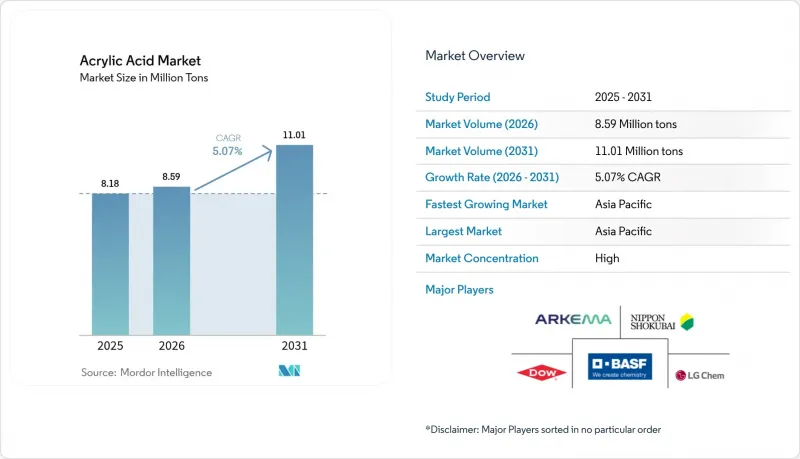
根據 Mordor Intelligence 預測,丙烯酸市場規模將從 2025 年的 818 萬噸成長到 2026 年的 859 萬噸,然後在 2031 年達到 1101 萬噸,2026 年至 2031 年的複合年成長率為 5.07%。
本報告按衍生物(丙烯酸甲酯、丙烯酸丁酯、丙烯酸乙酯等)、應用(油漆和塗料、黏合劑和密封劑等)、純度等級(技術級、冰晶級、超高純度)、最終用戶行業(個人護理和衛生用品、建築和施工、汽車和運輸等)以及地區(亞太地區、北美、歐洲等)進行分類。
全球丙烯酸市場趨勢與洞察
對超吸水性聚合物的需求呈上升趨勢。
全球人口老化和可支配收入的成長推動了衛生用品使用量的增加,並擴大了聚丙烯酸酯類超吸收性聚合物的消費量。農業領域,特別是乾旱地區,農民利用這些聚合物來改善土壤保水性,其應用日益廣泛,從而擴大了丙烯酸酯市場。對可生物分解交聯劑的研究在保持產品吸水性的同時,降低了人們對廢棄產品的擔憂。亞太地區銷售量成長最為顯著,嬰幼兒和成人失禁用品市場迅速擴張。主要樹脂供應商正在應用微波回收技術來處理甲基丙烯酸甲酯,以實現澆鑄丙烯酸酯廢棄物的循環利用。此外,製造商正在改進催化製程以降低能耗,這是保持長期成本競爭力的基礎。
水性建築塗料的擴張
政府對揮發性有機化合物(VOC)的監管正在加速從溶劑型塗料向水性塗料的永續轉型,丙烯酸分散體正逐漸成為最佳黏合劑。BASF在荷蘭新建的生產線體現了其致力於永續規模化生產的承諾,在不增加二氧化碳排放的情況下提升了區域產能。在波灣合作理事會(GCC)國家,丙烯酸樹脂已佔塗料配方的40%以上,主要得益於大規模基礎建設工程對快乾耐腐蝕塗料的需求。丙烯酸市場也從中受益,因為水性塗料需要高固態含量黏合劑才能達到傳統塗料的性能,這顯著增加了對單體的需求。此外,包裝材料從塑膠轉向紙質也進一步擴大了對分散體的需求。
丙烯酸(AA)蒸氣的健康和毒性問題
監管機構正在收緊暴露限值,迫使生產商投資於閉迴路填充系統、先進的洗滌器和個人防護設備。歐盟委員會指出存在呼吸道刺激風險,而美國國家職業安全與健康研究所 (NIOSH) 建議的時間加權平均值 (TWA) 為 2 ppm。澳洲國家污染物清單 (NPI) 記錄每個工廠的排放量,以指南許可標準。世界衛生組織 (WHO) 和美國環保署 (EPA) 的指導意見正在影響跨國公司的政策,而合規要求的複雜性正在增加固定成本。下游加工商,特別是黏合劑工廠,被迫重新設計其通風系統以滿足更低的室內空氣品質標準。隨著維修工作的進行,短期產能運轉率可能會降低,這正在減緩監管嚴格地區丙烯酸市場的成長。
細分市場分析
2025年,丙烯酸丁酯的出貨量佔比達到46.98%,這得益於其在塗料、黏合劑和密封劑等領域的廣泛應用。丙烯酸丁酯兼具柔軟性、耐候性和成本效益,因此在建設產業和包裝行業的配方中得到越來越廣泛的應用。然而,人口結構的變化以及由此帶來的對更嚴格衛生標準的要求,正在刺激對超吸收性聚合物(SAP)的需求,預計到2031年,SAP衍生物的複合年成長率將達到5.53%,成為成長最快的產品。 SAP生產商利用丙烯酸的特性,形成高度交聯的網路,這種網路能夠吸收自身重量數百倍的液體。丙烯酸甲酯等特殊產品在快速固化的透氣性塗料系統領域擁有穩定的市場需求,而丙烯酸乙酯則適用於需要深入滲透纖維的紡織品和皮革整理過程。丙烯酸二乙酯仍是壓敏黏著劑的主要增粘劑。光照丙烯酸是電子和醫藥中間體的基礎原料,純度高達 99% 以上,最大限度地減少了微量金屬污染。
到2025年,由於持續的基礎設施投資,塗料市場將保持35.46%的市場佔有率,而黏合劑和密封劑市場則以7.01%的複合年成長率成長,略高於傳統塗料市場的成長速度。高透明度和抗紫外線丙烯酸壓敏黏著劑正逐漸成為電子顯示器貼合加工和汽車外飾件的主流產品,加速了單體需求的成長。在衛生用品領域,提高交聯密度有助於在維持吸收性能的同時減少芯材厚度,進而降低物流成本。在界面活性劑應用領域,丙烯酸的兩性特性被用來提升濃縮洗衣精的清潔力。在紡織加工領域,丙烯酸衍生物被用於實現持久的防水防污處理,即使經過多次洗滌也能保持效果。因此,丙烯酸市場正在重組為高附加價值黏合劑解決方案,以滿足電子產業小型化和汽車產業淨零整車重量的目標。
區域分析
預計到2025年,亞太地區將佔全球丙烯酸酯產量的52.10%,並在2031年之前以5.36%的複合年成長率持續成長。該地區的生產商利用從裂解到酯類生產的高效一體化生產系統,而下游行業的消費成長速度更快,這得益於都市化、衛生標準的提高以及基礎設施的進步。中國正引領化工產業向高附加價值價值鏈藍圖,在政府的自給自足政策推動下,萬華化工等企業正被鼓勵將業務拓展至丙烯酸酯領域。
在北美,基於墨西哥灣沿岸地區的綜合性生產設施,供應預測仍然強勁。美國生產商正充分利用頁岩氣衍生丙烯的優勢,但同時也面臨環境資訊揭露的要求,促使他們加大對生物合成路線和碳核算的投資。電氣和電子產業對超純冰級丙烯產品的需求,正推動產能的逐步擴張。
在歐洲,強制性範圍3報告和循環經濟指令正在加強其在永續發展領域的領導地位。中東和非洲地區雖然基數最小,但隨著石化生產商透過整合衍生性產品獲得價值,生產力計畫正顯著成長。科威特石油公司對萬華的投資凸顯了海灣企業尋求進入亞洲需求市場的策略。這些區域性發展趨勢共同鞏固了丙烯酸市場在經濟狀況各階段的關鍵原料地位。
其他好處:
- Excel格式的市場預測(ME)表
- 3個月的分析師支持
目錄
第1章:引言
- 研究假設和市場定義
- 調查範圍
第2章:調查方法
第3章執行摘要
第4章 市場狀況
- 市場概覽
- 市場促進因素
- 對超吸收性聚合物的需求不斷成長
- 水性建築塗料的擴張
- 加強亞洲新興國家的衛生標準
- 生物丙烯酸生產流程的商業化
- 電子產品用壓敏黏著劑的需求正在激增。
- 市場限制因素
- 人們對AA蒸氣的健康和毒性表示擔憂
- 丙烯價格波動
- 與老化環氧丙烷設備相關的供應風險
- 價值鏈分析
- 波特五力模型
第5章 市場規模與成長預測
- 導數
- 丙烯酸甲酯
- 丙烯酸丁酯
- 丙烯酸乙酯
- 2-乙基己基丙烯酸酯
- 發光丙烯酸
- 超吸收性聚合物
- 透過使用
- 油漆和塗料
- 黏合劑和密封劑
- 衛生用品
- 界面活性劑
- 紡織品
- 其他用途
- 按純度等級
- 技術級(約94%)
- 冰晶等級(99%或更高)
- 超高純度(電子)
- 按最終用戶行業分類
- 個人護理和衛生用品
- 建築/施工
- 汽車和運輸業
- 電氣和電子設備
- 包裝
- 農業和園藝
- 按地區
- 亞太地區
- 中國
- 印度
- 日本
- 韓國
- 澳洲
- 印尼
- 馬來西亞
- 泰國
- 越南
- 其他亞太國家
- 北美洲
- 美國
- 加拿大
- 墨西哥
- 歐洲
- 德國
- 英國
- 法國
- 義大利
- 西班牙
- 北歐國家
- 土耳其
- 俄羅斯
- 其他歐洲國家
- 南美洲
- 巴西
- 阿根廷
- 哥倫比亞
- 其他南美國家
- 中東和非洲
- 沙烏地阿拉伯
- 阿拉伯聯合大公國
- 卡達
- 埃及
- 奈及利亞
- 南非
- 其他中東和非洲國家
- 亞太地區
第6章 競爭情勢
- 市場集中度
- 策略趨勢
- 市佔率分析
- 公司簡介
- Arkema
- BASF
- China Petroleum & Chemical Corporation(Sinopec)
- Dow
- Evonik Industries AG
- Formosa Plastics Group
- LG Chem
- Mitsubishi Chemical Group Corporation
- NIPPON SHOKUBAI CO., LTD.
- Sasol
- Satellite Chemical Co., Ltd.
- Shanghai Huayi Acrylic Acid Co., Ltd.
- Wanhua
第7章 市場機會與未來展望
According to Mordor Intelligence, the acrylic acid market size is expected to grow from 8.18 million tons in 2025 to 8.59 million tons in 2026 and is forecast to reach 11.01 million tons by 2031 at 5.07% CAGR over 2026-2031.
This report is Segmented by Derivative (Methyl Acrylate, Butyl Acrylate, Ethyl Acrylate, and More), Application (Paints and Coatings, Adhesives and Sealants, and More), Purity Grade (Technical Grade, Glacial Grade, and Ultra-High Purity), End-User Industry (Personal Care and Hygiene, Building and Construction, Automotive and Transportation, and More), and Geography (Asia-Pacific, North America, Europe, and More).
Global Acrylic Acid Market Trends and Insights
Super-Absorbent Polymer Demand Up-Trend
Global demographic ageing and rising disposable incomes lift hygiene-product penetration, intensifying consumption of polyacrylate-based super-absorbents. Agricultural adoption broadens the acrylic acid market as growers use the polymers to enhance soil water retention in arid regions. Research into biodegradable cross-linkers lessens end-of-life concerns while preserving absorption capacity. Volume growth remains most pronounced in Asia-Pacific, where infant and adult incontinence products scale rapidly. Leading resin suppliers introduce microwave-based recycling for methyl methacrylate, closing the loop for cast-acrylic waste. Manufacturers also refine catalytic processes to cut energy intensity, underpinning long-term cost competitiveness.
Expansion Of Water-Borne Architectural Coatings
Governmental VOC regulations stimulate a lasting shift from solvent-borne to water-borne systems, cementing acrylic dispersions as the binder of choice. BASF's new Dutch production line elevates regional capacity without CO2 increases, signalling a commitment to sustainable scale-up. In the Gulf Co-operation Council states, acrylic resin already commands more than 40% coating formulations, buoyed by large-scale infrastructure builds that require fast-drying, corrosion-resistant finishes. The acrylic acid market benefits as water-borne chemistries need higher binder solids to match legacy performance, materially lifting monomer pull-through. Packaging conversions from plastic to paper substrates further amplify dispersion demand.
Health and Toxicity Concerns of AA Vapours
Regulatory agencies tighten exposure thresholds, compelling producers to invest in closed-loop loading, advanced scrubbers, and personal protective equipment. The European Commission cites respiratory irritation risks, while NIOSH recommends a 2 ppm TWA. Australia's National Pollutant Inventory records site emissions to guide licensing limits. WHO and EPA guidance shape multinational policy, adding layers of compliance that elevate fixed costs. Downstream converters, particularly adhesive plants, must redesign ventilation to meet lowered indoor-air targets. Short-term capacity utilisation can dip as retrofits proceed, tempering acrylic acid market growth in highly regulated regions.
Other drivers and restraints analyzed in the detailed report include:
- Rising Hygiene Mandates in Emerging Asia
- Commercialisation of Bio-Acrylic Acid Routes
- Propylene Price Volatility
For complete list of drivers and restraints, kindly check the Table Of Contents.
Segment Analysis
Butyl acrylate contributed 46.98% of 2025 shipments on the strength of broad coating, adhesive, and sealant usage. Its balance of flexibility, weatherability, and cost efficiency secures formulation loyalty across the construction and packaging industries. However, demographic trends that lift hygiene standards stoke super-absorbent polymer (SAP) demand, giving SAP derivatives the highest 5.53% CAGR through 2031. SAP producers exploit acrylic acid's capacity to form highly cross-linked networks that absorb liquids exceeding several hundred times their own weight. Specialty streams such as methyl acrylate enjoy steady niche orders for rapid-cure transmission-coating systems, whereas ethyl acrylate supports textile and leather finishing requiring deep fibre penetration. Two-ethylhexyl acrylate remains the tackifier of choice for pressure-sensitive adhesive labels. Glacial acrylic acid underpins electronics and pharmaceutical intermediates, where 99%+ purity ensures minimal trace metals.
Paints and coatings retained 35.46% volume in 2025 thanks to ongoing infrastructure spending, yet adhesives and sealants display a 7.01% CAGR that edges out traditional coating increments. High-clarity, UV-resistant acrylic pressure-sensitive adhesives dominate electronic display lamination and exterior automotive trim, accelerating monomer uptake. Sanitary products leverage advances in cross-link density to reduce core thickness while maintaining absorption metrics, thereby lowering logistics costs. Surfactant applications tap acrylic acid's amphiphilic property set to improve detergency across concentrated laundry formats. Textile treatments incorporate acrylic derivatives for durable water repellency and anti-soiling finishes that survive multiple wash cycles. Consequently, the acrylic acid market realigns toward high-value bonding solutions that satisfy miniaturisation in electronics and net-zero body-weight targets in automotive.
Complete Report Scope:
- By Derivative
- Methyl Acrylate
- Butyl Acrylate
- Ethyl Acrylate
- 2-Ethylhexyl Acrylate
- Glacial Acrylic Acid
- Superabsorbent Polymer
- By Application
- Paints and Coatings
- Adhesives and Sealants
- Sanitary Products
- Surfactants
- Textiles
- Other Applications
- By Purity Grade
- Technical Grade (~94 %)
- Glacial Grade (more than or equal to 99%)
- Ultra-high Purity (Electronics)
- By End-user Industry
- Personal Care and Hygiene
- Building and Construction
- Automotive and Transportation
- Electrical and Electronics
- Packaging
- Agriculture and Horticulture
- By Geography
- Asia-Pacific
- China
- India
- Japan
- South Korea
- Australia
- Indonesia
- Malaysia
- Thailand
- Vietnam
- Rest of Asia-Pacific
- North America
- United States
- Canada
- Mexico
- Europe
- Germany
- United Kingdom
- France
- Italy
- Spain
- Nordic Countries
- Turkey
- Russia
- Rest of Europe
- South America
- Brazil
- Argentina
- Colombia
- Rest of South America
- Middle-East and Africa
- Saudi Arabia
- United Arab Emirates
- Qatar
- Egypt
- Nigeria
- South Africa
- Rest of Middle-East and Africa
- Asia-Pacific
Geography Analysis
Asia-Pacific accounted for 52.10% of global volume in 2025 and is projected to expand at a 5.36% CAGR to 2031. Regional producers capitalise on efficient cracker-to-ester integration, yet downstream consumption rises even faster as urbanisation, hygiene mandates, and infrastructure build intensify. China guides its chemical-industry roadmap toward higher-value chains, encouraging firms such as Wanhua to broaden into acrylic esters under governmental self-sufficiency drives.
North America maintains a resilient supply outlook anchored by integrated Gulf Coast complexes. US producers benefit from shale-advantaged propylene yet face environmental disclosure obligations that spur investment in bio-routes and carbon accounting. Electrical and electronics demand for ultra-high-purity glacial grades supports incremental debottlenecking.
Europe advances sustainability leadership through mandatory scope-3 reporting and circular-economy directives. The Middle East and Africa record the smallest base but witness a pronounced uptick in capacity planning as petrochemical producers capture value through derivative integration. Kuwait Petroleum's equity entry into Wanhua underscores Gulf entities' strategy to access Asian demand corridors. Collectively, geographic dynamics elevate the acrylic acid market as a cornerstone feedstock across differentiated economic stages.
- Arkema
- BASF
- China Petroleum & Chemical Corporation (Sinopec)
- Dow
- Evonik Industries AG
- Formosa Plastics Group
- LG Chem
- Mitsubishi Chemical Group Corporation
- NIPPON SHOKUBAI CO., LTD.
- Sasol
- Satellite Chemical Co., Ltd.
- Shanghai Huayi Acrylic Acid Co., Ltd.
- Wanhua
Additional Benefits:
- The market estimate (ME) sheet in Excel format
- 3 months of analyst support
TABLE OF CONTENTS
1 Introduction
- 1.1 Study Assumptions and Market Definition
- 1.2 Scope of the Study
2 Research Methodology
3 Executive Summary
4 Market Landscape
- 4.1 Market Overview
- 4.2 Market Drivers
- 4.2.1 Super-Absorbent Polymer Demand Up-Trend
- 4.2.2 Expansion of Water-Borne Architectural Coatings
- 4.2.3 Rising Hygiene Mandates in Emerging Asia
- 4.2.4 Commercialisation of Bio-Acrylic Acid Routes
- 4.2.5 Surge in Electronics-Grade Pressure-Sensitive Adhesives
- 4.3 Market Restraints
- 4.3.1 Health and Toxicity Concerns of AA Vapours
- 4.3.2 Propylene Price Volatility
- 4.3.3 Supply Risk from Ageing Propylene Oxide Assets
- 4.4 Value Chain Analysis
- 4.5 Porter's Five Forces
- 4.5.1 Bargaining Power of Suppliers
- 4.5.2 Bargaining Power of Buyers
- 4.5.3 Threat of New Entrants
- 4.5.4 Threat of Substitutes
- 4.5.5 Degree of Competition
5 Market Size and Growth Forecasts (Volume)
- 5.1 By Derivative
- 5.1.1 Methyl Acrylate
- 5.1.2 Butyl Acrylate
- 5.1.3 Ethyl Acrylate
- 5.1.4 2-Ethylhexyl Acrylate
- 5.1.5 Glacial Acrylic Acid
- 5.1.6 Superabsorbent Polymer
- 5.2 By Application
- 5.2.1 Paints and Coatings
- 5.2.2 Adhesives and Sealants
- 5.2.3 Sanitary Products
- 5.2.4 Surfactants
- 5.2.5 Textiles
- 5.2.6 Other Applications
- 5.3 By Purity Grade
- 5.3.1 Technical Grade (~94 %)
- 5.3.2 Glacial Grade (more than or equal to 99%)
- 5.3.3 Ultra-high Purity (Electronics)
- 5.4 By End-user Industry
- 5.4.1 Personal Care and Hygiene
- 5.4.2 Building and Construction
- 5.4.3 Automotive and Transportation
- 5.4.4 Electrical and Electronics
- 5.4.5 Packaging
- 5.4.6 Agriculture and Horticulture
- 5.5 By Geography
- 5.5.1 Asia-Pacific
- 5.5.1.1 China
- 5.5.1.2 India
- 5.5.1.3 Japan
- 5.5.1.4 South Korea
- 5.5.1.5 Australia
- 5.5.1.6 Indonesia
- 5.5.1.7 Malaysia
- 5.5.1.8 Thailand
- 5.5.1.9 Vietnam
- 5.5.1.10 Rest of Asia-Pacific
- 5.5.2 North America
- 5.5.2.1 United States
- 5.5.2.2 Canada
- 5.5.2.3 Mexico
- 5.5.3 Europe
- 5.5.3.1 Germany
- 5.5.3.2 United Kingdom
- 5.5.3.3 France
- 5.5.3.4 Italy
- 5.5.3.5 Spain
- 5.5.3.6 Nordic Countries
- 5.5.3.7 Turkey
- 5.5.3.8 Russia
- 5.5.3.9 Rest of Europe
- 5.5.4 South America
- 5.5.4.1 Brazil
- 5.5.4.2 Argentina
- 5.5.4.3 Colombia
- 5.5.4.4 Rest of South America
- 5.5.5 Middle-East and Africa
- 5.5.5.1 Saudi Arabia
- 5.5.5.2 United Arab Emirates
- 5.5.5.3 Qatar
- 5.5.5.4 Egypt
- 5.5.5.5 Nigeria
- 5.5.5.6 South Africa
- 5.5.5.7 Rest of Middle-East and Africa
- 5.5.1 Asia-Pacific
6 Competitive Landscape
- 6.1 Market Concentration
- 6.2 Strategic Moves
- 6.3 Market Share Analysis
- 6.4 Company Profiles (includes Global level Overview, Market level overview, Core Segments, Financials as available, Strategic Information, Market Rank/Share for key companies, Products and Services, and Recent Developments)
- 6.4.1 Arkema
- 6.4.2 BASF
- 6.4.3 China Petroleum & Chemical Corporation (Sinopec)
- 6.4.4 Dow
- 6.4.5 Evonik Industries AG
- 6.4.6 Formosa Plastics Group
- 6.4.7 LG Chem
- 6.4.8 Mitsubishi Chemical Group Corporation
- 6.4.9 NIPPON SHOKUBAI CO., LTD.
- 6.4.10 Sasol
- 6.4.11 Satellite Chemical Co., Ltd.
- 6.4.12 Shanghai Huayi Acrylic Acid Co., Ltd.
- 6.4.13 Wanhua
7 Market Opportunities and Future Outlook
- 7.1 White-space and Unmet-Need Assessment

 2026年全球丙烯酸乙酯市場報告
 丙烯酸乙酯市場:全球市場預測,2026-2032年生物丙烯酸市場:全球市場預測(2026-2032年)丙烯酸市場-2026-2032年全球市場預測
 丙烯酸市場:按衍生物、應用和地區分類
 全球丙烯酸酯市場規模、佔有率、趨勢和成長分析報告(2026-2034)酸性磨料添加劑市場按產品類型、應用、最終用途產業、形態和分銷管道分類,全球預測(2026-2032年)全球丙烯酸市場:市場規模、佔有率、成長率、產業分析、按類型、應用和地區劃分的考量、未來預測(2026-2034)
 丙烯酸市場規模、佔有率和成長分析(按類型、技術、最終用途和地區分類)—產業預測,2026-2033年
 丙烯酸衍生物市場規模、佔有率和成長分析(按應用、產品類型、最終用途產業、分子量和地區分類)—產業預測(2026-2033 年)