


 |
市場調查報告書
商品編碼
2113489
汽車緊急煞車(AEB)系統:市場佔有率分析、行業趨勢和統計數據以及成長預測(2026-2031 年)Automotive Autonomous Emergency Braking System - Market Share Analysis, Industry Trends & Statistics, Growth Forecasts (2026 - 2031) |
||||||

※ 本網頁內容可能與最新版本有所差異。詳細情況請與我們聯繫。
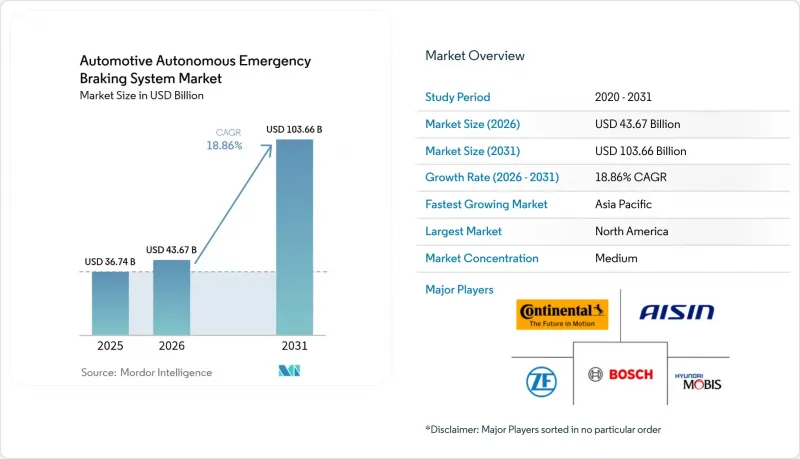
據 Mordor Intelligence 稱,汽車緊急煞車 (AEB) 系統的市場規模預計在 2026 年達到 436.7 億美元,高於 2025 年的 367.4 億美元,預計到 2031 年將達到 1036.6 億美元。
預計 2026 年至 2031 年的複合年成長率為 18.86%。
本報告按車輛類型(乘用車、輕型商用車等)、組件技術(基於雷達、基於攝影機、基於雷射雷達的自動緊急煞車等)、運行速度等級(低速、高速、行人用自動緊急煞車等)和銷售管道(原廠安裝、售後改裝等)進行分類。市場預測以美元計價。
全球汽車緊急煞車(AEB)系統市場趨勢與洞察
關於強制安裝自動緊急煞車系統(AEB)的規定
政府引入自動緊急煞車(AEB)要求,正推動市場不可避免地擴張,其規模遠超傳統的汽車產業引進週期。美國國家公路交通安全管理局(NHTSA)的最終規則規定,AEB系統必須能夠在時速高達90英里(約145公里)的情況下自動煞車。行人偵測也必須在黑暗中有效運行,所有車輛必須在2029年9月前全面達標。由於該法規採用基於性能的方法,而非與特定技術掛鉤,製造商可以在滿足嚴格的有效性標準的同時,選擇最佳的感測器組合。初步測試表明,只有2023款豐田Corolla符合這些全面的標準,這表明整個行業的技術水平都得到了顯著提升。這個法律規範透過設定最低性能標準,從根本上改變了競爭動態,有利於那些能夠提供整合感測器融合解決方案的技術先進供應商。每輛車預計82美元的部署成本與預計52.4億至65.2億美元的終身淨收益相比,幾乎可以忽略不計,這為加速推廣應用提供了令人信服的經濟理由。
消費者對NCAP五星安全評級的需求日益成長
消費者安全意識的增強促使他們做出超出監管最低標準的購車決策,從而為獲得最高安全評級的車輛創造了市場溢價。歐洲新車安全評鑑協會(Euro NCAP)2026 年修訂版規程引入了增強型自動緊急煞車(AEB)測試場景,包括十字路口碰撞規避和騎乘者偵測,要求製造商整合先進的感測器才能獲得最高評級。美國公路安全保險協會(IIHS)呼籲制定更嚴格的 AEB 法規,這反映了消費者認為現有系統在低光源條件下的表現顯著下降,這為採用紅外線攝影機和先進感測器融合技術的製造商創造了差異化競爭機會。這種由消費者主導的需求對豪華車市場的影響尤其顯著,安全技術是該市場的關鍵差異化因素,例如Volvo等製造商利用「城市安全系統」(City Safety)技術來展示其在降低碰撞事故方面的顯著效果。 NCAP 的藍圖延伸至 2033 年,確保了持續的技術進步,防止市場停滯,並鼓勵對持續創新進行投資。 Liberty Mutual 的「TechSafety」計畫為配備先進安全功能的沃爾沃汽車車主提供折扣,這表明消費者的需求與保險業對自動緊急煞車 (AEB) 有效性的認可正在趨於一致。
用於高級自動緊急煞車系統的雷射雷達和多感測器堆疊高成本。
儘管雷射雷達(LiDAR)擁有卓越的探測能力,但其高昂的部署成本阻礙了其廣泛應用,導致高階車型和大眾車型市場分化。雖然像和賽這樣的公司計劃在2025年前將LiDAR的價格降低50%,但目前的成本仍遠高於雷達和攝影機的組合,限制了其在高階車型領域的應用。根據奧緯諮詢(Oliver Wyman)的分析,雷射雷達在緊急煞車等安全關鍵應用中具有更高的精度,但面臨來自雷達解析度和成本效益不斷提高的競爭壓力。在將LiDAR、雷達和攝影機結合以實現冗餘和性能提升的多感測器融合架構中,這項挑戰進一步加劇,因為系統複雜性的增加導致更高的整合成本和檢驗要求。 Aeva Technologies被選為大眾車型的一級LiDAR供應商,凸顯了市場對調頻連續波(FMCW)技術的信心。然而,過渡期將持續到2025年中期,這表明仍有重大的技術挑戰和成本最佳化需求。這些成本限制將尤其影響商用車的採用。商用車輛車隊營運商可能會優先考慮總擁有成本 (TCO) 而不是先進的安全功能,這可能會減緩基於雷射雷達的自動緊急光束偵測 (AEB) 在大規模生產領域的應用。
細分市場分析
乘用車在自動緊急煞車系統(AEB)市場佔據最大佔有率,高達73.05%,這主要得益於消費者日益成長的安全需求以及對合規性的要求。重型商用車預計到2025年僅佔6.20%的市場佔有率,但其複合年成長率(CAGR)高達13.65%,是成長最快的市場,這主要受美國聯邦汽車運輸安全管理局(FMCSA)針對總重超過10,001磅(約4.5噸)的卡車製定的法規驅動。這一強勁的成長基礎使車隊成為重要的戰略立足點,售後市場提供的套件價格從1,500美元起,能夠透過減少碰撞事故造成的運作和獲得保險賠償來收回投資。輕型商用車維持20.75%的市場佔有率,主要得益於電子商務物流帶來的配送距離不斷增加。隨著法規合規期限的臨近和車隊採購週期的縮短,預計2026年至2031年間,重型商用車的自動緊急煞車系統市場規模將增加三倍以上。
車隊技術也在影響技術進步。採埃孚的線控刹車計畫涵蓋500萬輛汽車,展現了商用平台在規模經濟方面的強大作用,這種優勢隨後會擴展到乘用車領域。一級供應商目前正在設計模組化感測器套件,這些套件可以安裝在牽引車駕駛室和拖車車頭,從而最大限度地減少停機時間並實現維修零件的標準化。這種跨領域的技術流動使自動緊急煞車產業保持著生產和創新之間的良性循環。
預計到2025年,雷達將在自動緊急煞車市場佔據45.75%的佔有率,其全天候的可靠性和持續下降的成本曲線備受青睞。純攝影機系統將佔22.40%的佔有率,但低光照條件下的挑戰將促使雷達-攝影機融合系統得到更廣泛的應用,預計其市場佔有率將達到19.90%。雷射雷達仍處於發展階段,但垂直共振腔面射型雷射(VCSEL)和調頻連續波(FMCW)架構顯著降低了物料清單(BOM)成本,並實現了亞10厘米的測距精度,使其快速成長,複合年成長率(CAGR)高達30.55%。超音波裝置將保持在3.85%的佔有率,主要用於低速應用。到 2031 年,基於雷射雷達的自動緊急煞車系統的市場佔有率預計將接近 15.80%,這主要得益於全球 OEM 固態感測器累積訂單超過 60 億美元。
科技融合的可能性正在增加。混合模組將窄視野雷射雷達(用於高解析度中程測繪)與寬視野雷達相結合,以確保在惡劣天氣條件下的可靠性,從而實現經濟高效的覆蓋。半導體藍圖將雷達數位訊號處理器(DSP)、人工智慧加速器和雷射雷達控制器整合到單一晶片上,預計將進一步實現整合,並將加劇自動緊急煞車行業的競爭。
區域分析
預計到2025年,北美將佔全球自動緊急煞車系統(AEB)銷售額的34.05%,這一地位得益於嚴格的聯邦安全標準和鼓勵積極採用新系統的成熟訴訟環境。此外,該地區車輛平均使用壽命較長,促使越來越多的車輛加快合規進程以獲得保險優惠,從而支撐了強勁的售後市場需求。預計到2031年,北美自動緊急煞車系統市場規模將達到352.8億美元,與FMVSS 127標準的分階段合規期相符。
歐洲緊追在後,佔29.85%的市場佔有率,主要得益於《通用安全法規II》(General Safety Regulation II)。該法規統一了其27個成員國的安全要求,並將自動緊急煞車(AEB)整合到更廣泛的高級駕駛輔助系統(ADAS)框架中。歐洲的汽車製造商(OEM)傾向於採用集中式電子電氣(E/E)架構,將AEB、車道維持輔助和主動式車距維持定速系統控制功能整合到共用的感測器陣列上,從而提高供應商的規模經濟效益,並提升自動緊急煞車市場的盈利。
預計到2025年,亞太地區將佔據28.35%的市場佔有率,但由於比亞迪等中國汽車製造商在其售價低於1.5萬美元的低成本電動車上配備了自動緊急煞車系統(AEB),該地區的複合年成長率(CAGR)高達12.15%。國產晶片組和垂直整合的感測器供應鏈正在壓縮成本結構,使得大規模部署成為可能,其產量遠超歐洲。澳洲將於2025年2月起強制所有新乘用車安裝自動緊急煞車系統,這將擴大該地區的監管範圍,預計將維持區域成長動能。如果目前的趨勢持續下去,亞太地區的自動緊急煞車系統市場規模預計將在2030年超過北美。
其他好處:
- Excel格式的市場預測(ME)表
- 3個月的分析師支持
目錄
第1章:引言
- 研究假設和市場定義
- 調查範圍
第2章:調查方法
第3章執行摘要
第4章 市場狀況
- 市場概覽
- 市場促進因素
- 強制部署AEB的監管要求
- 消費者對NCAP五星安全評級的需求日益成長
- 可擴展的 4D 融合降低了雷達和攝影機感測器的成本。
- 人工智慧成像雷達能夠實現低成本、高解析度的感知。
- 配備自動緊急煞車系統 (AEB) 的車輛可享里程保險折扣
- 中國和美國對夜間行人自動緊急煞車(AEB)的要求
- 市場限制因素
- 用於高級自動緊急煞車系統的雷射雷達和多感測器堆疊高成本。
- 惡劣天氣條件下的感測器性能限制和誤檢
- 77 GHz 雷達晶片組半導體短缺
- 毫米波雷達演算法相關的智慧財產權訴訟愈演愈烈
- 價值供應鏈分析
- 波特五力模型
第5章 市場規模與成長預測
- 車輛類型
- 搭乘用車
- 輕型商用車
- 中型和重型商用車輛
- 透過組件技術
- 基於雷達的自動緊急制動
- 基於攝影機的自動曝光
- 基於LiDAR的自動緊急制動
- 感知器融合式自動緊急煞車(雷達+攝影機)
- 超音波AEB
- 按運轉速度等級
- 低速自動緊急煞車(低於 40 公里/小時)
- 高速自動緊急煞車(超過 40 公里/小時)
- 行人用緊急制動
- 交叉路口自動緊急制動
- 按銷售管道
- OEM設備
- 改裝
- 車輛維修服務
- 按地區
- 北美洲
- 美國
- 加拿大
- 其他北美國家
- 歐洲
- 德國
- 英國
- 法國
- 義大利
- 西班牙
- 其他歐洲國家
- 亞太地區
- 中國
- 日本
- 印度
- 韓國
- 澳洲
- 其他亞太國家
- 南美洲
- 巴西
- 阿根廷
- 其他南美國家
- 中東和非洲
- 沙烏地阿拉伯
- 阿拉伯聯合大公國
- 南非
- 奈及利亞
- 其他中東和非洲國家
- 北美洲
第6章 競爭情勢
- 市場集中度
- 策略趨勢
- 市佔率分析
- 公司簡介
- Robert Bosch GmbH
- Continental AG
- ZF Friedrichshafen AG
- Denso Corporation
- Autoliv Inc.
- Hyundai Mobis Co. Ltd.
- WABCO Holdings Inc.
- Valeo SA
- Aisin Corporation
- Aptiv PLC
- Mobileye NV
- Magna International Inc.
第7章 市場機會與未來展望
According to Mordor Intelligence, the automotive autonomous emergency braking system market size in 2026 is estimated at USD 43.67 billion, growing from 2025 value of USD 36.74 billion with 2031 projections showing USD 103.66 billion, growing at 18.86% CAGR over 2026-2031.
This report is Segmented by Vehicle Type (Passenger Cars, Light Commercial Vehicles, and More), Component Technology (Radar-Based, Camera-Based, LiDAR-Based AEB, and More), Operating Speed Class (Low-Speed, High-Speed, Pedestrian AEB, and More), and Sales Channel (OEM-Installed, Aftermarket Retrofit, and More). The Market Forecasts are Provided in Terms of Value (USD).
Global Automotive Autonomous Emergency Braking System Market Trends and Insights
Regulatory Mandates for Mandatory AEB Installation
Government-imposed AEB requirements create non-negotiable market expansion that transcends traditional automotive adoption cycles. NHTSA's final rule mandates that AEB systems be capable of automatic braking at speeds up to 90 mph. That pedestrian detection functionality should operate effectively in darkness, with full compliance required by September 2029.The regulation's performance-based approach, rather than technology-specific requirements, enables manufacturers to choose optimal sensor combinations while meeting stringent effectiveness thresholds. Preliminary testing reveals that only the 2023 Toyota Corolla meets these comprehensive standards, indicating substantial technology upgrades required across the industry. This regulatory framework fundamentally alters competitive dynamics by establishing minimum performance baselines that favor technologically sophisticated suppliers capable of delivering integrated sensor fusion solutions. The estimated USD 82 per vehicle implementation cost represents a minimal barrier relative to the projected USD 5.24 to USD 6.52 billion lifetime net benefits, creating compelling economic justification for accelerated adoption.
Rising Consumer Demand for NCAP 5-Star Safety Ratings
Consumer safety consciousness drives purchasing decisions beyond regulatory minimums, creating market premiums for vehicles achieving top-tier safety ratings. Euro NCAP's updated 2026 protocols introduce enhanced AEB testing scenarios, including junction collision avoidance and cyclist detection capabilities, with manufacturers requiring advanced sensor integration to achieve maximum ratings. The Insurance Institute for Highway Safety's advocacy for stringent AEB regulations reflects consumer awareness that current systems significantly underperform in darkness, creating differentiation opportunities for manufacturers deploying infrared cameras and advanced sensor fusion. This consumer-driven demand particularly influences premium vehicle segments where safety technology is a key differentiator, with manufacturers like Volvo leveraging City Safety technology to demonstrate measurable crash reduction benefits. The NCAP roadmap extending through 2033 ensures continuous technology evolution requirements, preventing market stagnation and rewarding ongoing innovation investments. Liberty Mutual's TechSafety program, offering discounts to Volvo owners with advanced safety features, demonstrates how consumer demand intersects with the insurance industry's recognition of AEB effectiveness.
High Cost of LiDAR & Multi-Sensor Stacks for Premium AEB
LiDAR integration costs constrain widespread adoption despite superior detection capabilities, creating market segmentation between premium and volume vehicle categories. While companies like Hesai plan to reduce LiDAR prices by 50% in 2025, current costs still exceed radar-camera combinations by substantial margins, limiting deployment to higher-end vehicle segments. Oliver Wyman's analysis indicates that LiDAR provides superior accuracy for safety-critical applications like emergency braking but faces competitive pressure due to improved radar resolution and cost-effectiveness. The challenge intensifies multi-sensor fusion architectures that combine LiDAR, radar, and cameras to achieve redundancy and enhanced performance, as system complexity increases, integration costs, and validation requirements. Aeva Technologies' selection as a Tier 1 LiDAR supplier for series production vehicles demonstrates market confidence in FMCW technology. However, the transition timeline extending to mid-decade reflects the substantial engineering and cost optimization required. This cost constraint particularly affects commercial vehicle adoption, where fleet operators prioritize total cost of ownership over premium safety features, potentially delaying LiDAR-based AEB penetration in high-volume segments.
Other drivers and restraints analyzed in the detailed report include:
- Declining Radar & Camera Sensor Cost with Scalable 4D Fusion
- AI-Enhanced Imaging Radar Unlocking Low-Cost High-Resolution Perception
- Sensor Performance Limits in Adverse Weather & False Positives
For complete list of drivers and restraints, kindly check the Table Of Contents.
Segment Analysis
Passenger cars hold the largest autonomous emergency braking market share at 73.05%, benefiting from rising consumer safety expectations that align with regulation. Heavy commercial vehicles represented only 6.20% of the market share in 2025, yet are climbing at the highest CAGR of 13.65% on the back of FMCSA rules covering trucks above 10,001 lb GVW. This high-growth base positions fleets as a strategic beachhead, with retrofit kits priced from USD 1,500 achieving payback through collision-related downtime reduction and insurance rebates. Light commercial vans retain a 20.75% share as e-commerce logistics multiply delivery miles. The heavy commercial vehicles' autonomous emergency braking market size is projected to more than triple between 2026 and 2031 as fleet purchasing cycles compress around compliance deadlines.
Fleets are also influencing technology paths. ZF's brake-by-wire program covering 5 million units demonstrates commercial platforms' power to set scale economies that later cascade into passenger segments. Tier 1 suppliers now design modular sensor suites that clip onto tractor cabs or trailer noses, minimizing downtime and standardizing service parts. This cross-segment technology flow ensures the autonomous emergency braking industry retains a virtuous cycle of volume and innovation.
Radar dominated the autonomous emergency braking market with a 45.75% share in 2025, prized for all-weather robustness and steadily falling cost curves. Camera-only systems cover 22.40% but struggle in lowlight, driving uptake of radar-camera fusion that occupies a 19.90% share. LiDAR, though nascent, is surging at 30.55% CAGR as vertical cavity surface-emitting lasers and FMCW architectures slash BOM and deliver sub-10 cm range accuracy. Ultrasonic units remain parked at 3.85% for low-speed maneuvers. The autonomous emergency braking market share of LiDAR-centric systems is expected to approach 15.80% by 2031, supported by global OEM order books exceeding USD 6 billion for solid-state sensors.
Convergence is increasingly likely. Hybrid modules integrate a narrow-field LiDAR for high-resolution mid-range mapping with wide-field radar to secure adverse-weather reliability, yielding cost-balanced coverage. Semiconductor roadmaps embedding radar DSP, AI accelerators, and LiDAR control on a single die promise further consolidation, amplifying competitive tension inside the autonomous emergency braking industry.
Complete Report Scope:
- By Vehicle Type
- Passenger Cars
- Light Commercial Vehicles
- Medium and Heavy Commercial Vehicles
- By Component Technology
- Radar-based AEB
- Camera-based AEB
- LiDAR-based AEB
- Sensor-Fusion AEB (Radar + Camera)
- Ultrasonic-based AEB
- By Operating Speed Class
- Low-Speed AEB (Less Than 40 Kmph)
- High-Speed AEB (More Than 40 Kmph)
- Pedestrian AEB
- Junction or Intersection AEB
- By Sales Channel
- OEM-Installed
- Aftermarket Retrofit
- Fleet Retrofit Service
- By Geography
- North America
- United States
- Canada
- Rest of North America
- Europe
- Germany
- United Kingdom
- France
- Italy
- Spain
- Rest of Europe
- Asia-Pacific
- China
- Japan
- India
- South Korea
- Australia
- Rest of Asia-Pacific
- South America
- Brazil
- Argentina
- Rest of South America
- Middle East and Africa
- Saudi Arabia
- United Arab Emirates
- South Africa
- Nigeria
- Rest of Middle East and Africa
- North America
Geography Analysis
North America commanded 34.05% of 2025 revenue, a position underpinned by rigorous federal safety standards and a familiar litigation landscape that encourages proactive adoption. The region's high-average-vehicle age also underwrites robust retrofit demand as fleets accelerate compliance to capture insurance benefits. The autonomous emergency braking market size in North America is set to reach USD 35.28 billion by 2031, paralleling the staged FMVSS 127 compliance window.
Europe followed with 29.85% market share, supported by the General Safety Regulation II that synchronizes safety requirements across 27 member states and embeds AEB within a wider umbrella of Advanced Driver Assistance Systems. Euro-centric OEMs favour centralized E/E architectures that host AEB, lane-keep and adaptive cruise on a shared sensor array, improving scale effects for suppliers and boosting profitability within the autonomous emergency braking market.
Asia-Pacific posted 28.35% share in 2025 yet registers the highest 12.15% CAGR as Chinese OEMs like BYD inject AEB into budget EVs retailing below USD 15,000. Domestic chipsets and vertically integrated sensor supply chains compress cost structures, unlocking mass-volume deployments that dwarf European build counts. Australia's mandate for AEB on all new passenger cars from February 2025 widens regulatory coverage in the region, sustaining regional momentum. The autonomous emergency braking market size in Asia-Pacific could surpass North America before 2030 if current trajectories hold.
- Robert Bosch GmbH
- Continental AG
- ZF Friedrichshafen AG
- Denso Corporation
- Autoliv Inc.
- Hyundai Mobis Co. Ltd.
- WABCO Holdings Inc.
- Valeo SA
- Aisin Corporation
- Aptiv PLC
- Mobileye N.V.
- Magna International Inc.
Additional Benefits:
- The market estimate (ME) sheet in Excel format
- 3 months of analyst support
TABLE OF CONTENTS
1 Introduction
- 1.1 Study Assumptions & Market Definition
- 1.2 Scope of the Study
2 Research Methodology
3 Executive Summary
4 Market Landscape
- 4.1 Market Overview
- 4.2 Market Drivers
- 4.2.1 Regulatory Mandates for Mandatory AEB Installation
- 4.2.2 Rising Consumer Demand for NCAP 5-Star Safety Ratings
- 4.2.3 Declining Radar & Camera Sensor Cost With Scalable 4D Fusion
- 4.2.4 AI-Enhanced Imaging Radar Unlocking Low-Cost High-Resolution Perception
- 4.2.5 Usage-Based Insurance Discounts Tied to AEB-Equipped Vehicles
- 4.2.6 Night-Time Pedestrian AEB Requirements in China & US
- 4.3 Market Restraints
- 4.3.1 High Cost of LiDAR & Multi-Sensor Stacks for Premium AEB
- 4.3.2 Sensor Performance Limits in Adverse Weather & False Positives
- 4.3.3 Semiconductor Shortages for 77 GHz Radar Chipsets
- 4.3.4 Intensifying IP Litigation Around mmWave Radar Algorithms
- 4.4 Value / Supply-Chain Analysis
- 4.5 Porter's Five Forces
- 4.5.1 Threat of New Entrants
- 4.5.2 Bargaining Power of Buyers/Consumers
- 4.5.3 Bargaining Power of Suppliers
- 4.5.4 Threat of Substitute Products
- 4.5.5 Intensity of Competitive Rivalry
5 Market Size & Growth Forecasts (Value, USD)
- 5.1 By Vehicle Type
- 5.1.1 Passenger Cars
- 5.1.2 Light Commercial Vehicles
- 5.1.3 Medium and Heavy Commercial Vehicles
- 5.2 By Component Technology
- 5.2.1 Radar-based AEB
- 5.2.2 Camera-based AEB
- 5.2.3 LiDAR-based AEB
- 5.2.4 Sensor-Fusion AEB (Radar + Camera)
- 5.2.5 Ultrasonic-based AEB
- 5.3 By Operating Speed Class
- 5.3.1 Low-Speed AEB (Less Than 40 Kmph)
- 5.3.2 High-Speed AEB (More Than 40 Kmph)
- 5.3.3 Pedestrian AEB
- 5.3.4 Junction or Intersection AEB
- 5.4 By Sales Channel
- 5.4.1 OEM-Installed
- 5.4.2 Aftermarket Retrofit
- 5.4.3 Fleet Retrofit Service
- 5.5 By Geography
- 5.5.1 North America
- 5.5.1.1 United States
- 5.5.1.2 Canada
- 5.5.1.3 Rest of North America
- 5.5.2 Europe
- 5.5.2.1 Germany
- 5.5.2.2 United Kingdom
- 5.5.2.3 France
- 5.5.2.4 Italy
- 5.5.2.5 Spain
- 5.5.2.6 Rest of Europe
- 5.5.3 Asia-Pacific
- 5.5.3.1 China
- 5.5.3.2 Japan
- 5.5.3.3 India
- 5.5.3.4 South Korea
- 5.5.3.5 Australia
- 5.5.3.6 Rest of Asia-Pacific
- 5.5.4 South America
- 5.5.4.1 Brazil
- 5.5.4.2 Argentina
- 5.5.4.3 Rest of South America
- 5.5.5 Middle East and Africa
- 5.5.5.1 Saudi Arabia
- 5.5.5.2 United Arab Emirates
- 5.5.5.3 South Africa
- 5.5.5.4 Nigeria
- 5.5.5.5 Rest of Middle East and Africa
- 5.5.1 North America
6 Competitive Landscape
- 6.1 Market Concentration
- 6.2 Strategic Moves
- 6.3 Market Share Analysis
- 6.4 Company Profiles (Includes Global Level Overview, Market Level Overview, Core Segments, Financials as Available, Strategic Information, Market Rank/Share for Key Companies, Products & Services, and Recent Developments)
- 6.4.1 Robert Bosch GmbH
- 6.4.2 Continental AG
- 6.4.3 ZF Friedrichshafen AG
- 6.4.4 Denso Corporation
- 6.4.5 Autoliv Inc.
- 6.4.6 Hyundai Mobis Co. Ltd.
- 6.4.7 WABCO Holdings Inc.
- 6.4.8 Valeo SA
- 6.4.9 Aisin Corporation
- 6.4.10 Aptiv PLC
- 6.4.11 Mobileye N.V.
- 6.4.12 Magna International Inc.
7 Market Opportunities & Future Outlook
- 7.1 White-space & Unmet-Need Assessment

 自動緊急煞車市場規模、佔有率和成長分析:按組件、車輛類型、速度範圍、銷售管道和地區分類-2026-2033年產業預測
 自動緊急煞車系統市場:按組件、偵測技術、車輛類型和銷售管道分類-2026-2032年全球市場預測
 自動緊急煞車市場分析及預測(至2035年):類型、產品、技術、組件、應用、最終用戶、功能、安裝類型、解決方案、模式
 2026年全球汽車自動駕駛緊急煞車系統市場報告2026年全球自動緊急煞車系統市場報告2026年全球自動緊急煞車系統(AEBS)市場報告
 汽車乘用車緊急煞車系統市場-全球產業規模、佔有率、趨勢、機會及預測(按感測器類型、技術、地區和競爭格局分類,2021-2031年)自動緊急煞車系統市場 - 全球產業規模、佔有率、趨勢、機會及預測(按車輛類型、技術、組件、作業系統、應用、地區和競爭格局分類),2021-2031年
 全球自動緊急煞車市場(2026-2030 年)乘用車再生煞車系統市場-全球產業規模、佔有率、趨勢、機會和預測,按系統類型(電動、液壓、動能)、驅動類型(純電動車、混合動力車、插電式混合動力車)、地區和競爭格局分類,2021-2031年預測