


 |
市場調查報告書
商品編碼
2113479
電信雲:市場佔有率分析、產業趨勢與統計、成長預測(2026-2031)Telecom Cloud - Market Share Analysis, Industry Trends & Statistics, Growth Forecasts (2026 - 2031) |
||||||

※ 本網頁內容可能與最新版本有所差異。詳細情況請與我們聯繫。
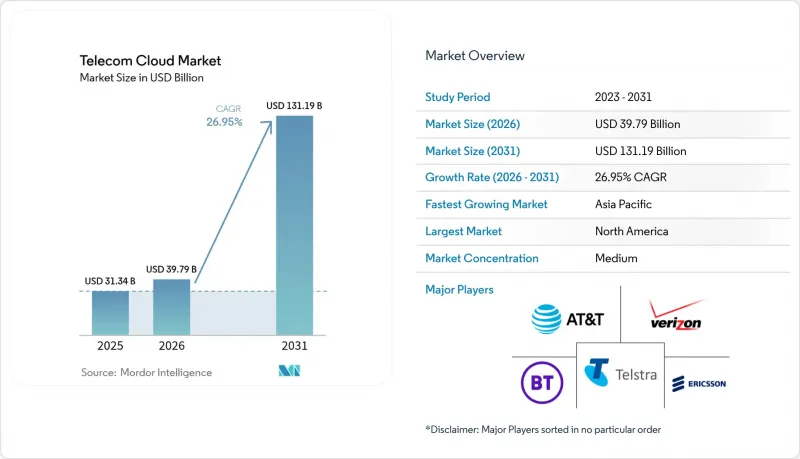
根據 Mordor Intelligence 預測,通訊雲市場規模將從 2025 年的 313.4 億美元成長到 2026 年的 397.9 億美元,然後在 2031 年達到 1,311.9 億美元,2026 年至 2031 年的複合年成長率為 26.95%。
本報告按類型(解決方案、服務等)、應用(收費和配置、流量管理等)、雲端平台(SaaS、IaaS、PaaS)、最終用戶(銀行、金融服務和保險、零售、製造等)以及地區進行細分。市場預測以價值(美元)表示。
全球電信雲端市場趨勢與洞察
5G的快速部署對雲端原生核心網路提出了更高的要求。
獨立組網的5G需要雲端原生核心網,打破單體架構,轉向微服務架構,進而實現自動化網路切片和即時資源配置。德國電信與Google雲端合作推出的AI驅動型無線存取網編配方案表明,自動化對於管理5G流量的規模和複雜性至關重要。西班牙電信德國公司已將其4,500萬用戶遷移到愛立信的雲端原生5G核心網,加快了服務上線速度,並提升了網路敏捷性。這些轉型表明,5G收入取決於營運商級的雲端原生能力。
電信業者擴大採用混合雲和多重雲端
樂天Symphony的多重雲端藍圖支援工作負載在不同雲端服務供應商之間遷移,同時滿足網路主權義務。這種混合架構允許可擴展的工作負載快速部署到公共雲端,而對延遲敏感的網路功能則保留在本地。思科的研究表明,目前已有82%的企業採用混合模式,證明了該策略在提升網路彈性和最佳化成本方面的有效性。隨著電信業者不斷調整合規要求以適應創新步伐,這種雙雲環境的普及速度正在加快。
資料主權和安全合規性的障礙
谷歌雲端針對電信業者的合規框架清晰地展現了他們必須遵守的複雜且因地區而異的隱私法規體系。強製本地化會使運算成本增加高達 60%,從而削弱電信雲端市場的成本優勢。 VMware 的 Sovereign Cloud Blueprint 表明,當營運商強制要求在本地儲存靜態資料並對其進行加密時,架構的複雜性會增加。監管政策的波動會限制部署的柔軟性並延長專案週期。
細分市場分析
預計到2025年,解決方案業務板塊將佔據52.85%的市場佔有率,這反映了電信業者最初對底層雲端架構的關注。然而,服務業務板塊正以27.25%的複合年成長率快速成長,隨著營運商將營運外包給專業合作夥伴,預計服務業務板塊將縮小與解決方案業務板塊的差距。整合通訊、內容傳遞網路 (CDN) 和安全工作負載仍然是解決方案業務收入的主要驅動力,但託管服務、專業服務和網路即服務 (NaaS) 合約的成長速度更快。
電信營運商正擴大採用託管模式,以降低轉型風險,並將人才重新配置到客戶創新領域。託管資料中心使營運商能夠保持與邊緣區域的接近性,同時利用專業服務有助於解決技能短缺問題。這一趨勢表明,整個電信雲端市場正在發生結構性轉變,轉向基於營運支出 (OPEX) 的消費模式,該模式可根據流量彈性和用戶季節性變化調整營運商支出。
到2025年,「收費和配置」領域將佔電信雲端市場規模的45.10%,為所有電信業者提供重要的收入保障。同時,隨著5G數據激增給網路帶來壓力,「流量管理」領域預計將以27.6%的年成長率成長。思科的「Ultra Traffic Optimization」和Opanga的「RAIN AI」是利用人工智慧緩解網路擁塞的典型案例,它們無需購買新的頻段即可提升使用者體驗品質(QoE)。
能夠預測網路擁塞並即時重路由封包的AI引擎正成為不可或缺的功能。 HCL的增強型網路自動化解決方案在降低營運成本(OPEX)的同時,實現了20%的容量提升,凸顯了該領域的顯著成長。安全分析和客戶體驗入口網站等輔助工作負載也順應此趨勢遷移到雲端,進一步豐富了通訊雲端市場的應用層。
區域分析
預計到2025年,北美將佔全球5G收入的34.90%,這得益於北美地區5G部署的早期階段、與超大規模資料中心業者資料中心營運商建立的夥伴關係以及有利的監管環境。電信營運商正在透過邊緣服務和企業連接實現盈利,從而鞏固其在通訊雲端市場的區域領先地位。聯邦政府對農村地區5G部署的資助也推動了投資動能。
亞太地區預計到2031年將以26.85%的複合年成長率成長,主要得益於政府的數位化專案和大規模資料中心投資。 AWS在日本的150億美元投資承諾和微軟在日本的29億美元投資計畫顯示了該地區的高資本密集度,而華為2023年雲端服務收入成長77%則顯示國內需求正在加速成長。中國2023年92億美元的雲端基礎設施支出正在推動國內電信業者和本地供應商的成長。
歐洲仍然是大規模的市場,嚴格的主權要求推動了主權雲端的發展,並促進了開放式無線存取網路(Open RAN)的實驗。能源效率目標與雲端整合相契合,使得網路現代化成為歐洲電信營運商的策略要務。在中東、非洲和拉丁美洲,受智慧城市計畫、金融科技的普及以及行動優先人口結構的推動,雲端技術的採用率正在上升,但監管漏洞和技能短缺阻礙了短期內的快速擴張。
其他好處:
- Excel格式的市場預測(ME)表
- 3個月的分析師支持
目錄
第1章:引言
- 研究假設和市場定義
- 調查範圍
第2章:調查方法
第3章執行摘要
第4章 市場狀況
- 市場概覽
- 市場促進因素
- 隨著 5G 的快速部署,對雲端原生核心網路的需求日益成長。
- 電信業者擴大採用混合雲端和多重雲端架構
- 透過利用NFV降低營運成本來提高成本效益
- 開放式無線接取網路的融合正在加速無線接取網路的雲端化進程。
- 邊緣雲端聯盟實現超低延遲企業 4.0
- 為了實踐永續發展理念,電信公司正遷移到綠色公共雲端。
- 市場限制因素
- 與資料主權和安全合規性相關的障礙
- 與傳統BSS/OSS堆疊整合的複雜性
- 電信業者營運團隊中雲端原生工程師短缺
- 跨境雲端使用面臨高額退出成本風險
- 供應鏈分析
- 監理情勢
- 技術展望
- 波特五力分析
- 供應商的議價能力
- 買方的議價能力
- 新進入者的威脅
- 替代品的威脅
- 競爭公司之間的競爭
- 對影響市場的宏觀經濟因素進行評估
第5章 市場規模與成長預測
- 按類型
- 解決方案
- 整合通訊與協作
- 內容傳遞網路
- 其他解決方案
- 服務
- 託管服務
- 網路服務
- 專業服務
- 託管服務
- 其他類型
- 解決方案
- 透過使用
- 收費和配置
- 交通管理
- 其他用途
- 透過雲端平台
- Software-as-a-Service(SaaS)
- Infrastructure-as-a-Service(IaaS)
- Platform-as-a-Service(PaaS)
- 最終用戶
- BFSI
- 零售
- 製造業
- 運輸/配送
- 衛生保健
- 政府
- 媒體與娛樂
- 其他最終用戶
- 按地區
- 北美洲
- 美國
- 加拿大
- 墨西哥
- 南美洲
- 巴西
- 阿根廷
- 哥倫比亞
- 歐洲
- 德國
- 英國
- 法國
- 義大利
- 西班牙
- 其他歐洲國家
- 亞太地區
- 中國
- 日本
- 韓國
- 印度
- 台灣
- 其他亞太國家
- 中東和非洲
- 中東
- 沙烏地阿拉伯
- 阿拉伯聯合大公國
- 土耳其
- 其他中東國家
- 非洲
- 南非
- 奈及利亞
- 埃及
- 其他非洲國家
- 中東
- 北美洲
第6章 競爭情勢
- 市場集中度
- 策略趨勢
- 市佔率分析
- 公司簡介
- ATandT Inc.
- Verizon Communications Inc.
- BT Group plc
- Deutsche Telekom AG
- NTT Communications Corp.
- China Telecommunications Corp.
- Telstra Corp. Ltd
- Telefonaktiebolaget LM Ericsson
- CenturyLink(Lumen Technologies)
- Singapore Telecommunications Ltd
- Telus Corp.
- Swisscom AG
- Amazon Web Services
- Microsoft Azure
- Google Cloud
- IBM Cloud
- Oracle Communications Cloud
- Huawei Cloud
- VMware(Telco Cloud Platform)
- Cisco Systems(Telco Cloud)
第7章 市場機會與未來展望
According to Mordor Intelligence, the telecom cloud market size is expected to grow from USD 31.34 billion in 2025 to USD 39.79 billion in 2026 and is forecast to reach USD 131.19 billion by 2031 at 26.95% CAGR over 2026-2031.
This report is Segmented by Type (Solution, Services, and More), Application (Billing and Provisioning, Traffic Management, and More), Cloud Platform (SaaS, Iaas, and PaaS), End User (BFSI, Retail, Manufacturing, and More) and by Geography. The Market Forecasts are Provided in Terms of Value (USD).
Global Telecom Cloud Market Trends and Insights
Surge in 5G roll-outs demanding cloud-native core networks
Standalone 5G mandates cloud-native cores, dismantling monolithic architectures in favor of micro-services that enable automated network slicing and real-time provisioning. Deutsche Telekom's work with Google Cloud on AI-driven RAN orchestration proves that automation is now indispensable to manage the scale and complexity of 5G traffic. Telefonica Germany migrated 45 million subscribers to Ericsson's cloud-native 5G core, cutting service-activation times and fortifying network agility.These transformations signal that 5G revenue relies on cloud-native capabilities deployed at carrier grade.
Growing adoption of hybrid and multi-cloud by telecom operators
Rakuten Symphony's multi-cloud blueprint showcases workload portability across providers while guarding sovereignty obligations. Hybrid architectures allow latency-sensitive network functions to remain on-premise while scalable workloads burst to public clouds. Cisco finds 82% of enterprises now run hybrid models, validating the strategy for resilience and cost optimization. This dual-environment adoption is accelerating as operators link compliance with innovation velocity.
Data-sovereignty and security compliance hurdles
Google Cloud's telecom-specific compliance frameworks attest to the maze of regional privacy rules carriers must meet. Localization mandates inflate compute costs by up to 60%, eroding the telecom cloud market's cost-saving allure. VMware sovereign-cloud blueprints show architecture complexity rises when carriers enforce in-country residency and encryption at rest. Evolving statutes constrain deployment flexibility and lengthen project timelines.
Other drivers and restraints analyzed in the detailed report include:
- Edge-cloud federation enabling ultra-low-latency enterprise 4.0
- Convergence of Open RAN accelerating RAN-cloudification
- Integration complexity with legacy BSS/OSS stacks
For complete list of drivers and restraints, kindly check the Table Of Contents.
Segment Analysis
In 2025 solution segment held 52.85% share, reflecting operators' first-wave focus on foundational cloud stacks. Yet Services are accelerating at a 27.25% CAGR, forecast to close the gap as carriers outsource operations to specialist partners. Unified communication, CDN, and security workloads continue to lift Solution revenues, but managed hosting, professional services, and network-as-a-service contracts are growing faster.
Operators increasingly adopt managed models to de-risk transformation and redeploy staff toward customer innovation. Colocation footprints give carriers proximity to edge zones, while professional-service engagements address skills shortages. This trend signals a structural shift toward opex-based consumption, aligning telco spending with traffic elasticity and subscriber seasonality across the telecom cloud market.
Billing and Provisioning retained 45.10% of telecom cloud market size in 2025, underpinning revenue assurance activities critical to every carrier. Traffic Management, however, is projected to grow 27.6% annually as 5G data surges strain networks. Cisco's Ultra Traffic Optimization and Opanga's RAIN AI showcase AI-driven congestion relief that boosts QoE without fresh spectrum buys.
AI-infused engines that predict congestion and reroute packets in real time are becoming must-have capabilities. HCL's Augmented Network Automation illustrates 20% capacity lifts alongside OPEX cuts, explaining the outsized growth. Ancillary workloads such as security analytics and customer-experience portals also migrate to cloud in lockstep, reinforcing application-layer diversification within the telecom cloud market.
Complete Report Scope:
- By Type
- Solution
- Unified Communication and Collaboration
- Content Delivery Network
- Other Solutions
- Service
- Colocation Services
- Network Services
- Professional Services
- Managed Services
- Other Types
- Solution
- By Application
- Billing and Provisioning
- Traffic Management
- Other Applications
- By Cloud Platform
- Software-as-a-Service (SaaS)
- Infrastructure-as-a-Service (IaaS)
- Platform-as-a-Service (PaaS)
- By End User
- BFSI
- Retail
- Manufacturing
- Transportation and Distribution
- Healthcare
- Government
- Media and Entertainment
- Other End Users
- By Geography
- North America
- United States
- Canada
- Mexico
- South America
- Brazil
- Argentina
- Colombia
- Europe
- Germany
- United Kingdom
- France
- Italy
- Spain
- Rest of Europe
- Asia-Pacific
- China
- Japan
- South Korea
- India
- Taiwan
- Rest of Asia-Pacific
- Middle-East and Africa
- Middle-East
- Saudi Arabia
- United Arab Emirates
- Turkey
- Rest of Middle- East
- Africa
- South Africa
- Nigeria
- Egypt
- Rest of Africa
- Middle-East
- North America
Geography Analysis
North America accounted for 34.90% revenue in 2025 as early 5G roll-outs, established hyperscaler partnerships, and favorable regulations aligned. Carriers monetized edge services and enterprise connectivity, strengthening regional leadership in the telecom cloud market. Federal funding streams for rural 5G also bolster investment momentum.
Asia-Pacific is projected to expand at 26.85% CAGR through 2031, supported by government digitalization programs and massive data-center investments. AWS's USD 15 billion commitment and Microsoft's USD 2.9 billion plan in Japan illustrate capital intensity, while Huawei's 77% cloud-service revenue jump in 2023 signals domestic demand acceleration. China's USD 9.2 billion 2023 cloud-infrastructure spend positions its carriers and local providers for growth.
Europe remains a sizeable market, where stringent sovereignty mandates foster sovereign-cloud builds and spark Open RAN experiments. Energy-efficiency goals align with cloud consolidation, giving European carriers strategic imperatives to modernize networks. Middle East and Africa and Latin America show rising adoption curves fueled by smart-city initiatives, fintech penetration, and mobile-first demographics, though regulatory gaps and skills shortages temper near-term scale.
- ATandT Inc.
- Verizon Communications Inc.
- BT Group plc
- Deutsche Telekom AG
- NTT Communications Corp.
- China Telecommunications Corp.
- Telstra Corp. Ltd
- Telefonaktiebolaget LM Ericsson
- CenturyLink (Lumen Technologies)
- Singapore Telecommunications Ltd
- Telus Corp.
- Swisscom AG
- Amazon Web Services
- Microsoft Azure
- Google Cloud
- IBM Cloud
- Oracle Communications Cloud
- Huawei Cloud
- VMware (Telco Cloud Platform)
- Cisco Systems (Telco Cloud)
Additional Benefits:
- The market estimate (ME) sheet in Excel format
- 3 months of analyst support
TABLE OF CONTENTS
1 INTRODUCTION
- 1.1 Study Assumptions and Market Definition
- 1.2 Scope of the Study
2 RESEARCH METHODOLOGY
3 EXECUTIVE SUMMARY
4 MARKET LANDSCAPE
- 4.1 Market Overview
- 4.2 Market Drivers
- 4.2.1 Surge in 5G roll-outs demanding cloud-native core networks
- 4.2.2 Growing adoption of hybrid and multi-cloud by telecom operators
- 4.2.3 Cost efficiency via NFV-enabled OPEX savings
- 4.2.4 Convergence of Open RAN accelerating RAN-cloudification
- 4.2.5 Edge-cloud federation enabling ultra-low-latency enterprise 4.0
- 4.2.6 Sustainability pledges shifting telcos to green public clouds
- 4.3 Market Restraints
- 4.3.1 Data-sovereignty and security compliance hurdles
- 4.3.2 Integration complexity with legacy BSS/OSS stacks
- 4.3.3 Shortage of cloud-native skills in telco ops teams
- 4.3.4 High cross-border cloud exit-cost risk exposures
- 4.4 Supply-Chain Analysis
- 4.5 Regulatory Landscape
- 4.6 Technological Outlook
- 4.7 Porter's Five Force Analysis
- 4.7.1 Bargaining Power of Suppliers
- 4.7.2 Bargaining Power of Buyers
- 4.7.3 Threat of New Entrants
- 4.7.4 Threat of Substitutes
- 4.7.5 Intensity of Competitive Rivalry
- 4.8 Assesment of Macroeconomic Factors on the Market
5 MARKET SIZE AND GROWTH FORECASTS (VALUE)
- 5.1 By Type
- 5.1.1 Solution
- 5.1.1.1 Unified Communication and Collaboration
- 5.1.1.2 Content Delivery Network
- 5.1.1.3 Other Solutions
- 5.1.2 Service
- 5.1.2.1 Colocation Services
- 5.1.2.2 Network Services
- 5.1.2.3 Professional Services
- 5.1.2.4 Managed Services
- 5.1.3 Other Types
- 5.1.1 Solution
- 5.2 By Application
- 5.2.1 Billing and Provisioning
- 5.2.2 Traffic Management
- 5.2.3 Other Applications
- 5.3 By Cloud Platform
- 5.3.1 Software-as-a-Service (SaaS)
- 5.3.2 Infrastructure-as-a-Service (IaaS)
- 5.3.3 Platform-as-a-Service (PaaS)
- 5.4 By End User
- 5.4.1 BFSI
- 5.4.2 Retail
- 5.4.3 Manufacturing
- 5.4.4 Transportation and Distribution
- 5.4.5 Healthcare
- 5.4.6 Government
- 5.4.7 Media and Entertainment
- 5.4.8 Other End Users
- 5.5 By Geography
- 5.5.1 North America
- 5.5.1.1 United States
- 5.5.1.2 Canada
- 5.5.1.3 Mexico
- 5.5.2 South America
- 5.5.2.1 Brazil
- 5.5.2.2 Argentina
- 5.5.2.3 Colombia
- 5.5.3 Europe
- 5.5.3.1 Germany
- 5.5.3.2 United Kingdom
- 5.5.3.3 France
- 5.5.3.4 Italy
- 5.5.3.5 Spain
- 5.5.3.6 Rest of Europe
- 5.5.4 Asia-Pacific
- 5.5.4.1 China
- 5.5.4.2 Japan
- 5.5.4.3 South Korea
- 5.5.4.4 India
- 5.5.4.5 Taiwan
- 5.5.4.6 Rest of Asia-Pacific
- 5.5.5 Middle-East and Africa
- 5.5.5.1 Middle-East
- 5.5.5.1.1 Saudi Arabia
- 5.5.5.1.2 United Arab Emirates
- 5.5.5.1.3 Turkey
- 5.5.5.1.4 Rest of Middle- East
- 5.5.5.2 Africa
- 5.5.5.2.1 South Africa
- 5.5.5.2.2 Nigeria
- 5.5.5.2.3 Egypt
- 5.5.5.2.4 Rest of Africa
- 5.5.5.1 Middle-East
- 5.5.1 North America
6 COMPETITIVE LANDSCAPE
- 6.1 Market Concentration
- 6.2 Strategic Moves
- 6.3 Market Share Analysis
- 6.4 Company Profiles {(includes Global level Overview, Market level overview, Core Segments, Financials as available, Strategic Information, Market Rank/Share for key companies, Products and Services, and Recent Developments)}
- 6.4.1 ATandT Inc.
- 6.4.2 Verizon Communications Inc.
- 6.4.3 BT Group plc
- 6.4.4 Deutsche Telekom AG
- 6.4.5 NTT Communications Corp.
- 6.4.6 China Telecommunications Corp.
- 6.4.7 Telstra Corp. Ltd
- 6.4.8 Telefonaktiebolaget LM Ericsson
- 6.4.9 CenturyLink (Lumen Technologies)
- 6.4.10 Singapore Telecommunications Ltd
- 6.4.11 Telus Corp.
- 6.4.12 Swisscom AG
- 6.4.13 Amazon Web Services
- 6.4.14 Microsoft Azure
- 6.4.15 Google Cloud
- 6.4.16 IBM Cloud
- 6.4.17 Oracle Communications Cloud
- 6.4.18 Huawei Cloud
- 6.4.19 VMware (Telco Cloud Platform)
- 6.4.20 Cisco Systems (Telco Cloud)
7 MARKET OPPORTUNITIES AND FUTURE OUTLOOK
- 7.1 White-Space and Unmet-Need Assessment

 電信雲端市場:按組件、雲端服務模型、雲端部署類型、應用、組織規模和產業分類-2026-2032年全球市場預測
 通訊雲原生市場預測——按組件、部署模型、網路能力、組織規模、應用、最終用戶和地區分類的全球分析——2034 年電信雲端市場預測至2034年—按組件、部署模式、服務模式、組織規模、應用、最終用戶和地區分類的全球分析
 電信雲端市場規模、佔有率、趨勢和預測:按類型、運算服務、應用、最終用戶和地區分類,2026-2034 年邊緣電信雲端市場預測至2034年—按組件、網路架構、部署模式、技術、最終用戶和區域分類的全球分析
 2026-2034年全球電信雲端市場規模、佔有率、趨勢和成長分析報告
 2026年全球電信雲端市場報告
 全球電信雲端市場:市場規模、佔有率和趨勢分析(按組件、部署方式、服務模式、企業規模、應用和地區分類),細分市場預測(2026-2033 年)
 電信雲端市場分析及預測(至2035年):依類型、產品、服務、技術、組件、應用、部署、最終用戶、設備及解決方案分類全球通訊雲端市場:市場規模、佔有率、成長率、產業分析、依類型、應用和地區劃分的分析以及未來預測(2026-2034)