


 |
市場調查報告書
商品編碼
2113464
汽車抬頭顯示器:市佔率分析、產業趨勢與統計及成長預測(2026-2031)Automotive Head-up Display - Market Share Analysis, Industry Trends & Statistics, Growth Forecasts (2026 - 2031) |
||||||

※ 本網頁內容可能與最新版本有所差異。詳細情況請與我們聯繫。
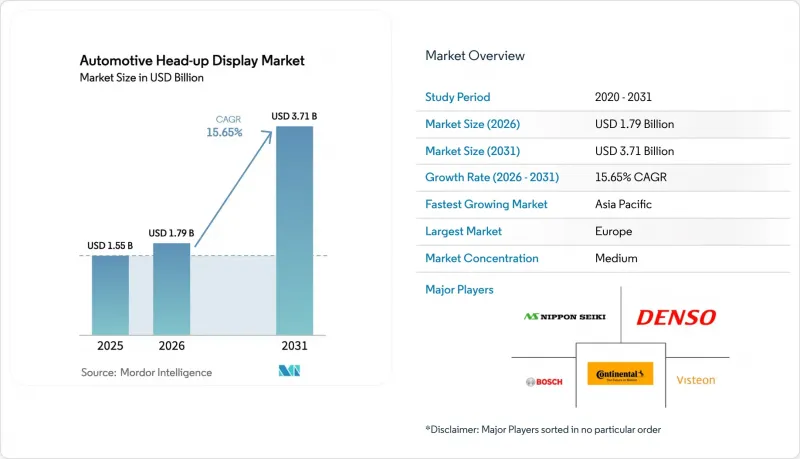
據 Mordor Intelligence 稱,2025 年汽車抬頭顯示器(HUD) 市場價值為 15.5 億美元,預計到 2031 年將從 2026 年的 17.9 億美元成長至 37.1 億美元,預測期(2026-2031 年)的複合年成長率為 15.65%。
本報告按抬頭顯示器類型(擋風玻璃安裝式抬頭顯示器和組合式抬頭顯示器)、技術(傳統抬頭顯示器和擴增實境(AR)抬頭顯示器)、銷售管道(OEM 和售後市場)、車輛類型(乘用車和商用車)以及地區(北美、南美、歐洲、亞太地區以及中東和非洲)進行細分。市場預測以美元計價。
全球汽車抬頭顯示器市場趨勢及洞察
強制實施ADAS系統並推廣GSR-II合規性
歐洲通用安全法規II (GSR-II) 強制要求車輛配備智慧速度輔助和車道維持警示功能,這增加了顯示器的負荷。傳統的儀錶板若要應付如此高的負荷,就必須讓駕駛長時間保持視線固定。大陸集團的擴增實境抬頭顯示器 (AR-HUD) 將限速資訊和車道線疊加在駕駛員的視野範圍內,在滿足法規規定的亮度和延遲閾值的同時,降低了駕駛員的認知負荷。美國新車安全評鑑協會 (US NCAP) 的藍圖也反映了這些指導原則,顯示全球標準正在趨於一致。這迫使汽車製造商採用抬頭顯示器,因為這是符合人體工學的最佳合規方式。供應商可以從法規驅動的需求而非消費者的自主選擇中獲益,從而保護汽車抬頭顯示器市場免受宏觀經濟放緩的影響。
豪華車數位駕駛座的競爭
豪華汽車製造商正圍繞無縫數位化體驗重新設計內飾,抬頭顯示器)也從選配功能轉變為核心配置。 BMW的「全景iDrive」系統將統一的影像帶投射到整個擋風玻璃上,整合儀表數據和即時導航訊息,在提升品牌價值的同時,減少了對輔助顯示器的需求。 AudiA6 e-tron原型車配備了一個88吋、焦距200公尺的虛擬平面,引導駕駛者的視線從儀錶板轉移到前方道路。美國新創新興企業Lucid承諾在其整個UX 3.0平台中整合AR-HUD,這表明高階電動車買家期望將先進的投影技術作為標準配置。豪華車市場的早期應用分散了固定的研發成本,使供應商能夠在兩個車型週期中重新配置中階車型的光學系統。能夠掌握這種「高階到量產」推廣模式的供應商,可以在滿足更嚴格的安全檢驗標準的同時,維持利潤率。
擋風玻璃空間與包裝限制
在小型轎車中,將投影光學元件安裝在儀表板和擋風玻璃之間是一項挑戰。福特的一份服務快報詳細介紹了每次更換擋風玻璃時都需要進行的調整程序,這些程序會暴露出公差極小的問題。梅賽德斯-奔馳的一項內部研究發現,即使曲率發生微小的變化也會降低影像的清晰度和亮度,迫使汽車製造商儘早確定玻璃供應商以確保一致性。像法雷奧的“Panovision”這樣的跨柱式概念克服了空間限制,但需要對平台進行重新設計,導致模具成本增加和交付延遲。這些限制將汽車抬頭顯示器市場分類為高階產品線(允許客製化儀表板)和經濟型產品線(必須等待更薄的光學元件上市)。
細分市場分析
2025年,擋風玻璃抬頭顯示系統將佔汽車抬頭顯示器市場72.85%的佔有率。這主要歸功於其與車輛內飾的無縫整合以及與高階品牌的親和性。 BMW的全景投影系統可將影像投射到整個擋風玻璃的寬度上,證明大型虛擬影像可以取代二次性螢幕。雖然這些設備提升了車輛價值並符合ADAS(高級駕駛輔助系統)的可見性標準,但它們依賴複雜的光學對準和車輛專用封裝。隨著產量的增加,擋風玻璃抬頭顯示器系統的市場規模預計仍將擴大,但隨著豪華車型滲透率的飽和,成長速度將會放緩。
組合式解決方案成長最為迅猛,預計2031年年複合成長率(CAGR)將達到16.03%。這些自主型模組突破了擋風玻璃形狀的限制,縮短了安裝時間,並方便二手車車主進行改裝。供應商正利用標準化支架並最大限度地減少車輛拆卸,從而為經銷商提供高利潤的配件。組合式技術如今支援更明亮的影像和防眩光塗層,縮小了與擋風玻璃投影方式在品質上的差距。此細分市場將拓展汽車抬頭顯示器市場,以滿足價格敏感型客戶的需求以及車隊維修需求。
由於傳統投影方式可靠性高且成本低,預計到2025年,它們仍將佔據汽車抬頭顯示器市場61.45%的佔有率。大陸集團在不採用先進渲染技術的情況下,透過滿足監管亮度標準來維持其大規模生產計畫。然而,由於微型LED成本的降低和GPU效能的提升,AR抬頭顯示器能夠實現高精度深度疊加,因此其應用正以16.52%的複合年成長率快速成長。凱迪拉克2026款Vistatiq將採用EnvySix的全像波導技術,根據實際道路距離顯示方向指示,從而提供直覺的導航。隨著AR單元精度的提高,它們將達到L3級自動駕駛的感知標準,從而鞏固其主流應用地位。因此,AR系統中汽車抬頭顯示器的市場規模將會擴大,尤其是在全彩良率瓶頸被克服後。
區域分析
預計到2025年,歐洲將佔據汽車抬頭顯示器市場36.90%的佔有率,主要得益於強制性的駕駛輔助顯示器法規以及豪華車銷售的集中度。 BMW、奧迪和賓士已將抬頭顯示器作為其頂級車型的標準配置,進一步強化了消費者對投射式顯示器作為安全配置的認知。聯合國歐洲經濟委員會(UNECE)WP.29工作小組制定的法規環境已確立了技術規範標準,從而保障了總部位於該地區的一級供應商的穩定訂單。本地供應商利用其靠近原始設備製造商(OEM)工程中心的優勢,縮短迭代周期,並確保符合ISO 26262檢驗審核的要求。
預計到2031年,亞太地區的複合年成長率將達到16.24%,成為所有地區中成長最快的地區。理想汽車和蔚來汽車等中國品牌正在採用抬頭顯示器(HUD)技術,以打造類似智慧型手機的使用者體驗,並使其軟體定義駕駛座脫穎而出。台灣半導體公司正在供應專用驅動晶片,降低零件成本,並為該地區的成本競爭力奠定基礎。政府為促進智慧汽車生產而獎勵進一步推動了HUD技術的普及。高度整合的供應鏈實現了快速的工程迭代周期,使汽車製造商能夠逐年改進HUD技術,以滿足精通技術的國內消費者的需求。
在北美,抬頭顯示技術(AR-HUD)的應用正在不斷擴展,主要集中在豪華SUV和皮卡領域。凱迪拉克即將推出的AR-HUD正是底特律汽車製造商努力的象徵,而龐大的二手車市場也帶動了蓬勃發展的售後改裝市場。美國公路安全保險協會(NCAP)修訂後的標準也鼓勵汽車製造商採用擋風玻璃投影技術來輔助車輛速度警示。儘管北美地區的車輛更換速度較慢,整體需求也低於亞洲,但這些因素仍在推動該地區的需求成長。
中東和拉丁美洲等其他地區雖然仍處於發展階段,但市場潛力巨大。豪華進口車的成長、人們對安全性能日益增強的意識,以及光學元件成本的下降,都將推動這些地區的普及。供應商正瞄準這些市場,推出模組化組合套件,以消除擋風玻璃規格的差異,簡化型式認證流程。
其他好處:
- Excel格式的市場預測(ME)表
- 3個月的分析師支持
目錄
第1章:引言
- 研究假設和市場定義
- 調查範圍
第2章:調查方法
第3章執行摘要
第4章 市場狀況
- 市場概覽
- 市場促進因素
- 豪華車數位駕駛座的競爭
- 由於強制性ADAS和GSR-II的要求,需求增加。
- PGU光學元件的成本低於35美元。
- 透明微型LED擋風玻璃的研發已經成功。
- 中國一級製造商自主研發的HUD訂單激增。
- 將AR導航與5G邊緣渲染結合
- 市場限制因素
- 擋風玻璃的房地產和包裝限制
- AR-HUD中的重影問題仍有安全隱患。
- 汽車用紅色微型LED的良率差距
- 擋風玻璃供應商之間的光學對準差異
- 價值供應鏈分析
- 監理情勢
- 技術展望
- 波特五力模型
第5章 市場規模與成長預測
- HUD類型
- 擋風玻璃抬頭顯示器
- 組合器HUD
- 科技
- 傳統HUD
- 擴增實境(AR)HUD
- 銷售管道
- OEM 原廠設備
- 售後市場
- 按車輛類型
- 搭乘用車
- 商用車輛
- 按地區
- 北美洲
- 美國
- 加拿大
- 其他北美國家
- 南美洲
- 巴西
- 阿根廷
- 其他南美國家
- 歐洲
- 德國
- 英國
- 法國
- 義大利
- 西班牙
- 俄羅斯
- 其他歐洲國家
- 亞太地區
- 中國
- 日本
- 印度
- 韓國
- 其他亞太國家
- 中東和非洲
- 阿拉伯聯合大公國
- 沙烏地阿拉伯
- 土耳其
- 埃及
- 南非
- 其他中東和非洲國家
- 北美洲
第6章 競爭情勢
- 市場集中度
- 策略趨勢
- 市佔率分析
- 公司簡介
- Nippon Seiki Co. Ltd
- Continental AG
- Yazaki Corporation
- DENSO Corporation
- Robert Bosch GmbH
- Visteon Corporation
- Panasonic Corporation
- Pioneer Corporation
- HUDWAY LLC
- Harman International
- Valeo SA
- Alps Alpine Co. Ltd
- LG Display Co. Ltd
- Envisics Ltd
- WayRay AG
第7章 市場機會與未來展望
According to Mordor Intelligence, the automotive head-up display market size was valued at USD 1.55 billion in 2025 and estimated to grow from USD 1.79 billion in 2026 to reach USD 3.71 billion by 2031, at a CAGR of 15.65% during the forecast period (2026-2031).
This report is Segmented by HUD Type (Windshield HUD and Combiner HUD), Technology (Conventional HUD and Augmented-Reality HUD), Sales Channel (OEM-Fitted and Aftermarket), Vehicle Type (Passenger Cars and Commercial Vehicles), and Geography (North America, South America, Europe, Asia-Pacific, and Middle East and Africa). The Market Forecasts are Provided in Terms of Value (USD).
Global Automotive Head-up Display Market Trends and Insights
Mandatory ADAS and GSR-II Compliance Push
Europe's General Safety Regulation II obliges intelligent speed assistance and lane-keeping alerts, increasing display workload that conventional clusters cannot accommodate without longer glance times. Continental's AR-HUD overlays speed limits and lane boundaries inside the driver's sightline, cutting cognitive load and meeting regulatory brightness and latency thresholds . The United States NCAP roadmap mirrors these guidelines, signalling converging global standards that point automakers toward HUD adoption as the most ergonomic path to compliance. Suppliers benefit from demand anchored in law rather than consumer discretion, protecting the Automotive Head-Up Display market against macro-economic softening.
Premium-Vehicle Digital-Cockpit Race
Luxury OEMs are reframing cabin design around seamless digital experiences in which head-up displays move from optional accessory to centerpiece. BMW's Panoramic iDrive projects a unified image band across the windshield that blends instrument data with live navigation cues, reinforcing brand value while reducing the need for secondary displays. Audi's A6 e-tron prototype stretches an 88-inch virtual plane at a 200-meter focal distance, lifting driver gaze from the dashboard to the road ahead. The United States newcomer Lucid guarantees AR-HUD availability across its UX 3.0 platform, confirming that premium EV buyers expect advanced projection by default. Early luxury adoption spreads fixed R&D costs, letting suppliers re-package the optics for mid-segment launches within two model cycles. Vendors that master this premium-to-volume cascade safeguard margins while meeting stricter safety validation criteria.
Windshield Real-Estate and Packaging Limits
Compact vehicles struggle to house projection optics between the dashboard and the glass. Ford's service bulletin details recalibration procedures that expose tight tolerances whenever a windshield is replaced. Mercedes-Benz internal studies show minor curvature shifts can degrade image focus and brightness, forcing OEMs to lock in glass suppliers early to secure consistency. Pillar-to-pillar concepts like Valeo's Panovision counteract space limits but require platform-level redesigns that add tooling cost and delay. The constraint divides the Automotive Head-Up Display market into premium programs that can afford bespoke dashboards and economy lines that must wait for slimmer optics.
Other drivers and restraints analyzed in the detailed report include:
- Falling PGU Optics Cost Below USD 35
- 5G Edge-Rendered AR Navigation Integration
- Persistent AR-HUD Ghost-Image Safety Risk
For complete list of drivers and restraints, kindly check the Table Of Contents.
Segment Analysis
Windshield systems captured 72.85% of the automotive head-up display market share in 2025, underpinned by seamless cabin integration and premium brand alignment. BMW's panoramic projection spans the full glass width and demonstrates how large virtual images can replace secondary screens. These units boost perceived vehicle value and satisfy ADAS visibility rules, though they depend on complex optical alignment and vehicle-specific packaging. As volumes scale, the Automotive Head-Up Display market size for windshield units will still widen, yet growth rates will cool as penetration saturates luxury models.
Combiner solutions recorded the sharpest rise with a 16.03% CAGR through 2031. Their self-contained modules bypass windshield geometry constraints, cutting install time and making retrofits feasible for used-car owners. Suppliers leverage standardized brackets and minimize vehicle teardown, giving dealers a high-margin accessory. Combiner technology now supports brighter images and anti-glare coatings, narrowing the quality gap with windshield projection. The segment will extend the Automotive Head-Up Display market to cost-sensitive customers and fleet refurbishments.
Conventional projection still accounts for 61.45% of the automotive head-up display market share in 2025, thanks to proven reliability and low cost. Continental continues to secure high-volume programs by meeting regulator-specified luminance without advanced rendering. However, AR-HUD installations are climbing at a 16.52% CAGR as falling micro-LED prices and stronger GPUs enable depth-accurate overlays. Cadillac's 2026 Vistiq will use Envisics holographic waveguides to place turn prompts at true-road distance, promising intuitive guidance. AR units fulfill the Level 3 automated-driving perception criteria as accuracy improves, positioning them for mainstream rollout. Therefore, the Automotive Head-Up Display market size for AR systems will gain share, especially once full-color yield hurdles are cleared.
Complete Report Scope:
- HUD Type
- Windshield HUD
- Combiner HUD
- Technology
- Conventional HUD
- Augmented-Reality (AR) HUD
- Sales Channel
- OEM-fitted
- Aftermarket
- Vehicle Type
- Passenger Cars
- Commercial Vehicles
- By Geography
- North America
- United States
- Canada
- Rest of North America
- South America
- Brazil
- Argentina
- Rest of South America
- Europe
- Germany
- United Kingdom
- France
- Italy
- Spain
- Russia
- Rest of Europe
- Asia-Pacific
- China
- Japan
- India
- South Korea
- Rest of Asia-Pacific
- Middle East and Africa
- United Arab Emirates
- Saudi Arabia
- Turkey
- Egypt
- South Africa
- Rest of Middle East and Africa
- North America
Geography Analysis
Europe's 36.90% of the automotive head-up display market share in 2025 stems from statutory driver-assistance display mandates and dense premium-vehicle sales. BMW, Audi, and Mercedes-Benz embed HUDs as standard on top trims, reinforcing buyer perception that projection is integral to safety packages. The regulatory backdrop under UNECE WP.29 creates a baseline technical specification, ensuring a steady pipeline of orders to tier-1s headquartered in the region. Local suppliers capitalize on proximity to OEM engineering centers, keeping iteration loops short and ensuring conformity with ISO 26262 validation audits.
Asia-Pacific charts the highest regional CAGR at 16.24% through 2031. Chinese brands like Li Auto and Nio use HUDs to differentiate software-defined cockpits, mirroring smartphone-grade UX. Taiwanese semiconductor firms supply specialized driver ICs, trimming the bill of materials and anchoring regional cost leadership. Government incentives that promote intelligent-vehicle production further stimulate adoption. The supply-chain density enables rapid engineering cycles, letting automakers deploy yearly HUD refinements that cater to tech-savvy domestic buyers.
North America leverages luxury SUVs and pickup trucks to widen adoption. Cadillac's upcoming AR-HUD launch signals Detroit's commitment, while aftermarket fitment thrives in a large used-vehicle base. The revised NCAP encourages OEMs to favor windshield projection for speed-assistance alerts. These factors lift regional demand even as a lower fleet-renewal tempo moderates volume compared with Asia.
Other regions, including the Middle East and Latin America, remain nascent yet attractive. Premium-import growth and rising safety-feature awareness will nudge penetration upward, helped by falling optics costs. Suppliers target these markets with modular combiner kits that bypass windshield variance and simplify homologation.
- Nippon Seiki Co. Ltd
- Continental AG
- Yazaki Corporation
- DENSO Corporation
- Robert Bosch GmbH
- Visteon Corporation
- Panasonic Corporation
- Pioneer Corporation
- HUDWAY LLC
- Harman International
- Valeo SA
- Alps Alpine Co. Ltd
- LG Display Co. Ltd
- Envisics Ltd
- WayRay AG
Additional Benefits:
- The market estimate (ME) sheet in Excel format
- 3 months of analyst support
TABLE OF CONTENTS
1 Introduction
- 1.1 Study Assumptions and Market Definition
- 1.2 Scope of the Study
2 Research Methodology
3 Executive Summary
4 Market Landscape
- 4.1 Market Overview
- 4.2 Market Drivers
- 4.2.1 Premium-Vehicle Digital-Cockpit Race
- 4.2.2 Mandatory ADAS and GSR-II Compliance Push
- 4.2.3 Falling PGU Optics Cost Below USD 35
- 4.2.4 Transparent Micro-LED Windscreen R&D Wins
- 4.2.5 China Tier-1 In-House HUD Sourcing Surge
- 4.2.6 5G Edge-Rendered AR Navigation Integration
- 4.3 Market Restraints
- 4.3.1 Windshield Real-Estate and Packaging Limits
- 4.3.2 Persistent AR-HUD Ghost-Image Safety Risk
- 4.3.3 Automotive-Grade Red Micro-LED Yield Gap
- 4.3.4 Windshield-Supplier Optical-Alignment Variance
- 4.4 Value / Supply-Chain Analysis
- 4.5 Regulatory Landscape
- 4.6 Technological Outlook
- 4.7 Porter's Five Forces
- 4.7.1 Threat of New Entrants
- 4.7.2 Bargaining Power of Buyers
- 4.7.3 Bargaining Power of Suppliers
- 4.7.4 Threat of Substitutes
- 4.7.5 Intensity of Competitive Rivalry
5 Market Size and Growth Forecasts (Value (USD))
- 5.1 HUD Type
- 5.1.1 Windshield HUD
- 5.1.2 Combiner HUD
- 5.2 Technology
- 5.2.1 Conventional HUD
- 5.2.2 Augmented-Reality (AR) HUD
- 5.3 Sales Channel
- 5.3.1 OEM-fitted
- 5.3.2 Aftermarket
- 5.4 Vehicle Type
- 5.4.1 Passenger Cars
- 5.4.2 Commercial Vehicles
- 5.5 By Geography
- 5.5.1 North America
- 5.5.1.1 United States
- 5.5.1.2 Canada
- 5.5.1.3 Rest of North America
- 5.5.2 South America
- 5.5.2.1 Brazil
- 5.5.2.2 Argentina
- 5.5.2.3 Rest of South America
- 5.5.3 Europe
- 5.5.3.1 Germany
- 5.5.3.2 United Kingdom
- 5.5.3.3 France
- 5.5.3.4 Italy
- 5.5.3.5 Spain
- 5.5.3.6 Russia
- 5.5.3.7 Rest of Europe
- 5.5.4 Asia-Pacific
- 5.5.4.1 China
- 5.5.4.2 Japan
- 5.5.4.3 India
- 5.5.4.4 South Korea
- 5.5.4.5 Rest of Asia-Pacific
- 5.5.5 Middle East and Africa
- 5.5.5.1 United Arab Emirates
- 5.5.5.2 Saudi Arabia
- 5.5.5.3 Turkey
- 5.5.5.4 Egypt
- 5.5.5.5 South Africa
- 5.5.5.6 Rest of Middle East and Africa
- 5.5.1 North America
6 Competitive Landscape
- 6.1 Market Concentration
- 6.2 Strategic Moves
- 6.3 Market Share Analysis
- 6.4 Company Profiles (Includes Global level Overview, Market level overview, Core Segments, Financials as available, Strategic Information, Market Rank/Share for key companies, Products and Services, and Recent Developments)
- 6.4.1 Nippon Seiki Co. Ltd
- 6.4.2 Continental AG
- 6.4.3 Yazaki Corporation
- 6.4.4 DENSO Corporation
- 6.4.5 Robert Bosch GmbH
- 6.4.6 Visteon Corporation
- 6.4.7 Panasonic Corporation
- 6.4.8 Pioneer Corporation
- 6.4.9 HUDWAY LLC
- 6.4.10 Harman International
- 6.4.11 Valeo SA
- 6.4.12 Alps Alpine Co. Ltd
- 6.4.13 LG Display Co. Ltd
- 6.4.14 Envisics Ltd
- 6.4.15 WayRay AG
7 Market Opportunities and Future Outlook

 汽車抬頭顯示器(HUD) 市場預測至 2034 年-全球產品、組件、車輛類型、HUD 類型、乘用車等級、驅動系統、應用、最終用戶和區域分析汽車抬頭顯示器 (HUD) 市場預測至 2034 年——全球分析,按 HUD 類型、乘用車級別、車輛類型、驅動系統、電動汽車類型、自動駕駛級別、交付方式、銷售管道、組合式 HUD 顯示螢幕尺寸、技術、應用、最終用戶和地區分類
 汽車抬頭顯示器市場:2026-2032年全球市場預測(依產品類型、組件、顯示類型、技術、尺寸類型、應用、車輛類型和分銷管道分類)
 汽車抬頭顯示器市場分析及預測(至2035年):依類型、產品、技術、組件、應用、形狀、材料類型、最終用戶、功能及安裝類型分類
 全球汽車抬頭顯示器市場:按抬頭顯示器類型、技術、乘用車等級、車輛類型、動力類型、電動車類型、自動駕駛等級、產品/服務、銷售管道和地區分類-預測(至2033年)
 汽車抬頭顯示器市場機會、成長促進因素、產業趨勢分析及預測(2026-2035年)
 汽車抬頭顯示器市場:依產品類型、乘用車類型和地區分類
 2026年全球抬頭顯示器(HUD)車載資訊娛樂系統市場報告
 全球汽車抬頭顯示器市場規模、佔有率、趨勢和成長分析報告(2026-2034)2026年全球後擋風玻璃抬頭顯示器(HUD)市場報告