

 |
市場調查報告書
商品編碼
2113442
歐洲化妝品和香水玻璃瓶包裝:市場佔有率分析、行業趨勢和統計數據以及成長預測(2026-2031 年)Europe Cosmetic And Perfumery Glass Bottle Packaging - Market Share Analysis, Industry Trends & Statistics, Growth Forecasts (2026 - 2031) |
||||||

※ 本網頁內容可能與最新版本有所差異。詳細情況請與我們聯繫。
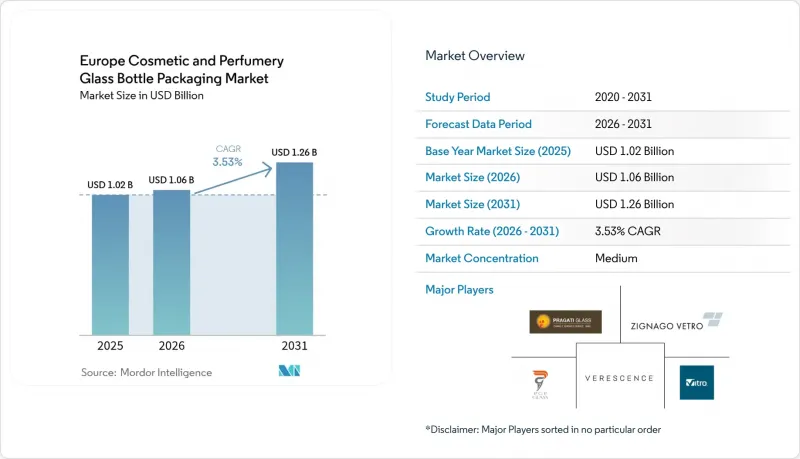
據 Mordor Intelligence 稱,2025 年歐洲化妝品和香水玻璃瓶包裝市場價值 10.2 億美元,預計到 2031 年將從 2026 年的 10.6 億美元成長至 12.6 億美元,預測期(2026-2031 年)複合年成長率為 3.53%。
本報告按應用領域(香水、護膚、彩妝品及其他應用)、容量(50毫升以下、50-100毫升、100-150毫升及150毫升以上)、顏色(透明/燧石色、琥珀色及其他顏色)、終端用戶(奢侈品牌、高階大眾品牌、大眾市場及獨立/自有品牌及獨立/自有品牌及國家/地區/地區。市場預測僅以美元計價。
歐洲化妝品和香水玻璃瓶包裝市場趨勢與洞察
滴管瓶的需求日益成長
配方研發人員正在尋求高效精華液,他們推薦使用玻璃滴管瓶,因為這種瓶型能夠實現精準計量,提升產品功效感知,並且相比螺旋蓋瓶,價格高出15-25%。 Virospack公司於2024年推出的專利後座力和防旋轉管狀管瓶表明,生產瓶頸並非爐容量,而是尺寸的可重複性,這促使加工商與瓶蓋供應商合作,共同設計瓶頸。隨著歐洲化妝品和香水玻璃瓶包裝市場日益關注活性成分,50毫升以下的瓶子正逐漸受到青睞,因為許多新配方都採用滴管蓋來定量計量視視網醇、菸鹼醯胺和微生物培養物。德國和荷蘭的灌裝商(其中許多在符合製藥級潔淨室標準的環境中運作)正利用其品管(QC)經驗,從缺乏內部灌裝生產線的臨床化妝品新創公司那裡獲得承包工程合約。因此,市場轉向小批量、高利潤率的訂單,這為具有快速週轉能力和利用數位技術進行裝飾的加工商創造了有利條件。
人們越來越關注包裝作為產品差異化的一種手段。
無論是奢侈品牌還是高階大眾品牌,都在升級其裝飾工藝,以展現個性,同時兼顧可回收。 Bormioli Luigi 於 2024 年推出了真空濺鍍設備,無需使用清漆即可在整個瓶身上實現金屬光澤,使加工商能夠將容器納入透明玻璃回收流程。隨後,Ballaran 於 2025 年推出了 3D 浮雕技術,將凸起的標誌直接嵌入模具,打造觸感豐富的品牌標識,作為二次標籤的替代方案。由於裝飾流程已融入生產流程而非後處理步驟,因此產品上市時間得以縮短,獨立品牌所需的小批量生產週期也得以減少。因此,能夠以一體化方式進行設計、成型和裝飾的加工商正在獲得更高的市場佔有率。這一趨勢在法國和義大利尤為明顯,兩國的一體化玻璃工廠能夠在八週內提供全套原型服務。歐洲化妝品和香水玻璃瓶包裝市場受益於品牌經理將額外的預算從數位廣告轉移到實體差異化,儘管銷售持平,但價值成長卻有所恢復。
塑膠包裝作為玻璃瓶的替代品而日益普及
在20歐元以下的價位區間,PET和單一材質PP正在蠶食玻璃的市佔率。這是因為履約的運費、破損費和危險物品附加費推高了25%至40%的成本。 Quadpack計劃於2025年推出的「Lola PET Jar」正是針對這一價格敏感問題而設計的,它採用單一聚合物包裝,避免了玻璃重量帶來的額外成本。 DHL的化妝品行業指南指出,玻璃容器包裝的高酒精香水被歸類為危險品,這增加了小規模線上經銷商的合規負擔。然而,歐盟將於2027年實施的微塑膠禁令(該禁令將禁止使用某些塑膠添加劑、鋁和生物基PET)將在中期內減輕注重成本的品牌的負擔。加工商正在透過減輕玻璃瓶的重量來應對這一變化,但人們對這些改變的接受程度褒貶不一。由於大型藥局在計算總到岸成本時沒有給永續性聲明賦予貨幣價值,因此除非供應商能夠證明每份的克數與玻璃容器相當,否則玻璃容器處於劣勢。
細分市場分析
2025年,香水市佔率維持在46.02%。這凸顯了香水保存和品牌故事的重要性,而這兩方面都依賴惰性不透明玻璃。高濃度產品,例如淡香精(EDP)和香精,需要厚壁瓶來防止揮發和氧化,知名品牌會將高達15%的出廠價格用於初級包裝,遠高於化妝品行業的平均水平。在歐洲,蘭蔻的「美麗人生」(La Vie Et Belle)和迪奧的「曠野」(Sauvage)等旗艦產品每年銷量超過300萬瓶,均採用燧石瓶包裝,這些瓶子也具有一定的收藏價值。歐洲化妝品和香水玻璃瓶包裝市場受益於一定的內置替換需求,因為補充裝採用相同的高規格配比,以適配現有瓶子的形狀。
護膚產業雖然只佔銷售額的33%,但隨著臨床級精華液的日益普及,其複合年成長率(CAGR)正以4.56%的速度成長。整合於玻璃容器中的無氣泵現已符合ISO 15378藥品包裝標準,使藥用化妝品品牌能夠檢驗類類視色素胜肽成分長達36個月的穩定性。在法國和荷蘭,近一半新推出的、經常獲得皮膚科醫生推薦的護膚化妝品都採用滴管瓶包裝。獨立品牌傾向於選擇容量小於30毫升的琥珀色玻璃滴管瓶,以營造藥妝般的質感並最大限度地減少紫外線劣化。在所有領域,歐洲化妝品和香水玻璃瓶包裝行業都在利用製藥技術、無塵室成型工藝、環氧乙烷(EO)滅菌技術以及防篡改封條,提案塑膠包裝無法實現的高價值服務。
預計到2025年,50毫升至100毫升的瓶裝產品將佔據歐洲化妝品和香水玻璃瓶包裝市場42.10%的佔有率,這主要得益於其便於攜帶,可輕鬆放入手提包,並符合免稅規定。 75毫升的容量仍然是高階香水的主力軍,推動了模具成型和瓦楞紙箱尺寸的規模經濟。同時,100毫升至150毫升的容量範圍預計將以5.49%的複合年成長率成長,這主要得益於被稱為“超值罐裝”的晚霜和高階身體油等產品,這些產品採用大容量包裝是合理的。 VetroPak即將推出的熱固性輕量化技術可望在不影響抗摔性的前提下,將容量範圍內玻璃瓶的重量減輕30%,這項突破性技術可望促進高級產品的普及。
30毫升以下的規格在濃縮濃縮液和試用套裝中非常受歡迎,較小的容量也使得每毫升的零售價可以低至1歐元。然而,由於航空行李限制和二次包裝重量限制,10毫升以下的安瓿瓶面臨來自塑膠和鋁製吸塑包裝的激烈競爭。另一方面,容量超過150毫升的產品仍是小眾市場,但在透過直銷通路銷售的沐浴露和水療油領域,這類產品正逐漸獲得市場認可。這些產品通常使用燧石玻璃或塗層黑色瓶子,以強調儀式感和美感,進一步增強玻璃帶來的體驗吸引力。對於加工商而言,容量配置決定了熔爐的運作計畫。較小的規格需要窄口壓吹塑成型機,而罐裝產品則需要寬口壓模成型機,因此多條IS生產線每週輪換模具,以平衡換模損失和庫存風險。
其他好處:
- Excel格式的市場預測(ME)表
- 3個月的分析師支持
目錄
第1章:引言
- 研究假設和市場定義
- 調查範圍
第2章:調查方法
第3章執行摘要
第4章 市場狀況
- 市場概覽
- 市場促進因素
- 滴管瓶的需求日益成長
- 人們越來越關注包裝作為產品差異化的一種手段。
- 歐洲香水和護膚市場的優質化
- 歐盟包裝和包裝廢棄物法規正在加速高PCR玻璃(再生玻璃)的採用。
- 奢侈化妝品行業可重複填充和可回收玻璃容器系統的擴展
- 熟練玻璃吹製工人的短缺正在推動對自動化工程的投資。
- 市場限制因素
- 塑膠包裝作為玻璃瓶的替代品而日益普及
- 玻璃生產過程中的高能源成本和碳排放
- 電子商務中易碎物品的運輸附加費
- 堿灰供應的波動擾亂了熔爐的運作計畫。
- 產業價值鏈分析
- 監理情勢
- 技術展望
- 宏觀經濟因素對市場的影響
- 波特五力分析
第5章 市場規模與成長預測
- 透過使用
- 香水
- 護膚
- 彩妝
- 其他用途
- 按產能
- 50毫升或更少
- 50~100 ml
- 100~150 ml
- 150毫升或更多
- 按顏色
- 透明/燧石
- 琥珀色
- 其他顏色
- 最終用戶
- 奢侈品牌
- 優質大眾
- 大眾市場
- 獨立/自有品牌
- 國家
- 德國
- 英國
- 法國
- 義大利
- 西班牙
- 比荷盧經濟聯盟
- 其他歐洲國家
第6章 競爭情勢
- 市場集中度
- 策略趨勢
- 市佔率分析
- 公司簡介
- Verescence France SASU
- Vitro SAB de CV
- Zignago Vetro SpA
- Piramal Glass Private Limited
- Pragati Glass Private Limited
- Roma International PLC
- Saver Glass SAS
- SGB Packaging Group Inc.
- SKS Bottle and Packaging Inc.
- Stolzle-Oberglas GmbH
- APG Group BV(Verbeeck Packaging Group)
- Baralan International SpA
- Bormioli Luigi SpA
- Consol Glass(Pty)Ltd
- Continental Bottle Company Ltd
- Gerresheimer AG
- Heinz-Glas GmbH and Co. KGaA
- Lumson SpA
- Pochet du Courval SA
- Quadpack Industries SA
- Vidrala SA
第7章 市場機會與未來展望
According to Mordor Intelligence, the Europe cosmetic and perfumery glass bottle packaging market size was valued at USD 1.02 billion in 2025 and estimated to grow from USD 1.06 billion in 2026 to reach USD 1.26 billion by 2031, at a CAGR of 3.53% during the forecast period (2026-2031).
This report is Segmented by Application (Perfumes, Skin Care, Color Cosmetics, Other Applications), Capacity (Up To 50 Ml, 50-100 Ml, 100-150 Ml, Above 150 Ml), Color (Clear/Flint, Amber, Other Colors), End-User (Luxury Brands, Premium Mass, Mass Market, Indie/Private Label), and Country. The Market Forecasts are Provided in Terms of Value (USD) Only.
Europe Cosmetic And Perfumery Glass Bottle Packaging Market Trends and Insights
Rising Demand for Dropper Bottles
Formulators seeking high-potency serums are championing glass droppers because the format signals precision dosing, enhances perceived efficacy, and commands price premiums of 15-25% over screw-cap bottles. Virospack's 2024 rollout of tubular vials with Blowback and Antirotation patents underscores that dimensional repeatability, not furnace output, is the gating factor, nudging converters to co-engineer neck finishes with closure suppliers. As the Europe cosmetic and perfumery glass bottle packaging market deepens its focus on actives, bottles below 50ml are capturing new formulations that rely on dropper caps to meter retinol, niacinamide, and microbiome cultures. German and Dutch fillers, many operating at pharmaceutical-grade clean-room standards, are exploiting their QC credentials to win turnkey contracts from clinical-beauty startups that lack in-house filling lines. The net result is a shift toward small-batch, high-margin orders that reward converters with rapid changeover capability and digitally enabled decoration.
Increased Emphasis on Packaging for Product Differentiation
Luxury and premium mass labels alike are upgrading their decorations to convey exclusivity while preserving recyclability. Bormioli Luigi opened a vacuum sputtering unit in 2024 that metallizes entire bottles without lacquers, allowing converters to keep the container in the clear-glass recycling stream. Baralan then introduced 3D relief technology in 2025, embedding raised logos directly in the mold so that tactile branding replaces secondary labels. These capabilities accelerate time to market because decoration is integral, not post-process, reducing cycle times for limited runs that indie brands demand. Converters that can bundle design, molding, and decoration are therefore capturing a higher wallet share, a trend visible in France and Italy, where integrated glassworks can deliver full-service prototypes in under eight weeks. The Europe cosmetic and perfumery glass bottle packaging market is benefiting as brand managers allocate incremental budget from digital advertising back toward physical differentiation, reviving value growth even as unit sales flatten.
Growth of Plastic Packaging as a Substitute for Glass Bottles
Below EUR 20 price points, PET and monomaterial PP are eroding glass's share because freight, breakage, and dangerous-goods surcharges add 25-40% to the cost during e-commerce fulfillment. Quadpack's 2025 Lola PET jar targets this sensitivity by offering a single-polymer pack that sidesteps glass weight penalties. DHL's cosmetics sector guide highlights that alcohol-rich perfumes in glass face hazmat classification, raising compliance overhead for small web merchants. However, the EU's 2027 microplastics ban will prohibit certain plastic additives, aluminum, and bio-PET, and offer medium-term relief for cost-driven brands. Converters respond by lightweighting flint bottles, but acceptance varies: mass drugstores calculate total landed cost without assigning monetary value to sustainability claims, so glass loses out unless a supplier can prove parity on grams per dose.
Other drivers and restraints analyzed in the detailed report include:
- Premiumization of European Fragrance and Skin Care Segments
- EU PPWR Accelerating High-PCR Glass Adoption
- High Energy Costs and Carbon Footprint of Glass Production
For complete list of drivers and restraints, kindly check the Table Of Contents.
Segment Analysis
Perfumes maintained a 46.02% share in 2025, underscoring the importance of scent preservation and brand storytelling, which rely on inert, fragrance-impermeable glass. EDP and extrait concentrations require thick-wall bottles to prevent evaporation and oxidation, and leading houses allocate up to 15% of ex-factory cost to primary packaging, well above the cosmetics average. Within Europe, flagship SKUs such as Lancome La Vie Est Belle and Dior Sauvage each sell over 3 million units annually in flint bottles that act as quasi-collectibles. The Europe cosmetic and perfumery glass bottle packaging market benefits because refill pods use the same high-spec ratios to fit existing bottle geometries, embedding a base load of replacement demand.
Skin care, which accounts for only 33% of the volume, is expanding at a 4.56% CAGR as clinical-grade serums proliferate. Airless pumps built into glass barrels now meet ISO 15378 pharma-pack standards, letting cosmeceutical brands validate 36-month stability for retinoids and peptides. Dropper bottles account for nearly half of new skin-care treatment launches in France and the Netherlands, where dermocosmetics often capture dermatologist recommendations. Indie brands often prefer amber glass droppers under 30ml to reinforce apothecary cues and minimize UV degradation. In both strands, the Europe cosmetic and perfumery glass bottle packaging industry leverages pharmaceutical know-how, clean-room molding, EO sterilization, and tamper bands to upsell value-added services that plastic cannot match.
Bottles between 50 ml and 100 ml held a 42.10% share of the Europe cosmetic and perfumery glass bottle packaging market in 2025, as they align with the portability of handbags and customs duty-free limits. The 75 ml size remains flagship for prestige fragrances, driving economies of scale in mold cavitation and carton sizes. Yet the 100-150 ml bracket will clock a 5.49% CAGR on the back of "value jar" night creams and premium body oils that justify pantry-size packs. Vetropack's upcoming thermally hardened lightweight technology promises 30% lighter glass in that range without sacrificing drop resistance, a breakthrough that could unlock mass-premium adoption.
Formats under 30 ml thrive in booster concentrates and discovery sets, where lower fill volumes support retail pricing of EUR 1 per milliliter. However, for ampoules below 10 ml, plastic and aluminum blister sticks compete aggressively due to airline carry-on rules and the weight of secondary packaging. At the opposite extreme, formats exceeding 150 ml remain niche but are gaining traction in bath elixirs and spa oils sold through direct-to-consumer channels. These tend to use flint or coated black bottles to emphasize ritual and aesthetics, reinforcing the experiential pull that glass confers. For converters, the capacity mix dictates furnace scheduling: small formats demand narrow-neck press-and-blow, while jars require wide-mouth presses, so multi-IS lines rotate molds weekly to balance changeover losses with inventory risk.
Complete Report Scope:
- By Application
- Perfumes
- Skin Care
- Color Cosmetics
- Other Applications
- By Capacity
- Up to 50 ml
- 50 - 100 ml
- 100 - 150 ml
- Above 150 ml
- By Color
- Clear / Flint
- Amber
- Other Colors
- By End-User
- Luxury Brands
- Premium Mass
- Mass Market
- Indie / Private Label
- By Country
- Germany
- United Kingdom
- France
- Italy
- Spain
- Benelux
- Rest of Europe
List of Companies Covered in this Report:
- Verescence France SASU
- Vitro S.A.B. de C.V.
- Zignago Vetro SpA
- Piramal Glass Private Limited
- Pragati Glass Private Limited
- Roma International PLC
- Saver Glass SAS
- SGB Packaging Group Inc.
- SKS Bottle and Packaging Inc.
- Stolzle-Oberglas GmbH
- APG Group BV (Verbeeck Packaging Group)
- Baralan International SpA
- Bormioli Luigi SpA
- Consol Glass (Pty) Ltd
- Continental Bottle Company Ltd
- Gerresheimer AG
- Heinz-Glas GmbH and Co. KGaA
- Lumson SpA
- Pochet du Courval SA
- Quadpack Industries SA
- Vidrala SA
Additional Benefits:
- The market estimate (ME) sheet in Excel format
- 3 months of analyst support
TABLE OF CONTENTS
1 INTRODUCTION
- 1.1 Study Assumptions and Market Definition
- 1.2 Scope of the Study
2 RESEARCH METHODOLOGY
3 EXECUTIVE SUMMARY
4 MARKET LANDSCAPE
- 4.1 Market Overview
- 4.2 Market Drivers
- 4.2.1 Rising Demand for Dropper Bottles
- 4.2.2 Increased Emphasis on Packaging for Product Differentiation
- 4.2.3 Premiumization of European Fragrance and Skin Care Segments
- 4.2.4 EU Packaging and Packaging Waste Regulation Accelerating High-PCR Glass Adoption
- 4.2.5 Expansion of Refillable and Returnable Glass Systems Across Luxury Beauty
- 4.2.6 Automation Investments Driven by Skilled-Glassmaker Shortages
- 4.3 Market Restraints
- 4.3.1 Growth of Plastic Packaging as a Substitute for Glass Bottles
- 4.3.2 High Energy Costs and Carbon Footprint of Glass Production
- 4.3.3 Freight-Surcharges for E-commerce Fragile Goods
- 4.3.4 Soda-Ash Supply Volatility Disrupting Furnace Scheduling
- 4.4 Industry Value Chain Analysis
- 4.5 Regulatory Landscape
- 4.6 Technological Outlook
- 4.7 Impact of Macroeconomic Factors on the Market
- 4.8 Porter's Five Forces Analysis
- 4.8.1 Bargaining Power of Suppliers
- 4.8.2 Bargaining Power of Consumers
- 4.8.3 Threat of New Entrants
- 4.8.4 Threat of Substitute Products
- 4.8.5 Intensity of Competitive Rivalry
5 MARKET SIZE AND GROWTH FORECASTS (VALUE)
- 5.1 By Application
- 5.1.1 Perfumes
- 5.1.2 Skin Care
- 5.1.3 Color Cosmetics
- 5.1.4 Other Applications
- 5.2 By Capacity
- 5.2.1 Up to 50 ml
- 5.2.2 50 - 100 ml
- 5.2.3 100 - 150 ml
- 5.2.4 Above 150 ml
- 5.3 By Color
- 5.3.1 Clear / Flint
- 5.3.2 Amber
- 5.3.3 Other Colors
- 5.4 By End-User
- 5.4.1 Luxury Brands
- 5.4.2 Premium Mass
- 5.4.3 Mass Market
- 5.4.4 Indie / Private Label
- 5.5 By Country
- 5.5.1 Germany
- 5.5.2 United Kingdom
- 5.5.3 France
- 5.5.4 Italy
- 5.5.5 Spain
- 5.5.6 Benelux
- 5.5.7 Rest of Europe
6 COMPETITIVE LANDSCAPE
- 6.1 Market Concentration
- 6.2 Strategic Moves
- 6.3 Market Share Analysis
- 6.4 Company Profiles (includes Global Level Overview, Market Level Overview, Core Segments, Financials as Available, Strategic Information, Market Rank/Share for Key Companies, Products and Services, and Recent Developments)
- 6.4.1 Verescence France SASU
- 6.4.2 Vitro S.A.B. de C.V.
- 6.4.3 Zignago Vetro SpA
- 6.4.4 Piramal Glass Private Limited
- 6.4.5 Pragati Glass Private Limited
- 6.4.6 Roma International PLC
- 6.4.7 Saver Glass SAS
- 6.4.8 SGB Packaging Group Inc.
- 6.4.9 SKS Bottle and Packaging Inc.
- 6.4.10 Stolzle-Oberglas GmbH
- 6.4.11 APG Group BV (Verbeeck Packaging Group)
- 6.4.12 Baralan International SpA
- 6.4.13 Bormioli Luigi SpA
- 6.4.14 Consol Glass (Pty) Ltd
- 6.4.15 Continental Bottle Company Ltd
- 6.4.16 Gerresheimer AG
- 6.4.17 Heinz-Glas GmbH and Co. KGaA
- 6.4.18 Lumson SpA
- 6.4.19 Pochet du Courval SA
- 6.4.20 Quadpack Industries SA
- 6.4.21 Vidrala SA
7 MARKET OPPORTUNITIES AND FUTURE OUTLOOK
- 7.1 White-Space and Unmet-Need Assessment

 感官包裝市場-2026-2032年全球市場預測
 2026年全球三級包裝市場報告
 家居用品包裝市場預測至2034年-按包裝類型、材料、產品類型、包裝形式、最終用戶和地區分類的全球分析
 磚形紙盒包裝市場規模、佔有率和成長分析:按材料類型、產品類型、應用、產能、最終用戶、封口方式和地區分類-2026-2033年產業預測
 三折包裝市場規模、佔有率和成長分析:按材料、產品類型、印刷技術、應用、最終用戶、分銷管道和地區分類-2026-2033年產業預測
 轉換器設備市場規模、佔有率和成長分析:按設備類型、材料類型、自動化程度、最終用戶產業、安裝類型、銷售管道和地區分類-2026-2033年產業預測個人化數位包裝市場預測至2034年-全球分析(按印刷方法、包裝形式、基材、個人化方法、最終用戶和地區分類)包裝市場預測至2034年-按材料、包裝類型、產品類型、包裝功能、技術、最終用戶和地區分類的全球分析有機聚合物包裝解決方案市場預測至2034年-按產品類型、聚合物類型、原料、生物分解性、應用、最終用戶和地區分類的全球分析植物來源樹脂包裝解決方案市場預測至2034年-按樹脂類型、包裝類型、原料來源、應用、最終用戶和地區分類的全球分析