


 |
市場調查報告書
商品編碼
2113439
汽車夜視系統:市場佔有率分析、產業趨勢與統計及成長預測(2026-2031)Automotive Night Vision System - Market Share Analysis, Industry Trends & Statistics, Growth Forecasts (2026 - 2031) |
||||||

※ 本網頁內容可能與最新版本有所差異。詳細情況請與我們聯繫。
據 Mordor Intelligence 稱,2025 年汽車夜視系統市值為 33 億美元,預計到 2031 年將達到 63.4 億美元,而 2026 年為 36.8 億美元,預測期(2026-2031 年)的複合年成長率為 11.52%。
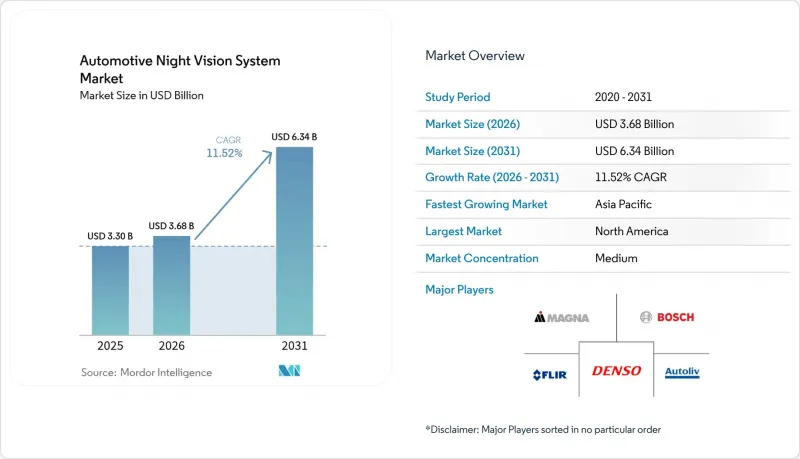
本報告按技術類型(遠紅外線、近紅外線、短波紅外線)、顯示類型(導航系統、儀表叢集等)、組件類型(夜視攝影機等)、車輛類型(乘用車等)、銷售管道(OEM原廠配套等)和地區進行細分。市場預測以美元計價。
全球汽車夜視系統市場趨勢及洞察
美國 FMVSS 111 和歐盟 GSR 2029 強制要求 ADAS
美國聯邦機動車輛安全標準 (FMVSS) 127 和歐盟通用安全法規 (GSR) 2029 的協調一致,統一了合規期限,並從根本上重塑了汽車夜視系統市場中夜視技術的應用經濟格局。美國國家公路交通安全管理局 (NHTSA) 強制要求所有車輛在 2029 年 9 月前安裝行人自動緊急煞車系統,凸顯了不同系統性能上的顯著差異。 Teledyne FLIR 和 VSI Labs 的測試表明,熱熔法行人自動緊急煞車系統 (PAEB) 在所有夜間場景下均表現良好,而三款 2024 年款的關鍵車型卻在多項測試中失敗。這些監管壓力正將夜視技術從「豪華配置」轉變為「合規要求」。 2022 年 77.7% 的行人死亡事故發生在夜間,這一事實也凸顯了夜視技術的安全必要性。歐盟的平行時間表限制了全球汽車製造商採取區域性應對措施,因此無法形成規模經濟,進而加速整個熱成像供應鏈的成本降低。小規模製造商獲得了一年的寬限期,直至 2030 年 9 月,這可能會造成兩極分化的市場動態,有利於擁有現有熱感測技術的大型製造商。
透過純電動車和高階內燃機車型打入高階市場
目前,高階電動車普遍配備熱成像攝影機,以證明其高價的合理性,並與傳統競爭對手區分開來。梅賽德斯-奔馳的「夜視輔助增強版」(Night View Assist Plus)可探測160公尺外的行人和野生動物,並用聚光燈照亮它們,而不會使對面來車駕駛員眩目。 BMW的遠紅外線解決方案偵測距離可達300米,即使在沒有外部照明的情況下也能有效運作。奧迪A6和Q7等高階內燃機車型也採用了類似的技術,兩者均作為2500美元的選配配置提供。高階消費者願意接受超過2300-2500美元價格區間的配置清單,這為供應鏈的學習曲線提供了必要的初始銷量,並最終為在大規模生產領域引入成本最佳化配置鋪平了道路。
非製冷長波紅外線模組的平均售價較高,且整合了抬頭顯示器(HUD)。
與攝影機和雷達單元相比,熱敏核心及其相關光學元件仍然價格昂貴。整合式抬頭顯示功能會進一步增加成本,因為每個顯示器都需要一個光學組合器和複雜的校準。 OEM廠商的成本工程團隊必須在長波紅外線(LWIR)全覆蓋方案和雷達-攝影機融合方案之間做出選擇,後者既能保證符合監管要求,又能降低元件數量。新興的百葉窗演算法和晶圓級製造技術或許能夠緩解成本壓力,但在過渡期內,主流市場對價格的敏感度可能依然存在。
細分市場分析
長波紅外線(LWIR)汽車夜視系統佔據全球市場價值的62.78%。其強大的熱對比度確保了在車燈照射範圍之外也能可靠地識別行人,因此在監管測試中持續得到應用。隨著晶圓級光電二極體單價突破100美元大關,短波紅外線(SWIR)感測器的年複合成長率高達15.88%。採用相機製造流程的半導體技術帶來了極具吸引力的成本優勢,而SWIR則能夠穿透雪霧和輕霧,使其在高速公路自動駕駛領域極具吸引力。儘管LWIR在汽車夜視系統中的市場佔有率仍然是監管合規認證的重要標準,但預計其佔有率將逐漸縮小。主動式近紅外線(ANIR)技術則處於中間位置,與分離式LED發射器結合使用時,可在600英尺(約183公尺)的範圍內提供單色影像。
研發工作持續拓展頻譜範圍。阿爾託大學開發了一種鍺光電二極體,其在1.55µm波長處的靈敏度提高了35%,非常適合汽車短波頻寬(SWIR)波段應用。例如,量子點檢測器已實現低至18µm波長的探測靈敏度,預示著感測器設計者未來面臨的挑戰。未來五年,將長波紅外線(LWIR)和短波紅外線(SWIR)融合於通用邏輯電路的雙波段陣列有望成為高階封裝的主流。這將在保持整體擁有成本(TCO)較低的同時,實現冗餘備份。
到2025年,抬頭顯示器(HUD)將佔據43.10%的市場佔有率,從而推動汽車夜視系統市場的擴張。駕駛者優先考慮保持前方視野並減少眼球移動時間。然而,隨著汽車製造商在導航和串流媒體播放方面採用12吋或更大的觸控屏,中控台顯示器的預算分配也日益增加。預計到本十年末,基於資訊娛樂系統的影像傳輸將以18.05%的複合年成長率趕上HUD的安裝量。因此,預計到2031年,HUD模組在汽車夜視系統市場的佔有率將下降至30%左右。
未來的駕駛座很可能配備更強大的擴增實境(AR)疊加功能。大陸集團、博世和哈曼都已發布了顯示控制器,能夠以彩色邊框突出顯示人體輪廓。在低階車型中,儀錶板顯示器或分割畫面Widgets或許就足夠了。由於將資料投射到擋風玻璃上需要精確的光學調整,一些量產車製造商可能會推遲採用抬頭顯示器(HUD)架構,直到組件成本降低。雙模式策略使得高階品牌能夠將HUD作為旗艦功能,而中端品牌則可以重複使用中央面板,從而保持其產品線的功能一致性。
區域分析
預計到2025年,北美將佔汽車夜視系統銷量的41.20%。明確的法規是決定性的優勢。美國國家公路交通安全管理局(NHTSA)強制要求行人自動緊急煞車(AEB)系統在2029年9月前實現夜間工作,這迫使汽車製造商盡快敲定採購藍圖。 Teledyne FLIR和L3 Harris等美國本土供應商提供成熟的熱成像核心技術,從而維持了其在國內市場的附加價值。儘管美國對高階SUV的需求推動了銷售成長,但由於車輛架構的通用,加拿大組裝廠正在按照美國規格生產車輛。此外,Teledyne FLIR與VSI Labs合作進行FMVSS 127合規性測試,也為北美供應商拓展全球市場提供了競爭優勢。
亞太地區預計將實現14.33%的複合年成長率。中國在該地區處於領先地位,正大力推廣國產品牌的L2+級高級駕駛輔助系統(ADAS)。廣汽、蔚來和比亞迪正在將人工智慧影像增強技術應用於標準CMOS感測器,以提升其偽熱成像輸出能力,同時,旗艦車型也正在加速採用真正的長波紅外線(LWIR)技術。為緩解出口限制的影響,硫系透鏡和低成本晶圓的在地化生產正在穩步推進。日本和韓國正透過豐田、Lexus、現代和捷恩斯等品牌,不斷拓展其在高階市場的佔有率,這些品牌均配備了夜視和環景顯示攝影機系統。
在歐洲,基於其自身的“2029年通用安全法規”,正呈現均衡成長態勢。德國汽車製造商自2000年代初以來便領先採用相關技術,如今正致力於改進感測器融合技術,以實現有條件自動駕駛。法雷奧(Valeo)與泰萊達因·弗萊爾(Teledyne FLIR)達成的供應協議涵蓋了符合ASIL B標準的熱成像攝影機的批量生產。法國林瑞德(Lynred)正斥資8,500萬歐元,將其無塵室面積擴大一倍,以確保檢測器產能,應對地緣政治衝擊。在斯堪的斯堪地那維亞市場,由於冬季漫長的黑夜,相關技術的採用率高於平均水平,儘管南歐的銷售嚴重依賴奢侈品進口。雖然該地區的市場佔有率落後於北美,但監管政策的協調一致和供應商的投資正確保其穩定成長。
其他好處:
- Excel格式的市場預測(ME)表
- 3個月的分析師支持
目錄
第1章:引言
- 研究假設和市場定義
- 調查範圍
第2章:調查方法
第3章執行摘要
第4章 市場狀況
- 市場概覽
- 市場促進因素
- 美國 FMVSS 111 和歐盟 GSR 2029 強制要求 ADAS
- 透過純電動車和高階內燃機車型打入高階市場
- 透過晶圓級光學技術和人工智慧專用解決方案實現成本轉移
- 整合式熱感應器和可見光感應器,實現夜間 L3 級自動駕駛。
- 配備紅外線設備的車輛可享有保險遠端資訊處理折扣
- 軍用級長波紅外線感測器進入民用供應鏈。
- 市場限制因素
- 高平均售價 (ASP) 和整合到非製冷長波紅外線模組的抬頭顯示器 (HUD) 中
- 美國《國際武器貿易條例》(ITAR)和《瓦塞納爾協定》對頻率超過9赫茲的熱磁芯出口有限制。
- 消費者強烈反對在飛機上使用紅外線成像技術以保護隱私。
- 非製冷檢測器中MEMS百葉窗的可靠性漂移
- 價值供應鏈分析
- 監理情勢
- 技術展望
- 波特五力模型
第5章 市場規模與成長預測
- 依技術類型
- 遠紅外線(LWIR,非製冷)
- 近紅外線(NIR)
- 短波紅外線(SWIR)
- 顯示類型
- 導航系統
- 儀表板
- 抬頭顯示器(HUD)
- 中央資訊娛樂/車載資訊娛樂系統螢幕
- 依組件類型
- 夜視攝影機(熱成像、近紅外線)
- 控制和處理單元
- 顯示模組
- 紅外線照明光源(LED/VCSEL)
- 感測器和其他組件
- 按車輛類型
- 搭乘用車
- 輕型商用車
- 中型和重型商用車輛
- 按銷售管道
- 原廠安裝
- 售後改裝
- 按地區
- 北美洲
- 美國
- 加拿大
- 其他北美國家
- 歐洲
- 德國
- 英國
- 法國
- 義大利
- 西班牙
- 其他歐洲國家
- 亞太地區
- 中國
- 日本
- 印度
- 韓國
- 澳洲和紐西蘭
- 其他亞太國家
- 南美洲
- 巴西
- 阿根廷
- 其他南美國家
- 中東和非洲
- 沙烏地阿拉伯
- 阿拉伯聯合大公國
- 南非
- 其他中東和非洲國家
- 北美洲
第6章 競爭情勢
- 市場集中度
- 策略趨勢
- 市佔率分析
- 公司簡介
- Magna International Inc.
- DENSO Corporation
- Robert Bosch GmbH
- Valeo SA
- Autoliv Inc.
- FLIR Systems Inc.
- L3Harris Technologies Inc.
- Aptiv PLC
- Hella KGaA Hueck and Co.
- Visteon Corporation
- Aisin Corporation
- Raytheon Technologies
- Continental AG
- Mobileye Global Inc.
- Renesas Electronics Corp.
- Veoneer AB
- OmniVision Technologies
- Teledyne Technologies Inc.
- Nidec-ELV Automotive Vision
- Pioneer Corporation
第7章 市場機會與未來展望
According to Mordor Intelligence, the automotive night vision systems market size was valued at USD 3.30 billion in 2025 and estimated to grow from USD 3.68 billion in 2026 to reach USD 6.34 billion by 2031, at a CAGR of 11.52% during the forecast period (2026-2031).
This report is Segmented by Technology Type (Far Infrared, Near Infrared, and Short-Wave Infrared), Display Type (Navigation System, Instrument Cluster, and More), Component Type (Night Vision Cameras and More), Vehicle Type (Passenger Cars and More), Sales Channel (OEM Factory-Fit and More), and Geography. The Market Forecasts are Provided in Terms of Value (USD).
Global Automotive Night Vision System Market Trends and Insights
ADAS Mandates in US-FMVSS 111 and EU GSR 2029
Regulatory convergence between US Federal Motor Vehicle Safety Standard No. 127 and EU General Safety Regulation 2029 creates a synchronized compliance deadline that fundamentally reshapes automotive night vision adoption economics in the Automotive Night Vision System Market. The NHTSA mandate requiring pedestrian automatic emergency braking systems by September 2029 exposes a critical performance gap, as testing by Teledyne FLIR and VSI Labs demonstrated that thermal-fused PAEB systems passed all nighttime scenarios while three major 2024 vehicle models failed multiple tests. This regulatory pressure transforms night vision from luxury feature to compliance necessity, with 77.7% of pedestrian fatalities occurring at night in 2022 providing the safety justification. The EU's parallel timeline ensures global automakers cannot regionalize their approach, creating economies of scale that accelerate cost reduction across thermal imaging supply chains. Small-volume manufacturers receive a one-year extension until September 2030, creating a two-tier market dynamic that may advantage established players with existing thermal sensing capabilities.
Premium-segment Penetration in BEVs and Luxury ICE Models
High-end EVs now integrate thermal cameras to justify price premiums and differentiate against conventional rivals. Mercedes-Benz Night View Assist Plus identifies pedestrians and wildlife up to 160 m ahead and applies a spotlight beam without dazzling on-coming traffic. BMW's far-infrared solution reaches 300 m and remains effective without external illumination. Luxury ICE models such as the Audi A6 and Q7 mirror this practice, each offering a USD 2,500 option. Because premium buyers accept equipment lists that push the USD 2,300-2,500 threshold, they provide the seed volumes necessary for supply-chain learning curves, thereby paving the way for cost-optimized trims in volume segments.
High ASP of Uncooled LWIR Modules and HUD Integration
Thermal cores and associated optics remain expensive relative to camera and radar units. Integrating head-up projections adds further expense because each display demands optical combiners and elaborate calibration. OEM cost-engineering teams must choose between full LWIR coverage or radar-camera fusion pathways that promise compliance at lower bill-of-material counts. Emerging shutter-free algorithms and wafer-level manufacturing can relieve pressure, but the transition period keeps mainstream segments price-sensitive
Other drivers and restraints analyzed in the detailed report include:
- Cost Downshift via Wafer-Level Optics and AI-Only Solutions
- Thermal/visible Sensor Fusion Enabling L3 Autonomy at Night
- US ITAR / Wassenaar Export Controls on More Than 9 Hz Thermal Cores
For complete list of drivers and restraints, kindly check the Table Of Contents.
Segment Analysis
The automotive night vision systems for LWIR solutions contributed 62.78% of the global value. Strong thermal contrast enables reliable pedestrian recognition beyond headlight beams, explaining sustained uptake in regulatory test cycles. SWIR sensors are scaling at a high CAGR of 15.88% as wafer-level photodiodes have crossed the USD 100-per-unit threshold. Semiconductor processes familiar to camera fabs supply attractive cost curves, and SWIR's ability to see through snow spray and light fog is compelling for autonomous highway duty. The automotive night vision systems market share held by LWIR is expected to erode gradually, though it remains the benchmark for compliance certification. Active Near-Infrared occupies a middle path, supplying monochrome imagery at 600 ft ranges when paired with discreet LED emitters.
R&D pipelines continue to broaden spectral reach. Aalto University delivered germanium photodiodes with 35% higher responsivity at 1.55 µm, ideal for SWIR automotive bands. At the extreme, quantum-dot detectors have logged detectivity up to 18 µm wavelengths, demonstrating the future ceiling for sensor designers. For the next five years, dual-band arrays that blend LWIR and SWIR on common logic will likely headline premium packages, assuring redundancy while tempering total cost of ownership.
Head-up displays secured 43.10% of the market share in 2025, contributing to the market size of automotive night vision systems. Drivers value forward-view retention and reduced glance time. Even so, center-stack displays capture budget placements because automakers already embed 12-inch or larger touchscreens for navigation and streaming. A CAGR of 18.05% sets infotainment-based feeds on course to meet HUD installations by the decade's end. Therefore, the automotive night vision systems market share of HUD modules is forecast to slip to the mid-30% band by 2031.
Future cockpits will reinforce augmented-reality overlays. Continental, Bosch, and HARMAN previewed display controllers that highlight warm-body silhouettes in color-coded boundaries. In lower trims, instrument-cluster views or split-screen widgets may suffice. Because windshield-projected data demands stringent optical alignment, some mass-volume badges bypass HUD architecture until component prices fall. Dual-mode strategies allow premium marques to sustain HUD as a headline feature while mid-range nameplates repurpose center panels, preserving functional consistency across line-ups.
Complete Report Scope:
- By Technology Type
- Far Infrared (LWIR, uncooled)
- Near Infrared (NIR)
- Short-Wave Infrared (SWIR)
- By Display Type
- Navigation System
- Instrument Cluster
- Head-Up Display (HUD)
- Central Infotainment/IVI Screen
- By Component Type
- Night Vision Cameras (Thermal, NIR)
- Control/Processing Units
- Display Modules
- IR Illumination Sources (LED/VCSEL)
- Sensors and Other Components
- By Vehicle Type
- Passenger Cars
- Light Commercial Vehicles
- Medium and Heavy Commercial Vehicles
- By Sales Channel
- OEM Factory-fit
- Aftermarket Retrofit
- By Geography
- North America
- United States
- Canada
- Rest of North America
- Europe
- Germany
- United Kingdom
- France
- Italy
- Spain
- Rest of Europe
- Asia-Pacific
- China
- Japan
- India
- South Korea
- Australia and New Zealand
- Rest of Asia-Pacific
- South America
- Brazil
- Argentina
- Rest of South America
- Middle East and Africa
- Saudi Arabia
- United Arab Emirates
- South Africa
- Rest of Middle East and Africa
- North America
Geography Analysis
North America controlled 41.20% of the 2025 automotive night vision systems market turnover. Legislative clarity is the decisive edge. The NHTSA stipulation that pedestrian AEB operate in darkness by September 2029 forces automakers to lock in sourcing roadmaps now. Domestic suppliers such as Teledyne FLIR and L3Harris furnish mature thermal cores, keeping value added onshore. Premium-SUV demand in the United States compounds volume, while Canadian assembly plants mirror U.S. specifications thanks to shared vehicle architectures.Teledyne FLIR's collaboration with VSI Labs in FMVSS No. 127 compliance testing positions North American suppliers advantageously for global market expansion.
Asia-Pacific is projected to record a 14.33% CAGR. China leads the regional charge as it scales level-2+ ADAS for domestic brands. GAC, NIO, and BYD incorporate AI-powered image enhancement that elevates standard CMOS sensors toward pseudo-thermal output, yet true LWIR adoption is accelerating in flagship trims. Local fabrication of chalcogenide lenses and low-cost wafers is underway to reduce exposure to export controls. Japan and South Korea add premium penetration via Toyota, Lexus, Hyundai, and Genesis nameplates, each pairing night vision with surround-view camera suites.
Europe exhibits balanced growth built on its own General Safety Regulation 2029. German marques led with early-2000s deployment and now refine sensor fusion for conditional autonomy. Valeo's supply agreement with Teledyne FLIR covers series production thermal cameras that meet ASIL B objectives. France's Lynred is doubling clean-room area under an EUR 85 million program to secure detector capacity against geopolitical shocks. Scandinavian markets display above-average uptake because of prolonged winter darkness, while southern European volume hinges on upscale imports. Although the region trails North America in share, synchronous regulation and supplier investments lock in dependable growth.
- Magna International Inc.
- DENSO Corporation
- Robert Bosch GmbH
- Valeo SA
- Autoliv Inc.
- FLIR Systems Inc.
- L3Harris Technologies Inc.
- Aptiv PLC
- Hella KGaA Hueck and Co.
- Visteon Corporation
- Aisin Corporation
- Raytheon Technologies
- Continental AG
- Mobileye Global Inc.
- Renesas Electronics Corp.
- Veoneer AB
- OmniVision Technologies
- Teledyne Technologies Inc.
- Nidec-ELV Automotive Vision
- Pioneer Corporation
Additional Benefits:
- The market estimate (ME) sheet in Excel format
- 3 months of analyst support
TABLE OF CONTENTS
1 Introduction
- 1.1 Study Assumptions and Market Definition
- 1.2 Scope of the Study
2 Research Methodology
3 Executive Summary
4 Market Landscape
- 4.1 Market Overview
- 4.2 Market Drivers
- 4.2.1 ADAS mandates in US-FMVSS 111 and EU GSR 2029
- 4.2.2 Premium-segment penetration in BEVs and luxury ICE models
- 4.2.3 Cost downshift via wafer-level optics and AI-only solutions
- 4.2.4 Thermal/visible sensor fusion enabling L3 autonomy at night
- 4.2.5 Insurance telematics discounts for infrared-equipped fleets
- 4.2.6 Military-grade LWIR sensors entering civilian supply chains
- 4.3 Market Restraints
- 4.3.1 High ASP of uncooled LWIR modules and HUD integration
- 4.3.2 US ITAR/Wassenaar export controls on more than 9 Hz thermal cores
- 4.3.3 Consumer data-privacy pushback on cabin IR imaging
- 4.3.4 Reliability drift of MEMS shutters in uncooled detectors
- 4.4 Value / Supply-Chain Analysis
- 4.5 Regulatory Landscape
- 4.6 Technological Outlook
- 4.7 Porter's Five Forces
- 4.7.1 Threat of New Entrants
- 4.7.2 Bargaining Power of Buyers/Consumers
- 4.7.3 Bargaining Power of Suppliers
- 4.7.4 Threat of Substitute Products
- 4.7.5 Intensity of Competitive Rivalry
5 Market Size and Growth Forecasts (Value (USD))
- 5.1 By Technology Type
- 5.1.1 Far Infrared (LWIR, uncooled)
- 5.1.2 Near Infrared (NIR)
- 5.1.3 Short-Wave Infrared (SWIR)
- 5.2 By Display Type
- 5.2.1 Navigation System
- 5.2.2 Instrument Cluster
- 5.2.3 Head-Up Display (HUD)
- 5.2.4 Central Infotainment/IVI Screen
- 5.3 By Component Type
- 5.3.1 Night Vision Cameras (Thermal, NIR)
- 5.3.2 Control/Processing Units
- 5.3.3 Display Modules
- 5.3.4 IR Illumination Sources (LED/VCSEL)
- 5.3.5 Sensors and Other Components
- 5.4 By Vehicle Type
- 5.4.1 Passenger Cars
- 5.4.2 Light Commercial Vehicles
- 5.4.3 Medium and Heavy Commercial Vehicles
- 5.5 By Sales Channel
- 5.5.1 OEM Factory-fit
- 5.5.2 Aftermarket Retrofit
- 5.6 By Geography
- 5.6.1 North America
- 5.6.1.1 United States
- 5.6.1.2 Canada
- 5.6.1.3 Rest of North America
- 5.6.2 Europe
- 5.6.2.1 Germany
- 5.6.2.2 United Kingdom
- 5.6.2.3 France
- 5.6.2.4 Italy
- 5.6.2.5 Spain
- 5.6.2.6 Rest of Europe
- 5.6.3 Asia-Pacific
- 5.6.3.1 China
- 5.6.3.2 Japan
- 5.6.3.3 India
- 5.6.3.4 South Korea
- 5.6.3.5 Australia and New Zealand
- 5.6.3.6 Rest of Asia-Pacific
- 5.6.4 South America
- 5.6.4.1 Brazil
- 5.6.4.2 Argentina
- 5.6.4.3 Rest of South America
- 5.6.5 Middle East and Africa
- 5.6.5.1 Saudi Arabia
- 5.6.5.2 United Arab Emirates
- 5.6.5.3 South Africa
- 5.6.5.4 Rest of Middle East and Africa
- 5.6.1 North America
6 Competitive Landscape
- 6.1 Market Concentration
- 6.2 Strategic Moves
- 6.3 Market Share Analysis
- 6.4 Company Profiles (Includes Global level Overview, Market level overview, Core Segments, Financials as available, Strategic Information, Market Rank/Share for key companies, Products and Services, and Recent Developments)
- 6.4.1 Magna International Inc.
- 6.4.2 DENSO Corporation
- 6.4.3 Robert Bosch GmbH
- 6.4.4 Valeo SA
- 6.4.5 Autoliv Inc.
- 6.4.6 FLIR Systems Inc.
- 6.4.7 L3Harris Technologies Inc.
- 6.4.8 Aptiv PLC
- 6.4.9 Hella KGaA Hueck and Co.
- 6.4.10 Visteon Corporation
- 6.4.11 Aisin Corporation
- 6.4.12 Raytheon Technologies
- 6.4.13 Continental AG
- 6.4.14 Mobileye Global Inc.
- 6.4.15 Renesas Electronics Corp.
- 6.4.16 Veoneer AB
- 6.4.17 OmniVision Technologies
- 6.4.18 Teledyne Technologies Inc.
- 6.4.19 Nidec-ELV Automotive Vision
- 6.4.20 Pioneer Corporation
7 Market Opportunities and Future Outlook
- 7.1 White-space and Unmet-Need Assessment

 汽車視覺系統市場:預測至 2034 年-全球分析(按組件、視覺系統類型、技術、車輛類型、驅動系統、應用程式、銷售管道、最終用戶和地區分類)汽車夜視系統市場預測至2034年-按組件、技術、顯示類型、車輛類型、銷售管道和地區分類的全球分析
 汽車夜視系統市場:依系統類型、技術、應用、車輛類型和最終用戶分類-2026-2032年全球市場預測
 汽車夜視系統市場分析及預測(至2035年):依類型、產品類型、技術、組件、應用、最終用戶、功能、安裝類型、設備及解決方案分類
 2026年全球汽車夜視系統市場報告汽車熱感成像攝影機市場:按技術、車輛類型、解析度、影格速率、安裝位置、應用和最終用戶分類的全球預測(2026-2032年)
 汽車夜視系統市場:市場機會、成長促進因素、產業趨勢分析及預測(2026-2035)
 汽車夜視系統市場規模、佔有率和成長分析(按組件、顯示類型、技術類型、車輛類型和地區分類)-2026-2033年產業預測
 汽車紅外線夜視系統(2025)
 汽車夜視系統:全球市佔率及排名、總銷售量及需求預測(2025-2031年)