


 |
市場調查報告書
商品編碼
2113438
氟橡膠:市場佔有率分析、產業趨勢與統計、成長預測(2026-2031)Fluoroelastomers - Market Share Analysis, Industry Trends & Statistics, Growth Forecasts (2026 - 2031) |
||||||

※ 本網頁內容可能與最新版本有所差異。詳細情況請與我們聯繫。
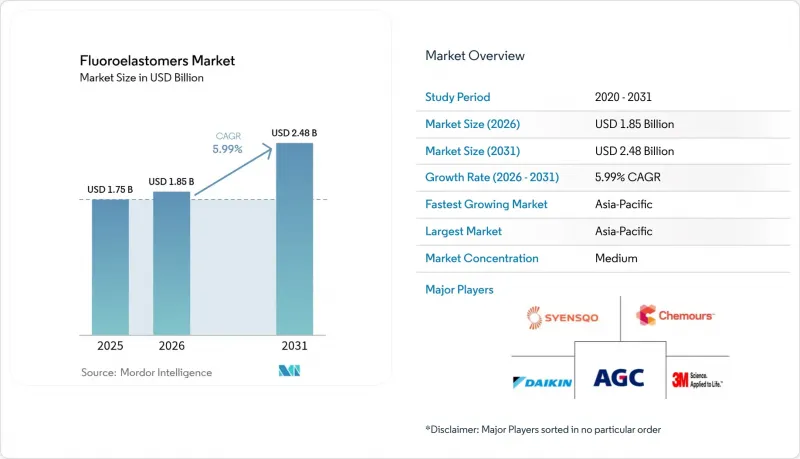
據 Mordor Intelligence 稱,氟橡膠市場預計到 2026 年價值 18.5 億美元,高於 2025 年的 17.5 億美元,預計到 2031 年將達到 24.8 億美元。
預計從 2026 年到 2031 年,其複合年成長率將達到 5.99%。
本報告按產品類型(氟橡膠、氟矽橡膠、全氟橡膠)、應用領域(隔膜、閥門、O型圈、密封件及其他應用)、終端用戶行業(汽車、航太等)和地區(亞太、北美、歐洲等)對產業進行細分。市場預測以美元計價。
全球氟橡膠市場趨勢與洞察
電動汽車溫度控管密封件的需求正在激增。
電動車電池組依賴複雜的液冷迴路,該迴路循環介電液體,可在不發生短路風險的情況下散熱。與矽膠和三元乙丙橡膠 (EPDM) 相比,由氟化橡膠)及類似化合物製成的密封件性能更優,即使在聚α烯烴基冷卻液中浸泡 1000 小時後,其膨脹率仍低於 5%。普瑞斯通 (Prestone) 根據中國 GB29743.2 標準配製的低電導率冷卻液,展示了改進的化學成分如何將密封件的性能提升到一個新的水平。隨著汽車製造商將電池保固期延長至 10 年,能夠在 -30 度C以下和 150 度C以上保持拉伸強度的全氟橡膠變得至關重要。預計到 2025 年,全球電動車產量將超過 2500 萬輛,因此,原始設備製造商 (OEM) 的採購團隊正在簽署多年期高純度全氟橡膠化合物的供應契約,這成為氟橡膠市場的一個關鍵成長支柱。
航太和新興航太應用領域對推進密封件的需求不斷成長。
商業發射運營商、衛星製造商和領先的國防公司指定使用能夠承受-200 度C至+300 度C溫度循環以及聯氨和液態氧等推進劑的全氟橡膠密封件。杜邦公司的Kallez級產品現已保證與超過1800種流體的化學相容性,從而減少了太空船生命維持管路和低溫供應系統中關鍵任務的洩漏途徑。在航空航太領域,人們越來越依賴氟化橡膠來降低輕型渦輪增壓器和永續航空燃料供應模組的維護頻率。一枚可重複使用的運載火箭需要使用超過1200個O型圈,隨著發射頻率的增加,材料需求量也增加倍增。因此,航太計畫正在進一步擴大對氟橡膠的長期需求。
高昂的材料成本和複合製造成本
氟橡膠的生產需要使用氟化單體,其價格高於標準石油化學原料。嚴格的製程控制和專有的硫化製程進一步增加了加工成本,限制了其在低利潤零件中的應用。全球天然橡膠供不應求正將價格上漲壓力推高至整個彈性體市場,即使性能優勢顯而易見,也使得市場對成本更加敏感。為了因應這項挑戰,供應商正著力降低生命週期成本。例如,一個可承受10,000小時運作的齒輪箱密封件通常可以取代兩到三個同等性能的丁腈橡膠(NBR)密封件。諸如Vamac等無鹵乙烯-丙烯酸酯類替代品在中溫應用領域的滲透,也對氟橡膠市場的潛在銷售量成長構成了壓力。
細分市場分析
在氟橡膠市場,預計到2025年,氟碳彈性體將佔據61.02%的市場。這主要得益於其在汽車燃油管接頭、煉油廠墊片和通用工業設備等領域的成熟應用。氟碳彈性體廣泛的加工條件使其零件供應商無需依賴專用模具即可滿足大量生產週期要求。然而,銷售量領先並不一定意味著成長率最高。全氟橡膠預計到2031年將以6.98%的複合年成長率成長,這主要得益於一些應用領域對密封性能的要求超過了傳統氟橡膠的極限,例如半導體潔淨室和可重複使用火箭。這一成長趨勢將使全氟橡膠市場在2030年代末為整個氟橡膠市場貢獻約6.13億美元。
需求的加速成長也得益於新的製造流程。索爾維的「Technoflon NFS」製程無需使用基於PFAS的界面活性劑即可實現相當的壓縮永久變形保持率,從而在不犧牲性能的前提下應對了歐洲政策的不確定性。在模擬化學物質滲透濃度低至兆分之一的大規模晶圓廠中,無污染的全氟橡膠正逐漸超越低成本的替代品,展現出更高的價值。矽橡膠雖然佔據的市場佔有率較小,但在航太環境控制系統中仍然至關重要,因為這些系統既需要在-60 度C的低溫下保持柔軟性,又需要耐噴射機燃料。供應商不斷改進雙酚固化體系,以提高高空和高壓環境的彈性模量,從而在更廣泛的氟橡膠市場中獲得穩定的收入來源。
區域分析
到2025年,亞太地區將以45.63%的市場佔有率主導氟橡膠市場,預計到2031年,該地區的需求將以7.02%的複合年成長率成長。中國為實現半導體自給自足而持續投資興建12吋晶圓廠,每個晶圓廠都需要數千個符合個位數ppm級放氣標準的高純度O型圈。印度的汽車產業改革,特別是針對國內電池製造的生產連結獎勵計畫(PLI)計劃,正在加速電動車冷卻液密封件的國內生產。古吉拉突邦氟化學公司宣布計劃在未來四年投資60億美元,以擴大其電池化學品產能,體現了氟聚合物供應鏈的長期區域整合。
北美位居第二,這得益於其成熟的航太項目、頁岩油開發以及先進邏輯晶片代工廠的本土化。 CHIPS and Science Act法案將加速區域晶圓產能的提升,從而在短期內推動全氟橡膠消費量的激增。此外,美國墨西哥灣深水油氣開發也帶動了耐高溫高壓(HPHT)密封解決方案的需求。由於正在考慮禁止使用全氟烷基和多氟烷基物質(PFAS),歐洲的市場佔有率面臨壓力,因為這可能會限制某些含氟中間體的使用。像James Walker這樣的製造商正在公開倡導針對特定應用的豁免,同時也對用於中等負載應用的無PFAS化合物進行試點測試。小規模的區域叢集也在逐步成長。在南美洲,鹽層下探勘計畫需要高性能的氟橡膠隔離閥;而在中東,氫氣和氨氣出口基礎設施的建設將受益於耐化學腐蝕的密封劑。即使這些地區加起來,也僅佔目前氟橡膠市場銷售額的不到10%。不過,考慮到多年資本項目的儲備,預計到 2030 年,這些項目將對銷售量成長做出重大貢獻。
其他好處:
- Excel格式的市場預測(ME)表
- 3個月的分析師支持
目錄
第1章:引言
- 研究假設和市場定義
- 調查範圍
第2章:調查方法
第3章執行摘要
第4章 市場狀況
- 市場概覽
- 市場促進因素
- 溫度控管密封件需求激增
- 航太和新興航太應用領域對推進密封件的需求不斷成長。
- 對半導體製程密封件的需求不斷成長
- 在石油和天然氣產業的應用擴展
- 可再生能源基礎設施的擴張
- 市場限制因素
- 原物料價格上漲和複合成本增加
- 原料供應波動
- 循環經濟中的回收義務
- 價值鏈分析
- 波特五力模型
第5章 市場規模與成長預測
- 依產品類型
- 氟基彈性體
- 矽橡膠
- 全氟橡膠
- 透過使用
- O型環、密封件、密封劑
- 隔膜
- 閥門
- 其他用途(軟管、管道等)
- 按最終用戶行業分類
- 車
- 航太
- 石油和天然氣
- 產業
- 其他終端用戶產業(半導體、電子產品等)
- 按地區
- 亞太地區
- 中國
- 日本
- 印度
- 韓國
- 其他亞太國家
- 北美洲
- 美國
- 加拿大
- 墨西哥
- 歐洲
- 德國
- 英國
- 法國
- 義大利
- 其他歐洲國家
- 南美洲
- 巴西
- 阿根廷
- 其他南美國家
- 中東和非洲
- 沙烏地阿拉伯
- 南非
- 其他中東和非洲國家
- 亞太地區
第6章 競爭情勢
- 市場集中度
- 策略趨勢
- 市佔率和排名分析
- 公司簡介
- 3M
- AGC Chemicals Americas
- DAIKIN INDUSTRIES, Ltd.
- DuPont
- Eagle Elastomer Inc.
- Freudenberg Sealing Technologies
- GARLOCK, AN ENPRO COMPANY.
- Gujarat Fluorochemicals Limited
- HaloPolymer
- James Walker
- KUREHA CORPORATION
- LANXESS
- NOK CORPORATION
- Syensqo
- The Chemours Company
- Trp Polymer Solutions
第7章 市場機會與未來展望
According to Mordor Intelligence, fluoroelastomers market size in 2026 is estimated at USD 1.85 billion, growing from 2025 value of USD 1.75 billion with 2031 projections showing USD 2.48 billion, growing at 5.99% CAGR over 2026-2031.
This report Segments the Industry by Product Type (Fluorocarbon Elastomers, Fluorosilicone Elastomers, Perfluoroelastomers ), Application (Diaphragms, Valves, O-Rings, Seals, and Sealants, Other Applications), End-User Industry (Automotive, Aerospace, and More), and Geography (Asia-Pacific, North America, Europe, and More). The Market Forecasts are Provided in Terms of Value (USD).
Global Fluoroelastomers Market Trends and Insights
EV Thermal-Management Seal Demand Surge
Electric-vehicle battery packs rely on sophisticated liquid-cooling loops that circulate dielectric fluids able to dissipate heat without risking short circuits. Seals made from Viton and similar compounds limit swelling to less than 5% after 1 000 hours in polyalphaolefin-based coolants, outperforming silicone and EPDM alternatives. Prestone's low-conductivity coolant formulated under China's GB29743.2 standard illustrates how chemistry updates push sealing specifications to new thresholds, Automakers have extended battery warranties to 10 years, so perfluoroelastomers that maintain tensile strength below -30 °C and above 150 °C become essential. As global EV production climbs past 25 million units in 2025, OEM sourcing teams lock in multiyear supply contracts for high-purity perfluoroelastomer compounds, anchoring a key growth pillar for the fluoroelastomers market.
Growing Demand for Aerospace & New Space Propulsion Seals
Commercial launch providers, satellite manufacturers, and defense primes specify perfluoroelastomer seals that survive propellants such as hydrazine or liquid oxygen while cycling from -200 °C to +300 °C. DuPont's Kalrez grades now guarantee chemical compatibility with more than 1 800 fluids, reducing mission-critical leak paths in spacecraft life-support lines and cryogenic feed systems . In aviation, lightweight turbochargers and sustainable-aviation-fuel delivery modules increasingly rely on Viton to curb maintenance frequency. Each reusable launch vehicle can contain over 1 200 individual O-rings, multiplying material demand as launch cadence accelerates. Consequently, aerospace programs amplify the long-run pull on the fluoroelastomers market.
High Material & Compounding Cost
Fluoroelastomer production relies on fluorinated monomers that trade at premiums standard petrochemical feedstocks. Tight process control and proprietary curing packages push conversion costs further, limiting uptake in low-margin components. Global natural rubber shortages extend price pressures across the wider elastomer landscape, reinforcing cost sensitivity even where performance benefits are clear-cut. To counterbalance, suppliers emphasize life-cycle savings: one gearbox seal rated for 10 000 operating hours often replaces two or three NBR equivalents. Halogen-free ethylene-acrylic alternatives such as Vamac creep into mid-temperature applications, compressing potential volume growth for the fluoroelastomers market.
Other drivers and restraints analyzed in the detailed report include:
- Increasing Requirement for Semiconductor Process Seals
- Growing Utilization in the Oil and Gas Industry
- Feedstock Supply Volatility
For complete list of drivers and restraints, kindly check the Table Of Contents.
Segment Analysis
Fluorocarbon elastomers retained 61.02% of the fluoroelastomers market share in 2025, buoyed by entrenched use in automotive fuel-line connectors, refinery gaskets, and general industrial equipment. Their broad processing window helps component suppliers meet mass-production takt times without resorting to exotic tooling. Volume leadership, however, does not equate to highest growth. Perfluoroelastomers expand at a 6.98% CAGR through 2031, catalyzed by semiconductor cleanrooms and reusable launch vehicles that push sealing specifications past traditional fluorocarbon limits. This growth vector translates to a perfluoroelastomer segment contribution of roughly USD 613 million to the overall fluoroelastomers market size by the end of the decade.
Demand acceleration also stems from novel manufacturing methods. Solvay's Tecnoflon NFS process eliminates PFAS surfactants yet delivers identical compression-set retention, addressing European policy uncertainty without sacrificing performance . As large fabs simulate chemical permeation down to parts-per-trillion thresholds, non-contaminating perfluoroelastomers gain value over lower-cost counterparts. Meanwhile, fluorosilicone elastomers hold a smaller niche but remain indispensable in aerospace environmental control systems where -60 °C flexibility meets jet-fuel resistance. Suppliers continue tailoring bisphenol-cure systems to enhance modulus at altitude pressures, protecting a steady revenue stream inside the broader fluoroelastomers market.
Complete Report Scope:
- By Product Type
- Fluorocarbon Elastomers
- Fluorosilicone Elastomers
- Perfluoroelastomers
- By Application
- O-Rings, Seals and Sealants
- Diaphragms
- Valves
- Other Applications (Hoses and Tubes, etc.)
- By End-user Industry
- Automotive
- Aerospace
- Oil and Gas
- Industrial
- Other End-user Industries (Semiconductor and Electronics, etc.)
- By Geography
- Asia-Pacific
- China
- Japan
- India
- South Korea
- Rest of Asia-Pacific
- North America
- United States
- Canada
- Mexico
- Europe
- Germany
- United Kingdom
- France
- Italy
- Rest of Europe
- South America
- Brazil
- Argentina
- Rest of South America
- Middle East and Africa
- SaudI Arabia
- South Africa
- Rest of Middle East and Africa
- Asia-Pacific
Geography Analysis
Asia-Pacific dominated the fluoroelastomers market in 2025 with 45.63% revenue share, and regional demand is projected to rise at a 7.02% CAGR through 2031. China's push for semiconductor self-sufficiency drives sustained investment in 12-inch fabs, each requiring thousands of high-purity O-rings with single-digit ppm outgassing specifications. India's automotive reforms, including PLI incentives for local battery manufacturing, encourage domestic production of EV-grade coolant seals. Gujarat Fluorochemicals has committed USD 6 billion over the next four years to expand battery-chemical capacity, signalling long-term regional integration of fluoropolymer supply chains.
North America ranks second, buoyed by mature aerospace programs, shale-oil activity, and onshoring of advanced logic foundries. The CHIPS and Science Act accelerates regional wafer capacity, translating into near-term spikes in perfluoroelastomer consumption. Additionally, US deepwater developments in the Gulf of Mexico reinforce demand for HPHT-rated sealing solutions. Europe's share faces pressure from prospective PFAS bans that could restrict certain fluorinated intermediates. Manufacturers such as James Walker publicly advocate for application-based exemptions while simultaneously piloting PFAS-free compounds for moderate-duty services. Smaller regional clusters add incremental growth. South America's pre-salt exploration programs necessitate high-performance fluoroelastomer isolation valves, whereas the Middle East targets hydrogen and ammonia export infrastructure that benefits from chemical-resistant sealing materials. Although these regions combined account for less than 10% of current fluoroelastomers market revenue, their multiyear capital-project pipelines suggest a notable contribution to volume upside by 2030.
- 3M
- AGC Chemicals Americas
- DAIKIN INDUSTRIES, Ltd.
- DuPont
- Eagle Elastomer Inc.
- Freudenberg Sealing Technologies
- GARLOCK, AN ENPRO COMPANY.
- Gujarat Fluorochemicals Limited
- HaloPolymer
- James Walker
- KUREHA CORPORATION
- LANXESS
- NOK CORPORATION
- Syensqo
- The Chemours Company
- Trp Polymer Solutions
Additional Benefits:
- The market estimate (ME) sheet in Excel format
- 3 months of analyst support
TABLE OF CONTENTS
1 Introduction
- 1.1 Study Assumptions and Market Definition
- 1.2 Scope of the Study
2 Research Methodology
3 Executive Summary
4 Market Landscape
- 4.1 Market Overview
- 4.2 Market Drivers
- 4.2.1 Surge in Demand for Thermal-Management Seal
- 4.2.2 Growing Demand for Aerospace and New Space Propulsion Seals
- 4.2.3 Increasing Requirement for Semiconductor Process Seals
- 4.2.4 Growing Utilzation in the Oil and Gas Industry
- 4.2.5 Expansion in Renewable Energy Infrastructure
- 4.3 Market Restraints
- 4.3.1 High Material and Compounding Cost
- 4.3.2 Feedstock Supply Volatility
- 4.3.3 Circular Economy Recycling Mandates
- 4.4 Value Chain Analysis
- 4.5 Porter's Five Forces
- 4.5.1 Bargaining Power of Suppliers
- 4.5.2 Bargaining Power of Buyers
- 4.5.3 Threat of New Entrants
- 4.5.4 Threat of Substitutes
- 4.5.5 Competitive Rivalry
5 Market Size and Growth Forecasts (Value)
- 5.1 By Product Type
- 5.1.1 Fluorocarbon Elastomers
- 5.1.2 Fluorosilicone Elastomers
- 5.1.3 Perfluoroelastomers
- 5.2 By Application
- 5.2.1 O-Rings, Seals and Sealants
- 5.2.2 Diaphragms
- 5.2.3 Valves
- 5.2.4 Other Applications (Hoses and Tubes, etc.)
- 5.3 By End-user Industry
- 5.3.1 Automotive
- 5.3.2 Aerospace
- 5.3.3 Oil and Gas
- 5.3.4 Industrial
- 5.3.5 Other End-user Industries (Semiconductor and Electronics, etc.)
- 5.4 By Geography
- 5.4.1 Asia-Pacific
- 5.4.1.1 China
- 5.4.1.2 Japan
- 5.4.1.3 India
- 5.4.1.4 South Korea
- 5.4.1.5 Rest of Asia-Pacific
- 5.4.2 North America
- 5.4.2.1 United States
- 5.4.2.2 Canada
- 5.4.2.3 Mexico
- 5.4.3 Europe
- 5.4.3.1 Germany
- 5.4.3.2 United Kingdom
- 5.4.3.3 France
- 5.4.3.4 Italy
- 5.4.3.5 Rest of Europe
- 5.4.4 South America
- 5.4.4.1 Brazil
- 5.4.4.2 Argentina
- 5.4.4.3 Rest of South America
- 5.4.5 Middle East and Africa
- 5.4.5.1 SaudI Arabia
- 5.4.5.2 South Africa
- 5.4.5.3 Rest of Middle East and Africa
- 5.4.1 Asia-Pacific
6 Competitive Landscape
- 6.1 Market Concentration
- 6.2 Strategic Moves
- 6.3 Market Share(%)/Ranking Analysis
- 6.4 Company Profiles (includes Global level Overview, Market level overview, Core Segments, Financials as available, Strategic Information, Market Rank/Share for key companies, Products and Services, and Recent Developments)
- 6.4.1 3M
- 6.4.2 AGC Chemicals Americas
- 6.4.3 DAIKIN INDUSTRIES, Ltd.
- 6.4.4 DuPont
- 6.4.5 Eagle Elastomer Inc.
- 6.4.6 Freudenberg Sealing Technologies
- 6.4.7 GARLOCK, AN ENPRO COMPANY.
- 6.4.8 Gujarat Fluorochemicals Limited
- 6.4.9 HaloPolymer
- 6.4.10 James Walker
- 6.4.11 KUREHA CORPORATION
- 6.4.12 LANXESS
- 6.4.13 NOK CORPORATION
- 6.4.14 Syensqo
- 6.4.15 The Chemours Company
- 6.4.16 Trp Polymer Solutions
7 Market Opportunities and Future Outlook
- 7.1 White-space and Unmet-need Assessment

 磷腈氟橡膠市場規模、佔有率和成長分析:按產品類型、加工方法、應用、終端用戶產業和地區分類-2026-2033年產業預測
 氟橡膠市場-全球市場預測(2026-2032年)
 氟橡膠市場預測至2034年—按產品類型、單體類型、應用、最終用戶和地區分類的全球分析
 全球氟橡膠市場規模、佔有率、趨勢和成長分析報告(2026-2034年)
 氟橡膠市場規模、佔有率及成長分析(按類型、應用、終端用戶產業及地區分類)-2026-2033年產業預測
 氟橡膠-全球市佔率及排名、總收入及需求預測(2025-2031年)
 氟橡膠市場規模、佔有率、趨勢分析報告(按類型、最終用途、地區、細分市場預測),2025 年至 2030 年
 氟彈性體市場報告:趨勢、預測和競爭分析(至 2031 年)氟橡膠市場,按類型、按應用、按最終用戶、按國家和地區分類 - 2025 年至 2032 年全球行業分析、市場規模、市場佔有率和預測
 氟彈性體市場機會、成長動力、產業趨勢分析及 2025 - 2034 年預測