


 |
市場調查報告書
商品編碼
2113421
浮體式生產系統(FPS):市場佔有率分析、產業趨勢與統計、成長預測(2026-2031 年)Floating Production Systems (FPS) - Market Share Analysis, Industry Trends & Statistics, Growth Forecasts (2026 - 2031) |
||||||

※ 本網頁內容可能與最新版本有所差異。詳細情況請與我們聯繫。
據 Mordor Intelligence 稱,2025 年浮體式生產系統市值為 666 億美元,預計到 2031 年將達到 1173.5 億美元,而 2026 年為 732.1 億美元,預測期(2026-2031 年)複合年成長率為 9.92%。
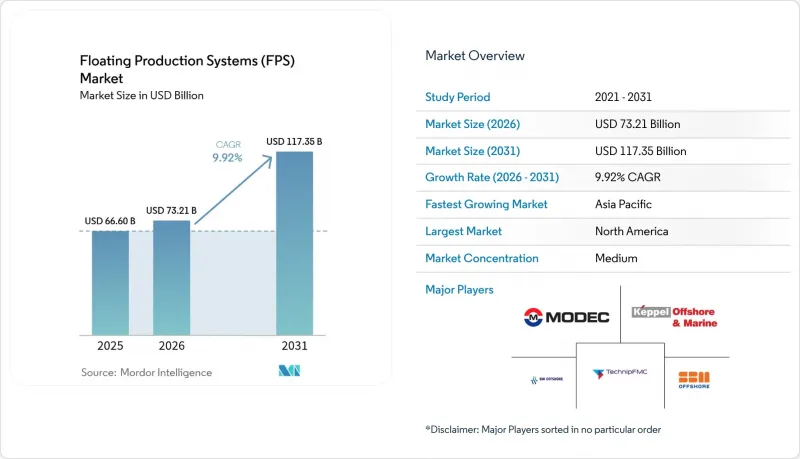
本報告按類型(FPSO、張力腳平臺、SPAR、半潛式平台、駁船)、水深(淺海、深海、超深海)、建造方式(新建、改造)和地區(北美、歐洲、亞太、南美、中東和非洲)進行細分。市場規模和預測均以美元計價。
全球浮體式生產系統(FPS)市場趨勢與洞察
加大對深海探勘的投資
隨著營運商在傳統生產區域之外尋求具有重大影響的油氣發現,資金正迅速湧入深水和超深水地區。埃克森美孚在圭亞那的第四艘FPSO(浮式生產儲卸油船)使該國的日運作提升至90萬桶,凸顯了投資者對超深水油田的信心,即使在中等原油價格水平下,這些油田也能保持盈利。雪佛龍的Anchor油田和BP的Casquida油田開發案採用20千磅/平方英吋(kpsi)的海底結構,從古近紀地層中開採原油,這些地層先前無法使用傳統設施開採。道達爾能源在安哥拉的Caminho計畫表明,非洲前沿地區越來越願意接受數十億美元的浮體式設施投資,而無需依賴固定平台。總而言之,這些項目表明,技術成熟、儲存產能強勁以及稅收優惠政策如何推動浮體式生產系統市場新建設合約的簽訂。
淺水區蘊藏量的減少將導致生產轉移到海上。
北海和其他大陸棚地區儲存的枯竭迫使營運商將平台重新部署到更深的濁積岩油田,而這些油田只有浮體式生產方案在技術上可行。挪威國家石油公司(Equinor)斥資100億美元挪威克朗為奧斯伯格油田(Oseberg field)實施的延壽項目,正利用電氣化技術將產量高峰期延長至2040年後,同時騰出固定平台的預算,用於投資附近更深的目標油田。墨西哥灣的現有業者也採用了類似的策略。半潛式平台「鯨魚號」(Whale)於2025年1月投入運營,日產能為10萬桶,用於補充即將達到使用壽命的老舊上部平台的產量。因此,船體、船舶系纜和海底系統等設備的需求結構性地增加,這些設備可以在主要油田產量下降後重新用於新的油田。這進一步提升了可重新部署的FPSO(浮式生產儲卸油船)的吸引力。
原油價格波動
浮體式開發屬於資本密集項目,投資回收期長達數年,這意味著原油價格的劇烈波動可能會凍結最終的投資決策。 2024年下半年,基準油價跌破每桶70美元時,業者暫時中止了墨西哥灣的多個回接項目,導致鑽機運轉率下降了5個百分點。雖然大型一體化公司可以進行避險,但獨立公司通常會推遲核准,直到期貨價格穩定下來,這導致船體製造商的訂單模式不穩定。另一方面,浮體式生產系統市場目前受益於較低的結構性損益平衡點。許多深海項目已經過標準化和數位化最佳化,即使在每桶45-50美元的價格下也能獲利,從而減輕了短期價格衝擊的影響。
細分市場分析
預計2025年,以FPSO(浮動生產儲卸油裝置)為目標的浮體式生產系統市場規模將達到360.3億美元,年複合成長率達10.12%,到2031年將成長近一倍。 FPSO即使在易受颶風影響的海域也能良好運行,並且能夠隨著油田經濟效益的變化而重新部署。正如SBM公司位於巴西近海的Almirante Tamandare號平台所展示的那樣,FPSO的上部模組日處理能力超過22.5萬桶。張力腳平臺繼續在超深水、狹長的目標區域作業,在這些區域,輪轂抑制至關重要;而SPAR平台和半潛式平台在惡劣環境下的鑽井和初始生產測試中仍然發揮關鍵作用。市場向環保應用的轉變在FPSO整合二氧化碳脫除塔和陸上電力連接功能方面體現得最為明顯,這些技術難以改造到傳統的半潛式平台和駁船上。
第二代FPSO利用數位孿生技術預測設備疲勞、最佳化氣舉分配並制定維護計劃,從而使運轉率超過96%。這些改進推動了FPSO在浮體式生產系統市場的顯著成長,並促使金融相關人員將FPSO視為準基礎設施收入來源。駁船等特殊船型在亞洲淺水Delta地區仍具有重要的戰略意義,但其成長潛力受到水深限制。總體而言,隨著營運商尋求符合新的脫碳要求的靈活、低人員配置的解決方案,FPSO在絕對收入和不斷成長的需求方面將繼續保持主導地位。
區域分析
即使到了2025年,北美仍將維持38.30%的收入佔有率。這項預測主要基於墨西哥灣,美國能源資訊署(EIA)預測,該地區2025年的海上石油產量將穩定在每日180萬桶。新發現的油田,例如巴里莫耳油田和劍魚油田,正在利用現有的管道樞紐,而監管的確定性也促成了大量適合中型FPSO的訂單接項目。墨西哥的深海薩利納盆地目前仍處於評估階段,但一旦財政獎勵到位,預計將進一步成長。加拿大的北灣是全國首個適合FPSO作業的區塊,如果開發成功,將使該地區的製造業產能超越紐芬蘭造船廠的維修。
亞太地區是成長最快的地區,中國、印尼和澳洲優先開發國內油氣資源,預計2031年複合年成長率將達到11.18%。中國海洋石油總公司(中海油)的破紀錄發現使造船廠生意興隆,中國承包商已委託建造了世界上第一艘配備碳捕集系統的FPSO(浮式生產儲卸油裝置),以提高液體產量,同時支持中國的氣候目標。印尼修訂後的產量分成協議旨在快速實現東加里曼丹沿海前沿油田的商業化,使租賃營運型FPSO成為該地區最現實的海上作業模式。同時,韓國和日本正透過向鄰近市場供應高階上部模組、動態定位推進器和低溫設備來增強其區域競爭力。
儘管歐洲的市場佔有率保持穩定,但由於北海油氣市場的成熟,其成長率相對較低。然而,英國在設得蘭群島西部的電氣化回接叢集和挪威的陸上電力供應舉措,維持著一些適應低碳運營的高規格浮體式生產設施群。在更南邊的地中海,塞浦路斯和以色列沿海的深水油田正處於最終投資決定(FID)前的階段,預計在本十年後半期提振訂單。由於地緣政治制約,俄羅斯在北極的FPSO計畫已被擱置,這使得歐洲的工程能力轉向了非洲的大型企劃和巴西的鹽鹽層下開發計畫。整體而言,地域多元化使浮體式生產系統市場能夠減輕特定海域經濟波動的影響。
其他好處:
- Excel格式的市場預測(ME)表
- 3個月的分析師支持
目錄
第1章:引言
- 研究假設和市場定義
- 調查範圍
第2章:調查方法
第3章執行摘要
第4章 市場狀況
- 市場概覽
- 運作中鑽機數量
- 市場促進因素
- 加大對深海探勘的投資
- 由於淺海蘊藏量下降,石油生產正在向海上轉移。
- FPSO改造技術的進步
- 新興經濟體為保障能源安全所做的努力
- 邊際油田租賃模式的激增
- 透過上部電氣化降低營運成本(OPEX)。
- 市場限制因素
- 原油價格波動
- 需要大量的資本支出(CAPEX)和營運支出(OPEX)。
- 缺乏建造巨型船舶的能力
- ESG相關資金籌措限制
- 供應鏈分析
- 監理情勢
- 技術展望
- 波特五力模型
第5章 市場規模與成長預測
- 按類型
- FPSO
- 張力腳平臺
- SPAR
- 半潛式
- 駁船
- 按水深
- 淺水區(水深小於400公尺)
- 深海(400-1500公尺)
- 超深海(超過1500公尺)
- 透過施工方法
- 新建工程
- 轉換
- 按地區
- 北美洲
- 美國
- 加拿大
- 墨西哥
- 歐洲
- 德國
- 英國
- 挪威
- 俄羅斯
- 其他歐洲國家
- 亞太地區
- 中國
- 印度
- 泰國
- 越南
- 澳洲
- 其他亞太國家
- 南美洲
- 巴西
- 千里達及托巴哥
- 其他南美國家
- 中東和非洲
- 沙烏地阿拉伯
- 阿拉伯聯合大公國
- 卡達
- 埃及
- 奈及利亞
- 安哥拉
- 奈米比亞
- 其他中東和非洲國家
- 北美洲
第6章 競爭情勢
- 市場集中度
- 策略趨勢(併購、聯盟、購電協議)
- 市場佔有率分析(主要公司的市場排名和佔有率)
- 公司簡介
- SBM Offshore NV
- MODEC Inc.
- BW Offshore Ltd
- Keppel Offshore & Marine Ltd
- Samsung Heavy Industries Co. Ltd
- Bumi Armada Berhad
- TechnipFMC plc
- Hyundai Heavy Industries Co. Ltd
- Mitsubishi Heavy Industries Ltd
- Teekay Corporation
- Sembcorp Marine Ltd
- Offshore Oil Engineering Co.(CNOOC)
- COSCO Shipyard Group Co.
- Daewoo Shipbuilding & Marine Engineering Co. Ltd
- Aker Solutions ASA
- Petrofac Ltd
- China Harbor Engineering Co. Ltd
- Yinson Holdings Berhad
- Saipem SpA
- Wood Group PLC
第7章 市場機會與未來展望
According to Mordor Intelligence, the floating production systems market size was valued at USD 66.60 billion in 2025 and estimated to grow from USD 73.21 billion in 2026 to reach USD 117.35 billion by 2031, at a CAGR of 9.92% during the forecast period (2026-2031).
This report is Segmented by Type (FPSO, Tension Leg Platform, SPAR, Semi-Submersible, and Barge), Water Depth (Shallow Water, Deepwater, and Ultra-Deepwater), Build Method (Newbuild and Conversion), and Geography (North America, Europe, Asia-Pacific, South America, and Middle East and Africa). The Market Sizes and Forecasts are Provided in Terms of Value (USD).
Global Floating Production Systems (FPS) Market Trends and Insights
Rising Deep-water Exploration Investments
Capital is moving rapidly into deep and ultra-deepwater acreage as operators chase high-impact discoveries outside legacy provinces. ExxonMobil's fourth FPSO in Guyana lifts the country's installed capacity toward 900,000 b/d and underscores investor confidence in ultra-deep finds that remain profitable at mid-cycle oil prices. Chevron's Anchor and BP's Kaskida developments utilize a 20 kpsi subsea architecture to deliver Paleogene barrels that conventional equipment could not unlock. TotalEnergies' Kaminho project in Angola demonstrates that African frontiers can now absorb multi-billion-dollar floating investments without relying on fixed platforms. Collectively, these programs illustrate how technology maturity, robust reservoir productivity, and fiscal incentives are sustaining a pipeline of new build contracts for the floating production systems market.
Declining Shallow-water Reserves Shifting Production Offshore
Reservoir depletion across the North Sea and other shelf provinces is pushing operators to re-platform toward deeper turbidite plays where only floating concepts are technically feasible. Equinor's NOK 10 billion life extension of Oseberg leverages electrification to extend plateau production beyond 2040, while freeing fixed-platform budgets for deeper targets nearby. Gulf of Mexico incumbents mirror this strategy: the Whale semi-submersible began pumping in January 2025 with a 100,000 b/d capacity, replacing output from legacy topsides that were approaching decommissioning. The consequence is a structural rise in demand for hulls, mooring lines, and subsea systems that can be redirected to new reservoirs once primary leases decline, thereby reinforcing the attractiveness of redeployable FPSOs.
Crude-oil Price Volatility
Floating developments are capital-intensive and rely on multi-year payback horizons so that rapid oil-price swings can freeze final investment decisions. Operators paused several Gulf of Mexico tie-backs in late 2024 when benchmark prices dipped below USD 70/bbl, and rig utilization slid five percentage points in tandem. While integrated majors can hedge, independents often defer sanctioning until strip prices stabilize, creating a lumpy ordering pattern for hull fabricators. The counterweight is that the floating production systems market now benefits from lower structural breakevens-many deepwater projects operate profitably at USD 45-50/bbl after standardization and digital optimization-softening the impact of short-term price shocks.
Other drivers and restraints analyzed in the detailed report include:
- Advances in FPSO Conversion Technologies
- Energy-security Push by Emerging Economies
- High CAPEX & OPEX Requirements
For complete list of drivers and restraints, kindly check the Table Of Contents.
Segment Analysis
The floating production systems market size for FPSO units stood at USD 36.03 billion in 2025 and, supported by a 10.12% CAGR, is set to nearly double by 2031. FPSOs perform well in cyclonic basins, can be relocated as field economics evolve, and integrate topside processing for 225,000 b/d or more, as evidenced by SBM's Almirante Tamandare unit off Brazil. Tension-leg platforms continue to serve slender ultra-deep targets where heave suppression is vital, while SPARs and semi-subs retain roles in harsh-environment drilling and early production testing. The market's environmental pivot is most visible in FPSOs that bundle CO2-stripping columns and shore-power readiness, technologies that are harder to retrofit on legacy semi-subs or barges.
Second-generation FPSOs are utilizing digital twins to predict equipment fatigue, optimize gas-lift allocation, and schedule maintenance, resulting in uptime exceeding 96%. These improvements underpin the segment's leading growth within the floating production systems market and encourage financiers to treat FPSO revenue streams as quasi-infrastructure. Niche hull classes, such as barges, retain strategic importance for shallow Asian deltas, but their growth potential is capped by water-depth limits. Overall, FPSOs will continue ruling both absolute revenue and incremental demand as operators seek flexible, low-staffed solutions that align with emerging decarbonization mandates.
Complete Report Scope:
- By Type
- FPSO
- Tension Leg Platform
- SPAR
- Semi-submersible
- Barge
- By Water Depth
- Shallow Water (Below 400 m)
- Deepwater (400 to 1,500 m)
- Ultra-deepwater (Above 1,500 m)
- By Build Method
- Newbuild
- Conversion
- By Geography
- North America
- United States
- Canada
- Mexico
- Europe
- Germany
- United Kingdom
- Norway
- Russia
- Rest of Europe
- Asia-Pacific
- China
- India
- Thailand
- Vietnam
- Australia
- Rest of Asia-Pacific
- South America
- Brazil
- Trinidad and Tobago
- Rest of South America
- Middle East and Africa
- Saudi Arabia
- United Arab Emirates
- Qatar
- Egypt
- Nigeria
- Angola
- Namibia
- Rest of Middle East and Africa
- North America
Geography Analysis
North America retained a 38.30% revenue share in 2025, anchored by the Gulf of Mexico, where the U.S. Energy Information Administration projects stable offshore oil output of 1.80 million barrels per day (b/d) for 2025. Discoveries, such as Ballymore and Swordfish, leverage existing pipeline hubs, and regulatory certainty fosters a steady backlog of tie-backs that favor mid-sized FPSOs. Mexico's deepwater Salina Basin, although still at the appraisal stage, promises upside once fiscal incentives mature. Canada's Bay du Nord is the country's first floater-ready prospect and, should it proceed, will extend regional fabrication capacity beyond Newfoundland yard upgrades.
Asia-Pacific is the fastest-growing territory, recording an 11.18% CAGR to 2031 as China, Indonesia, and Australia prioritize domestic hydrocarbons. CNOOC's record discovery success keeps shipyards busy, and Chinese contractors have launched the world's first carbon-capture-equipped FPSO to underpin national climate goals while boosting liquids output. Indonesia's reformed production-sharing contracts are designed for the rapid monetization of frontier blocks off East Kalimantan, where lease-and-operate FPSOs offer the most feasible evacuation route. Meanwhile, Korea and Japan strengthen regional competitiveness by supplying high-end topside modules, dynamic positioning thrusters, and cryogenic equipment to neighboring markets.
Europe's share is stable but relatively low-growth, limited by the maturity of the North Sea. Nevertheless, the United Kingdom's electrified West of Shetland tie-backs and Norway's power-from-shore initiatives sustain a niche cluster of high-specification floaters equipped for low-carbon operations. Further south, Mediterranean deepwater acreage off Cyprus and Israel is at pre-FID stage and could lift orders later in the decade. Russia's Arctic FPSO ambitions pause under geopolitical constraints, redirecting European engineering capacity toward African mega-projects and Brazilian pre-salt campaigns. Overall, geographic diversification cushions the floating production systems market from cyclical swings in any single basin.
- SBM Offshore N.V.
- MODEC Inc.
- BW Offshore Ltd
- Keppel Offshore & Marine Ltd
- Samsung Heavy Industries Co. Ltd
- Bumi Armada Berhad
- TechnipFMC plc
- Hyundai Heavy Industries Co. Ltd
- Mitsubishi Heavy Industries Ltd
- Teekay Corporation
- Sembcorp Marine Ltd
- Offshore Oil Engineering Co. (CNOOC)
- COSCO Shipyard Group Co.
- Daewoo Shipbuilding & Marine Engineering Co. Ltd
- Aker Solutions ASA
- Petrofac Ltd
- China Harbor Engineering Co. Ltd
- Yinson Holdings Berhad
- Saipem S.p.A.
- Wood Group PLC
Additional Benefits:
- The market estimate (ME) sheet in Excel format
- 3 months of analyst support
TABLE OF CONTENTS
1 Introduction
- 1.1 Study Assumptions & Market Definition
- 1.2 Scope of the Study
2 Research Methodology
3 Executive Summary
4 Market Landscape
- 4.1 Market Overview
- 4.2 Offshore Active Rig Count
- 4.3 Market Drivers
- 4.3.1 Rising deep-water exploration investments
- 4.3.2 Declining shallow-water reserves shifting production offshore
- 4.3.3 Advances in FPSO conversion technologies
- 4.3.4 Energy-security push by emerging economies
- 4.3.5 Surge in marginal-field leasing models
- 4.3.6 Electrification of topsides lowering OPEX
- 4.4 Market Restraints
- 4.4.1 Crude-oil price volatility
- 4.4.2 High CAPEX & OPEX requirements
- 4.4.3 Limited mega-hull shipyard capacity
- 4.4.4 ESG-linked financing constraints
- 4.5 Supply-Chain Analysis
- 4.6 Regulatory Landscape
- 4.7 Technological Outlook
- 4.8 Porter's Five Forces
- 4.8.1 Bargaining Power of Suppliers
- 4.8.2 Bargaining Power of Consumers
- 4.8.3 Threat of New Entrants
- 4.8.4 Threat of Substitutes
- 4.8.5 Intensity of Competitive Rivalry
5 Market Size & Growth Forecasts
- 5.1 By Type
- 5.1.1 FPSO
- 5.1.2 Tension Leg Platform
- 5.1.3 SPAR
- 5.1.4 Semi-submersible
- 5.1.5 Barge
- 5.2 By Water Depth
- 5.2.1 Shallow Water (Below 400 m)
- 5.2.2 Deepwater (400 to 1,500 m)
- 5.2.3 Ultra-deepwater (Above 1,500 m)
- 5.3 By Build Method
- 5.3.1 Newbuild
- 5.3.2 Conversion
- 5.4 By Geography
- 5.4.1 North America
- 5.4.1.1 United States
- 5.4.1.2 Canada
- 5.4.1.3 Mexico
- 5.4.2 Europe
- 5.4.2.1 Germany
- 5.4.2.2 United Kingdom
- 5.4.2.3 Norway
- 5.4.2.4 Russia
- 5.4.2.5 Rest of Europe
- 5.4.3 Asia-Pacific
- 5.4.3.1 China
- 5.4.3.2 India
- 5.4.3.3 Thailand
- 5.4.3.4 Vietnam
- 5.4.3.5 Australia
- 5.4.3.6 Rest of Asia-Pacific
- 5.4.4 South America
- 5.4.4.1 Brazil
- 5.4.4.2 Trinidad and Tobago
- 5.4.4.3 Rest of South America
- 5.4.5 Middle East and Africa
- 5.4.5.1 Saudi Arabia
- 5.4.5.2 United Arab Emirates
- 5.4.5.3 Qatar
- 5.4.5.4 Egypt
- 5.4.5.5 Nigeria
- 5.4.5.6 Angola
- 5.4.5.7 Namibia
- 5.4.5.8 Rest of Middle East and Africa
- 5.4.1 North America
6 Competitive Landscape
- 6.1 Market Concentration
- 6.2 Strategic Moves (M&A, Partnerships, PPAs)
- 6.3 Market Share Analysis (Market Rank/Share for key companies)
- 6.4 Company Profiles (includes Global level Overview, Market level overview, Core Segments, Financials as available, Strategic Information, Products & Services, and Recent Developments)
- 6.4.1 SBM Offshore N.V.
- 6.4.2 MODEC Inc.
- 6.4.3 BW Offshore Ltd
- 6.4.4 Keppel Offshore & Marine Ltd
- 6.4.5 Samsung Heavy Industries Co. Ltd
- 6.4.6 Bumi Armada Berhad
- 6.4.7 TechnipFMC plc
- 6.4.8 Hyundai Heavy Industries Co. Ltd
- 6.4.9 Mitsubishi Heavy Industries Ltd
- 6.4.10 Teekay Corporation
- 6.4.11 Sembcorp Marine Ltd
- 6.4.12 Offshore Oil Engineering Co. (CNOOC)
- 6.4.13 COSCO Shipyard Group Co.
- 6.4.14 Daewoo Shipbuilding & Marine Engineering Co. Ltd
- 6.4.15 Aker Solutions ASA
- 6.4.16 Petrofac Ltd
- 6.4.17 China Harbor Engineering Co. Ltd
- 6.4.18 Yinson Holdings Berhad
- 6.4.19 Saipem S.p.A.
- 6.4.20 Wood Group PLC
7 Market Opportunities & Future Outlook
- 7.1 White-space & Unmet-Need Assessment

 自最佳化生產系統市場預測至2034年-按組件、技術、產業、應用、最終用戶和地區分類的全球分析
 浮體式生產系統市場規模、佔有率和成長分析:按類型、應用、水深、產能、功能和地區分類-2026-2033年產業預測浮體式氫氣市場預測至2034年-全球分析(依生產技術、能源來源、生產組合、儲存方式、平台類型、水深、應用、最終用戶及地區分類)
 浮體式生產系統市場:系統類型、水深、船體材料、錨碇系統、應用、最終用途-2026-2032年全球市場預測
 浮式生產系統市場-全球產業規模、佔有率、趨勢、機會和預測,按類型、水深、建造方式、地區和競爭格局分類,2021-2031年預測
 全球浮式生產系統市場規模研究與預測,依類型(FPSO、張力腿平台、SPAR、半潛式平台、駁船)、水深(淺水、深水、超深水)及區域分類,2025-2035年預測到 2030 年浮體式生產系統市場預測:按產品類型、水深、材料、技術、應用、最終用戶和地區進行的全球分析