

 |
市場調查報告書
商品編碼
2113400
北美電動液壓式轉向系統:市場佔有率分析、行業趨勢和統計數據以及成長預測(2026-2031 年)North America Electrically Powered Hydraulic Steering - Market Share Analysis, Industry Trends & Statistics, Growth Forecasts (2026 - 2031) |
||||||

※ 本網頁內容可能與最新版本有所差異。詳細情況請與我們聯繫。
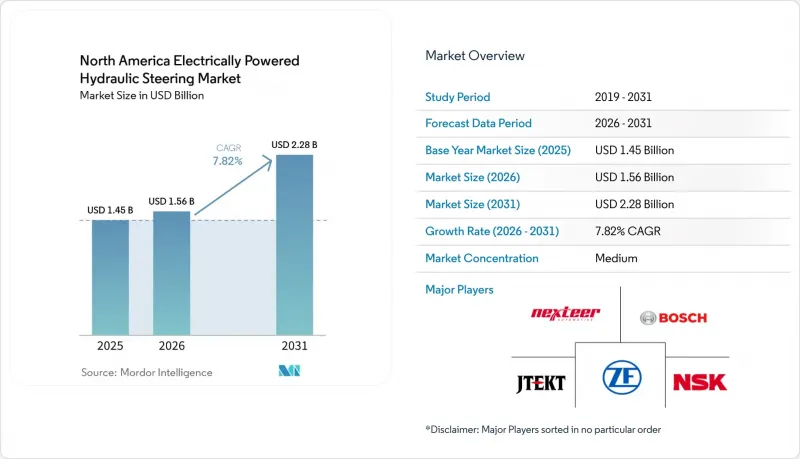
根據 Mordor Intelligence 預測,北美電動液壓式轉向系統市場在 2025 年的價值將達到 14.5 億美元,在 2026 年成長到 15.6 億美元,到 2031 年將擴大到 22.8 億美元,在 2026 年至 2031 年期間的複合年成長率為 7.82%。
本報告按類型(例如,柱式轉向器)、零件類型(例如,方向盤馬達)、車輛類型(乘用車和商用車)、動力傳動系統(例如,內燃機車)、銷售管道(OEM 和售後市場)以及國家/地區進行細分。市場預測以貨幣價值(美元)和銷售(單位)兩種形式呈現。
北美電動液壓式轉向市場趨勢與洞察
商用車的電氣化
電動商用車需要無需引擎驅動幫浦即可運作的轉向系統。電動液壓式轉向系統透過其馬達和泵浦的配置滿足了這一需求,該配置獨立於引擎轉速運轉。隨著車隊營運商將純電動卡車和巴士納入營運計劃,北美電動液壓式系統市場將從中受益。根據國際能源總署 (IEA) 預測,到 2025 年,該地區電動卡車的銷量將顯著成長,這支撐了對獨立驅動車輛系統的需求趨勢。車隊營運商還需要能夠承受反覆使用、高軸荷和長運作週期的零件。這有利於那些能夠在開發、測試和服務規劃階段為汽車製造商提供幫助的成熟供應商。
在SUV、皮卡和輕型卡車中的應用日益廣泛。
大型皮卡和運動型多用途車 (SUV) 由於經常用於牽引、裝載和越野駕駛,因此仍然是電動液壓式輔助轉向系統的重要市場。這些使用場景通常比小型車輛需要更強的轉向輔助。通用汽車 (GM) 預測,2025 年全尺寸皮卡的銷量將保持強勁,顯示該車型在北美地區的重要性仍然不減。北美電液動力方向盤市場的發展得益於各車型項目中對適用於嚴苛使用條件的硬體的持續維護。即使是大型車輛的混合模式,在內燃機暫時關閉的情況下也需要轉向輔助。因此,即使汽車製造商在其他小型車輛上採用電動轉向系統,他們仍然可以在某些車型專案中繼續使用電液輔助轉向系統。
EPS替代方案和平台遷移
電動方向盤通常易於整合到乘用車和輕型跨界車中。由於它無需液壓迴路,因此可以減少轉向力需求不高的車輛的機械部件數量。這限制了電動液壓式轉向基本客群群。供應商應將資源集中在液壓輔助仍然適用的車型,而不是將所有小型車視為相同的商機。這種差異在乘用車與大型皮卡、商用卡車或特殊車輛之間尤其顯著。由於系統需求是在車輛項目層面設定的,因此在確定產品系列時必須仔細考慮這種差異。
細分市場分析
2025年,柱式電動液壓式轉向系統在北美市場佔43.53%的佔有率。這反映了其在輕型商用車、中型卡車和皮卡中的廣泛應用,這些車型需要緊湊的結構和可靠的轉向輔助。這種設計可以縮短液壓管路的長度,使其適用於空間有限的車輛架構。柱式和齒輪式轉向系統可以在不同的平台系列中共存,其選擇通常取決於運行條件的要求。易於維護和零件通用也會影響最終配置。
雙齒輪轉向系統預計到2031年將以9.33%的複合年成長率成長,成為北美電動液壓式轉向市場成長最快的類型。這種佈局將傳統的駕駛員輸入路徑與獨立的執行器相結合,提供電子控制的修正,在保持液壓輔助的同時支援駕駛輔助功能。這對於商業平台至關重要,因為在這些平台上,安全功能和可控的轉向回應正變得越來越重要。預計市場需求將集中在具有明確操作要求的應用領域,汽車製造商正在積極應對日益複雜的系統,以滿足特定的安全性和控制需求。
到2025年,方向盤馬達將佔零件銷售額的31.38%。馬達在電液系統中扮演核心角色,在需要轉向輔助時為幫浦提供動力。正因如此,效率、耐用性和溫度控管是產品設計中至關重要的考量。液壓泵和油箱負責管理液壓油的供應,從而確保轉向反應的一致性。由於單一部件的變化都可能影響整個系統的能耗、噪音和響應速度,因此泵浦、馬達和液壓迴路必須作為一個整體協同工作。供應商必須精心管理各部件之間的介面,而那些能夠同時提供硬體知識和應用支援的公司將創造更多價值。
預計到2031年,感測器和ECU叢集的複合年成長率將達到10.09%,成為所有零件類別中成長最快的。感測器向車輛控制器提供轉向角、扭矩、力以及系統狀態等訊息,ECU利用這些資訊來控制泵浦的輸出並監控系統性能。這種轉變使得校準、軟體開發和電子可靠性在北美電液動力方向盤市場的重要性日益凸顯。供應商需要清晰的軟體更新、診斷和故障回應流程,而且車輛上市後的長期技術支援也變得越來越重要。
其他好處:
- Excel格式的市場預測(ME)表
- 3個月的分析師支持
目錄
第1章:引言
- 研究假設和市場定義
- 調查範圍
第2章:調查方法
第3章執行摘要
第4章 市場狀況
- 市場概覽
- 市場促進因素
- 商用車的電氣化
- SUV、皮卡和輕型卡車的普及率不斷提高。
- 相容ADAS的轉向輔助
- 大型電動平台對高壓轉向系統的需求
- 按需供電,節省燃料
- 軟體控制變因泵浦的效率
- 市場限制因素
- EPS替代方案和平台遷移
- 高昂的檢驗成本和安全冗餘成本
- 高電壓下的熱整合和電整合限制
- 與液壓洩漏、噪音和可維護性相關的風險。
- 價值和供應鏈分析
- 監理情勢
- 技術展望
- 波特五力分析
第5章 市場規模與成長預測
- 按類型
- 列類型
- 小齒輪類型
- 雙小齒輪
- 依組件類型
- 方向盤馬達
- 感應器
- 液壓泵和儲液罐
- 電控系統
- 液壓管道、閥門、執行器
- 轉向裝置、齒條和轉向柱介面
- 車輛類型
- 搭乘用車
- 搭乘用車
- 運動型多用途車(SUV)
- 皮卡車
- 商用車輛
- 輕型商用車
- 中型卡車
- 大型卡車
- 巴士和長途汽車
- 工程機械
- 農業機械
- 搭乘用車
- 透過驅動系統
- 內燃機車
- 油電混合車
- 插電式混合動力電動車
- 電池式電動車
- 燃料電池汽車
- 按銷售管道
- 目的地設備製造商
- 售後市場
- 替換零件
- 再生系統
- 國家
- 美國
- 加拿大
- 墨西哥
- 其他北美國家
第6章 競爭情勢
- 市場集中度
- 策略趨勢
- 市佔率分析
- 公司簡介
- JTEKT Corporation
- Nexteer Automotive
- Robert Bosch GmbH
- ZF Friedrichshafen AG
- NSK Ltd.
- Hitachi Astemo, Ltd.
- thyssenkrupp Presta AG
- Mando Corporation
- Continental AG
- Hyundai Mobis Co., Ltd.
- Danfoss A/S
- Knorr-Bremse AG
- Concentric AB
- Magna International Inc.
- DENSO Corporation
- Schaeffler AG
- Mitsubishi Electric Corporation
- China Automotive Systems, Inc.
第7章 市場機會與未來展望
According to Mordor Intelligence, the North America electro-hydraulic power steering market size was valued at USD 1.45 billion in 2025 and is projected to expand from USD 1.56 billion in 2026 to USD 2.28 billion by 2031, registering a CAGR of 7.82% between 2026 and 2031.
This report is Segmented by Type (Column Type and More), Component Type (Steering Motor and More), Vehicle Type (Passenger Vehicles and Commercial Vehicles), Propulsion Type (Internal Combustion Engine Vehicles and More), Sales Channel (Original Equipment Manufacturer and Aftermarket), and Country. Market Forecasts are Provided in Terms of Value (USD) and Volume (Units).
North America Electrically Powered Hydraulic Steering Market Trends and Insights
Commercial-Vehicle Electrification
Electric commercial vehicles need a steering system that operates without an engine-driven pump. Electro-hydraulic steering meets that need through an electric motor and pump arrangement that can work independently of engine speed. The North America electro-hydraulic power steering market benefits when fleets add battery-electric trucks and buses to their operating plans. The International Energy Agency reported that regional electric truck sales rose significantly in 2025, which supports the direction of demand for independently powered vehicle systems. Fleet operators also need components that can withstand repeated use, high axle loads, and long duty cycles. This favors established suppliers that can support vehicle makers during development, testing, and service planning.
Growing SUV, Pickup, and Light-Truck Content
Large pickups and sport utility vehicles remain important outlets for electro-hydraulic steering because they are often used for towing, payload, and off-road work. These operating conditions can require more steering assistance than smaller vehicles need. General Motors reported strong full-size pickup sales in 2025, showing the continued importance of this vehicle category in the region. The North America electro-hydraulic power steering market gains support when vehicle programs retain hardware suited to demanding use. Hybrid versions of larger vehicles also need steering support when the combustion engine is temporarily off. Vehicle makers can therefore keep electro-hydraulic designs in selected programs even as they use electric steering in other light vehicles.
EPS Substitution and Platform Migration
Electric power steering is often simpler to package in passenger cars and lighter crossover vehicles. It removes the hydraulic circuit and can reduce the number of mechanical parts in programs with modest steering-force requirements. This limits the addressable base for the North America electro-hydraulic power steering market in smaller vehicle categories. Suppliers must focus their resources on vehicle programs where hydraulic assistance remains useful, rather than treating all light vehicles as similar opportunities. The separation is most visible between passenger cars and larger pickups, commercial trucks, or specialized equipment. Portfolio decisions must account for this difference because system requirements are set at the vehicle-program level.
Other drivers and restraints analyzed in the detailed report include:
- ADAS-Compatible Steering Assistance
- High-Voltage Steering Demand in Heavy Electric Platforms
- High Validation and Safety-Redundancy Costs
For complete list of drivers and restraints, kindly check the Table Of Contents.
Segment Analysis
Column type accounted for 43.53% of the North America electro-hydraulic power steering market share in 2025. This reflects its use across light commercial vehicles, medium-duty trucks, and pickup trucks that require compact packaging and dependable steering assistance. The design reduces hydraulic routing length and fits vehicle architectures with limited space. Column and pinion arrangements can coexist across different platform families, with the choice typically reflecting duty requirements. Service access and part commonality can also influence the final configuration.
The dual pinion type is projected to record a 9.33% CAGR through 2031, making it the fastest-growing type in the North America electro-hydraulic power steering market. The layout combines a conventional driver input path with a separate actuator for electronically commanded corrections, supporting driver assistance functions while retaining hydraulic assistance. This is relevant to commercial platforms where safety functions and controlled steering response are increasingly specified together. Demand is likely to concentrate in applications with clear operational requirements, where vehicle makers adopt the added complexity to address a defined safety or control need.
Steering motors accounted for 31.38% of component revenue in 2025. Motors are central to electro-hydraulic operation as they provide the power that drives the pump when steering assistance is required. This role makes efficiency, durability, and heat management important product considerations. Hydraulic pumps and reservoirs manage fluid delivery and support consistent steering response. The pump, motor, and hydraulic circuit must function as a coordinated assembly, as a change in 1 component can affect energy use, noise, and response across the system. Suppliers need to manage component interfaces carefully, creating value for companies that can provide both hardware knowledge and application support.
The sensors and ECU cluster are expected to expand at a 10.09% CAGR through 2031, the fastest rate among the component categories. Sensors supply information on steering angle, torque, force, and system condition to the vehicle controller, while the ECU uses that information to manage pump output and monitor system performance. This shift increases the importance of calibration, software development, and electronic reliability in the North America electro-hydraulic power steering market. Suppliers need clear procedures for software updates, diagnostics, and fault handling, increasing the importance of long-term technical support after vehicle launch.
Complete Report Scope:
- By Type
- Column Type
- Pinion Type
- Dual Pinion Type
- By Component Type
- Steering Motor
- Sensors
- Hydraulic Pump and Reservoir
- Electronic Control Unit
- Hydraulic Lines, Valves, and Actuators
- Steering Gear, Rack, and Column Interfaces
- By Vehicle Type
- Passenger Vehicles
- Passenger Cars
- Sport Utility Vehicles
- Pickup Trucks
- Commercial Vehicles
- Light Commercial Vehicles
- Medium-Duty Trucks
- Heavy-Duty Trucks
- Buses and Coaches
- Construction Equipment
- Agricultural Machinery
- Passenger Vehicles
- By Propulsion Type
- Internal Combustion Engine Vehicles
- Hybrid Electric Vehicles
- Plug-in Hybrid Electric Vehicles
- Battery Electric Vehicles
- Fuel-Cell Electric Vehicles
- By Sales Channel
- Original Equipment Manufacturer
- Aftermarket
- Replacement Parts
- Remanufactured Systems
- By Country
- United States
- Canada
- Mexico
- Rest of North America
List of Companies Covered in this Report:
- JTEKT Corporation
- Nexteer Automotive
- Robert Bosch GmbH
- ZF Friedrichshafen AG
- NSK Ltd.
- Hitachi Astemo, Ltd.
- thyssenkrupp Presta AG
- Mando Corporation
- Continental AG
- Hyundai Mobis Co., Ltd.
- Danfoss A/S
- Knorr-Bremse AG
- Concentric AB
- Magna International Inc.
- DENSO Corporation
- Schaeffler AG
- Mitsubishi Electric Corporation
- China Automotive Systems, Inc.
Additional Benefits:
- The market estimate (ME) sheet in Excel format
- 3 months of analyst support
TABLE OF CONTENTS
1 Introduction
- 1.1 Study Assumptions and Market Definition
- 1.1.1 Scope of the Study
2 Research Methodology
3 Executive Summary
4 Market Landscape
- 4.1 Market Overview
- 4.2 Market Drivers
- 4.2.1 Commercial-Vehicle Electrification
- 4.2.2 Growing SUV, Pickup, and Light-Truck Content
- 4.2.3 ADAS-Compatible Steering Assistance
- 4.2.4 High-Voltage Steering Demand in Heavy Electric Platforms
- 4.2.5 Power-On-Demand Fuel Savings
- 4.2.6 Software-Controlled Variable-Flow Pump Efficiency
- 4.3 Market Restraints
- 4.3.1 EPS Substitution and Platform Migration
- 4.3.2 High Validation and Safety-Redundancy Costs
- 4.3.3 High-Voltage Thermal and Electrical Integration Constraints
- 4.3.4 Hydraulic Leakage, Noise, and Serviceability Exposure
- 4.4 Value and Supply-Chain Analysis
- 4.5 Regulatory Landscape
- 4.6 Technological Outlook
- 4.7 Porter's Five Forces Analysis
- 4.7.1 Threat of New Entrants
- 4.7.2 Bargaining Power of Buyers/Consumers
- 4.7.3 Bargaining Power of Suppliers
- 4.7.4 Threat of Substitute Products
- 4.7.5 Intensity of Competitive Rivalry
5 Market Size and Growth Forecasts (Value (USD), Volume (Units))
- 5.1 By Type
- 5.1.1 Column Type
- 5.1.2 Pinion Type
- 5.1.3 Dual Pinion Type
- 5.2 By Component Type
- 5.2.1 Steering Motor
- 5.2.2 Sensors
- 5.2.3 Hydraulic Pump and Reservoir
- 5.2.4 Electronic Control Unit
- 5.2.5 Hydraulic Lines, Valves, and Actuators
- 5.2.6 Steering Gear, Rack, and Column Interfaces
- 5.3 By Vehicle Type
- 5.3.1 Passenger Vehicles
- 5.3.1.1 Passenger Cars
- 5.3.1.2 Sport Utility Vehicles
- 5.3.1.3 Pickup Trucks
- 5.3.2 Commercial Vehicles
- 5.3.2.1 Light Commercial Vehicles
- 5.3.2.2 Medium-Duty Trucks
- 5.3.2.3 Heavy-Duty Trucks
- 5.3.2.4 Buses and Coaches
- 5.3.2.5 Construction Equipment
- 5.3.2.6 Agricultural Machinery
- 5.3.1 Passenger Vehicles
- 5.4 By Propulsion Type
- 5.4.1 Internal Combustion Engine Vehicles
- 5.4.2 Hybrid Electric Vehicles
- 5.4.3 Plug-in Hybrid Electric Vehicles
- 5.4.4 Battery Electric Vehicles
- 5.4.5 Fuel-Cell Electric Vehicles
- 5.5 By Sales Channel
- 5.5.1 Original Equipment Manufacturer
- 5.5.2 Aftermarket
- 5.5.2.1 Replacement Parts
- 5.5.2.2 Remanufactured Systems
- 5.6 By Country
- 5.6.1 United States
- 5.6.2 Canada
- 5.6.3 Mexico
- 5.6.4 Rest of North America
6 Competitive Landscape
- 6.1 Market Concentration
- 6.2 Strategic Moves
- 6.3 Market Share Analysis
- 6.4 Company Profiles (Includes Global Level Overview, Market Level Overview, Core Segments, Financials as available, Strategic Information, Market Rank/Share, Products and Services, Recent Developments)
- 6.4.1 JTEKT Corporation
- 6.4.2 Nexteer Automotive
- 6.4.3 Robert Bosch GmbH
- 6.4.4 ZF Friedrichshafen AG
- 6.4.5 NSK Ltd.
- 6.4.6 Hitachi Astemo, Ltd.
- 6.4.7 thyssenkrupp Presta AG
- 6.4.8 Mando Corporation
- 6.4.9 Continental AG
- 6.4.10 Hyundai Mobis Co., Ltd.
- 6.4.11 Danfoss A/S
- 6.4.12 Knorr-Bremse AG
- 6.4.13 Concentric AB
- 6.4.14 Magna International Inc.
- 6.4.15 DENSO Corporation
- 6.4.16 Schaeffler AG
- 6.4.17 Mitsubishi Electric Corporation
- 6.4.18 China Automotive Systems, Inc.
7 Market Opportunities and Future Outlook
- 7.1 White-Space and Unmet-Need Assessment


