


 |
市場調查報告書
商品編碼
2113397
歐洲水輪機:市場佔有率分析、行業趨勢和統計數據以及成長預測(2026-2031 年)Europe Hydro Turbine - Market Share Analysis, Industry Trends & Statistics, Growth Forecasts (2026 - 2031) |
||||||

※ 本網頁內容可能與最新版本有所差異。詳細情況請與我們聯繫。
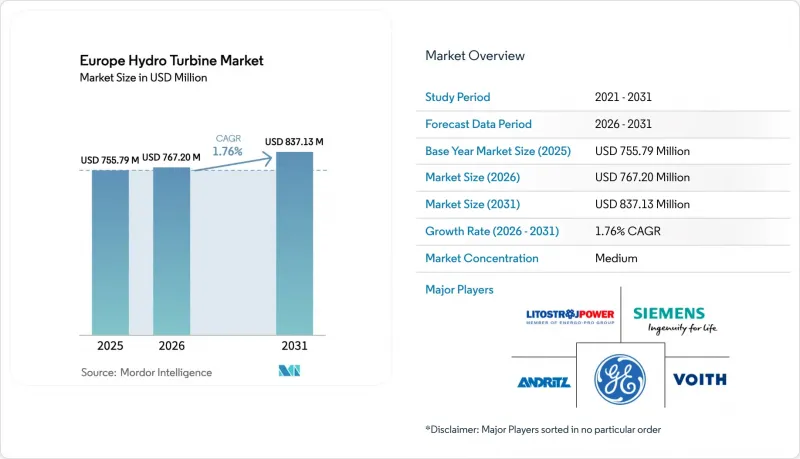
據 Mordor Intelligence 稱,2025 年歐洲水輪機市值為 7.5579 億美元,預計到 2031 年將達到 8.3713 億美元,而 2026 年為 7.672 億美元,預測期(2026-2031 年)的複合成長率為 1.76%。
本報告按技術(反動式水輪機和衝擊式水輪機)、容量(大型水力發電、中型水力發電、小規模和微型水力發電)、安裝類型(新建設和維修/現代化)、部件(轉輪和葉片、尾水管和機械部件、發電機、控制和數位系統等)以及地區(德國、英國、法國、義大利、北歐國家等)進行分類。
歐洲水輪機市場趨勢與洞察
歐盟綠色交易旨在加速維修和新建發電設施的擴建。
2024年更新的REPowerEU計畫規定,到2030年,可再生能源佔最終消費的42.5%,這明確強調了水力發電在柔軟性服務中的重要性。到2030年,歐盟將在電網基礎設施方面投入5,840億歐元,用於資助抽水蓄能電站的互聯建設以及更換渦輪機以提高頻率響應能力。根據歐盟分類法,維修計畫只要符合生態學流量標準,即可享有優惠待遇。希臘的680兆瓦Amphylokia計畫和奧地利的150兆瓦Ebensee現代化改造計畫均於2024年獲得批准,顯示復甦資金如何迅速延長計畫的使用壽命。 Ebensee的變速維修使其能夠在不到90秒的時間內從滿載切換到備用電源,這項服務目前在輔助服務競標中的交易價格為每兆瓦時15-20歐元。隨著這些政策工具的成熟,歐盟核心經濟區內的歐洲水輪機市場將持續獲得維修合約。
火力發電廠的關閉導致人們對抽水蓄能水力發電的穩定供電需求增加。
2024年至2025年間,德國、英國、比利時和西班牙的燃煤和核能發電廠關閉,導致同步發電容量損失12吉瓦。抽水蓄能水力發電目前已投入使用46吉瓦,是唯一成熟可靠的技術,能夠在不劣化循環壽命的情況下連續放電數小時。英國的600兆瓦克盧阿坎2號水力發電廠和西班牙的200兆瓦薩爾托德奇拉水力發電廠計畫表明,投資者對該技術的興趣重燃。葡萄牙的1,158兆瓦塔梅加水力發電廠於2024年投入運作,目前已提供該國40%的平衡備用容量。隨著電力公司尋求從電網穩定中獲取收益,基於長期儲能的歐洲水輪機市場正穩步成長。
冗長的環境影響評估(EIA)和授權程序
新建水壩的綜合環境影響評估 (EIA) 可能需要五到七年時間,尤其當工程與「自然2000」保護區重疊或需要根據《埃斯波公約》進行諮詢時更是如此。奧地利計劃擴建的900兆瓦庫夫泰水電站計畫自2021年以來一直捲入訴訟,顯示生物多樣性問題正在阻礙投資。瑞士維修的水資源保護法現在要求對生物多樣性產生“淨積極影響”,這意味著資金將流向符合條件的維修項目,這些項目可享受18至24個月的快速審查。然而,即使審查週期縮短,這些修復項目仍然可能因下游流量管理的公眾聽證會而延誤。
細分市場分析
2025年,反動式水輪機佔歐洲水力發電渦輪機市場的74.9%。這主要得益於變速發電機的普及,因為變速發電機能夠帶來更高的輔助收入。預計該細分市場將以1.99%的複合年成長率成長,並預計在2031年之前為歐洲水力發電渦輪機市場的規模提供穩定的基礎。衝擊式水輪機,尤其是高水頭阿爾卑斯山計畫中的佩爾頓水輪機,正隨著冰川融水導致入流變化而改變季節性水流模式,重新獲得市場青睞。據供應商稱,2024年至2025年,弗朗西斯水輪機訂單中已有30%包含完整的變流器驅動系統,較2020年的10%大幅成長,凸顯了數位化升級正在重新定義性能標準。
變速控制使營運商能夠根據水頭波動微調效率,從而擴大其在頻率響應市場的佔有率,並延長維護週期。伯爾頓輪機的改良型採用對魚類友善的葉片,將葉片碰撞死亡率降低到5%以下,從而更容易符合Natura 2000標準。 Turgo水輪機因其緊湊的面積和抗泥沙性能,在5兆瓦以下的區域項目中越來越受歡迎,並具有經濟優勢。儘管由於電網營運商優先考慮快速的電力波動響應和慣性服務,無功式水輪機技術仍然是歐洲水力發電渦輪機市場的支柱,但小眾的脈衝式機組預計將以超過平均成長率的速度成長,儘管其基數小規模。
2025年,裝置容量超過100兆瓦的項目佔總收入的50.1%,而10兆瓦以下的資產預計將以3.33%的複合年成長率成長,增速幾乎是傳統大型項目的兩倍。歐盟修訂後的法規豁免了10兆瓦以下項目進行全面環境影響評估(EIA),從而顯著降低了軟成本並加快了建設週期。 2024年至2025年間,德國、奧地利和瑞士的區域合作社籌集了1.8億歐元,用於支持可在12年內收回投資的徑流式水力發電計畫。這一趨勢為歐洲水力渦輪機市場的基層支持奠定了基礎。
模組化渦輪機和發電機組撬裝組件現已在工廠完成測試並交付,將現場施工時間從18個月縮短至6個月,並降低了融資風險。對於10兆瓦至100兆瓦的中型設施,為現有水壩增建下游水庫以實現混合儲能的維修合約數量激增。像蘇格蘭1500兆瓦的科伊爾格拉斯水力發電廠這樣的大型計畫仍然不多見,但至關重要,它透過增加30吉瓦時的儲能容量來平抑離岸風力發電輸出的波動。總體而言,儘管大型水壩建設用地有所減少,但由於工程規模的多樣性,歐洲水力發電渦輪機市場仍在持續成長。
其他好處:
- Excel格式的市場預測(ME)表
- 3個月的分析師支持
目錄
第1章:引言
- 調查範圍
- 研究假設和市場定義
第2章:調查方法
第3章執行摘要
第4章 市場狀況
- 市場概覽
- 市場促進因素
- 歐盟綠色新政旨在加速現有設施的維修和新設施的建設。
- 火力發電廠退役 → 對抽水蓄能水力發電穩定供電的需求
- 碳定價和綠色金融正在提高水力發電的投資報酬率。
- 對魚類友善的渦輪機設計使得獲得與生物多樣性相關問題的批准變得更加容易。
- 利用數位孿生技術進行運作和維護 (O&M);降低小規模電力公司的營運成本 (OPEX)。
- 資料中心營運商為企業提供可再生能源購電協議 (PPA)。
- 市場限制因素
- 冗長的環境影響評估(EIA)和授權程序
- 大規模太陽能發電+電池儲能的價格競爭力
- 阿爾卑斯山水壩擴建訴訟
- 特種鋼供應衝擊加劇了資本投資的波動性。
- 供應鏈分析
- 監管情況(歐盟水框架指令、分類法等)
- 技術趨勢(變速、積層製造)
- 波特五力模型
第5章 市場規模與成長預測
- 透過技術
- 反動式渦輪機
- 衝擊式渦輪機
- 按產能
- 大型水力發電(100兆瓦或以上)
- 中型水力發電(10-100兆瓦)
- 小規模和超小規模水力發電(小於10兆瓦)
- 按安裝類型
- 新建工程
- 維修和現代化
- 按組件
- 滑軌和刀片
- 廢氣管和機械部件
- 發電機
- 控制與數位系統
- 其他
- 按地區
- 德國
- 英國
- 法國
- 義大利
- 西班牙
- 北歐國家
- 俄羅斯
- 其他歐洲國家
第6章 競爭情勢
- 市場集中度
- 策略趨勢(併購、聯盟、購電協議)
- 市場佔有率分析(主要公司的市場排名和佔有率)
- 公司簡介
- Andritz AG
- Voith GmbH & Co. KGaA
- General Electric Co.(GE Vernova)
- Siemens Energy AG
- Litostroj Power Group
- Toshiba Energy Systems
- Alstom Hydro France
- Rainpower(SnPower)
- Canadian Hydro Components
- Norcan Hydraulic Turbine
- Gilkes & Co.
- Kirloskar Brothers
- IMPSA
- Harbin Electric Machinery
- BHEL
- CJ Turbines
- Hidrostal AG
- Voith Hydro Ocean Current
- Global Hydro Energy
- Energy Namibia Hydro
第7章 市場機會與未來展望
According to Mordor Intelligence, the Europe hydro turbine market size was valued at USD 755.79 million in 2025 and is estimated to grow from USD 767.20 million in 2026 to reach USD 837.13 million by 2031, at a CAGR of 1.76% during the forecast period (2026-2031).
This report is Segmented by Technology (Reaction Turbines and Impulse Turbines), Capacity (Large Hydro, Medium Hydro, and Small and Micro Hydro), Installation Type (New Build and Refurbishment/Modernisation), Component (Runner and Blades, Draft Tube and Mechanical Parts, Generator, Control and Digital Systems, and Others), and Geography (Germany, United Kingdom, France, Italy, NORDIC Countries, and More).
Europe Hydro Turbine Market Trends and Insights
EU Green Deal Targets Accelerating Refurbishment & Greenfield Capacity
The REPowerEU plan, updated in 2024, mandates 42.5% renewable energy in final consumption by 2030 and explicitly highlights hydropower for flexibility services. Grid-infrastructure spending of EUR 584 billion through 2030 is channeling funds toward pumped-storage interconnections and turbine replacements that strengthen frequency response. Refurbishment enjoys preferential treatment under the EU Taxonomy, provided projects meet ecological-flow standards. Greece's 680 MW Amfilochia scheme, approved in 2024, and Austria's 150 MW Ebensee modernization showcase how recovery funds are fast-tracking lifecycle extensions. Variable-speed upgrades at Ebensee now deliver full-load-to-reserve transitions in under 90 seconds, a service currently priced at EUR 15 to EUR 20 per MWh in ancillary-service auctions. As these policy levers mature, the European hydro turbine market will see a sustained flow of refurbishment contracts across core EU economies.
Retirement of Thermal Plants Creating Demand for Pumped-Storage Stability
Coal and nuclear shutdowns removed 12 GW of synchronous capacity across Germany, the UK, Belgium, and Spain between 2024 and 2025. Pumped-storage hydropower, with 46 GW already installed, is the only proven technology capable of delivering multi-hour discharge without cycle-life degradation. The UK's 600 MW Cruachan 2 and Spain's 200 MW Salto de Chira schemes underscore renewed investor appetite. Portugal's 1,158 MW Tamega complex, commissioned in 2024, already provides 40% of national balancing reserves. As utilities chase grid-stability revenue, the European hydro turbine market gains a dependable growth avenue anchored in long-duration storage.
Lengthy Environmental Impact Assessments and Permitting
Full EIAs for greenfield dams can stretch five to seven years, especially where projects intersect Natura 2000 zones or trigger Espoo Convention consultations. Austria's proposed 900 MW Kuhtai expansion has been in litigation since 2021, illustrating how biodiversity challenges stall investments. Switzerland's revised Water Protection Act now demands net-positive biodiversity outcomes, steering funds toward refurbishments that qualify for expedited 18- to 24-month reviews. Although refurbishment enjoys shorter timelines, public consultations on downstream flow regimes can still delay schedules.
Other drivers and restraints analyzed in the detailed report include:
- Carbon Pricing & Green Finance Improving Hydro ROI
- Fish-Friendly Turbine Designs Easing Biodiversity Approvals
- Price Competitiveness of Utility-Scale Solar + Battery Storage
For complete list of drivers and restraints, kindly check the Table Of Contents.
Segment Analysis
Reaction designs accounted for 74.9% of the European hydro turbine market in 2025, supported by variable-speed generators that unlock higher ancillary revenue. This segment is projected to expand at a 1.99% CAGR, assuring a stable anchor for the European hydro turbine market size through 2031. Impulse turbines, led by Pelton wheels in high-head Alpine projects, are regaining momentum as melting-glacier inflows shift seasonal profiles. Suppliers report that 30% of 2024-2025 Francis orders already include full-converter drives, a sharp rise from 10% in 2020, underlining how digital upgrades are redefining performance baselines.
Variable-speed controls allow operators to fine-tune efficiency across fluctuating heads, double participation in frequency-response markets, and extend maintenance intervals. Kaplan variants now integrate fish-friendly blades that reduce blade-strike mortality below 5%, easing Natura 2000 compliance. Turgo turbines are penetrating sub-5 MW community projects where their compact footprint and sediment tolerance offer economic advantages. As grid operators valorize rapid ramping and inertia services, reaction technology remains the backbone of the European hydro turbine market, yet niche impulse units will outpace average growth from a smaller base.
Installations above 100 MW retained 50.1% of 2025 revenue, but sub-10 MW assets are forecast to expand at a 3.33% CAGR, outpacing legacy giants by nearly two-to-one. Revised EU rules waive full EIAs for projects below 10 MW, slashing soft costs and accelerating build cycles. Community cooperatives in Germany, Austria, and Switzerland raised EUR 180 million between 2024 and 2025 to back run-of-river ventures that repay in under 12 years, a trend that anchors the grassroots tier of the European hydro turbine market.
Modular turbine-generator skids now ship factory-tested, reducing on-site works from 18 months to 6 months and de-risking loans. Medium facilities from 10 MW to 100 MW are thriving on refurbishment contracts that pair existing dams with lower-reservoir additions for hybrid storage. Large projects such as Scotland's 1,500 MW Coire Glas remain rare but critical, adding 30 GWh of storage to smooth offshore-wind swings. In aggregate, scale diversity ensures the European hydro turbine market continues growing even as prime large-dam sites vanish.
Complete Report Scope:
- By Technology
- Reaction Turbines
- Impulse Turbines
- By Capacity
- Large Hydro (Above 100 MW)
- Medium Hydro (10 to 100 MW)
- Small and Micro Hydro (Below 10 MW)
- By Installation Type
- New Build
- Refurbishment/Modernisation
- By Component
- Runner and Blades
- Draft Tube and Mechanical Parts
- Generator
- Control & Digital Systems
- Others
- By Geography
- Germany
- United Kingdom
- France
- Italy
- Spain
- NORDIC Countries
- Russia
- Rest of Europe
List of Companies Covered in this Report:
- Andritz AG
- Voith GmbH & Co. KGaA
- General Electric Co. (GE Vernova)
- Siemens Energy AG
- Litostroj Power Group
- Toshiba Energy Systems
- Alstom Hydro France
- Rainpower (SnPower)
- Canadian Hydro Components
- Norcan Hydraulic Turbine
- Gilkes & Co.
- Kirloskar Brothers
- IMPSA
- Harbin Electric Machinery
- BHEL
- CJ Turbines
- Hidrostal AG
- Voith Hydro Ocean Current
- Global Hydro Energy
- Energy Namibia Hydro
Additional Benefits:
- The market estimate (ME) sheet in Excel format
- 3 months of analyst support
TABLE OF CONTENTS
1 Introduction
- 1.1 Scope of the Study
- 1.2 Study Assumptions & Market Definition
2 Research Methodology
3 Executive Summary
4 Market Landscape
- 4.1 Market Overview
- 4.2 Market Drivers
- 4.2.1 EU Green Deal targets accelerating refurbishment & greenfield capacity
- 4.2.2 Retirement of thermal plants -> demand for pumped-storage stability
- 4.2.3 Carbon pricing & green finance improving hydro ROI
- 4.2.4 Fish-friendly turbine designs easing biodiversity approvals
- 4.2.5 Digital-twin O&M lowering OPEX for small utilities
- 4.2.6 Corporate renewable PPAs from data-center operators
- 4.3 Market Restraints
- 4.3.1 Lengthy Environmental Impact Assessments (EIA) and permitting
- 4.3.2 Price competitiveness of utility-scale solar + battery storage
- 4.3.3 Litigation against Alpine dam expansions
- 4.3.4 Specialty-steel supply shocks raising CAPEX volatility
- 4.4 Supply-Chain Analysis
- 4.5 Regulatory Landscape (EU Water Framework, taxonomy, etc.)
- 4.6 Technological Outlook (variable-speed, additive manufacturing)
- 4.7 Porter's Five Forces
- 4.7.1 Bargaining Power of Suppliers
- 4.7.2 Bargaining Power of Buyers
- 4.7.3 Threat of New Entrants
- 4.7.4 Threat of Substitutes
- 4.7.5 Intensity of Competitive Rivalry
5 Market Size & Growth Forecasts
- 5.1 By Technology
- 5.1.1 Reaction Turbines
- 5.1.2 Impulse Turbines
- 5.2 By Capacity
- 5.2.1 Large Hydro (Above 100 MW)
- 5.2.2 Medium Hydro (10 to 100 MW)
- 5.2.3 Small and Micro Hydro (Below 10 MW)
- 5.3 By Installation Type
- 5.3.1 New Build
- 5.3.2 Refurbishment/Modernisation
- 5.4 By Component
- 5.4.1 Runner and Blades
- 5.4.2 Draft Tube and Mechanical Parts
- 5.4.3 Generator
- 5.4.4 Control & Digital Systems
- 5.4.5 Others
- 5.5 By Geography
- 5.5.1 Germany
- 5.5.2 United Kingdom
- 5.5.3 France
- 5.5.4 Italy
- 5.5.5 Spain
- 5.5.6 NORDIC Countries
- 5.5.7 Russia
- 5.5.8 Rest of Europe
6 Competitive Landscape
- 6.1 Market Concentration
- 6.2 Strategic Moves (M&A, Partnerships, PPAs)
- 6.3 Market Share Analysis (Market Rank/Share for key companies)
- 6.4 Company Profiles (includes Global level Overview, Market level overview, Core Segments, Financials as available, Strategic Information, Products & Services, and Recent Developments)
- 6.4.1 Andritz AG
- 6.4.2 Voith GmbH & Co. KGaA
- 6.4.3 General Electric Co. (GE Vernova)
- 6.4.4 Siemens Energy AG
- 6.4.5 Litostroj Power Group
- 6.4.6 Toshiba Energy Systems
- 6.4.7 Alstom Hydro France
- 6.4.8 Rainpower (SnPower)
- 6.4.9 Canadian Hydro Components
- 6.4.10 Norcan Hydraulic Turbine
- 6.4.11 Gilkes & Co.
- 6.4.12 Kirloskar Brothers
- 6.4.13 IMPSA
- 6.4.14 Harbin Electric Machinery
- 6.4.15 BHEL
- 6.4.16 CJ Turbines
- 6.4.17 Hidrostal AG
- 6.4.18 Voith Hydro Ocean Current
- 6.4.19 Global Hydro Energy
- 6.4.20 Energy Namibia Hydro
7 Market Opportunities & Future Outlook
- 7.1 White-space & Unmet-Need Assessment

 2026 年至 2035 年水力發電渦輪機更換的市場機會、成長要素、產業趨勢與預測。
 水輪機市場規模、佔有率和成長分析:按類型、容量、分銷、安裝類型、應用、最終用戶和地區分類-2026-2033年產業預測
 水力渦輪機市場-全球產業規模、佔有率、趨勢、機會、預測:按類型、容量、應用、地區和競爭格局分類,2021-2031年衝擊式水輪機市場-全球產業規模、佔有率、趨勢、機會、預測:按輸出容量、水頭類型、安裝地點、地區和競爭格局分類,2021-2031年
 水輪機市場:按渦輪機類型、應用、容量和地區分類
 水力渦輪機及發電機
 水力發電渦輪機市場:按安裝類型、渦輪機容量、渦輪機類型、應用和最終用戶分類-2026-2032年全球市場預測
 水力發電機市場規模、佔有率和成長分析:按類型、應用、輸出/容量、安裝方式、最終用戶、地區和產業預測,2026-2033年
 全球水力電池市場規模、佔有率、趨勢和成長分析報告(2026-2034年)全球水輪機市場規模、佔有率、趨勢和成長分析報告(2026-2034年)