


 |
市場調查報告書
商品編碼
2113338
SDHI類殺菌劑:市佔率分析、產業趨勢與統計、成長預測(2026-2031年)SDHI Fungicide - Market Share Analysis, Industry Trends & Statistics, Growth Forecasts (2026 - 2031) |
||||||

※ 本網頁內容可能與最新版本有所差異。詳細情況請與我們聯繫。
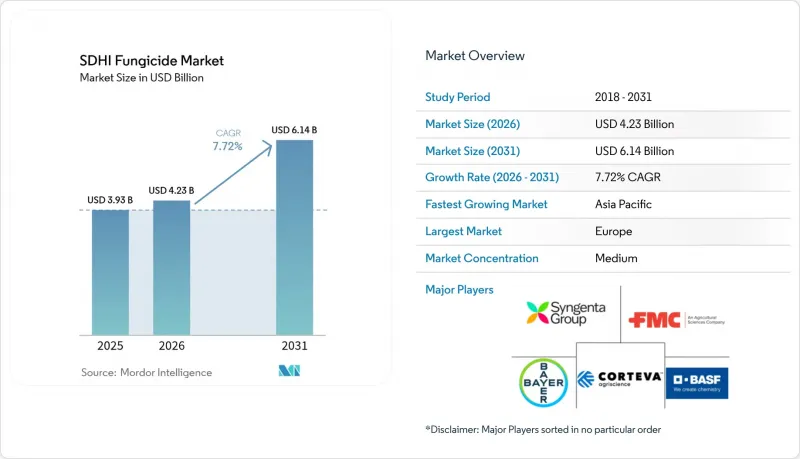
根據 Mordor Intelligence 預測,SDHI 殺菌劑市場規模將從 2025 年的 39.3 億美元成長到 2026 年的 42.3 億美元,然後在 2031 年達到 61.4 億美元,2026 年至 2031 年的複合年成長率為 7.72%。
本報告按應用領域(穀物、豆類/油籽等)、施用方法(葉面噴布等)、活性成分(啶醯菌胺、氟吡菌胺等)、劑型(液體製劑、可濕性顆粒劑等)和地區(北美、歐洲等)進行分類。市場預測以美元計價。
全球SDHI殺菌劑市場趨勢及洞察
氣候變遷導致的疾病壓力
病原體的進化和地理擴散正在改變全球農業對琥珀酸脫氫酶抑制劑(SDHI)類殺菌劑的需求模式。稻瘟病菌(Magnaporthe oryzae)已在孟加拉和巴西形成地方性流行,迫使種植戶實施SDHI(琥珀酸脫氫酶抑制劑)週期性防治方案。氣溫和降雨模式的變化延長了枯萎病、小麥穎枯病和稻瘟病的侵染期。這些較長的病害週期需要增加殺菌劑的使用,導致SDHI類殺菌劑用量的增加。氣候變遷帶來的病害壓力導致需求持續成長,這與傳統的殺菌劑使用模式有所不同。新型SDHI化合物,包括異氟菌胺和苯並氟吡菌胺,在多種環境條件下均表現出優於傳統三唑類和甲氧基丙烯酸酯類酯類殺菌劑的防治效果。
SDHI註冊批准在新興市場迅速擴展
亞太和南美市場近期監管政策的變化為SDHI類殺菌劑生產商創造了成長機會。在中國,《國家間醫療援助協議》(ICAMA)批准了多種SDHI類殺菌劑於2024年註冊,其中包括啶醯菌胺和氟吡菌胺製劑的國內生產許可。在巴西,大豆和玉米的SDHI類殺菌劑報名手續得到簡化,為農民提供了應對抗藥性問題的替代方案。 2024年,印度食品安全標準局(FSSAI)將草藥和香辛料中農藥的最大殘留基準值(MRL)從0.01毫克/公斤提高到0.1毫克/公斤,從而促進了SDHI類殺菌劑在印度農業領域的更廣泛應用。這些監管政策的進步對擁有必要註冊文件和本地生產設施的公司而言具有優勢。核准範圍的擴大尤其有利於將SDHI類化合物與其他作用機制結合的複方製劑,這與監管機構對綜合抗藥性管理策略的需求相符。
新一代生物殺菌劑的研發管線競爭
在某些作物保護場景下,生物殺菌劑正逐漸被接受為SDHI類化合物的替代品,可能會限制高階市場的成長。領先的農藥公司正透過開發結合合成和生物成分的產品來增強其生物防治能力。 Certis Biologicals於2024年收購Howler和Theia,顯示其在某些作物上具有可比的功效。BASF的生物殺菌劑Serifel透過多種作用機制提供廣譜病害防治,進而減少綜合蟲害防治方案中SDHI的使用。在高階蔬果市場,由於買家傾向於優先考慮無化學添加的農產品,生產商正轉向生物替代品。
細分市場分析
到2025年,穀物將佔SDHI類殺菌劑市場佔有率的44.22%。如此龐大的市佔率主要歸因於全球小麥、玉米和大麥種植面積廣闊,以及對病害進行全面防治的迫切需求。小麥產區鐮刀菌穗枯病和玉米灰斑病的蔓延,推動了對SDHI類殺菌劑(尤其是將SDHI成分與其他作用機制相結合的產品)的持續需求。
草坪和觀賞植物領域是成長最快的應用領域,預計到2031年複合年成長率將達到9.55%。這一成長主要得益於價格的高接受度以及高爾夫球場、體育設施和景觀美化等場所對高強度維護的需求。隨著SDHI在特種作物上的新應用獲批,果蔬領域的應用也不斷擴展。同時,SDHI計畫正在棉花和甘蔗等高價值經濟作物的生產系統中得到應用。豆類和油籽作物的應用持續成長,尤其是在北美地區,由於病害壓力較大,大豆和菜籽種植者正在採用基於SDHI的解決方案來防治白黴病和根腐病。這種多樣化的應用使得開發針對特定作物病害的專用配方成為可能,同時也能滿足監管要求。
葉面噴布噴施憑藉著成熟的種植實踐和在所有作物系統中對葉部病原體的顯著防治效果,預計到2025年將佔SDHI類殺菌劑市場規模的66.35%。種子處理預計到2031年將以9.78%的複合年成長率成長,這主要得益於新型SDHI製劑的核准以及對早期病害防治需求的不斷成長。採後後處理佔據了特定的市場區隔領域,例如糧食儲存保護和水果保鮮,這為擁有專業製劑研發能力和必要法規核准的公司創造了商機。
種子處理技術的進步帶來了許多優勢,包括最大限度地減少環境影響、精準控制病原體以及與其他種子處理產品(如殺蟲劑和植物生長調節劑)的兼容性。BASF的種子處理劑ILeVO(氟吡菌胺)就是一個絕佳的例子,它充分展現了SDHI類化合物在保護葉面噴布。這一趨勢對那些擁有種子處理劑配方專業知識,並與種子生產商和商業處理機構保持密切合作關係的公司而言尤其有利。
區域分析
至2025年,歐洲將佔據SDHI類殺菌劑市場33.74%的佔有率。該地區糧食產量高、農業指導服務完善,且對正確使用要求嚴格,這些因素共同促成了SDHI類殺菌劑成為抗性管理策略的重要組成部分。儘管面臨監管方面的挑戰,但該地區支持綜合蟲害管理(IPM)的補貼計畫仍維持著對高品質殺菌劑的需求。德國、法國和英國是主要市場,這得益於其高糧食產量和成熟的SDHI類殺菌劑使用系統。西班牙和義大利則特別關注SDHI類殺菌劑在水果和蔬菜等特種作物中的應用。法國食品、環境及職業健康安全署(ANSES)和歐洲食品安全局(EFSA)正在進行的監管審查可能會影響歐洲特定地區未來的市場成長。
預計亞太地區將維持最高的成長率,到2031年複合年成長率將達到9.52%。這一成長主要歸功於中國和印度的農業現代化、新型SDHI產品的核准以及各種作物系統面臨的病害壓力不斷增加。中國國內SDHI的生產能力和關鍵活性成分的法律規範為該地區的成長提供了支撐。在印度,特種作物的擴張和最大殘留限量(MRL)的改進正在推動市場發展。日本和澳洲是成熟的市場,SDHI的使用已被廣泛認可,市場普遍接受其高價。
在北美,尤其是在玉米和大豆種植中,SDHI類殺菌劑提供了一種至關重要的抗性管理解決方案,透過廣泛的穀物生產和全面的病害管理方案,維持了農業的穩定成長。南美洲、中東和非洲的成長機會源自於農業生產的擴張和殺菌劑使用量的增加。巴西農業的擴張以及SDHI類殺菌劑獲準用於大豆和玉米,展現了巨大的市場潛力;而包括阿根廷在內的其他區域市場,正在製定針對穀物和特種作物的SDHI類殺菌劑方案。
其他好處:
- Excel格式的市場預測(ME)表
- 3個月的分析師支持
目錄
第1章:引言
- 市場分析與定義的前提條件
- 分析範圍
第2章 分析方法
第3章執行摘要
第4章 市場狀況
- 市場概覽
- 市場促進因素
- 氣候變遷引發疾病的威脅
- SDHI適應症在新興市場的快速擴展
- 與數位農業決策工具的整合
- 真菌病原體多重抗藥性的出現
- 提高低利潤田間作物產量的必要性
- 投資者的注意力集中在低碳作物保護產品組合。
- 市場限制因素
- 新一代生物殺菌劑的研發管線競爭
- 加強最大殘留限量(MRL)的監測
- 高昂的藥物研發與註冊成本
- 主要SDHI中間體供應鏈的變異性
- 監理情勢
- 技術展望
- 波特五力分析
第5章:預測市場規模與成長率
- 透過使用
- 糧食
- 豆類和油籽
- 經濟作物
- 水果和蔬菜
- 草坪和觀賞植物
- 其他用途(乾草、飼料、花卉等)
- 透過應用方法
- 葉面噴布
- 種子處理
- 收穫後處理
- 按活性成分
- 博斯哈利德
- 氟吡菌
- 氟沙吡羅沙
- 比沙芬
- 苯甲氟啶
- 異氟普蘭
- 其他(戊硫吡啶、賽達沙南、異氟胺等)
- 按劑型
- 液態流動劑
- 可水合顆粒
- 乳液
- 可濕性粉
- 其他劑型(噴霧粉劑、水溶性粉劑等)
- 按地區
- 北美洲
- 美國
- 加拿大
- 墨西哥
- 其他北美國家
- 歐洲
- 西班牙
- 英國
- 法國
- 德國
- 俄羅斯
- 義大利
- 其他歐洲國家
- 亞太地區
- 中國
- 日本
- 印度
- 澳洲
- 其他亞太國家
- 南美洲
- 巴西
- 阿根廷
- 其他南美國家
- 中東
- 沙烏地阿拉伯
- 土耳其
- 其他中東國家
- 非洲
- 南非
- 奈及利亞
- 其他非洲國家
- 北美洲
第6章 競爭情勢
- 市場集中度
- 策略趨勢
- 市佔率分析
- 公司簡介
- Syngenta Group
- BASF SE
- Bayer AG
- Corteva Agriscience
- FMC Corporation
- UPL Limited
- Sumitomo Chemical Co., Ltd.
- Nufarm Limited
- PI Industries Limited
- Rallis India Limited(A Subsidiary of Tata Chemicals)
- Godrej Agrovet Limited
- Hebei Lansheng Biotech Co., Ltd..
- Natursim Science Co., Ltd.
- Indofil Industries Limited(KK Modi Group)
- Ishihara Sangyo Kaisha, Ltd.
第7章 化肥產業執行長面臨的關鍵策略挑戰
According to Mordor Intelligence, the SDHI fungicide market size is expected to grow from USD 3.93 billion in 2025 to USD 4.23 billion in 2026 and is forecast to reach USD 6.14 billion by 2031 at 7.72% CAGR over 2026-2031.
This report is Segmented by Application (Grains and Cereals, Pulses and Oilseeds, and More), by Mode of Application (Foliar Spray, and More), by Active Ingredient (Boscalid, Fluopyram, and More), by Formulation Type (Liquid Suspension Concentrates, Water-Dispersible Granules, and More), and by Geography (North America, Europe, and More). The Market Forecasts are Provided in Terms of Value (USD).
Global SDHI Fungicide Market Trends and Insights
Climate-Change-Driven Disease Pressure
The evolution and geographic expansion of pathogens are altering the demand patterns for SDHI fungicides in global agriculture. Wheat blast (Magnaporthe oryzae) has established permanent populations in Bangladesh and Brazil, necessitating growers to implement SDHI rotation programs. Changes in temperature and rainfall patterns have extended infection periods for Fusarium, Septoria, and wheat blast diseases. These longer disease cycles necessitate additional fungicide applications, increasing SDHI usage. The climate-induced disease pressure generates sustained demand growth, unlike historical fungicide adoption patterns. New SDHI molecules, including isoflucypram and benzovindiflupyr, exhibit superior efficacy under varying environmental conditions compared to traditional triazole and strobilurin fungicides.
Rapid Expansion of SDHI Label Approvals in Emerging Markets
Recent regulatory changes in the Asia-Pacific and South American markets have created growth opportunities for SDHI fungicide manufacturers. In China, Interstate Compact on Adoption and Medical Assistance (ICAMA) approved several SDHI registrations in 2024, including domestic production licenses for boscalid and fluopyram formulations. Brazil streamlined registrations for soybean and corn applications, providing growers with alternatives to address resistance issues. In 2024, India's Food Safety Standards Authority (FSSAI) increased the Maximum Residue Limit (MRL) of pesticides in herbs and spices from 0.01 mg/kg to 0.1 mg/kg, enabling wider adoption across India's agricultural sector. These regulatory developments benefit companies with established registration documentation and local production facilities. The expanded approvals particularly support combination products that integrate SDHI chemistry with other modes of action, aligning with regulatory preferences for comprehensive resistance management strategies.
Pipeline Competition From Next-Gen Biologic Fungicides
Biological fungicides are gaining acceptance as alternatives to SDHI chemistry in specific crop protection scenarios, which may limit market growth in premium segments. Major agrochemical companies are acquiring biocontrol capabilities to develop synthetic-biological product combinations. Certis Biologicals' acquisition of Howler and Theia in 2024 demonstrates comparable efficacy in certain crops. BASF's Serifel biofungicide offers broad-spectrum disease control through multiple modes of action, enabling reduced SDHI usage in integrated pest management programs. In premium fruit and vegetable markets, growers are transitioning to biological alternatives where buyers prioritize chemical-free produce.
Other drivers and restraints analyzed in the detailed report include:
- Integration with Digital-Farming Decision Tools
- Rising Multi-Fungicide Resistance in Fungal Pathogens
- Growing Maximum-Residue-Limit (MRL) Scrutiny
For complete list of drivers and restraints, kindly check the Table Of Contents.
Segment Analysis
Grains and cereals account for 44.22% of the SDHI fungicide market share in 2025. This dominance stems from extensive acreage and intensive disease management needs across global wheat, corn, and barley production systems. The prevalence of Fusarium head blight in wheat regions and gray leaf spot in corn drives consistent SDHI demand, particularly for products combining SDHI chemistry with other modes of action.
Turf and ornamentals represent the fastest-growing application segment with a 9.55% CAGR through 2031. This growth is driven by high pricing tolerance and intensive maintenance needs in golf courses, sports facilities, and landscape applications. The fruits and vegetables segment expands through new SDHI label approvals for specialty crops, while commercial crops such as cotton and sugarcane implement SDHI programs in high-value production systems. Pulses and oilseeds applications continue to grow as soybean and canola producers adopt SDHI-based solutions for white mold and sclerotinia management, particularly in North American regions with increased disease pressure. This application diversity enables the development of specialized formulations targeting specific crop diseases while meeting regulatory requirements.
Foliar spray applications hold 66.35% of the SDHI fungicide market size in 2025, supported by established grower practices and demonstrated effectiveness against foliar pathogens across crop systems. Seed treatment applications are growing at a 9.78% CAGR through 2031, driven by new SDHI formulation approvals and increasing demand for early-season disease protection. Post-harvest treatments occupy specific market segments, including grain storage protection and fruit preservation, creating opportunities for companies with specialized formulation capabilities and required regulatory clearances.
The transition toward seed treatments offers multiple advantages, including minimized environmental impact, precise pathogen control, and compatibility with other seed-applied products like insecticides and plant growth regulators. BASF's ILeVO fluopyram seed treatment exemplifies SDHI chemistry's effectiveness in protecting corn and soybean seedlings from soilborne diseases. Regulatory bodies prefer seed treatments over foliar applications due to reduced drift and lower environmental risks. This trend benefits companies that possess seed treatment formulation expertise and maintain strong connections with seed producers and commercial treatment facilities.
Complete Report Scope:
- By Application
- Grains and Cereals
- Pulses and Oilseeds
- Commercial Crops
- Fruits and Vegetables
- Turf and Ornamentals
- Other Applications (Forage and Fodders, Flowers, etc.)
- By Mode of Application
- Foliar Spray
- Seed Treatment
- Post-Harvest Treatment
- By Active Ingredient
- Boscalid
- Fluopyram
- Fluxapyroxad
- Bixafen
- Benzovindiflupyr
- Isoflucypram
- Others (Penthiopyrad, Sedaxane, Isaflumet, etc.)
- By Formulation Type
- Liquid Suspension Concentrates
- Water-Dispersible Granules
- Emulsifiable Concentrates
- Wettable Powders
- Other Formulations (Dustable Powder, Soluble Powder, etc.)
- By Geography
- North America
- United States
- Canada
- Mexico
- Rest of North America
- Europe
- Spain
- United Kingdom
- France
- Germany
- Russia
- Italy
- Rest of Europe
- Asia-Pacific
- China
- Japan
- India
- Australia
- Rest of Asia-Pacific
- South America
- Brazil
- Argentina
- Rest of South America
- Middle East
- Saudi Arabia
- Turkey
- Rest of Middle East
- Africa
- South Africa
- Nigeria
- Rest of Africa
- North America
Geography Analysis
Europe held 33.74% of the SDHI fungicide market share in 2025. The region's extensive cereal production, robust agricultural advisory services, and strict stewardship requirements have established SDHIs as an essential component in resistance management strategies. The region's subsidy systems, which support integrated pest management practices, maintain the demand for premium fungicides despite regulatory challenges. Germany, France, and the United Kingdom serve as primary markets due to their intensive cereal production and established SDHI usage. Spain and Italy focus on specialty crop applications, particularly in fruits and vegetables. Ongoing regulatory reviews by the French Agency for Food, Environmental and Occupational Health & Safety (ANSES) and European Food Safety Authority (EFSA) may affect future market growth in specific European regions.
Asia-Pacific exhibits the highest growth rate at 9.52% CAGR through 2031. This growth stems from agricultural modernization in China and India, new SDHI product approvals, and increasing disease pressures across various crop systems. China's domestic SDHI manufacturing capabilities and regulatory framework for key active ingredients support regional growth. India's expansion in specialty crops and improved Maximum Residue Level (MRL) standards facilitate market development. Japan and Australia represent established markets with consistent SDHI usage and acceptance of premium pricing.
North America maintains consistent growth through extensive grain production and comprehensive disease management programs, particularly in corn and soybean cultivation, where SDHI chemistry provides key resistance management solutions. South America, the Middle East, and Africa present growth opportunities through expanding agricultural production and increasing fungicide adoption. Brazil's agricultural expansion and SDHI approvals for soybeans and corn applications offer significant market potential, while Argentina and other regional markets develop SDHI programs for cereals and specialty crops.
- Syngenta Group
- BASF SE
- Bayer AG
- Corteva Agriscience
- FMC Corporation
- UPL Limited
- Sumitomo Chemical Co., Ltd.
- Nufarm Limited
- PI Industries Limited
- Rallis India Limited (A Subsidiary of Tata Chemicals)
- Godrej Agrovet Limited
- Hebei Lansheng Biotech Co., Ltd..
- Natursim Science Co., Ltd.
- Indofil Industries Limited (KK Modi Group)
- Ishihara Sangyo Kaisha, Ltd.
Additional Benefits:
- The market estimate (ME) sheet in Excel format
- 3 months of analyst support
TABLE OF CONTENTS
1 Introduction
- 1.1 Study Assumptions and Market Definition
- 1.2 Scope of the Study
2 Research Methodology
3 Executive Summary
4 Market Landscape
- 4.1 Market Overview
- 4.2 Market Drivers
- 4.2.1 Climate-change-driven disease pressure
- 4.2.2 Rapid expansion of SDHI label approvals in emerging markets
- 4.2.3 Integration with digital-farming decision tools
- 4.2.4 Rising multi-fungicide resistance in fungal pathogens
- 4.2.5 Yield-boost imperatives for low-margin row crops
- 4.2.6 Investor focus on low-carbon crop-protection portfolios
- 4.3 Market Restraints
- 4.3.1 Pipeline competition from next-generation biologic fungicides
- 4.3.2 Growing maximum-residue-limit (MRL) scrutiny
- 4.3.3 High discovery and registration costs
- 4.3.4 Supply-chain volatility for key SDHI intermediates
- 4.4 Regulatory Landscape
- 4.5 Technological Outlook
- 4.6 Porter's Five Forces Analysis
- 4.6.1 Bargaining Power of Suppliers
- 4.6.2 Bargaining Power of Buyers
- 4.6.3 Threat of New Entrants
- 4.6.4 Threat of Substitutes
- 4.6.5 Intensity of Competitive Rivalry
5 Market Size and Growth Forecasts (Value)
- 5.1 By Application
- 5.1.1 Grains and Cereals
- 5.1.2 Pulses and Oilseeds
- 5.1.3 Commercial Crops
- 5.1.4 Fruits and Vegetables
- 5.1.5 Turf and Ornamentals
- 5.1.6 Other Applications (Forage and Fodders, Flowers, etc.)
- 5.2 By Mode of Application
- 5.2.1 Foliar Spray
- 5.2.2 Seed Treatment
- 5.2.3 Post-Harvest Treatment
- 5.3 By Active Ingredient
- 5.3.1 Boscalid
- 5.3.2 Fluopyram
- 5.3.3 Fluxapyroxad
- 5.3.4 Bixafen
- 5.3.5 Benzovindiflupyr
- 5.3.6 Isoflucypram
- 5.3.7 Others (Penthiopyrad, Sedaxane, Isaflumet, etc.)
- 5.4 By Formulation Type
- 5.4.1 Liquid Suspension Concentrates
- 5.4.2 Water-Dispersible Granules
- 5.4.3 Emulsifiable Concentrates
- 5.4.4 Wettable Powders
- 5.4.5 Other Formulations (Dustable Powder, Soluble Powder, etc.)
- 5.5 By Geography
- 5.5.1 North America
- 5.5.1.1 United States
- 5.5.1.2 Canada
- 5.5.1.3 Mexico
- 5.5.1.4 Rest of North America
- 5.5.2 Europe
- 5.5.2.1 Spain
- 5.5.2.2 United Kingdom
- 5.5.2.3 France
- 5.5.2.4 Germany
- 5.5.2.5 Russia
- 5.5.2.6 Italy
- 5.5.2.7 Rest of Europe
- 5.5.3 Asia-Pacific
- 5.5.3.1 China
- 5.5.3.2 Japan
- 5.5.3.3 India
- 5.5.3.4 Australia
- 5.5.3.5 Rest of Asia-Pacific
- 5.5.4 South America
- 5.5.4.1 Brazil
- 5.5.4.2 Argentina
- 5.5.4.3 Rest of South America
- 5.5.5 Middle East
- 5.5.5.1 Saudi Arabia
- 5.5.5.2 Turkey
- 5.5.5.3 Rest of Middle East
- 5.5.6 Africa
- 5.5.6.1 South Africa
- 5.5.6.2 Nigeria
- 5.5.6.3 Rest of Africa
- 5.5.1 North America
6 Competitive Landscape
- 6.1 Market Concentration
- 6.2 Strategic Moves
- 6.3 Market Share Analysis
- 6.4 Company Profiles (Includes Global level Overview, Market Level Overview, Core Segments, Financials as Available, Strategic Information, Market Rank/Share for Key Companies, Products and Services, and Recent Developments)
- 6.4.1 Syngenta Group
- 6.4.2 BASF SE
- 6.4.3 Bayer AG
- 6.4.4 Corteva Agriscience
- 6.4.5 FMC Corporation
- 6.4.6 UPL Limited
- 6.4.7 Sumitomo Chemical Co., Ltd.
- 6.4.8 Nufarm Limited
- 6.4.9 PI Industries Limited
- 6.4.10 Rallis India Limited (A Subsidiary of Tata Chemicals)
- 6.4.11 Godrej Agrovet Limited
- 6.4.12 Hebei Lansheng Biotech Co., Ltd..
- 6.4.13 Natursim Science Co., Ltd.
- 6.4.14 Indofil Industries Limited (KK Modi Group)
- 6.4.15 Ishihara Sangyo Kaisha, Ltd.


