


 |
市場調查報告書
商品編碼
2113318
觸控螢幕控制器:市場佔有率分析、產業趨勢與統計、成長預測(2026-2031)Touch Screen Controllers - Market Share Analysis, Industry Trends & Statistics, Growth Forecasts (2026 - 2031) |
||||||

※ 本網頁內容可能與最新版本有所差異。詳細情況請與我們聯繫。
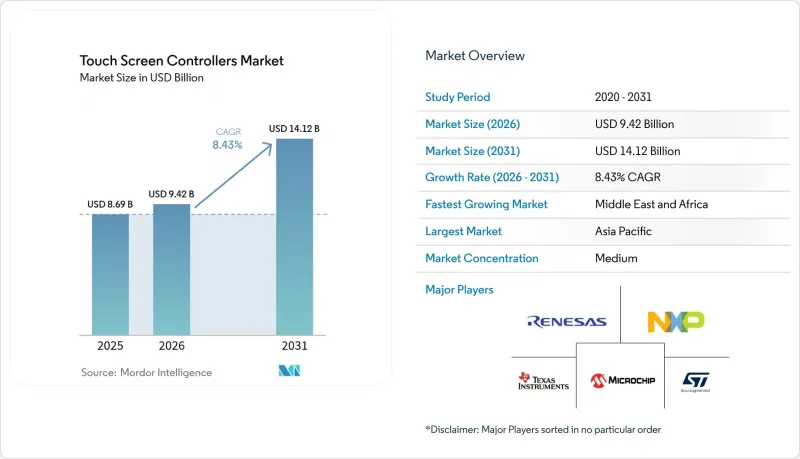
根據 Mordor Intelligence 預測,觸控螢幕控制器市場規模將從 2025 年的 86.9 億美元成長到 2026 年的 94.2 億美元,然後在 2031 年達到 141.2 億美元,2026 年至 2031 年的複合年成長率為 8.43%。
本報告按技術(電阻式、電容式等)、介面(I2C、SPI、USB、UART)、觸控點(單點觸控、多點觸控)、顯示器尺寸(5吋以下、5-10吋、10吋以上)、終端用戶產業(家用電子電器、工業/製造、零售/POS終端等)及地區進行細分。市場預測以美元(USD)計價。
全球觸控螢幕控制器市場趨勢與洞察
軟性OLED智慧型手機顯示器中多點觸控電容式的應用
智慧型手機製造商正在部署曲面螢幕和折疊式鉸鏈,這增加了觸控通道佈線和防誤觸邏輯的複雜性。控制器必須能夠處理不規則表面上的可變壓力輸入,同時最大限度地減少寄生電容。預計在2025年推出的氧化物面板展示了整合式觸控路徑,即使在螢幕機殼超過90%且邊框極窄的情況下,也能保持訊號雜訊比。與邊緣屏蔽和局部驅動波形相關的專利組合構成了觸控螢幕控制器市場的高階產品,供應商利用這些專業智慧財產權(IP)為量產旗艦設備帶來利潤。
歐洲車載資訊娛樂系統升級,配備二級ADAS功能
目前,汽車儀錶板採用34吋曲面面板,整合了儀錶叢集、導航和媒體控制功能。因此,控制器需要具備寬廣的動作溫度範圍、嚴格的電磁干擾抗擾度和容錯韌體。例如,ATMXT3072M1等元件採用112個可重構通道和獨特的交叉電容擷取方法,可將訊號雜訊比提高15 dB,即使在動力傳動系統和ADAS雷達產生的電磁干擾下也能確保可靠的偵測。整合在顯示器頂部的觸覺旋鈕可恢復觸覺回饋,提高駕駛員的注意力,同時進一步限制控制器掃描迴路的延遲。
55奈米混合訊號晶圓供應鏈緊張
由於汽車MCU和工業IoT的需求與消費級觸控晶片的需求競爭,關鍵的55奈米製程節點的代工廠配額仍然緊張。控制器製造商擴大簽訂多年期「照付不議」合約以確保產能,這導致營運資金緊張並延長了設計週期。一些公司正在重新設計產品以適應65奈米或40奈米體矽CMOS工藝,但這種移植會產生重新認證成本,並可能導致晶片尺寸增大。恩智浦揭露的配額有限凸顯了整個觸控控制器市場短期供應風險。
細分市場分析
到2025年,電容式觸控螢幕將佔據觸控螢幕控制器市場71.12%的佔有率,這反映出其在智慧型手機、平板電腦和汽車駕駛座等領域的應用日益廣泛。電容式觸控螢幕能夠穿透蓋板玻璃進行觸控,並支援超過10個觸控點,這確保了其在對耐用性、光學清晰度和手勢操作靈活性要求極高的領域中得到廣泛應用。整合式TDDI晶片的普及也推動了這一領域的發展,該晶片減少了邊框數量和模組厚度。同時,電阻式仍應用於工廠主機和需要戴手套操作的POS終端,但由於PCAP價格的下降,其市場佔有率正在放緩。
預計到2031年,紅外線(IR)控制器將以10.45%的複合年成長率(CAGR)實現最高成長。邊框式發射器-接收器陣列使整合商能夠以合理的成本將螢幕尺寸擴展到100英寸以上,這對於教室、數位電子看板和耐用型自助服務終端而言是一項顯著優勢。紅外線LED驅動器效率的提升,結合先進的眼動追蹤演算法,降低了延遲並提高了抗環境光干擾能力。這促使人們開始考慮在教育機構和企業會議室部署互動式牆。這一趨勢保持了觸控螢幕控制器市場的技術多樣性,並鼓勵供應商在PCAP、紅外線以及細分領域的聲學和光學成像解決方案方面保持並行的產品線。
I2C協定憑藉其兩線連接、引腳數量少、支援多主控等優點,預計到2025年將佔據42.65%的市場佔有率,使其非常適合系統晶片(SoC)環境。 I2C被廣泛應用於智慧型手機、穿戴式裝置和眾多車載顯示器,以實現控制器和主機處理器之間的低雜訊、低功耗通訊。 SPI在頻寬需求不斷成長的面板電腦和高解析度平板電腦領域保持穩定的市場佔有率,而UART則繼續應用於需要盡量減少韌體更新的傳統工業終端。
由於其即插即用的特性以及支援觸控筆資料和懸停感應的高吞吐量,USB 正以 9.05% 的複合年成長率 (CAGR) 成為成長最快的市場。自助服務終端、醫療推車和可拆卸顯示器的 ODM 廠商非常青睞其標準化的連接器和獨立於主機的枚舉流程。白盒 PC 製造商也青睞 USB Touch,因為它不需要額外的橋接 IC。這種介面的柔軟性拓寬了應用範圍,擴大了觸控螢幕控制器市場規模,並要求供應商提供支援無縫現場重新配置的多介面韌體。
區域分析
亞太地區擁有密集的零件供應鏈、技術嫻熟的勞動力以及政府鼓勵半導體自給自足的獎勵,預計到2025年將佔全球銷售額的61.25%。中國擁有主要的控制器IC晶圓廠,以及為本土智慧型手機和消費性電子巨頭提供產品的下游模組組裝。像FocalTech這樣的區域供應商不斷透過整合顯示器和觸控解決方案推動創新,這些解決方案滿足了汽車產業的可靠性要求。韓國和日本在OLED和氧化物TFT方面擁有尖端技術,推動了軟性折疊式設備對高價值控制器插座的需求。
北美則位居第二,這主要得益於汽車電子、醫療影像和工業自動化領域的平台創新。矽谷的設計中心正專注於人工智慧增強的訊號處理,以過濾複雜嘈雜的環境訊號。零售連鎖店正在加速部署自助結帳系統終端,進一步推高了對控制器單元的需求。該地區嚴格的網路安全要求也促使人們對整合到觸控控制器中的硬體加速加密技術產生濃厚興趣。
歐洲也緊跟其後,嚴重依賴德國、法國和瑞典的汽車生產群集。雖然嚴格的功能安全和電磁相容性 (EMC) 標準延長了設計週期,但也為認證供應商創造了一個穩固的利基市場。歐盟範圍內向 L2 和 L3 級高級駕駛輔助系統 (ADAS) 的過渡,推動了採用高通道控制器的大型駕駛座顯示器的普及,進一步拓展了觸控螢幕控制器市場的應用範圍。
預計中東和非洲地區將達到最高成長率,到2031年複合年成長率將達到10.03%。海灣國家的智慧城市計畫正在推動對觸控式自助服務終端、數位電子看板和支付終端的需求。零售和酒店業正在實施互動式系統,以縮短服務等待時間。隨著小規模國內系統整合商透過全球經銷商採購控制器,本地設計活動蓬勃發展。
在南美洲,觸控螢幕控制器市場正逐步擴張,巴西和阿根廷的銀行ATM機和教室IT設備都在進行升級改造。儘管外匯波動和關稅結構影響著採購週期,但智慧型手機普及率的不斷提高支撐了售後市場對維修觸控模組的需求。全部區域的這項進展正在擴大觸控螢幕控制器市場的地理範圍,並緩解對亞洲集中供應的過度依賴。
其他好處:
- Excel格式的市場預測(ME)表
- 3個月的分析師支持
目錄
第1章:引言
- 研究假設和市場定義
- 調查範圍
第2章:調查方法
第3章執行摘要
第4章 市場狀況
- 市場概覽
- 市場促進因素
- 軟性OLED智慧型手機顯示器中多點觸控電容式的應用
- 歐洲車載資訊娛樂系統升級,配備L2級ADAS功能
- 北美地區自助結帳系統POS系統的普及是由人手不足的。
- 攜帶式醫療影像設備的微型化
- 在中國,用於工業 4.0 的堅固型 PCAP 面板正在取代薄膜小鍵盤。
- 觸控智慧型手錶的普及推動了對低功耗 32 位元控制器的需求。
- 市場限制因素
- 55奈米混合訊號晶圓的供應鏈面臨壓力。
- 24 吋及以上電容式汽車顯示器在 EMI/ESD 合規性方面所面臨的挑戰。
- 控制器智慧財產權訴訟案,被告為印度白盒平板電腦製造商
- 由於面板製造商的垂直整合,平均售價下降
- 產業生態系分析
- 技術展望(控制架構和感測演算法)
- 監管趨勢(電磁相容性和汽車標準)
- 波特五力分析
第5章 市場規模與成長預測
- 透過技術
- 電阻類型
- 電容式(凸出式和表面式)
- 表面聲波
- 紅外線的
- 光學成像
- 透過介面
- I2C
- SPI
- USB
- UART
- 透過觸點
- 單觸
- 多點觸控
- 按顯示尺寸
- 小於5英寸
- 5-10英寸
- 10吋或更大
- 按最終用戶行業分類
- 家用電子產品
- 工業和製造業
- 醫療保健和醫療設備
- 零售和POS終端
- 車
- 銀行和金融自助服務終端
- 其他(航空、教育)
- 按地區
- 北美洲
- 美國
- 加拿大
- 墨西哥
- 歐洲
- 德國
- 英國
- 法國
- 義大利
- 西班牙
- 北歐國家(丹麥、瑞典、挪威、芬蘭)
- 其他歐洲國家
- 亞太地區
- 中國
- 日本
- 韓國
- 印度
- 東南亞
- 澳洲
- 其他亞太國家
- 南美洲
- 巴西
- 阿根廷
- 其他南美國家
- 中東
- 波灣合作理事會(GCC)成員國
- 土耳其
- 其他中東國家
- 非洲
- 南非
- 奈及利亞
- 其他非洲國家
- 北美洲
第6章 競爭情勢
- 市場集中度
- 策略趨勢
- 市佔率分析
- 公司簡介
- NXP Semiconductors
- Renesas Electronics Corporation
- Samsung Electronics Co. Ltd.
- Texas Instruments Incorporated
- Analog Devices Inc.
- STMicroelectronics
- Microchip Technology Inc.
- Cypress(Infineon Technologies AG)
- Synaptics Incorporated
- Goodix Technology Inc.
- FocalTech Systems Co. Ltd.
- MELFAS Co. Ltd.
- Elan Microelectronics Corp.
- Novatek Microelectronics Corp.
- Ilitek I-SFT Technology Inc.
- Silicon Labs
- Himax Technologies Inc.
- Semtech Corporation
- Broadcom Inc.
- PixArt Imaging Inc.
- ROHM Semiconductor
- AMS OSRAM AG
- Raydium Semiconductor Corp.
第7章 市場機會與未來展望
According to Mordor Intelligence, the touch screen controllers market size is expected to grow from USD 8.69 billion in 2025 to USD 9.42 billion in 2026 and is forecast to reach USD 14.12 billion by 2031 at 8.43% CAGR over 2026-2031.
This report is Segmented by Technology (Resistive, Capacitive, and More), Interface (I2C, SPI, USB, and UART), Touch Points (Single-Touch, and Multi-Touch), Display Size (Less Than 5 Inch, 5-10 Inch, and Above 10 Inch), End-User Industry (Consumer Electronics, Industrial and Manufacturing, Retail and POS Terminals, and More), and Geography. The Market Forecasts are Provided in Terms of Value (USD).
Global Touch Screen Controllers Market Trends and Insights
Multi-touch Capacitive Adoption in Flexible OLED Smartphone Displays
Smartphone makers are stretching displays over curved edges and foldable hinges, raising complexity for touch-channel routing and palm-rejection logic. Controllers must process variable pressure inputs over irregular surfaces while minimizing parasitic capacitance. Oxide-based panels showcased in 2025 demonstrated integrated touch paths that sustain signal-to-noise ratios at narrow bezels above 90% screen-to-body levels. Patent portfolios around edge shielding and localized drive waveforms create a premium tier inside the touch screen controllers market, where suppliers monetize specialized IP against high-volume flagship handsets.
In-Vehicle Infotainment Upgrades with Level-2 ADAS in Europe
Car dashboards now host curved 34-inch panels that merge cluster, navigation, and media controls. Controllers, therefore, need wide operating temperatures, stringent EMI resilience, and fault-tolerant firmware. Devices such as the ATMXT3072M1 adopt 112 reconfigurable channels and proprietary mutual-cap acquisition schemes that raise SNR by 15 dB, ensuring reliable detection under electromagnetic stress from powertrains and ADAS radars. Haptic knobs embedded atop displays restore tactile feedback, improving driver attention scores and placing additional latency constraints on the controller's scan loop.
55 nm Mixed-Signal Wafer Supply-Chain Tightness
Foundry allocations at key 55 nm nodes remain strained because automotive MCU and industrial IoT demand compete with consumer touch chips. Controller makers increasingly sign multi-year take-or-pay contracts to guarantee capacity, diverting working capital and elongating design cycles. Some firms are redesigning products for 65 nm or 40 nm bulk CMOS, though such porting introduces requalification costs and can raise die size. NXP's disclosure of limited allocation windows underscores near-term supply risk across the touch screen controllers market.
Other drivers and restraints analyzed in the detailed report include:
- Self-Checkout POS Proliferation amid North-American Labor Shortages
- Industry 4.0 Rugged PCAP Panels Replacing Membrane Keypads in China
- EMI/ESD Compliance Issues for >24" Capacitive Automotive Displays
For complete list of drivers and restraints, kindly check the Table Of Contents.
Segment Analysis
Capacitive solutions captured 71.12% of the touch screen controllers market share in 2025, reflecting strong adoption in phones, tablets, and vehicle cockpits. Their ability to sense through cover-glass and to support ten-plus touch points secures design wins where durability, optical clarity, and gesture richness matter. The segment benefits from ongoing migration to integrated TDDI chips that lower bezel count and shrink module thickness. Conversely, resistive products continue serving glove-based factory consoles and point-of-sale terminals, though incremental volumes decline as PCAP pricing falls.
Infrared controllers post the highest 10.45% CAGR to 2031. Bezel-mounted emitter-receiver arrays let integrators scale beyond 100 inches at moderate cost, a key advantage for classrooms, digital signage, and heavy-duty kiosks. Efficiency gains in IR LED drivers combined with refined line-of-sight algorithms are reducing latency and improving ambient light immunity, prompting education boards and corporate meeting rooms to consider interactive walls. This dynamic keeps technology diversity alive inside the touch screen controllers market, encouraging vendors to maintain parallel product lines across PCAP, IR, and niche acoustic or optical imaging solutions.
The I2C protocol delivered 42.65% revenue in 2025 thanks to its two-wire simplicity, low pin count, and multi-master capability, catering to system-on-chip environments. Smartphones, wearables, and many automotive displays rely on I2C for low-noise, low-power communication between the controller and host processor. SPI holds steady in panel PCs and higher-resolution tablets where bandwidth requirements rise, while UART persists in legacy industrial terminals seeking minimal firmware updates.
USB emerges as the fastest-growing at a 9.05% CAGR given its plug-and-play nature and high throughput that supports stylus data and hover sensing. ODMs targeting kiosks, medical carts, and detachable monitors appreciate the standard connector and host-agnostic enumeration process. White-box PC makers also favor USB touch due to the cost avoidance of additional bridge ICs. This interface flexibility widens application reach, adds volumes to the touch screen controllers market, and pressures vendors to supply multi-interface firmware capable of seamless field reconfiguration.
Complete Report Scope:
- By Technology
- Resistive
- capacitive (Projected and Surface)
- Surface Acoustic Wave
- Infrared
- Optical Imaging
- By Interface
- I2C
- SPI
- USB
- UART
- By Touch Points
- Single-Touch
- Multi-Touch
- By Display Size
- Less than 5 Inch
- 5 - 10 Inch
- Above 10 Inch
- By End-user Industry
- Consumer Electronics
- Industrial and Manufacturing
- Healthcare and Medical Devices
- Retail and POS Terminals
- Automotive
- Banking and Financial Kiosks
- Others (Aviation, Education)
- By Geography
- North America
- United States
- Canada
- Mexico
- Europe
- Germany
- United Kingdom
- France
- Italy
- Spain
- Nordics (Denmark, Sweden, Norway, Finland)
- Rest of Europe
- Asia-Pacific
- China
- Japan
- South Korea
- India
- Southeast Asia
- Australia
- Rest of Asia-Pacific
- South America
- Brazil
- Argentina
- Rest of South America
- Middle East
- Gulf Cooperation Council Countries
- Turkey
- Rest of Middle East
- Africa
- South Africa
- Nigeria
- Rest of Africa
- North America
Geography Analysis
Asia Pacific held 61.25% revenue in 2025, supported by dense component supply chains, skilled labor, and government incentives for semiconductor self-sufficiency. China hosts major controller IC fabs plus downstream module assemblers that feed local smartphone and appliance giants. Regional suppliers such as FocalTech continue to innovate with integrated display-and-touch solutions that meet automotive reliability goals. South Korea and Japan contribute leading OLED and oxide TFT expertise, fueling high-value controller sockets in flexible and foldable devices.
North America ranks second, driven by platform innovation in automotive electronics, medical imaging, and industrial automation. Silicon Valley design centers emphasize AI-enhanced signal processing that filters complex noise environments. Retail chains accelerate self-checkout installations, securing additional controller unit demand. Robust cybersecurity requirements in this region elevate interest in hardware-accelerated encryption embedded within touch controllers.
Europe follows closely and relies heavily on automotive production clusters in Germany, France, and Sweden. Stringent functional-safety and electromagnetic-compatibility norms lengthen design timelines yet create defendable niches for certified suppliers. EU-wide push toward Level-2 and Level-3 ADAS drives larger cockpit displays that utilize high-channel-count controllers, enriching application diversity in the touch screen controllers market.
The Middle East and Africa region posts the fastest 10.03% CAGR through 2031. Smart-city programs in Gulf economies order touch-enabled kiosks, digital signage, and payment terminals. Retail and hospitality segments adopt interactive systems that shorten service queues. Smaller domestic integrators procure controllers via global distributors, raising local design activity.
South America shows gradual expansion, with Brazil and Argentina upgrading banking ATMs and classroom technology. Currency volatility and tariff structures influence procurement cycles, yet growing smartphone penetration nourishes aftermarket demand for repair-grade touch modules. Collective regional progress broadens the geographic footprint of the touch screen controllers market, mitigating overreliance on Asia-based output.
- NXP Semiconductors
- Renesas Electronics Corporation
- Samsung Electronics Co. Ltd.
- Texas Instruments Incorporated
- Analog Devices Inc.
- STMicroelectronics
- Microchip Technology Inc.
- Cypress (Infineon Technologies AG)
- Synaptics Incorporated
- Goodix Technology Inc.
- FocalTech Systems Co. Ltd.
- MELFAS Co. Ltd.
- Elan Microelectronics Corp.
- Novatek Microelectronics Corp.
- Ilitek I-SFT Technology Inc.
- Silicon Labs
- Himax Technologies Inc.
- Semtech Corporation
- Broadcom Inc.
- PixArt Imaging Inc.
- ROHM Semiconductor
- AMS OSRAM AG
- Raydium Semiconductor Corp.
Additional Benefits:
- The market estimate (ME) sheet in Excel format
- 3 months of analyst support
TABLE OF CONTENTS
1 INTRODUCTION
- 1.1 Study Assumptions and Market Definition
- 1.2 Scope of the Study
2 RESEARCH METHODOLOGY
3 EXECUTIVE SUMMARY
4 MARKET LANDSCAPE
- 4.1 Market Overview
- 4.2 Market Drivers
- 4.2.1 Multi-Touch capacitive Adoption in Flexible OLED Smartphone Displays
- 4.2.2 In-Vehicle Infotainment Upgrades with Level-2 ADAS in Europe
- 4.2.3 Self-Checkout POS Proliferation amid North-American Labor Shortages
- 4.2.4 Hand-held Medical Imaging Devices Miniaturization
- 4.2.5 Industry 4.0 Rugged PCAP Panels Replacing Membrane Keypads in China
- 4.2.6 Touch-Enabled Smartwatch Shift Driving Low-Power 32-bit Controllers
- 4.3 Market Restraints
- 4.3.1 55 nm Mixed-Signal Wafer Supply-Chain Tightness
- 4.3.2 EMI/ESD Compliance Issues for Above 24-inch capacitive Automotive Displays
- 4.3.3 Controller-IP Litigation with Indian White-Box Tablet Makers
- 4.3.4 ASP Erosion from Panel-Maker Vertical Integration
- 4.4 Industry Ecosystem Analysis
- 4.5 Technological Outlook (Controller Architectures and Sensing Algorithms)
- 4.6 Regulatory Outlook (EMC and Automotive-Grade Standards)
- 4.7 Porter's Five Forces Analysis
- 4.7.1 Bargaining Power of Suppliers
- 4.7.2 Bargaining Power of Buyers
- 4.7.3 Threat of New Entrants
- 4.7.4 Threat of Substitute Products
- 4.7.5 Intensity of Competitive Rivalry
5 MARKET SIZE AND GROWTH FORECASTS (VALUE)
- 5.1 By Technology
- 5.1.1 Resistive
- 5.1.2 capacitive (Projected and Surface)
- 5.1.3 Surface Acoustic Wave
- 5.1.4 Infrared
- 5.1.5 Optical Imaging
- 5.2 By Interface
- 5.2.1 I2C
- 5.2.2 SPI
- 5.2.3 USB
- 5.2.4 UART
- 5.3 By Touch Points
- 5.3.1 Single-Touch
- 5.3.2 Multi-Touch
- 5.4 By Display Size
- 5.4.1 Less than 5 Inch
- 5.4.2 5 - 10 Inch
- 5.4.3 Above 10 Inch
- 5.5 By End-user Industry
- 5.5.1 Consumer Electronics
- 5.5.2 Industrial and Manufacturing
- 5.5.3 Healthcare and Medical Devices
- 5.5.4 Retail and POS Terminals
- 5.5.5 Automotive
- 5.5.6 Banking and Financial Kiosks
- 5.5.7 Others (Aviation, Education)
- 5.6 By Geography
- 5.6.1 North America
- 5.6.1.1 United States
- 5.6.1.2 Canada
- 5.6.1.3 Mexico
- 5.6.2 Europe
- 5.6.2.1 Germany
- 5.6.2.2 United Kingdom
- 5.6.2.3 France
- 5.6.2.4 Italy
- 5.6.2.5 Spain
- 5.6.2.6 Nordics (Denmark, Sweden, Norway, Finland)
- 5.6.2.7 Rest of Europe
- 5.6.3 Asia-Pacific
- 5.6.3.1 China
- 5.6.3.2 Japan
- 5.6.3.3 South Korea
- 5.6.3.4 India
- 5.6.3.5 Southeast Asia
- 5.6.3.6 Australia
- 5.6.3.7 Rest of Asia-Pacific
- 5.6.4 South America
- 5.6.4.1 Brazil
- 5.6.4.2 Argentina
- 5.6.4.3 Rest of South America
- 5.6.5 Middle East
- 5.6.5.1 Gulf Cooperation Council Countries
- 5.6.5.2 Turkey
- 5.6.5.3 Rest of Middle East
- 5.6.6 Africa
- 5.6.6.1 South Africa
- 5.6.6.2 Nigeria
- 5.6.6.3 Rest of Africa
- 5.6.1 North America
6 COMPETITIVE LANDSCAPE
- 6.1 Market Concentration
- 6.2 Strategic Moves
- 6.3 Market Share Analysis
- 6.4 Company Profiles (includes Global Overview, Market Overview, Core Segments, Financials, Strategic Information, Market Rank/Share, Products and Services, Recent Developments)
- 6.4.1 NXP Semiconductors
- 6.4.2 Renesas Electronics Corporation
- 6.4.3 Samsung Electronics Co. Ltd.
- 6.4.4 Texas Instruments Incorporated
- 6.4.5 Analog Devices Inc.
- 6.4.6 STMicroelectronics
- 6.4.7 Microchip Technology Inc.
- 6.4.8 Cypress (Infineon Technologies AG)
- 6.4.9 Synaptics Incorporated
- 6.4.10 Goodix Technology Inc.
- 6.4.11 FocalTech Systems Co. Ltd.
- 6.4.12 MELFAS Co. Ltd.
- 6.4.13 Elan Microelectronics Corp.
- 6.4.14 Novatek Microelectronics Corp.
- 6.4.15 Ilitek I-SFT Technology Inc.
- 6.4.16 Silicon Labs
- 6.4.17 Himax Technologies Inc.
- 6.4.18 Semtech Corporation
- 6.4.19 Broadcom Inc.
- 6.4.20 PixArt Imaging Inc.
- 6.4.21 ROHM Semiconductor
- 6.4.22 AMS OSRAM AG
- 6.4.23 Raydium Semiconductor Corp.
7 MARKET OPPORTUNITIES AND FUTURE OUTLOOK
- 7.1 White-Space and Unmet-Need Assessment

 多點觸控螢幕市場:按技術、面板尺寸、應用和最終用戶分類-2026-2032年全球市場預測
 多點觸控螢幕市場規模、佔有率、趨勢和預測:按產品、技術、應用和地區分類,2026-2034年
 TFT LCD觸控螢幕市場報告:趨勢、預測與競爭分析(至2035年)TFT觸控螢幕市場報告:趨勢、預測與競爭分析(至2035年)
 汽車觸控螢幕控制系統市場:市場機會、成長要素、產業趨勢分析及2026-2035年預測
 2026-2030年全球汽車觸控螢幕控制系統市場
 2026年全球零售觸控螢幕顯示器市場報告全球非接觸式感測市場:產業分析、市場規模、佔有率及預測(按組件、產品類型、應用、技術、國家和地區分類)(2025-2032 年)堅固耐用的不銹鋼觸控平板電腦市場:按產品類型、螢幕大小、作業系統、應用和分銷管道分類,全球預測(2026-2032年)2026年全球觸控螢幕控制器市場報告