


 |
市場調查報告書
商品編碼
2113294
永磁馬達:市場佔有率分析、產業趨勢與統計、成長預測(2026-2031)Permanent Magnet Motor - Market Share Analysis, Industry Trends & Statistics, Growth Forecasts (2026 - 2031) |
||||||

※ 本網頁內容可能與最新版本有所差異。詳細情況請與我們聯繫。
根據 Mordor Intelligence 預測,永磁馬達市場規模預計將在 2026 年達到 579.4 億美元,到 2031 年達到 894.7 億美元,在此期間的複合年成長率為 9.08%。
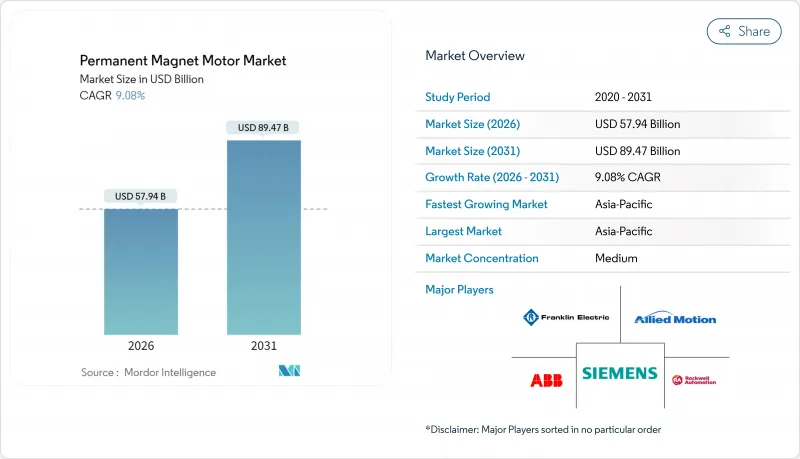
本報告按馬達類型(永磁交流馬達、永磁直流馬達及其他)、磁性材料材料類型(釹鐵硼、釤鈷及其他)、額定功率(4kW以下、4-22kW及其他)、冷卻方式(風冷、液冷及其他)、終端用戶產業(汽車及其他)和地區進行分類。市場預測以美元計價。
全球永磁電機市場趨勢與洞察
利用永磁體提高馬達效率
永磁同步馬達在4-22kW功率範圍內可達到94-97%的額定負載效率,比同類感應馬達設計高出5個百分點。此優勢可將工業領域的投資回收期縮短至18個月以內。在變速運轉模式下,由於繞組電流被磁勵磁所取代,消除了轉子銅損,從而進一步降低了成本。這也符合ISO 50001標準,該標準強調降低部分負載損耗。歐盟生態設計指令於2024年擴大了最低能源效率標準的適用範圍,從而促進了安裝空間有限的冷凍和通風系統的維修。雖然在200kW以上功率範圍內,磁力驅動的成本效益差異有所縮小,但對於諸如再生式起重機等需要頻繁循環運行的特殊應用而言,磁力驅動仍然是一個可行的選擇,因為在這些應用中,頻繁循環運行會顯著增加生命週期成本。
電動車需求不斷成長
預計到2025年,全球電池式電動車產量將達到1,400萬輛,其中78%將採用永磁驅動電機,以實現更高的扭矩密度和能量回收效率。中國汽車製造商目前正透過將發卡式定子與分段式磁轉子結合,顯著降低渦流損耗,即使不使用液冷,也能實現超過150kW的連續功率輸出。特斯拉的「磁阻輔助」設計已將釹的使用量減少了20%,而競爭對手正在加速開發無鏑材料。商用車的需求也不斷增加。戴姆勒卡車和沃爾沃集團計劃在2027年每年生產超過5萬輛電動重型車輛,這將導致每年消耗超過1200噸釹鐵硼磁鐵。
利用永磁發電機擴大可再生能源發電
一項計畫於2025年投入運作的離岸風力發電工程將採用額定功率為12-15兆瓦的直驅式永磁發電機。取消齒輪箱將使渦輪機的運轉率提升至97%以上。維斯塔斯(Vestas)和通用電氣Vernova公司已簽署一份多年期契約,每年供應高達4000噸釹鐵硼(NdFeB)材料,直至2028年。透過以永磁同步發電機取代外露極式發電機來改造水力發電廠,將使部分負載下的效率維修4-6個百分點,預計100兆瓦電廠的年發電量將增加高達20吉瓦時。透過降低發電限制來實現排碳權的貨幣化,將進一步提高該專案在經合組織(OECD)電力市場的經濟可行性。
細分市場分析
預計到2025年,永磁交流馬達將佔總銷售量的48.03%。這反映了永磁交流馬達在工廠自動化和暖通空調(HVAC)系統中的強大應用,在這些領域,由於三相電網和成熟的逆變器生態系統,永磁交流馬達的部署更為便捷。在永磁電機市場,能夠與電動車和協作機器人中的48伏子系統無縫整合的無刷直流馬達正以兩位數的速度快速成長。像大陸集團這樣的製造商正在展示梯形反電動勢曲線,可將半導體開關損耗降低高達12%,這種性能提升縮短了控制器的成本回收週期。在小型電子產品領域,傳統的永磁直流馬達設計仍然存在,但隨著鋰離子電池組電壓的標準化,其市場佔有率正在萎縮。這是因為具有更長使用壽命的無感測器無刷拓撲結構更具優勢。隨著製冷領域的快速成長和熱泵維修需求的增加,全封閉式馬達越來越受到關注,因為它們的密封定子消除了在反覆熱循環過程中冷媒洩漏的途徑。
無刷架構也在改變維護成本。由於沒有電刷,消除了火花和粉塵,延長了對清潔度要求極高的應用(例如食品輸送機和醫用人工呼吸器)的檢修週期。隨著汽車電子產品廣泛採用磁場定向控制 (FOC) 技術,用於車輛輔助系統的無刷平台永磁馬達市場預計將保持成長動能。同時,在需要平滑正弦扭矩且尺寸稍大以符合電磁相容性 (EMC) 標準的併網設備中,永磁交流馬達仍然是首選。因此,我們看到的是平行成長而非完全替代,設計工程師在選擇馬達外形規格時,不僅考慮磁鐵成本,還考慮佔空比和逆變器的複雜程度。
釹鐵硼(NdFeB)永久磁鐵憑藉著超過35 MGOe的能量密度,預計到2025年將維持52.40%的市佔率。此能量密度使得設計人員即使在轉子直徑減小的情況下也能實現所需的扭力目標。然而,奈米複合釹鐵硼永磁體目前在永磁電機市場正經歷快速成長,複合年成長率(CAGR)高達10.04%。這種奈米複合材料透過在晶界析出鋱和鏑,將重稀土元素含量降低近一半,同時矯頑力提高了30%。這些合金能夠幫助原始設備製造商(OEM)應對鏑價格飆升帶來的影響(預計2024-2025年鏑價格漲幅將超過60%),並且即使在高速主軸超過180 度C的環境下也能保證馬達無退磁運行。儘管釤鈷材料的成本約為釹鐵硼的三倍,但由於其在超過 200 度C的溫度下仍具有良好的熱穩定性,航太和國防領域的用戶仍然指定使用釤鈷。鐵氧體雖然能量密度較低,但在電費低於 0.08 美元/千瓦時的地區,家用電器和灌溉泵製造商更青睞鐵氧體,這使得鐵氧體的投資回報閾值高於價格更高的磁體,從而提升了其經濟效益。
奈米複合材料的擴散線需要更嚴格的製程控制和超過1000萬美元的資本投資,但領先透過智慧財產權設置了准入壁壘,阻礙了後進企業。在混合磁阻輔助拓樸結構的普及推動下,鐵氧體永磁馬達的市佔率預計將趨於穩定,不會大幅下滑。這種拓樸結構可以將磁鐵質量降低40%至60%。最終,磁體配置將沿著性能-成本曲線兩極分化:技術要求高的汽車和工業領域將採用奈米複合材料,而優先考慮大規模生產的消費性電子產品製造商則會最佳化並利用鐵氧體。
區域分析
預計到2025年,亞太地區將佔全球銷售額的43.50%,並維持9.58%的複合年成長率,主要得益於中國垂直整合的供應鏈將前置作業時間縮短至八週以內。日本正利用其釤鈷磁鐵技術在航太領域的合約中佔據優勢,不受中國競爭的影響。同時,韓國正投資1.8兆韓元(約13.5億美元)擴大現代汽車和LG項目所需的髮夾式繞組和分段式轉子的產能。在印度,與生產連結獎勵計畫正在加速摩托車和自動三輪車採用1-5kW無刷輪轂式馬達,並透過取代鐵氧體磁體來實現成本目標。
北美和歐洲正大力投資供應鏈本地化。美國國防部已撥款2.85億美元用於國內分離和磁鐵製造設施,目標是到2030年將進口依賴度降低到50%以下。歐盟《關鍵材料法案》規定,到2028年,15%的稀土元素必須在地採購,這推動了從瑞典諾拉-克爾礦到德國回收工廠等多個項目的進展。 《通膨控制法案》的誘因鼓勵汽車製造商使用美國製造的磁體,儘管採購成本高出12%至18%,因為車輛可獲得7,500美元的消費者稅額扣抵。 2030年實現60吉瓦離岸風力發電的目標需要大量的永磁發電機,而價格和數量已透過長期供應合約得到保障。
在中東、非洲和南美洲,選擇性應用正在逐步推進。在沿岸地區的海水淡化廠,高壓泵正在維修為永磁驅動裝置,能耗最多可降低25%。智利和秘魯的銅礦正在進行輸送機和通風系統的維修試驗,每個礦場每年可節省超過1.2吉瓦時的能源。儘管撒哈拉以南非洲市場對價格仍然較為敏感,但無需逆變器成本的太陽能無刷直流灌溉泵正在推廣應用,即使在電網不穩定的地區也能提高作物產量。
其他好處
- Excel格式的市場預測(ME)表
- 3個月的分析師支持
目錄
第1章:引言
- 研究假設和市場定義
- 調查範圍
第2章:調查方法
第3章執行摘要
第4章 市場狀況
- 市場概覽
- 市場促進因素
- 利用永磁體提高馬達效率
- 電動車需求不斷成長
- 嚴格的能源效率法規
- 利用永磁發電機擴大可再生能源發電
- 客製化永磁轉子積層製造技術的進展
- 稀土元素磁鐵供應鏈本地化
- 市場限制因素
- 稀土元素供應減少
- 永磁馬達初始成本高
- 高溫運轉期間有退磁風險
- 地緣政治供應鏈集中風險
- 產業價值鏈分析
- 宏觀經濟因素對市場的影響
- 監理情勢
- 技術展望
- 波特五力分析
第5章 市場規模與成長預測
- 依馬達類型
- 永磁交流電機
- 永磁直流電機
- 無刷直流馬達
- 密封馬達
- 按材料類型
- 釹、鐵、硼
- 釤鈷
- 鐵氧體
- 奈米複合材料NdFeB
- 按類型分類的額定輸出
- 4千瓦或以下
- 4~22kW
- 22~75kW
- 75千瓦或以上
- 透過冷卻法
- 空冷式
- 液冷
- 油冷
- 混合冷卻系統
- 按最終用戶行業分類
- 車
- 工業自動化
- 能源(風能和水力發電)
- 用水和污水管理
- 採礦、石油和天然氣
- 航太/國防
- 家用電子產品
- 醫療設備
- 按地區
- 北美洲
- 美國
- 加拿大
- 墨西哥
- 歐洲
- 英國
- 德國
- 法國
- 義大利
- 其他歐洲國家
- 亞太地區
- 中國
- 日本
- 印度
- 韓國
- 其他亞洲國家
- 中東
- 以色列
- 沙烏地阿拉伯
- 阿拉伯聯合大公國
- 土耳其
- 其他中東國家
- 非洲
- 南非
- 埃及
- 其他非洲國家
- 南美洲
- 巴西
- 阿根廷
- 其他南美國家
- 北美洲
第6章 競爭情勢
- 市場集中度
- 策略趨勢
- 市佔率分析
- 公司簡介
- ABB Ltd.
- Siemens AG
- Nidec Corporation
- Rockwell Automation, Inc.
- Toshiba Corporation
- WEG SA
- Wolong Electric Group
- Mitsubishi Electric Corporation
- Hitachi, Ltd.
- Regal Rexnord Corporation
- TECO Electric and Machinery
- Johnson Electric Holdings Ltd
- Allied Motion Technologies Inc
- Ametek, Inc.
- Franklin Electric Co., Inc.
- Continental AG
第7章 市場機會與未來展望
According to Mordor Intelligence, the permanent magnet motor market stood at USD 57.94 billion in 2026 and is forecast to reach USD 89.47 billion by 2031, translating to a 9.08% CAGR over the period.
This report is Segmented by Motor Type (Permanent Magnet AC Motor, Permanent Magnet DC Motor, and More), Magnetic Material Type (Neodymium Iron Boron, Samarium Cobalt, and More), Power Rating (Up To 4 KW, 4-22 KW, and More), Cooling Method (Air-Cooled, Liquid-Cooled, and More), End-User Industry (Automotive, and More), and Geography. The Market Forecasts are Provided in Terms of Value (USD).
Global Permanent Magnet Motor Market Trends and Insights
Increased Motor Efficiency Due to Permanent Magnets
Permanent-magnet synchronous motors deliver 94-97% full-load efficiency in the 4-22 kW class, outpacing comparable induction designs by up to 5 percentage points, a delta that trims industrial payback periods below 18 months. Variable-speed duty cycles amplify the savings because rotor copper losses disappear when magnet excitation replaces winding current, a fit with ISO 50001 programs that prize low part-load losses. The European Union's Ecodesign Directive widened the scope of minimum efficiency rules in 2024, triggering retrofits in space-constrained refrigeration and ventilation equipment. Above 200 kW the cost-benefit narrows, yet niches such as regenerative cranes still justify magnet adoption where frequent cycling dominates lifecycle cost.
Rising Demand for Electric Vehicles
Global battery-electric output reached 14 million vehicles in 2025, and 78% used permanent-magnet traction motors for superior torque density and regeneration efficiency. Chinese automakers now combine hairpin stators with segmented-magnet rotors to slash eddy losses, enabling continuous ratings above 150 kW without liquid cooling. Tesla's reluctance-assisted design trimmed neodymium content by 20%, prompting rivals to accelerate dysprosium-free chemistries. Commercial fleets amplify demand: Daimler Truck and Volvo Group plan more than 50,000 electric heavy vehicles each year by 2027, absorbing over 1,200 metric tons of NdFeB magnets annually.
Expansion of Renewable Energy Generation Using PM Generators
Offshore wind projects commissioned in 2025 favour direct-drive permanent-magnet generators rated 12-15 MW, eliminating gearboxes and pushing turbine availability above 97%. Vestas and GE Vernova locked in multi-year supply deals covering up to 4,000 metric tons of NdFeB per year through 2028. Hydropower upgrades that replace salient-pole alternators with permanent-magnet synchronous units add 4-6 percentage points of part-load efficiency, boosting generation by up to 20 GWh annually at 100 MW stations. Carbon-credit monetization of reduced curtailment further sweetens project economics in OECD power markets.
Other drivers and restraints analyzed in the detailed report include:
- Stringent Energy-Efficiency Regulations
- Diminishing Availability of Rare-Earth Metals
- High Initial Cost of PM Motors
For complete list of drivers and restraints, kindly check the Table Of Contents.
Segment Analysis
Permanent magnet AC machines generated 48.03% of revenue in 2025, reflecting their entrenched role in factory automation and HVAC installations where three-phase grids and mature inverter ecosystems simplify deployment. The permanent magnet motor market is witnessing double-digit expansion of brushless DC alternatives that pair naturally with 48-volt subsystems in electric vehicles and collaborative robots. Manufacturers like Continental have demonstrated trapezoidal back-EMF profiles that reduce semiconductor switching losses by up to 12%, a performance gain that shortens controller cost recovery cycles. Legacy permanent magnet DC designs linger in small electronics, yet their share contracts as lithium-ion packs standardize around voltages that reward sensorless brushless topologies with longer lifespans. Hermetic motors sit at the intersection of the refrigeration boom and heat-pump retrofits, drawing interest because sealed stators eliminate refrigerant leakage paths during repeated thermal cycling.
Brushless architectures also reshape maintenance economics. Absence of brushes removes sparking and dust, extending overhaul intervals in food-grade conveyors and medical ventilators where cleanliness is paramount. The permanent magnet motor market size for brushless platforms in auxiliary vehicle systems is expected to maintain momentum because onboard electronics already support field-oriented control. Conversely, permanent magnet AC remains favoured in grid-tied equipment that demands smooth sinusoidal torque and accepts slightly larger frames to simplify compliance with electromagnetic compatibility norms. The net effect is parallel growth corridors rather than outright substitution, with design engineers selecting form factors according to duty cycle and inverter sophistication rather than magnet cost alone.
Neodymium-iron-boron retained 52.40% share in 2025, thanks to energy products above 35 MGOe that let designers trim rotor diameters and still hit torque targets. Yet the permanent magnet motor market now tracks a rapid 10.04% CAGR for nanocomposite NdFeB, a chemistry that deposits terbium or dysprosium at grain boundaries, raising coercivity by up to 30% while cutting heavy rare-earth loadings nearly in half. These alloys shield OEMs from dysprosium price spikes that exceeded 60% in 2024-2025, and they allow operation beyond 180 °C in high-speed spindles without demagnetization. Aerospace and defense users still specify samarium-cobalt for thermal stability above 200 °C despite material costs roughly triple those of NdFeB. Ferrite, though lower in energy density, draws appliance and irrigation-pump producers that compete in regions where electricity tariffs sit under USD 0.08 /kWh, extending ROI thresholds beyond premium magnet economics.
Nanocomposite diffusion lines require tighter process controls and capital outlays upward of USD 10 million, but early movers lock in intellectual property barriers that deter fast-follower entry. The permanent magnet motor market share for ferrite will likely stabilize rather than collapse, helped by hybrid reluctance-assisted topologies that allow magnet mass reductions of 40-60%. Ultimately magnet mix bifurcates along performance and cost curves, matching technologically demanding automotive and industrial segments with nanocomposites, while volume-driven appliance makers optimize around ferrite.
Complete Report Scope:
- By Motor Type
- Permanent Magnet AC Motor
- Permanent Magnet DC Motor
- Brushless DC Motor
- Hermetic Motor
- By Magnetic Material Type
- Neodymium Iron Boron
- Samarium Cobalt
- Ferrite
- Nanocomposite NdFeB
- By Power Rating
- Up to 4 kW
- 4-22 kW
- 22-75 kW
- 75 kW and Above
- By Cooling Method
- Air-Cooled
- Liquid-Cooled
- Oil-Cooled
- Hybrid Cooling
- By End-User Industry
- Automotive
- Industrial Automation
- Energy (Wind and Hydro)
- Water and Wastewater Management
- Mining, Oil and Gas
- Aerospace and Defense
- Consumer Electronics
- Healthcare Equipment
- By Geography
- North America
- United States
- Canada
- Mexico
- Europe
- United Kingdom
- Germany
- France
- Italy
- Rest of Europe
- Asia-Pacific
- China
- Japan
- India
- South Korea
- Rest of Asia
- Middle East
- Israel
- Saudi Arabia
- United Arab Emirates
- Turkey
- Rest of Middle East
- Africa
- South Africa
- Egypt
- Rest of Africa
- South America
- Brazil
- Argentina
- Rest of South America
- North America
Geography Analysis
Asia-Pacific generated 43.50% of 2025 revenue and continues at a 9.58% CAGR as China's vertically integrated chain shrinks lead times to under eight weeks. Japan leverages samarium-cobalt prowess for aerospace contracts insulated from Chinese competition, while South Korea channels KRW 1.8 trillion (USD 1.35 billion) into hairpin winding and segmented rotor capacity for Hyundai and LG projects. India, buoyed by production-linked incentives, speeds adoption of 1-5 kW brushless hub motors in two-wheelers and auto-rickshaws that meet cost targets by substituting ferrite magnets.
North America and Europe invest heavily in supply-chain regionalization. The U.S. Department of Defense awarded USD 285 million for domestic separation and magnet facilities aiming to cut import reliance below 50% by 2030. The European Union's Critical Raw Materials Act requires 15% local rare-earth sourcing by 2028, spurring projects from Sweden's Norra Karr mine to German recycling plants. Inflation Reduction Act incentives push automakers toward U.S. magnet content despite a 12-18% procurement premium, since vehicles qualify for USD 7,500 consumer tax credits. Offshore wind ambitions of 60 GW by 2030 require vast permanent-magnet generator volumes, and long-term supply agreements already lock in price and availability.
Middle East and Africa plus South America show selective adoption. Gulf desalination plants retrofit high-pressure pumps with permanent magnet drives that cut energy use by up to 25%. Chilean and Peruvian copper mines trial conveyor and ventilation conversions that save over 1.2 GWh per site per year. Sub-Saharan markets remain price-sensitive but install solar-powered brushless DC irrigation pumps that avoid inverter costs, expanding crop yields where grid service is unreliable.
- ABB Ltd.
- Siemens AG
- Nidec Corporation
- Rockwell Automation, Inc.
- Toshiba Corporation
- WEG S.A.
- Wolong Electric Group
- Mitsubishi Electric Corporation
- Hitachi, Ltd.
- Regal Rexnord Corporation
- TECO Electric and Machinery
- Johnson Electric Holdings Ltd
- Allied Motion Technologies Inc
- Ametek, Inc.
- Franklin Electric Co., Inc.
- Continental AG
Additional Benefits:
- The market estimate (ME) sheet in Excel format
- 3 months of analyst support
TABLE OF CONTENTS
1 INTRODUCTION
- 1.1 Study Assumptions and Market Definition
- 1.2 Scope of the Study
2 RESEARCH METHODOLOGY
3 EXECUTIVE SUMMARY
4 MARKET LANDSCAPE
- 4.1 Market Overview
- 4.2 Market Drivers
- 4.2.1 Increased Motor Efficiency Due to Permanent Magnets
- 4.2.2 Rising Demand for Electric Vehicles
- 4.2.3 Stringent Energy-Efficiency Regulations
- 4.2.4 Expansion of Renewable Energy Generation Using PM Generators
- 4.2.5 Advances in Additive Manufacturing of Custom PM Rotors
- 4.2.6 Regionalization of Rare-Earth Magnet Supply Chains
- 4.3 Market Restraints
- 4.3.1 Diminishing Availability of Rare-Earth Metals
- 4.3.2 High Initial Cost of PM Motors
- 4.3.3 Demagnetization Risk at Elevated Operating Temperatures
- 4.3.4 Geopolitical Supply-Chain Concentration Risk
- 4.4 Industry Value Chain Analysis
- 4.5 Impact of Macroeconomic Factors on the Market
- 4.6 Regulatory Landscape
- 4.7 Technological Outlook
- 4.8 Porter's Five Forces Analysis
- 4.8.1 Threat of New Entrants
- 4.8.2 Bargaining Power of Buyers
- 4.8.3 Bargaining Power of Suppliers
- 4.8.4 Threat of Substitute Products
- 4.8.5 Intensity of Competitive Rivalry
5 MARKET SIZE AND GROWTH FORECASTS (VALUE)
- 5.1 By Motor Type
- 5.1.1 Permanent Magnet AC Motor
- 5.1.2 Permanent Magnet DC Motor
- 5.1.3 Brushless DC Motor
- 5.1.4 Hermetic Motor
- 5.2 By Magnetic Material Type
- 5.2.1 Neodymium Iron Boron
- 5.2.2 Samarium Cobalt
- 5.2.3 Ferrite
- 5.2.4 Nanocomposite NdFeB
- 5.3 By Power Rating
- 5.3.1 Up to 4 kW
- 5.3.2 4-22 kW
- 5.3.3 22-75 kW
- 5.3.4 75 kW and Above
- 5.4 By Cooling Method
- 5.4.1 Air-Cooled
- 5.4.2 Liquid-Cooled
- 5.4.3 Oil-Cooled
- 5.4.4 Hybrid Cooling
- 5.5 By End-User Industry
- 5.5.1 Automotive
- 5.5.2 Industrial Automation
- 5.5.3 Energy (Wind and Hydro)
- 5.5.4 Water and Wastewater Management
- 5.5.5 Mining, Oil and Gas
- 5.5.6 Aerospace and Defense
- 5.5.7 Consumer Electronics
- 5.5.8 Healthcare Equipment
- 5.6 By Geography
- 5.6.1 North America
- 5.6.1.1 United States
- 5.6.1.2 Canada
- 5.6.1.3 Mexico
- 5.6.2 Europe
- 5.6.2.1 United Kingdom
- 5.6.2.2 Germany
- 5.6.2.3 France
- 5.6.2.4 Italy
- 5.6.2.5 Rest of Europe
- 5.6.3 Asia-Pacific
- 5.6.3.1 China
- 5.6.3.2 Japan
- 5.6.3.3 India
- 5.6.3.4 South Korea
- 5.6.3.5 Rest of Asia
- 5.6.4 Middle East
- 5.6.4.1 Israel
- 5.6.4.2 Saudi Arabia
- 5.6.4.3 United Arab Emirates
- 5.6.4.4 Turkey
- 5.6.4.5 Rest of Middle East
- 5.6.5 Africa
- 5.6.5.1 South Africa
- 5.6.5.2 Egypt
- 5.6.5.3 Rest of Africa
- 5.6.6 South America
- 5.6.6.1 Brazil
- 5.6.6.2 Argentina
- 5.6.6.3 Rest of South America
- 5.6.1 North America
6 COMPETITIVE LANDSCAPE
- 6.1 Market Concentration
- 6.2 Strategic Moves
- 6.3 Market Share Analysis
- 6.4 Company Profiles (includes Global Level Overview, Market Level Overview, Core Segments, Financials as Available, Strategic Information, Market Rank/Share for Key Companies, Products and Services, and Recent Developments)
- 6.4.1 ABB Ltd.
- 6.4.2 Siemens AG
- 6.4.3 Nidec Corporation
- 6.4.4 Rockwell Automation, Inc.
- 6.4.5 Toshiba Corporation
- 6.4.6 WEG S.A.
- 6.4.7 Wolong Electric Group
- 6.4.8 Mitsubishi Electric Corporation
- 6.4.9 Hitachi, Ltd.
- 6.4.10 Regal Rexnord Corporation
- 6.4.11 TECO Electric and Machinery
- 6.4.12 Johnson Electric Holdings Ltd
- 6.4.13 Allied Motion Technologies Inc
- 6.4.14 Ametek, Inc.
- 6.4.15 Franklin Electric Co., Inc.
- 6.4.16 Continental AG
7 MARKET OPPORTUNITIES AND FUTURE OUTLOOK
- 7.1 White-Space and Unmet-Need Assessment

 永磁電機市場-2026-2032年全球市場預測
 永磁馬達市場分析及預測(至2035年):類型、產品、技術、組件、應用、材質、最終用戶、功能、安裝類型
 永磁馬達市場規模、佔有率和趨勢分析報告:按馬達類型、磁性材料材料類型、額定功率、冷卻方式、終端用戶產業、地區和細分市場進行預測(2026-2033 年)
 永磁電機市場:按電機類型、磁性材料類型、行業和地區分類
 2026年全球永磁電機市場報告
 永磁電機市場-全球產業規模、佔有率、趨勢、機會和預測:按類型、磁鐵類型、功率範圍、應用、地區和競爭格局分類,2021-2031年永久磁電機線性致動器市場按控制類型、行程長度、額定功率、安裝類型、電壓、最終用途行業和應用分類 - 全球預測 2026-2032
 永磁馬達市場規模、佔有率及成長分析(按類型、磁性材料、額定功率、最終用戶和地區分類)-2026-2033年產業預測
 永磁電機市場-2025年至2030年的預測
 全球永磁馬達市場(至 2030 年):按類型(PMAC、PMDC、無刷直流馬達)、額定功率(小於 25kW、25-100kW、100-300kW、超過 300kW)、最終用戶(工業、商業和家庭、其他)和地區分類