


 |
市場調查報告書
商品編碼
2113268
丁二烯:市場佔有率分析、產業趨勢與統計、成長預測(2026-2031)Butadiene - Market Share Analysis, Industry Trends & Statistics, Growth Forecasts (2026 - 2031) |
||||||

※ 本網頁內容可能與最新版本有所差異。詳細情況請與我們聯繫。
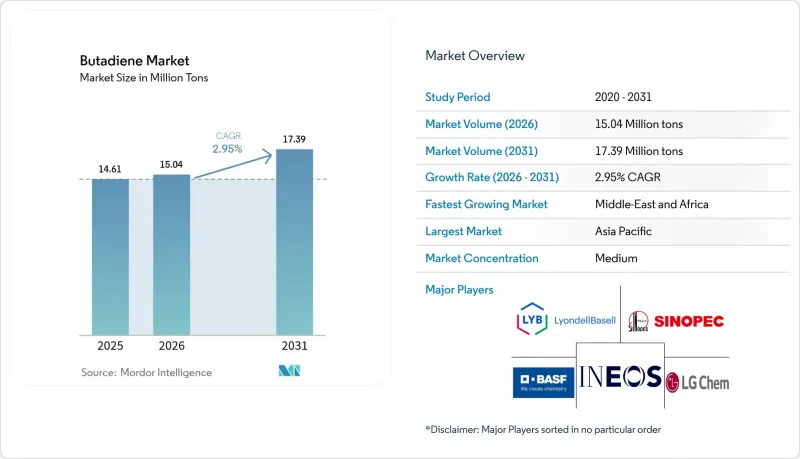
根據 Mordor Intelligence 預測,丁二烯市場將從 2025 年的 1,461 萬噸成長到 2026 年的 1,504 萬噸,然後在 2031 年達到 1,739 萬噸,2026 年至 2031 年的複合年成長率為 2.95%。
本報告按應用領域(聚丁二烯、氯丁橡膠、苯乙烯-丁二烯共聚物、丁腈橡膠、SB乳膠、ABS、己二腈、碸、亞乙基降冰片烯及其他)、終端用戶產業(塑膠及聚合物、輪胎及橡膠、化學及其他)及地區(亞太、北美、歐洲、南美、中東和非洲)進行細分。市場預測以噸為單位。
全球丁二烯市場趨勢與洞察
亞太地區汽車和輪胎產量增加
2024年,亞太地區輪胎產量超過13億條。這一成長主要由中國、印度和日本推動,這三個國家的產量約佔該地區總產量的70%。高順式聚丁二烯佔乘用車輪胎胎面配方的10-15%,直接推高了丁二烯市場的需求。泰國豐富的天然橡膠供應和印尼的摩托車輪胎產業支撐著區域成長,而印度和越南向子午線卡車輪胎的轉型則增加了每條輪胎中合成橡膠的使用量。 2024年,歐盟和英國的進口量年增18%,顯示亞洲生產商即使在成熟市場也能滿足不斷成長的需求。
家用電器對ABS的需求不斷成長
由於ABS樹脂具有優異的衝擊強度和光滑的表面,其價格比高抗衝聚苯乙烯高出15-20%。隨著美國貿易措施於2025年生效,進口電子產品的成本將增加約10%,各大品牌開始在近岸地區組裝以確保獲得國產ABS,這加劇了北美地區丁二烯的供需平衡。由於丁二烯佔ABS成分的20-25%,ABS產量每增加1個百分點,丁二烯的消耗量就會增加0.2-0.25個百分點。此外,汽車內裝件對ABS-聚碳酸酯共混物的需求不斷成長,這種共混物無需添加鹵素添加劑即可滿足嚴格的阻燃標準,這也進一步推動了ABS的出貨量。
毒性及更嚴格的暴露限值
美國職業安全與健康管理局 (OSHA) 規定丁二烯的 8 小時容許暴露限值為 1 ppm,15 分鐘容許偏差限值為 5 ppm。因此,裂解裝置營運商被迫安裝封閉回路型蒸氣回收系統和連續監測設備,每個裝置的成本通常高達 500 萬至 800 萬美元。加州「65 號提案」的標籤要求進一步增加了下游企業的遵循成本。同時,歐洲化學品管理局 (ECHA)提案將職場丁二烯暴露限值設定為 0.5 ppm,僅為美國現行閾值的一半。小規模萃取裝置受到的影響尤其嚴重,這正在推動產業整合,預計到 2026 年,全球丁二烯萃取裝置的數量將減少到約 160 家。
細分市場分析
到2025年,聚丁二烯將佔特定應用領域產量的26.27%,其中高順式等級的聚丁二烯在輪胎胎面和胎側配方中保持穩固地位,可最大限度地提高耐磨性和低溫柔柔軟性。西布爾公司於2024年擴大了在俄羅斯的聚丁二烯產能,而阿朗新科公司正在朱拜勒建設一座年產14萬噸的超高順式等級聚丁二烯工廠,預計將於2026年運作。受家用電器和汽車內裝零件需求的推動,ABS樹脂預計到2031年將以3.94%的複合年成長率成長,這將加劇區域丁二烯市場的供需平衡。苯乙烯-丁二烯橡膠(SBR)仍然是主要輪胎製造商的必需材料,這些製造商優先考慮濕地抓地力和滾動阻力之間的平衡,溶液型SBR正在電動汽車輪胎中逐步取代乳液型SBR。
丁腈橡膠佔汽車密封應用的60%,而新興的氫化丁腈橡膠則瞄準了電動車電池組,這些電池組需持續承受150 度C的熱循環。己二腈由丁二烯氰化製得,是引擎室零件用尼龍6,6的原料。英威達計劃於2024年擴大在北美的產能,以滿足該領域4-5%的年成長率。氯丁橡膠、碸和亞乙基降冰片烯等小規模的市場也有助於維持穩定的需求基礎。 2024年每噸500美元的價格上漲反映了原物料和能源成本的上升。
區域分析
預計到2025年,亞太地區將佔全球產量的51.62%。這主要得益於中國丙烷脫氫(PDH)裝置的產能較2022年成長77%,在丙烷石腦油價差超過每噸150美元的情況下,其專用生產成本比石腦油裂解裝置的平均生產成本低10-15%。樂天化學計畫在2024年將其萃取產能擴大至每年21萬噸,而信實工業計畫在2030年將其位於賈姆訥格爾的工廠產能提高70萬噸,並整合生物石腦油。儘管產能有所提高,但現貨價格在2024年初跌破每噸900美元,迫使中國生產商以折扣價出口,這給中東和北美的競爭對手帶來了壓力。日本和韓國正在削減產量ZEON計劃在2026會計年度減少德山的彈性體生產線——而樂天-宇部在馬來西亞的合資企業也因多年來利潤率的壓力而萎縮。
中東和非洲地區預計將以5.89%的複合年成長率成長,主要得益於沙烏地阿拉伯批准的Sipchem和利安德巴塞爾(LyondellBasell)混合原料裂解裝置。該裝置年產能將達到150萬噸乙烯和180萬噸包括丁二烯在內的衍生物,並於2025年2月獲得最終投資決定(FID)。計劃於2030年完工的塔斯尼(Tasni)330萬噸石化聯合體,以及阿布達比國家石油公司(ADNOC)對科思創(Covestro)等專業資產的收購,都體現了該地區透過一體化平台實現聯產氣商業化的努力。海灣合作理事會(GCC)化學產業的收入預計將從2023年的858億美元增至2030年的1,333億美元,這將為下游產業多元化發展帶來的丁二烯需求成長奠定基礎。
北美和歐洲正面臨利潤率和資產合理化的壓力。殼牌公司於2023年將其位於蓋斯馬的萃取工廠出售給了英力士集團,而Versalis公司則於2024年關閉了其位於格蘭傑茅斯的年產10.5萬噸的聚丁二烯生產線,原因是該地區的能源成本表現優於其他地區。固特異公司宣佈出售其位於博蒙特和休士頓的化學資產,作為一項13億美元成本削減計劃的一部分,這凸顯了通用彈性體向高附加價值高性能輪胎的轉變。 2025年第一季,歐洲輪胎產量增加了3%,但2024年從中國的輪胎進口量激增了18%,凸顯了區域製造商面臨的競爭挑戰。南美洲雖然貢獻仍然較小,但受益於阿朗新科位於特里溫福的工廠產能的提升以及接近性天然橡膠種植園的地理優勢,這有利於橡膠的混煉。
其他好處:
- Excel格式的市場預測(ME)表
- 3個月的分析師支持
目錄
第1章:引言
- 研究的先決條件
- 調查範圍
第2章:調查方法
第3章執行摘要
第4章 市場狀況
- 市場概覽
- 市場促進因素
- 亞太地區汽車和輪胎產量增加
- 家用電器對ABS的需求不斷成長
- 採用高性能S-SBR作為電動車材料
- 生物丁二烯生產能力快速擴張
- 利用丁苯橡膠(SBR)製備鋰離子電池黏結劑
- 市場限制因素
- 收緊毒性和暴露限值
- 原油價格波動
- 中國的產能過剩正在給利潤率帶來壓力。
- 價值鏈分析
- 波特五力模型
- 原料分析
- 技術趨勢概述
第5章 市場規模與成長預測
- 透過使用
- 聚丁二烯(PBR)
- 氯丁二烯
- 苯乙烯-丁二烯(SBR)
- 丁腈橡膠(丙烯腈丁二烯橡膠,NBR)
- SB 乳膠
- 丙烯腈丁二烯苯乙烯(ABS)
- 己二腈
- 硫烷
- 乙二烯降冰片烯
- 其他
- 按最終用戶行業分類
- 塑膠和聚合物
- 輪胎和橡膠
- 化學品
- 其他
- 按地區
- 亞太地區
- 中國
- 印度
- 日本
- 韓國
- 東南亞國協
- 其他亞太國家
- 北美洲
- 美國
- 加拿大
- 墨西哥
- 歐洲
- 德國
- 法國
- 英國
- 義大利
- 俄羅斯
- 其他歐洲國家
- 南美洲
- 巴西
- 阿根廷
- 其他南美國家
- 中東和非洲
- 沙烏地阿拉伯
- 南非
- 其他中東和非洲國家
- 亞太地區
第6章 競爭情勢
- 市場集中度
- 策略趨勢
- 市佔率和排名分析
- 公司簡介
- BASF
- Braskem
- China National Petroleum Corporation
- China Petroleum & Chemical Corporation
- Dow
- ENEOS Materials Corporation
- Evonik Industries AG
- Exxon Mobil Corporation
- Formosa Plastics Corporation
- INEOS
- LG Chem
- LOTTE CHEMICAL TITAN HOLDING BERHAD
- LyondellBasell Industries Holdings BV
- Reliance Industries Limited
- Repsol
- Shell plc
- SABIC
- TPC Group
- ARLANXEO
第7章 市場機會與未來展望
According to Mordor Intelligence, the butadiene market size is expected to grow from 14.61 million tons in 2025 to 15.04 million tons in 2026 and is forecast to reach 17.39 million tons by 2031 at 2.95% CAGR over 2026-2031.
This report is Segmented by Application (Polybutadiene, Chloroprene, Styrene-Butadiene, Nitrile Rubber, SB Latex, ABS, Adiponitrile, Sulfolane, Ethylidene Norbornene, and Others), End-User Industry (Plastic and Polymer, Tire and Rubber, Chemical, and Others), and Geography (Asia-Pacific, North America, Europe, South America, and Middle East and Africa). Market Forecasts are Provided in Terms of Volume (tons).
Global Butadiene Market Trends and Insights
Rising Automotive and Tire Production in Asia-Pacific
Asia-Pacific tire output surpassed 1.3 billion units in 2024, supported by China, India, and Japan, which jointly contributed about 70% of regional volume. High-cis polybutadiene accounts for 10-15% of passenger-tire tread formulations, thereby directly increasing butadiene market demand. Thailand's strong natural-rubber supply and Indonesia's motorcycle-tire ecosystem underpin regional growth, while India and Vietnam's shift toward radial truck tires increases synthetic-rubber use per unit. Imports into the European Union and the United Kingdom increased by 18% year-over-year in 2024, indicating that Asian producers are capturing incremental demand even in mature markets.
Expanding ABS Demand from Consumer Electronics
ABS resin maintains a 15-20% price premium over high-impact polystyrene because it offers superior impact strength and a smoother surface finish. US trade measures enacted in 2025 lifted landed costs for imported electronics by roughly 10%, prompting brands to nearshore assembly and secure domestic ABS, tightening butadiene balances in North America. Because butadiene accounts for 20-25% of ABS composition, each incremental percentage point of ABS output drives 0.2-0.25 percentage points of additional butadiene consumption. Automotive interior-trim growth further supports ABS volumes, as ABS-polycarbonate blends meet stringent flame-retardancy standards without the use of halogenated additives.
Toxicity and Tightening Exposure Limits
The US Occupational Safety and Health Administration enforces an 8-hour permissible exposure limit of 1 ppm and a 15-minute excursion limit of 5 ppm for butadiene, prompting cracker operators to install closed-loop vapor-recovery systems and continuous monitors, often costing USD 5-8 million per facility. California's Proposition 65 labeling requirements add downstream compliance expenses, while the European Chemicals Agency is proposing a 0.5 ppm workplace limit, half the current US threshold. Smaller extraction units are disproportionately impacted, driving consolidation and trimming the global count of butadiene extraction facilities to an estimated 160 by 2026.
Other drivers and restraints analyzed in the detailed report include:
- EV-Ready High-Performance S-SBR Adoption
- Rapid Capacity Additions in Bio-Butadiene
- Crude-Oil Price Volatility
For complete list of drivers and restraints, kindly check the Table Of Contents.
Segment Analysis
Polybutadiene captured 26.27% of 2025 application volume, confirming its entrenched role in tire tread and sidewall formulations where high-cis grades maximize abrasion resistance and cold-weather flexibility. SIBUR expanded its Russian polybutadiene capacity in 2024, while ARLANXEO is building a 140,000-ton-per-year ultra-high-cis facility in Jubail, slated for a 2026 start-up. ABS resins are projected to advance at a 3.94% CAGR to 2031, driven by demand for consumer electronics and automotive interior trim, which is expected to tighten regional butadiene market balances. Styrene-butadiene rubber remains vital for mainstream tire producers that balance wet grip and rolling resistance; solution grades are steadily displacing emulsion types in EV fitments.
Nitrile rubber accounts for 60% of automotive seal applications, while emerging hydrogenated nitrile rubbers target EV battery packs that face sustained 150°C thermal cycling. Adiponitrile produced from butadiene cyanation feeds nylon 6,6 for under-hood components, with Invista increasing its North American capacity in 2024 to meet a 4-5% annual growth in this segment. Smaller outlets, such as chloroprene rubber, sulfolane, and ethylidene norbornene, help maintain a stable baseline demand; price rises of USD 500 per ton in 2024 reflected higher feedstock and energy costs.
Complete Report Scope:
- By Application
- Polybutadiene (PBR)
- Chloroprene
- Styrene-Butadiene (SBR)
- Nitrile Rubber (Acrylonitrile Butadiene NBR)
- SB Latex
- Acrylonitrile Butadiene Styrene (ABS)
- Adiponitrile
- Sulfolane
- Ethylidene Norbornene
- Others
- By End-user Industry
- Plastic and Polymer
- Tire and Rubber
- Chemical
- Others
- By Geography
- Asia-Pacific
- China
- India
- Japan
- South Korea
- ASEAN Countries
- Rest of Asia-Pacific
- North America
- United States
- Canada
- Mexico
- Europe
- Germany
- France
- United Kingdom
- Italy
- Russia
- Rest of Europe
- South America
- Brazil
- Argentina
- Rest of South America
- Middle East and Africa
- Saudi Arabia
- South Africa
- Rest of Middle-East and Africa
- Asia-Pacific
Geography Analysis
The Asia-Pacific region represented 51.62% of the 2025 volume, thanks to Chinese PDH complexes that added capacity 77% above 2022 levels, enabling on-purpose production costs 10-15% below naphtha-cracker averages when propane-naphtha spreads widen beyond USD 150 per ton. Lotte Chemical increased its extraction capacity to 210,000 tons per year in 2024, while Reliance Industries plans a 0.7-million-ton expansion at Jamnagar, featuring bio-naphtha integration, by 2030. Despite capacity gains, spot prices dipped below USD 900 per ton in early 2024, compelling Chinese producers to export at discounts that squeezed Middle Eastern and North American competitors. Japan and South Korea are curbing output-Zeon intends to reduce Tokuyama elastomer lines in fiscal 2026-and the Lotte-Ube JV in Malaysia is winding down after years of margin pressure.
Middle East & Africa is projected to grow at a 5.89% CAGR, led by Saudi approvals for a Sipchem-LyondellBasell mixed-feed cracker capable of 1.5 million tons of ethylene and 1.8 million tons of derivatives, including butadiene, with a final investment decision reached in February 2025. Tasnee's 3.3 million-ton petrochemical complex, due by 2030, and ADNOC's bid to acquire specialty assets, such as Covestro, illustrate the region's move to monetize associated gas via integrated platforms. Gulf Cooperation Council chemical revenue is forecast to climb from USD 85.8 billion in 2023 to USD 133.3 billion by 2030, anchoring incremental butadiene demand tied to downstream diversification.
North America and Europe contend with margin compression and asset rationalization. Shell sold its Geismar extraction unit to INEOS in 2023, and Versalis shuttered its 105,000-ton polybutadiene line at Grangemouth in 2024 as energy costs outstripped peer regions. Goodyear's announced divestiture of its Beaumont and Houston chemical assets under a USD 1.3 billion cost-reduction program underscores the shift toward higher-value performance tires over commodity elastomers. European tire output rose 3% in Q1 2025, but Chinese tire imports surged 18% in 2024, highlighting competitiveness challenges for regional producers. South America remains a smaller contributor but benefits from ARLANXEO's expanded Triunfo capacity and proximity to natural-rubber plantations that facilitate blended formulations.
- BASF
- Braskem
- China National Petroleum Corporation
- China Petroleum & Chemical Corporation
- Dow
- ENEOS Materials Corporation
- Evonik Industries AG
- Exxon Mobil Corporation
- Formosa Plastics Corporation
- INEOS
- LG Chem
- LOTTE CHEMICAL TITAN HOLDING BERHAD
- LyondellBasell Industries Holdings BV
- Reliance Industries Limited
- Repsol
- Shell plc
- SABIC
- TPC Group
- ARLANXEO
Additional Benefits:
- The market estimate (ME) sheet in Excel format
- 3 months of analyst support
TABLE OF CONTENTS
1 Introduction
- 1.1 Study Assumptions
- 1.2 Scope of the Study
2 Research Methodology
3 Executive Summary
4 Market Landscape
- 4.1 Market Overview
- 4.2 Market Drivers
- 4.2.1 Rising automotive and tire production in Asia-Pacific
- 4.2.2 Expanding ABS demand from consumer electronics
- 4.2.3 EV-ready high-performance S-SBR adoption
- 4.2.4 Rapid capacity additions in bio-butadiene
- 4.2.5 Growth of Li-ion battery binders using SBR
- 4.3 Market Restraints
- 4.3.1 Toxicity and tightening exposure limits
- 4.3.2 Crude-oil price volatility
- 4.3.3 China overcapacity depressing margins
- 4.4 Value Chain Analysis
- 4.5 Porter's Five Forces
- 4.5.1 Bargaining Power of Suppliers
- 4.5.2 Bargaining Power of Buyers
- 4.5.3 Threat of New Entrants
- 4.5.4 Threat of Substitutes
- 4.5.5 Degree of Competition
- 4.6 Feedstock Analysis
- 4.7 Technological snapshot
5 Market Size & Growth Forecasts (Volume)
- 5.1 By Application
- 5.1.1 Polybutadiene (PBR)
- 5.1.2 Chloroprene
- 5.1.3 Styrene-Butadiene (SBR)
- 5.1.4 Nitrile Rubber (Acrylonitrile Butadiene NBR)
- 5.1.5 SB Latex
- 5.1.6 Acrylonitrile Butadiene Styrene (ABS)
- 5.1.7 Adiponitrile
- 5.1.8 Sulfolane
- 5.1.9 Ethylidene Norbornene
- 5.1.10 Others
- 5.2 By End-user Industry
- 5.2.1 Plastic and Polymer
- 5.2.2 Tire and Rubber
- 5.2.3 Chemical
- 5.2.4 Others
- 5.3 By Geography
- 5.3.1 Asia-Pacific
- 5.3.1.1 China
- 5.3.1.2 India
- 5.3.1.3 Japan
- 5.3.1.4 South Korea
- 5.3.1.5 ASEAN Countries
- 5.3.1.6 Rest of Asia-Pacific
- 5.3.2 North America
- 5.3.2.1 United States
- 5.3.2.2 Canada
- 5.3.2.3 Mexico
- 5.3.3 Europe
- 5.3.3.1 Germany
- 5.3.3.2 France
- 5.3.3.3 United Kingdom
- 5.3.3.4 Italy
- 5.3.3.5 Russia
- 5.3.3.6 Rest of Europe
- 5.3.4 South America
- 5.3.4.1 Brazil
- 5.3.4.2 Argentina
- 5.3.4.3 Rest of South America
- 5.3.5 Middle East and Africa
- 5.3.5.1 Saudi Arabia
- 5.3.5.2 South Africa
- 5.3.5.3 Rest of Middle-East and Africa
- 5.3.1 Asia-Pacific
6 Competitive Landscape
- 6.1 Market Concentration
- 6.2 Strategic Moves
- 6.3 Market Share(%)/Ranking Analysis
- 6.4 Company Profiles (includes Global level Overview, Market level overview, Core Segments, Financials as available, Strategic Information, Market Rank/Share, Products & Services, Recent Developments)
- 6.4.1 BASF
- 6.4.2 Braskem
- 6.4.3 China National Petroleum Corporation
- 6.4.4 China Petroleum & Chemical Corporation
- 6.4.5 Dow
- 6.4.6 ENEOS Materials Corporation
- 6.4.7 Evonik Industries AG
- 6.4.8 Exxon Mobil Corporation
- 6.4.9 Formosa Plastics Corporation
- 6.4.10 INEOS
- 6.4.11 LG Chem
- 6.4.12 LOTTE CHEMICAL TITAN HOLDING BERHAD
- 6.4.13 LyondellBasell Industries Holdings BV
- 6.4.14 Reliance Industries Limited
- 6.4.15 Repsol
- 6.4.16 Shell plc
- 6.4.17 SABIC
- 6.4.18 TPC Group
- 6.4.19 ARLANXEO
7 Market Opportunities and Future Outlook
- 7.1 White-space and Unmet-need Assessment

 丁二烯市場:全球市場預測,2026-2032年合成與生物基丁二烯市場:依原料類型、技術、純度及最終用途產業分類-2026-2032年全球預測
 1,3-丁二烯全球市場規模、佔有率、趨勢和成長分析報告(2026-2034年)2026-2034年合成丁二烯和生物基丁二烯全球市場規模、佔有率、趨勢和成長分析報告
 2026年丁二烯全球市場報告
 丁二烯市場 - 全球產業規模、佔有率、趨勢、機會及預測(按產品類型、最終用戶、地區和競爭格局分類,2021-2031年)
 1,3-丁二烯的全球市場全球合成丁二烯和生物基丁二烯市場按產品類型、應用、最終用戶、區域範圍和預測
 全球丁二烯市場,需求分析,按類型、應用及預測分析(2034年)
 丁二烯市場規模、佔有率及成長分析(按應用程式、最終用戶和地區)-2025-2032 年產業預測