


 |
市場調查報告書
商品編碼
2113237
汽車導航系統:市場佔有率分析、產業趨勢與統計、成長預測(2026-2031)Automotive Navigation System - Market Share Analysis, Industry Trends & Statistics, Growth Forecasts (2026 - 2031) |
||||||

※ 本網頁內容可能與最新版本有所差異。詳細情況請與我們聯繫。
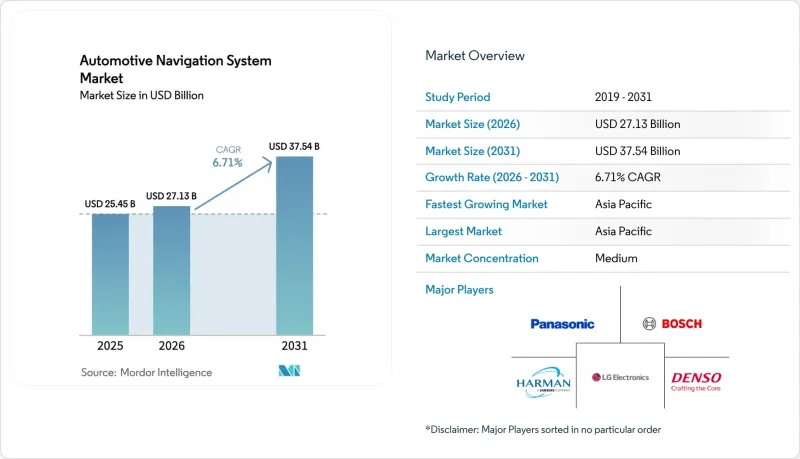
根據 Mordor Intelligence 預測,汽車導航系統市場規模將從 2025 年的 254.5 億美元成長到 2026 年的 271.3 億美元,到 2031 年達到 375.4 億美元,在預測期(2026-2031 年)內複合年成長率為 6.71%。
本報告按設備類型(例如,儀錶板整合導航系統、可攜式導航設備)、技術(例如,2D地圖)、車輛類型(例如,乘用車、商用車)、組件(例如,硬體)、連接方式(例如,嵌入式系統)、銷售管道(例如,OEM 安裝系統)和地區進行細分。市場預測以美元計價。
全球汽車導航系統市場趨勢及洞察
對聯網汽車和自動駕駛汽車的需求日益成長
到2025年,歐洲和北美地區出貨的大部分車輛都將配備嵌入式連接模組,這將進一步拓展以導航為中心的駕駛輔助功能的部署平台。如今,以厘米級車道形狀定義的高清地圖已成為主動式車距維持定速系統、車道維持輔助和自動泊車的基礎,導航功能也正從簡單的路線引導轉變為定位的核心。特斯拉的軟體能夠在感測器工作之前讀取道路拓撲結構,從而將都市區的能源效率提高8%至12%。汽車製造商正在優先選擇能夠將地圖、定位和路線規劃整合到單一技術堆疊中的供應商,加速整個汽車導航系統市場的垂直整合。能夠預測路況而非被動因應的預測能力正成為一項差異化優勢,為L2+等級和未來的L3級自動駕駛項目提供支援。
工廠預裝資訊娛樂/導航設備的普及率
2025年,在日本、歐洲和北美,原廠導航系統的普及率大幅提升,這主要得益於資訊娛樂系統捆綁銷售策略,使得每輛車的額外硬體成本低於50美元。歐盟的《通用安全法規》強制要求車輛具備基於地圖的限速辨識功能,進一步強化了嵌入式導航系統的角色。像Harman Ignite之類的平台整合了語音助理和電子商務功能,不僅能夠將用戶留在OEM生態系統中,還能透過應用程式帶來持續的收入。隨著價格溢價的降低以及與ADAS(高級駕駛輔助系統)整合度的提高,嵌入式系統正在從智慧型手機手中奪回汽車導航系統市場佔有率。
免費智慧型手機導航替代方案
谷歌地圖和蘋果地圖提供免費路線導航、頻繁更新和日曆整合,到2025年,美國駕駛員很可能更傾向於使用智慧型手機而非車載導航系統。這些服務在攜帶式導航設備市場的主導地位正在崩壞,預計Garmin的銷量在2020年至2025年間將下降42%。汽車製造商正透過整合CarPlay和Android Auto來應對這項挑戰,但這讓他們失去了對介面控制權和資料變現的機會。智慧型手機的便利性和普遍認為的功能與車載導航系統相當,這仍然是車載導航系統市場,尤其是價格敏感型細分市場的一大阻力。
細分市場分析
到2025年,基於智慧型手機的解決方案憑藉其熟悉的介面和較低的額外成本,在車載導航系統市場將維持48.11%的市場佔有率。同時,隨著汽車製造商將導航系統與ADAS(高級駕駛輔助系統)整合,而ADAS需要車輛最佳化定位,預計到2031年,整合於儀錶板的車載導航系統將以12.84%的複合年成長率成長。預計到2031年,整合於儀錶板的車載導航系統市場規模將達到189億美元,反映出原廠安裝系統的日益普及。可攜式範圍已縮小至小眾商業應用,但在設備便攜性至關重要的場合,它們仍然很受歡迎。
可靠性和與感測器的深度整合使嵌入式平台能夠提供獨特的價值提案。 Alpine 的「Halo 11」即使在智慧型手機未連接的情況下也能提供持續導航,滿足了專業駕駛員的需求。 Pioneer 將 Alexa 語音控制整合到車載系統中,展現了消費性物聯網生態系統與車輛功能的融合。空中下載 (OTA) 更新縮小了智慧型手機和車輛之間地圖資訊的差距,有助於汽車導航系統市場佔有率的逐步恢復。
傳統的2D地圖資料需求低、硬體相容性廣,預計2025年將佔據車載導航系統市場51.63%的佔有率。擴增實境(AR)導航預計將以24.72%的複合年成長率成長,為高階市場開闢新的收入來源。隨著抬頭顯示器(HUD)的普及,預計到2031年,支援AR功能的車載導航系統市場規模將超過50億美元。
大陸集團的AR-HUD透過將全彩影像投射到駕駛員影像中130公分(51吋)寬、60公分(23吋)高的區域,模擬7.5公尺(24英尺9吋)的光學距離,從而減少駕駛者的注意力分散。 WayRay的全像投影機即使在陽光下也能投射出清晰可見的全彩影像,目前已應用於梅賽德斯-賓士EQS車型。Panasonic為其添加了眼動追蹤功能,以保持精確的顯示定位,凸顯了這項技術的快速發展。雖然3D地圖和語音導航仍然很重要,但沉浸式AR疊加顯示技術正處於下一波競爭的前沿。
區域分析
預計到2025年,亞太地區將佔據汽車導航系統市場33.48%的佔有率,並在2031年以6.93%的複合年成長率超越其他所有地區。印度對支援NavIC的接收器提供的補貼正在推動本土供應商的成長。儘管這些趨勢促進了本土創新,但外國供應商必須遵守資料主權法規才能在汽車導航系統市場中獲得佔有率。
到2025年,北美將佔據全球第二大市場。通用汽車(GM)計劃逐步淘汰CarPlay,轉而使用其自主研發的Ultifi系統,這表明其策略正在轉變。福特的BlueCruise系統利用嵌入式地圖來分類免持區域,凸顯了導航在其ADAS(高級駕駛輔助系統)品牌中的作用。在加拿大,一項天氣疊加功能正在試點中,旨在減少冬季交通事故,這表明當地情況如何影響產品優先順序。
強制性電子呼叫和高階汽車的高滲透率構成了歐洲市場的基礎。累計到2025年,大陸集團的導航和資訊娛樂業務銷售額將達到38億歐元,反映出一級供應商的強勁需求。英國計劃於2030年禁止銷售內燃機汽車,預計將加速電動車專用導航系統的普及,捷豹路虎的「Pivi Pro」系統就著重強調了續航里程預測功能。法國米其林收購了Sygic 30%的股份,顯示各細分市場正在不斷融合。
其他好處:
- Excel格式的市場預測(ME)表
- 3個月的分析師支持
目錄
第1章:引言
- 研究假設和市場定義
- 調查範圍
第2章:調查方法
第3章執行摘要
第4章 市場狀況
- 市場概覽
- 市場促進因素
- 對聯網汽車和自動駕駛汽車的需求日益成長
- 正品資訊娛樂/導航單元的普及率
- 透過電子呼叫和先進安全標準的相關法規進行推廣
- 一種考慮續航里程的路線搜尋演算法,專門針對電動車。
- 透過訂閱制線上旅行社的地圖更新獲得收入。
- 採用低成本雙頻GNSS+IMU,精度提升
- 市場限制因素
- 免費智慧型手機導航替代應用
- 硬體和軟體開發成本高昂
- GNSS欺騙和網路攻擊的法律責任
- 資料主權法限制了雲地圖繪製。
- 價值供應鏈分析
- 監理情勢
- 技術展望
- 波特五力模型
第5章 市場規模與成長預測
- 依設備類型
- 儀錶板整合式導航系統
- 可攜式導航設備(PND)
- 基於智慧型手機的導航
- 透過技術
- QR 圖
- 3D地圖
- 語音導航
- 擴增實境(AR)導航
- 車輛類型
- 搭乘用車
- 商用車輛
- 按組件
- 硬體
- 軟體
- 服務
- 連結性別
- 嵌入式系統
- 連接系統
- 透過分銷管道
- OEM安裝的系統
- 售後系統
- 按地區
- 北美洲
- 美國
- 加拿大
- 其他北美國家
- 南美洲
- 巴西
- 阿根廷
- 其他南美國家
- 歐洲
- 德國
- 英國
- 法國
- 義大利
- 西班牙
- 其他歐洲國家
- 亞太地區
- 中國
- 印度
- 日本
- 韓國
- 其他亞太國家
- 中東和非洲
- 阿拉伯聯合大公國
- 沙烏地阿拉伯
- 南非
- 土耳其
- 其他中東和非洲國家
- 北美洲
第6章 競爭情勢
- 市場集中度
- 策略趨勢
- 市佔率分析
- 公司簡介
- TomTom International BV
- HERE Technologies
- Garmin Ltd.
- Continental AG
- Denso Corporation
- Robert Bosch GmbH
- Alpine Electronics
- Pioneer Corporation
- Mitsubishi Electric Corp.
- Aisin AW Co.
- Harman International
- JVCKENWOOD Corp.
- Panasonic Holdings Corporation
- Sony Group Corp.
- Visteon Corp.
- Faurecia Clarion
- LG Electronics Inc.
- Apple Inc.(CarPlay)
- Google LLC(Android Auto/Maps)
- WayRay AG
第7章 市場機會與未來展望
According to Mordor Intelligence, the automotive navigation system market is expected to grow from USD 25.45 billion in 2025 to USD 27.13 billion in 2026 and is forecast to reach USD 37.54 billion by 2031, growing at a 6.71% CAGR over the forecast period (2026-2031).
This report is Segmented by Device Type (In-Dash Navigation Systems, Portable Navigation Devices, and More), Technology (2D Maps, and More), Vehicle Type (Passenger Cars, Commercial Vehicles), Component (Hardware, and More), Connectivity (Embedded Systems, and More), Distribution Channel (OEM-Installed Systems, and More), and Geography. The Market Forecasts are Provided in Terms of Value (USD).
Global Automotive Navigation System Market Trends and Insights
Rising Demand for Connected and Autonomous-Ready Vehicles
The majority of vehicles in Europe and North America shipped with embedded connectivity modules in 2025, creating a larger installed base for navigation-centric driver-assistance functions. High-definition maps with centimeter-level lane geometry now underpin adaptive cruise, lane keeping, and automated parking, shifting navigation from simple routing to a localization backbone. Tesla's software loads the road topology before sensors, improving urban energy efficiency by 8-12%. Automakers favor suppliers that can integrate mapping, localization, and path-planning into a single stack, thereby accelerating vertical integration across the automotive navigation system market. Predictive capabilities that anticipate road conditions rather than reacting to them are becoming a differentiator, supporting Level 2+ and future Level 3 autonomy programs.
Penetration of Factory-Fitted Infotainment/Navigation Units
Factory-fit navigation penetration in Japan, Europe, and North America surged in 2025, driven by bundled infotainment strategies that lower incremental hardware cost to under USD 50 per vehicle. The EU's General Safety Regulation mandates speed limit recognition based on map data, further solidifying the role of embedded units. Platforms such as Harman Ignite integrate voice assistants and e-commerce, locking users into OEM ecosystems and generating recurring revenue from apps. Lower price premiums and tighter ADAS coupling mean that embedded systems are increasingly recapturing share from smartphones within the automotive navigation system market.
Free Smartphone-Navigation Substitutes
Google Maps and Apple Maps offer free routing, frequent updates, and calendar integration, leading the United States drivers to prefer phones over embedded systems in 2025. Their dominance in the portable navigation device segment collapsed, pushing Garmin's revenue down 42% between 2020 and 2025. Automakers respond by integrating CarPlay and Android Auto, yet doing so surrenders control of the interface and data monetization. The convenience and perceived parity of smartphones continue to be a headwind for the automotive navigation system market, particularly in price-sensitive segments.
Other drivers and restraints analyzed in the detailed report include:
- Regulatory Push for e-Call and Advanced Safety Compliance
- EV-Specific Range-Aware Routing Algorithms
- High Hardware and Software Development Costs
For complete list of drivers and restraints, kindly check the Table Of Contents.
Segment Analysis
Smartphone-based solutions retained 48.11% of the automotive navigation system market share in 2025, benefitting from familiar interfaces and zero incremental cost. In-dash systems, however, are forecast to grow at a 12.84% CAGR through 2031 as automakers integrate navigation with ADAS that demands vehicle-calibrated positioning. The automotive navigation system market size for in-dash units is projected to reach USD 18.9 billion by 2031, reflecting the rising penetration of factory-fit units. Portables have shrunk to niche commercial use but persist where device mobility matters.
Reliability and deeper sensor integration give embedded platforms a unique value proposition. Alpine's Halo11 continues to provide guidance even when smartphones are disconnected, satisfying professional drivers. Pioneer's integration of Alexa voice control demonstrates convergence between consumer IoT ecosystems and vehicle functions. Over-the-air updates narrow the map freshness gap with phones, supporting the gradual reclaiming of share inside the automotive navigation system market.
Traditional 2D maps held a 51.63% market share in the automotive navigation system market in 2025, driven by their low data requirements and broad hardware compatibility. Augmented-reality navigation will expand at a 24.72% CAGR, unlocking new revenue pockets in premium segments. The automotive navigation system market size for AR-enabled solutions is expected to surpass USD 5 billion by 2031 as head-up displays proliferate.
Continental's AR-HUD projects full-color graphics onto the real road view in a 130 cm (51 in) wide by 60 cm (23 in) high segment of the driver's field of vision, simulating an optical distance of 7.5 m (24 ft 9 in). distance, reducing driver distraction. WayRay's holographic projector delivers full-color images visible in sunlight and is currently implemented in Mercedes-Benz EQS models. Panasonic adds eye-tracking to maintain alignment, highlighting the rapid evolution of this feature. While 3D maps and voice guidance remain important, AR's immersive overlay positions it as the next competitive frontier.
Complete Report Scope:
- By Device Type
- In-Dash Navigation Systems
- Portable Navigation Devices (PNDs)
- Smartphone-Based Navigation
- By Technology
- 2D Maps
- 3D Maps
- Voice-Guided Navigation
- Augmented Reality Navigation
- By Vehicle Type
- Passenger Cars
- Commercial Vehicles
- By Component
- Hardware
- Software
- Services
- By Connectivity
- Embedded Systems
- Connected Systems
- By Distribution Channel
- OEM-Installed Systems
- Aftermarket Systems
- By Geography
- North America
- United States
- Canada
- Rest of North America
- South America
- Brazil
- Argentina
- Rest of South America
- Europe
- Germany
- United Kingdom
- France
- Italy
- Spain
- Rest of Europe
- Asia-Pacific
- China
- India
- Japan
- South Korea
- Rest of Asia-Pacific
- Middle East and Africa
- United Arab Emirates
- Saudi Arabia
- South Africa
- Turkey
- Rest of Middle-East and Africa
- North America
Geography Analysis
The Asia-Pacific region held a 33.48% share of the automotive navigation system market in 2025 and is projected to outpace all other areas with a 6.93% CAGR through 2031. India's subsidies for NavIC-compatible receivers stimulate domestic supplier growth. These dynamics boost local innovation, although foreign vendors must navigate data-sovereignty rules to capture share inside the automotive navigation system market.
North America commanded the second-highest share in 2025. General Motors plans to phase out CarPlay in favor of its Ultifi stack, signaling a strategic pivot. Ford's BlueCruise relies on embedded maps to designate hands-free zones, illustrating the role of navigation in ADAS branding. Canada pilots weather-overlay features that reduce winter accidents, demonstrating how regional conditions influence product priorities.
E-call mandates and a high density of premium vehicles underpin the European market. Continental generated EUR 3.8 billion from navigation and infotainment in 2025, reflecting robust demand from Tier 1. The U.K.'s impending 2030 ICE ban is expected to accelerate the uptake of EV-specific navigation systems, with JLR's Pivi Pro emphasizing range prediction. France's Michelin acquired a 30% stake in Sygic, illustrating cross-segment convergence.
- TomTom International BV
- HERE Technologies
- Garmin Ltd.
- Continental AG
- Denso Corporation
- Robert Bosch GmbH
- Alpine Electronics
- Pioneer Corporation
- Mitsubishi Electric Corp.
- Aisin AW Co.
- Harman International
- JVCKENWOOD Corp.
- Panasonic Holdings Corporation
- Sony Group Corp.
- Visteon Corp.
- Faurecia Clarion
- LG Electronics Inc.
- Apple Inc. (CarPlay)
- Google LLC (Android Auto / Maps)
- WayRay AG
Additional Benefits:
- The market estimate (ME) sheet in Excel format
- 3 months of analyst support
TABLE OF CONTENTS
1 Introduction
- 1.1 Study Assumptions and Market Definition
- 1.2 Scope of the Study
2 Research Methodology
3 Executive Summary
4 Market Landscape
- 4.1 Market Overview
- 4.2 Market Drivers
- 4.2.1 Rising Demand for Connected and Autonomous-Ready Vehicles
- 4.2.2 Penetration of Factory-Fitted Infotainment/Navigation Units
- 4.2.3 Regulatory Push for e-Call and Advanced Safety Compliance
- 4.2.4 EV-Specific Range-Aware Routing Algorithms
- 4.2.5 Subscription-Based OTA Map-Update Revenue Streams
- 4.2.6 Low-Cost Dual-Frequency GNSS + IMU Accuracy Gains
- 4.3 Market Restraints
- 4.3.1 Free Smartphone-Navigation Substitutes
- 4.3.2 High Hardware and Software Development Costs
- 4.3.3 GNSS Spoofing and Cyber-Attack Liability
- 4.3.4 Data-Sovereignty Laws Restricting Cloud Mapping
- 4.4 Value/Supply-Chain Analysis
- 4.5 Regulatory Landscape
- 4.6 Technological Outlook
- 4.7 Porter's Five Forces
- 4.7.1 Threat of New Entrants
- 4.7.2 Bargaining Power of Suppliers
- 4.7.3 Bargaining Power of Buyers
- 4.7.4 Threat of Substitutes
- 4.7.5 Competitive Rivalry
5 Market Size and Growth Forecasts (Value (USD))
- 5.1 By Device Type
- 5.1.1 In-Dash Navigation Systems
- 5.1.2 Portable Navigation Devices (PNDs)
- 5.1.3 Smartphone-Based Navigation
- 5.2 By Technology
- 5.2.1 2D Maps
- 5.2.2 3D Maps
- 5.2.3 Voice-Guided Navigation
- 5.2.4 Augmented Reality Navigation
- 5.3 By Vehicle Type
- 5.3.1 Passenger Cars
- 5.3.2 Commercial Vehicles
- 5.4 By Component
- 5.4.1 Hardware
- 5.4.2 Software
- 5.4.3 Services
- 5.5 By Connectivity
- 5.5.1 Embedded Systems
- 5.5.2 Connected Systems
- 5.6 By Distribution Channel
- 5.6.1 OEM-Installed Systems
- 5.6.2 Aftermarket Systems
- 5.7 By Geography
- 5.7.1 North America
- 5.7.1.1 United States
- 5.7.1.2 Canada
- 5.7.1.3 Rest of North America
- 5.7.2 South America
- 5.7.2.1 Brazil
- 5.7.2.2 Argentina
- 5.7.2.3 Rest of South America
- 5.7.3 Europe
- 5.7.3.1 Germany
- 5.7.3.2 United Kingdom
- 5.7.3.3 France
- 5.7.3.4 Italy
- 5.7.3.5 Spain
- 5.7.3.6 Rest of Europe
- 5.7.4 Asia-Pacific
- 5.7.4.1 China
- 5.7.4.2 India
- 5.7.4.3 Japan
- 5.7.4.4 South Korea
- 5.7.4.5 Rest of Asia-Pacific
- 5.7.5 Middle East and Africa
- 5.7.5.1 United Arab Emirates
- 5.7.5.2 Saudi Arabia
- 5.7.5.3 South Africa
- 5.7.5.4 Turkey
- 5.7.5.5 Rest of Middle-East and Africa
- 5.7.1 North America
6 Competitive Landscape
- 6.1 Market Concentration
- 6.2 Strategic Moves
- 6.3 Market Share Analysis
- 6.4 Company Profiles (Includes Global level Overview, Market level overview, Core Segments, Financials as available, Strategic Information, Market Rank/Share for key companies, Products and Services, and Recent Developments)
- 6.4.1 TomTom International BV
- 6.4.2 HERE Technologies
- 6.4.3 Garmin Ltd.
- 6.4.4 Continental AG
- 6.4.5 Denso Corporation
- 6.4.6 Robert Bosch GmbH
- 6.4.7 Alpine Electronics
- 6.4.8 Pioneer Corporation
- 6.4.9 Mitsubishi Electric Corp.
- 6.4.10 Aisin AW Co.
- 6.4.11 Harman International
- 6.4.12 JVCKENWOOD Corp.
- 6.4.13 Panasonic Holdings Corporation
- 6.4.14 Sony Group Corp.
- 6.4.15 Visteon Corp.
- 6.4.16 Faurecia Clarion
- 6.4.17 LG Electronics Inc.
- 6.4.18 Apple Inc. (CarPlay)
- 6.4.19 Google LLC (Android Auto / Maps)
- 6.4.20 WayRay AG
7 Market Opportunities and Future Outlook
- 7.1 White-space and Unmet-Need Assessment

 全球車載導航市場規模、佔有率、趨勢及成長分析報告(2026-2034)摩托車導航系統市場規模、佔有率、成長率及全球產業分析、區域趨勢及2026年至2034年預測
 嵌入系統導航系統市場規模、佔有率和成長分析:按系統類型、車輛類型、技術、顯示器尺寸、銷售管道、最終用戶和地區分類 - 產業預測,2026-2033 年
 面向自動駕駛汽車的視覺和導航系統市場預測(至2034年)-全球分析(按組件、技術、導航系統類型、自動駕駛等級、應用、最終用戶和地區分類)
 車載導航系統市場規模、佔有率、趨勢和預測:按組件、技術、螢幕尺寸、車輛類型、銷售管道和地區分類,2026-2034 年
 2026年全球嵌入系統導航系統市場報告
 摩托車/汽車導航市場規模、佔有率和成長分析:按設備配置、功能集、螢幕大小、連接方式和地區分類-2026-2033年產業預測
 汽車導航系統市場:全球市場分析、市場規模、市場佔有率及2026年至2033年預測,依導航方法、應用、車輛類型、設備、組件、國家及地區分類。全球車載導航系統市場規模、佔有率、趨勢和成長分析報告(2026-2034)
 汽車導航系統市場 - 全球產業規模、佔有率、趨勢、機會、預測:按類別、車輛類型、地區和競爭格局分類的需求,2021-2031年