


 |
市場調查報告書
商品編碼
2113221
汽車空氣懸吊:市場佔有率分析、行業趨勢和統計數據、成長預測(2026-2031)Automotive Air Suspension - Market Share Analysis, Industry Trends & Statistics, Growth Forecasts (2026 - 2031) |
||||||

※ 本網頁內容可能與最新版本有所差異。詳細情況請與我們聯繫。
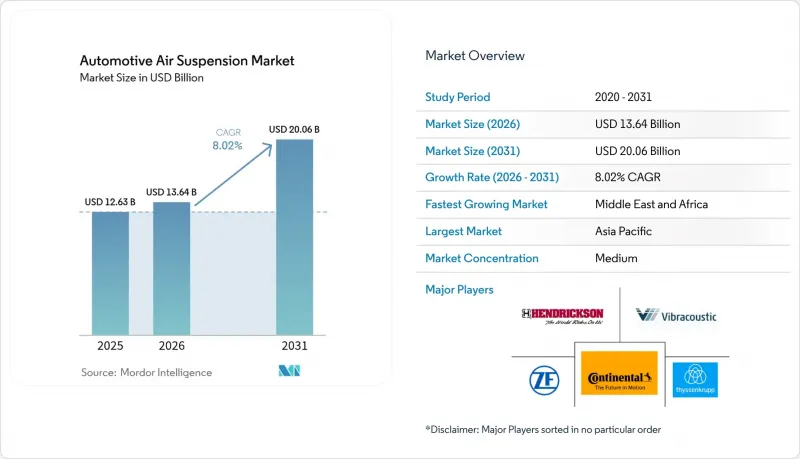
據 Mordor Intelligence 稱,汽車空氣懸吊系統市場預計到 2026 年價值 136.4 億美元,高於 2025 年的 126.3 億美元,預計到 2031 年將達到 200.6 億美元。
預計從 2026 年到 2031 年,其複合年成長率將達到 8.02%。
本報告按控制系統(ECAS 和 NECAS)、車輛類型(乘用車等)、最終用戶(OEM 和售後市場)、零件(空氣彈簧等)、動力系統(內燃機和純電動車)、懸吊結構(被動式空氣懸吊等)、銷售管道(直接銷售給 OEM 等)以及地區進行細分。市場預測以價值(美元)和銷售(輛)為單位呈現。
全球汽車空氣懸吊市場趨勢與洞察
乘用車舒適性和車內舒適性的需求日益成長。
在消費者意識不斷提升和品牌差異化策略的推動下,即使在主流市場,消費者對高階舒適性的追求也日益凸顯。英菲尼迪2025款QX80配備了電子控制氣壓懸吊,可動態調整車身高度,確保乘客輕鬆上下車、越野行駛時的操控性和拖車時的穩定性,充分體現了這一轉變。亞洲消費者受益於可支配所得的成長,對兼具便利性和身分象徵意義的功能特別敏感。在純電動SUV領域,例如小鵬G9所採用的Vibracoustic系統,整合了雙腔空氣彈簧,可同時實現行駛柔軟性和電池溫度控管。利用路面數據的預測演算法進一步提升了舒適性和操控性。路虎最新車型探測車利用從導航系統取得的eHorizon資訊預先調整避震器設定。這些技術的進步共同鞏固了空氣懸吊在全球市場作為一項顯著差異化優勢的地位。
擴大亞太和歐洲地區豪華及高階汽車的銷售。
中國仍然是高階需求的中心,國內外品牌都在擴大電子空氣懸吊的應用,以吸引那些渴望擁有高階車型的消費者。 BMW預計到2024年其全球銷量中電動車佔比將達到17.4%,顯示電氣化與可選配的空氣懸吊系統之間存在著密切聯繫,後者能夠最佳化車身高度控制,從而提升車內靜謐性和空氣動力學性能。梅賽德斯-奔馳正在擴大其位於上海的研發中心,以加速底盤技術的本地化,包括針對當地路況設計的空氣懸吊模組。中國豪華電動車新創公司為了在價格上超越歐美競爭對手,正在將經濟實惠的空氣懸吊系統引入中階車型,加速其在該地區的應用。
中型車系統和整合成本高昂
電子空氣懸吊的零件成本可能比傳統鋼製彈簧高出數百美元,這阻礙了其在注重成本的C級車市場中的普及。複雜的標定工作增加了ECU邏輯,並需要加強底盤安裝,進一步增加了工程成本。新興市場的汽車製造商優先考慮降低售價而非先進底盤的舒適性,這減緩了電子空氣懸吊在大眾市場的普及速度。然而,在中國在地採購和更精簡的零件設計正在縮小成本差距。小鵬汽車在維持G9價格競爭力的同時採用Vibracoustic的雙腔彈簧,就是一個旨在降低成本的創新典範。
細分市場分析
2025年,NECAS解決方案在空氣懸吊系統市場仍佔54.90%的佔有率。這主要歸功於車隊採購商優先考慮其成熟的簡易性和低實施成本。該細分市場在公車、拖車和基礎皮卡車型中仍佔據主導地位,因為靜態負載平衡足以滿足這些需求。相較之下,ECAS正以9.03%的複合年成長率快速成長,因為OEM廠商正轉向以軟體為中心的架構。 ECAS單元收集來自加速計、攝影機和地圖服務的數據,以預測懸吊設置,從而提高行駛時的乘坐舒適性和操控性。 ECAS還支援可變車身高度,用於最佳化電動車的空氣動力學性能,使其成為即將推出的高階跨界車型的必備組件。
在軟體定義車輛中,空中下載 (OTA) 校準和功能解鎖(ECAS 獨有的功能)備受重視。採埃孚的「sMOTION」和大陸集團的「E-Level」系列產品允許售後升級,以微調彈簧曲線並添加越野模式。 NECAS 在售後市場和注重成本的地區仍然佔據重要地位。然而,隨著 ECAS 成為中型豪華轎車、高性能 SUV 和電動貨車的標配,NECAS 的市場佔有率預計將會下降。閥門和壓力感測器價格的持續下降可能會加速整個價值型車輛向 ECAS 的過渡。
到2025年,乘用車將佔據空氣懸吊系統市場65.10%的佔有率,這主要得益於豪華轎車和SUV的強勁成長,因為提升舒適性是這兩類車型的關鍵賣點。同時,中型和重型卡車預計將在所有車型類別中實現最高的複合年成長率(CAGR),達到7.94%。電動動力系統透過實現自動負載平衡和車身高度控制,延長續航里程並保護電池組,從而提升了空氣懸吊的價值。輕型商用車和長途客車也正在採用這項技術,分別用於提高都市區的配送效率和提升乘客舒適度,但預計它們的成長速度將落後於中型和重型卡車。
8級電動牽引車採用氣壓懸吊技術,透過分配軸荷來緩解電池重量增加的不利影響,同時又符合法定重量限制。乘用車銷售仍佔據主導地位,但商用車領域正在推動創新週期,影響著零件的耐用性和預測性維護能力,這些技術最終也將應用於乘用車車型。
就2025年的銷售額而言,原廠配套設備(OEM)佔據了空氣懸吊系統市場73.60%的佔有率。這主要是由於整合的複雜性,以及懸吊調校需要與碰撞安全性和ADAS(高級駕駛輔助系統)標定相符。隨著車輛老化以及車迷對舒適性和車身高度升級的需求,售後市場正以7.38%的複合年成長率快速成長。 Arnott Industries(現為MidOcean Partners的子公司)正積極開發適用於歐洲SUV和美國肌肉車的多品牌替換套件,這表明該公司有意重塑售後市場格局。
當原廠氣壓彈簧達到使用壽命終點(通常在8年後)時,消費者會轉向售後市場套件。即插即用的ECAS替換模組的日益普及,以及安裝時間的縮短,正在擴大其市場吸引力。對於首次安裝而言,保固、型號認證和整合診斷功能至關重要,因此原廠通路仍然不可或缺。售後市場可能會從老舊車輛、性能愛好者以及尋求可調節離地間隙的小眾越野群中獲得更多銷售。
區域分析
到2025年,亞太地區將以38.90%的市佔率引領氣壓懸吊系統市場。雖然中國市場對豪華車和電動車的需求是推動銷售的主要動力,但日本品牌仍在不斷改進其舒適性技術。梅賽德斯-奔馳與全球一級供應商合作,在本地化研發和製造地縮短了供應鏈,並能夠根據不同地區的駕乘舒適性偏好調整產品規格。政府對新能源汽車的支持也進一步拓展了先進底盤整合的可能性。
受基礎設施項目和富裕消費群的推動,中東和非洲地區預計將保持最高的成長率,到2031年複合年成長率將達到6.94%。高階SUV和皮卡佔據了市場的大部分佔有率,買家優先考慮可調節高度的懸架,以增強在沙漠地形中的適應性。在歐洲,嚴格的車輛二氧化碳排放法規推動了輕量化空氣彈簧和基於行駛高度的空氣動力學效率提升策略的發展,從而維持了較高的市場普及率。北美市場的趨勢取決於皮卡和重型卡車的普及。包括Stellantis在內的底特律三大汽車製造商正在重新設計其非承載式車身平台,並專注於空氣懸吊模組,以滿足純電動車的牽引穩定性和空氣動力學性能要求。南美仍然是一個新興市場,但巴西高階SUV的產量正在上升,這得益於燃油效率零件進口關稅的降低。
其他好處:
- Excel格式的市場預測(ME)表
- 3個月的分析師支持
目錄
第1章:引言
- 研究假設和市場定義
- 調查範圍
第2章:調查方法
第3章執行摘要
第4章 市場狀況
- 市場概覽
- 市場促進因素
- 對乘坐舒適性和內裝舒適性的需求日益成長。
- 亞太和歐洲豪華及高階汽車銷售成長
- ECAS與ADAS和底盤網域控制器的整合
- 電動重型卡車對車隊的燃料成本降低效果(這常常被低估)。
- 預測性維護數位孿生技術可降低物流車輛的總擁有成本(媒體通報不足)
- 對振動敏感貨物的監管更加嚴格(媒體報告不足)
- 市場限制因素
- 中檔車輛的系統和整合成本較高
- 對可靠性和維護複雜性的擔憂
- 與ECU相關的ECAS網路安全風險(報告不足)
- 彈性體和複合材料價格波動(媒體報告不足)
- 價值供應鏈分析
- 監理情勢
- 技術展望
- 向 48V 和軟體定義底盤過渡
- 輕質複合材料空氣彈簧波紋管
- 波特五力分析
第5章 市場規模與成長預測
- 控制類型
- 電子控制空氣懸吊(ECAS)
- 非電子控制空氣懸吊(NECAS)
- 車輛類型
- 搭乘用車
- 輕型商用車
- 中型和大型卡車
- 巴士和長途汽車
- 最終用戶
- OEM
- 售後市場
- 按組件
- 空氣彈簧
- 壓縮機和儲存
- 電控系統
- 高度和壓力感測器
- 避震器
- 透過推進力
- 內燃機車
- 電池式電動車
- 透過懸浮結構
- 被動式氣壓懸吊
- 半主動/自我調整氣壓懸吊
- 全主動式氣壓懸吊
- 按銷售管道
- 直接向原始設備製造商銷售
- 一級/模組供應商
- 按地區
- 北美洲
- 美國
- 加拿大
- 其他北美國家
- 南美洲
- 巴西
- 阿根廷
- 其他南美國家
- 歐洲
- 德國
- 英國
- 法國
- 義大利
- 西班牙
- 其他歐洲國家
- 亞太地區
- 中國
- 日本
- 印度
- 韓國
- 其他亞太國家
- 中東和非洲
- 沙烏地阿拉伯
- 阿拉伯聯合大公國
- 南非
- 奈及利亞
- 其他中東和非洲國家
- 北美洲
第6章 競爭情勢
- 市場集中度
- 策略趨勢
- 市佔率分析
- 公司簡介
- Continental AG
- ZF Friedrichshafen AG
- Hendrickson International
- Thyssenkrupp Bilstein
- Vibracoustic SE
- Firestone Industrial Products
- Hitachi Astemo
- Mando Corporation
- SAF-Holland SE
- Meritor(Cummins)
- AccuAir Suspension
- Air Lift Company
- Arnott Industries
- BWI Group
- KYB Corporation
- Komman Air Suspension
- Guangzhou Guomat Air Spring
- Dunlop Systems & Components
- Tenneco Inc.
第7章 市場機會與未來展望
According to Mordor Intelligence, automotive air suspension systems market size in 2026 is estimated at USD 13.64 billion, growing from 2025 value of USD 12.63 billion with 2031 projections showing USD 20.06 billion, growing at 8.02% CAGR over 2026-2031.
This report is Segmented by Control Type (ECAS and NECAS), Vehicle Type (Passenger Cars and More), End User (OEM and Aftermarket), Component (Air Springs and More), Propulsion (ICE and BEV), Suspension Architecture (Passive Air Suspension and More), Sales Channel (Direct To OEM and More) and Geography. The Market Forecasts are Provided in Terms of Value (USD) and Volume (Units).
Global Automotive Air Suspension Market Trends and Insights
Rising Demand for Ride Quality and Cabin Comfort
Premium comfort expectations are now evident even in mainstream segments, driven by consumer awareness and brand differentiation strategies. INFINITI's 2025 QX80 illustrates this shift with an Electronic Air Suspension that adjusts dynamic height for easy ingress, off-road articulation, and towing stability. Asian buyers, supported by rising disposable incomes, are particularly responsive to features that marry convenience with perceived status. In battery-electric SUVs, integrating two-chamber air springs, such as Vibracoustic's system for XPeng's G9, allows simultaneous ride compliance and battery thermal management. Predictive algorithms using road-surface data further enhance comfort and handling; Land Rover's latest Range Rover employs navigation-fed eHorizon information to pre-condition damper settings. Collectively, these advances reinforce air suspension as a tangible differentiator across global markets.
Growing Luxury and Premium Vehicle Sales in Asia-Pacific and Europe
China remains the epicenter of premium demand, with domestic and imported marques expanding electronic air suspension fitment to secure aspirational buyers. BMW achieved a 17.4% EV mix in 2024 global deliveries, underscoring how electrification often coincides with optional air suspension packages for cabin tranquility and aero-optimized stance control. Mercedes-Benz's enlarged R&D footprint in Shanghai accelerates the localization of chassis technologies, including air suspension modules designed for local road conditions. Chinese premium EV startups, keen to undercut Western rivals, are bringing cost-controlled air systems to mid-tier price points, quickening regional adoption.
High System and Integration Cost for Mid-Segment Vehicles
The electronic air suspension bill of material can exceed conventional steel springs by several hundred USD, discouraging inclusion in cost-sensitive C-segment cars. Complex calibration work added ECU logic and reinforced chassis mounts, further inflating engineering spending. Emerging-market OEMs prioritize lower transaction prices over advanced chassis comfort, delaying penetration in mass segments. Nonetheless, localized sourcing in China and leaner component designs are narrowing the gap; XPeng's decision to deploy Vibracoustic's two-chamber springs while keeping the G9's price competitive exemplifies cost-down innovation.
Other drivers and restraints analyzed in the detailed report include:
- Integration of ECAS with ADAS and Chassis Domain Controllers
- Fleet Fuel-Saving Benefits for Electric Heavy-Duty Trucks
- Reliability & Maintenance Complexity Concerns
For complete list of drivers and restraints, kindly check the Table Of Contents.
Segment Analysis
NECAS Solutions retained a 54.90% share of the air suspension systems market in 2025, mainly because fleet buyers value proven simplicity and lower acquisition costs. The segment remains prevalent in buses, trailers, and basic pickup models where static load leveling suffices. In contrast, ECAS is scaling fast at a 9.03% CAGR as OEMs migrate toward software-centric architectures. ECAS units harvest data from accelerometers, cameras, and map services to predict suspension settings, improving both comfort and handling on the fly. ECAS also supports variable ride height for EV aero optimization, making it indispensable for forthcoming premium crossovers.
Software-defined vehicles emphasize over-the-air calibration and feature unlocks, capabilities inherent to ECAS. ZF's sMOTION and Continental's E-Level families allow post-sale updates that fine-tune spring curves or add off-road modes. NECAS remains relevant in retrofit and cost-driven regions. Yet, its share is projected to decline as ECAS becomes standard on mid-size luxury sedans, performance SUVs, and electric delivery vans. The ongoing price erosion of valves and pressure sensors will accelerate the pivot toward ECAS across value segments.
Passenger cars captured 65.10% of the air suspension systems market share in 2025 through luxury sedans and SUVs, where heightened comfort is a selling point. Medium and Heavy trucks, however, are on track for an 7.94% CAGR, the highest among all vehicle categories. Electrified drivelines amplify the value of air suspension by enabling automated load balancing and ride-height control that extend the range and protect battery packs. Light commercial vans and coaches adopt the technology for urban delivery efficiency and passenger comfort, respectively, although their growth profile lags medium and heavy trucks.
Air suspension technology in Class 8 electric tractors mitigates battery mass penalties by distributing axle loads while preserving legal weight limits. Passenger cars will keep leading in volume terms, yet commercial segments drive innovation cycles, influencing component durability and predictive maintenance capabilities that later cascade into retail models
OEM fitment accounted for 73.60% of the air suspension systems market share in 2025 revenue because of integration complexity and the need to align suspension tuning with crash safety and ADAS calibration. The aftermarket expands at 7.38% CAGR as vehicle parc ages and enthusiasts seek comfort or stance upgrades. Arnott Industries, now under MidOcean Partners, is aggressively expanding multi-brand replacement kits for European SUVs and American muscle cars, signaling consolidation intent within the retrofit domain.
Consumers turn to aftermarket kits when factory air springs reach end-of-life, often after eight years. Increased availability of plug-and-play ECAS replacement modules reduces installation time, broadening appeal. OEM channels remain indispensable for first-fitment, where warranty coverage, homologation, and integrated diagnostics are paramount. The aftermarket will capture incremental revenue from aging fleets, performance enthusiasts, and niche off-road communities seeking adjustable ground clearance.
Complete Report Scope:
- By Control Type
- Electronically Controlled Air Suspension (ECAS)
- Non-Electronically Controlled Air Suspension (NECAS)
- By Vehicle Type
- Passenger Cars
- Light Commercial Vehicles
- Medium and Heavy Trucks
- Buses & Coaches
- By End User
- OEM
- Aftermarket
- By Component
- Air Springs
- Compressors and Reservoirs
- Electronic Control Units
- Height & Pressure Sensors
- Shock Dampers
- By Propulsion
- ICE Vehicles
- Battery-Electric Vehicles
- By Suspension Architecture
- Passive Air Suspension
- Semi-Active / Adaptive Air Suspension
- Fully Active Air Suspension
- By Sales Channel
- Direct to OEM
- Tier-1 / Module Supplier
- By Geography
- North America
- United States
- Canada
- Rest of North America
- South America
- Brazil
- Argentina
- Rest of South America
- Europe
- Germany
- United Kingdom
- France
- Italy
- Spain
- Rest of Europe
- Asia-Pacific
- China
- Japan
- India
- South Korea
- Rest of Asia-Pacific
- Middle East and Africa
- Saudi Arabia
- United Arab Emirates
- South Africa
- Nigeria
- Rest of Middle East and Africa
- North America
Geography Analysis
Asia-Pacific led the air suspension systems market with a 38.90% share in 2025. Chinese luxury and electric vehicle demand fuels most of the volume, while Japanese brands continue to refine comfort technologies. Mercedes-Benz's localized R&D and manufacturing footprints by global tier-1 suppliers shorten supply chains and adapt specifications for regional ride-comfort preferences. Government support for new energy vehicles also raises the ceiling for advanced chassis integration.
As infrastructure projects and affluent consumer bases converge, the Middle East and Africa will deliver the fastest CAGR at 6.94% through 2031. Premium SUVs and pickups dominate the mix, and buyers value height-adjustable suspensions for desert terrain versatility. Europe retains high penetration because stringent fleet CO2 limits encourage lightweight air springs and height-based aero efficiency strategies. North America's dynamics hinge on pickup and heavy-truck adoption. Stellantis and other Detroit-Three manufacturers are reorganizing body-on-frame platforms around air suspension modules to satisfy towing stability and BEV aerodynamics. South America remains emergent but shows rising uptake in Brazilian premium SUV assembly, aided by import-duty reductions on components that enhance fuel economy.
- Continental AG
- ZF Friedrichshafen AG
- Hendrickson International
- Thyssenkrupp Bilstein
- Vibracoustic SE
- Firestone Industrial Products
- Hitachi Astemo
- Mando Corporation
- SAF-Holland SE
- Meritor (Cummins)
- AccuAir Suspension
- Air Lift Company
- Arnott Industries
- BWI Group
- KYB Corporation
- Komman Air Suspension
- Guangzhou Guomat Air Spring
- Dunlop Systems & Components
- Tenneco Inc.
Additional Benefits:
- The market estimate (ME) sheet in Excel format
- 3 months of analyst support
TABLE OF CONTENTS
1 Introduction
- 1.1 Study Assumptions & Market Definition
- 1.2 Scope of the Study
2 Research Methodology
3 Executive Summary
4 Market Landscape
- 4.1 Market Overview
- 4.2 Market Drivers
- 4.2.1 Rising demand for ride quality & cabin comfort
- 4.2.2 Growing luxury & premium vehicle sales in Asia-Pacific & Europe
- 4.2.3 Integration of ECAS with ADAS & chassis domain controllers
- 4.2.4 Fleet fuel-saving benefits for electric heavy-duty trucks (under-reported)
- 4.2.5 Predictive-maintenance digital twins lowering TCO for logistics fleets (under-reported)
- 4.2.6 Vibration-sensitive cargo regulations tightening (under-reported)
- 4.3 Market Restraints
- 4.3.1 High system & integration cost for mid-segment vehicles
- 4.3.2 Reliability & maintenance complexity concerns
- 4.3.3 Cyber-security risks in ECU-connected ECAS (under-reported)
- 4.3.4 Elastomer & composite price volatility (under-reported)
- 4.4 Value / Supply-Chain Analysis
- 4.5 Regulatory Landscape
- 4.6 Technological Outlook
- 4.6.1 Transition to 48-V & software-defined chassis
- 4.6.2 Lightweight composite air-spring bellows
- 4.7 Porter's Five Forces Analysis
- 4.7.1 Threat of New Entrants
- 4.7.2 Bargaining Power of Buyers
- 4.7.3 Bargaining Power of Suppliers
- 4.7.4 Threat of Substitute Products
- 4.7.5 Intensity of Competitive Rivalry
5 Market Size & Growth Forecasts
- 5.1 By Control Type
- 5.1.1 Electronically Controlled Air Suspension (ECAS)
- 5.1.2 Non-Electronically Controlled Air Suspension (NECAS)
- 5.2 By Vehicle Type
- 5.2.1 Passenger Cars
- 5.2.2 Light Commercial Vehicles
- 5.2.3 Medium and Heavy Trucks
- 5.2.4 Buses & Coaches
- 5.3 By End User
- 5.3.1 OEM
- 5.3.2 Aftermarket
- 5.4 By Component
- 5.4.1 Air Springs
- 5.4.2 Compressors and Reservoirs
- 5.4.3 Electronic Control Units
- 5.4.4 Height & Pressure Sensors
- 5.4.5 Shock Dampers
- 5.5 By Propulsion
- 5.5.1 ICE Vehicles
- 5.5.2 Battery-Electric Vehicles
- 5.6 By Suspension Architecture
- 5.6.1 Passive Air Suspension
- 5.6.2 Semi-Active / Adaptive Air Suspension
- 5.6.3 Fully Active Air Suspension
- 5.7 By Sales Channel
- 5.7.1 Direct to OEM
- 5.7.2 Tier-1 / Module Supplier
- 5.8 By Geography
- 5.8.1 North America
- 5.8.1.1 United States
- 5.8.1.2 Canada
- 5.8.1.3 Rest of North America
- 5.8.2 South America
- 5.8.2.1 Brazil
- 5.8.2.2 Argentina
- 5.8.2.3 Rest of South America
- 5.8.3 Europe
- 5.8.3.1 Germany
- 5.8.3.2 United Kingdom
- 5.8.3.3 France
- 5.8.3.4 Italy
- 5.8.3.5 Spain
- 5.8.3.6 Rest of Europe
- 5.8.4 Asia-Pacific
- 5.8.4.1 China
- 5.8.4.2 Japan
- 5.8.4.3 India
- 5.8.4.4 South Korea
- 5.8.4.5 Rest of Asia-Pacific
- 5.8.5 Middle East and Africa
- 5.8.5.1 Saudi Arabia
- 5.8.5.2 United Arab Emirates
- 5.8.5.3 South Africa
- 5.8.5.4 Nigeria
- 5.8.5.5 Rest of Middle East and Africa
- 5.8.1 North America
6 Competitive Landscape
- 6.1 Market Concentration
- 6.2 Strategic Moves
- 6.3 Market Share Analysis
- 6.4 Company Profiles (includes Global level Overview, Market level overview, Core Segments, Financials as available, Strategic Information, Market Rank/Share for key companies, Products & Services, and Recent Developments)
- 6.4.1 Continental AG
- 6.4.2 ZF Friedrichshafen AG
- 6.4.3 Hendrickson International
- 6.4.4 Thyssenkrupp Bilstein
- 6.4.5 Vibracoustic SE
- 6.4.6 Firestone Industrial Products
- 6.4.7 Hitachi Astemo
- 6.4.8 Mando Corporation
- 6.4.9 SAF-Holland SE
- 6.4.10 Meritor (Cummins)
- 6.4.11 AccuAir Suspension
- 6.4.12 Air Lift Company
- 6.4.13 Arnott Industries
- 6.4.14 BWI Group
- 6.4.15 KYB Corporation
- 6.4.16 Komman Air Suspension
- 6.4.17 Guangzhou Guomat Air Spring
- 6.4.18 Dunlop Systems & Components
- 6.4.19 Tenneco Inc.
7 Market Opportunities & Future Outlook
- 7.1 White-space & Unmet-Need Assessment

 全球空氣懸吊市場規模、佔有率、趨勢和成長分析報告(2026-2034)
 氣壓懸吊市場-2026-2032年全球市場預測電子氣壓懸吊系統市場:按組件、動力類型、車輛類型和銷售管道分類-2026-2032年全球市場預測
 氣壓懸吊市場規模、佔有率和成長分析:按組件、技術、懸吊類型、車輛類型、驅動系統、銷售管道和地區分類-2026-2033年產業預測
 2026年全球氣壓懸吊市場報告2026年全球汽車空氣懸吊市場報告空氣彈簧市場:按類型、組件、材料、銷售管道、應用和最終用戶產業分類-2026-2032年全球市場預測汽車空氣懸吊市場規模、佔有率、成長及全球產業分析:按組件、類型、動力系統、車輛類型和地區分類的洞察與預測(2026-2034 年)智慧電子控制懸吊系統用電磁閥市場(按車輛類型、閥門類型、技術、材料、工作電壓、最終用戶和應用分類)—全球預測,2026-2032年新能源車主動式氣壓懸吊市場:按動力傳動系統、車輛類型、懸吊配置、懸吊技術、應用和銷售管道,全球預測(2026-2032)