


 |
市場調查報告書
商品編碼
2113199
功能性印刷:市場佔有率分析、產業趨勢與統計、成長預測(2026-2031)Functional Printing - Market Share Analysis, Industry Trends & Statistics, Growth Forecasts (2026 - 2031) |
||||||

※ 本網頁內容可能與最新版本有所差異。詳細情況請與我們聯繫。
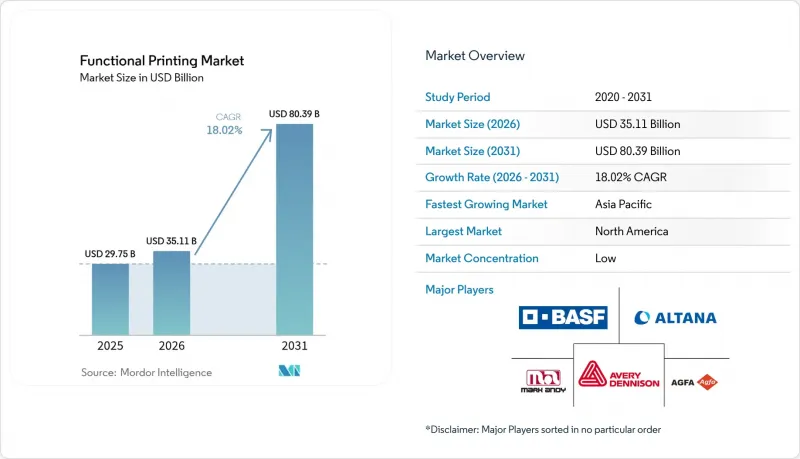
根據 Mordor Intelligence 估計,功能性印刷市場在 2026 年的價值將達到 351.1 億美元,高於 2025 年的 297.5 億美元,預計到 2031 年將達到 803.9 億美元。
預計 2026 年至 2031 年的複合年成長率為 18.02%。
本報告按基材(紙張、紙板、塑膠薄膜等)、油墨(導電油墨、介電/絕緣油墨等)、印刷技術(噴墨印刷、網版印刷、凹版印刷、柔版印刷等)、應用(感測器、顯示器、OLED照明面板等)和地區進行細分。市場規模和預測以美元計價。
全球功能性印刷市場趨勢與洞察
對低成本、高速生產電子元件的需求
消費品和汽車行業的成本壓力正促使原始設備製造商 (OEM) 用無需潔淨室基礎設施的捲對卷加工功能電路取代光刻技術。汽車電池管理系統現在整合了印刷溫度和電流感測器,在滿足非關鍵精度要求的同時,電子元件的成本降低了高達 60%。擁有捲對卷生產線的區域晶圓廠可在六個月內實現本地化生產,從而比傳統矽晶圓廠更快地進行設計迭代。這種柔軟性使亞洲契約製造製造商能夠透過將設計支援與低利潤、大批量生產相結合,贏得智慧包裝插件和藍牙天線新計畫。隨著油墨燒結技術的進步提高了性能上限,功能印刷市場正在擴大其在中端電子產品領域的佔有率,該領域此前一直由剛性 PCB 主導。
軟性穿戴電子設備的迅速普及
在數位化醫療領域,能夠隨著身體運動自然彎曲的皮膚穿戴式裝置正被廣泛採用,但剛性矽基基板無法滿足這項需求。西北大學研發的皮膚健康貼片可在不引起使用者不適的情況下測量皮膚濕度和pH值。一家歐洲循環系統診所正在試用一種可列印的心電圖貼片,可連續佩戴96小時而不會引起刺激,有助於提高患者的依從性。可拉伸電路的高良率列印意味著每個單元從印表機出來即可完全正常工作,從而減少了昂貴的組裝工序,並實現了大規模部署。亞洲製造商正利用規模經濟優勢,每年出貨數千萬片血糖值監測貼片,形成全球部署基礎,並持續推動對配套雲端分析服務的需求。
與矽電子裝置的性能差距
印刷IGZO電晶體的遷移率仍落後於矽電晶體,限制了其在電腦和高速通訊設備的應用。碳化矽的熔點高達2700 度C,遠超印刷電子裝置200 度C以下的耐熱極限,因此難以在汽車等極端溫度環境下使用。由於聚合物油墨的長期漂移可能導致現場失效,關鍵任務型航太和醫療植入仍依賴成熟的矽材料。這種限制使得功能性印刷市場僅限於那些柔軟性和價格優先於極致性能的領域。
細分市場分析
預計到2031年,玻璃和陶瓷基板的複合年成長率將達到21.98%,成長速度超過整體功能性印刷市場。其熱穩定性和光學透明度使其適用於汽車抬頭顯示器和高溫壓力感測器。到2025年,塑膠薄膜仍將佔據功能性印刷市場54.12%的佔有率,為智慧標籤和消費性穿戴裝置的超高速、低成本卷對卷生產線提供支援。儘管玻璃的加工成本較高,但它在微米級間距下具有更高的尺寸穩定性,能夠實現塑膠無法達到足夠良率的多層OLED背板。
製造商正在最佳化基板選擇,以匹配固化製程。 PET基材可透過光燒結在數秒內形成銀層,而陶瓷基材則利用熱燒結來實現高導電性且不會發生基板翹曲。紙基和奈米纖維素板作為符合循環經濟法規的一次性生物裝置貼片,正日益受到關注。金屬箔仍應用於電磁干擾屏蔽和高電流匯流排等特定領域,在這些領域,其導電性優勢超過了重量增加的負面影響。基板的多樣化為原始設備製造商 (OEM) 提供了更多選擇,以平衡性能和永續性目標,從而推動功能性印刷市場各個細分領域的均衡成長。
到2025年,導電油墨將佔銷售額的64.89%,並將繼續成為大多數印刷電路的基礎。然而,基於奈米顆粒的功能性油墨預計將以22.12%的複合年成長率成長,其優勢在於無需提高固化溫度即可降低線性電阻。銀奈米顆粒漿料經光子燒結後,電導率已達到10⁵ S/m,這一數值以往僅在固體金屬中才能看到。銅油墨雖然降低了材料成本,但需要惰性氣氛固化站來防止氧化,因此需要採用在生產過程中切換氣氛的混合印刷生產線。
介電油墨與導電油墨同步發展,低損耗有機矽酸鹽配方使得在薄型PET薄膜上形成GHz頻段天線成為可能,取代低功耗物聯網節點中蝕刻的FR-4材料。光伏和熱電油墨系統拓展了功能性印刷市場的應用場景,使製造商能夠在數分鐘內塗覆大型太陽能電池和能源採集層。隨著化學技術創新的加速,油墨供應商在油墨的片狀形狀、黏合劑的生物特性以及與燒結的兼容性等方面實現差異化,並深化與印表機OEM廠商的合作研發。
區域分析
預計北美將引領市場,到2025年將佔據32.12%的市場佔有率,這主要得益於國防航空電子設備和先進汽車內裝領域對尖端印刷薄膜的需求。由於軟性PCB生產線的設備升級週期較長,北美功能性印刷市場預計將穩定成長。同時,亞太地區預計將以21.09%的複合年成長率實現最高成長率,主要得益於中國和日本對卷對卷生產資本投資的獎勵。 Elephantech公司2,010萬美元的E輪資金籌措也顯示了國內對永續印刷PCB的強勁需求。
歐洲供應商正專注於高階領域,例如醫療穿戴式裝置和汽車雷射雷達外殼,並將嚴格的監管要求轉化為競爭優勢。 「改革計畫」等措施旨在確保關鍵油墨和基板的本地供應鏈,並降低地緣政治風險。在中東和非洲,用於離網照明的印刷太陽能箔的投資正在成長,而南美洲的農業相關企業則正在部署低成本的土壤濕度感測器來最佳化灌溉。這些不同的優先事項凸顯了區域專業化而非一刀切的解決方案才是推動功能性印刷市場成長的關鍵所在。
其他好處:
- Excel格式的市場預測(ME)表
- 3個月的分析師支持
目錄
第1章:引言
- 研究假設和市場定義
- 調查範圍
第2章:調查方法
第3章執行摘要
第4章 市場狀況
- 市場概覽
- 市場促進因素
- 對低成本、高速生產電子設備的需求
- 軟性穿戴電子產品的迅速普及
- 導電和介電油墨化學技術的進步
- 物聯網智慧包裝的出貨量
- 電動車領域的捲對卷3D結構電子產品
- 遠端醫療皮膚黏貼診斷貼片
- 市場限制因素
- 與矽電子裝置的性能差距
- 缺乏全球製造標準
- 銀奈米顆粒供應的變異性
- 針對不可回收基材的電子廢棄物法規
- 供應鏈分析
- 監理情勢
- 技術展望
- 投資和資金籌措趨勢
- 波特五力分析
第5章 市場規模與成長預測
- 透過基板
- 紙張和紙板
- 塑膠薄膜
- 玻璃和陶瓷
- 金屬箔和軟性金屬
- 墨水
- 導電油墨
- 介電和絕緣油墨
- 用於半導體和太陽能發電的油墨
- 基於奈米顆粒的功能性油墨
- 透過印刷技術
- 噴墨列印
- 按需噴墨
- 連續噴墨
- 網版印刷
- 凹版印刷
- 柔版印刷
- 氣溶膠噴射列印
- 其他印刷技術
- 噴墨列印
- 透過使用
- 感應器
- 溫濕度感測器
- 壓力/力道感測器
- 生物感測器和穿戴式設備
- 展示
- 電子紙顯示器
- OLED顯示器
- OLED 照明面板
- 軟性薄膜電池
- 太陽能
- 有機太陽能電池
- 鈣鈦礦太陽能電池
- RFID和NFC標籤
- 其他用途
- 感應器
- 按地區
- 北美洲
- 美國
- 加拿大
- 墨西哥
- 歐洲
- 德國
- 英國
- 法國
- 義大利
- 西班牙
- 俄羅斯
- 其他歐洲國家
- 亞太地區
- 中國
- 日本
- 韓國
- 印度
- ASEAN
- 澳洲
- 其他亞太國家
- 中東和非洲
- 中東
- GCC
- 土耳其
- 其他中東國家
- 非洲
- 南非
- 埃及
- 奈及利亞
- 其他非洲國家
- 中東
- 南美洲
- 巴西
- 阿根廷
- 其他南美國家
- 北美洲
第6章 競爭情勢
- 市場集中度
- 策略趨勢
- 市佔率分析
- 公司簡介
- Avery Dennison Corp.
- BASF SE
- Blue Spark Technologies
- E Ink Holdings Inc.
- Eastman Kodak Co.
- Enfucell Oy
- GSI Technologies LLC
- Isorg SA
- Mark Andy Inc.
- ALTANA AG
- Agfa-Gevaert NV
- Ceradrop-MGI Group
- DuPont de Nemours Inc.
- Samsung Electronics(Printed Solutions)
- LG Display Co.
- Molex LLC
- Thinfilm Electronics ASA
- Toppan Forms Co.
- Toyo Ink SC Holdings
- Optomec Inc.
- Xaar PLC
- Xennia Technology Ltd.
- Kateeva Inc.
- NovaCentrix
- Cambrios Advanced Materials
- Nano Dimension Ltd.
第7章 市場機會與未來展望
According to Mordor Intelligence, functional printing market size in 2026 is estimated at USD 35.11 billion, growing from 2025 value of USD 29.75 billion with 2031 projections showing USD 80.39 billion, growing at 18.02% CAGR over 2026-2031.
This report is Segmented by Substrates (Paper and Paperboard, Plastic Films, and More), Ink (Conductive Inks, Dielectric and Insulating Inks, and More), Printing Technology (Inkjet Printing, Screen Printing, Gravure Printing, Flexography Printing, and More), Application (Sensors, Displays, OLED Lighting Panels, and More), and Geography. The Market Sizes and Forecasts are Provided in Terms of Value (USD).
Global Functional Printing Market Trends and Insights
Demand for Low-Cost, High-Speed Electronic Production
Cost pressure across the consumer and automotive sectors prompts OEMs to replace photolithography with roll-processed functional circuits that require no cleanroom infrastructure. Automotive battery-management systems now integrate printed temperature and current sensors that cut electronics cost by up to 60% while meeting non-critical accuracy thresholds. Regional fabs equipped with roll-to-roll lines can localize production in under six months, allowing quicker response to design iterations than traditional silicon foundries. This flexibility helps Asian contract manufacturers win new projects for smart packaging inserts and Bluetooth antennas by bundling design support with low-margin, high-volume output. As performance ceilings rise through better ink sintering, the functional printing market gains share in mid-range electronics previously reserved for rigid PCBs.
Rapid Adoption of Flexible and Wearable Electronics
Digitized healthcare embraces on-skin devices that flex naturally with body movement, an area where rigid silicon substrates underperform. Northwestern University's skin health patch captures hydration and pH data without user discomfort. European cardiology clinics are piloting printed ECG stickers that achieve 96-hour wear without irritation, improving patient compliance. High-yield printing of stretchable circuits enables mass adoption because each unit ships fully functional from the press, reducing costly assembly steps. Asian manufacturers capitalize on scale economics to ship tens of millions of glucose-monitoring patches annually, feeding a global installed base that drives recurring demand for ancillary cloud-based analytics.
Performance Gap vs. Silicon Electronics
Printed IGZO transistors still lag silicon mobility benchmarks, limiting uptake in computing and high-speed telecom devices. Silicon carbide's 2700 °C melting point dwarfs printed electronics' thermal ceiling below 200 °C, excluding printed circuits from harsh-temperature automotive zones. Mission-critical aerospace and medical implants remain tethered to proven silicon because long-term drift in polymer inks risks field failures. This ceiling confines the functional printing market to segments where flexibility or price trumps ultimate performance.
Other drivers and restraints analyzed in the detailed report include:
- Advances in Conductive and Dielectric Ink Chemistry
- IoT-Driven Smart Packaging Volumes
- Lack of Global Manufacturing Standards
For complete list of drivers and restraints, kindly check the Table Of Contents.
Segment Analysis
Glass and ceramic substrates are projected to grow at 21.98% CAGR, outpacing the wider functional printing market through 2031. Their thermal stability and optical clarity suit automotive HUD displays and high-temperature pressure sensors. Plastic films retained 54.12% functional printing market share in 2025 by supporting ultrafast, low-cost roll-to-roll lines that supply smart labels and consumer wearables. Despite higher handling costs, glass improves dimensional stability at micron pitches, enabling multilayer OLED backplanes that plastic cannot achieve with sufficient yield.
Manufacturers optimize each substrate choice around curing profiles; PET allows photo-sintered silver within seconds, while ceramic routes use thermal sintering to achieve high conductivity without substrate warping. Paper and nanocellulose boards gain traction for disposable biodevice patches, aligning with circular-economy regulations. Metal foils remain niche for EMI shielding and high-current bus lines where their conductivity offsets added weight. Substrate diversification gives OEMs a palette to match performance with sustainability targets driving balanced growth across segments of the functional printing market.
Conductive inks captured 64.89% of revenue in 2025 and remain the bedrock of most printed circuits. Yet nanoparticle-based functional inks are forecast to escalate at 22.12% CAGR, underscoring their prowess in reducing line resistance without elevating curing temperature. Silver nanoparticle pastes now reach 10^5 S/m conductivity after photonic sintering, a figure once reserved for bulk metal.Copper inks pare material spend but demand inert-atmosphere curing stations to prevent oxidation, prompting hybrid printing lines that switch atmospheres mid-run.
Dielectric inks evolve alongside conductors; low-loss organosilicate formulations permit GHz-range antennas on thin PET, replacing etched FR-4 in low-power IoT nodes. Photovoltaic and thermoelectric ink systems widen functional printing market addressable use-cases by letting manufacturers coat large solar or energy-harvest layers in minutes. As chemistry innovation accelerates, ink suppliers differentiate on flake geometry, binder biology, and sintering compatibility, deepening collaborative R&D with printer-OEMs.
Complete Report Scope:
- By Substrates
- Paper and Paperboard
- Plastic Films
- Glass and Ceramics
- Metal Foils and Flex-metals
- By Inks
- Conductive Inks
- Dielectric and Insulating Inks
- Semiconductive and PV Inks
- Nanoparticle-based Functional Inks
- By Printing Technology
- Inkjet Printing
- Drop-on-Demand Inkjet
- Continuous Inkjet
- Screen Printing
- Gravure Printing
- Flexography Printing
- Aerosol Jet Printing
- Other Printing Technology
- Inkjet Printing
- By Application
- Sensors
- Temperature and Humidity Sensors
- Pressure and Force Sensors
- Biosensors and Wearables
- Displays
- E-paper Displays
- OLED Displays
- OLED Lighting Panels
- Flexible Thin-film Batteries
- Photovoltaic
- Organic PV
- Perovskite PV
- RFID and NFC Tags
- Other Application
- Sensors
- By Geography
- North America
- United States
- Canada
- Mexico
- Europe
- Germany
- United Kingdom
- France
- Italy
- Spain
- Russia
- Rest of Europe
- Asia-Pacific
- China
- Japan
- South Korea
- India
- ASEAN
- Australia
- Rest of Asia-Pacific
- Middle East and Africa
- Middle East
- GCC
- Turkey
- Rest of Middle East
- Africa
- South Africa
- Egypt
- Nigeria
- Rest of Africa
- Middle East
- South America
- Brazil
- Argentina
- Rest of South America
- North America
Geography Analysis
North America maintained leadership with 32.12% share in 2025 on the back of defense avionics and advanced automotive interiors that specify cutting-edge printed films. The functional printing market size for North America is slated to grow steadily on high equipment replacement cycles in flexible PCB lines. Asia-Pacific, meanwhile, is forecast for the quickest 21.09% CAGR, buoyed by Chinese and Japanese incentives that reimburse capital outlays for roll-to-roll production. Elephantech's USD 20.1 million Series E demonstrates domestic appetite for sustainable printed PCBs.
European suppliers focus on premium segments such as medical wearables and automotive lidar housings, leveraging stringent regulatory hurdles as a competitive moat. Initiatives like the Reform Project aim to secure a local supply chain for critical inks and substrates, mitigating geopolitical risk. The Middle East and Africa invest in printed solar foils for off-grid lighting, while South American agribusiness deploys low-cost soil-moisture labels to optimize irrigation. These divergent priorities underline why regional specialization rather than one-size-fits-all solutions will drive functional printing market adoption.
- Avery Dennison Corp.
- BASF SE
- Blue Spark Technologies
- E Ink Holdings Inc.
- Eastman Kodak Co.
- Enfucell Oy
- GSI Technologies LLC
- Isorg SA
- Mark Andy Inc.
- ALTANA AG
- Agfa-Gevaert NV
- Ceradrop - MGI Group
- DuPont de Nemours Inc.
- Samsung Electronics (Printed Solutions)
- LG Display Co.
- Molex LLC
- Thinfilm Electronics ASA
- Toppan Forms Co.
- Toyo Ink SC Holdings
- Optomec Inc.
- Xaar PLC
- Xennia Technology Ltd.
- Kateeva Inc.
- NovaCentrix
- Cambrios Advanced Materials
- Nano Dimension Ltd.
Additional Benefits:
- The market estimate (ME) sheet in Excel format
- 3 months of analyst support
TABLE OF CONTENTS
1 INTRODUCTION
- 1.1 Study Assumptions and Market Definition
- 1.2 Scope of the Study
2 RESEARCH METHODOLOGY
3 EXECUTIVE SUMMARY
4 MARKET LANDSCAPE
- 4.1 Market Overview
- 4.2 Market Drivers
- 4.2.1 Demand for low-cost, high-speed electronic production
- 4.2.2 Rapid adoption of flexible and wearable electronics
- 4.2.3 Advances in conductive and dielectric ink chemistry
- 4.2.4 IoT-driven smart packaging volumes
- 4.2.5 Roll-to-roll 3D structural electronics in e-mobility
- 4.2.6 On-skin diagnostic patches for tele-health
- 4.3 Market Restraints
- 4.3.1 Performance gap vs. silicon electronics
- 4.3.2 Lack of global manufacturing standards
- 4.3.3 Silver nanoparticle supply volatility
- 4.3.4 E-waste rules targeting non-recyclable substrates
- 4.4 Supply-Chain Analysis
- 4.5 Regulatory Landscape
- 4.6 Technological Outlook
- 4.7 Investment and Funding Landscape
- 4.8 Porter's Five Forces Analysis
- 4.8.1 Threat of New Entrants
- 4.8.2 Bargaining Power of Buyers
- 4.8.3 Bargaining Power of Suppliers
- 4.8.4 Threat of Substitutes
- 4.8.5 Intensity of Rivalry
5 MARKET SIZE AND GROWTH FORECASTS (VALUE)
- 5.1 By Substrates
- 5.1.1 Paper and Paperboard
- 5.1.2 Plastic Films
- 5.1.3 Glass and Ceramics
- 5.1.4 Metal Foils and Flex-metals
- 5.2 By Inks
- 5.2.1 Conductive Inks
- 5.2.2 Dielectric and Insulating Inks
- 5.2.3 Semiconductive and PV Inks
- 5.2.4 Nanoparticle-based Functional Inks
- 5.3 By Printing Technology
- 5.3.1 Inkjet Printing
- 5.3.1.1 Drop-on-Demand Inkjet
- 5.3.1.2 Continuous Inkjet
- 5.3.2 Screen Printing
- 5.3.3 Gravure Printing
- 5.3.4 Flexography Printing
- 5.3.5 Aerosol Jet Printing
- 5.3.6 Other Printing Technology
- 5.3.1 Inkjet Printing
- 5.4 By Application
- 5.4.1 Sensors
- 5.4.1.1 Temperature and Humidity Sensors
- 5.4.1.2 Pressure and Force Sensors
- 5.4.1.3 Biosensors and Wearables
- 5.4.2 Displays
- 5.4.2.1 E-paper Displays
- 5.4.2.2 OLED Displays
- 5.4.3 OLED Lighting Panels
- 5.4.4 Flexible Thin-film Batteries
- 5.4.5 Photovoltaic
- 5.4.5.1 Organic PV
- 5.4.5.2 Perovskite PV
- 5.4.6 RFID and NFC Tags
- 5.4.7 Other Application
- 5.4.1 Sensors
- 5.5 By Geography
- 5.5.1 North America
- 5.5.1.1 United States
- 5.5.1.2 Canada
- 5.5.1.3 Mexico
- 5.5.2 Europe
- 5.5.2.1 Germany
- 5.5.2.2 United Kingdom
- 5.5.2.3 France
- 5.5.2.4 Italy
- 5.5.2.5 Spain
- 5.5.2.6 Russia
- 5.5.2.7 Rest of Europe
- 5.5.3 Asia-Pacific
- 5.5.3.1 China
- 5.5.3.2 Japan
- 5.5.3.3 South Korea
- 5.5.3.4 India
- 5.5.3.5 ASEAN
- 5.5.3.6 Australia
- 5.5.3.7 Rest of Asia-Pacific
- 5.5.4 Middle East and Africa
- 5.5.4.1 Middle East
- 5.5.4.1.1 GCC
- 5.5.4.1.2 Turkey
- 5.5.4.1.3 Rest of Middle East
- 5.5.4.2 Africa
- 5.5.4.2.1 South Africa
- 5.5.4.2.2 Egypt
- 5.5.4.2.3 Nigeria
- 5.5.4.2.4 Rest of Africa
- 5.5.4.1 Middle East
- 5.5.5 South America
- 5.5.5.1 Brazil
- 5.5.5.2 Argentina
- 5.5.5.3 Rest of South America
- 5.5.1 North America
6 COMPETITIVE LANDSCAPE
- 6.1 Market Concentration
- 6.2 Strategic Moves
- 6.3 Market Share Analysis
- 6.4 Company Profiles (includes Global level Overview, Market level overview, Core Segments, Financials as available, Strategic Information, Market Rank/Share, Products and Services, Recent Developments)
- 6.4.1 Avery Dennison Corp.
- 6.4.2 BASF SE
- 6.4.3 Blue Spark Technologies
- 6.4.4 E Ink Holdings Inc.
- 6.4.5 Eastman Kodak Co.
- 6.4.6 Enfucell Oy
- 6.4.7 GSI Technologies LLC
- 6.4.8 Isorg SA
- 6.4.9 Mark Andy Inc.
- 6.4.10 ALTANA AG
- 6.4.11 Agfa-Gevaert NV
- 6.4.12 Ceradrop - MGI Group
- 6.4.13 DuPont de Nemours Inc.
- 6.4.14 Samsung Electronics (Printed Solutions)
- 6.4.15 LG Display Co.
- 6.4.16 Molex LLC
- 6.4.17 Thinfilm Electronics ASA
- 6.4.18 Toppan Forms Co.
- 6.4.19 Toyo Ink SC Holdings
- 6.4.20 Optomec Inc.
- 6.4.21 Xaar PLC
- 6.4.22 Xennia Technology Ltd.
- 6.4.23 Kateeva Inc.
- 6.4.24 NovaCentrix
- 6.4.25 Cambrios Advanced Materials
- 6.4.26 Nano Dimension Ltd.
7 MARKET OPPORTUNITIES AND FUTURE OUTLOOK
- 7.1 White-space and Unmet-Need Assessment


