


 |
市場調查報告書
商品編碼
2100759
不織布包裝:市場佔有率分析、產業趨勢與統計、成長預測(2026-2031年)Non-Woven Packaging - Market Share Analysis, Industry Trends & Statistics, Growth Forecasts (2026 - 2031) |
||||||

※ 本網頁內容可能與最新版本有所差異。詳細情況請與我們聯繫。
據 Mordor Intelligence 稱,2025 年不織布包裝市場價值為 17.3 億噸,預計到 2031 年將從 2026 年的 18.6 億噸成長至 26.5 億噸,預測期(2026-2031 年)複合年成長率為 7.38%。
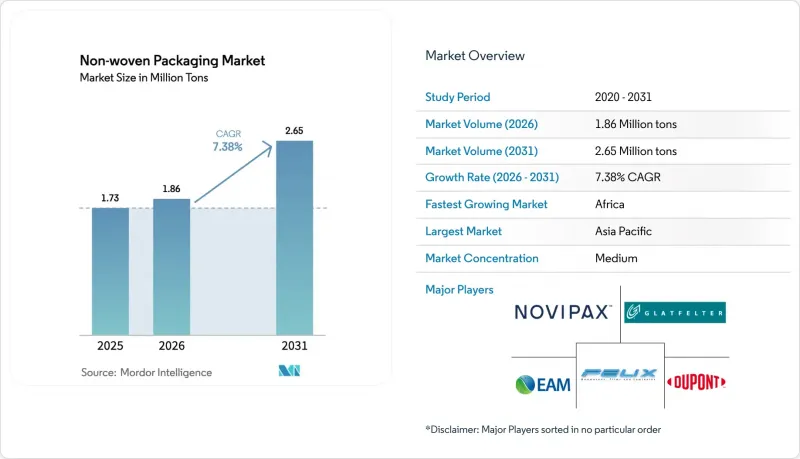
本報告按技術(乾式成網、紡絲成網、熔噴、水刺等技術)、終端用戶包裝應用(食品飲料、工業、醫療保健、消費品、農業等)和地區進行細分。市場預測以噸為單位。
全球不織布包裝市場趨勢及洞察
對環保包裝的需求日益成長
加州SB 1046法案規定,自2025年1月起禁止使用不可回收的一次性塑膠外帶袋,要求零售商改用符合嚴格生物分解標準的可堆肥不織布。佛蒙特州的全州禁令已使塑膠袋消耗量減少了91%,獲得了公眾的廣泛支持,並進一步推動了可堆肥PLA和纖維素不織布的推廣。弗勞恩霍夫實驗室展示了一種可在工業堆肥條件下完全分解的商業規模PLA薄膜,並榮獲2024年約瑟夫·馮·弗勞恩霍夫獎。這為加工商提供了一種經過驗證的高性能基材。
食品袋、包裝紙和包裝材料的消耗量增加。
零售商擴大採用輕質紡粘聚丙烯包裝袋來包裝主食、醬料和蒸餾食品,以減輕運輸重量並防止冷凝。用於農作物和種子的不織布散裝袋可透過調節織物內部的濕度來延長保存期限,這一特性尤其受到亞洲米出口商的重視。歐盟一次性產品法規進一步加速了基於聚乳酸(PLA)網狀材料並嵌入不織布過濾器的可堆肥包裝袋的市場推廣,例如NatureWorks公司計劃於2024年推出的用於咖啡膠囊的包裝袋。
聚丙烯和PET原料價格波動劇烈
2025年3月,南亞地區拉菲草級聚丙烯的平均價格達到每噸980美元,較上一季上漲4%,對加工商的利潤率帶來壓力。與原油價格相關的對苯二甲酸(PTA)和乙二醇(MEG)價格飆升,也波及到聚對苯二甲酸乙二醇酯(PET)片材的價格,迫使歐洲部分生產線停產以減少損失。這些價格波動正迫使買家轉向價格固定的生物基原料,尤其是在考慮到碳排放稅的影響時。
細分市場分析
至2025年,紡絲成網生產線的產量佔總加工量的43.60%。這主要得益於纖維紡絲和網狀成型製程的整合降低了單位成本,以及在不犧牲拉伸強度的前提下實現15克/平方米或更低克重的織物。這一成本優勢意味著紡絲成網仍然是通用包裝袋和農業地膜的主要生產方法。熔噴生產線預計將成長最快,到2031年複合年成長率將達到8.12%,因為直徑2微米或更小的過濾級纖維對於無菌包裝和高阻隔阻隔性零食包裝至關重要。乾式成網和水刺基材在高階禮品包裝和對觸感要求較高的消費擦拭巾等細分市場中佔據著一定的市場佔有率。 DiloGroup公司擁有的節能型高密度針刺專利技術,與水刀黏合相比,可將每公斤耗電量降低三分之一,一旦設計投入大規模生產,將顯著提高加工商的盈利。
技術組合的多樣化可以降低供應風險,並減輕原料價格波動的影響。紡絲成網生產基地正向海灣合作理事會(GCC)地區的樹脂產地附近遷移,而專業的熔噴無紡布生產商則在北美和東亞的醫療設備中心附近選址。這些措施縮短了前置作業時間,降低了運輸成本。因此,紡絲成網在不織布包裝市場仍然至關重要,是成本敏感型大宗應用的理想選擇,而熔噴無紡佈在高價值防護應用領域的重要性日益凸顯。
區域分析
到2025年,亞太地區將以31.75%的市佔率引領不織布包裝市場,這主要得益於中國、印度和馬來西亞從樹脂到不織布的一體化產業中心。中國包裝加工商憑藉著低廉的能源成本和龐大的電商小包裹量,得以每年新增1萬噸紡粘紡絲成網生產線。印度軟包裝市場規模在2023年達到490億美元,隨著當地大型食品業者以可回收的PP不織布取代PVC薄膜,下游對特種不織布的需求也隨之成長。日本和韓國則利用高精度熔噴技術為美國和歐洲市場生產醫療耗材。
非洲的成長速度最快,複合年成長率達7.99%,這主要得益於政府對國內生產的激勵措施以及促進成品包裝袋流通的跨洲自由貿易走廊。奈及利亞和埃及的新生產線正在為區域糧食出口商供貨,從而減少了他們對進口黃麻袋的依賴。南非零售商正逐步對符合生產者延伸責任制(EPR)費用要求的可堆肥聚乳酸(PLA)購物袋進行檢驗。這些發展將使近期安裝的紡粘無紡佈設備的運轉率在2026年之前超過70%,從而在非洲不織布包裝市場創造獨特的成長格局。
其他福利
- Excel格式的市場預測(ME)表
- 3個月的分析師支持
目錄
第1章:引言
- 研究假設和市場定義
- 調查範圍
第2章:調查方法
第3章執行摘要
第4章 市場狀況
- 市場概覽
- 市場促進因素
- 對環保包裝材料的需求日益成長
- 食品袋和包裝材料的消耗量增加
- 電子商務的快速發展正在推動對防護不織布產品的需求。
- 廣泛使用醫用個人防護工具(PPE)和無菌包裝材料。
- 使用由單一材料製成的可回收層壓板(儘管這一點很少受到關注)。
- 生物基聚合物在減少 VOC 排放方面取得了突破性(但常被忽視)的進展。
- 市場限制因素
- 聚丙烯和PET原料價格波動
- 加強對一次性塑膠製品的監管
- 來自紙張和生質塑膠等替代品的競爭
- 複合材料網的回收基礎設施有限(而且沒有得到足夠的重視)。
- 供應鏈分析
- 監理情勢
- 技術展望
- 波特五力分析
- 對影響市場的宏觀經濟因素進行評估
第5章 市場規模與成長預測
- 透過技術
- 空襲
- 紡絲成網
- 熔噴
- 水纏
- 其他
- 按應用程式進行最終用戶包裝
- 飲食
- 產業
- 醫療保健
- 消費品
- 農業
- 其他
- 按地區
- 北美洲
- 美國
- 加拿大
- 墨西哥
- 南美洲
- 巴西
- 阿根廷
- 其他南美國家
- 歐洲
- 德國
- 英國
- 法國
- 義大利
- 西班牙
- 其他歐洲國家
- 亞太地區
- 中國
- 日本
- 韓國
- 印度
- 印尼
- 澳洲
- 其他亞太國家
- 中東和非洲
- 中東
- 阿拉伯聯合大公國
- 沙烏地阿拉伯
- 土耳其
- 其他中東國家
- 非洲
- 南非
- 埃及
- 其他非洲地區
- 中東
- 北美洲
第6章 競爭情勢
- 市場集中度
- Strategic Initiatives
- 市佔率分析
- 公司簡介
- Novipax Buyer LLC
- EAM Corporation(Domtar)
- Glatfelter Corporation
- Felix Nonwovens
- DuPont de Nemours Inc.
- Freudenberg Performance Materials
- Mundo Productos SA
- Eximius Innovative Pvt Ltd
- Ahlstrom-Munksj Oyj
- Berry Global Inc.
- Kimberly-Clark Corporation
- Suominen Corporation
- Fibertex Nonwovens A/S
- PFNonwovens as
- Johns Manville
- Avgol Industries Ltd
- Toray Industries Inc.
- Mitsui Chemicals Inc.
- Fitesa SA
- Pegas Nonwovens(R2G)
- Lydall Inc.(Unifrax)
- Sandler AG
- TWE Group
- Zhejiang Kingsafe Advanced Material Co.
第7章 市場機會與未來展望
According to Mordor Intelligence, the non-Woven packaging market size was valued at 1.73 billion tons in 2025 and estimated to grow from 1.86 billion tons in 2026 to reach 2.65 billion tons by 2031, at a CAGR of 7.38% during the forecast period (2026-2031).
This report is Segmented by Technology (Dry-Laid, Spun-Laid, Melt-Blown, Hydro-Entangled, Other Technologies), End-User Packaging Application (Food and Beverage, Industrial, Medical and Healthcare, Consumer Goods, Agriculture, Other Applications), and by Geography. The Market Forecasts are Provided in Terms of Volume (Tons).
Global Non-Woven Packaging Market Trends and Insights
Growing Demand for Environmentally Sustainable Packaging
California's SB 1046 bans single-use plastic carry-out bags that lack recyclability from January 2025, forcing retailers to shift to compostable non-woven substitutes that meet strict biodegradation criteria. Vermont's statewide ban cut plastic bag consumption by 91% and achieved strong public approval, reinforcing the policy momentum that favors compostable PLA or cellulose non-woven formats. The Fraunhofer Institute demonstrated commercial-scale PLA film that fully decomposes under industrial composting and won the 2024 Joseph von Fraunhofer Prize, giving converters a proven high-performance substrate.
Rising Consumption in Food-Grade Sacks, Bags and Wrap
Retailers boost lightweight spunbond polypropylene sacks for staples, sauces, and ready meals to curb transport weight and avoid condensation. Non-woven crop and seed bulk bags unlock longer shelf life by regulating humidity inside the weave, a feature especially valued by Asian rice exporters. EU single-use rules further accelerate compostable pouch launches based on PLA webs with embedded non-woven filters for applications such as coffee pods released by NatureWorks in 2024.
Volatile Polypropylene and PET Feedstock Prices
Raffia-grade polypropylene averaged USD 980 per metric ton in South Asia in March 2025, a 4% quarter-on-quarter rise that squeezed converter margins. Crude-linked PTA and MEG hikes ripple into PET sheets, prompting moth-balled lines in Europe to curb losses. These gyrations push buyers toward fixed-price bio-based feedstocks, especially when carbon-tax exposure is considered.
Other drivers and restraints analyzed in the detailed report include:
- E-Commerce Boom Fuelling Protective Non-Woven Formats
- Proliferation of Medical PPE and Sterilization Wraps
- Tightening Single-Use Plastic Legislation
For complete list of drivers and restraints, kindly check the Table Of Contents.
Segment Analysis
Spun-laid lines captured 43.60% of 2025 throughput on the strength of integrated fiber spinning and web consolidation that lowers unit cost and allows fabric weights below 15 gsm without sacrificing tensile strength. This cost edge keeps commodity sacks and agriculture row covers in the spun-laid camp. Melt-blown plants post the fastest gains at an 8.12% CAGR to 2031 as filtration-grade diameters below 2 µm become essential for sterile wraps and high-barrier snack packs. Dry-laid and hydro-entangled substrates retain niches in premium gift wraps and consumer wipes where hand feel counts. DiloGroup's patent on energy-saving intense needling reduces kWh per kilogram by one-third versus water-jet bonding, offering converters a profitability booster once the design scales.
A deeper technology mix reduces supply risk and cushions raw-material volatility. Spun-laid output relocates closer to resin sources in the Gulf Cooperation Council, while melt-blown specialists co-locate near medical device hubs in North America and East Asia. These moves shorten lead times and prune freight emissions. Consequently, spun-laid remains pivotal in the Non-Woven Packaging Market as the preferred choice for cost-sensitive bulk formats, yet melt-blown gains relevance in value-added protective
Complete Report Scope:
- By Technology
- Dry-Laid
- Spun-Laid
- Melt-blown
- Hydro-Entangled
- Other Technologies
- By End-user Packaging Application
- Food and Beverage
- Industrial
- Medical and Healthcare
- Consumer Goods
- Agriculture
- Other Applications
- By Geography
- North America
- United States
- Canada
- Mexico
- South America
- Brazil
- Argentina
- Rest of South America
- Europe
- Germany
- United Kingdom
- France
- Italy
- Spain
- Rest of Europe
- Asia-Pacific
- China
- Japan
- South Korea
- India
- Indonesia
- Australia
- Rest of Asia-Pacific
- Middle East and Africa
- Middle East
- UAE
- Saudi Arabia
- Turkey
- Rest of Middle East
- Africa
- South Africa
- Egypt
- Rest of Africa
- Middle East
- North America
Geography Analysis
Asia-Pacific led the Non-Woven Packaging Market in 2025 with 31.75% share due to integrated resin-to-fabric hubs in China, India, and Malaysia. China's packaging converters enjoyed low-cost energy and massive e-commerce parcel flow that justified new spun-laid lines of 10,000 tons per year. India's flexible packaging expansion, valued at USD 49 billion in 2023, created downstream pull for specialty webs as local food giants replace PVC film with recyclable PP non-wovens. Japan and South Korea leveraged high-precision melt-blown expertise for medical consumables bound for the United States and Europe.
Africa recorded the quickest growth at 7.99% CAGR owing to government incentives for domestic manufacturing and continental free-trade corridors that ease movement of finished bags. New lines in Nigeria and Egypt feed regional grain exporters, reducing reliance on imported jute sacks. South Africa's retailers trial compostable PLA carry-bags that comply with extended producer responsibility fees. These moves push capacity utilization past 70% on recently installed spunbond machines by 2026, giving Africa a distinctive growth narrative within the Non-Woven Packaging Market.
- Novipax Buyer LLC
- EAM Corporation (Domtar)
- Glatfelter Corporation
- Felix Nonwovens
- DuPont de Nemours Inc.
- Freudenberg Performance Materials
- Mundo Productos SA
- Eximius Innovative Pvt Ltd
- Ahlstrom-Munksj Oyj
- Berry Global Inc.
- Kimberly-Clark Corporation
- Suominen Corporation
- Fibertex Nonwovens A/S
- PFNonwovens a.s.
- Johns Manville
- Avgol Industries Ltd
- Toray Industries Inc.
- Mitsui Chemicals Inc.
- Fitesa S.A.
- Pegas Nonwovens (R2G)
- Lydall Inc. (Unifrax)
- Sandler AG
- TWE Group
- Zhejiang Kingsafe Advanced Material Co.
Additional Benefits:
- The market estimate (ME) sheet in Excel format
- 3 months of analyst support
TABLE OF CONTENTS
1 INTRODUCTION
- 1.1 Study Assumptions and Market Definition
- 1.2 Scope of the Study
2 RESEARCH METHODOLOGY
3 EXECUTIVE SUMMARY
4 MARKET LANDSCAPE
- 4.1 Market Overview
- 4.2 Market Drivers
- 4.2.1 Growing demand for environmentally sustainable packaging
- 4.2.2 Rising consumption in food-grade sacks, bags and wrap
- 4.2.3 E-commerce boom fuelling protective non-woven formats
- 4.2.4 Proliferation of medical PPE and sterilisation wraps
- 4.2.5 Adoption of mono-material recyclable laminates (under-radar)
- 4.2.6 Bio-based polymer breakthroughs lowering VOC footprint (under-radar)
- 4.3 Market Restraints
- 4.3.1 Volatile poly-propylene and PET feedstock prices
- 4.3.2 Tightening single-use-plastic legislation
- 4.3.3 Competition from paper and bioplastic alternatives
- 4.3.4 Limited recycling infrastructure for composite webs (under-radar)
- 4.4 Supply-Chain Analysis
- 4.5 Regulatory Landscape
- 4.6 Technological Outlook
- 4.7 Porter's Five Forces Analysis
- 4.7.1 Threat of New Entrants
- 4.7.2 Bargaining Power of Buyers
- 4.7.3 Bargaining Power of Suppliers
- 4.7.4 Threat of Substitutes
- 4.7.5 Competitive Rivalry
- 4.8 Assesment of Macroeconomic Factors on the Market
5 MARKET SIZE AND GROWTH FORECASTS (VALUE)
- 5.1 By Technology
- 5.1.1 Dry-Laid
- 5.1.2 Spun-Laid
- 5.1.3 Melt-blown
- 5.1.4 Hydro-Entangled
- 5.1.5 Other Technologies
- 5.2 By End-user Packaging Application
- 5.2.1 Food and Beverage
- 5.2.2 Industrial
- 5.2.3 Medical and Healthcare
- 5.2.4 Consumer Goods
- 5.2.5 Agriculture
- 5.2.6 Other Applications
- 5.3 By Geography
- 5.3.1 North America
- 5.3.1.1 United States
- 5.3.1.2 Canada
- 5.3.1.3 Mexico
- 5.3.2 South America
- 5.3.2.1 Brazil
- 5.3.2.2 Argentina
- 5.3.2.3 Rest of South America
- 5.3.3 Europe
- 5.3.3.1 Germany
- 5.3.3.2 United Kingdom
- 5.3.3.3 France
- 5.3.3.4 Italy
- 5.3.3.5 Spain
- 5.3.3.6 Rest of Europe
- 5.3.4 Asia-Pacific
- 5.3.4.1 China
- 5.3.4.2 Japan
- 5.3.4.3 South Korea
- 5.3.4.4 India
- 5.3.4.5 Indonesia
- 5.3.4.6 Australia
- 5.3.4.7 Rest of Asia-Pacific
- 5.3.5 Middle East and Africa
- 5.3.5.1 Middle East
- 5.3.5.1.1 UAE
- 5.3.5.1.2 Saudi Arabia
- 5.3.5.1.3 Turkey
- 5.3.5.1.4 Rest of Middle East
- 5.3.5.2 Africa
- 5.3.5.2.1 South Africa
- 5.3.5.2.2 Egypt
- 5.3.5.2.3 Rest of Africa
- 5.3.5.1 Middle East
- 5.3.1 North America
6 COMPETITIVE LANDSCAPE
- 6.1 Market Concentration
- 6.2 Strategic Initiatives
- 6.3 Market Share Analysis
- 6.4 Company Profiles (includes Global level Overview Recent Developments)
- 6.4.1 Novipax Buyer LLC
- 6.4.2 EAM Corporation (Domtar)
- 6.4.3 Glatfelter Corporation
- 6.4.4 Felix Nonwovens
- 6.4.5 DuPont de Nemours Inc.
- 6.4.6 Freudenberg Performance Materials
- 6.4.7 Mundo Productos SA
- 6.4.8 Eximius Innovative Pvt Ltd
- 6.4.9 Ahlstrom-Munksj Oyj
- 6.4.10 Berry Global Inc.
- 6.4.11 Kimberly-Clark Corporation
- 6.4.12 Suominen Corporation
- 6.4.13 Fibertex Nonwovens A/S
- 6.4.14 PFNonwovens a.s.
- 6.4.15 Johns Manville
- 6.4.16 Avgol Industries Ltd
- 6.4.17 Toray Industries Inc.
- 6.4.18 Mitsui Chemicals Inc.
- 6.4.19 Fitesa S.A.
- 6.4.20 Pegas Nonwovens (R2G)
- 6.4.21 Lydall Inc. (Unifrax)
- 6.4.22 Sandler AG
- 6.4.23 TWE Group
- 6.4.24 Zhejiang Kingsafe Advanced Material Co.
7 MARKET OPPORTUNITIES AND FUTURE OUTLOOK
- 7.1 White-space and Unmet-need Assessment

 不織布磨料市場:按形狀、磨料、基材、粘合劑、柔軟性、工件、最終用途產業、應用和分銷管道分類-2026-2032年全球市場預測
 不織布:市場佔有率分析、產業趨勢與統計、成長預測(2026-2031)
 2026-2034年全球粗梳不織布市場規模、佔有率、趨勢及成長分析報告
 紡織短纖維市場規模、佔有率和成長分析:按纖維類型、應用、最終用途、通路和地區分類-2026-2033年產業預測
 高密度聚乙烯(HDPE)不織布市場規模、佔有率和成長分析:按技術、應用、終端用戶產業和地區分類-2026-2033年產業預測聚丙烯不織布:市場佔有率分析、產業趨勢與統計、成長預測(2026-2031)
 全球布袋市場分析:市場規模、佔有率、應用及預測(2018-2034)
 不織布市場:按材料、技術、應用和地區分類可沖式不織布市場:至2031年的未來展望棉水針不織布市場:依布料成分、紙張重量、後整理、應用及通路分類-2026-2032年全球市場預測