


 |
市場調查報告書
商品編碼
2100745
亞太地區含氟聚合物:市場佔有率分析、產業趨勢與統計及成長預測(2026-2031)Asia-Pacific Fluoropolymer - Market Share Analysis, Industry Trends & Statistics, Growth Forecasts (2026 - 2031) |
||||||

※ 本網頁內容可能與最新版本有所差異。詳細情況請與我們聯繫。
據 Mordor Intelligence 稱,亞太地區氟聚合物市場在 2025 年的價值為 256.25 千噸,預計到 2031 年將從 2026 年的 277.65 千噸成長到 414.37 千噸,在預測期(2026-2031 年)成長到 414.37 千噸,在預測期(2026-2031 年)為 8.3%。
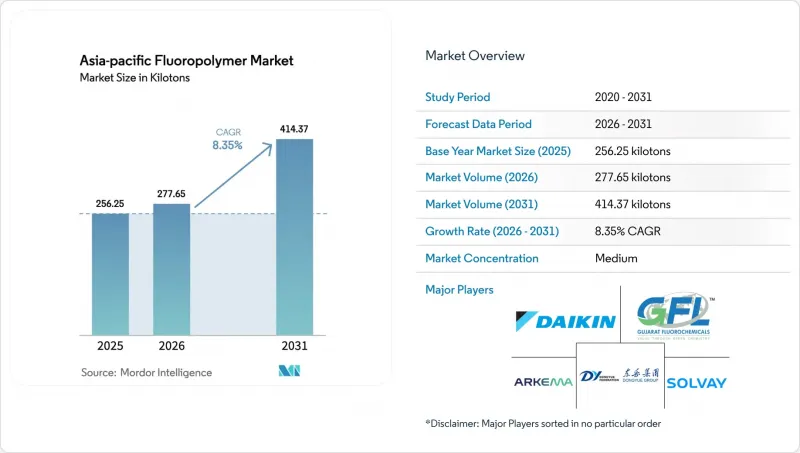
本報告按樹脂類型(ETFE、FEP、PTFE、PVF、PVDF 及其他樹脂)、終端用戶產業(航太、汽車、建築施工、工業機械及其他)和地區(中國、印度、日本、韓國、澳洲、馬來西亞及其他亞太國家)進行細分。市場預測以數量(噸)和價值(美元)兩種單位呈現。
亞太地區含氟聚合物市場趨勢及洞察。
亞洲電池供應鏈中電動車用聚偏二氟乙烯(PVDF)需求激增
到2024年,亞太地區鋰離子電池產能將達到1,200吉瓦時(GWh),其中中國就佔850吉瓦時。要滿足如此龐大的產能,需要使用金屬含量低於500ppm的電池級PVDF作為隔膜和黏結劑,這導致其價格比工業級PVDF高出30%以上。當寧德時代(CATL)計劃在2027年增產500吉瓦時,這意味著供應缺口將進一步擴大,促使索爾維(Solvay)在常熟和阿科瑪(Arkema)在亞太地區擴大產能。東岳集團等中國製造商正在建造高純度PVDF專用生產線,以確保國內需求並最終取代進口。電動車原料在地化的持續競爭正在推動亞太地區氟聚合物市場的長期結構性需求成長。
電子設備的微型化推動了對高純度聚四氟乙烯和氟乙烯的需求。
向3奈米邏輯半導體、先進封裝和高頻5G模組的轉變,進一步提高了耗材和薄膜純度要求,要求達到10 ppb或更低。台灣和韓國的主要晶圓代工廠制定了嚴格的標準,只有少數幾種氟聚合物等級能夠滿足這些標準。由於價格高昂且對污染接受度極低,像Chemoirs和Daikin這樣的公司已經設立了專門的半導體級氟聚合物生產線,有效地將這些生產線與一般工業生產線隔離開來。馬來西亞和泰國的契約製造製造商也紛紛效仿,將FEP薄膜應用於智慧型手機和汽車LiDAR等軟性印刷電路基板的生產。因此,亞太地區的氟聚合物市場正受益於消費電子領域高階需求和產量成長的雙重推動。
R-142b 和 R-22 原料供應的波動
《蒙特婁議定書》的實施將使中國從2023年起R-142b的產量減少60%,導致價格上漲40%,並對中小規模的氟聚合物工廠造成衝擊。由於依賴進口,生產商正面臨物流衝擊,而將工廠維修為生產非消耗臭氧層物質(ODS)產品需要18至24個月的時間。擁有自有氟化氫(HF)生產設施的大型綜合企業,例如科慕和大金,正透過後向整合來維持獲利能力,加速市場重組。短期價格波動會削弱訂單預測的確定性,並可能導致亞太地區氟聚合物市場下游專案的延誤,尤其是需要即時庫存管理的電子設備契約製造。
細分市場分析
聚四氟乙烯 (PTFE) 的應用主要集中在高溫密封件、汽車墊片和化學襯裡等領域,預計到 2025 年,PTFE 將佔據亞太地區含氟聚合物市場 46.98% 的佔有率。成熟的終端應用確保了 PTFE 的穩健成長,與中國、印度和東南亞的工業生產水準相符。同時,聚聚二氟亞乙烯電池隔膜和黏合劑,而鋰離子電池佔該地區全球電池產能的 70%,預計 PVDF 到 2031 年將以 19.34% 的複合年成長率 (CAGR) 實現最快成長。隨著電動車的普及和固定式儲能設施的擴張,亞太地區 PVDF 含氟聚合物市場預計將進一步成長。氟化乙烯丙烯 (FEP) 在超大規模資料中心的電線電纜絕緣領域展現出適度的成長勢頭,而 ETFE 的成長則得益於其在建築膜和化學儲罐襯裡等領域的應用,這些應用對耐化學性要求較高。
歷史對比數據凸顯了這一轉變。 PVDF的複合年成長率已從2019-2024年的12.8%飆升至2031年的19.34%。聚偏氟乙烯(PVDF)在太陽能電池背板和外牆薄膜領域的需求不斷成長,而全氟烷氧基化物(PFAL)和ECTFE等小眾材料則在半導體濕式製程和腐蝕性管道領域佔據一席之地。針對PFAS持久性的監管壓力正推動PVDF結構改良型研發,以期在提高分解速率的同時維持電化學穩定性。因此,供應商正投資開發微量金屬含量低於100 ppb的特種等級產品,旨在提升亞太地區含氟聚合物市場的每公斤附加價值。
其他福利
- Excel格式的市場預測(ME)表
- 3個月的分析師支持
目錄
第1章:引言
- 研究假設和市場定義
- 調查範圍
第2章:調查方法
第3章執行摘要
第4章 市場狀況
- 市場概覽
- 市場促進因素
- 亞洲電池供應鏈中電動車用聚偏二氟乙烯(PVDF)需求激增
- 電子設備的微型化推動了對高純度聚四氟乙烯和氟乙烯的需求。
- 中國和韓國半導體製造廠迅速擴張
- 建築領域向ETFE/PVF建築膜過渡
- 使用改質PVDF進行鈉離子電池隔板的中試
- 市場限制因素
- R-142b 和 R-22 原料供應情況的波動
- 在日本和澳大利亞,遵守 PFAS 法規的成本正在飆升。
- 山東省一家大型氫氟酸工廠意外停產
- 價值鏈分析
- 波特五力模型
- 終端用戶領域的趨勢
- 航太(航太零件生產產生的銷售收入)
- 汽車(汽車生產)
- 建築與施工(新建建築占地面積)
- 電氣和電子(電氣和電子產品生產產生的銷售收入)
- 包裝(塑膠包裝數量)
- 進出口趨勢
- 法律規範
- 澳洲
- 中國
- 印度
- 日本
- 馬來西亞
- 韓國
第5章 市場規模與成長預測
- 依樹脂類型
- 乙烯-四氟乙烯(ETFE)
- 氟化乙烯丙烯(FEP)
- 聚四氟乙烯(PTFE)
- 聚偏氟乙烯(PVF)
- 聚二氟亞乙烯(PVDF)
- 其他
- 按最終用戶行業分類
- 航太
- 車
- 建築/施工
- 電氣和電子設備
- 工業機械
- 包裝
- 其他
- 按地區
- 中國
- 印度
- 日本
- 韓國
- 澳洲
- 馬來西亞
- 其他亞太地區
第6章 競爭情勢
- 市場集中度
- 策略趨勢
- 市佔率(%)/排名分析
- 公司簡介
- AGC Inc.
- Arkema
- Daikin Industries Ltd.
- Dongyue Group
- Gujarat Fluorochemicals Limited
- Halopolymer
- Kureha Corporation
- Shanghai Huayi 3F New Materials Co., Ltd.
- Sinochem Holdings
- Solvay
- Syensqo
- The Chemours Company
- Wuhan Everflon Fluoropolymers Co.,Ltd
第7章 市場機會與未來展望
第8章:執行長面臨的關鍵策略挑戰
According to Mordor Intelligence, the Asia-Pacific fluoropolymer market size was valued at 256.25 kilotons in 2025 and estimated to grow from 277.65 kilotons in 2026 to reach 414.37 kilotons by 2031, at a CAGR of 8.35% during the forecast period (2026-2031).
This report is Segmented by Sub-Resin Type (ETFE, FEP, PTFE, PVF, PVDF, and Other Sub-Resin Types), End-User Industry (Aerospace, Automotive, Building and Construction, Industrial and Machinery, and More), and Geography (China, India, Japan, South Korea, Australia, Malaysia, and Rest of Asia-Pacific). The Market Forecasts are Provided in Terms of Volume (Tons) and Value (USD).
Asia-Pacific Fluoropolymer Market Trends and Insights
EV-Grade PVDF Demand Surge from Asia's Battery Supply-Chain
Asia-Pacific's lithium-ion battery capacity reached 1,200 GWh in 2024, and China alone accounted for 850 GWh. This scale requires battery-grade PVDF for separators and binders that meet purity levels of under 500 ppm of metals, driving premiums of over 30% compared to industrial grades. CATL's plan to add 500 GWh by 2027 signals a widening supply gap that spurs capacity additions by Solvay in Changshu and Arkema across the region. Chinese producers such as Dongyue Group have earmarked dedicated high-purity PVDF lines to secure domestic demand and eventually displace imports. The ongoing race to localize raw materials for electric vehicles anchors the Asia-Pacific Fluoropolymer Market to long-term structural volume growth.
Electronics Miniaturization Driving High-Purity PTFE & FEP
The shift to 3-nanometer logic, advanced packaging, and high-frequency 5G modules intensifies the need for purity requirements below 10 ppb for consumables and films. Foundry giants in Taiwan and South Korea set stringent benchmarks that only a handful of fluoropolymer grades can satisfy. Premium pricing and low tolerance for contamination have encouraged Chemours and Daikin to ring-fence dedicated semiconductor-grade output, essentially quarantining these lines from bulk industrial streams. Malaysia and Thailand's contract manufacturers follow suit, adopting FEP films for flexible printed boards used in smartphones and automotive LiDAR. The Asia-Pacific Fluoropolymer Market, therefore, benefits from both top-end specification pull and volume ramp-up in the consumer electronics sector.
Volatile R-142b & R-22 Feedstock Availability
Montreal Protocol enforcement cut Chinese R-142b output by 60% since 2023, spiking prices 40% and disrupting small- and mid-tier fluoropolymer plants. Import dependence exposes producers to logistics shocks, while plant retrofits to non-ODS routes need 18-24 months. Integrated giants with captive HF units, including Chemours and Daikin, leverage backward integration to preserve margins, precipitating market consolidation. Short-term volatility affects order predictability and can delay downstream projects in the Asia-Pacific Fluoropolymer Market, particularly among electronics subcontractors that require just-in-time inventory management.
Other drivers and restraints analyzed in the detailed report include:
- Rapid Build-Out of Semiconductor Fabs in China & South Korea
- Construction Shift to ETFE/PVF Architectural Membranes
- Escalating PFAS Compliance Costs in Japan & Australia
For complete list of drivers and restraints, kindly check the Table Of Contents.
Segment Analysis
Polytetrafluoroethylene (PTFE) claimed 46.98% of the Asia-Pacific Fluoropolymer Market share in 2025, driven by its applications in high-temperature seals, automotive gaskets, and chemical-processing linings. Mature end-uses ensure baseline growth aligned with industrial output across China, India, and Southeast Asia. Meanwhile, polyvinylidene fluoride is expected to register the fastest growth, with a 19.34% CAGR to 2031, driven by the demand for lithium-ion battery separators and binders, which account for 70% of the global cell capacity in the region. The Asia-Pacific Fluoropolymer Market size for PVDF is projected to increase alongside the growth of electric vehicle penetration and the expansion of stationary storage installations. Fluorinated ethylene-propylene (FEP) gains moderate momentum in wire-and-cable insulation for hyperscale data centers, whereas ETFE growth is tied to architectural membranes and chemical-tank linings, which require elevated chemical resistance.
Historical comparisons underline the shift: PVDF's CAGR leapt from 12.8% during 2019-2024 to 19.34% through 2031. Polyvinyl fluoride strengthens via solar backsheets and facade films, while niche materials like perfluoroalkoxy and ECTFE carve a foothold in semiconductor wet benches and corrosion-prone pipelines. Regulatory pressure around PFAS persistence spurs R&D into modified PVDF architectures that degrade faster yet maintain electrochemical stability. Suppliers therefore allocate capital toward specialized grades with trace-metal thresholds under 100 ppb, positioning the Asia-Pacific Fluoropolymer Market for higher value capture per kilogram.
Complete Report Scope:
- By Sub-Resin Type
- Ethylenetetrafluoroethylene (ETFE)
- Fluorinated Ethylene-propylene (FEP)
- Polytetrafluoroethylene (PTFE)
- Polyvinyl Fluoride (PVF)
- Polyvinylidene Fluoride (PVDF)
- Other Sub-Resin Types
- By End-User Industry
- Aerospace
- Automotive
- Building and Construction
- Electrical and Electronics
- Industrial and Machinery
- Packaging
- Other End-user Industries
- By Geography
- China
- India
- Japan
- South Korea
- Australia
- Malaysia
- Rest of Asia-Pacific
List of Companies Covered in this Report:
- AGC Inc.
- Arkema
- Daikin Industries Ltd.
- Dongyue Group
- Gujarat Fluorochemicals Limited
- Halopolymer
- Kureha Corporation
- Shanghai Huayi 3F New Materials Co., Ltd.
- Sinochem Holdings
- Solvay
- Syensqo
- The Chemours Company
- Wuhan Everflon Fluoropolymers Co.,Ltd
Additional Benefits:
- The market estimate (ME) sheet in Excel format
- 3 months of analyst support
TABLE OF CONTENTS
1 Introduction
- 1.1 Study Assumptions & Market Definition
- 1.2 Scope of the Study
2 Research Methodology
3 Executive Summary
4 Market Landscape
- 4.1 Market Overview
- 4.2 Market Drivers
- 4.2.1 EV-grade PVDF demand surge from Asia's battery supply-chain
- 4.2.2 Electronics miniaturisation driving high-purity PTFE & FEP
- 4.2.3 Rapid build-out of semiconductor fabs in China & South Korea
- 4.2.4 Construction shift to ETFE/PVF architectural membranes
- 4.2.5 Sodium-ion battery separator pilots using modified PVDF
- 4.3 Market Restraints
- 4.3.1 Volatile R-142b & R-22 feedstock availability
- 4.3.2 Escalating PFAS compliance costs in Japan & Australia
- 4.3.3 Unplanned outages at key HF plants in Shandong
- 4.4 Value Chain Analysis
- 4.5 Porter's Five Forces
- 4.5.1 Threat of New Entrants
- 4.5.2 Bargaining Power of Suppliers
- 4.5.3 Bargaining Power of Buyers
- 4.5.4 Threat of Substitutes
- 4.5.5 Competitive Rivalry
- 4.6 End-use Sector Trends
- 4.6.1 Aerospace (Aerospace Component Production Revenue)
- 4.6.2 Automotive (Automobile Production)
- 4.6.3 Building and Construction (New Construction Floor Area)
- 4.6.4 Electrical and Electronics (Electrical and Electronics Production Revenue)
- 4.6.5 Packaging(Plastic Packaging Volume)
- 4.7 Import and Export Trends
- 4.8 Regulatory Framework
- 4.8.1 Australia
- 4.8.2 China
- 4.8.3 India
- 4.8.4 Japan
- 4.8.5 Malaysia
- 4.8.6 South Korea
5 Market Size & Growth Forecasts (Value and Volume)
- 5.1 By Sub-Resin Type
- 5.1.1 Ethylenetetrafluoroethylene (ETFE)
- 5.1.2 Fluorinated Ethylene-propylene (FEP)
- 5.1.3 Polytetrafluoroethylene (PTFE)
- 5.1.4 Polyvinyl Fluoride (PVF)
- 5.1.5 Polyvinylidene Fluoride (PVDF)
- 5.1.6 Other Sub-Resin Types
- 5.2 By End-User Industry
- 5.2.1 Aerospace
- 5.2.2 Automotive
- 5.2.3 Building and Construction
- 5.2.4 Electrical and Electronics
- 5.2.5 Industrial and Machinery
- 5.2.6 Packaging
- 5.2.7 Other End-user Industries
- 5.3 By Geography
- 5.3.1 China
- 5.3.2 India
- 5.3.3 Japan
- 5.3.4 South Korea
- 5.3.5 Australia
- 5.3.6 Malaysia
- 5.3.7 Rest of Asia-Pacific
6 Competitive Landscape
- 6.1 Market Concentration
- 6.2 Strategic Moves
- 6.3 Market Share (%)**/Ranking Analysis
- 6.4 Company Profiles (includes Global level Overview, Market level overview, Core Segments, Financials as available, Strategic Information, Market Rank/Share for key companies, Products & Services, and Recent Developments)
- 6.4.1 AGC Inc.
- 6.4.2 Arkema
- 6.4.3 Daikin Industries Ltd.
- 6.4.4 Dongyue Group
- 6.4.5 Gujarat Fluorochemicals Limited
- 6.4.6 Halopolymer
- 6.4.7 Kureha Corporation
- 6.4.8 Shanghai Huayi 3F New Materials Co., Ltd.
- 6.4.9 Sinochem Holdings
- 6.4.10 Solvay
- 6.4.11 Syensqo
- 6.4.12 The Chemours Company
- 6.4.13 Wuhan Everflon Fluoropolymers Co.,Ltd
7 Market Opportunities & Future Outlook
- 7.1 White-space & Unmet-Need Assessment
8 Key Strategic Questions for CEOs

 航太氟聚合物市場報告:趨勢、預測和競爭分析(至2035年)
 醫用氟聚合物市場-2026-2032年全球市場預測
 氟聚合物添加劑市場規模、佔有率和成長分析:按產品類型、功能、形式、應用、最終用途產業和地區分類-2026-2033年產業預測
 氟聚合物市場規模、佔有率、趨勢和預測:按產品類型、應用、最終用途行業和地區分類,2026-2034年
 醫用氟聚合物市場規模、佔有率和成長分析:按類型、應用、最終用途和地區分類-2026-2033年產業預測
 氟聚合物市場規模、佔有率和成長分析:按氟聚合物類型、終端用途產業、應用、配方、耐熱性和地區分類-2026-2033年產業預測
 高純度氟聚合物(PFA)管材和管道-2026-2032 年全球市場佔有率和排名、總銷售額和需求預測。氟聚合物市場:按類型、形態、製程和最終用戶分類-2026-2032年全球市場預測半導體氟聚合物管材市場:管材類型、材質、製造流程、直徑範圍、應用及最終用途-2026-2032年全球市場預測5G含氟聚合物市場:依產品類型、形態、製造流程和最終用途產業分類-2026-2032年全球預測