


 |
市場調查報告書
商品編碼
2100658
歐洲生質燃料:市場佔有率分析、行業趨勢和統計數據以及成長預測(2026-2031 年)Europe Biofuel - Market Share Analysis, Industry Trends & Statistics, Growth Forecasts (2026 - 2031) |
||||||

※ 本網頁內容可能與最新版本有所差異。詳細情況請與我們聯繫。
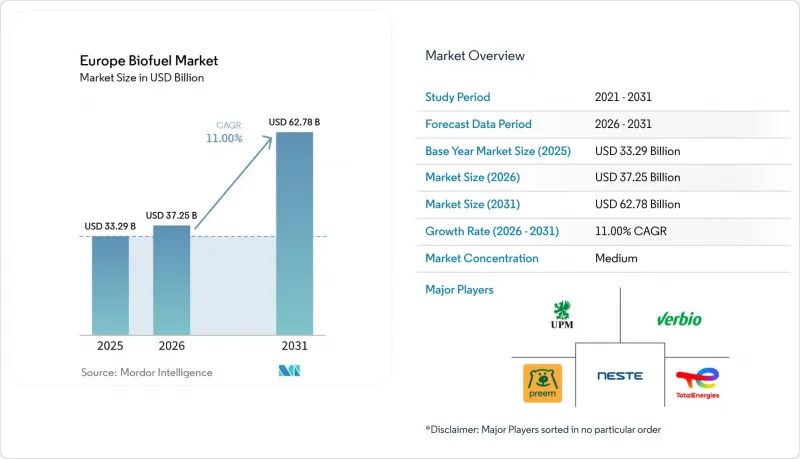
根據 Mordor Intelligence 預測,歐洲生質燃料市場規模將從 2025 年的 332.9 億美元成長到 2026 年的 372.5 億美元,然後在 2031 年達到 627.8 億美元,2026 年至 2031 年的複合年成長率為 11%。
本報告按燃料類型(生質乙醇、生質柴油、可再生柴油/HVO 等)、世代(第一代、第二代、第三代、第四代)、原料(糖料作物、澱粉作物、藻類等)、技術(發酵、酯交換、加氫等)、最終用途部門(道路運輸、航空、航運等)和地區(德國、英國、法國、義大利、荷蘭)進行分類。
歐洲生質燃料市場的趨勢與洞察
加強歐盟可再生能源指令III項下的義務
將於2024年生效的RED III指令規定,到2030年,交通運輸部門29%的能源消耗必須來自可再生能源,其中先進生質燃料的子目標為5.5個百分點。成員國必須在2025年5月前將指令納入本國法律,這將推動各國朝向統一合規的方向發展。目前,德國、法國和荷蘭的投資決策正在加速。棕櫚油和大豆等具有高間接土地利用變化(ILUC)風險的原料預計將被逐步淘汰,資金正轉向廢油、農業殘渣和藻類。德國在2025年公佈了一項規則草案,擬從2028年起對第一代生質燃料的產量水準實施處罰,這正在加速開發商將釀酒廠改造為木質纖維素乙醇生產廠。法國將先進生質燃料的倍增係數提高至2024年的1.5,促使道達爾能源公司維修以廢棄食用油和動物脂肪為原料的加氫生產線。雖然更嚴格的永續性標準擠壓了傳統生物柴油的利潤空間,但也為能夠將生質能分離成多種產品的綜合生物煉製廠創造了新的機會。
「適合55歲」的溫室氣體減量目標
「Fit-for-55」一攬子計畫要求到2030年溫室氣體淨排放量比1990年水準降低55%,並設定乘用車和貨車的排放上限分別為37.5%和31%。對於沒有切實可行的電氣化路徑的大型車隊而言,可再生柴油和生質乙醇仍然是僅有的可直接取代柴油的燃料。芬蘭的St1 Nordic公司於2024年在哥德堡投產了一座年產40萬噸廢棄物衍生乙醇的工廠,以抓住這一柴油替代機會。航運和航空業目前已納入歐盟排放交易體系(EU ETS),這提振了對生物船用燃料和永續航空燃料(SAF)的需求。義大利威尼斯的一家生物煉油廠於2024年開始生產生物船用柴油,以滿足即將實施的FuelEU Maritime排放上限要求的船舶的需求。
原物料價格波動和供應短缺
2024年1月,鹿特丹的廢棄食用油現貨價格為每噸800歐元,到2025年12月飆升至每噸1350歐元,原因是可再生柴油煉油廠的出價高於化學和飼料買家。到2025年年中,由於法國和德國的乾旱導致收成大幅減少,菜籽油價格徘徊在每噸1100歐元左右。目前,原物料成本佔Neste可再生產品現金成本的四分之三,因此其利潤率對利潤率高度敏感。 RED III的間接土地利用變化上限的提高減少了棕櫚油甲酯的進口,而印尼任何與天氣相關的供應中斷都將立即導致歐洲價格飆升。因此,生產商正在透過簽訂多年期承購協議和投資秸稈和木質素等替代原料來對沖風險。
細分市場分析
2025年,歐洲生質柴油市場佔歐洲生質燃料,由於符合更嚴格的溫室氣體減排配額標準,因此在斯堪地那維亞和德國的飛機機隊中可再生了合約。預計到2025年,歐洲SAF生質燃料市場規模將達到24億美元,到2031年將超過100億美元,凸顯了航空業對監管合規性的高要求。航空公司已簽署了期限為10至15年的供應合約。法國航空-荷航集團承諾在2035年採購80萬噸,這將確保穩定的收入來源,並降低與加氫和醇制航空煤油投資相關的風險。傳統引擎在B7混合比例下已達到性能極限,而原油供應又受到間接土地利用變化(ILUC)限制,導致生質柴油需求停滯不前。可再生柴油的替代特性,加上混合生質乙醇(HBE)認證帶來的溢價,正在蠶食荷蘭和德國的生質柴油銷售量。生物石腦油等小眾化合物的市佔率目前仍不足3%,但作為可再生塑膠的石化原料,其戰略重要性日益凸顯。
生質乙醇的消費受到彈性燃料普及的影響。在瑞典,稅收優惠政策促使E85銷售量在2024年成長了12%,而義大利和西班牙則因汽油需求萎縮而下滑。永續航空燃料(SAF)的成長正推動煉油廠重新最佳化其產品組合。道達爾能源公司已將其位於拉梅德的煉油廠40%的產能於2024年轉化為噴射機燃料,而耐斯特公司計劃在2027年前在其鹿特丹煉油廠進行類似的改造。加氫處理流程可在柴油和噴射機燃料產量之間靈活切換,從而為應對需求波動提供保障利潤的途徑。隨著「ReFuelEU」混合比例的提高,預計在2026年至2031年間,SAF的產量將佔新增加氫產能的約四分之一,這將永久改變歐洲煉油廠的經濟格局。
到2025年,以糖和澱粉為原料的第一代生物燃料生產流程將佔據歐洲生質燃料市場65.2%的佔有率,但政策上限和原料成本阻礙了其進一步成長。同時,以殘渣為原料的第二代生物燃料生產流程正逐漸實現商業性獲利能力,並受惠於累計課稅政策。科萊恩位於羅馬尼亞的「Sunliquid」工廠在2024年生產的乙醇價格為每公升0.90歐元,與第一代生物燃料生產製程的經濟效益相差不到10%。第三代藻類生物燃料生產仍處於示範階段,但荷蘭新創公司Fotonor在2025年籌集了3000萬歐元,用於啟動一個年產1萬噸藍菌的資金籌措項目,該項目可直接將二氧化碳和陽光轉化為乙醇。第四代合成生物學平台,例如Lanzatec公司的氣體發酵技術,預計將以19.5%的年成長率擴大在歐洲生質燃料市場的佔有率。這一成長軌跡反映了企業資金籌措和基因組編輯成本的降低,這縮短了從實驗室到試點階段的週期,並提高了菌株的生產力。
隨著RED III收緊間接土地利用變化(ILUC)上限,法國和德國的第一代生物能源碳捕獲與封存(BECCS)設施正在考慮改用廢油或降低產能。 Teleos計劃在2026年前關閉兩家釀酒廠,並將其農作物衍生乙醇供應量減少40萬噸。投資者更青睞那些使用較少依賴土地資源的原料的平台。英國航空已向Lanzatec位於塔爾伯特港的專案投資1,000萬英鎊,以確保儘早獲得透過氣體發酵生產的永續航空燃料(SAF)。雖然第四代計畫仍需證明擴充性和成本競爭力,但預計技術學習曲線的提升以及BECCS信用額度的潛力將在2030年後顯著擴大其市場佔有率。
其他好處:
- Excel格式的市場預測(ME)表
- 3個月的分析師支持
目錄
第1章:引言
- 調查範圍
- 研究假設和市場定義
第2章:調查方法
第3章執行摘要
第4章 市場狀況
- 市場概覽
- 市場促進因素
- 加強歐盟可再生能源指令III項下的義務
- 「適合55歲」的溫室氣體減量目標
- 歐盟排放交易體系(EU ETS)碳價格上漲
- 強制使用永續航空燃料(ReFuelEU)
- 綜合電廠提高生物能源碳捕獲與封存(BECCS)積分的潛力
- 生質燃料禁令促進了掩埋衍生廢棄物計畫的發展
- 市場限制因素
- 原物料價格波動和供應短缺
- 土地利用和間接土地利用變化永續性限制
- 先進生質燃料工廠所需的資本投資相對較高。
- 透過電子燃料和綠色氫能展開競爭
- 供應鏈分析
- 監理情勢
- 技術展望
- 波特五力模型
第5章 市場規模與成長預測
- 按燃料類型
- 生質乙醇
- 生質柴油(FAME)
- 可再生柴油/氫化植物油
- 永續航空燃料(SAF)
- 生物石腦油和其他可直接取代的生質燃料
- 按世代
- 第一代(糖和澱粉)
- 第二代(纖維素基)
- 第三代(藻類衍生)
- 第四代(合成生物學/光生物學)
- 按原料
- 糖料作物(甘蔗、甜菜)
- 澱粉作物(玉米、小麥、木薯)
- 油籽(大豆、菜籽、棕櫚)
- 廢棄食用油和動物脂肪
- 木質纖維素農業殘渣
- 藻類
- 透過技術
- 發酵
- 酯交換反應
- 氫處理(HVO/SAF)
- 氣化和費托合成
- 熱解和提質
- 按最終用途類別
- 道路運輸
- 航空
- 海上
- 發電和供熱
- 按地區
- 德國
- 英國
- 法國
- 義大利
- 西班牙
- 荷蘭
- 北歐國家
- 俄羅斯
- 其他歐洲國家
第6章 競爭情勢
- 市場集中度
- 策略趨勢(併購、聯盟、購電協議)
- 市場佔有率分析(主要公司的市場排名和市場佔有率)
- 公司簡介
- Neste Oyj
- TotalEnergies SE
- Preem AB
- UPM-Kymmene Oyj
- Verbio Vereinigte BioEnergie AG
- St1 Nordic Oy
- SunPine AB
- Galp Energia SGPS SA
- Eni SpA(Eni Sustainable Mobility)
- BP plc(bp Biofuels)
- Shell plc
- SkyNRG BV
- Clariant AG
- Beta Renewables SpA
- Borregaard ASA
- Green Fuel Nordic Oy
- Svenska Cellulosa AB(SCA)
- Cepsa Biofuels
- Biomethanol Chemie Nederland BV
- Velocys plc
第7章 市場機會與未來展望
According to Mordor Intelligence, the Europe biofuel market size is expected to grow from USD 33.29 billion in 2025 to USD 37.25 billion in 2026 and is forecast to reach USD 62.78 billion by 2031 at 11% CAGR over 2026-2031.
This report is Segmented by Fuel Type (Bioethanol, Biodiesel, Renewable Diesel/HVO, and More), Generation (First, Second, Third, and Fourth), Feedstock (Sugar Crops, Starch Crops, Algae, and More), Technology (Fermentation, Trans-Esterification, Hydrotreatment, and More), End-Use Sector (Road Transport, Aviation, Marine, and More), and Geography (Germany, United Kingdom, France, Italy, Netherlands, and More).
Europe Biofuel Market Trends and Insights
EU Renewable Energy Directive III Escalating Mandates
RED III, effective 2024, requires renewable energy to cover 29% of transport consumption by 2030 and sets a 5.5-percentage-point sub-target for advanced biofuels. Member states must transpose the law by May 2025, creating a synchronized compliance wave that has already accelerated investment decisions across Germany, France, and the Netherlands. High-ILUC-risk feedstocks such as palm oil and soy face a gradual phase-out, redirecting capital toward waste oils, agricultural residues, and algae. Germany issued draft rules in 2025 that penalize first-generation volumes from 2028 onward, spurring developers to retool distilleries for lignocellulosic ethanol. France lifted its advanced-biofuel multiplier to 1.5 in 2024, prompting TotalEnergies to retrofit hydrotreatment lines for used-cooking-oil and tallow feedstocks. The tightened sustainability screen is squeezing conventional biodiesel margins but opening room for integrated biorefineries that can fractionate biomass into multiple products.
Fit-for-55 Greenhouse-Gas-Reduction Targets
The Fit-for-55 package obliges a 55% net GHG cut by 2030 versus 1990, with new emission ceilings of 37.5% for cars and 31% for vans in 2030. Renewable diesel and bioethanol remain the only drop-in options for heavy-duty fleets lacking viable electrification routes. Finland's St1 Nordic started a 400,000-tonne waste-ethanol plant in Gothenburg in 2024 to capture this diesel-substitution opportunity. Maritime and aviation are now inside the EU ETS, boosting demand for bio-marine fuels and SAF. Italy's Venice biorefinery began producing bio-marine gasoil in 2024 to serve vessels preparing for FuelEU Maritime emission caps.
Feedstock Price Volatility & Supply Tightness
UCO spot prices in Rotterdam surged from EUR 800 per tonne in January 2024 to EUR 1,350 by December 2025 as renewable-diesel refiners outbid chemical and animal-feed buyers. Rapeseed oil hovered near EUR 1,100 per tonne in mid-2025 after drought slashed French and German harvests. Feedstock now represents three-quarters of renewable-product cash costs for Neste, heightening margin sensitivity. Imports of palm-oil methyl ester have waned under RED III's high-ILUC cap, meaning any weather-induced supply disruption in Indonesia causes immediate European price spikes. Producers are therefore hedging by signing multi-year offtake deals and investing in alternative feedstocks such as straw and lignin.
Other drivers and restraints analyzed in the detailed report include:
- Rising EU ETS Carbon Prices
- Sustainable-Aviation-Fuel (ReFuelEU) Mandates
- High CAPEX for Advanced Biofuel Plants
For complete list of drivers and restraints, kindly check the Table Of Contents.
Segment Analysis
The Europe Biodiesel Market accounted for 66.6% of the European biofuel market share in 2025, supported by established blending mandates and widespread use in the transportation sector. However, sustainable aviation fuel (SAF) expanded at an annual rate of 25.2% and is forecast to maintain similar growth through 2031. Renewable diesel, chemically identical to fossil diesel, is winning fleet contracts across Scandinavia and Germany because it meets more stringent greenhouse-gas-reduction quotas. The European biofuel market size for SAF reached USD 2.4 billion in 2025 and is projected to surpass USD 10 billion by 2031, underscoring aviation's compliance pull. Airlines are locking 10- to 15-year supply agreements. Air France-KLM is committed to 800,000 tonnes through 2035, providing predictable revenue streams that de-risk hydrotreatment and alcohol-to-jet investments. Biodiesel demand is plateauing as legacy engines max out at B7 blending levels and ILUC caps constrain virgin-oil feedstock. Renewable diesel's drop-in characteristics, coupled with HBE certificate premiums, are cannibalizing biodiesel volumes in the Netherlands and Germany. Niche molecules such as bio-naphtha remain below 3% of volumes but are gaining strategic relevance as petrochemical feedstocks for renewable plastics.
Bioethanol consumption depends on flex-fuel adoption; Sweden's E85 sales increased 12% in 2024 under tax incentives, while Italy and Spain saw declines amid gasoline demand shrinkage. SAF growth is driving product-slate re-optimization at refineries: TotalEnergies shifted 40% of La Mede output to jet fuel in 2024, and Neste plans a similar pivot in Rotterdam by 2027. The hydrotreatment route's ability to swing cut yields between diesel and jet provides margin insurance against demand fluctuations. As ReFuelEU blending rates escalate, SAF production is expected to account for nearly one-quarter of hydrotreating capacity additions between 2026 and 2031, permanently altering European refinery economics.
First-generation pathways from sugar and starch crops controlled 65.2% of the European biofuel market in 2025, but policy ceilings and feedstock costs cap further growth. Second-generation, residue-based plants are moving into commercial viability, helped by double-counting credits; Clariant's Sunliquid facility in Romania delivered ethanol at EUR 0.90 per liter in 2024, closing to within 10% of first-generation economics. Third-generation algae remains at demonstration scale; Dutch startup Photanol attracted EUR 30 million in 2025 to pilot a 10,000-tonne cyanobacteria plant that converts CO2 and sunlight directly into ethanol. Fourth-generation synthetic-biology platforms, such as LanzaTech's gas-fermentation, are forecast to lift their share of the European biofuel market size by growing 19.5% annually. That trajectory reflects corporate-venture funding and falling genome-editing costs, which shorten lab-to-pilot cycles and improve strain productivity.
As RED III tightens ILUC caps, first-generation facilities in France and Germany are exploring waste-oil retrofits or capacity closures. Tereos will idle two distilleries by 2026, removing 400,000 tonnes of crop-based ethanol supply. Investors are favoring platforms with land-neutral feedstocks; British Airways placed GBP 10 million into a LanzaTech project in Port Talbot to secure early access to gas-fermentation SAF. Fourth-generation projects must still prove scalability and cost competitiveness, but the technological learning curve and BECCS credit potential make them a material share gainer beyond 2030.
Complete Report Scope:
- By Fuel Type
- Bioethanol
- Biodiesel (FAME)
- Renewable Diesel/HVO
- Sustainable Aviation Fuel (SAF)
- Bio-naphtha and Other Drop-in Biofuels
- By Generation
- First-Generation (Sugar and Starch)
- Second-Generation (Cellulosic)
- Third-Generation (Algae-based)
- Fourth-Generation (Synthetic Biology/Photobiological)
- By Feedstock
- Sugar Crops (Sugarcane, Sugar Beet)
- Starch Crops (Corn, Wheat, Cassava)
- Oilseeds (Soy, Rapeseed, Palm)
- Used Cooking Oil and Animal Fat
- Lignocellulosic Agri-Residues
- Algae
- By Technology
- Fermentation
- Trans-esterification
- Hydrotreatment (HVO / SAF)
- Gasification and FT-Synthesis
- Pyrolysis and Upgrading
- By End-use Sector
- Road Transport
- Aviation
- Marine
- Power Generation and Heating
- By Geography
- Germany
- United Kingdom
- France
- Italy
- Spain
- Netherlands
- NORDIC Countries
- Russia
- Rest of Europe
List of Companies Covered in this Report:
- Neste Oyj
- TotalEnergies SE
- Preem AB
- UPM-Kymmene Oyj
- Verbio Vereinigte BioEnergie AG
- St1 Nordic Oy
- SunPine AB
- Galp Energia SGPS SA
- Eni SpA (Eni Sustainable Mobility)
- BP plc (bp Biofuels)
- Shell plc
- SkyNRG BV
- Clariant AG
- Beta Renewables SpA
- Borregaard ASA
- Green Fuel Nordic Oy
- Svenska Cellulosa AB (SCA)
- Cepsa Biofuels
- Biomethanol Chemie Nederland BV
- Velocys plc
Additional Benefits:
- The market estimate (ME) sheet in Excel format
- 3 months of analyst support
TABLE OF CONTENTS
1 Introduction
- 1.1 Scope of the Report
- 1.2 Study Assumptions & Market Definition
2 Research Methodology
3 Executive Summary
4 Market Landscape
- 4.1 Market Overview
- 4.2 Market Drivers
- 4.2.1 EU Renewable Energy Directive III escalating mandates
- 4.2.2 Fit-for-55 GHG-reduction targets
- 4.2.3 Rising EU ETS carbon prices
- 4.2.4 Sustainable-aviation-fuel (ReFuelEU) mandates
- 4.2.5 BECCS credit upside for integrated plants
- 4.2.6 Waste-to-biofuel projects driven by landfill bans
- 4.3 Market Restraints
- 4.3.1 Feedstock price volatility & supply tightness
- 4.3.2 Land-use & ILUC sustainability caps
- 4.3.3 High CAPEX for advanced biofuel plants
- 4.3.4 Competition from e-fuels & green hydrogen
- 4.4 Supply-Chain Analysis
- 4.5 Regulatory Landscape
- 4.6 Technological Outlook
- 4.7 Porter's Five Forces
- 4.7.1 Bargaining Power of Suppliers
- 4.7.2 Bargaining Power of Consumers
- 4.7.3 Threat of New Entrants
- 4.7.4 Threat of Substitutes
- 4.7.5 Intensity of Competitive Rivalry
5 Market Size & Growth Forecasts
- 5.1 By Fuel Type
- 5.1.1 Bioethanol
- 5.1.2 Biodiesel (FAME)
- 5.1.3 Renewable Diesel/HVO
- 5.1.4 Sustainable Aviation Fuel (SAF)
- 5.1.5 Bio-naphtha and Other Drop-in Biofuels
- 5.2 By Generation
- 5.2.1 First-Generation (Sugar and Starch)
- 5.2.2 Second-Generation (Cellulosic)
- 5.2.3 Third-Generation (Algae-based)
- 5.2.4 Fourth-Generation (Synthetic Biology/Photobiological)
- 5.3 By Feedstock
- 5.3.1 Sugar Crops (Sugarcane, Sugar Beet)
- 5.3.2 Starch Crops (Corn, Wheat, Cassava)
- 5.3.3 Oilseeds (Soy, Rapeseed, Palm)
- 5.3.4 Used Cooking Oil and Animal Fat
- 5.3.5 Lignocellulosic Agri-Residues
- 5.3.6 Algae
- 5.4 By Technology
- 5.4.1 Fermentation
- 5.4.2 Trans-esterification
- 5.4.3 Hydrotreatment (HVO / SAF)
- 5.4.4 Gasification and FT-Synthesis
- 5.4.5 Pyrolysis and Upgrading
- 5.5 By End-use Sector
- 5.5.1 Road Transport
- 5.5.2 Aviation
- 5.5.3 Marine
- 5.5.4 Power Generation and Heating
- 5.6 By Geography
- 5.6.1 Germany
- 5.6.2 United Kingdom
- 5.6.3 France
- 5.6.4 Italy
- 5.6.5 Spain
- 5.6.6 Netherlands
- 5.6.7 NORDIC Countries
- 5.6.8 Russia
- 5.6.9 Rest of Europe
6 Competitive Landscape
- 6.1 Market Concentration
- 6.2 Strategic Moves (M&A, Partnerships, PPAs)
- 6.3 Market Share Analysis (Market Rank/Share for key companies)
- 6.4 Company Profiles (includes Global level Overview, Market level overview, Core Segments, Financials as available, Strategic Information, Products & Services, and Recent Developments)
- 6.4.1 Neste Oyj
- 6.4.2 TotalEnergies SE
- 6.4.3 Preem AB
- 6.4.4 UPM-Kymmene Oyj
- 6.4.5 Verbio Vereinigte BioEnergie AG
- 6.4.6 St1 Nordic Oy
- 6.4.7 SunPine AB
- 6.4.8 Galp Energia SGPS SA
- 6.4.9 Eni SpA (Eni Sustainable Mobility)
- 6.4.10 BP plc (bp Biofuels)
- 6.4.11 Shell plc
- 6.4.12 SkyNRG BV
- 6.4.13 Clariant AG
- 6.4.14 Beta Renewables SpA
- 6.4.15 Borregaard ASA
- 6.4.16 Green Fuel Nordic Oy
- 6.4.17 Svenska Cellulosa AB (SCA)
- 6.4.18 Cepsa Biofuels
- 6.4.19 Biomethanol Chemie Nederland BV
- 6.4.20 Velocys plc
7 Market Opportunities & Future Outlook
- 7.1 White-space & Unmet-Need Assessment

 2026-2030年全球糖作物衍生生生質燃料市場
 汽車生質燃料市場:規模、佔有率、成長、全球產業分析、區域趨勢及2026年至2034年預測
 下一代生質燃料市場報告:趨勢、預測和競爭分析(至2035年)乳化燃料市場規模:依燃料類型、乳化類型、應用、地區和預測。
 2034年農業生質燃料市場預測:按燃料類型、原料、技術、應用、最終用戶和地區分類的全球分析
 生質燃料市場:2026-2032年全球市場預測(依生質燃料類型、原料類型、生產流程、形態、混合比例、最終用途及通路分類)
 2026年全球燃油品質分析儀市場報告生物合成燃料市場預測至2034年—按燃料類型、原料、技術、應用、最終用戶和地區分類的全球分析
 生質燃料市場-全球產業規模、佔有率、趨勢、機會、預測:按形態、應用、原料、區域和競爭格局分類,2021-2031年生質燃料生產市場:預測(至2034年)-按生質燃料類型、生產流程、原料、形態、最終用戶和地區分類的全球分析