


 |
市場調查報告書
商品編碼
2100657
石油和天然氣行業主要自動化承包商 (MAC):市場佔有率分析、行業趨勢和統計數據以及成長預測 (2026-2031)Main Automation Contractor (MAC) in the Oil and Gas Industry - Market Share Analysis, Industry Trends & Statistics, Growth Forecasts (2026 - 2031) |
||||||

※ 本網頁內容可能與最新版本有所差異。詳細情況請與我們聯繫。
據 Mordor Intelligence 稱,石油和天然氣行業主要自動化承包商 (MAC) 的市場規模預計將從 2025 年的 224.5 億美元成長到 2026 年的 238.5 億美元,預計到 2031 年將達到 322.8 億美元。
預計從 2026 年到 2031 年,年複合成長率將達到 6.24%。
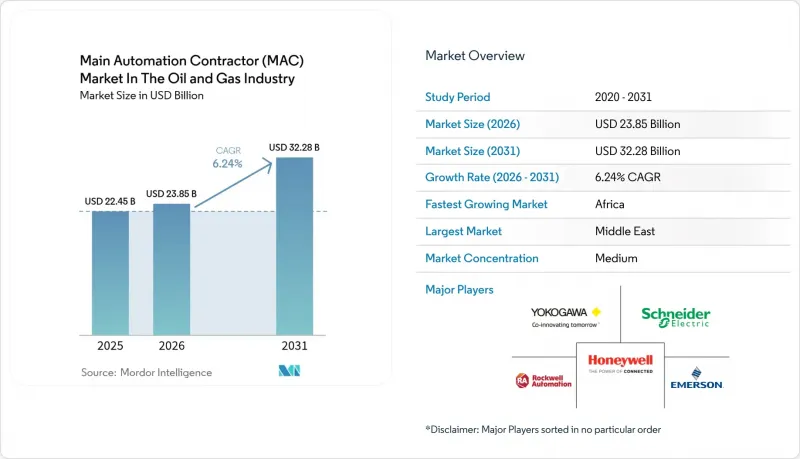
本報告按行業(上游、中游、下游)、專案規模(中小型、大型)、自動化系統類型(DCS、PLC、SCADA、SIS 等)、服務類型(FEED、採購等)、專案階段(待開發區、棕地)和地區進行細分。市場預測以美元計價。
來自全球石油和天然氣行業領先自動化承包商 (MAC) 的趨勢和見解。
透過整合自動化平台降低成本
營運商正在將分散的獨立解決方案整合到一個統一的生態系統中,該系統涵蓋分散式控制、安全儀器和資產效能模組。艾默生於2024年2月對萊昂內爾巴塞爾的韋瑟林裂解裝置維修,採用了人工智慧驅動的代碼轉換技術,將工程週期從兩個月縮短至兩週。這表明整合套件如何降低調度風險和維護負擔。 S-OIL為期三年的「S-imoms」計畫將30個舊有應用程式整合到單一的主幹系統中,預計255億韓元的投資將在15個月內收回。 ADNOC於2024年8月實施的「Neuron 5」人工智慧系統清晰地展現了其優勢,將意外停機時間減少了50%,並將檢查間隔延長了20%。這些成果支持「按節省付費」的概念,並正在加速全球整合平台的普及。
高度可靠的控制對於深海和海底工程至關重要。
墨西哥灣的雪佛龍安克油田等超深水資產採用20,000 psi的海底樹枝狀鑽井系統、全電動驅動裝置和長距離回接裝置,所有這些都需要即時、確定性的自動化控制。預計到2027年,海底領域的投資將以每年約10%的速度成長,到2024年底將達到320億美元,這將擴大大型自動化承包商(MAC)的目標市場。 SLB OneSubsea於2024年獲得的Equinor Fram Sor 12井全電動系統的FEED契約,凸顯了從液壓控制向全電動控制的轉變,這種轉變簡化了安裝,降低了碳排放強度,並能與數位孿生技術原生整合。
原油價格波動對預算帶來壓力。
當布蘭特原油價格持續低於每桶85美元時,所有自動化項目都會被推遲。例如,巴西石油公司(Petrobras)計劃透過自動化將鑽機平台的年度成本降低1億美元,但為了應對價格的不確定性,該公司分階段實施這項支出。深海回接計畫就是一個例子,當期貨曲線趨於平緩時,這類計畫往往會先被推遲,這表明週期性因素正在使預期的複合年成長率(CAGR)下降0.9個百分點。
細分市場分析
2025年近一半的投資來自上游資產,但中游領域7.12%的年複合成長率表明,隨著管道運營商對壓縮站進行電氣化改造並實施邊緣SCADA洩漏檢測,該領域正經歷結構性成長。阿布達比國家石油公司(ADNOC)斥資9.2億美元用於陸上油田數位化改造的項目,體現了上游領域現有設備的優勢。然而,未來新建的氫氣管道和二氧化碳幹線管道預計將提升中游領域在石油和天然氣行業主要自動化承包商(MAC)的收入佔有率。整合管道模擬、SCADA和預測性維護的整合控制套件正迅速成為競標規範中的標準配置。同時,下游領域的利潤率依然較低,限制了資本配置,使其更傾向於分階段實施先進的製程控制,而不是更換全廠分散式控制系統(DCS)。
隨著投資轉向待開發區天然氣和碳捕獲項目的運輸和出口樞紐,領先的油氣行業自動化承包商(MAC)來自上游控制系統的收入佔比預計將低於整體市場水平。營運商也正在投資自主鑽井和電壓裂平台,這些平台可以減少鑽井鑽機人員數量並提高鑽井速度,從而向投資委員會展示實際的投資回報。
儘管超過3,100萬美元的項目仍佔據收入的大部分,但隨著沙烏地阿拉伯國家石油公司(NOC)將大型EPC合約拆分成更易於管理的模組,中小型合約正以7.92%的複合年成長率快速成長。沙烏地阿拉伯的「2030願景」和阿拉伯聯合大公國的「本土價值」政策正在推動這種分割趨勢,為本地系統整合商創造了機會,使其能夠參與棕地工廠的訂單儀器、網路安全增強和DCS遷移等專案中。艾默生的AI驅動型代碼轉換工具正在縮短停機時間,並使老舊工廠中成本低於1000萬美元的維修項目在經濟上可行。
大規模液化天然氣生產線、天然氣處理廠擴建以及深海平台預計將繼續推動油氣產業主自動化承包商(MAC)的業務規模擴大,但收入將因訂單時間而波動。雖然大型企劃能夠帶來規模經濟效益,但當原油價格下跌時,供應商將面臨與大宗商品價格相關的更劇烈的價格調整風險。因此,許多公司正在透過增加短期、中型專案的比例來平衡其投資組合,這些專案執行風險較低,投資回報速度更快。
區域分析
預計到2025年,中東地區將佔全球支出的28.29%,主要得益於沙烏地阿美公司投資77億美元的法迪利油田擴建計畫以及阿布達比國家石油公司(ADNOC)旗下多個資產對人工智慧的採用。供應鏈本地化政策正迫使一級企業建立合資企業、投資本地組裝,並將部分工作委託給區域整合商。預計非洲將以9.55%的複合年成長率成為該地區成長最快的地區,這主要得益於奈及利亞、安哥拉和塞內加爾深海項目的獲批,以及莫三比克和坦尚尼亞的天然氣出口設施建設。海底設施的檢查和維護框架合約表明,後續業務收益的持續時間將超過建設支出。
北美受益於成熟的頁岩油氣自動化技術和「開放式流程自動化」的試點實施,但同時也面臨著不斷上漲的資本成本和勞動力短缺的挑戰。歐洲則專注於海上平台的電氣化、碳捕獲技術的整合,以及轉型為符合大陸脫碳目標的海底電氣化架構。亞太地區的情況則較為複雜。中國和印度正在投資煉油和石化聯合設施,澳洲正在推動深海天然氣開發,東南亞則在開發浮體式儲存再氣化裝置(FSRU),但各自在核准進度和在地採購率方面都面臨著不同的挑戰。整體而言,這些趨勢為能夠平衡不同產油區專案風險的供應商提供了多元化經營的機會。區域政策的變化,例如美國的甲烷排放法規和歐洲的淨零排放目標,將進一步影響投資趨勢和技術選擇。
其他好處:
- Excel格式的市場預測(ME)表
- 3個月的分析師支持
目錄
第1章:引言
- 研究假設和市場定義
- 調查範圍
第2章:調查方法
第3章執行摘要
第4章 市場狀況
- 市場概覽
- 市場促進因素
- 擴大整合自動化平台的應用,以降低資本支出和營運支出。
- 需要複雜自動化技術的深海和水下專案部署正在加速。
- 數位孿生和進階分析技術的融合正在增強 MAC 的價值提案。
- 嚴格的安全和環境法規正在推動自動化技術的應用。
- 擴大成熟油田棕地現代化改造規模
- 中東大型企劃供應鏈在地化可享優惠待遇
- 市場限制因素
- 原油價格波動抑制了資本投資。
- 整合控制系統工程領域人員短缺
- 多供應商整合相關的網路安全問題
- 國營石油公司專案核准流程冗長
- 宏觀經濟因素對市場的影響
- 產業價值/供應鏈分析
- 監理情勢
- 技術展望
- 波特五力分析
第5章 市場規模與成長預測
- 按行業
- 上游部門(海上和陸上)
- 中游產業
- 下游產業
- 英語:
- 中小企業(年營業額500萬美元至3000萬美元)
- 大規模(超過3100萬美元)
- 按自動化系統類型分類
- 分散式控制系統(DCS)
- 可程式邏輯控制器(PLC)
- 監控與數據採集(SCADA)
- 安全儀器系統(SIS)
- 其他類型的自動化系統
- 按服務類型
- 前端工程設計(FEED)
- 採購
- 安裝和試運行
- 訓練
- 維護和支援
- 專案階段
- 待開發區
- 棕地
- 按地區
- 北美洲
- 美國
- 加拿大
- 墨西哥
- 南美洲
- 巴西
- 阿根廷
- 智利
- 其他南美國家
- 歐洲
- 英國
- 德國
- 法國
- 義大利
- 西班牙
- 其他歐洲國家
- 亞太地區
- 中國
- 日本
- 印度
- 韓國
- 澳洲和紐西蘭
- 其他亞太國家
- 中東和非洲
- 中東
- 阿拉伯聯合大公國
- 沙烏地阿拉伯
- 土耳其
- 其他中東國家
- 非洲
- 南非
- 肯亞
- 奈及利亞
- 其他非洲國家
- 中東
- 北美洲
第6章 競爭情勢
- 市場集中度
- 策略趨勢
- 市佔率分析
- 公司簡介
- Rockwell Automation Inc.
- Schneider Electric SE
- Yokogawa Electric Corporation
- Honeywell International Inc.
- Emerson Electric Co.
- Siemens AG
- ABB Ltd.
- Mitsubishi Electric Corporation
- General Electric Company
- Baker Hughes Company
- Schlumberger NV
- Larsen and Toubro Limited
- Petrofac Limited
- Worley Ltd.
- Technip Energies NV
- Kongsberg Gruppen ASA
- Valmet Oyj
- National Instruments Corporation
- Aveva Group plc
- Wood Group PLC
第7章 市場機會與未來展望
According to Mordor Intelligence, the main automation contractor (MAC) market size in the oil and gas industry market size in 2026 is estimated at USD 23.85 billion, growing from 2025 value of USD 22.45 billion with 2031 projections showing USD 32.28 billion, growing at 6.24% CAGR over 2026-2031.
This report is Segmented by Sector (Upstream, Midstream, and Downstream), Project Size (Small and Medium, and Large), Automation System Type (DCS, PLC, SCADA, SIS, and More), Service Type (FEED, Procurement, and More), Project Phase (Greenfield, and Brownfield), and Geography. The Market Forecasts are Provided in Terms of Value (USD).
Global Main Automation Contractor (MAC) in the Oil and Gas Industry Trends and Insights
Integrated Automation Platforms Cut Costs
Operators are pulling disparate point solutions into unified ecosystems that span distributed control, safety instrumentation, and asset performance modules. Emerson's February 2024 overhaul of LyondellBasell's Wesseling cracker compressed a two-month engineering window into a two-week turnaround by using AI-powered code conversion, demonstrating how integrated suites shrink schedule risk and maintenance burdens. S-OIL's three-year S-imoms program linked 30 legacy applications into one backbone and is forecast to recoup its KRW 25.5 billion investment in under 15 months. ADNOC's August 2024 rollout of Neuron 5 AI illustrates the upside: a 50% cut in unplanned shutdowns and a 20% extension of service intervals. These outcomes validate a pay-as-you-save argument that accelerates integrated-platform adoption worldwide.
Deepwater and Subsea Projects Require High-Reliability Control
Ultra-deepwater assets such as Chevron's Anchor field in the Gulf of Mexico employ 20,000 psi subsea trees, all-electric actuation, and long-offset tiebacks that demand real-time, deterministic automation. Subsea investment is predicted to grow roughly 10% annually through 2027, reaching USD 32 billion by end-2024, thereby enlarging the addressable Main Automation Contractor market. SLB OneSubsea's 2024 FEED award for Equinor's Fram Sor 12-well all-electric system underscores the pivot from hydraulic to fully electric control that simplifies installation, reduces carbon intensity, and integrates natively with digital twins
Volatile Crude Prices Pressure Budgets
When Brent hovers below USD 85 per barrel, discretionary automation scopes slide to future years. Petrobras, for example, targets USD 100 million in annual rig-fleet savings through automation but is staging spend over multiple phases to hedge price uncertainty. Deepwater tiebacks among the first deferred when forward curves flatten illustrate how cyclicality chips 0.9 percentage points off the forecast CAGR.
Other drivers and restraints analyzed in the detailed report include:
- Digital Twins Amplify Lifecycle Value
- Safety and Environmental Regulation Spurs Retrofits
- Talent Shortage Stalls Project Velocity
For complete list of drivers and restraints, kindly check the Table Of Contents.
Segment Analysis
Upstream assets generated nearly half of 2025 spending, yet midstream's higher 7.12% CAGR signals structural catch-up as pipeline operators electrify compressor stations and add edge SCADA for leak detection. ADNOC's USD 920 million program to digitize its onshore fields typifies the upstream installed-base advantage. However, new hydrogen-ready pipelines and CO2 trunk lines will give midstream a larger slice of future Main Automation Contractor (MAC) in the Oil and Gas Industry revenue. Integrated control suites that merge pipeline simulation, SCADA, and predictive maintenance are rapidly becoming bid-spec norms. Meanwhile, downstream margins remain tight, limiting capital allocation to incremental advanced process control rollouts rather than whole-of-plant DCS swaps.
The Main Automation Contractor (MAC) in the Oil and Gas Industry share tied to upstream control packages is expected to trail the broader market as greenfield LNG and carbon-capture projects realign spending toward transmission and export hubs. Operators also channel funds into autonomous drilling and electric fracturing platforms that reduce rig crew counts and improve rate of penetration, thereby demonstrating tangible payback to investment committees.
Projects exceeding USD 31 million still dominate revenue, but small and medium contracts are expanding faster at an 7.92% CAGR as NOCs break mega-EPCs into digestible modules. Saudi Vision 2030 and the UAE's In-Country Value drive this fragmentation, giving local integrators an opening to compete for decoupled instrumentation, cyber-hardening, and brownfield DCS migration work. Emerson's AI-assisted code-conversion tool shortens shutdown windows, making sub-USD 10 million revamp packages economically practical for aging plants.
Large LNG trains, gas-processing expansions, and deepwater host platforms will continue to underpin Main Automation Contractor (MAC) in the Oil and Gas Industry size growth, but award timing creates revenue volatility. Mega-projects offer scale economies yet expose suppliers to sharper commodity-linked repricing when crude drops. Consequently, many players balance portfolios with a higher volume of quick-turn, medium-sized jobs that carry lower execution risk and faster cash conversion.
Complete Report Scope:
- By Sector
- Upstream (Offshore and Onshore)
- Midstream
- Downstream
- By Project Size
- Small and Medium (USD 5 million to USD 30 million)
- Large (USD 31 million and Above)
- By Automation System Type
- Distributed Control System (DCS)
- Programmable Logic Controller (PLC)
- Supervisory Control and Data Acquisition (SCADA)
- Safety Instrumented System (SIS)
- Other Automation System Types
- By Service Type
- Front-End Engineering Design (FEED)
- Procurement
- Installation and Commissioning
- Training
- Maintenance and Support
- By Project Phase
- Greenfield
- Brownfield
- By Geography
- North America
- United States
- Canada
- Mexico
- South America
- Brazil
- Argentina
- Chile
- Rest of South America
- Europe
- United Kingdom
- Germany
- France
- Italy
- Spain
- Rest of Europe
- Asia-Pacific
- China
- Japan
- India
- South Korea
- Australia and New Zealand
- Rest of Asia-Pacific
- Middle East and Africa
- Middle East
- United Arab Emirates
- Saudi Arabia
- Turkey
- Rest of Middle East
- Africa
- South Africa
- Kenya
- Nigeria
- Rest of Africa
- Middle East
- North America
Geography Analysis
The Middle East contributed 28.29% of 2025 spending, underpinned by Saudi Aramco's USD 7.7 billion Fadhili expansion and ADNOC's multi-asset AI rollouts. Supply-chain localization schemes force Tier-1s to form joint ventures, invest in local assembly, and cede workshare to regional integrators. Africa is projected to deliver the highest regional CAGR at 9.55% on the back of deepwater sanctioning in Nigeria, Angola, and Senegal plus gas-export facilities in Mozambique and Tanzania. Frame agreements for subsea inspection and maintenance indicate follow-on service revenue that will outlast construction spend.
North America benefits from mature shale automation and prototype Open Process Automation deployments yet wrestles with cost-of-capital inflation and labor scarcity. Europe concentrates on electrifying offshore platforms, integrating carbon capture, and migrating to electric subsea architectures that dovetail with continental decarbonization targets. Asia-Pacific presents a fragmented picture: China and India bankroll refinery-petrochemical complexes, Australia pursues deepwater gas, and Southeast Asia advances floating storage and regasification units, each with distinct approval timelines and local-content hurdles. Collectively, these dynamics sustain diversification opportunities for suppliers capable of balancing project risk across basins. Regional policy shifts, such as methane-fee rules in the United States or net-zero mandates in Europe, will further shape spending patterns and technology choice.
- Rockwell Automation Inc.
- Schneider Electric SE
- Yokogawa Electric Corporation
- Honeywell International Inc.
- Emerson Electric Co.
- Siemens AG
- ABB Ltd.
- Mitsubishi Electric Corporation
- General Electric Company
- Baker Hughes Company
- Schlumberger NV
- Larsen and Toubro Limited
- Petrofac Limited
- Worley Ltd.
- Technip Energies NV
- Kongsberg Gruppen ASA
- Valmet Oyj
- National Instruments Corporation
- Aveva Group plc
- Wood Group PLC
Additional Benefits:
- The market estimate (ME) sheet in Excel format
- 3 months of analyst support
TABLE OF CONTENTS
1 INTRODUCTION
- 1.1 Study Assumptions and Market Definition
- 1.2 Scope of the Study
2 RESEARCH METHODOLOGY
3 EXECUTIVE SUMMARY
4 MARKET LANDSCAPE
- 4.1 Market Overview
- 4.2 Market Drivers
- 4.2.1 Rising Adoption of Integrated Automation Platforms to Reduce CAPEX and OPEX
- 4.2.2 Accelerated Deployment of Deepwater and Subsea Projects Requiring Complex Automation
- 4.2.3 Digital Twin and Advanced Analytics Integration Enhancing MAC Value Proposition
- 4.2.4 Strict Safety and Environmental Regulations Driving Automation Upgrades
- 4.2.5 Growing Brownfield Modernization in Maturing Fields
- 4.2.6 Supply Chain Localization Incentives in Middle East Mega-Projects
- 4.3 Market Restraints
- 4.3.1 Volatility in Crude Prices Limiting Capital Expenditure
- 4.3.2 Talent Shortage in Integrated Control System Engineering
- 4.3.3 Cybersecurity Concerns Over Multivendor Integration
- 4.3.4 Lengthy Approval Cycles for National Oil Company Projects
- 4.4 Impact of Macroeconomic Factors on the Market
- 4.5 Industry Value / Supply-Chain Analysis
- 4.6 Regulatory Landscape
- 4.7 Technological Outlook
- 4.8 Porter's Five Forces Analysis
- 4.8.1 Threat of New Entrants
- 4.8.2 Bargaining Power of Buyers
- 4.8.3 Bargaining Power of Suppliers
- 4.8.4 Threat of Substitute Products
- 4.8.5 Intensity of Competitive Rivalry
5 MARKET SIZE AND GROWTH FORECASTS (VALUE)
- 5.1 By Sector
- 5.1.1 Upstream (Offshore and Onshore)
- 5.1.2 Midstream
- 5.1.3 Downstream
- 5.2 By Project Size
- 5.2.1 Small and Medium (USD 5 million to USD 30 million)
- 5.2.2 Large (USD 31 million and Above)
- 5.3 By Automation System Type
- 5.3.1 Distributed Control System (DCS)
- 5.3.2 Programmable Logic Controller (PLC)
- 5.3.3 Supervisory Control and Data Acquisition (SCADA)
- 5.3.4 Safety Instrumented System (SIS)
- 5.3.5 Other Automation System Types
- 5.4 By Service Type
- 5.4.1 Front-End Engineering Design (FEED)
- 5.4.2 Procurement
- 5.4.3 Installation and Commissioning
- 5.4.4 Training
- 5.4.5 Maintenance and Support
- 5.5 By Project Phase
- 5.5.1 Greenfield
- 5.5.2 Brownfield
- 5.6 By Geography
- 5.6.1 North America
- 5.6.1.1 United States
- 5.6.1.2 Canada
- 5.6.1.3 Mexico
- 5.6.2 South America
- 5.6.2.1 Brazil
- 5.6.2.2 Argentina
- 5.6.2.3 Chile
- 5.6.2.4 Rest of South America
- 5.6.3 Europe
- 5.6.3.1 United Kingdom
- 5.6.3.2 Germany
- 5.6.3.3 France
- 5.6.3.4 Italy
- 5.6.3.5 Spain
- 5.6.3.6 Rest of Europe
- 5.6.4 Asia-Pacific
- 5.6.4.1 China
- 5.6.4.2 Japan
- 5.6.4.3 India
- 5.6.4.4 South Korea
- 5.6.4.5 Australia and New Zealand
- 5.6.4.6 Rest of Asia-Pacific
- 5.6.5 Middle East and Africa
- 5.6.5.1 Middle East
- 5.6.5.1.1 United Arab Emirates
- 5.6.5.1.2 Saudi Arabia
- 5.6.5.1.3 Turkey
- 5.6.5.1.4 Rest of Middle East
- 5.6.5.2 Africa
- 5.6.5.2.1 South Africa
- 5.6.5.2.2 Kenya
- 5.6.5.2.3 Nigeria
- 5.6.5.2.4 Rest of Africa
- 5.6.5.1 Middle East
- 5.6.1 North America
6 COMPETITIVE LANDSCAPE
- 6.1 Market Concentration
- 6.2 Strategic Moves
- 6.3 Market Share Analysis
- 6.4 Company Profiles (includes Global-level Overview, Market-level Overview, Core Segments, Financials as available, Strategic Information, Market Rank / Share for key companies, Products and Services, and Recent Developments)
- 6.4.1 Rockwell Automation Inc.
- 6.4.2 Schneider Electric SE
- 6.4.3 Yokogawa Electric Corporation
- 6.4.4 Honeywell International Inc.
- 6.4.5 Emerson Electric Co.
- 6.4.6 Siemens AG
- 6.4.7 ABB Ltd.
- 6.4.8 Mitsubishi Electric Corporation
- 6.4.9 General Electric Company
- 6.4.10 Baker Hughes Company
- 6.4.11 Schlumberger NV
- 6.4.12 Larsen and Toubro Limited
- 6.4.13 Petrofac Limited
- 6.4.14 Worley Ltd.
- 6.4.15 Technip Energies NV
- 6.4.16 Kongsberg Gruppen ASA
- 6.4.17 Valmet Oyj
- 6.4.18 National Instruments Corporation
- 6.4.19 Aveva Group plc
- 6.4.20 Wood Group PLC
7 MARKET OPPORTUNITIES AND FUTURE OUTLOOK
- 7.1 White-space and Unmet-Need Assessment

 碼頭號誌燈市場:全球市場預測,2026-2032年
 2026年全球機器人與自動化市場報告
 主自動化承包商 (MAC) 市場規模、佔有率和成長分析:按服務類型、行業、專案類型、最終用戶和地區分類—2026-2033 年行業預測
 2026-2030年全球工業自動化市場
 封口機市場規模、佔有率和成長分析:按機器類型、封口類型、包裝袋材料、最終用戶、安裝類型和地區分類 - 產業預測,2026-2033年
 工業機器人控制軟體市場預測至2034年—全球部署類型、軟體類型、組件、服務類型、技術、應用、最終用戶和區域分析
 工業自動化:軟體定義自動化 (SDA)工業自動化:軟體定義自動化 (SDA) - 市場數據概覽(2026 年第三季)工業自動化邊緣人工智慧市場:2034 年預測-按組件、部署模式、企業規模、技術、應用、最終用戶和地區分類的全球分析
 工業自動化市場-全球產業規模、佔有率、趨勢、機會與預測:按組件、產業、垂直市場、地區和競爭對手分類,2021-2031年