


 |
市場調查報告書
商品編碼
2100653
彈性地板材料:市場佔有率分析、產業趨勢與統計、成長預測(2026-2031)Resilient Flooring - Market Share Analysis, Industry Trends & Statistics, Growth Forecasts (2026 - 2031) |
||||||

※ 本網頁內容可能與最新版本有所差異。詳細情況請與我們聯繫。
根據 Mordor Intelligence 預測,彈性地板材料市場規模將從 2025 年的 335.9 億美元成長到 2026 年的 363.1 億美元,到 2031 年將達到 536 億美元,2026 年至 2031 年的複合年成長率為 8.10%。
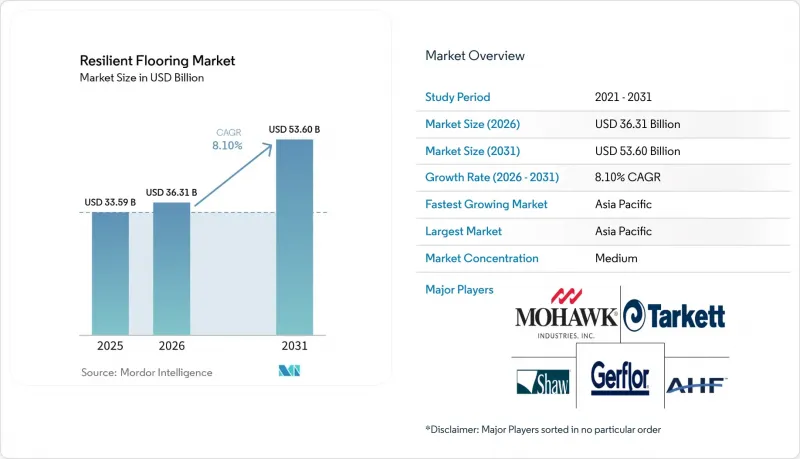
本報告按產品類型(PVC地板材料、橡膠地板材料及其他產品類型)、安裝方式(卡扣式、膠粘式、免膠式和自粘式)、最終用途行業(住宅、商業、公共和工業)以及地區(亞太、北美、歐洲、南美以及中東和非洲)進行細分。市場預測以美元計價。
全球彈性地板材料市場趨勢及洞察
豪華乙烯基瓷磚(LVT)的迅速普及
剛性芯材技術消除了適應期延誤,可直接安裝在不平整的基材上,並可在多用戶住宅領域降低 20-25% 的人事費用。富含石灰石的 SPC 芯材可防止基材的不平整在表面顯現,而先進的壓紋工藝則以三分之一的安裝成本複製了高階實木地板的外觀。卡扣式邊緣設計使零售商店能夠在夜間維修期間保持營業,並且它正在取代醫療機構潮濕區域需要快速更換的瓷磚。
DIY住宅裝潢中,使用卡扣式硬芯產品的熱潮日益高漲。
2024年至2025年間,家居裝潢連鎖店的卡扣式地板庫存單位(SKU)數量增加了約40%。同時,各大品牌發布的教學影片觀看量也激增。由於安裝所需工具極少,住宅可以自行安裝,從而增加了地板翻新的頻率,並為零售商帶來了更多回頭客。如今,這種DIY熱潮已占美國住宅銷售量的近三分之一。
對聚氯乙烯產品中的揮發性有機化合物和鄰苯二甲酸酯製定更嚴格的法規
美國環保署 (EPA) 將於 2024 年 12 月對聚氯乙烯 (PVC) 進行審查,這預示著更嚴格的法規即將訂定,這將推高合規成本。歐盟第 923/2023 號法規將於 2026 年 1 月起禁止使用含鉛穩定劑,隨著製造商轉向鈣鋅基體系,原料成本將上漲 5% 至 8%。中國也已推出類似的排放限制措施,並對工廠進行審核,對不符合標準的進口產品進行召回。
細分市場分析
預計到2025年,PVC地板材料將佔彈性地板材料市場38.98%的佔有率,到2031年將維持9.85%的複合年成長率。這一趨勢表明,SPC和WPC板材在實現逼真外觀的同時,也克服了卷材PVC地板對基材的嚴格要求。 SPC地板出貨量的激增也帶動了對石灰石填充材需求的成長。橡膠地板仍主要應用於健身設施和交通運輸等小眾市場,而亞麻油氈地板儘管固化時間較長,卻也獲得了環保意識強的決策者的支持。高階軟木地板因其良好的隔音效果而廣受歡迎,但在承受較大靜態負載時性能較差。
創新正在模糊材料之間的界線。生物基PVC原料如今已被應用於物料平衡項目中,而含有85%再生材料的配方,例如含有85%再生材料的配方,則符合獲得多項綠色建築認證積分的要求。由於乙烯基彈性地板材料能夠比橡膠或亞麻油氈更快地融入壓紋、防水芯材和抗菌添加劑等改進工藝,因此其市場規模預計將比任何其他替代產品成長更快。
區域分析
預計到2025年,亞太地區將佔彈性地板材料市場47.21%的佔有率,並將在2031年之前以8.76%的複合年成長率成長。印度的基礎設施投資和中國房地產行業的穩定是主要驅動力,而越南正在吸引外國直接投資並加強該地區的製造業基礎。在日本和韓國等成熟經濟體,由於人口老化,維修需求依然強勁。
在北美,蓬勃發展的翻新週期和靈活的辦公室內裝修為市場提供了強勁的推動力。美國家裝零售商的卡扣式產品庫存量較2024年水準成長了40%,這印證了DIY需求的不斷成長。在加拿大,儘管勞動力短缺,但一系列公共工程項目支撐了機構需求;而在墨西哥,近岸外包浪潮正在促進邊境沿線工業設施的建設。
在歐洲,維修機會與遵守嚴格的揮發性有機化合物(VOC)法規的成本之間存在著平衡。德國、英國和法國的人均消費量領先,而生物基亞麻油氈在北歐國家正迅速普及。在南歐,瓷磚仍然佔據文化主導地位,雖然乙烯基(PVC)地板材料在住宅領域的滲透率有限,但LVT(豪華乙烯基複合地板)正被應用於快速商業翻新項目中。
南美洲、中東和非洲正在推動新興市場的成長。巴西的聯邦住宅計畫正在支持經濟的逐步復甦,而沙烏地阿拉伯的「2030願景」大型企劃則指定飯店設施使用耐磨地板材料。在阿拉伯聯合大公國,即使在2020年世博會結束後,零售區的需求依然強勁;在南非,儘管面臨進口競爭,工業需求依然強勁。
其他好處:
- Excel格式的市場預測(ME)表
- 3個月的分析師支持
目錄
第1章:引言
- 研究假設和市場定義
- 調查範圍
第2章:調查方法
第3章執行摘要
第4章 市場狀況
- 市場概覽
- 市場促進因素
- 豪華乙烯基瓷磚(LVT)的迅速普及
- 使用卡扣式硬芯產品的DIY住宅裝修正在迅速增加。
- 亞太地區住宅和基礎設施獎勵策略
- 在商業設施中擴大耐磨乙烯基地板材料的使用範圍
- 辦公大樓內部裝潢的租賃模式促進了涉及頻繁更換的建設項目。
- 市場限制因素
- 加強對聚氯乙烯產品中揮發性有機化合物和鄰苯二甲酸酯的監管
- 與瓷磚和工程木地板競爭。
- 一些國家缺乏合格的安裝人員
- 價值鏈分析
- 波特五力模型
第5章 市場規模與成長預測
- 依產品類型
- 乙烯基地板材料
- 橡膠地板材料
- 其他產品類型(例如軟木地板材料)
- 透過安裝方法
- 點選鎖定
- 黏合結構
- 鬆散地
- 黏合劑類型
- 按最終用途行業分類
- 住宅
- 商業的
- 對機構而言
- 產業
- 按地區
- 亞太地區
- 中國
- 印度
- 日本
- 韓國
- 越南
- 馬來西亞
- 印尼
- 泰國
- 其他亞太國家
- 北美洲
- 美國
- 加拿大
- 墨西哥
- 歐洲
- 德國
- 英國
- 法國
- 義大利
- 西班牙
- 北歐國家
- 其他歐洲國家
- 南美洲
- 巴西
- 阿根廷
- 其他南美國家
- 中東和非洲
- 沙烏地阿拉伯
- 南非
- 卡達
- 奈及利亞
- 阿拉伯聯合大公國
- 其他中東和非洲國家
- 亞太地區
第6章 競爭情勢
- 市場集中度
- 策略趨勢
- 市佔率和排名分析
- 公司簡介
- AHF Products
- Altro Limited
- Beaulieu International Group
- Congoleum
- Forbo Flooring Systems
- Gerflor
- Interface, Inc.
- Karndean Designflooring
- LG Hausys
- Mannington Mills, Inc.
- Milliken
- Mohawk Industries, Inc.
- Mondo Spa
- Novalis
- NOX Corp.
- Polyflor Ltd
- Responsive Industries Ltd.
- Shaw Industries Group, Inc.
- Tarkett
第7章 市場機會與未來展望
According to Mordor Intelligence, the resilient flooring market size is expected to grow from USD 33.59 billion in 2025 to USD 36.31 billion in 2026 and is forecast to reach USD 53.60 billion by 2031 at 8.10% CAGR over 2026-2031.
This report is Segmented by Product Type (Vinyl Flooring, Rubber Flooring, and Other Product Types), Installation Method (Click-Lock, Glue-Down, Loose-Lay, and Self-Adhesive), End-Use Industry (Residential, Commercial, Institutional, and Industrial), and Geography (Asia-Pacific, North America, Europe, South America, and Middle East and Africa). The Market Forecasts are Provided in Terms of Value (USD).
Global Resilient Flooring Market Trends and Insights
Rapid Penetration of Luxury Vinyl Tile (LVT)
Rigid-core technology eradicates acclimation delays, allows direct installation over imperfect substrates, and reduces labor by 20-25% in the multifamily segment. Limestone-rich SPC cores resist telegraphing, while advanced embossing reproduces premium hardwood visuals at one-third the installed cost. Click-lock edges keep retail sites operational during overnight renovations and have displaced ceramic tile in wet areas of healthcare environments where swift turnover matters.
Surge in Residential DIY Renovation Via Click-Lock Rigid-Core Products
Home-improvement chains raised click-lock stock-keeping units by roughly 40% between 2024 and 2025, mirroring a spike in tutorial views for leading brands. Minimal tooling requirements empower homeowners, who subsequently refresh floors more often, generating repeat traffic for retailers. This DIY momentum now represents nearly one-third of U.S. residential volume.
Stricter VOC and Phthalate Regulations on PVC Products
The U.S. Environmental Protection Agency's December 2024 vinyl chloride review prefigures tougher controls that raise compliance costs. Europe's Regulation 923/2023 bans lead-based stabilizers from January 2026, lifting raw-material bills by 5-8% as producers shift to calcium-zinc systems. Similar emission limits in China trigger factory audits and recalls for non-conforming imports.
Other drivers and restraints analyzed in the detailed report include:
- APAC Housing and Infrastructure Stimulus Programmes
- Growing Application of Resilient Vinyl Flooring in Commercial Spaces
- Competition from Ceramic Tile and Engineered Wood
For complete list of drivers and restraints, kindly check the Table Of Contents.
Segment Analysis
Vinyl flooring accounted for 38.98% of the resilient flooring market in 2025 and will post a 9.85% CAGR to 2031. This trajectory underscores how SPC and WPC planks are overcoming sheet vinyl's subfloor demands while adding photorealistic visuals. Limestone fillers' demand rose as SPC volumes ballooned. Rubber remains a niche for fitness and transport settings, whereas linoleum attracts eco-centric specifiers despite its lengthier curing period. A boutique cork segment thrives on acoustic comfort but lags under heavy static loads.
Innovation is blurring material boundaries. Bio-attributed PVC feedstocks now feed mass-balance programs, and recycled-content formulations such as an 85% post-consumer blend qualify for multiple green-building points. The resilient flooring market size for vinyl is projected to widen faster than any alternative product because it absorbs embossing, waterproof cores, and antimicrobial additives more swiftly than rubber or linoleum can integrate comparable upgrades.
Complete Report Scope:
- By Product Type
- Vinyl Flooring
- Rubber Flooring
- Other Product Types (Cork Flooring etc.)
- By Installation Method
- Click-lock
- Glue-down
- Loose-lay
- Self-adhesive
- By End-use Industry
- Residential
- Commercial
- Institutional
- Industrial
- By Geography
- Asia-Pacific
- China
- India
- Japan
- South Korea
- Vietnam
- Malaysia
- Indonesia
- Thailand
- Rest of Asia-Pacific
- North America
- United States
- Canada
- Mexico
- Europe
- Germany
- United Kingdom
- France
- Italy
- Spain
- NORDIC Countries
- Rest of Europe
- South America
- Brazil
- Argentina
- Rest of South America
- Middle East and Africa
- Saudi Arabia
- South Africa
- Qatar
- Nigeria
- United Arab Emirates
- Rest of Middle East and Africa
- Asia-Pacific
Geography Analysis
Asia-Pacific held 47.21% of the resilient flooring market in 2025 and is advancing at an 8.76% CAGR through 2031. Indian infrastructure outlays and China's property-sector stabilization are principal engines, while Vietnam attracts foreign direct investment that adds regional manufacturing heft. Mature economies such as Japan and South Korea register steady retrofit demand tied to aging demographics.
North America benefits from a buoyant remodeling cycle and flexible-office fit-outs. U.S. home-improvement retailers boosted click-lock SKUs by 40% from 2024 levels, underscoring DIY traction. Canada's public-works pipeline sustains institutional demand despite labor constraints, and Mexico's near-shoring wave fuels industrial installations along border corridors.
Europe balances renovation opportunities against the compliance costs of stringent VOC rules. Germany, the United Kingdom, and France top per-capita consumption, while Nordic nations adopt bio-based linoleum quickly. Southern Europe sustains ceramic tile's cultural dominance, limiting vinyl's residential penetration but embracing LVT in fast-track commercial refurbishments.
South America and the Middle East-Africa contribute emerging-market upside. Brazil's federal housing programs support modest rebounds, whereas Saudi Arabia's Vision 2030 megaprojects specify resilient flooring for hospitality components. The United Arab Emirates sees ongoing demand in retail precincts post-Expo 2020, and South Africa retains steady industrial requisitions amid import competition.
- AHF Products
- Altro Limited
- Beaulieu International Group
- Congoleum
- Forbo Flooring Systems
- Gerflor
- Interface, Inc.
- Karndean Designflooring
- LG Hausys
- Mannington Mills, Inc.
- Milliken
- Mohawk Industries, Inc.
- Mondo Spa
- Novalis
- NOX Corp.
- Polyflor Ltd
- Responsive Industries Ltd.
- Shaw Industries Group, Inc.
- Tarkett
Additional Benefits:
- The market estimate (ME) sheet in Excel format
- 3 months of analyst support
TABLE OF CONTENTS
1 Introduction
- 1.1 Study Assumptions and Market Definition
- 1.2 Scope of the Study
2 Research Methodology
3 Executive Summary
4 Market Landscape
- 4.1 Market Overview
- 4.2 Market Drivers
- 4.2.1 Rapid Penetration of Luxury Vinyl Tile (LVT)
- 4.2.2 Surge in Residential DIY Renovation Via Click-Lock Rigid-Core Products
- 4.2.3 APAC Housing and Infrastructure Stimulus Programmes
- 4.2.4 Growing Application of Resilient Vinyl Flooring in Commercial Spaces
- 4.2.5 Leasing Models for Office Fit-Outs Driving High-Turnover Installs
- 4.3 Market Restraints
- 4.3.1 Stricter VOC and Phthalate Regulations on PVC Products
- 4.3.2 Competition from Ceramic Tile and Engineered Wood
- 4.3.3 Shortage of Certified Installers in Several Countries
- 4.4 Value Chain Analysis
- 4.5 Porter's Five Forces
- 4.5.1 Bargaining Power of Suppliers
- 4.5.2 Bargaining Power of Buyers
- 4.5.3 Threat of New Entrants
- 4.5.4 Threat of Substitutes
- 4.5.5 Competitive Rivalry
5 Market Size and Growth Forecasts (Value)
- 5.1 By Product Type
- 5.1.1 Vinyl Flooring
- 5.1.2 Rubber Flooring
- 5.1.3 Other Product Types (Cork Flooring etc.)
- 5.2 By Installation Method
- 5.2.1 Click-lock
- 5.2.2 Glue-down
- 5.2.3 Loose-lay
- 5.2.4 Self-adhesive
- 5.3 By End-use Industry
- 5.3.1 Residential
- 5.3.2 Commercial
- 5.3.3 Institutional
- 5.3.4 Industrial
- 5.4 By Geography
- 5.4.1 Asia-Pacific
- 5.4.1.1 China
- 5.4.1.2 India
- 5.4.1.3 Japan
- 5.4.1.4 South Korea
- 5.4.1.5 Vietnam
- 5.4.1.6 Malaysia
- 5.4.1.7 Indonesia
- 5.4.1.8 Thailand
- 5.4.1.9 Rest of Asia-Pacific
- 5.4.2 North America
- 5.4.2.1 United States
- 5.4.2.2 Canada
- 5.4.2.3 Mexico
- 5.4.3 Europe
- 5.4.3.1 Germany
- 5.4.3.2 United Kingdom
- 5.4.3.3 France
- 5.4.3.4 Italy
- 5.4.3.5 Spain
- 5.4.3.6 NORDIC Countries
- 5.4.3.7 Rest of Europe
- 5.4.4 South America
- 5.4.4.1 Brazil
- 5.4.4.2 Argentina
- 5.4.4.3 Rest of South America
- 5.4.5 Middle East and Africa
- 5.4.5.1 Saudi Arabia
- 5.4.5.2 South Africa
- 5.4.5.3 Qatar
- 5.4.5.4 Nigeria
- 5.4.5.5 United Arab Emirates
- 5.4.5.6 Rest of Middle East and Africa
- 5.4.1 Asia-Pacific
6 Competitive Landscape
- 6.1 Market Concentration
- 6.2 Strategic Moves
- 6.3 Market Share(%)/Ranking Analysis
- 6.4 Company Profiles (includes Global level Overview, Market level overview, Core Segments, Financials as available, Strategic Information, Market Rank/Share, Products and Services, Recent Developments)
- 6.4.1 AHF Products
- 6.4.2 Altro Limited
- 6.4.3 Beaulieu International Group
- 6.4.4 Congoleum
- 6.4.5 Forbo Flooring Systems
- 6.4.6 Gerflor
- 6.4.7 Interface, Inc.
- 6.4.8 Karndean Designflooring
- 6.4.9 LG Hausys
- 6.4.10 Mannington Mills, Inc.
- 6.4.11 Milliken
- 6.4.12 Mohawk Industries, Inc.
- 6.4.13 Mondo Spa
- 6.4.14 Novalis
- 6.4.15 NOX Corp.
- 6.4.16 Polyflor Ltd
- 6.4.17 Responsive Industries Ltd.
- 6.4.18 Shaw Industries Group, Inc.
- 6.4.19 Tarkett
7 Market Opportunities and Future Outlook
- 7.1 White-space and Unmet-Need Assessment
- 7.2 IoT-enabled "Smart Floors" for Predictive Maintenance in Retail

 彈性地板材料市場規模、佔有率、成長、全球產業分析、區域趨勢及2026年至2034年預測。
 彈性地板材料市場規模、佔有率和趨勢分析報告:按產品、應用、地區和細分市場預測(2026-2033 年)
 2026年全球彈性地板材料市場報告
 豪華乙烯基板材(LVS)市場規模、佔有率和成長分析:按產品類型、最終用戶、分銷管道和地區分類-2026-2033年產業預測全球抗衝擊地板材料市場規模、佔有率、趨勢和成長分析報告(2026-2034年)2026年全球商用彈性地板材料市場報告
 彈性地板市場規模、佔有率和成長分析(按產品類型、應用和地區)- 產業預測 2025-2032
 德國彈性地板材料:市場佔有率分析、產業趨勢、成長預測(2025-2030)美國彈性地板市場:市場規模、佔有率和趨勢分析(按產品、應用和細分,2025-2030 年)